Online Colleges and Bachelor's Degree Programs in West Virginia
Every verified bachelor's program at a college in West Virginia: 890+ programs at 20+ colleges, with the online options, net price and graduation rates behind each one.

Can you finish a bachelor's degree in West Virginia while working, parenting, or living far from campus? Yes, but cost varies widely. Marshall University lists online undergraduate tuition at $391.25 per credit hour for 2025-26, and other schools price differently.
Per-credit tuition, grant amounts, transfer rules, admissions and outcomes are drawn from school and state sources. The college and degree lists are printed elsewhere on this page.
State aid has also narrowed: HEAPS Part-Time ended in 2026, which hits students taking one or two courses at a time hardest.
Key Points
- Marshall University charges $391.25 per online undergraduate credit hour in 2025-26.
- File the FAFSA by April 15 for West Virginia's need-based grants.
- Before paying a deposit, request a written evaluation of transfer credits.
Popular degrees in West Virginia
Bachelor's degrees in West Virginia by field
Business & Management
- Business Administration37 programs
- Marketing25 programs
- Accounting19 programs
- Management19 programs
- Communication12 programs
- Sports Management11 programs
- Finance11 programs
- Entrepreneurship9 programs
Science & Engineering
- Biology20 programs
- Mathematics13 programs
- Natural Resources or Conservation12 programs
- Chemistry10 programs
- Environmental Science8 programs
- Biochemistry7 programs
- Electrical Engineering or Electronics Engineering or Electronic Systems Engineering Technology6 programs
- Engineering Technology6 programs
Education & Teaching
- Science19 programs
- Elementary Education12 programs
- Secondary Education12 programs
- Special Education10 programs
- English Education8 programs
- Mathematics Education8 programs
- Physical Education7 programs
- Early Childhood Education or Child Development4 programs
Liberal Arts & Humanities
- English20 programs
- Literature or English Literature16 programs
- History12 programs
- General Studies6 programs
- Humanities4 programs
- Spanish4 programs
- Interdisciplinary Studies4 programs
- Global Health or Health Studies4 programs
Arts & Design
- Art or Art Studies14 programs
- Fine Arts or Studio Art13 programs
- Graphic Design9 programs
- Media Arts or Digital Media9 programs
- Audio & Music5 programs
- Game Programming & Development4 programs
- Digital Photography2 programs
- Creative Writing2 programs
Computers & IT
- Cybersecurity16 programs
- Computer Science12 programs
- Innovation or Technological Entrepreneurship8 programs
- Information Technology7 programs
- Computer Information Systems6 programs
- Artificial Intelligence4 programs
- Software Development & Engineering3 programs
- Computer Engineering3 programs
Criminal Justice & Law
- Criminal Justice19 programs
- Forensic Science8 programs
- Criminal Justice Administration6 programs
- Corrections5 programs
- Criminology4 programs
- Legal Services3 programs
- Homeland Security3 programs
- Security Management3 programs
Nursing
- Bachelor of Science in Nursing25 programs
- Nursing (RN to BSN)14 programs
- Accelerated BSN (ABSN)7 programs
- LPN/LVN to BSN4 programs
Social Work & Social Sciences
- Sociology17 programs
- Political Science, Government13 programs
- Social Work8 programs
- Human Services2 programs
Communications & Media
- Communications11 programs
- Journalism10 programs
- Public Relations4 programs
- Professional Writing4 programs
- Communication Disorders3 programs
- Speech Pathology3 programs
- Strategic Communications2 programs
- Technical Communication1 program
Healthcare
- Exercise & Sports Science13 programs
- Health Sciences6 programs
- Public Health5 programs
- Health Education5 programs
- Nutrition2 programs
- Health Informatics2 programs
- Speech Pathology2 programs
- Community Health2 programs
Psychology
- General Psychology13 programs
- Sport Psychology1 program
Natural & Applied Sciences
- Applied Science6 programs
- Agriculture or Agricultural3 programs
- GIS and Geoscience2 programs
- Oceanography or Ocean or Marine Biology1 program
Religion & Theology
- Christian Studies or Religious Studies4 programs
- Christian Ministry or Ministry Leadership1 program
Counseling
- Mental Health Counseling1 program
How Online Bachelor's Degrees Work in West Virginia
Online study promises flexibility, yet few bachelor's degrees are entirely free of in-person obligations. Understanding the formats helps you spot the difference before you apply.
Formats in Plain Terms
- Fully online: All coursework is completed remotely, with no required campus visits.
- Hybrid: Online coursework is combined with scheduled on-campus meetings.
- Asynchronous: You watch lectures and submit work on your own time, within weekly deadlines.
- Scheduled live sessions: You log in at set times for class with an instructor, even though you are off campus.
Labels vary by school, so confirm on each program page whether a degree is fully online or includes campus visits. Fairmont State, for example, lists its Criminal Justice bachelor's as available on campus and online, so check which version you are choosing.4
In-Person Requirements Are Normal
Some components happen in person even in online degrees. RN-to-BSN students complete clinicals, education majors do student teaching or field placements, and some programs require internships. Bluefield State's online Multi-Categorical Special Education bachelor's is 100% online and still includes field experience.1
Exams may be proctored too. West Virginia State University uses ProctorU, with appointments made at least three days ahead, and outside proctors require three weeks' notice.2 These are ordinary features of accredited programs, not red flags.
Where Online Options Exist
Online bachelor's and degree-completion options turn up at WVU Online, Marshall Online, Fairmont State and the Regents Bachelor of Arts system, Bluefield State, West Virginia State, and American Public University System in Charles Town. APUS combined with Rasmussen and Hondros on Aug. 4, 2026.3 Offerings differ by school, so verify the specific major you want.
How Long It Takes
Starting from scratch, expect about four years full-time. American Public University's bachelor's programs generally require 120 semester hours, with Engineering at 128.3 If you already hold an associate degree, degree completion often takes 18 to 24 months. Part-time pace stretches either timeline. Some schools offer 7- or 8-week accelerated terms that let you finish courses faster, but not every program uses them, so ask before you assume.
What Online Bachelor's Degrees Cost in West Virginia: Per-Credit Tuition Compared
Marshall University charges $391.25 per credit hour for undergraduate online coursework in 2025-26, and its published table lists $0.00 in added fees against that rate.1 That figure already folds in base tuition and e-course delivery charges for most undergraduate programs, though college- or program-specific fees can apply on top at some departments. Marshall's full-time online undergraduate charge works out to $4,694 per term, reflecting the 12-hour cap that undergraduate billing uses.1
WVU prices by program, not by one flat rate
West Virginia University does not publish a single online per-credit number. Its online undergraduate rates are built from a $401 university tuition component, a college tuition component that varies by academic unit, and a $75 online-learning component. The John Chambers College general business track, for example, lists $534 per credit ($401 university, $58 college, $75 online learning). Other WVU online undergraduate tables show totals of $519 and $634. WVU also describes its online-learning fee as $25 per credit capped at $75 per course, so a three-credit course carries the full $75.
Does residency change the online price?
This is the question most prospective students care about, and the published materials for WVU and Marshall answer it with single figures rather than separate in-state and out-of-state columns. Neither school's online tuition page, as published, splits the rate by residency. Treat that as a strong signal to confirm directly with the admissions or bursar office before you enroll, especially if you live outside West Virginia. Other institutions in the state set their own policies, and rates are explicitly subject to change year to year.
What 120 credits actually costs
Run the math on a full degree and the numbers get concrete:
- Marshall at $391.25 per credit: roughly $46,950 in tuition for 120 credits.
- WVU at $534 per credit: roughly $64,080 for the same 120 credits.
- Degree completion with 60 transferred credits: cut those totals in half, to roughly $23,500 and $32,000 respectively.
For most adult learners in West Virginia, that transfer math is the single biggest cost lever, worth more than shopping a $20 per-credit difference between schools.
One caution on sticker price. Per-credit rates are gross tuition before any grant or scholarship money is applied. Net price, what students actually pay after aid, is typically lower, and it is reported separately on each school's federal profile. Compare both figures before you decide which program is affordable.
Financial Aid and State Grants for West Virginia Online Students
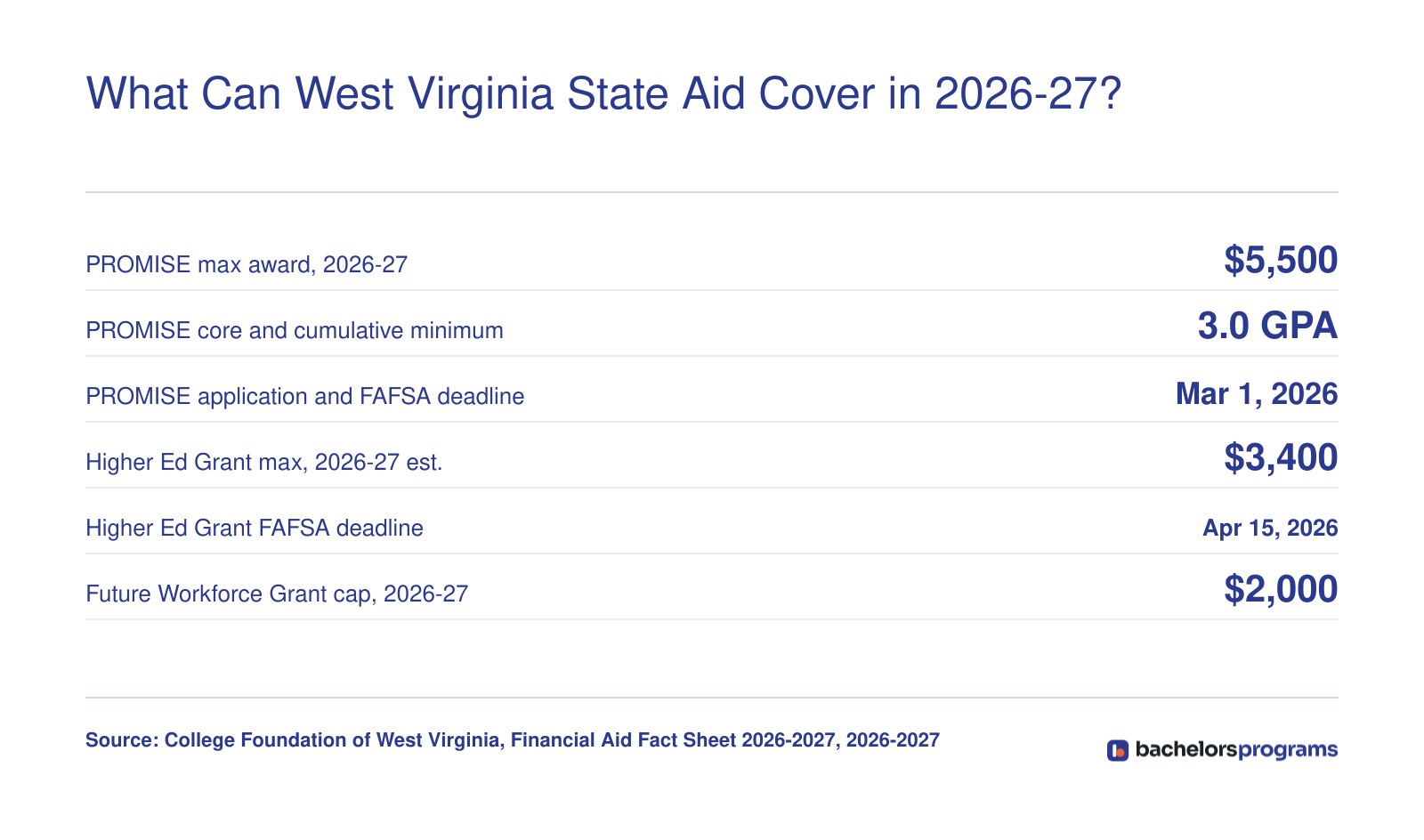
The FAFSA is the single application behind the federal Pell Grant, federal student loans, and West Virginia's own need-based aid. The state's general FAFSA deadline is April 15 each year, and the 2026-27 Higher Education Grant cycle follows that date.2 If PROMISE is in play, the calendar moves earlier: both the PROMISE application and the FAFSA are due March 1, 2026.2 File once, early, and list every West Virginia school you are considering.
The Higher Education Grant: Up to $3,400
The Higher Education Grant Program (HEGP) is need-based and open to full-time and part-time undergraduates enrolled in degree or certificate programs at eligible West Virginia institutions.1 The current award runs up to $3,400 and covers a maximum of eight full-time-equivalent semesters.1 Applicants need a high school diploma or equivalency, and students who already hold a bachelor's degree are not eligible. There is no separate online-only restriction, which makes HEGP the workhorse grant for students chipping away at a degree part time from a distance.
PROMISE: Merit Aid With a Full-Time Rule
PROMISE is merit-based, worth up to $5,500, and built for West Virginia high school seniors entering their first year.3 Initial awards go to full-time students. For the class of 2026, qualifying scores are an ACT composite of 21 with at least 19 in English, math, science, and reading, or an SAT total of 1080 with at least 510 in math and 510 in evidence-based reading and writing.2 A June 2026 SAT or July 2026 ACT still counts. Renewal depends on your college GPA and continued full-time enrollment, and because the rules are written around full-time study, confirm with the financial aid office how a fully online schedule is treated before you count on the money.
HEAPS and Other Ways to Pay
HEAPS is the state's grant for adult part-time students, awarded through participating Title IV institutions and driven by the FAFSA plus demonstrated need.4 The Future Workforce variant funds short-term training of up to 12 months leading to a certificate or industry credential, useful if you want to stack a credential before the bachelor's. WV Invests covers community college tuition on the way to a four-year degree.
Employer tuition assistance can reimburse part of your bill each term. Military benefits, including the GI Bill and tuition assistance, may cover more. The section on adult learners and military students below covers both in detail.
Aid changes the number that matters. Compare net price, the published tuition minus the grants and scholarships you actually qualify for, rather than the sticker figure on the program page.
What Can West Virginia State Aid Cover in 2026?
PROMISE and the West Virginia Higher Education Grant are the main state awards to target if you plan a full-time course load. Part-time online students should know that HEAPS Part-Time was eliminated in 2026. The former HEAPS Workforce Development award, now called the Future Workforce Grant, covers program costs up to a yearly cap.
Transferring Credits Into an Online Bachelor's Program in West Virginia
The statewide framework
Transfer in West Virginia runs on two tracks that are meant to connect: the Higher Education Policy Commission oversees the public universities, and the Community and Technical College System oversees the two-year colleges. State transfer and articulation rules, including a core coursework transfer agreement for general education, are designed so that approved general education courses completed at one participating public institution carry over to another without being re-taken.1 Confirm the current course list and the roster of participating campuses with your target school rather than assuming them.
An AA or AS transfer guarantee is narrower than it sounds. It generally means an approved associate degree, once you are admitted, satisfies the lower-division general education block as a package. It does not automatically grant junior standing, and it does not cover major prerequisites or upper-division requirements. Applied or occupational associate degrees often transfer less cleanly and may leave general education gaps to fill.
Caps and residency
There is no single statewide ceiling on community college credits that applies to every public university and every major. Limits are set by institution, program and sometimes accreditor. For scale: a West Virginia bachelor's degree generally requires at least 120 credits and an associate at least 60.1 Davis and Elkins College, a private institution, caps transfer at 62 semester hours2, and West Virginia University's guaranteed admission agreement with the Virginia Community College System maps roughly 60 to 62 credits before transfer and 58 to 60 after.3 Treat those as examples of how the math tends to work, not as a universal rule. Separately, every school sets a residency requirement: a minimum number of credits you must earn at the degree-granting institution, typically concentrated in the major and upper-division coursework.
The RBA and credit for prior learning
The Regents Bachelor of Arts is West Virginia's long-standing degree completion route for adults with scattered credit. WVU's online RBA evaluates portfolios, industry certifications, Joint Services Transcripts and transcripts from non-regionally accredited institutions, awarding credit for demonstrated learning rather than for time served. Fairmont State's RBA accepts all passing grades in transfer and also awards prior learning credit for learning only, with the requirement that you be admitted and enrolled and that the credit not be posted in your first or final semester.4 Under state policy, universities may award up to 60 prior learning credits toward a bachelor's, 30 toward an associate and 9 toward a certificate.1 Those are maximums, not entitlements.
One practical step: before you apply, ask for an unofficial transcript evaluation, and ask specifically how each course lands in the major, not merely whether it transfers as free elective credit.
Admissions Requirements and Start Dates for Online Programs
Requirements depend on whether you are entering college for the first time, transferring, or returning as an adult. West Virginia University's published policies offer a useful reference point. Confirm current details with each school, since program rules can be stricter than university minimums.
- First-time studentsExpect to submit a high school diploma or GED. WVU allows test-optional applications for students admitted under freshman standards. GPA expectations vary by school and program.
- Transfer and degree-completion applicantsWVU generally looks for at least 24 transferable credits and a minimum 2.0 GPA across all college coursework, with no test requirement at that level. Applicants with fewer credits must also meet freshman standards. Send transcripts from every college you attended.
- Adult learner pathways (RBA)The Regents Bachelor of Arts is built for returning adults and is typically aimed at students who left high school several years earlier. Check current eligibility rules. At WVU, RBA students may have F grades older than three years forgiven and dropped from their GPA.
- Start dates and deadlinesWVU reviews applications on a rolling basis, with deadlines of August 1 for fall and December 1 for spring. The WVU Online RBA accepts applications year-round for fall, spring and summer, with the next start on January 11, 2027. Ask about accelerated sessions, application fees and fee waivers, since these vary by school.
- Program-specific extrasRN-to-BSN programs typically require an active, unencumbered RN license. Education and health programs commonly require background checks before field placements.
How to Verify Accreditation for West Virginia Online Programs
Accreditation is the first thing to confirm, because it decides whether your degree, your federal aid and your licensure eligibility all hold up. Most degree-granting institutions in West Virginia, public and private, hold institutional accreditation from the Higher Learning Commission.
Three Checks You Can Run in Five Minutes
- The HLC Directory: Search the school's exact legal or operating name, not the marketing name on the website. Confirm the status reads "Accredited," not Candidate or Inactive, then open the Statement of Accreditation Status for dates, reaffirmation, any monitoring or sanctions, and branch locations.
- Federal DAPIP: The Department of Education's database is a separate source. Look up the exact school and campus, then reconcile what you find with the HLC record rather than treating either one alone as proof.
- NC-SARA Directory: West Virginia participates in the State Authorization Reciprocity Agreement, which lets approved out-of-state providers serve West Virginia students. The directory shows Participant or On Provisional status.
What Institutional Accreditation Does Not Cover
HLC approval is institution-level. It says nothing about whether a nursing, education or business program meets professional standards. Nursing programs commonly seek ACEN, CCNE or NLN C-NEA accreditation.1 Education programs may hold CAEP or AAQEP recognition2, and teacher licensure also depends on the West Virginia Department of Education and the rules of the state where you intend to teach. Business programs may carry ACBSP, IACBE or AACSB accreditation2, and you should confirm whether it covers the school, the program, or both.
SARA is state authorization, not accreditation, and it does not by itself guarantee clinical placements or licensure eligibility.3 If your degree leads to a license, call the licensing board before you enroll.
Graduation Rates, Retention and Earnings at West Virginia Colleges With Online Bachelor's Options
These are institution-wide numbers, not online-only results. Most come from federal College Scorecard data as compiled by third-party sites, and cohort years and definitions may differ between sources. Use them as rough guides, then confirm on each school's own Scorecard page. Schools appear alphabetically, not ranked.
Graduation Rates and Earnings by School
- American Public University System: 57.2% graduation rate.
- Bluefield State University: 37.0% graduation rate; median earnings of $61,729 four years after completion.1
- Fairmont State University: 44.3% graduation rate; $52,884.
- Marshall University: 51.2% graduation rate2; $54,141.
- Shepherd University: 51.0% graduation rate; $55,251.
- West Virginia State University: 39.2% graduation rate; $44,688.
- West Virginia University: 63% graduation rate; $64,952.
The earnings figures are measured four years after completion, so they describe graduates only and are not the same as earnings ten years after entry.1
How to Read Retention
First-year retention is the share of new students who come back for a second year. Treat it as an early warning sign. A school that loses many students after year one is often struggling with advising, scheduling or affordability, and those problems hit online learners hard. Look up each school's retention rate on its Scorecard profile, and ask admissions how many online students return after their first year.
Why Graduation Rates Undercount
Federal graduation rates generally track first-time, full-time students over a fixed window. Transfer students and part-time students, who make up much of the online population, are often left out or need longer to finish. A modest rate at a school serving working adults, such as American Public University System, does not automatically signal poor quality. It does mean you should ask for completion data on students like you.
A Quick Value Check: Earnings Against Debt
Compare what graduates earn with what they borrow. West Virginia University is the one school here with a debt figure: $21,146 in median total debt after graduation, against $64,952 in earnings, roughly three times the debt. For any other school, pull its Scorecard debt number and run the same comparison. A common rule of thumb is to keep total borrowing below your expected first-year salary.
The Bachelor's Degree Earnings Gap in West Virginia
A bachelor's degree is associated with a meaningful earnings advantage in West Virginia.
Options for Adult Learners, Military Students and Working Parents
If you are returning to school with credits already banked and a job you cannot leave, the real tradeoff is not prestige versus fit: it is how much of your existing experience a program will count, and how small it can slice the workload. West Virginia's public institutions are built around that question more than most states.
Adult learners and degree completion
The Regents Bachelor of Arts is the state's flagship adult completion route, designed for students who left college years ago and want a path that recognizes prior coursework and life experience rather than restarting a traditional major. Add accelerated terms, many online programs run eight-week sessions rather than full semesters, and part-time pacing, and a degree becomes something you finish one or two courses at a time. Working adults employed in West Virginia should also check their eligibility for HEAPS, the state's grant for part-time and workforce-focused students, since it is one of the few aid programs that does not assume full-time enrollment. Next step: have an RBA coordinator review your transcripts before you apply anywhere.
Military-connected students
West Virginia law requires state institutions to charge in-state rates regardless of where you live to active Guard and Reserve members, qualifying veterans, and their spouses and dependents.1 WVU applies that rate once it receives your DD-214, Certificate of Eligibility, or active-duty orders, so send those early. Guard members should also apply through the West Virginia Educational Encouragement Program; Army Guard applicants must secure Federal Tuition Assistance approval first.2 Yellow Ribbon participation is written into state law for eligible veterans at state institutions, and American Military University participates as well.3 American Public University System lists a $250 per credit preferred military rate for undergraduate and master's courses in 2026, plus a 10 percent veteran grant.4 Starting August 1, 2026, Selected Reserve GI Bill users gain in-state tuition protection under federal law. Next step: order your Joint Services Transcript and ask each school how it evaluates that training.
Working parents
Ask admissions what is actually available online, not just on campus: advising, tutoring, and career services. Then ask what a two-course term looks like week to week before you enroll.
How to Choose the Right Online Program in West Virginia
Which online bachelor's program is right for you in West Virginia? It depends less on the school's name than on where you are starting. Match your situation first, then test each option against a short checklist.
Match the Program to Your Situation
- Starting from scratch: Check whether you can enroll full-time, because PROMISE eligibility depends on it. A program that lets you stay full-time may be worth more than a cheaper part-time path.
- Holding an associate degree: Compare transfer acceptance before anything else. A school that takes your whole associate degree and applies it toward your major can save a year or more.
- Working adult: Look closely at the Regents Bachelor of Arts (RBA), HEAPS support for part-time adult students, and 8-week terms that let you take one or two courses at a time.
- Out-of-state student: Compare flat online rates. Some schools charge one price to everyone, which can erase the usual residency gap.
Your Five-Point Checklist
Run every program you are considering through the same questions:
- Net price: What will you pay after grants, not the sticker rate?
- Credits accepted: How much of your prior coursework counts toward the degree, not just as electives?
- In-person requirements: Does the program require campus visits, labs, a practicum, or proctored exams?
- Accreditation: Is the institution regionally accredited, and does any program-specific accreditation you need apply?
- Retention and graduation: Do students at this school stay enrolled and finish?
A program that scores well on all five is usually a safer bet than one that wins on price alone.
Next Steps
Start with the FAFSA, since state aid and most institutional awards depend on it. Then request transcript evaluations from two or three schools, ideally before you commit to any of them. Once the evaluations come back, ask each school for a written cost estimate that shows tuition, fees, and the credits you would still need. Put the estimates side by side and compare total cost to finish, not the per-credit rate. That one comparison usually makes the decision clear.
Colleges in West Virginia with the most bachelor's programs
| School | City | Type | Bachelor's programs | Online | Net price / yr | Grad rate |
|---|---|---|---|---|---|---|
| West Virginia University | Morgantown | Public | 130 | 15 | $15,634 | 65% |
| Marshall University | Huntington | Public | 98 | 17 | $7,502 | 51% |
| American Public University System | Charles Town | Private for-profit | 73 | 73 | $9,597 | 57% |
| Shepherd University | Shepherdstown | Public | 64 | 3 | $11,363 | 51% |
| West Liberty University | West Liberty | Public | 55 | 8 | $15,366 | 60% |
| Concord University | Athens | Public | 52 | 11 | $9,966 | 39% |
| Fairmont State University | Fairmont | Public | 52 | 6 | $9,032 | 44% |
| West Virginia State University | Institute | Public | 47 | 8 | $11,139 | 39% |
| University of Charleston | Charleston | Private nonprofit | 45 | 12 | $22,107 | 46% |
| Davis & Elkins College | Elkins | Private nonprofit | 44 | 4 | $18,273 | 39% |
| West Virginia Wesleyan College | Buckhannon | Private nonprofit | 42 | 1 | $18,083 | 57% |
| Bethany College | Bethany | Private nonprofit | 38 | 2 | $18,605 | 47% |
| Bluefield State University | Bluefield | Public | 34 | 13 | $13,684 | 37% |
| Glenville State University | Glenville | Public | 25 | 3 | $14,006 | 34% |
| Strayer University-West Virginia | Scott Depot | Private for-profit | 23 | 23 | — | — |
Program counts are the verified bachelor's listings in our directory; net price is the school-wide average a first-time undergraduate paid after aid, and graduation rate the share finishing within six years (College Scorecard).
Compare programs nationwide
Many West Virginia residents study online. Every ranked list above has an online lens, or browse every field.
Online bachelor's degrees Browse all fields