Online Colleges and Bachelor's Degree Programs in Kentucky
Every verified bachelor's program at a college in Kentucky: 1,400+ programs at 30+ colleges, with the online options, net price and graduation rates behind each one.

Many Kentucky public colleges now charge online undergraduates a single per-credit price, wherever they live. Published 2026-27 rates run from $195 to $620 per credit, roughly $23,400 to $74,400 for a 120-credit degree before aid.
Lists of colleges and fields tell you where programs exist. The harder questions are what you actually pay after KEES awards and College Access Program (CAP) grants, whether the school holds legitimate accreditation, and whether its students finish.
Transfer credit often shapes both your cost and your timeline more than any single choice. Since House Bill 160 passed in 2011, KCTCS general education credits count toward degrees at Kentucky public universities.
Key Points
- Kentucky online tuition runs $195 to $620 per credit in 2026-27.
- Under House Bill 160, general education credits transfer among Kentucky public colleges.
- Check SACSCOC accreditation first, then compare schools on net price after aid.
Popular degrees in Kentucky
Bachelor's degrees in Kentucky by field
Business & Management
- Business Administration52 programs
- Marketing30 programs
- Finance25 programs
- Accounting23 programs
- Communication22 programs
- Management22 programs
- Sports Management17 programs
- Organizational Leadership13 programs
Science & Engineering
- Biology30 programs
- Mathematics27 programs
- Chemistry24 programs
- Physics15 programs
- Biochemistry14 programs
- Natural Resources or Conservation11 programs
- Anthropology10 programs
- Engineering Technology10 programs
Education & Teaching
- Science36 programs
- Secondary Education34 programs
- Elementary Education25 programs
- Mathematics Education18 programs
- English Education17 programs
- Special Education16 programs
- Physical Education14 programs
- Early Childhood Education or Child Development11 programs
Liberal Arts & Humanities
- English24 programs
- Literature or English Literature24 programs
- History22 programs
- Spanish16 programs
- Philosophy13 programs
- General Studies9 programs
- Global Health or Health Studies8 programs
- Humanities7 programs
Arts & Design
- Art or Art Studies32 programs
- Fine Arts or Studio Art21 programs
- Graphic Design13 programs
- Audio & Music11 programs
- Media Arts or Digital Media10 programs
- Art History8 programs
- Creative Writing5 programs
- Digital Photography3 programs
Communications & Media
- Communications23 programs
- Journalism18 programs
- Public Relations10 programs
- Communication Disorders7 programs
- Speech Pathology5 programs
- Strategic Communications5 programs
- Professional Writing4 programs
- Social Media1 program
Social Work & Social Sciences
- Sociology25 programs
- Political Science, Government20 programs
- Social Work17 programs
- Human Services4 programs
- Public Policy1 program
- Disability Studies1 program
Computers & IT
- Computer Science19 programs
- Cybersecurity11 programs
- Computer Information Systems9 programs
- Information Technology8 programs
- Artificial Intelligence4 programs
- Software Development & Engineering3 programs
- Innovation or Technological Entrepreneurship3 programs
- Cloud Computing2 programs
Healthcare
- Exercise & Sports Science18 programs
- Public Health10 programs
- Health Sciences10 programs
- Health Education9 programs
- Nutrition6 programs
- Speech Pathology6 programs
- Respiratory Care Therapy2 programs
- Community Health1 program
Nursing
- Bachelor of Science in Nursing29 programs
- Nursing (RN to BSN)20 programs
- Accelerated BSN (ABSN)8 programs
- LPN/LVN to BSN3 programs
Criminal Justice & Law
- Criminal Justice18 programs
- Legal Services6 programs
- Criminal Justice Administration5 programs
- Forensic Science5 programs
- Legal Studies4 programs
- Paralegal3 programs
- Criminology3 programs
- Corrections1 program
Psychology
- General Psychology22 programs
- Sport Psychology2 programs
- Developmental Psychology2 programs
- Forensic Psychology1 program
- Applied Psychology1 program
- Addiction Psychology1 program
- Applied Behavior Analysis1 program
- Counseling Psychology1 program
Religion & Theology
- Christian Studies or Religious Studies8 programs
- Christian Ministry or Ministry Leadership8 programs
Natural & Applied Sciences
- Agriculture or Agricultural7 programs
- GIS and Geoscience4 programs
- Neuroscience4 programs
- Oceanography or Ocean or Marine Biology1 program
Counseling
- Substance Abuse Counseling1 program
How Online Bachelor's Degrees Work in Kentucky
A bachelor's degree earned online in Kentucky is a four-year undergraduate credential, delivered mostly or entirely over the internet by the same public and private colleges that teach on campus. The label covers several formats, and the differences affect your schedule more than the diploma does.
Three Common Formats
- Fully online: Every class is delivered remotely, with no required trips to campus.
- Hybrid: Most coursework is online, but you attend some sessions, labs, or weekend residencies in person.
- Degree completion: Built for students who already hold college credits or an associate degree and want to finish the remaining upper-level courses.
Live Classes or Self-Paced
Synchronous courses meet at set times through video, so they suit students who want discussion and quick feedback from instructors and classmates. Asynchronous courses have no fixed meeting time; you work through lectures and assignments on your own schedule, which suits working adults and parents whose evenings are unpredictable. Many programs mix both, so check each course listing rather than assuming.
In-Person Requirements to Expect
"Online" rarely means zero in-person time in licensure fields. Common requirements include:
- Proctored exams, taken at a campus, testing center, or through remote proctoring software
- Nursing clinicals arranged at hospitals or clinics near where you live
- Student teaching in a school classroom for education majors
- Internships or practicums in social work, business, and similar fields
Ask an admissions office early where these hours happen and whether you must arrange the placement yourself.
Term Length and Start Dates
Many Kentucky online programs use accelerated 7- or 8-week terms with several start dates a year. You take fewer courses at once but move through each one faster, and you can begin without waiting for fall. Other programs follow the standard 16-week semester, which spreads the workload more gradually. Pick the pace you can sustain alongside work and family, because a compressed term leaves little margin when something goes wrong.
What an Online Bachelor's Degree Costs in Kentucky
Kentucky's public colleges have moved toward flat online rates that ignore residency, which makes the state easier to budget for than most.
For 2026-27, published online undergraduate tuition at Kentucky colleges runs from $195 to $620 per credit, so a 120-credit bachelor's comes to roughly $23,400 to $74,400 in tuition before fees and financial aid.
Public per-credit rates
- KCTCS: $198 per credit for Kentucky residents and non-residents alike, plus an $8 mandatory fee and a $20 distance learner fee per credit hour.1 Across 120 credits that is about $23,760 in tuition, or roughly $27,100 once the per-credit fees are added.
- Western Kentucky University: $551 per credit, identical for residents and non-residents. The distance-learning per-hour rate applies to all part-time students regardless of residency, and students enrolled only in distance-learning courses are billed at it. A 120-credit degree is about $66,120 in tuition.
- University of Kentucky: assesses a $24 fee for students enrolled only in UK Online classes, and its online pricing carries no full-time cap, so budget per credit rather than per semester.4
The single-rate pattern holds at KCTCS and WKU, but not everywhere: several Kentucky publics still price online seats differently for residents and non-residents, and some add distance fees on top. Ask which rate applies to your program, not to the university as a whole. For applicants who live outside Kentucky, a flat-rate public is often the cheapest route, because there is no non-resident surcharge to absorb.
Private per-credit rates
- University of the Cumberlands: $220 per credit for residents and non-residents, or about $26,400 for 120 credits.2
- Campbellsville University: $195 to $620 per credit depending on the online program, which puts a 120-credit degree between roughly $23,400 and $74,400.3
From a rate to a real total
Multiply the per-credit rate by 120, add per-credit fees, then subtract aid. Starting at KCTCS changes the arithmetic more than any single rate does: 60 credits there costs about $11,880 in tuition plus roughly $1,680 in fees, and 60 upper-division credits at WKU's $551 rate comes to $33,060, for a total near $46,600 instead of $66,120 for all four years at the university rate.
When a private college advertises reduced or no out-of-pocket cost for Kentucky residents, confirm the conditions in writing: whether it requires full-time enrollment, whether it covers online students or campus students only, and whether institutional aid stacks with federal Pell and state grant money. Run the school's net price calculator and keep the output. A per-credit rate is a starting point, not a net price.
Net Price, Financial Aid, and Kentucky State Grants
Net price, not the published tuition rate, is the number that tells you which Kentucky online college is most affordable. Net price is the sticker cost minus the grants and scholarships you receive. Two schools with the same tuition can land thousands of dollars apart once aid is applied, so compare each school's net price for your own situation. Loans are not subtracted, because you repay them.
Kentucky State Aid
The Kentucky Higher Education Assistance Authority (KHEAA) runs the state's main programs:
- KEES: Beginning in 2026-27, the minimum GPA is 2.75.1 KHEAA publishes the current dollar schedule, so confirm it there.5 Whether your online program qualifies is a question for the school's aid office.
- College Access Program (CAP) grant: A need-based grant for undergraduates enrolled at least half-time.2 The yearly amount is set by KHEAA, so check the current figure.
- Kentucky Tuition Grant (KTG): Need-based aid for Kentucky residents at eligible private colleges, up to $3,300 for 2026-27.1 It requires full-time enrollment, and online eligibility depends on the college and the approved program.
- Work Ready Kentucky Scholarship: For students with no associate degree or higher, in approved certificate, diploma, or AAS programs. It covers tuition and fees left after other grants, and the fee portion is capped at $400 a year.1 It does not fund a bachelor's program directly, but it can pay for a first credential at a KCTCS college. The October 1, 2026 deadline for fall and yearlong requests has passed, so ask KHEAA about later windows.
Federal, Employer, and Military Aid
File the FAFSA first. It is what makes you eligible for the federal Pell Grant, which maxes out at $7,395 for 2026-27.3 Pell goes to undergraduates with financial need and no prior bachelor's degree, for up to 12 semesters of enrollment (about six years).4 The school and program must be eligible, and there is no separate online restriction.
Also ask your employer's HR office about tuition assistance, which often has its own course or grade conditions. Veterans and service members should check GI Bill benefits through the VA. Active Kentucky National Guard members who have finished basic training can receive up to in-state tuition at a Kentucky public university, college, or technical school, subject to available funds.6 Applications go through the Guard's online system.
If You Study Part Time
Enrollment intensity changes what you can claim:
- CAP: You need at least half-time enrollment. Below that, you do not qualify.
- KTG: Full-time only, so part-time students are out.
- Pell: Part-time students can still receive it, but the award is smaller than for full-time enrollment, and each term counts only partly toward the 12-semester limit.
- Work Ready, KEES, and the Guard award: The credit-hour rules for part-time students were not confirmed, so ask your school's financial aid office before you register.
Get each school's aid offer in writing and compare the net prices side by side.
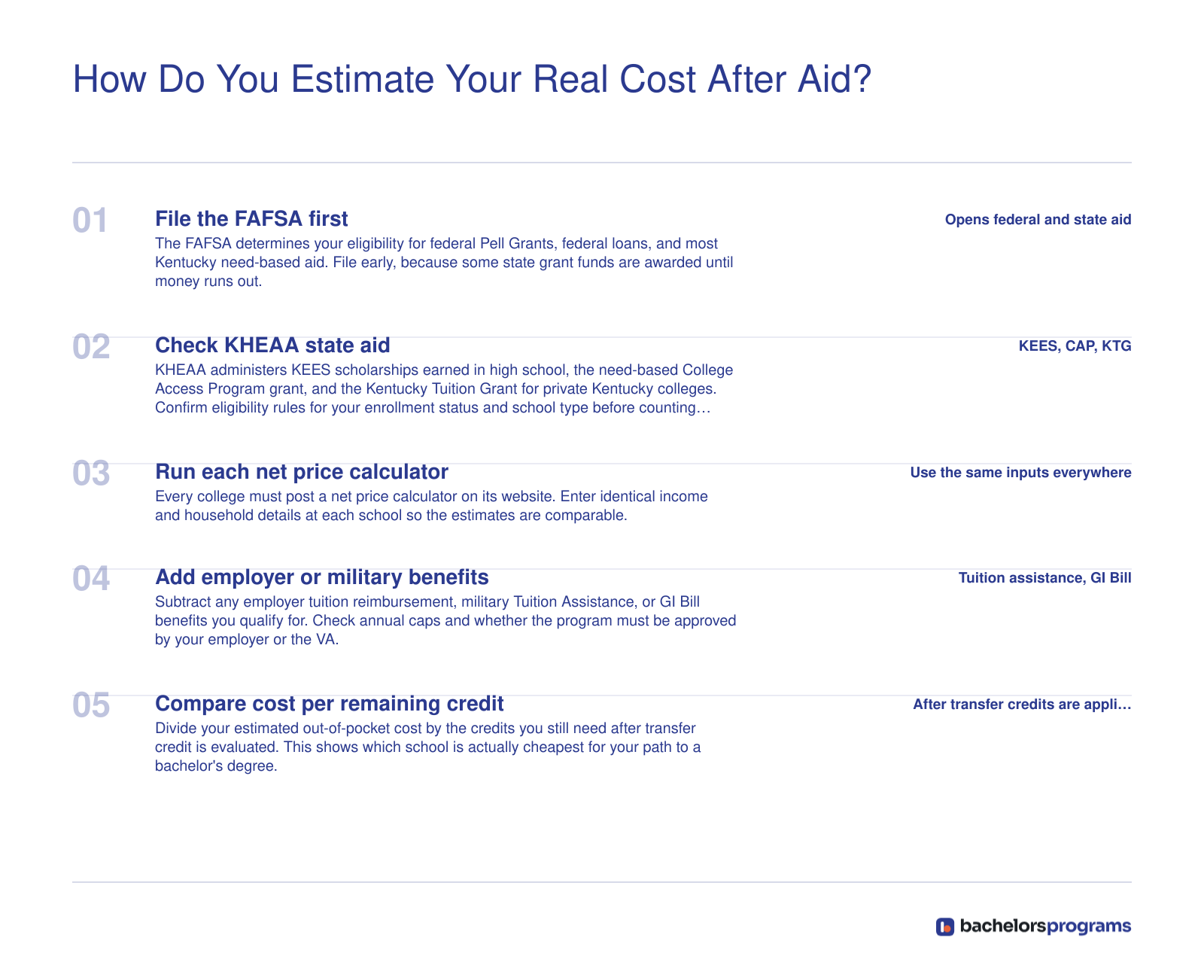
How Do You Estimate Your Real Cost After Aid?
Sticker price tells you little about what you will actually pay. Work through these steps for every Kentucky school on your list, then compare them on out-of-pocket cost after aid, not on published tuition.
Transfer Credits and KCTCS Degree Completion Paths
Kentucky's Statewide Transfer Rules
House Bill 160, passed in 2011, standardized transfer among Kentucky's public colleges.1 Under the Council on Postsecondary Education policy that followed, all six general education categories transfer among Kentucky public institutions and count toward degree requirements, either as individual courses or as a complete block.1 Students who transfer to a public university with 24 or more credit hours need at least a 2.0 GPA on a 4.0 scale.
The cleanest route is general education certification through KCTCS. Complete the 33-credit general education component, with at least 15 of those credits earned at KCTCS, and you are fully certified.2 That block then transfers to any Kentucky public university. Finishing only some categories certifies only those categories.
Associate Degrees and Completion Pathways
Certification does not cover every bachelor's requirement. Pre-major and major-specific courses outside the block may still be required. Associate in Arts and Associate in Science degrees are designed as transfer degrees built around general education and major prerequisites.3 KCTCS supports them with transfer guides and program-specific pathways to individual universities. If you hold an Associate in Applied Science, its general education courses count toward the receiving school's lower-division requirements, though you may need additional coursework. This route is well traveled: 60.2% of KCTCS AA/AS graduates transferred in 2024-2025, up from 57.7% in 2019-2020.4
How Many Credits Will Count
Each university sets its own ceiling. Caps often differ for community college credit and for total transfer credit, and most schools require a minimum number of credits earned in residence, sometimes including upper-division or major courses. Read the catalog for the specific online completion program at NKU, EKU, WKU, Murray State, UofL, or any school you're weighing.
Credits generally must come from an institutionally (regionally) accredited college. KCTCS recognizes accredited credit hour for hour and converts quarter hours at two-thirds of a semester hour, so a quarter-system transcript will shrink on conversion.5
These options can shorten your path further, though schools typically limit how much of each counts:
- CLEP and other exams: Test out of introductory courses you already know.
- Credit for prior learning: Portfolios or workplace training reviewed for credit.
- Military credit: Training and experience evaluated from your service transcript.
Get an Evaluation Before You Apply
Ask each school for an unofficial transcript evaluation before you submit an application. Request a course-by-course breakdown showing what counts toward general education, your major, and electives, plus how many credits remain. Comparing those numbers side by side tells you which program actually gets you to graduation fastest.
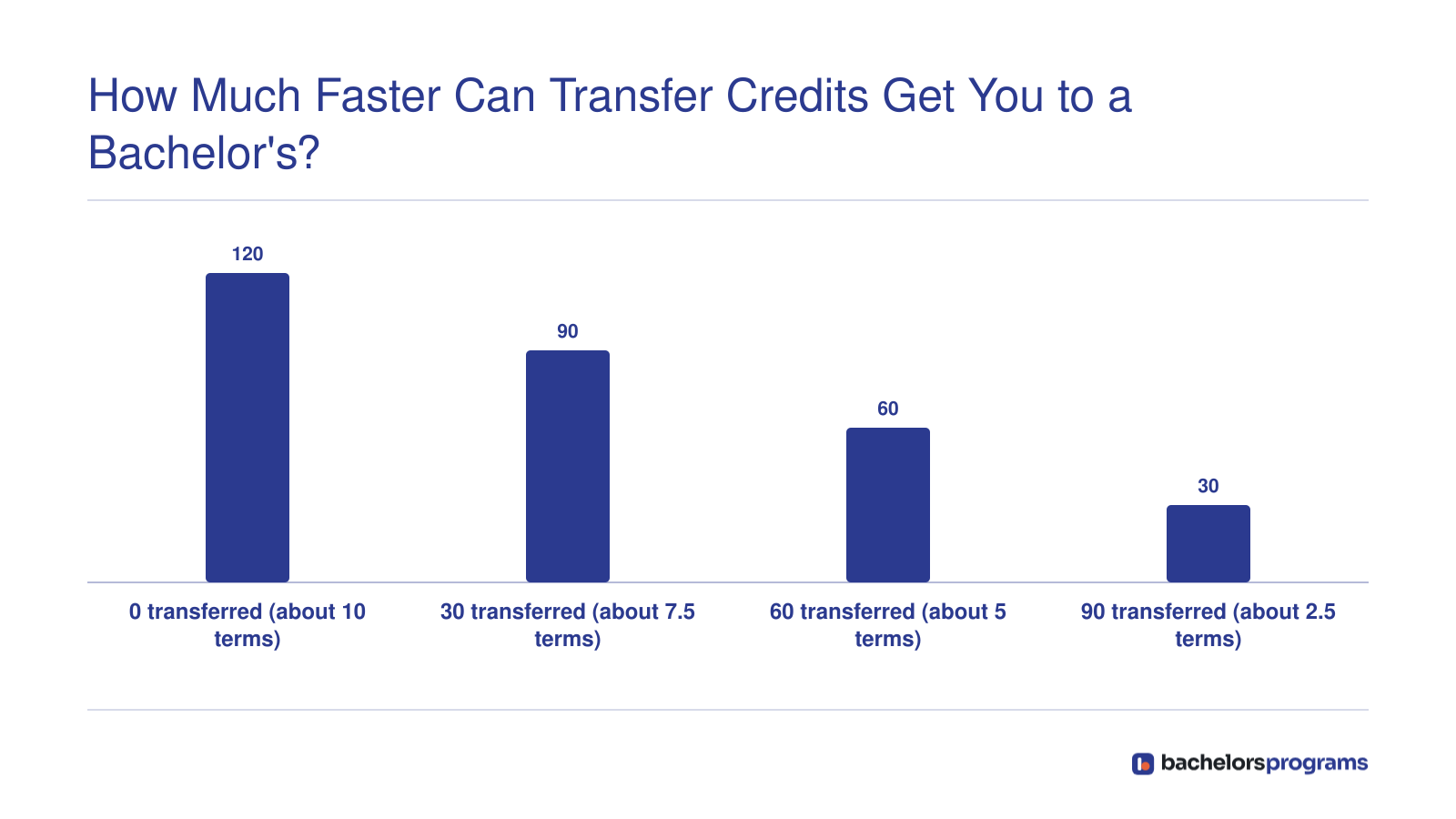
How Much Faster Can Transfer Credits Get You to a Bachelor's?
Every credit that transfers is one you don't have to take, or pay for, again. At 12 credits per term, a student starting with no transfer credit needs about 10 terms to finish a standard 120-credit degree, while a student bringing 60 credits from a completed associate degree needs about 5. These estimates assume every transferred credit applies to your major, and most Kentucky colleges require a minimum number of credits completed at the school itself (a residency requirement), which can cap how many transfer credits count.
Are Online Colleges in Kentucky Accredited?
Is an online degree from a Kentucky college accredited the same way as one earned on campus? At the state's public universities, yes. The University of Kentucky, University of Louisville, Northern Kentucky University, Western Kentucky University, and Eastern Kentucky University all hold institutional accreditation from SACSCOC, the Southern Association of Colleges and Schools Commission on Colleges, and their online bachelor's programs carry that same accreditation.1 Among private nonprofits, Asbury University is SACSCOC-accredited and licensed by the Kentucky Council on Postsecondary Education.2
Institutional vs. Programmatic Accreditation
Institutional accreditation applies to the entire college: its finances, faculty, library, and academic support. It is what makes federal financial aid, transfer credit, and most graduate admissions work. Programmatic accreditation reviews one school or program against professional standards, and it matters most where a license or employer expects it.
- Nursing: CCNE and ACEN accredit nursing programs, including many RN-to-BSN tracks. If nursing is your goal, ask the program directly which nursing accreditor approves it, because institutional accreditation alone does not cover nursing curricula.
- Business: AACSB accredits the business colleges at UK (Gatton), UofL, NKU (Haile), WKU (Gordon Ford, including business and accounting), and EKU.1
- Education: CAEP approves educator preparation. Asbury's School of Education is CAEP-approved for initial certification, including its online BS in Elementary Education and online MAT, and is approved by the Kentucky Educational Professional Standards Board.2 Note that Asbury's online elementary education program enrolls Kentucky residents only and places students in Kentucky schools.2
How to Verify a School's Status
Three checks settle the question quickly: search the SACSCOC member directory, confirm the program's specialized accreditor lists it, and look the institution up in the U.S. Department of Education's DAPIP database. Then check the Kentucky CPE licensed-in-state directory, which lists private colleges authorized to grant bachelor's degrees.4 Kentucky also participates in NC-SARA through SREB; institutions apply to CPE, must hold USDE-recognized accreditation, and private colleges need a composite financial stability score of at least 1.5 out of 3.0.3 SARA approval is a consumer-protection agreement for out-of-state students, not a substitute for CPE licensure or professional accreditation.
Red Flags to Watch
Be wary of an accreditor you cannot find in the federal database, especially if the school promises credit that other colleges will not accept. Ask, in writing, whether credits transfer to a Kentucky public university before you enroll.
Admissions Requirements and Start Dates for Online Students
Kentucky's public universities set modest baseline requirements for online undergraduates, but individual programs can raise the bar. Use this checklist to compare first-time and transfer standards and to plan around application deadlines.
- High school diploma or GEDUofL Online requires a diploma or equivalent from new students and from transfers with fewer than 24 transferable credits.
- Minimum high school GPA (first-time students)WKU looks for at least a 2.0 unweighted GPA, NKU 2.50, UofL's online BBA 2.75 and its early childhood education BS 2.5.
- Test scoresWKU is test-optional. NKU admits freshmen with a 2.50 GPA regardless of ACT or SAT. UofL expects a composite ACT of 23 for the BBA (22 in math) and 21 for early childhood education, though it weighs test-optional applicants case by case.
- Minimum transfer GPAWKU, EKU and NKU require a 2.0 college GPA, and UofL's BBA requires 2.5. Most schools also ask that you be in good standing at your previous institution.
- Official transcriptsWKU lists official transcripts as a standard requirement, so request them early from your high school and any college you attended.
- Application fee or waiverFees and waiver options differ by school, so confirm them on each university's application portal.
- Multiple start dates at EKUEKU Online offers six starts a year, with deadlines of Aug. 5, Oct. 5, Jan. 5, March 5, May 5 and June 15.
- UofL preferred deadlinesThe BBA has three starts, with deadlines of Aug. 1 for fall, December for spring and April 1 for summer. The early childhood BS adds October and February starts.
- Program-specific extrasWKU notes that requirements vary by program. RN-to-BSN tracks are built for licensed nurses, so check the RN license and prerequisite course rules on the program's page.
Questions to Ask Yourself
Have you asked the school to confirm your transfer credits in writing?
Can you complete clinicals, student teaching, or proctored exams near where you live?
Will you enroll at least half-time each term?
Is the online per-credit rate really lower once fees are added?
Graduation Rates, Debt, and Outcomes at Kentucky Colleges
Two ways to judge how a Kentucky college performs: accept a graduation rate or debt figure you saw once in a ranking, or pull the number from the federal record the school files every year. The first is fast and often stale. The second takes a few minutes and reflects the most recent cohort the government has processed.
Start With the Federal Records
The U.S. Department of Education's College Scorecard is the first stop. Its institution data were refreshed in November 2026 and cover through the 2025-26 academic year. There you can pull a school's six-year graduation rate, first-year retention rate, median federal debt for borrowers leaving the institution, median earnings 10 years after entry, and the eight-year outcome measures added in 2026. NCES/IPEDS, the federal collection behind those numbers, carries the same graduation and retention fields plus Outcome Measures that report award or enrollment status four, six, and eight years after a cohort enters.
Read the definitions before you compare. Earnings figures cover only federally aided students who are employed and not enrolled in further study, so people who went on to graduate school drop out of the calculation. Debt figures cover federal loan borrowers leaving the institution in a given year, which folds in students who withdrew along with graduates. Neither is a clean measure of what a graduate earns or what a degree costs. For reference, the University of Louisville's federal profile shows a 58% graduation rate and $19,500 in median total debt after graduation. Treat figures like these as a rough signal, then confirm the exact measure and reporting year on the school's own page.
Check the School's Own Disclosures
Every institution publishes consumer information, and it is usually more current than a third-party summary. Look for the office of institutional research, the consumer information page, and the financial aid site. Ask specifically for retention and completion data for the campus and, where published, the online program, plus the debt and earnings disclosures tied to the year you would enroll. A statewide average can hide a wide gap between a flagship campus and a regional one, and between a full-time residential cohort and an adult online cohort.
Cross-Checks That Add Context
Federal completion data tell you whether students finish. They do not tell you what happens next. Fill that gap with:
- Occupational outlook: BLS.gov publishes median pay and projected openings by occupation, which is more useful than a single institution-wide earnings median for fields like nursing, teaching, or business.
- State outcomes: the Kentucky Council on Postsecondary Education reports statewide and campus-level persistence, completion, and graduate wage data.
- Program specifics: licensure boards and professional associations publish exam pass rates and licensure outcomes for fields that require a credential to work.
Treat every figure as a snapshot. A six-year rate can move several points when one cohort's composition shifts, and federal methodology changes can break year-to-year comparisons. Verify the current number on the source site before you let it drive a decision.
Bachelor's Degree Earnings Premium in Kentucky
A bachelor's degree is linked to a clear earnings advantage in Kentucky.
How to Choose the Right Kentucky Online College
For most students choosing among Kentucky online colleges, accreditation and cost after aid matter more than the sticker price on a program page.
1. Confirm accreditation first
Check that the school is accredited by the Southern Association of Colleges and Schools Commission on Colleges (SACSCOC), the regional body for Kentucky institutions. Then check programmatic accreditation for your field, such as ABET for engineering or CCNE for nursing, because regional accreditation alone does not cover licensure tracks. Skipping this step is the most expensive mistake on the list.
2. Get a transfer credit evaluation
Ask for a written evaluation before you enroll. Your KCTCS credits should be mapped course by course against the bachelor's requirements, with a clear count of what remains. An unofficial "we accept up to 60 credits" statement is not the same thing.
3. Compare cost per remaining credit after aid
Sticker tuition tells you little. Divide your estimated out-of-pocket cost by the credits you still need. That number is what makes an in-state public completion program beat a private online rate in most cases, unless the private school's grant for Kentucky residents closes the gap.
4. Check format fit and in-person requirements
Confirm whether proctored exams, clinicals, practicums, or weekend labs require travel. A program marketed as fully online can still expect you in Bowling Green or Louisville a few times a term.
5. Review retention, graduation, and debt data
Look at first-to-second-year retention and completion rates for the online population specifically where the school publishes them, plus median debt for graduates in your intended major. National Center for Education Statistics data and the school's own consumer information page are the practical starting points.
6. Ask about academic and career support
Get specifics: who advises online students, what tutoring is available, and whether career services extend to graduates. Weak advising is the quiet reason adult students stall out.
The Next Step
Shortlist two or three schools and request net price estimates in writing, not verbal projections. Then file the FAFSA and request transcript evaluations from every institution you have attended. Those two moves turn estimates into numbers you can compare side by side.
Colleges in Kentucky with the most bachelor's programs
| School | City | Type | Bachelor's programs | Online | Net price / yr | Grad rate |
|---|---|---|---|---|---|---|
| Western Kentucky University | Bowling Green | Public | 115 | 30 | $10,990 | 56% |
| Eastern Kentucky University | Richmond | Public | 97 | 26 | $11,040 | 50% |
| University of Kentucky | Lexington | Public | 97 | 8 | $18,851 | 71% |
| Murray State University | Murray | Public | 86 | 15 | $9,096 | 61% |
| University of Louisville | Louisville | Public | 81 | 19 | $17,988 | 61% |
| Northern Kentucky University | Highland Heights | Public | 78 | 25 | $8,191 | 52% |
| Campbellsville University | Campbellsville | Private nonprofit | 67 | 23 | $19,341 | 42% |
| Morehead State University | Morehead | Public | 62 | 14 | $9,793 | 52% |
| University of the Cumberlands | Williamsburg | Private nonprofit | 53 | 33 | $14,107 | 50% |
| Bellarmine University | Louisville | Private nonprofit | 49 | 1 | $21,499 | 64% |
| Berea College | Berea | Private nonprofit | 47 | 0 | $6,106 | 58% |
| Kentucky State University | Frankfort | Public | 47 | 8 | $8,040 | 32% |
| Thomas More University | Crestview Hills | Private nonprofit | 45 | 6 | $21,835 | 41% |
| Asbury University | Wilmore | Private nonprofit | 42 | 6 | $21,401 | 65% |
| Georgetown College | Georgetown | Private nonprofit | 41 | 3 | $14,095 | 49% |
Program counts are the verified bachelor's listings in our directory; net price is the school-wide average a first-time undergraduate paid after aid, and graduation rate the share finishing within six years (College Scorecard).
Compare programs nationwide
Many Kentucky residents study online. Every ranked list above has an online lens, or browse every field.
Online bachelor's degrees Browse all fields