Online Colleges and Bachelor's Degree Programs in Pennsylvania
Every verified bachelor's program at a college in Pennsylvania: 5,100+ programs at 120+ colleges, with the online options, net price and graduation rates behind each one.

Average net price, what a year costs after grants and scholarships, is $18,756 at PASSHE universities and $26,201 at the main campuses of state-related universities such as Penn State, Pitt, and Temple. Private colleges, the third sector offering online and hybrid bachelor's programs, average $25,357.
The real question is what an online degree costs after aid, and how much earned credit can shorten it. Many programs are hybrid or require in-person clinicals or practicums, so "online" does not always mean no travel.
A school's credit policy can move the final bill as much as its tuition rate does.
Key Points
- PASSHE universities average $18,756 a year in net price after grants.
- The Pennsylvania State Grant requires the FAFSA plus a separate state form.
- PA TRAC transfer credits can cut a bachelor's degree roughly in half.
Popular degrees in Pennsylvania
Bachelor's degrees in Pennsylvania by field
Business & Management
- Marketing146 programs
- Business Administration116 programs
- Accounting95 programs
- Management89 programs
- Finance81 programs
- Communication74 programs
- Economics57 programs
- Human Resource Management or HR Management53 programs
Science & Engineering
- Biology112 programs
- Mathematics87 programs
- Chemistry79 programs
- Biochemistry72 programs
- Environmental Science56 programs
- Physics56 programs
- Anthropology33 programs
- Mechanical Engineering33 programs
Liberal Arts & Humanities
- English92 programs
- Literature or English Literature87 programs
- History78 programs
- Philosophy54 programs
- Spanish53 programs
- Humanities32 programs
- Interdisciplinary Studies22 programs
- Global Health or Health Studies22 programs
Education & Teaching
- Secondary Education98 programs
- Science89 programs
- Special Education62 programs
- English Education54 programs
- Elementary Education51 programs
- Early Childhood Education or Child Development46 programs
- Mathematics Education46 programs
- History Education36 programs
Arts & Design
- Art or Art Studies79 programs
- Fine Arts or Studio Art66 programs
- Media Arts or Digital Media57 programs
- Graphic Design42 programs
- Audio & Music36 programs
- Art History32 programs
- Creative Writing28 programs
- Game Programming & Development14 programs
Computers & IT
- Computer Science98 programs
- Cybersecurity63 programs
- Information Technology44 programs
- Innovation or Technological Entrepreneurship30 programs
- Artificial Intelligence29 programs
- Computer Information Systems28 programs
- Software Development & Engineering22 programs
- Computer Engineering18 programs
Communications & Media
- Communications112 programs
- Journalism56 programs
- Public Relations39 programs
- Communication Disorders21 programs
- Speech Pathology20 programs
- Professional Writing19 programs
- Strategic Communications15 programs
- Social Media7 programs
Social Work & Social Sciences
- Sociology79 programs
- Political Science, Government77 programs
- Social Work38 programs
- Public Policy13 programs
- Human Services10 programs
- Disability Studies2 programs
Healthcare
- Exercise & Sports Science49 programs
- Health Sciences40 programs
- Public Health34 programs
- Speech Pathology22 programs
- Health Education15 programs
- Nutrition9 programs
- Community Health8 programs
- Respiratory Care Therapy7 programs
Nursing
- Bachelor of Science in Nursing93 programs
- Nursing (RN to BSN)48 programs
- Accelerated BSN (ABSN)33 programs
- LPN/LVN to BSN10 programs
Criminal Justice & Law
- Criminal Justice68 programs
- Criminal Justice Administration24 programs
- Criminology22 programs
- Forensic Science18 programs
- Legal Studies11 programs
- Legal Services8 programs
- Homeland Security8 programs
- Corrections6 programs
Psychology
- General Psychology100 programs
- Applied Psychology6 programs
- Clinical Psychology5 programs
- Counseling Psychology3 programs
- Child Psychology2 programs
- Industrial Organizational Psychology2 programs
- Health Psychology1 program
- Positive Psychology1 program
Natural & Applied Sciences
- Neuroscience13 programs
- Oceanography or Ocean or Marine Biology10 programs
- GIS and Geoscience9 programs
- Agriculture or Agricultural5 programs
- Applied Science1 program
Religion & Theology
- Christian Studies or Religious Studies28 programs
- Christian Ministry or Ministry Leadership9 programs
Counseling
- Behavioral Health Science5 programs
- Substance Abuse Counseling1 program
How Online and Hybrid Bachelor's Programs Work in Pennsylvania
A fully online bachelor's and a hybrid one can carry the same degree name on the diploma, but the schedules differ sharply, and in Pennsylvania, so does the amount of travel.
The Four Labels That Matter
- Fully online: every course is delivered at a distance. Most Pennsylvania online bachelor's programs are built for working adults who cannot come to campus on weekdays.
- Hybrid: part of the coursework happens online and part happens in person, whether on a campus or at a partner site.
- Synchronous: you attend live sessions at set times, usually evenings, with a camera and a class roster.
- Asynchronous: you work on your own schedule inside weekly deadlines, discussion posts and exam windows.
Many programs mix the last two, pairing asynchronous lectures with a live seminar once a week.
What "Fully Online" Can Hide
In regulated fields, the classroom moves online but the supervised hours do not. Nursing students still complete clinical placements, teacher-education candidates still student teach to satisfy Pennsylvania certification requirements, and social work majors still log field hours. Some programs also schedule short on-campus residencies, lab intensives or orientation weekends.2 Ask how placements are arranged near your home, and who coordinates them.
Out-of-State Enrollment and Licensure
Pennsylvania has participated in the State Authorization Reciprocity Agreements since Fall 2016, with the Pennsylvania Department of Education serving as the state portal entity, so institutions approved under that framework can generally enroll students in other participating states.1 That framework covers institutional authorization, not licensure. A program that leads to a nursing license, teaching certificate or counseling credential may be limited to residents of certain states, and finishing the degree does not by itself guarantee license eligibility. Check the school's state authorization page and the licensure disclosures for your program before you apply.
One practical upside: out-of-state online students frequently pay a flat online rate instead of a nonresident campus rate. The cost section below breaks that down.
Online Per-Credit Tuition at Pennsylvania Public, State-Related, and Private Colleges
Per-credit tuition is the clearest starting point for comparing Pennsylvania online bachelor's degrees, but it does not settle which degree costs less. The 2026-2027 published rates at the public and state-related online units show why. A rate quoted for one campus or one credit band rarely tells the whole story.
Public and State-Related Rates
- Public (PASSHE), 2026-2027: PennWest Global Online charges $347 per credit plus a $32 per-credit technology fee, or $379 per credit for in-state students. Out-of-state students pay $354 per credit plus a $48 fee, or $402 per credit.
- State-related, 2026-2027: Penn State World Campus charges $644 per credit for students with 59 or fewer credits and $692 per credit at 60 or more.1 A flat tuition charge of $7,833 per term covers 12 to 19 credits at the lower band, and $8,455 at the upper band.1 World Campus charges the same rate regardless of where the student lives.
The 120-Credit Sticker Math
At 120 credits, PennWest's combined in-state rate comes to about $45,480, or about $48,240 out of state. Penn State World Campus comes to about $77,280 at the lower per-credit rate and about $83,040 at the upper rate. Those totals are sticker prices before financial aid. They also assume every credit is billed at the per-credit rate, which is not how a flat 12-to-19-credit term works. A student who takes 15 credits per term may pay less per credit than the published rate suggests, while a student who takes one course at a time may not benefit from the flat term rate at all.
Why the Lowest Per-Credit Rate Can Lose
A low per-credit number can hide mandatory fees, a residency premium, or a credit-load rule that raises the price later. PennWest bundles a technology fee into its combined rate and charges out-of-state students more. Penn State changes the rate after 60 credits. Private nonprofits and community colleges publish their own campus-specific rates, and a community college rate covers only the courses taken there, not the full bachelor's. A private college with a higher per-credit rate can still cost less overall if it accepts more transfer credits and requires fewer terms. Compare total cost after mandatory fees, residency rules, transfer credit, and the number of terms you will actually need. That is why the sticker comparison is a first filter, not a final answer.
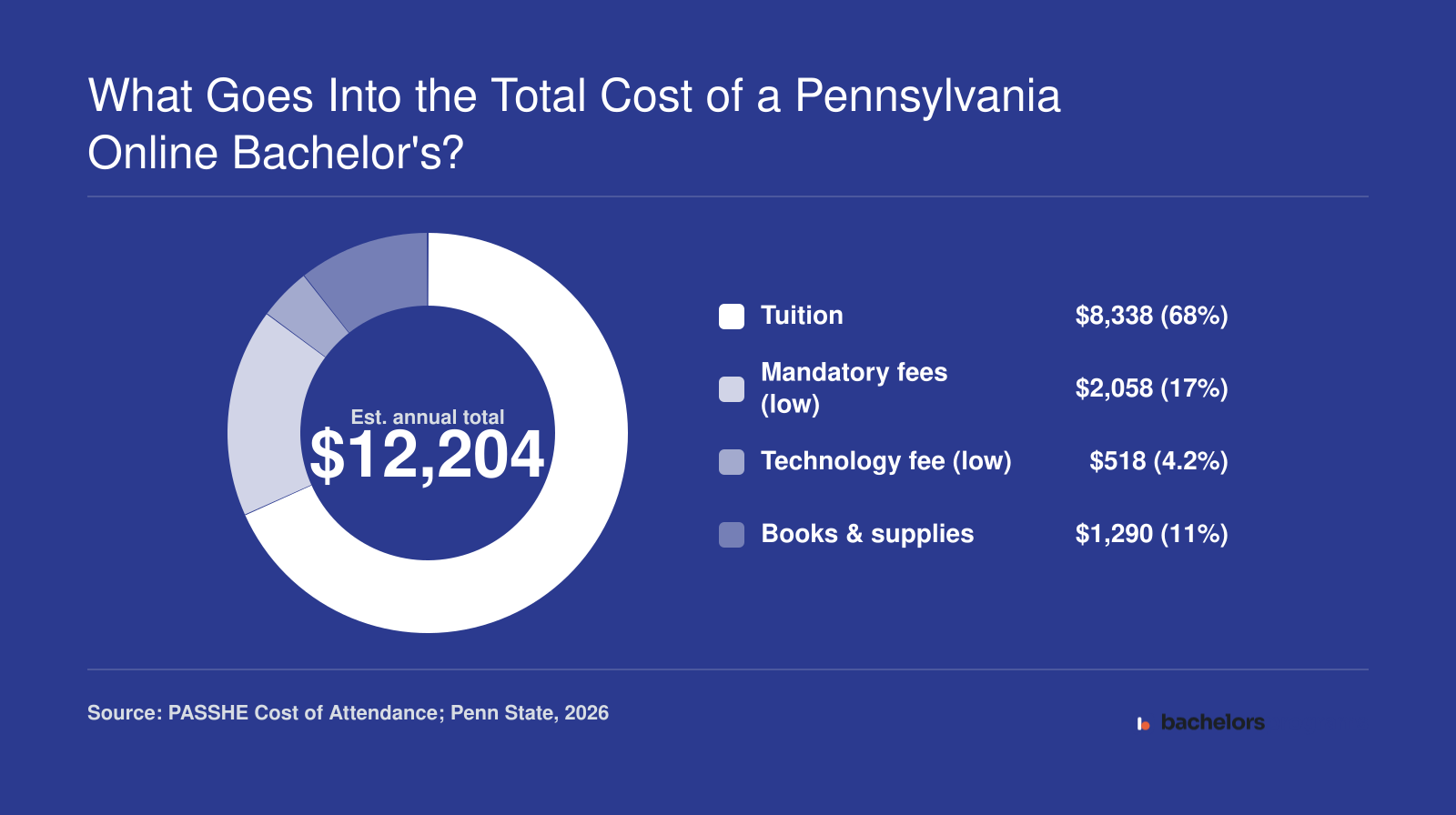
What Goes Into the Total Cost of a Pennsylvania Online Bachelor's?
This estimate starts with 2026 in-state tuition of $8,338 at Pennsylvania's State System of Higher Education (PASSHE). It adds the low end of PASSHE's mandatory fee range ($2,058-$4,118) and technology fee range ($518-$970), plus Penn State's $1,290 fall-and-spring estimate for books and supplies. At the top of both fee ranges, the total rises to about $14,716. These are campus-based figures that vary by university, so confirm your program's online rates. Online students usually avoid the housing and meal costs that push PASSHE's on-campus average to $24,521. Books, technology, and any required proctoring or residency travel still add hundreds to thousands of dollars per year.
Net Price vs. Sticker Price and the Cheapest Routes to a Degree
At Pennsylvania's PASSHE universities, average net price after grants and scholarships comes to $18,756 a year.1 The same measure reaches $26,201 at the main campuses of the state-related universities, $19,505 at their regional campuses, $25,357 at private nonprofit colleges, and $19,913 across the state's public colleges as a group, based on College Scorecard comparisons compiled for Pennsylvania.
Sticker Price vs. Net Price
Sticker price is the published tuition line: $14,581 average in-state tuition at Pennsylvania public four-year colleges in 2026, with a median of $14,620.2 Net price is what a student actually pays once Pell Grants, state grants, institutional aid, and scholarships are subtracted, and it also folds in fees, books, and living costs that tuition alone leaves out. That is why the PASSHE net figure of $18,756 sits above the tuition line rather than below it. Federal net-price figures describe students who receive federal aid, so they show a range of families rather than a single price. Compare net price to net price, never tuition line to tuition line.
Cheapest Realistic Routes
- Community college first: two years at a Pennsylvania community college followed by a bachelor's completion program keeps the lowest-cost credits in the front half of the degree.
- A PASSHE online program: at $18,756 average net price, the state system offers the lowest four-year figure available to Pennsylvania residents.
- Credit for prior learning: CLEP exams, military transcripts, and evaluated workplace training can retire required credits before you ever pay tuition for them.
- Credit-heavy completion programs: some online bachelor's completion degrees accept far more transferred credits than others, so ask for the residency requirement in writing.
A Rough Dollar Comparison
Four years at a state-related main campus at the $26,201 average net price works out to roughly $104,800.1 The same span at a PASSHE university runs about $75,000. A 2+2 path puts community college rates in the first two years and the state-related rate in the last two, so the upper division alone comes to about $52,400 before the community college half is added back in. Your actual savings depend on the community college's per-credit rate and on how many credits survive transfer intact.
Financial Aid and PHEAA State Grants for Online Students
Start With the FAFSA
File the FAFSA first. It is the gateway to Pell Grants, federal loans, and the Pennsylvania State Grant, and it must be filed every year. The State Grant also requires a separate Pennsylvania State Grant form. The state deadline is May 1 for students attending four-year Pennsylvania colleges, whether first-time or renewal applicants.2 It is August 1 for community colleges, business and trade schools, and other two-year or open-admission programs.2 The later federal June 30 FAFSA deadline does not replace either date, so treat May 1 as your target for a bachelor's program.
Can State Grant Aid Cover Online Study?
The maximum State Grant is $6,000 for the current award year.1 Whether it applies to your online program is the harder question. The published PHEAA guidance does not set a blanket rule that all online or distance enrollment qualifies. Eligibility depends on whether your program and school meet PHEAA's requirements. PHEAA treats part-time enrollment differently from full-time, and the published guidance does not spell out current credit minimums or a separate part-time award amount. Before you enroll, ask the school's financial aid office to confirm in writing that your specific online program is approved. Also confirm that your enrollment level qualifies and that you meet Pennsylvania residency requirements.
Other Pennsylvania Aid
- Ready to Succeed Scholarship: This award combines merit and need, and it reaches middle-income families with income up to $208,000 when GPA and income rules are met. It pays up to $3,000 full-time or $1,500 part-time, and it uses the same FAFSA and State Grant form.1
- Chafee Education and Training Grant: This is for students who left foster care after age 16 to return home or enter kinship care, guardianship, or adoption. It pays up to $5,000 per academic year, depending on available federal funds.3 Students must be at least half-time, be under 26 as of July 1, and can receive it for up to five years. It requires the FAFSA and a separate Chafee application to PHEAA.
School and Employer Help
State and federal aid is only part of the picture. PASSHE universities and private colleges often add their own institutional scholarships. Some of these apply to online students and some do not, so ask. Many Pennsylvania employers also offer tuition assistance, and some have partnership discounts with particular schools. Ask your HR department whether your employer has one, because it can lower your bill before any grant is counted.
Transfer Credits, PA TRAC, and Community College Pathways
Pennsylvania runs one of the more structured statewide transfer systems in the country, and using it correctly can cut a bachelor's degree roughly in half. The Pennsylvania Transfer and Articulation Center, known as PA TRAC, connects the state's 14 community colleges with its 14 state universities plus several state-related and private participants.1
How PA TRAC Actually Moves Credits
Two mechanisms do the work. The first is the 30-Credit Transfer Framework, a menu of foundation courses built to count toward nearly any degree at a participating school.2 It is a floor, not a finish line: completing those 30 credits does not guarantee a bachelor's will be completed on schedule, and not every community college course or receiving major is covered.
The second is Statewide Program-to-Program articulation, which links a specific associate degree to a matching bachelor's in a similar field.3 The associate must carry at least 60 college-level transferable credits (developmental, remedial, career, technical, and applied courses do not count). Students who hold that degree and are admitted receive junior standing and at least 60 credits toward the parallel bachelor's, including at PASSHE universities.3 Important limits apply: P2P does not guarantee admission to the college or the major, it does not survive a change of major, and it does not apply outside listed pairings or at non-participating colleges.
Which Schools Take the Most Credits
Caps and residency rules differ sharply by institution:
- Penn State World Campus: No stated limit on regionally accredited college-level credits, but the academic department decides what actually applies to a degree. At least 36 of the final 60 credits must be earned at Penn State.
- Temple University: Generally accepts college-level coursework graded C or better with no stated acceptance limit, while requiring a minimum of 30 Temple credits.4
- Drexel University: Accepts regionally accredited coursework with substantial content overlap, grades below C excluded, up to 60 semester or 90 quarter credits.5 Advisors may allow more in unusual cases.
Degree-completion programs aimed at adults who have college credit but no credential often go further, and many also award credit for prior learning through CLEP exams, military training, or portfolio review. Ask how each source is evaluated before you count on it.
The Warning Worth Heeding
Accepted credits and applied credits are different things. A course can land on your transcript as a free elective rather than a major or general-education requirement, leaving your graduation date untouched. Ask the admissions office for an unofficial transcript evaluation before you apply, and get a specific count of how many credits apply to the major.
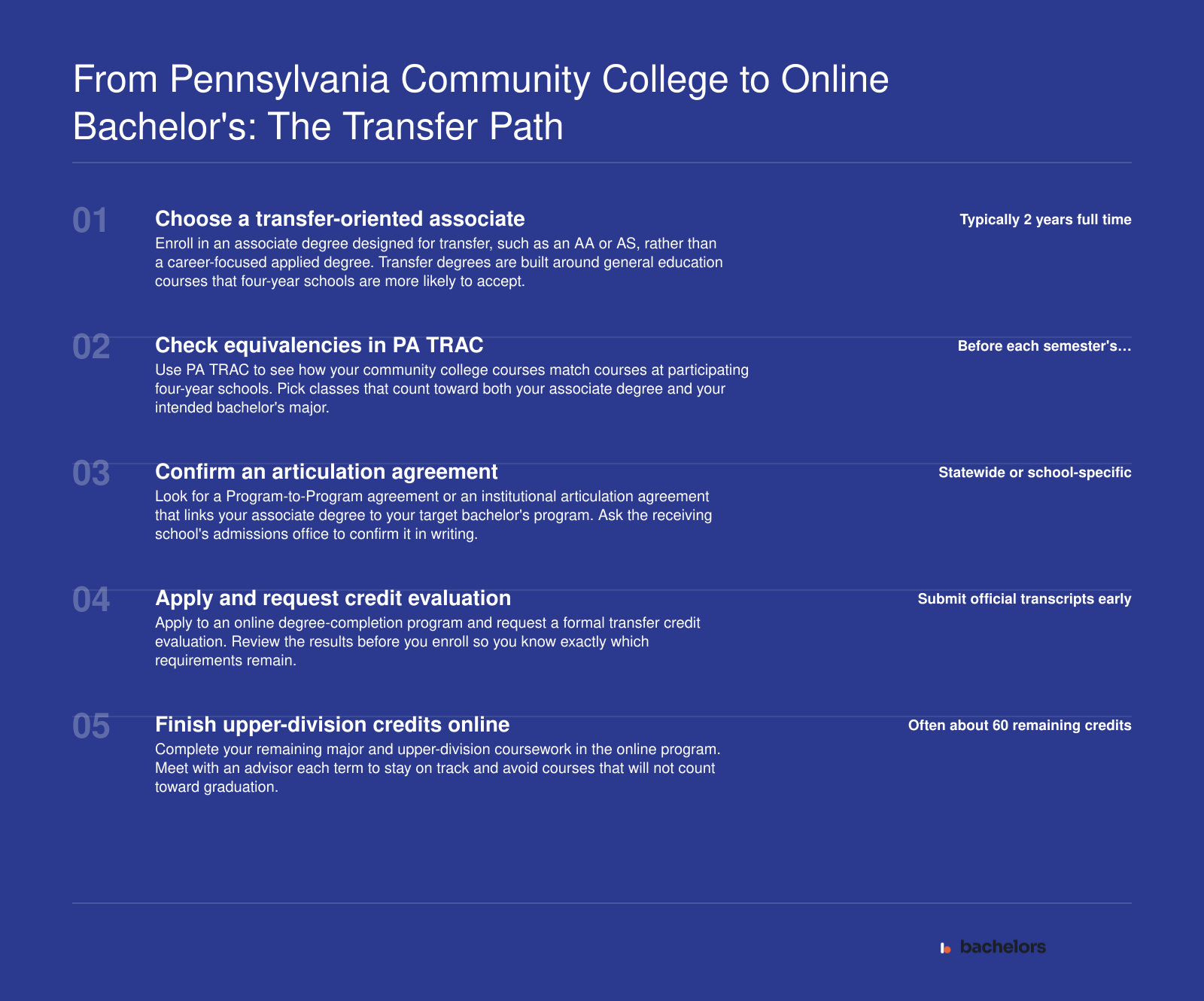
From Pennsylvania Community College to Online Bachelor's: The Transfer Path
Starting at a Pennsylvania community college and finishing online is one of the most common routes to a bachelor's degree in the state. The order of these steps matters, because credit decisions made in your first semester shape how much transfers later.
Admissions Requirements and Deadlines for Pennsylvania Online Programs
Requirements vary by school, and PASSHE universities, state-related schools, and private colleges each set their own rules. Penn State World Campus publishes the most detailed online admissions policies, so it serves as the reference point here. Confirm every item with the specific program you're considering.
- High school diploma or GEDPenn State World Campus requires an official high school transcript or GED record, no matter how long ago you graduated.
- Official transcripts from every college attendedSend records from all prior colleges, plus military transcripts and English proficiency proof when they apply to you.
- GPA expectationsPenn State World Campus sets no minimum GPA or test score for first-year applicants and reviews applications holistically. Transfer GPA thresholds differ by school, so ask each admissions office.
- Test-optional statusSAT and ACT scores are optional at Penn State World Campus. Adult learners and transfer students don't need them at all.
- Application fee or waiverAsk each school about its fee and whether waivers are available before you submit.
- Term deadlines and start datesDeadlines vary by program and term. For Fall 2026, World Campus's new-student deadline was June 30, 2026, covering both its 15-week and 7-week sessions. Penn State's general undergraduate application opens August 1 and uses rolling review, with November 1 Early Action and a recommended December 1 date. Check the program page for Spring 2027 dates.
- Returning and adult studentsFormer World Campus students with a GPA of 2.00 or higher use a separate form with later deadlines. For Fall 2026, those were August 14 and October 9. Ask each school about adult-learner tracks and credit for prior learning.
Can You Finish in Less Than Four Years? Accelerated, Part-Time, and Term Options
Yes, an online bachelor's degree in Pennsylvania can take less than four years. Transfer credits, accelerated 7- or 8-week terms, year-round enrollment, and credit for prior learning all shorten the clock, while part-time study commonly stretches the same degree to five or six years.
What Moves the Timeline
- Transfer credits: Courses you already completed at a community college or another four-year school count toward the degree when they match the curriculum and meet the grade minimum.
- Accelerated terms: Seven- and eight-week sessions let you stack more courses per calendar year than a traditional 15-week semester allows.
- Year-round enrollment: Summer and winter sessions keep you earning credits instead of pausing for three months.
- Credit for prior learning: Portfolios, exams, and military or professional training can clear requirements without a course.
- Part-time pace: Six credits a term is manageable alongside a full-time job, but it adds years to the finish line.
Why Term Structure Matters When You Transfer
Some Pennsylvania schools run semesters and award semester credits; others, particularly programs built on quarter terms, award quarter credits. One quarter credit is worth roughly two-thirds of a semester credit, so 45 quarter credits convert to about 30 semester credits. Confirm which system a receiving school uses before you assume your credits will land one for one.
The Tradeoff
A compressed term covers the same material in half the weeks, so two courses at once in an 8-week session can feel like four in a semester. Financial aid also follows your enrollment status each term, so dropping from full time to half time can reduce what you receive.
A Quick Illustration
An associate degree holder entering with 60 transferable credits into a 120-credit bachelor's, taking courses year-round, could finish in roughly two years.
Graduation Rates, Accreditation, and Support for Online Students
Institutional accreditation tells you a college is legitimate. Programmatic accreditation tells you a specific degree will be recognized by licensing boards and employers. Check both, then look at how students actually fare.
Institutional and Programmatic Accreditation
Most nonprofit Pennsylvania colleges are accredited by the Middle States Commission on Higher Education (MSCHE), the regional accreditor for the state. Examples from the schools' own accreditation pages:
- Penn State: MSCHE reaffirmed its accreditation on April 27, 2023, extending through 2031-2032.1
- Temple University: An MSCHE member since 1952.2
- PennWest University: Accredited by MSCHE.3
- Drexel University: Holds continued accreditation, last reviewed in April 2022, with its next review scheduled for fall 2026.4
Online degrees at these schools are covered by the institution's own accreditation, not a separate one. For career-specific majors, look one level deeper. Nursing programs should hold CCNE or ACEN accreditation, and AACSB accreditation carries weight with business employers and graduate schools. Verify status in the accreditor's own directory.
Reading Graduation, Retention, and Earnings Data
The federal College Scorecard and IPEDS databases publish graduation rates, first-year retention, and median earnings for nearly every Pennsylvania college. Read them carefully. These figures usually blend online and on-campus students, and graduation rates track first-time, full-time students, so they say little about adults finishing a degree part time online. Scorecard earnings come from tax records of federal aid recipients measured after completion, which reflects a school's broader graduating population rather than its online cohort. Use these numbers to compare schools, then ask admissions for online-specific completion data.
Support Services to Check Before Enrolling
- Online advising: A named advisor you can reach by phone or video.
- Tutoring: Live or on-demand help at hours working adults can use.
- Library access: Remote access to databases and e-books, plus librarian chat.
- Career services: Virtual résumé reviews, job boards, and alumni networking.
- Disability services: A clear process for requesting accommodations in online courses.
How to Choose the Right Pennsylvania Online College for Your Situation
More Pennsylvania schools now offer online degrees marketed as flexible, affordable, and transfer-friendly, so the fit between program and student matters more than the brand name. Start with your own situation, then apply the checks that matter for everyone.
If You Are a Working Adult
Look for asynchronous courses, multiple start dates each year, and credit for prior learning, such as military training, professional certifications, or portfolio review. Ask whether your employer has a tuition partnership with a school, since that can cut your out-of-pocket cost sharply.
If You Are Transferring From a Community College
Prioritize schools with Program-to-Program agreements that map your associate degree to a specific bachelor's major. Compare transfer credit caps, and weigh the lower per-credit pricing at PASSHE universities or degree-completion programs against other options.
If You Live Outside Pennsylvania
Confirm the school is authorized to enroll students in your state. If the degree leads to a license, such as teaching or nursing, verify that it qualifies you where you live. Then compare any flat online rate against your home-state public universities, which may cost less.
For Every Student
- Net price: Compare what you will pay after grants and scholarships, not the sticker price.
- Accreditation: Check regional accreditation for the school and programmatic accreditation for fields like business, nursing, or education.
- Outcomes: Ask how many students in the specific online program graduate, not just the campus-wide rate.
Your next step is concrete: file the FAFSA, then request transcript evaluations from every school on your shortlist. Those answers show your real cost and your real time to finish, and they make the comparison simple.
Colleges in Pennsylvania with the most bachelor's programs
| School | City | Type | Bachelor's programs | Online | Net price / yr | Grad rate |
|---|---|---|---|---|---|---|
| Pennsylvania State University | University Park | Public | 109 | 17 | $32,875 | 86% |
| Temple University | Philadelphia | Public | 104 | 8 | $28,198 | 75% |
| Drexel University | Philadelphia | Private nonprofit | 103 | 14 | $38,509 | 78% |
| Pennsylvania State University | University Park | Public | 100 | 30 | $19,550 | 34% |
| Slippery Rock University of Pennsylvania | Slippery Rock | Public | 91 | 8 | $19,608 | 66% |
| Messiah University | Mechanicsburg | Private nonprofit | 86 | 0 | $26,502 | 75% |
| Indiana University of Pennsylvania | Indiana | Public | 83 | 2 | $16,804 | 56% |
| University of Pennsylvania | Philadelphia | Private nonprofit | 82 | 6 | $28,699 | 97% |
| West Chester University of Pennsylvania | West Chester | Public | 81 | 9 | $23,331 | 71% |
| Duquesne University | Pittsburgh | Private nonprofit | 81 | 1 | $37,730 | 78% |
| Millersville University of Pennsylvania | Millersville | Public | 81 | 13 | $20,787 | 58% |
| University of Pittsburgh-Pittsburgh | Pittsburgh | Public | 80 | 1 | $30,434 | 86% |
| Commonwealth University of Pennsylvania | Bloomsburg | Public | 76 | 40 | $15,699 | 55% |
| York College of Pennsylvania | York | Private nonprofit | 72 | 2 | $18,556 | 64% |
| Pennsylvania Western University | California | Public | 70 | 25 | $18,256 | 52% |
Program counts are the verified bachelor's listings in our directory; net price is the school-wide average a first-time undergraduate paid after aid, and graduation rate the share finishing within six years (College Scorecard).
Pennsylvania Online Bachelor's Degree FAQs
These quick answers cover the questions Pennsylvania online students ask most about state aid, out-of-state enrollment, diplomas, and 529 savings. Rules vary by school and program, so confirm details with the college and the relevant agency before you enroll.
Can I get PHEAA state grant aid for an online degree?
Are Pennsylvania online colleges available to students who live out of state?
Does an online diploma from a Pennsylvania university say "online"?
Can I use 529 plan funds or the PA 529 for online tuition?
Compare programs nationwide
Many Pennsylvania residents study online. Every ranked list above has an online lens, or browse every field.
Online bachelor's degrees Browse all fields