Online Colleges and Bachelor's Degree Programs in Virginia
Every verified bachelor's program at a college in Virginia: 2,150+ programs at 50+ colleges, with the online options, net price and graduation rates behind each one.

A Virginia student comparing online bachelor's degrees is choosing among three price structures, not three campuses. Old Dominion charges online learners $640 per credit in state and $649 out of state; George Mason's out-of-state online rate runs $1,474.50. Private nonprofits and national online colleges set their own numbers entirely.
Net price after aid decides budgets more often than the published rate, and Virginia's state grant programs do not always follow online enrollment. Transfer credit rules and graduation rates then separate the options that look affordable from the ones that actually get students to a degree.
Key Points
- ODU's 2025-26 online rate: $649 per credit out-of-state, $640 in-state.
- Virginia's Board of Nursing approves prelicensure programs, not online RN-to-BSN degrees.
- Community college Guaranteed Admission Agreements secure admission, not always your major.
Popular degrees in Virginia
Bachelor's degrees in Virginia by field
Business & Management
- Business Administration67 programs
- Marketing58 programs
- Accounting39 programs
- Finance37 programs
- Management36 programs
- Economics30 programs
- Healthcare Administration or Healthcare Management24 programs
- Communication22 programs
Science & Engineering
- Biology42 programs
- Mathematics41 programs
- Chemistry32 programs
- Biochemistry28 programs
- Physics23 programs
- Environmental Science17 programs
- Natural Resources or Conservation13 programs
- Anthropology12 programs
Education & Teaching
- Science46 programs
- Secondary Education40 programs
- Elementary Education31 programs
- Special Education24 programs
- English Education22 programs
- Mathematics Education18 programs
- History Education16 programs
- Physical Education16 programs
Liberal Arts & Humanities
- English41 programs
- History38 programs
- Literature or English Literature36 programs
- Spanish26 programs
- Philosophy17 programs
- Global Health or Health Studies13 programs
- International Relations12 programs
- Global Studies11 programs
Arts & Design
- Art or Art Studies45 programs
- Fine Arts or Studio Art39 programs
- Graphic Design20 programs
- Audio & Music20 programs
- Media Arts or Digital Media17 programs
- Art History15 programs
- Creative Writing11 programs
- Digital Photography7 programs
Computers & IT
- Computer Science53 programs
- Cybersecurity24 programs
- Information Technology19 programs
- Computer Engineering14 programs
- Innovation or Technological Entrepreneurship12 programs
- Computer Information Systems12 programs
- Software Development & Engineering11 programs
- Artificial Intelligence10 programs
Social Work & Social Sciences
- Sociology43 programs
- Political Science, Government34 programs
- Social Work14 programs
- Public Policy9 programs
- Human Services6 programs
Communications & Media
- Communications38 programs
- Journalism23 programs
- Public Relations11 programs
- Strategic Communications7 programs
- Professional Writing6 programs
- Communication Disorders6 programs
- Speech Pathology5 programs
- Technical Communication4 programs
Criminal Justice & Law
- Criminal Justice26 programs
- Criminal Justice Administration13 programs
- Criminology12 programs
- Forensic Science9 programs
- Homeland Security7 programs
- Paralegal4 programs
- Legal Services3 programs
- Corrections3 programs
Nursing
- Bachelor of Science in Nursing38 programs
- Nursing (RN to BSN)26 programs
- Accelerated BSN (ABSN)13 programs
- LPN/LVN to BSN5 programs
Healthcare
- Exercise & Sports Science21 programs
- Health Sciences17 programs
- Public Health13 programs
- Health Education11 programs
- Speech Pathology5 programs
- Community Health5 programs
- Nutrition4 programs
- Health Informatics3 programs
Psychology
- General Psychology36 programs
- Addiction Psychology4 programs
- Sport Psychology2 programs
- Clinical Psychology2 programs
- Developmental Psychology2 programs
- Counseling Psychology2 programs
- Forensic Psychology1 program
- Child Psychology1 program
Natural & Applied Sciences
- Agriculture or Agricultural7 programs
- GIS and Geoscience5 programs
- Oceanography or Ocean or Marine Biology4 programs
- Applied Science3 programs
- Neuroscience3 programs
Religion & Theology
- Christian Studies or Religious Studies15 programs
- Christian Ministry or Ministry Leadership6 programs
Counseling
- Substance Abuse Counseling2 programs
How Online Bachelor's Degrees Work in Virginia: Fully Online, Hybrid, and In-Person Requirements
"Online degree" covers more ground in Virginia than most program pages admit, and the gap between finishing entirely from home and attending a campus for a semester usually shows up in the fine print.
Three delivery models, one label
- Fully online: All coursework is delivered remotely, often asynchronously. Liberty University advertises more than 100 online bachelor's degrees taught largely in eight-week terms, and says most require no campus visits at all.
- Hybrid: Coursework is online but some component meets in person. George Mason offers both fully online and hybrid formats, and notes that most Mason Core requirements have online options, with exceptions including ENGH 100 and Mason Apex courses.1
- Online with required field hours: The coursework is remote, but practicums, student teaching, clinicals, and certain labs happen on site. Liberty's online B.Ed. is the clearest example: no campus travel for classes, but practicum and student teaching occur at an approved location, typically near where you live.
University-wide rules still apply on top of delivery format. VCU, for instance, requires 120 credits, 45 at the upper level, a 2.0 minimum GPA, at least 25 percent of credits earned in residence (including 30 of the final 45), and one approved experiential learning activity for students entering Fall 2021 or later.2
Virginia schools vs. national online colleges
A Virginia-based institution such as Old Dominion, George Mason, Radford, Liberty, or Regent can charge in-state rates to residents, takes part in statewide transfer articulation, and keeps you eligible for state-funded aid that generally does not travel to out-of-state schools. National online colleges enrolling Virginians must be authorized or exempt under SCHEV rules before they can recruit here, and SARA-participating institutions are expected to meet a financial responsibility threshold of 1.5 out of 3.0, with scores from 1.0 to 1.49 subject to additional review.3
Can out-of-state students enroll?
Usually yes. Virginia joined NC-SARA in 2014, which lets member institutions enroll students across state lines without seeking separate approval in each state.3 The caveat is licensure-track programs, nursing, teaching, counseling, where a degree may not satisfy another state's board.
Verify in three moves: scan the program page for "residency," "on-site," or "intensive" language; ask admissions directly who arranges placement sites and where; and confirm the school's SARA participation or SCHEV authorization status before you deposit.
Online RN-to-BSN Programs and Virginia Board of Nursing Requirements
What Online Bachelor's Degrees Cost in Virginia by Sector
Based on each school's published 2025-26 per-credit rates, out-of-state online students do not always pay out-of-state campus prices: Old Dominion University charges $649 per credit for out-of-state learners versus $640 in-state, while George Mason University's out-of-state rate of $1,474.50 is more than three times its $433 in-state rate. The 120-credit estimates below multiply tuition by 120 and leave out fees, which can add up quickly; Radford, for example, layers per-credit technology and online fees on top of tuition, and Liberty University lists a separate $349 per-semester technology fee for 2025-26. For most Virginia residents, completing the first 60 credits at a Virginia Community College System school before transferring to a four-year university for the final 60 is generally the lowest-cost route, so confirm current VCCS rates and transfer agreements directly with the colleges you are considering.
| Institution | Sector | In-State Per-Credit | Out-of-State Per-Credit | Est. 120-Credit Tuition | Online/Tech Fees |
|---|---|---|---|---|---|
| Old Dominion University | Public university | $640 (2025-26) | $649 (2025-26) | About $76,800 in-state; about $77,880 out-of-state | $30 course technology fee; online student fee of $57 per credit in-state or $74.50 per credit out-of-state (2025-26) |
| George Mason University | Public university | $433 (2025-26) | $1,474.50 (2025-26) | About $51,960 in-state; about $176,940 out-of-state | N/A |
| Radford University | Public university | $361 (2025-26) | $916 (2025-26) | About $43,320 in-state; about $109,920 out-of-state | $5 per credit technology fee; $55 per credit online comprehensive fee; $20 per credit capital fee for out-of-state students (2025-26) |
Net Price vs. Sticker Price: What Virginia Bachelor's Students Actually Pay and Borrow
What does a Virginia bachelor's degree actually cost after aid, and how much do graduates end up borrowing? The published tuition rate rarely answers that question.
What net price measures (and who it describes)
Sticker price is the full cost of attendance: tuition, fees, books, housing, and living expenses. Net price is that total minus grant and scholarship aid that never has to be repaid. The gap between the two can run into five figures.
The catch: federal net price figures describe full-time, first-time undergraduates receiving aid. If you are a 34-year-old transferring in 60 credits and taking two online courses a term, that cohort does not look like you. Your housing and living costs are not part of your college bill, your credit load is lighter, and your aid package is calculated differently. Treat the number as a benchmark for comparing schools, not a forecast of your own bill.
Virginia figures worth knowing
Across Virginia's four-year institutions, average annual net price came to roughly $22,180 in 2022-23, with a median of about $22,521 across the 53 schools reported. Individual institutions vary widely:
- Old Dominion University: average net price around $12,913, among the lower figures for a Virginia public university
- George Mason University: average net price around $17,915
- Virginia Commonwealth University: average annual cost of roughly $23,433
- Liberty University: average net price around $29,235 at this private nonprofit
On borrowing, the statewide median federal debt at graduation sits near $21,000. George Mason reports a median of about $19,500 across 7,288 federal loan borrowers, VCU roughly $21,500 in total debt after graduation, and Old Dominion about $22,956. These are cumulative totals, not annual costs.
The number that matters more for online adults
If you are enrolling part-time online, multiply the per-credit tuition by the credits remaining in your degree; that beats any published net price as an estimate. Transferring 60 community college credits cuts your remaining bill roughly in half, and no net price table captures that.
Financial Aid for Online Students: Virginia Tuition Assistance Grant, Commonwealth Awards, and Military Benefits
Federal aid treats online students much like campus students, but Virginia's state programs do not always follow suit. Knowing which is which keeps you from budgeting around money you cannot receive.
Start With the FAFSA
File the FAFSA first. It is what makes you eligible for federal Pell Grants and loans, and Virginia colleges use it to award need-based state and institutional aid. Online and part-time students can apply, though Pell amounts are adjusted for enrollment level. State programs set their own rules, so check each one.
Virginia Tuition Assistance Grant (TAG)
TAG supports Virginia residents attending private nonprofit colleges in the state. The 2026-27 maximum for regular undergraduates is $5,250 per year ($2,625 per semester).1 Distance-learning awards are lower: $3,400 for grandfathered undergraduates and $2,625 for new and returning ones.1 Full-time enrollment is an eligibility requirement.2 Teachers may qualify for a $250 per semester bonus. These are maximums, not guaranteed payments, since actual awards depend on state funding and the number of eligible students.
Commonwealth Award, VGAP, and G3
The Commonwealth Award goes to Virginia residents with financial need at public institutions.2 Each campus's aid office administers it and can cover up to tuition and required fees. Virginia is phasing out VGAP beginning July 1, 2026, so ask your school how transitional students are handled and whether online enrollment counts.3
Community college students should look at G3 (Get Skilled, Get a Job, Give Back). It helps income-eligible residents in approved high-demand programs in education, healthcare, information technology, public safety, manufacturing, and hospitality. In 2025-26 it served 20,129 students.4 Online and part-time eligibility depends on the program and college.
Military Benefits
- GI Bill: Students who study exclusively online generally receive a lower housing allowance than those with in-person classes, so confirm your rate with the VA before enrolling.
- VMSDEP: The Virginia Military Survivors and Dependents Education Program gives qualifying spouses and children a tuition-and-fee waiver plus a stipend for up to eight semesters at public institutions.5 Contact the Virginia Department of Veterans Services at 844-838-7838 to ask whether fully online study qualifies.
- School support: Ask each college's military office about tuition assistance and credit for service training.
Employer Tuition Assistance
Working adults often overlook this source. Many employers reimburse tuition, and federal rules let employees receive up to $5,250 per year in educational assistance tax-free. Ask HR about eligible programs, grade requirements, and any commitment to stay after you finish.
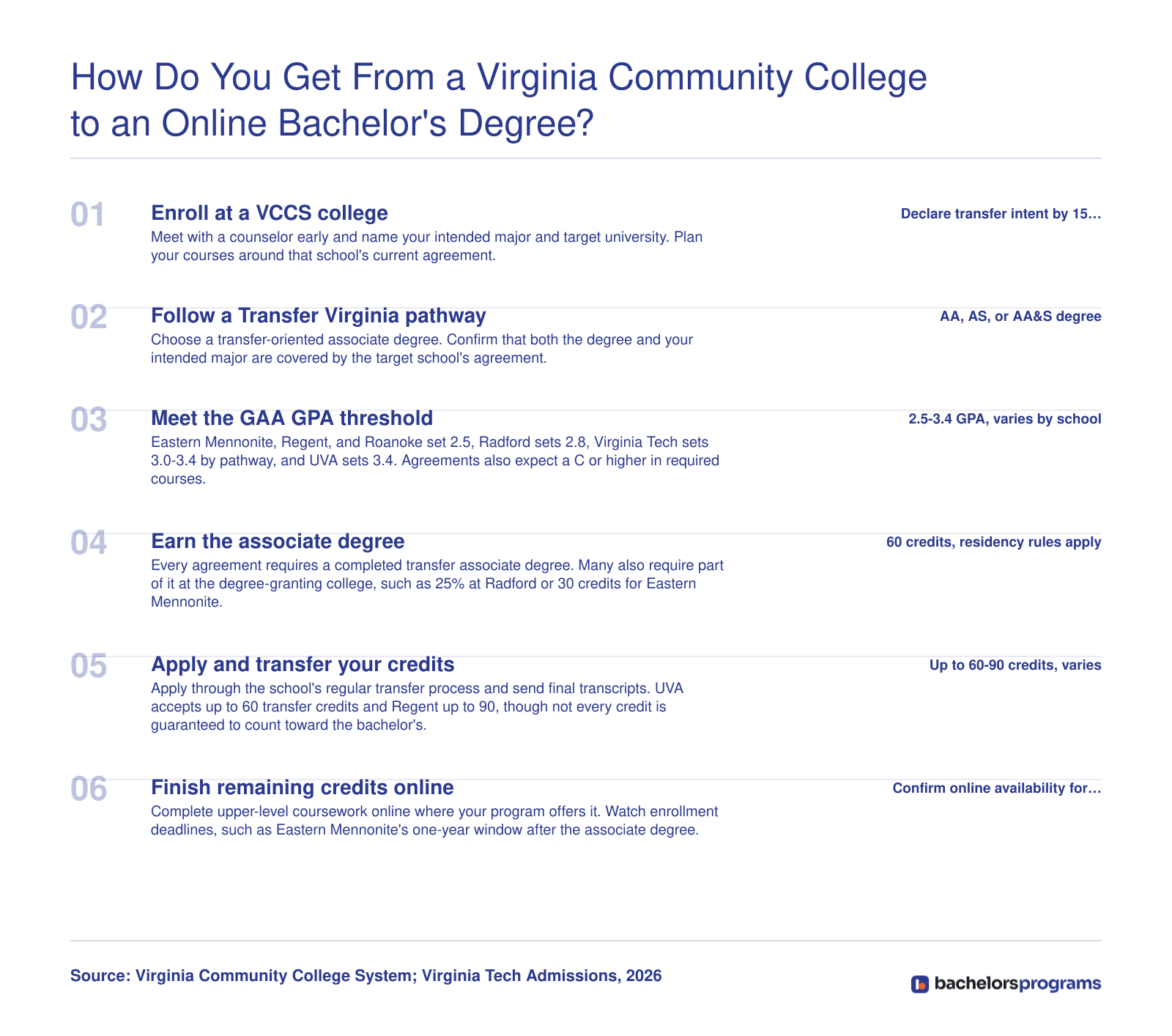
How Do You Get From a Virginia Community College to an Online Bachelor's Degree?
Virginia's Guaranteed Admission Agreements let community college students move into a four-year school on a planned route, but each agreement sets its own GPA, grade, and credit rules. Note that the guarantee covers admission to the institution, not always admission to a specific major, so confirm your program's conditions early.
How Many Transfer Credits Virginia Colleges Accept, Plus Credit for Prior Learning
How many credits will a Virginia college actually accept from your community college transcript? The answer depends on where your target school sets its ceiling and how much of the degree must be earned in residence.
Where the Caps Fall
Old Dominion University accepts up to 90 credits toward a bachelor's degree.1 Under its guaranteed admission agreement with the Virginia Community College System, the associate degree must include at least 60 credits, 30 of them completed at the community college awarding it.1 George Mason University also caps total transfer at 90, with no more than 75 coming from two-year institutions and credit-by-exam combined.2 Liberty University's 90-hour ceiling works out to roughly 75% of a degree and shifts with degree length and program requirements; its Experience Plus route can award up to 30 hours for professional and military experience. Regent University takes up to 90 credits toward a bachelor's but only 48 from an associate degree, and separately limits credit by exam to 30 semester hours at the bachelor's level (15 at the associate level).
The Residency Floor
Every degree carries a residency requirement: a minimum number of credits earned at the school granting the diploma. That floor is what keeps transfer credit from stacking indefinitely, which is why a 90-credit cap rarely translates into 90 credits in practice. Catalogs vary, and no statewide policy in Virginia sets a separate residency minimum for online bachelor's degrees, so confirm the current rule and any final-term requirement in the catalog or a degree audit.
Credit for Prior Learning in Virginia
State policy requires Virginia's public institutions to assess military training and experience for credit, typically through the Joint Services Transcript and ACE recommendations, and to disclose residency requirements at or before enrollment.3 CLEP, DSST, AP, Cambridge, and IB exams can also count, though awards are not guaranteed and may be reevaluated when you enroll.4 Portfolio assessment and industry certifications appear in many prior-learning policies, particularly at private universities.
National online universities often accept more transfer credit than Virginia schools, but they rarely hold articulation agreements with Virginia community colleges. Ask the school for an unofficial review of your transcript before you submit an application.
Admissions Requirements and Course Formats for Virginia Online Students
Most Virginia online bachelor's programs ask for the same core documents as on-campus programs, but online learners should also confirm they are ready for the course format and technology. Use this checklist before you apply.
- High school diploma or GEDExpect to show proof of high school completion, though many Virginia schools now admit first-year applicants without SAT or ACT scores under test-optional policies.
- Minimum GPACheck each program's GPA floor, and note that transfer applicants using a Virginia Community College System guaranteed admission agreement often need a higher GPA than the general minimum.
- Official transcriptsRequest sealed or electronic transcripts from every college you have attended, plus your Joint Services Transcript if you served in the military, so credits can be evaluated.
- Course format readinessFind out whether courses run in accelerated eight-week terms, whether they are asynchronous or include scheduled live sessions, and how many start dates the school offers each year.
- Technology requirementsPlan on a reliable computer, broadband internet and a webcam, since many online exams use remote proctoring.
- Proctoring and on-site testingAsk whether any exams must be taken at an approved testing center or on campus, and budget time and travel accordingly.
Virginia Online College Graduation Rates and Student Outcomes
Graduation and retention rates answer two different questions, who finishes a degree, and who comes back for a second year, and each is counted in a specific way. Published figures for Old Dominion University, Liberty University, George Mason University, and Regent University vary by cohort, modality, and methodology, so verify the current numbers yourself rather than relying on a single quoted percentage. Each of those figures has a public source you can pull yourself.
Start With Federal Data
- IPEDS College Navigator and Data Center: Pull the six-year graduation rate and the retention rate for each school. Graduation rates track a full-time, first-time cohort, and retention rates are reported separately for full-time and part-time students.1
- Outcome Measures: Look for the eight-year completion figures. These cover four entering groups, including part-time and transfer students, and report awards at 4, 6, and 8 years.1 That makes them more useful for adult and online learners.
- College Scorecard: Compare completion and earnings data from the U.S. Department of Education.
- Institutional research pages: Each school's consumer-information page often explains its own cohort definitions and may add online-student outcomes.
Add Virginia-Specific Sources
The State Council of Higher Education for Virginia (SCHEV) publishes research reports, college outcomes data, and distance-learning reports, including a January 2025 look at long-term distance-learning trends. Its outcomes resources include six-year graduation trends by economic subcohort.3 SCHEV may not publish separate distance-education outcomes for every institution, so a gap there does not mean a school is hiding something.
Also check each university's own site. George Mason, for example, posts institutional targets for eight-year graduation and first-year retention.2 Those are goals, not necessarily the latest federal figures, so label them correctly when you compare.
Put the Numbers in Context
- Use BLS.gov for occupational outlook and wage data in your intended field.
- Check program accreditor or professional-association pages for licensure and employment information.
- Ask admissions for current outcomes for online students specifically, since campus-wide rates can mask differences.
- Confirm the definitions before you compare. Make sure the schools use the same cohort, the same time frame, and the same full-time or part-time grouping.
A rate that looks lower may simply reflect a different mix of students, such as more transfers or part-time enrollees. Compare like with like, and treat any gap as a question to ask rather than a verdict.
Accreditation and Licensure for Online Programs in Virginia
Accreditation questions come in two forms, and Virginia students often conflate them: whether the college itself is accredited, and whether the specific program is recognized for the license or credential you are pursuing. Both matter, but to different audiences.
Institutional Accreditation
An online bachelor's from a Virginia college carries the same institutional accreditation as the same degree earned on campus; the online format does not create a separate category. Most Virginia schools hold accreditation from SACSCOC, the regional body for the southeastern states. Regent University, Marymount University and Liberty University are examples, each authorized through the degree levels it actually awards. Confirm that the degree you want sits inside that authorized scope, not merely that the university appears in a database.
Programmatic Accreditation and Licensure
Program-level recognition is a separate layer, and whether it matters depends on your goal:
- Nursing: CCNE and ACEN accredit nursing programs. UVA's nursing programs hold CCNE accreditation through June 30, 2034,1 and its pre-licensure tracks are approved by the Virginia Board of Nursing;2 NOVA's associate nursing program is ACEN-accredited. Many online RN-to-BSN options are completion programs for licensed nurses, so check whether the track leads to initial licensure if that is your goal.
- Business: AACSB signals business-school quality and can matter to employers and graduate admissions, but Virginia issues no general business license, so it is not a legal requirement. Treat it as an employer or graduate-school consideration unless a program says otherwise.
- Education: Virginia teacher licensure requires completion of a VDOE-approved educator preparation program.3 The VDOE publishes the approved list, which includes more than 36 Virginia institutions.4 Verify the exact online program is listed and leads to your intended endorsement.
Disclosures and Verification
Under the State Authorization Reciprocity Agreement, colleges must disclose whether a program meets licensure requirements outside Virginia. Read that statement if you live out of state or plan to move. Then verify accreditation through the U.S. Department of Education's database or CHEA rather than the school's own claims.
Virginia Teacher Licensure Through an Online Bachelor's Degree
How to Choose the Right Virginia Online Bachelor's Program for Your Situation
Online bachelor's degrees are now a mainstream route into higher education, so the question for Virginia students is no longer whether to study online but which model fits their life. The right answer depends on who you are when you enroll.
Match the Program to Your Student Type
- Working adults: Look for 8-week terms, a low per-credit price, and asynchronous delivery so coursework fits around shifts and family. Live log-in times are the first thing to check, because they can quietly undo the flexibility.
- Virginia Community College System (VCCS) transfers: Prioritize four-year partners with a Guaranteed Admission Agreement. These spell out the GPA and credit conditions in advance, which removes much of the guesswork.
- Military and veterans: Confirm the school accepts the Joint Services Transcript for credit and offers in-state rates to service members and eligible family.
- First-time students: Weigh retention support and graduation rates most heavily. Advising, tutoring, and early-alert systems matter more here than speed.
Virginia Public vs. National Online College
A Virginia public university usually wins on in-state tuition, eligibility for state aid, and transfer agreements built around VCCS course numbering. If you are a Virginia resident, start there.
A national online college can come out ahead in a few cases:
- Your prior credits exceed a public school's transfer cap.
- You need frequent start dates rather than two or three a year.
- You want competency-based pacing to move quickly through material you already know.
In those cases, compare total cost after credit, not the advertised rate.
Verification Checklist
Before you apply, confirm each of the following:
- Institutional accreditation: The school is accredited by the Southern Association of Colleges and Schools Commission on Colleges (SACSCOC) or another recognized regional accreditor.
- Programmatic accreditation: If the degree leads to licensure, as in nursing or teaching, the specific program holds the required approval.
- In-person requirements: Get any clinicals, practicums, proctored exams, or campus residencies in writing.
- Total cost after transfer credit: Ask for an itemized estimate that includes fees and the credits you will actually bring.
- Online-student completion data: Ask for graduation and retention figures for online students specifically, not the campus-wide average.
A program that passes all five checks is worth a closer look, whatever the sector.
Colleges in Virginia with the most bachelor's programs
| School | City | Type | Bachelor's programs | Online | Net price / yr | Grad rate |
|---|---|---|---|---|---|---|
| Liberty University | Lynchburg | Private nonprofit | 147 | 77 | $29,357 | 65% |
| George Mason University | Fairfax | Public | 122 | 27 | $17,915 | 68% |
| Old Dominion University | Norfolk | Public | 110 | 29 | $14,638 | 46% |
| Virginia Commonwealth University | Richmond | Public | 101 | 8 | $23,433 | 63% |
| Virginia Polytechnic Institute and State University | Blacksburg | Public | 82 | 1 | $24,953 | 86% |
| Radford University | Radford | Public | 77 | 9 | $14,578 | 49% |
| Regent University | Virginia Beach | Private nonprofit | 71 | 59 | $19,923 | 57% |
| University of Virginia | Charlottesville | Public | 69 | 3 | $21,565 | 96% |
| University of Lynchburg | Lynchburg | Private nonprofit | 65 | 0 | $22,235 | 57% |
| Hampton University | Hampton | Private nonprofit | 65 | 14 | $25,319 | 57% |
| Virginia State University | Petersburg | Public | 63 | 3 | $15,840 | 39% |
| Longwood University | Farmville | Public | 59 | 1 | $19,066 | 61% |
| Norfolk State University | Norfolk | Public | 58 | 10 | $15,282 | 39% |
| Shenandoah University | Winchester | Private nonprofit | 55 | 4 | $30,298 | 67% |
| University of Mary Washington | Fredericksburg | Public | 52 | 3 | $20,667 | 66% |
Program counts are the verified bachelor's listings in our directory; net price is the school-wide average a first-time undergraduate paid after aid, and graduation rate the share finishing within six years (College Scorecard).
Compare programs nationwide
Many Virginia residents study online. Every ranked list above has an online lens, or browse every field.
Online bachelor's degrees Browse all fields