Best Business Degree Programs (BBA & BSBA)
Compare 3,600+ accredited Business programs at 1,650+ colleges, with net price after aid, graduation rates, earnings and debt from IPEDS and the U.S. College Scorecard.

How much does a bachelor's in business actually cost after aid, and what does it pay in the first year? Business is still one of the largest undergraduate majors in the U.S., yet two schools that look identical on paper can differ by tens of thousands of dollars in net price, and by a comparable margin in what their graduates earn early on.
The numbers here come from federal records of what graduates of specific programs earned and borrowed, not from reputation surveys. Accreditation, delivery format and concentration choices move those figures as much as a school's name does.
Key Points
- UC Berkeley grads earn a median $90,008 against $11,300 in debt.
- Your concentration often shapes starting pay more than BBA versus BSBA.
- AACSB accreditation emphasizes faculty research alongside teaching and learner success.
The 10 Best BBA & BSBA Business Schools for 2027
Ten business schools, ten different bargains. Some send graduates into six-figure roles within a few years, while others keep debt low enough that a first job covers it comfortably. Below is a closer look at each program's shape, its concentrations and the kind of student it fits.
University of California-Berkeley
#1Berkeley, CA · ~$13,000/yr (est.)
Best for: Aspiring founders eyeing Silicon Valley networks
Berkeley's Haas School of Business runs a small, cohort-based undergraduate program inside one of the country's most selective public universities. Students pick among several structured pathways, including a four-year program with built-in internships, study abroad and a capstone, and a joint business-and-engineering track. Median earnings for business graduates were $90,008 one year after finishing.
- BS in Business Administration at the Haas School
- Tight-knit cohort model backed by a 45,000-person alumni network
- Entrepreneurship-focused curriculum with venture capital and startup paths
- Multiple specialized business tracks inside the degree
- Global Management Program includes a required Berkeley Global Edge term
- M.E.T. option pairs the business degree with a second engineering bachelor's
- Spieker Program adds internships, study abroad and capstone work
Harvard University
#2Cambridge, MA · $15,000 – $20,000/yr (est.)
Best for: Working adults wanting an Ivy League credential
Harvard's undergraduate business route runs through the Extension School rather than the traditional first-year application. The Bachelor of Liberal Arts lets students study business administration and management as a field within the Social science concentration, with hundreds of electives across 13 fields of study. Most of the 128-credit degree can be completed online, and the campus requirement is met over a few weekends or a summer term.
- Business administration and management studied within the Social science concentration
- 128 credits total, with at least 64 completed at Harvard
- Transfer up to 64 credits toward the degree
- Admission through three 4-credit courses with a B or better and a 3.0 GPA
- Campus requirement met through weekend options or a summer term
- Fall, spring and summer starts with part-time or full-time pacing
- Hundreds of electives drawn from 13 fields of study
Georgia Institute of Technology
#3Atlanta, GA · ~$12,000/yr (est.)
Best for: Analytics-focused students at a technical university
Scheller College of Business pairs a BSBA with the resources of a technical research university, and the college's degrees hold AACSB International accreditation. The curriculum leans into management of technology, international business, and entrepreneurial and innovative processes, backed by research centers in analytics, sustainability and leadership. Median earnings for business graduates were $73,557 one year after finishing.
- Bachelor of Science in Business Administration from Scheller
- AACSB International accreditation across the college's degrees
- Coursework blends core business functions with management of technology
- Centers focused on business analytics, sustainability, leadership and entrepreneurship
- Established in 1912 as the School of Commerce
- Also awards the MBA, MS in Analytics and PhD in Management
University of North Carolina at Chapel Hill
#4Chapel Hill, NC · ~$12,000/yr (est.)
Kenan-Flagler's BSBA is a general management degree that deliberately blends business fundamentals with a liberal arts foundation. Students complete 27 credit hours of core business coursework, from finance and marketing to ethics, then add business electives and areas of emphasis. Median earnings for business graduates were $85,618 one year after finishing.
- General management BSBA through the Kenan-Flagler Business School
- 27 core business credit hours covering finance, marketing and ethics
- 61.5 total credit hours in the major, with business electives
- Minimum 2.000 GPA required, plus separate admission to the program
- Areas of emphasis available alongside global programs
- Honors thesis opportunity and career services included
Rice University
#5Houston, TX · ~$13,000/yr (est.)
Rice's business degree is a Bachelor of Arts with a management concentration, built for students who want behavioral and strategic depth alongside accounting, finance and operations. At 16 courses and 120 credit hours, it leaves room for a second major or a change of concentration, and departmental honors are available. Coursework emphasizes leadership, negotiation and decision-making in real business settings.
- BA in Business with a Management concentration
- 16 courses and 120 credit hours total
- Combines accounting, finance, operations, marketing and strategic management
- Specialized coursework in leadership, teamwork, negotiation and decision-making
- Change concentration after declaring, with departmental honors available
- Transfer credit capped at 9 credit hours
- Minimum of 11 upper-level courses required
University of Michigan
#6Ann Arbor, MI · $18,000 – $61,000/yr (est.)
Ross runs a four-year BBA with a cohort core of roughly 80 students, a required senior capstone and 16 to 18 credits of business electives. The Inclusive Leaders Pathway threads human-centered practice and intercultural perspectives across all four years, and an optional global semester exchange is available. Median earnings for business graduates were $93,674 one year after finishing.
- 120 total credits split across Ross, U-M and elective coursework
- Floating core of BE 300, FIN 300, MKT 300 and TO 300
- Core classes run in a cohort of about 80 students
- 16 to 18 business elective credits, including global experience coursework
- Inclusive Leaders Pathway spans all four years of the degree
- Week-long entrepreneurial challenge and annual Signature Learning Experience
- Optional Global Semester Exchange
University of California-Irvine
#7Irvine, CA · $14,000/yr (est. net price)
The Merage School's business administration degree is campus-based and structured around 11 core courses, five electives and six emphasis options including accounting and marketing. Students complete an international business requirement and can add an internship, a corporate speaker series and a new venture competition. Median earnings for business graduates were $48,786 one year after finishing.
- Tracks: Accounting, Marketing (six emphasis options in all)
- 11 core business courses plus 5 business electives
- International business requirement with study abroad opportunities
- Minimum 3.0 GPA for transfer admission
- Internship program, corporate speaker series and New Venture Competition
- Business communication course with leadership and teamwork focus
- Preparatory coursework in calculus, economics, statistics and accounting
University of Florida
#8Gainesville, FL · ~$4,800/yr (est.)
Florida's BSBA in General Business is delivered through UF Online by the AACSB-accredited Warrington College of Business, covering accounting, economics, business law, finance, management, marketing and real estate. Transfer admission is well mapped, with seven prerequisites, a stated GPA bar and a conditional path for applicants who are close. Median earnings for business graduates were $52,032 one year after finishing.
- General Business major delivered through UF Online
- AACSB International accreditation through the Warrington College of Business
- Five concentration options within the degree
- Seven prerequisites at a 2.5 prerequisite GPA for upper-division transfer
- Conditional admission with five of seven prerequisites at a 2.9 GPA
- Path into UF MBA's 16-month accelerated program
- Military benefits accepted and financial aid available
CUNY Bernard M Baruch College
#9New York, NY · $7,000 – $15,000/yr (est.)
Baruch's Zicklin School divides the BBA almost evenly between liberal arts and business, with 34.5 credits of business base coursework and 24 credits in the major. A required liberal arts minor ends in a capstone course, and an optional 24- to 30-credit liberal arts concentration adds breadth for students who want it. Median earnings for business graduates were $45,758 one year after finishing.
- 124 total credits, roughly half in arts and sciences
- 34.5 business base credits plus 24 credits in the major
- Liberal arts minor required, ending in a 4000- to 6000-level capstone
- Optional 24- to 30-credit liberal arts concentration
- 2.0 GPA required overall and in the major
- 60% of major credits must be completed at Baruch
- Transfer students need at least 31 credits at Baruch
University of Washington-Seattle Campus
#10Seattle, WA · ~$14,000/yr (est.)
The Foster School's business administration major is capacity-constrained, so admission is a separate step from getting into the university. Students specialize in areas such as accounting, finance and marketing after finishing prerequisites in accounting, economics and statistics, with a minor and an international studies certificate available. Median earnings for business graduates were $49,004 one year after finishing.
- Capacity-constrained major requiring a separate application
- Specializations include accounting, finance and marketing
- Prerequisites in accounting, economics, statistics and calculus
- 2.0 cumulative and 2.0 business GPA minimums
- 60 academic credits needed at the time of application
- Transfer students apply to both the university and the business school
- First-year direct admission possible for some applicants
Cost & outcomes by school
Federal data for the highest-earning Business programs, independent of the ranking above. Earnings are this field's bachelor's graduates four years after completing where the Scorecard reports them, else the school's undergraduate median.
| School | Net price / yr | Grad rate | Earnings | Debt | Grads/yr | Format |
|---|---|---|---|---|---|---|
| Massachusetts Institute of Technology MA | $20,111 | 96% | $143,372 | $14,768 | 2,896 | Campus |
| California Institute of Technology CA | $16,075 | 94% | $128,566 | — | 500 | Campus |
| Babson College MA | $40,514 | 93% | $123,938 | $20,000 | 1,524 | Campus |
| Bentley University MA | $37,930 | 87% | $120,959 | $25,023 | 2,164 | Campus |
| Carnegie Mellon University PA | $31,944 | 94% | $114,862 | $21,750 | 4,542 | Campus |
| University of Pennsylvania PA | $28,699 | 97% | $111,371 | $15,715 | 7,188 | Campus |
| Claremont McKenna College CA | $28,849 | 91% | $104,736 | $13,500 | 1,018 | Campus |
| Cornell University NY | $28,690 | 95% | $104,043 | $14,000 | 9,222 | Campus |
| Boston College MA | $41,704 | 91% | $103,937 | $19,000 | 6,686 | Campus |
| Georgetown University DC | $40,815 | 95% | $103,494 | $15,500 | 4,462 | Campus |
| Georgia Institute of Technology GA | $12,116 | 94% | $102,772 | $21,672 | 9,744 | Campus |
| Columbia University in the City of New York NY | $21,590 | 96% | $102,491 | $21,500 | 5,836 | Campus |
Sources: U.S. Department of Education. Net price, graduation rate, earnings and debt: College Scorecard (earnings and debt for this field's bachelor's graduates where reported, else school-wide); graduates: IPEDS. A dash means no figure is reported.
Cost, debt & payoff
Median earnings of this field's bachelor's graduates (4 yrs after completing, else the school's undergraduate median) vs. their median federal loan debt · U.S. College Scorecard
Across these programs the median graduate earns about $52,528 and finishes with roughly $23,000 in debt — a ratio that clears a common rule of thumb (keep debt below first-year salary). Net price and debt vary widely school to school, so check the per-school figures in the table above before you shortlist.
BBA vs BSBA: Where the Two Degrees Actually Split
The letters on the diploma matter less than the catalog behind them, because a BBA at one school can be as quantitative as a BSBA at another. If you want a direct answer, the BSBA suits analytics, finance and MBA-bound students, while the BBA suits management, marketing and entrepreneurship generalists. Employers and MBA admissions committees generally weigh the school, your grades and your experience over the label. Before you commit, check which degree title each school ranked above actually awards.
| Factor | BBA | BSBA |
|---|---|---|
| Core curriculum focus | Typically more applied and management-focused | Broad exposure to accounting, finance, marketing, management, economics and operations, usually leaning quantitative |
| Math and quantitative requirements | One BBA catalog (Minnesota Duluth) requires MATH 1160 Finite Mathematics and Introduction to Calculus or MATH 1296 Calculus I (5 credits each), plus Econ 2030 Applied Statistics | One BSBA catalog requires MATH 220 Calculus for Business and Management (or MATH 223 and 224) plus STAT 1100 Statistics and Probability for Business Management |
| Credit load | 120 credits in the Minnesota Duluth example | 126 credit hours in one BSBA catalog |
| General education breadth | 35 liberal education credits plus a course meeting the international perspective requirement; typically more room for liberal-arts electives | Arts and sciences minimums run from at least 41 credits to 63 liberal arts and sciences credits, depending on the school |
| Typical concentrations | Management, marketing, entrepreneurship | Analytics, finance, operations, global management |
| Career fit | General management, sales, marketing and small-business roles | Analyst, financial and data-driven roles |
| Graduate school preparation | Solid for an MBA when paired with strong grades and work experience | Often positioned as a direct path to an MBA, thanks to heavier quantitative preparation |
| Employer and admissions view | Judged on school, academic performance and experience, not the label | Judged on school, academic performance and experience, not the label |
Why Federal Outcome Data Beats Prestige in Our Scoring
Federal outcome data tells you more about a business degree than a school's reputation does, because it records what graduates of a specific program actually earned and borrowed.
What Goes Into the Scoring
The rankings lean on College Scorecard figures for the business program itself: median earnings, median debt, and how many students complete it. School-wide measures round out the picture: net price after grants and scholarships, the graduation rate, and the share of first-year students who return for a second year.
Where the Numbers Stop
These figures have limits worth knowing before you lean on any one number.
- Program-level data: Earnings and debt are medians for the business program, so about half of graduates landed above that figure and half below.
- School-wide data: Graduation rate and net price describe the whole institution, not the business college alone.
- Missing figures: Some programs publish no earnings because their graduating cohorts are too small to report.
Why Prestige Measures Stayed Out
Reputation surveys and acceptance rates were left out on purpose. A low acceptance rate shows how many people want a seat, not what a typical graduate earns or owes. Survey scores capture perception, and perception rarely translates into a number you can budget around.
Who Is Likely to Appear
The ranking filters spanned every delivery format, online, hybrid and on-campus, and favored larger programs. Very small programs with thin data are therefore less likely to show up here. A strong small program absent from the list is not a weak program. If one is on your shortlist, look up its Scorecard page directly and compare it against the schools below.
AACSB, ACBSP or IACBE: Which Business Accreditation Carries Weight
Three accreditors certify most business schools, and they do not measure the same things.
What Each Accreditor Looks At
AACSB emphasizes faculty scholarship and research alongside teaching, curriculum, and learner success. Its standards are principles-based and tied to each school's mission, and the process involves internal assessment, adviser mentorship, an improvement plan, and peer review. ACBSP centers on teaching quality and student learning. IACBE is outcomes-based and mission-driven, judging a school against its own stated goals rather than a uniform resource model.
How Common AACSB Is
AACSB's own 2026 materials put its accredited institutions at roughly 1,100 across about 70 countries and territories, and say only about 6% of institutions offering business degrees worldwide hold it. Counts on its pages vary by date and category (one educator page says more than 900, and 195 institutions carry a separate accounting accreditation), and we found no clean U.S.-only figure, so treat these numbers as approximate. Official ACBSP and IACBE totals could not be confirmed.
When AACSB Matters
AACSB carries the strongest employer-facing signal. Give it priority if you are aiming at Big Four accounting recruiting, CPA-track roles, or later MBA and PhD study. No official survey shows employers require it, however, and nothing establishes that graduate programs reject ACBSP or IACBE schools. For marketing, management, operations, or small-business paths, an ACBSP or IACBE school is generally a reasonable choice.
Keep Institutional Accreditation Separate
Business accreditation is programmatic. Regional (institutional) accreditation covers the whole university, and it is the non-negotiable one: it determines federal financial aid eligibility and whether your credits transfer. A business badge cannot make up for a school that lacks it.
We do not assume any ranked school's business accreditation. Confirm it directly in each accreditor's directory and on the school's own site before you apply.
Related Articles
What a Business Degree Really Costs at the Lowest-Priced Ranked Schools
Net price below is each school's institution-wide average after grants and scholarships, based on U.S. Department of Education College Scorecard and IPEDS data for 2024, so your own bill will depend on your aid package. Residency drives the biggest swing at these public schools: out-of-state students pay $9,791 more per year at Texas A&M University-Central Texas, $7,950 more at Baruch College and $12,703 more at the University of Florida. Payback looks manageable at all of them, since each median monthly loan payment ($127 to $168) is under 5 percent of the business program's median first-year earnings before taxes ($45,400 to $52,032).
| School | Average Net Price After Aid (Institution-Wide) | In-State Tuition and Fees | Out-of-State Tuition and Fees | Out-of-State Premium | Median Federal Debt at Completion (Business Grads) | Median Monthly Payment, 10-Year Plan | Median First-Year Earnings (Business Grads) |
|---|---|---|---|---|---|---|---|
| Texas A&M University-Central Texas (Killeen, TX) | $1,300 | $7,363 | $17,154 | $9,791 | $15,875 | $168 | $45,400 |
| CUNY Bernard M. Baruch College (New York, NY) | $3,033 | $7,464 | $15,414 | $7,950 | $12,000 | $127 | $45,758 |
| University of Florida (Gainesville, FL) | $4,815 | $3,876 | $16,579 | $12,703 | $15,000 | $159 | $52,032 |
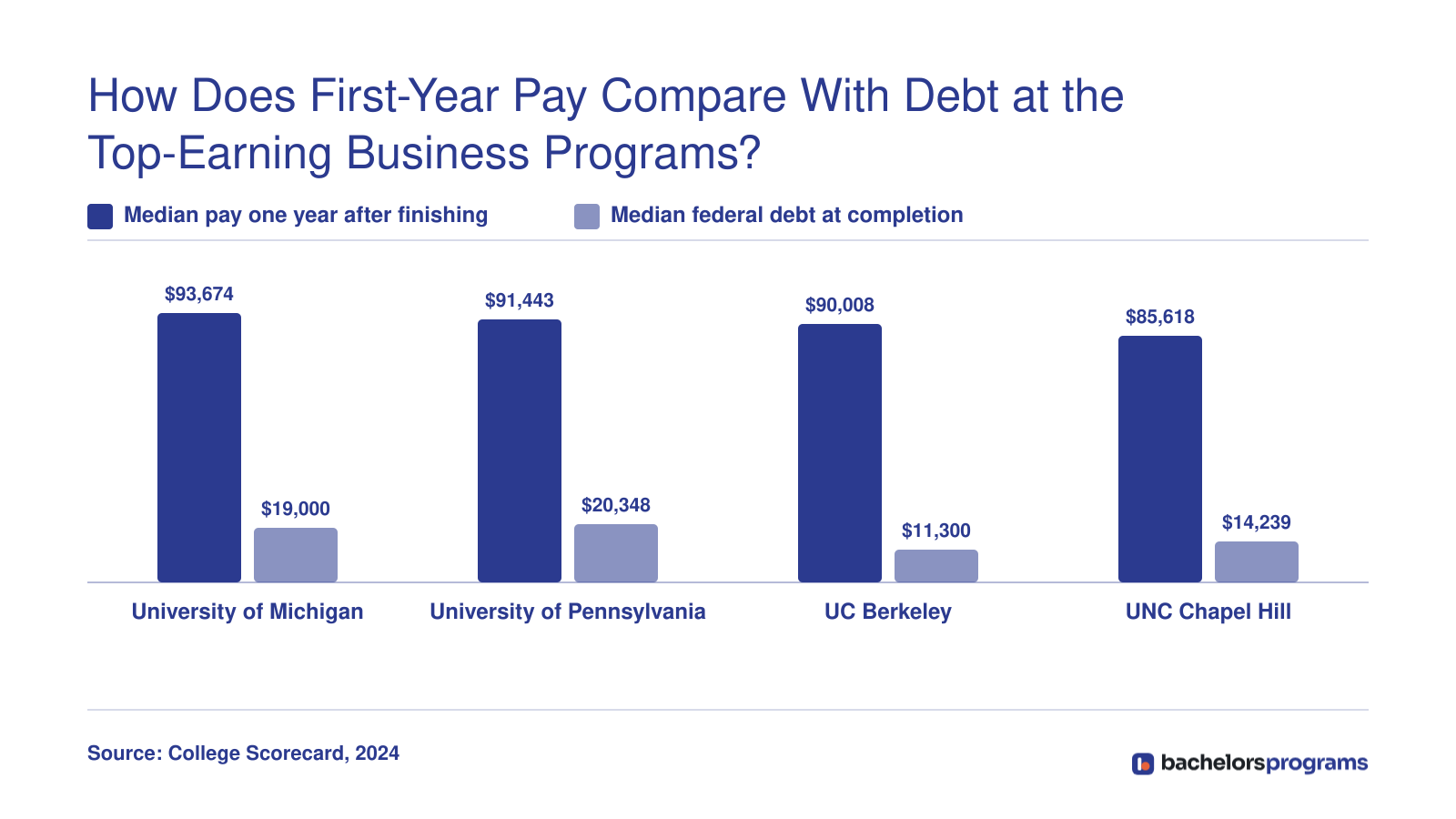
How Does First-Year Pay Compare With Debt at the Top-Earning Business Programs?
Among the highest-earning business programs, graduates' median pay one year after finishing runs four to eight times their median federal debt at completion. UC Berkeley shows the widest gap, about $78,708 between $90,008 in first-year earnings and $11,300 in debt, while the University of Pennsylvania shows the narrowest, about $71,095 between $91,443 in pay and the largest debt load here at $20,348. Washington and Lee posts strong first-year earnings of $76,627 but has no program-level debt figure, so it is left off the chart rather than filled in with campus-wide numbers.
Where Business Grads' Pay Heads Long Term
Entry-level earnings tell only part of the story. Federal wage data for the broader business workforce shows where that pay tends to climb as graduates gain experience.
Business programs by state
Quick Answers on BBA and BSBA Degrees
These answers cover the questions students ask most often when comparing business bachelor's degrees. Each one stands on its own, so skip to the topic you need.
What is the difference between a BBA and a BSBA?
Which is better, a BBA or a BSBA?
How much does a business degree cost after financial aid?
Is AACSB accreditation necessary for a business degree?
Can you earn a BBA or BSBA online?
Do you need calculus to complete a BSBA?
How long does a business bachelor's take if you already have transfer credits?
Compare Business programs on the data that matters
Explore more Business & Management majors or browse every field of study.
All Business & Management programs Browse every field of study