Online Colleges and Bachelor's Degree Programs in Alabama
Every verified bachelor's program at a college in Alabama: 1,500+ programs at 30+ colleges, with the online options, net price and graduation rates behind each one.

Flexibility, cost and credit transfer rarely line up at the same school, and that tension drives most decisions about an online bachelor's degree in Alabama. Public universities, private nonprofits and national for-profit colleges all enroll Alabama online students, yet their per-credit rates, aid rules and transfer policies differ widely.
For someone working full time, the real question is which programs are affordable, properly accredited and built to finish without quitting a job. The answer depends on how many credits you already hold, on licensing for fields like nursing, and on what each school counts toward your major.
Sticker price and net price often diverge sharply, and the cheaper-looking option on paper is not always the cheaper one after aid.
Key Points
- Compare schools by net price, what remains after grants and scholarships.
- Alabama's state aid was designed for campus students, so verify online eligibility.
- Alabama Transfers, formerly STARS, shows which community college credits carry over.
Popular degrees in Alabama
Bachelor's degrees in Alabama by field
Business & Management
- Business Administration41 programs
- Marketing34 programs
- Management26 programs
- Finance24 programs
- Accounting23 programs
- Logistics & Supply Chain Management19 programs
- Human Resource Management or HR Management17 programs
- Communication17 programs
Education & Teaching
- Science44 programs
- Secondary Education27 programs
- Elementary Education25 programs
- English Education20 programs
- Early Childhood Education or Child Development19 programs
- Physical Education19 programs
- Special Education18 programs
- Mathematics Education18 programs
Science & Engineering
- Biology32 programs
- Mathematics25 programs
- Chemistry23 programs
- Biochemistry13 programs
- Electrical Engineering or Electronics Engineering or Electronic Systems Engineering Technology11 programs
- Physics11 programs
- Environmental Science10 programs
- Engineering Technology7 programs
Arts & Design
- Fine Arts or Studio Art32 programs
- Art or Art Studies27 programs
- Graphic Design18 programs
- Audio & Music17 programs
- Media Arts or Digital Media13 programs
- Art History7 programs
- Digital Photography4 programs
- Interior Design4 programs
Liberal Arts & Humanities
- English36 programs
- Literature or English Literature22 programs
- History21 programs
- Interdisciplinary Studies12 programs
- Spanish11 programs
- Global Health or Health Studies10 programs
- Philosophy7 programs
- General Studies4 programs
Communications & Media
- Communications38 programs
- Journalism28 programs
- Public Relations12 programs
- Professional Writing7 programs
- Communication Disorders7 programs
- Speech Pathology7 programs
- Strategic Communications3 programs
Computers & IT
- Computer Science26 programs
- Computer Information Systems15 programs
- Cybersecurity14 programs
- Innovation or Technological Entrepreneurship14 programs
- Information Technology9 programs
- Artificial Intelligence8 programs
- Software Development & Engineering7 programs
- Computer Engineering7 programs
Healthcare
- Exercise & Sports Science18 programs
- Health Sciences13 programs
- Nutrition9 programs
- Public Health9 programs
- Speech Pathology7 programs
- Health Education6 programs
- Health Informatics2 programs
- Respiratory Care Therapy2 programs
Criminal Justice & Law
- Criminal Justice22 programs
- Criminal Justice Administration11 programs
- Criminology7 programs
- Forensic Science5 programs
- Legal Studies4 programs
- Legal Services3 programs
- Corrections3 programs
- Homeland Security3 programs
Social Work & Social Sciences
- Sociology17 programs
- Political Science, Government17 programs
- Social Work16 programs
- Human Services4 programs
- Disability Studies2 programs
Nursing
- Bachelor of Science in Nursing24 programs
- Nursing (RN to BSN)17 programs
- Accelerated BSN (ABSN)5 programs
- LPN/LVN to BSN2 programs
Psychology
- General Psychology22 programs
- Clinical Psychology2 programs
- Counseling Psychology2 programs
- Forensic Psychology1 program
- Health Psychology1 program
- Addiction Psychology1 program
- Sport Psychology1 program
- Developmental Psychology1 program
Natural & Applied Sciences
- Oceanography or Ocean or Marine Biology11 programs
- GIS and Geoscience6 programs
- Agriculture or Agricultural3 programs
Religion & Theology
- Christian Ministry or Ministry Leadership8 programs
- Christian Studies or Religious Studies6 programs
Counseling
- Substance Abuse Counseling2 programs
How Online Bachelor's Degrees Work in Alabama: Fully Online, Hybrid and Degree-Completion Formats
Fully online and hybrid bachelor's degrees differ in how much of the work happens on campus, and which format fits your schedule depends on the program. The label on a program page does not always tell you, so start with the three formats.
The Three Formats
- Fully online: Coursework, advising and testing happen remotely, with no required campus visits.
- Hybrid: Most content is online, but you must attend some in-person sessions, such as weekend intensives or lab days.
- Degree-completion: Built for students who already hold roughly 60 college credits, often from an associate degree, and need only the upper-division courses to finish.
In-Person Requirements Programs Often Downplay
A program can advertise itself as online and still require you to show up. Nursing and other health programs require supervised clinical hours at an approved site. Education majors complete student teaching in a real classroom. Many courses also rely on proctored exams, taken either through an online proctoring service or at an approved testing center. Some schools add a short orientation visit as well. None of this makes a program a poor choice, but each item affects your travel, time off work and costs.
Synchronous vs. Asynchronous Delivery
Synchronous classes meet live at scheduled times, which gives you more interaction with instructors and classmates. Asynchronous classes let you watch lectures and submit work on your own timeline, within weekly or monthly deadlines. That flexibility matters most for shift workers whose hours change from week to week, and for military families who may move or deploy mid-degree. If your schedule is unpredictable, favor asynchronous courses and confirm that required sessions are limited.
How to Verify Before You Apply
Ask each program for two things in writing: a complete list of on-site requirements (clinicals, practicums, student teaching, orientations, exam locations) and its proctoring method, including any fees. If you live outside Alabama, also ask whether the school is authorized to enroll students in your state, since that affects eligibility for clinical placements and, in some fields, licensure. A clear written answer is a good sign. A vague answer is a warning sign before you commit.
What an Online Bachelor's Degree Costs in Alabama: Per-Credit Tuition by School and Sector
The rates below come from each university's published tuition pages or a current online-degree tuition listing, checked in October 2026. Troy and South Alabama's rates are labeled 2026-2027. Many Alabama publics, including Alabama, UAB, Athens State, Troy and North Alabama, charge one online rate regardless of residency, while West Alabama and South Alabama double the price for out-of-state students and Auburn University at Montgomery adds a smaller differential. The 120-credit totals simply multiply the per-credit rate by 120, so treat them as estimates before fees, books, course materials and financial aid, all of which can push your real cost above tuition.
| School | Sector | In-State Online Tuition per Credit | Out-of-State Online Tuition per Credit | Estimated 120-Credit Tuition | Notable Online Fees |
|---|---|---|---|---|---|
| Athens State University | Public | $270 | $270 | $32,400 (estimate before fees and aid) | No separate online fee stated in the cited source; online and blended courses cost the same for out-of-state students |
| University of West Alabama | Public | $325 | $650 | $39,000 in-state; $78,000 out-of-state (estimates before fees and aid) | No separate online fee specified in the published tuition table |
| University of North Alabama | Public | $350 | $350 | $42,000 (estimate before fees and aid) | Program-based charges may apply; students taking 12 to 18 credits pay a $5,250 flat rate per semester instead of the per-credit rate |
| Troy University (TROY Online) | Public | $382 | $382 | $45,840 (estimate before fees and aid) | No separate online fee stated; rate listed for 2026-2027 |
| University of South Alabama | Public | $386 | $772 | $46,320 in-state; $92,640 out-of-state (estimates before fees and aid) | No separate online fee stated; rates listed for 2026-2027 |
| Auburn University at Montgomery | Public | $397 | $421 | $47,640 in-state; $50,520 out-of-state (estimates before fees and aid) | $40 per credit hour in fees (bringing the total to $467 resident or $491 nonresident per credit), plus a $35-per-semester administrative service fee |
| University of Alabama (Bama By Distance) | Public | $399 | $399 | $47,880 (estimate before fees and aid) | Course and test-proctoring fees are extra; books, supplies and individual college fees may be added |
| University of Alabama at Birmingham | Public | $500 per semester hour | $500 per semester hour | $60,000 (estimate before fees and aid) | Online B.S. in Finance and B.S. in Management programs list a $667-per-hour course fee |
How Does Net Price Compare Across Alabama's Public, Private Nonprofit and For-Profit Colleges?
Net price is what a student actually pays after federal, state and institutional grants and scholarships are subtracted from the full cost of attendance, which covers tuition, fees, books, supplies, housing and food. That makes it a better comparison tool than sticker price, especially when weighing public universities charging in-state rates against private colleges that award more institutional aid. Federal net price figures describe full-time, first-time undergraduates who received grant aid, so working adults and transfer students studying online may pay a different amount, and each school's net price calculator is the best way to check.
Financial Aid for Online Students in Alabama: FAFSA, State Grants, Employer and Military Benefits
Alabama's state aid programs were written with campus enrollment in mind, so read the eligibility rules closely before assuming a grant covers online study.
Start With the FAFSA
Federal aid is the foundation, and it does not care whether you attend in person. At an accredited, Title IV-eligible institution, online students qualify for Pell Grants and federal student loans on the same terms as campus students. The catch is enrollment intensity: most federal loans require at least half-time enrollment, so one course at a time may leave you with no loan eligibility even while you make progress toward the degree. File the FAFSA anyway, because Alabama's largest need-based program uses it as the application.1
Alabama's State Programs
The Alabama Student Assistance Program awards roughly $300 to $5,000 per academic year to Alabama residents pursuing a first undergraduate degree at an eligible Alabama institution, and Pell recipients are prioritized.1 There is no separate age restriction, and because the funds flow to institutions, your financial aid office is the place to confirm what you can actually receive.
The Alabama Student Grant Program works differently. It is non-need-based, capped at $3,000 for 2026-2027, and limited to eligible independent Alabama colleges.2 It requires at least half-time enrollment, excludes theology and divinity study, and the fall 2026 deadline at the institution's aid office was September 15, 20263, with later dates for winter and spring starts.
(Re)Engage Alabama targets adults 22 and older who have some college credit but no degree, with a two-year stop-out allowance in cases that meet other requirements. Part-time participants must carry at least six semester hours.4
Guard, Military and Employer Benefits
The Alabama National Guard Educational Assistance Program covers need-based tuition and fees for Guard members in good standing at public Alabama institutions, and recipients must still show at least $100 of cost remaining after other aid is applied.5 With Maxwell AFB, Fort Novosel and Redstone Arsenal in the state, many schools publish military rates alongside GI Bill and Yellow Ribbon participation and Tuition Assistance.
Employer tuition assistance is the other common source of help. Ask any program two questions: is the per-credit rate locked for the year, and do online students qualify for institutional scholarships and transfer awards, which some schools reserve for campus enrollees?
Are Online Degrees From Alabama Colleges Accredited? What to Verify
Athens State University's baccalaureate nursing program holds CCNE accreditation through June 30, 2028, while Auburn's runs through June 30, 2032.1 Those dates certify the program, not the school; an online degree needs both layers checked.
Institutional Accreditation
Institutional accreditation covers the whole school and its authority to award degrees. In Alabama, the regional accreditor is SACSCOC. The University of North Alabama, for example, is accredited by SACSCOC for baccalaureate through doctoral degrees, and the University of Alabama in Huntsville names SACSCOC as its institutional accreditor.2 An online degree from an accredited school carries the same institutional accreditation as its campus version, and the diploma usually does not say "online."
Programmatic Accreditation
Programmatic accreditation applies to a specific major and often decides licensure or graduate-school eligibility. Institutional status does not guarantee it.
- Nursing: CCNE or ACEN.
- Education: CAEP or state approval. UNA and Alabama A&M both report CAEP.4
- Business: AACSB, ACBSP or IACBE. UNA and Alabama A&M report AACSB.3
- Engineering and computing: ABET. It accredits programs, not institutions, and UNA's computer science program is one example.5
Be careful with delivery format. ABET offers a 100% online filter, but most accredited programs are mainly on-site. A listing does not prove every course or lab can be completed online, so confirm the exact bachelor's you want.
How to Check
- Search the SACSCOC member directory for the school.
- Use the U.S. Department of Education's DAPIP database as a second check. Its data is reported by agencies and states and is not audited.
- Look up the program in the specific accreditor's directory, such as CCNE's Alabama listing or ABET's online program search.
Red Flags
The Department of Education recognizes accrediting agencies, so confirm that a school's accreditor is on that recognized list. Unaccredited providers, or schools with only a national accreditor, may find that other colleges decline their credits. That matters if you plan to transfer or pursue a graduate degree later.
If you live outside Alabama, also confirm that the program leads to licensure in your own state. Nursing and teaching approvals are state-specific, so ask the program and your state board directly.
Transferring Community College Credits to an Online Bachelor's Program in Alabama
Most credits earned at an Alabama community college transfer into an online bachelor's program at a public university, provided the courses follow the state's approved transfer guide for your intended major. Private and out-of-state online schools set their own policies.
The Statewide Framework: AGSC and Alabama Transfers
Alabama's General Studies Committee, established in 1994 under Alabama Code §16-5-8(e), sets freshman and sophomore general-studies policy for the state's public colleges and universities. The articulation guides it publishes, long known as STARS, relaunched as Alabama Transfers in November 2022. Participation is mandatory for state-funded accredited public two- and four-year institutions, so an approved general-education course from an Alabama Community College System campus carries protected credit at a participating public university.3 Know the limits: the committee sets the framework, but each university still owns its degree requirements, and the protection does not extend automatically to private or out-of-state institutions.
Using the Guide Correctly
Choose your intended major and destination university first, then pull up the Official Transfer Guide for that exact pathway and print it. A submitted guide must be honored by public universities offering that major for four years. Courses taken outside the guide are the ones that get lost, arriving as general electives or not transferring at all.
Credit for Prior Learning
Beyond coursework, Alabama schools evaluate CLEP and DSST exams, AP scores, portfolio assessment, professional certifications and ACE-evaluated military training submitted on the Joint Services Transcript. Policies and caps vary by campus: Alabama State reviews prior learning case by case7, Jacksonville State accepts up to 43 semester hours for military coursework and training (specific course equivalents typically average 3 to 10 hours)6, and UAB posts military credit from the Joint Services Transcript automatically. CLEP cut scores and credit limits are set by the receiving school, so confirm them before you pay for an exam.4
Degree-Completion Models and Residency
Upper-division options such as Athens State's model assume you arrive with the first two years finished. Every degree also carries a residency requirement, a minimum number of credits earned at the school granting the diploma.5 Those rules are institution-specific, so check the catalog. For private or out-of-state online programs, request an unofficial credit evaluation before you apply.
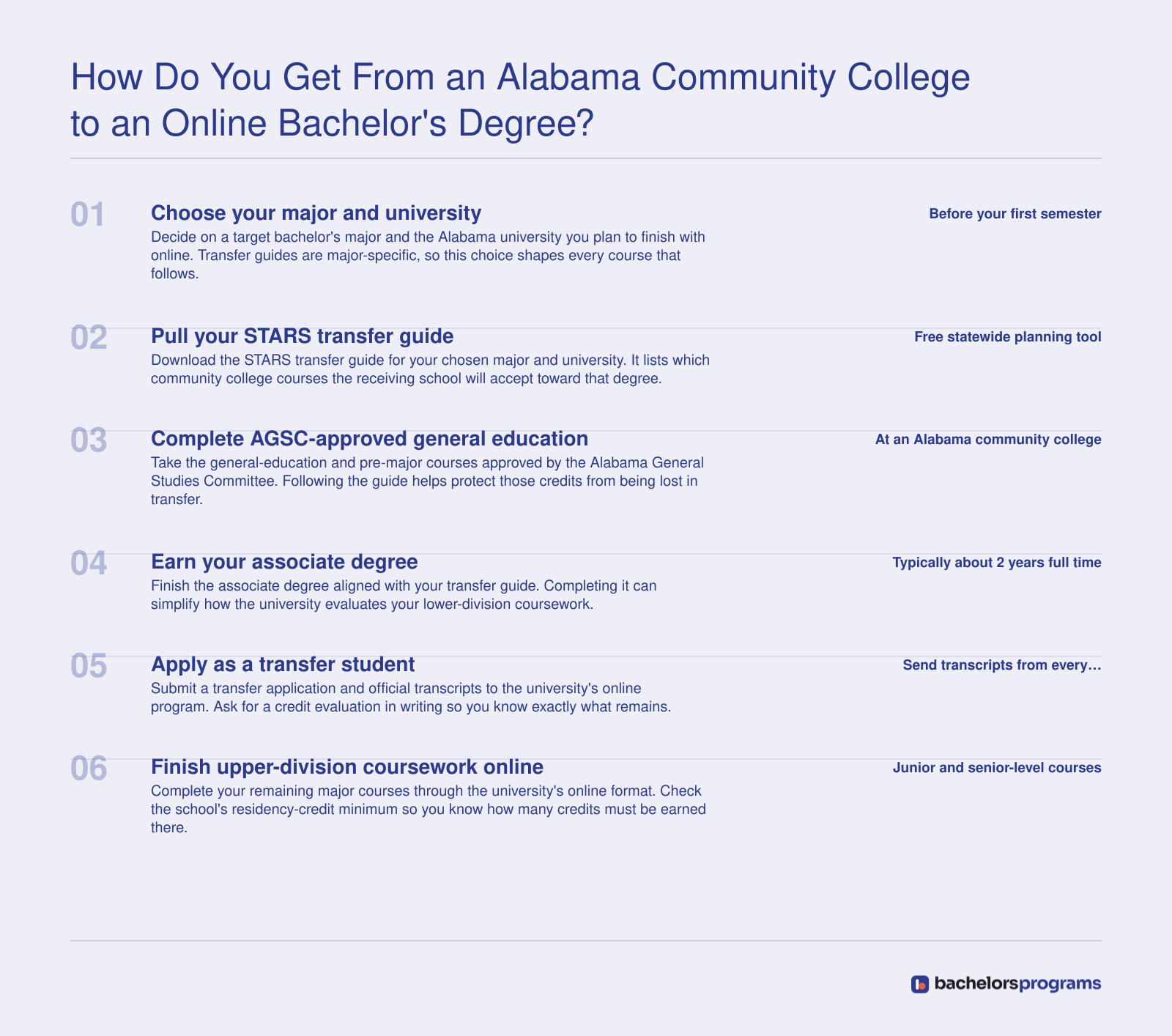
How Do You Get From an Alabama Community College to an Online Bachelor's Degree?
Alabama's statewide transfer system lets community college students map general-education credits to a specific four-year major before they enroll. Follow these steps in order so the courses you take now count toward the online bachelor's you finish later. Before you commit, confirm the receiving university's residency-credit minimum, meaning the number of credits you must complete at that school to earn its degree.
Admissions, Start Dates and How Long an Online Bachelor's Takes in Alabama
Admission rules for online bachelor's programs in Alabama depend on whether you are starting fresh, transferring or finishing a degree. Confirm each requirement with the school before you apply.
- First-time freshmenExpect to need a high school diploma or GED and a minimum GPA. Some schools also ask for ACT or SAT scores, but many are now test-optional.
- Transfer studentsMost programs set a minimum transfer GPA, often around 2.0, and require official transcripts from every college you attended. Some also require a minimum number of completed credit hours.
- Adult and degree-completion learnersSome programs waive test scores for adult applicants. Others require a set number of prior college credits or relevant work experience.
- Start datesMany Alabama online programs run accelerated 8-week terms with several start dates a year, so you may not have to wait for fall. Others follow a standard semester calendar.
- Time to completionA 120-credit degree takes about four years of full-time study if you start from scratch. With an associate degree, plan on roughly two years. Part-time study takes longer.
- Program-specific requirementsRN-to-BSN programs require an active RN license. Education and nursing programs often require background checks, and some majors require prerequisite courses before you can enroll.
RN to BSN Online in Alabama: Licensure and Clinical Requirements
Graduation Rates, Retention and Earnings: Judging Outcomes at Alabama Online Colleges
How do you tell whether an Alabama online bachelor's program actually leads somewhere? Start with outcomes, and read them with care.
What Graduation and Retention Rates Show
The spread among Alabama's public universities is wide. The University of Alabama reports a completion rate of 73.5% and a retention rate of 87.8% in a 2026 College Scorecard-based summary.1 Third-party summaries put Auburn's graduation rate at 82% and Troy's at 50%.2 Those summaries do not always state the cohort or year, so treat them as directional and confirm on Scorecard before relying on them.
Sector matters too. Public universities, private nonprofits and for-profit colleges often post very different completion numbers. Pull each sector's figures for any school you are weighing rather than assuming a public label guarantees strong results.
The First-Time, Full-Time Caveat
Federal graduation rates long tracked only first-time, full-time students. Many online learners are transfers or part-timers and never appear in that count. IPEDS Outcome Measures fits them better. It follows degree-seeking students at 4, 6 and 8 years, and it separates first-time from non-first-time and full-time from part-time students. For a degree-completion program, that is the more honest lens.
Earnings and Debt
College Scorecard is the best free public check on median earnings and debt by school and field. Reported figures vary widely and depend on timing:
- University of Alabama: about $70,439 four years after completion in one summary.1
- Auburn: about $72,440 one year after graduation.2
- Troy: about $58,407 one year after graduation.2
- Athens State: about $78,435 one year after graduation, but the group behind it was only 22 graduates, so do not lean on it.2
Online-only outcomes are rarely published separately, so you are usually reading blended campus and online results.
Enrollment Is Not Quality
High online enrollment or many distance-education completions say little about quality. They show scale, not results. At a regionally accredited Alabama university, the diploma typically does not say "online," and employers generally see the same degree. Judge the school on completion, retention, earnings and debt, not on how many students log in.
The Bachelor's Degree Earnings Premium in Alabama
A bachelor's degree is linked to noticeably higher earnings in Alabama, whether you study on campus or online.
How to Choose the Best Online College in Alabama for Your Situation
Alabama's public colleges publish course-by-course transfer guides through Alabama Transfers, the state articulation system formerly called STARS, so a transfer student can see which credits survive before applying anywhere. There is no single best online college in Alabama, only the school whose format, cost structure and credit policy match your transcript and your schedule.
Match the format to your situation
- Working adults: prioritize asynchronous courses, short 7- or 8-week terms, and a flat online rate that does not carry campus activity and facility fees. Ask directly whether online students are charged in-state tuition regardless of where they live.
- Community college transfers: favor Alabama public universities that publish an Alabama Transfers guide for your intended major, along with degree-completion programs built for students arriving with an associate degree. Send your transcript early and ask for the evaluation in writing.
- Nurses: for an RN-to-BSN, confirm programmatic accreditation from CCNE or ACEN, and ask how clinical or practicum hours are arranged near your Alabama workplace.
- Military and veterans: look for schools that cap tuition at the Department of Defense Tuition Assistance rate per credit hour, take part in the Yellow Ribbon Program, and award credit for military training recorded on the Joint Services Transcript.
Verify before you commit
A short checklist settles most of the uncertainty:
- Institutional accreditation from SACSCOC, plus programmatic accreditation for nursing, business, education or social work where it applies.
- Total cost including fees, and net price after grants and scholarships rather than sticker tuition.
- A written transfer evaluation showing exactly which credits count toward the major.
- Any in-person requirement: labs, proctored exams, clinicals or internships.
- Graduation rates and post-completion earnings on the U.S. Department of Education's College Scorecard.
Your next step
File the FAFSA first, since Alabama aid and federal loans both flow from it. Then request unofficial transcript evaluations from two or three schools at once and compare their total cost on the same basis: 120 credit hours, fees included, aid subtracted. The lowest total on that line is usually the right answer.
Colleges in Alabama with the most bachelor's programs
| School | City | Type | Bachelor's programs | Online | Net price / yr | Grad rate |
|---|---|---|---|---|---|---|
| Auburn University | Auburn | Public | 104 | 8 | $24,323 | 82% |
| University of South Alabama | Mobile | Public | 95 | 18 | $17,648 | 53% |
| The University of Alabama | Tuscaloosa | Public | 94 | 18 | $22,420 | 73% |
| University of North Alabama | Florence | Public | 90 | 21 | $12,170 | 55% |
| University of Alabama at Birmingham | Birmingham | Public | 81 | 18 | $18,749 | 64% |
| Jacksonville State University | Jacksonville | Public | 79 | 9 | $14,279 | 55% |
| Troy University | Troy | Public | 71 | 37 | $16,527 | 50% |
| Samford University | Birmingham | Private nonprofit | 71 | 3 | $32,622 | 77% |
| University of Alabama in Huntsville | Huntsville | Public | 66 | 4 | $18,796 | 64% |
| Alabama A & M University | Normal | Public | 59 | 0 | $17,621 | 24% |
| University of Mobile | Mobile | Private nonprofit | 59 | 4 | $22,382 | 57% |
| Faulkner University | Montgomery | Private nonprofit | 57 | 22 | $22,085 | 37% |
| Auburn University at Montgomery | Montgomery | Public | 55 | 4 | $13,224 | 33% |
| Alabama State University | Montgomery | Public | 54 | 10 | $20,435 | 30% |
| University of West Alabama | Livingston | Public | 50 | 18 | $12,684 | 35% |
Program counts are the verified bachelor's listings in our directory; net price is the school-wide average a first-time undergraduate paid after aid, and graduation rate the share finishing within six years (College Scorecard).
Compare programs nationwide
Many Alabama residents study online. Every ranked list above has an online lens, or browse every field.
Online bachelor's degrees Browse all fields