Best BSN Programs (Bachelor of Science in Nursing)
Compare 1,500+ accredited Bachelor of Science in Nursing (BSN) programs at 1,250+ colleges, with net price after aid, graduation rates, earnings and debt from IPEDS and the U.S. College Scorecard.

A Bachelor of Science in Nursing is the degree that qualifies a graduate to sit for the NCLEX-RN and apply for a registered nurse license. Hundreds of U.S. schools award one, and the spread is wide: average net price ranges from roughly $4,815 at the University of Florida to $28,699 at the University of Pennsylvania.
Formats differ just as much, from four-year campus cohorts to fully online RN-to-BSN completions for licensed nurses. Price rarely tracks quality. Clinical placement capacity and state board licensure rules shape the decision more than the tuition line does.
Key Points
- Texas A&M University-Central Texas lists $7,363 tuition but a $1,300 net price.
- CCNE and ACEN both accredit BSN programs; confirm either before applying.
- Online pre-licensure BSNs move coursework online, but clinical hours stay in person.
10 Top-Ranked BSN Schools, From Campus to Online
This list runs from large public research universities to a small private technical college, and most of the ten lead with campus-based BSN programs. The online entries are RN-to-BSN completions built for nurses who already hold a license, and Wisconsin-Madison appears with campus and online routes side by side, so the same institution can serve first-time students, second-degree seekers, and working nurses.
University of California-Irvine
#1Irvine, CA · $14,000/yr (est. net price)
Best for: First-time students wanting hospital-based clinicals
UC Irvine houses its nursing school inside a large public research university in Orange County, and the BSN cohort stays deliberately small, with an admission rate near 29 percent. About 87 percent of students graduate within six years, and the net price after aid lands near $14,300 for the typical first-year student. Median earnings for nursing graduates one year after finishing were about $87,700, the highest figure on this list.
- CCNE accredited
- Four-year program with a fall start
- Half or more of clinical placements at UCI Medical Center
- Immersive high-tech simulation equipment
- Coursework spans biological, social, behavioral, and pharmaceutical sciences
- Graduates eligible for public health nurse certification
- Close-knit cohort model with interdisciplinary instruction
University of Florida
#2Gainesville, FL · ~$4,800/yr (est.)
Best for: Working RNs needing fully online completion
The University of Florida delivers its BSN as an online RN-to-BSN completion out of Gainesville, built for licensed nurses who already hold an associate degree. Net price after aid is the lowest here at roughly $4,800, and the graduation rate sits near 85 percent. Admission is comparatively open at about 61 percent, and median earnings one year after finishing were around $73,700.
- Fully online RN-to-BSN for licensed nurses
- 90 clinical hours: 45 through virtual simulation, 45 through independent experience
- Two start dates per year, spring and fall
- Requires an active, unencumbered Florida RN license or eNLC licensure
- Associate degree in nursing plus a 2.8 GPA in nursing coursework
- 60 or more college credits for upper-division transfer
- Fingerprinting and drug screening required
University of Michigan
#3Ann Arbor, MI · $18,000 – $61,000/yr (est.)
Best for: Transfer students interested in global clinical experience
Michigan's Ann Arbor campus runs a BSN with more than 1,000 clinical hours, an honors track, and study abroad options. It is the most selective public option on this list, admitting about 16 percent of applicants, and roughly 93 percent of students graduate within six years. Net price after aid is about $13,100, and median earnings one year after finishing were near $75,500.
- CCNE accredited
- Four-year track for first-year applicants, three-year track for sophomore transfers
- More than 1,000 clinical hours
- Clinical rotations begin in the sophomore year
- Global study abroad experiences
- Honors program for high-achievers
- Alumni network of more than 13,000 nursing graduates
- Small student-to-faculty ratio
Florida State University
#4Tallahassee, FL · ~$11,000/yr (est.)
Florida State runs a campus BSN in Tallahassee that compresses the nursing sequence into four consecutive semesters, roughly 15 to 16 months. Admission is competitive at about 24 percent, with admitted students averaging a 3.7 to 3.8 GPA, and the graduation rate is close to 86 percent. Net price after aid is roughly $11,300, and graduates' median earnings one year out were about $70,000.
- CCNE accredited
- Four consecutive semesters, about 15 to 16 months
- 60 total credit hours
- Three start dates per year: fall, spring, and summer
- No entrance exam required
- 3.0 GPA minimum, with admitted students averaging 3.7 to 3.8
- Cohorts of up to 150 students
- Clinical placements across Florida and beyond
Brigham Young University
#5Provo, UT · $15,000 – $20,000/yr (est.)
BYU's Provo campus pairs a CCNE-accredited BSN with unusually low tuition for members of its sponsoring church, and about 68 percent of applicants are admitted. The graduation rate is near 81 percent and net price after aid is about $15,600. Median earnings one year after finishing were around $62,200, and the program leans on service and global health placements rather than scale.
- CCNE accredited
- Prepares graduates for the NCLEX-RN
- Global health practicums in the Czech Republic and Ghana
- Nursing clubs, research, and scholarship programs
University of Pennsylvania
#6Philadelphia, PA · $29,000/yr (est. net price)
Penn's Philadelphia campus runs a four-year, full-time BSN with clinicals starting in the spring of sophomore year and dual-degree options through Wharton, Annenberg, Engineering, and Arts and Sciences. It is the most selective school on this list at roughly 5 percent, and nearly 97 percent of students graduate. Net price after aid is the highest here at about $28,700, while median earnings one year after finishing were near $80,900.
- CCNE accredited
- Four-year, full-time program with one fall start
- Clinicals begin in the spring of sophomore year at hospitals on campus
- Combined programs with Wharton, Annenberg, Engineering, and Arts and Sciences
- Faculty-driven research with advanced simulation technology
- Transfer students generally finish in about three years
Texas A&M University-College Station
#7College Station, TX · ~$21,000/yr (est.)
Texas A&M's College Station campus admits transfer students into a two-year traditional BSN after 59 prerequisite credits, and the same program runs in McAllen. Admission is less selective than most here at about 57 percent, though applicants need a 3.0 GPA and a 75 percent score on every HESI A2 section. The graduation rate is near 84 percent, net price after aid is about $21,300, and median earnings one year after finishing were around $78,300.
- Two-year program for transfer students with 59 prerequisite credits
- 61 total credit hours
- 3.0 prerequisite GPA and 3.0 nursing-science GPA required
- Minimum 75 percent on each HESI A2 section
- Offered in Bryan-College Station and McAllen
- BSN Honors Program available
- Military benefits accepted, including a U.S. Army AECP partnership
Bolivar Technical College
#8Bolivar, MO · ~$28,000/yr (est.)
Bolivar Technical College is a small private school in Bolivar, Missouri, offering a one-year, fully online RN-to-BSN completion with a 5-to-1 student-to-teacher ratio. Admission is close to open at about 95 percent, and the graduation rate is reported near 92 percent. Self-paced coursework and small classes suit nurses who want a low-friction credential rather than a campus experience.
- 100 percent online, self-directed coursework
- Complete in as little as one year
- 5:1 student-to-teacher ratio
- Shadow Health virtual clinical simulations
- Requires NCLEX-RN before applying
- 2.0 GPA minimum
- Employer tuition reimbursement supported
- $50 application fee
University of Wisconsin-Madison
#9Madison, WI · ~$17,000/yr (est.)
Wisconsin-Madison gives readers three routes in one place: a traditional BSN for pre-nursing students, a 12-month accelerated BSN for people who already hold a bachelor's, and an online RN-to-BSN. Admission overall is about 45 percent, the graduation rate is near 90 percent, and net price after aid is roughly $17,400. Median earnings one year after finishing were about $75,500.
- CCNE accredited
- Four-year program, 124 total credit hours
- 93 percent licensure pass rate
- 2.8 GPA minimum to enter the nursing component
- Clinical placements up to 90 miles from campus
- BSN Honors in the Major available
- School registers students for the NCLEX exam
- 12-month completion for non-nursing bachelor's degree holders
- 96 percent licensure pass rate
- Cohort-based structure
- No entrance exam required
- Clinical placements arranged for students
- Second-degree application deadline of October 1
- $452 per credit
- 31 total credit hours, completed in 1.5 to 2.5 years
- Fully online asynchronous classes
- 135 clinical hours plus a capstone
- Seven-week or 14-week course formats
- Two start dates per year, fall and spring
- Statewide collaboration with seven UW campuses
University of Central Florida
#10Orlando, FL · ~$10,000/yr (est.)
UCF runs the largest BSN operation on this list from Orlando, with additional sites in Cocoa and Daytona Beach and a second-degree track for career changers. Admission is about 40 percent, the graduation rate is near 78 percent, and net price after aid is the second lowest here at roughly $10,400. Median earnings one year after finishing were around $73,800.
- CCNE accredited
- Five-semester, cohort-based lock-step curriculum
- Two start dates per year, fall and spring
- TEAS entrance exam required
- Clinical rotations in hospitals, long-term care, and community health centers
- Service-learning in underserved communities
- Military Enlisted Commissioning Program eligible
- Four-semester program starting in summer
- 65 total credit hours
- For people who already hold a non-nursing bachelor's degree
- Orlando campus only; students must be physically located in Florida
- No thesis or capstone required
- About 92 percent of graduates stay in Florida
- Four concentration options
- Complete in four to five years, 120 total credit hours
- Campus locations in Orlando, Cocoa, and Daytona Beach
- Pass rates exceed state and national NCLEX-RN averages
- Approved by the Florida State Board of Nursing
- Limited access program with one start date per year
Cost & outcomes by school
Federal data for the highest-earning Bachelor of Science in Nursing (BSN) programs, independent of the ranking above. Earnings are this field's bachelor's graduates four years after completing where the Scorecard reports them, else the school's undergraduate median.
| School | Net price / yr | Grad rate | Earnings | Debt | Grads/yr | Format |
|---|---|---|---|---|---|---|
| Albany College of Pharmacy and Health Sciences NY | $29,882 | 68% | $131,426 | $25,500 | 274 | Hybrid |
| University of Pennsylvania PA | $28,699 | 97% | $111,371 | $15,715 | 7,188 | Campus |
| Boston College MA | $41,704 | 91% | $103,937 | $19,000 | 6,686 | Campus |
| Georgetown University DC | $40,815 | 95% | $103,494 | $15,500 | 4,462 | Campus |
| Duke University NC | $29,612 | 97% | $97,800 | $13,000 | 5,506 | Campus |
| Mount Sinai Phillips School of Nursing NY | — | 100% | $96,980 | $19,750 | 428 | Campus |
| Northeastern University MA | $30,915 | 91% | $92,538 | $24,250 | 12,086 | Campus |
| Chamberlain University-Missouri MO | $30,716 | 100% | $92,405 | $20,919 | 130 | Hybrid |
| Chamberlain University-Michigan MI | $28,045 | 100% | $92,405 | $20,919 | 278 | Hybrid |
| University of Virginia VA | $21,565 | 96% | $86,863 | $17,500 | 10,898 | Campus |
| University of Michigan MI | $13,138 | 93% | $83,648 | $19,500 | 20,096 | Campus |
| University of California-Los Angeles CA | $12,548 | 93% | $82,511 | $14,000 | 20,598 | Campus |
Sources: U.S. Department of Education. Net price, graduation rate, earnings and debt: College Scorecard (earnings and debt for this field's bachelor's graduates where reported, else school-wide); graduates: IPEDS. A dash means no figure is reported.
Cost, debt & payoff
Median earnings of this field's bachelor's graduates (4 yrs after completing, else the school's undergraduate median) vs. their median federal loan debt · U.S. College Scorecard
Across these programs the median graduate earns about $54,272 and finishes with roughly $22,038 in debt — a ratio that clears a common rule of thumb (keep debt below first-year salary). Net price and debt vary widely school to school, so check the per-school figures in the table above before you shortlist.
What Earned a School a Spot: Price, Persistence, and Payoff
A famous name and a strong nursing school are not always the same thing. The better test is simpler: a great BSN school gets students in, through, and into paid nursing work without crushing debt. The schools below earned their spots on four practical measures:
- Price: average net price after grants and scholarships, which reflects what students typically pay rather than the published tuition.
- Persistence: the share of students who finish a degree at the school.
- Payoff: median earnings for graduates of the school's nursing program after completion.
- Debt: median federal loan debt carried by graduates.
Two caveats keep these numbers honest. The graduation rate covers the whole institution, not the nursing program alone, so a school's nursing cohort may finish at a higher or lower rate. Net price is also a school-wide average. Your own figure depends on family income, residency, and aid offers, so check the net price calculator at any school on your shortlist.
Two things every future nurse should check fall outside these figures: NCLEX pass rates and nursing accreditation. Both matter for licensure. The accreditation section below explains how to confirm CCNE or ACEN status, and the NCLEX section shows where to find each program's first-time pass results.
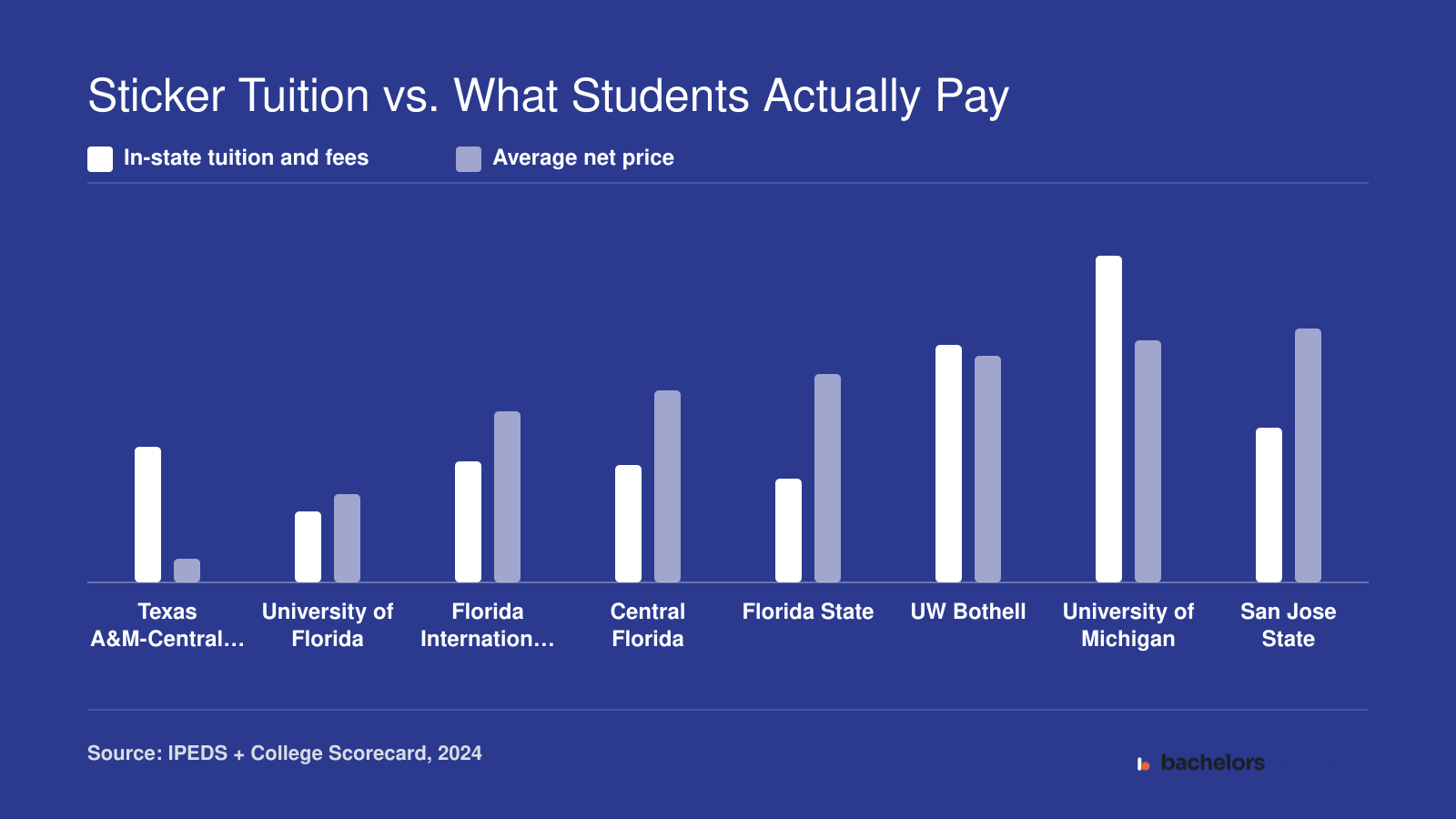
Sticker Tuition vs. What Students Actually Pay
Average net price counts tuition plus housing, books and other costs, minus grants and scholarships, so it can land well below the sticker price: Texas A&M University-Central Texas lists $7,363 in tuition and fees but posts a $1,300 net price, and the University of Michigan drops from $17,736 to $13,138 once aid is applied. At low-tuition Florida publics, net price runs above tuition because living costs are included, so compare total cost rather than tuition alone. The biggest trap in any BSN program tuition comparison is out-of-state pricing: nonresidents pay $60,946 at Michigan and $43,155 at UW Bothell. Net price is a school-wide average, so run each school's net price calculator for your own estimate.
CCNE or ACEN? Confirming Accreditation Before You Apply
The Accreditation Commission for Education in Nursing (ACEN) accredits practical, diploma, associate, baccalaureate, master's, and clinical doctorate programs1, while the Commission on Collegiate Nursing Education (CCNE) focuses on baccalaureate, graduate, and residency education. Both are recognized by the U.S. Department of Education, and neither is inherently better for a BSN.2
Why the Status Matters
Accreditation is not the same as state approval. In most states, NCLEX-RN eligibility depends on graduating from a program approved by that state's nursing regulatory body3, and some states also require national nursing accreditation.4 State rules vary and can change, so check the board in the state where you plan to seek your first license. Graduate programs set their own admission rules and may accept CCNE, ACEN, or either. Employers such as Magnet hospitals and the VA may screen applicants on accreditation.
How to Verify a Program
- CCNE: Search the official CCNE directory, select the baccalaureate category, and confirm the exact degree, campus, status, and dates.
- ACEN: Use the ACEN program search, filtering by program name, location, type, and status, then confirm the institution, the exact baccalaureate program, location, and accreditation period.
- State board: Cross-check the program against your state board's list of approved nursing programs.
Read the Status Carefully
Candidacy or pre-accreditation is not full accreditation5, and current students at a candidate program may face limits later. Also note that ACEN's directory does not list CCNE-accredited programs1, so an absent entry is not proof of anything. Verify each campus and online format separately.
Related Articles
Finding BSN Programs With the Highest NCLEX Pass Rates
Pass-rate data is easier to find than it used to be, but it still arrives in pieces: each state board publishes on its own calendar and in its own format. NCSBN's 2025 NCLEX Examination Statistics put the first-time pass rate for U.S.-educated baccalaureate candidates at roughly 91%.1 That is the benchmark to hold every school against.
How Ranked Schools Compare
Brigham Young University posted a 94.92% first-time rate on 118 candidates in Utah's 2026 data, which is a partial-year figure. Connecticut's 2026 school-level results show the University of Connecticut at 90%, Sacred Heart University at 99%, and the University of Bridgeport at 62%.2 That spread shows how far schools in a single state can differ.
How to Read the Numbers
- State average: Ohio's first-time candidates passed at 91.48% (2,051 of 2,242) from January through June 2026.3 A school's rate means more when you set it beside its own state's figure.
- Consistency: Look for three to five years of results. One strong year can be a fluke, and a steady record is harder to fake.
- Cohort size: Utah State University reached 100% with 50 candidates, while Nightingale College reported 65% across 1,017. Small groups swing more from year to year.
- Who actually tests: Some programs use exit exams or delayed graduation to keep weaker students from testing, which inflates pass rates. Ask what share of each entering class sits for the NCLEX on schedule.
Where to Check
Start with your state board of nursing's annual or quarterly report, then compare it against NCSBN's national program data. School nursing department pages often post rates too. Confirm the reporting period and whether the figure covers traditional, accelerated, or combined cohorts.
Traditional, Accelerated, or RN-to-BSN: Matching the Route to Your Starting Point
The right BSN route depends on where you are starting. Traditional programs fit high school graduates, accelerated programs fit career changers who already hold a bachelor's degree in another field, and RN-to-BSN programs fit licensed nurses with an associate degree. So how long does it take to get a BSN? Plan on four years for the traditional route, about 11 to 18 months for accelerated, and 1 to 2 years for RN-to-BSN.
| Factor | Traditional BSN | Accelerated BSN | RN-to-BSN |
|---|---|---|---|
| Who it is for | High school graduates and others entering nursing for the first time | Career changers with a bachelor's or graduate degree in a non-nursing field | Registered nurses with an ADN entering a degree-completion program |
| How long it takes | Four years | 11 to 18 months, including prerequisites | 1 to 2 years, depending on the school, program type, and your prior academic record |
| Entry requirements | No prior bachelor's degree needed; this is the standard entry-level route | Completed non-nursing bachelor's or graduate degree | Active, valid RN license required to enroll in clinical nursing courses |
| Prerequisites | Completed within the four-year pathway | Built into the 11-to-18-month timeline | Varies by school; South Dakota State University lists 11 prenursing prerequisite credits |
| Clinical hours | Set by state rules; Washington requires 600 hours, and up to 50% of simulation hours may count | Same number of clinical hours as traditional entry-level students | No single national minimum; Washington requires at least 100 practice hours, Penn State's NURS 352 includes 45, and WGU requires 35 |
| Format options | Mostly on-campus, with in-person labs and clinical placements | Intensive full-time format, usually with in-person labs and clinicals | Often online, built around a working nurse's schedule |
| Pace and workload | Spread across a standard college schedule, with room for general education courses | Fast and demanding because the same nursing content is compressed | Lighter clinical load; many students work as nurses while enrolled |
Earning a BSN Online: Clinical Hours and Out-of-State Licensure Rules
Can you really earn a BSN online and still become a nurse? Yes, with one catch: the coursework moves online, but hands-on training does not.
Clinical Hours Follow the Program Type
Pre-licensure online and hybrid BSNs still require in-person lab, simulation and supervised clinical rotations. RN-to-BSN programs are often fully online, and typically replace bedside rotations with practicum, community or leadership projects. Requirements vary by school and state.
Placement support also varies. Some schools identify sites, hold affiliation agreements and arrange preceptors. Others expect you to find a qualified preceptor, which the school must then approve before any hours count. Many programs blend the two. Before enrolling, ask:
- Who secures sites and preceptors, and does the enrollment agreement guarantee placement?
- Who replaces a site or preceptor that withdraws?
- If no approved preceptor is found, does tuition continue while you wait, and does graduation slip?
State Authorization Is Layered
A school needs permission to enroll students in your state, and clinical placement in a state is a separate approval. Some programs exclude certain states entirely. Texas, for example, requires Board of Nursing approval before out-of-state clinicals begin.
NC-SARA, the interstate reciprocity agreement for distance education, does not replace professional licensure approval or change state licensing rules. Participating schools must give program-by-program, state-by-state licensure disclosures, in writing, before you enroll. Those disclosures do not guarantee licensure. If your state's status is undetermined, expect written notice and a prompt to contact your board of nursing.
Where You Enroll vs. Where You Practice
The Nurse Licensure Compact governs where a graduate can practice, not where a student can enroll.
Are Online BSN Programs Legitimate?
Yes, when the program is accredited and approved by the relevant state board of nursing. Confirm both before you apply.
What Registered Nurses Earn Nationally
A BSN prepares you for the NCLEX-RN and a registered nurse license, and the national pay and hiring outlook for that license is strong.
Getting in: GPA, Prerequisites, and Waitlists at Competitive BSN Schools
Published minimums tell you who may apply, not who gets in. Plan around the competitive numbers.
- GPA: minimum vs. competitiveMinimum GPAs average about 2.85, and 3.0 is the most common cutoff. Admitted students at competitive programs typically hold 3.5 to 3.8. The University of Tampa, for example, requires a 3.25 but reports a 3.6 admitted average.
- Science prerequisitesExpect 8 to 12 courses, including anatomy and physiology I and II with lab, microbiology with lab, chemistry, and statistics. Competitive programs often require a B or B- in each science, and many want them completed within five years.
- Entrance examsAbout 40% of programs require the TEAS and about 15% the HESI A2. Accepted students at competitive schools average around 78 on the TEAS, and 80+ is the safer target. On the HESI A2, 75%+ is considered competitive.
- Direct-admit vs. pre-nursingDirect-admit programs reserve your clinical seat from high school if you keep meeting progression standards. Pre-nursing tracks spend one to two years on prerequisites before a separate competitive application, where waitlists and denials are possible.
- Clinical-entry paperworkConfirm each school's background check, immunization, and CPR requirements early. For accelerated programs, ask whether prior healthcare experience strengthens an application.
Bachelor of Science in Nursing (BSN) programs by state
Compare Bachelor of Science in Nursing (BSN) programs on the data that matters
Explore more Nursing majors or browse every field of study.
All Nursing programs Browse every field of study