Online Colleges and Bachelor's Degree Programs in Utah
Every verified bachelor's program at a college in Utah: 750+ programs at 18 colleges, with the online options, net price and graduation rates behind each one.

A bachelor's degree typically requires 120 semester credits, and in Utah the cost of earning them depends heavily on which school awards the degree. Public institutions such as Utah State University, with its regional campuses, and large online nonprofits both enroll online students. Each sets its own format, price, and transfer rules.
Most students arrive with three questions: what an online bachelor's costs, whether online students pay the same tuition as on-campus students, and whether existing credits will count.
Credits that transfer but land as general electives are the most common hidden expense, so request a written transfer evaluation before paying a deposit.
Key Points
- Net price at Utah universities started at $8,650 in 2022-23.
- Online courses at Utah public universities don't always cost less than on-campus.
- Watch transfer credits: many land as electives, not major requirements.
Popular degrees in Utah
Bachelor's degrees in Utah by field
Business & Management
- Marketing20 programs
- Finance14 programs
- Accounting10 programs
- Management10 programs
- Logistics & Supply Chain Management9 programs
- Human Resource Management or HR Management9 programs
- Communication8 programs
- Economics7 programs
Science & Engineering
- Chemistry12 programs
- Mathematics9 programs
- Anthropology7 programs
- Electrical Engineering or Electronics Engineering or Electronic Systems Engineering Technology7 programs
- Biology7 programs
- Physics7 programs
- Mechanical Engineering7 programs
- Environmental Science6 programs
Arts & Design
- Art or Art Studies16 programs
- Fine Arts or Studio Art16 programs
- Media Arts or Digital Media10 programs
- Graphic Design8 programs
- Audio & Music6 programs
- User Experience6 programs
- Art History6 programs
- Industrial Design or Product Design5 programs
Education & Teaching
- Science11 programs
- Elementary Education9 programs
- Mathematics Education8 programs
- English Education7 programs
- History Education7 programs
- Physical Education7 programs
- Special Education6 programs
- Secondary Education4 programs
Liberal Arts & Humanities
- English15 programs
- History8 programs
- Literature or English Literature8 programs
- Philosophy7 programs
- Spanish7 programs
- General Studies5 programs
- Humanities3 programs
- Interdisciplinary Studies3 programs
Computers & IT
- Computer Science14 programs
- Software Development & Engineering10 programs
- Computer Engineering6 programs
- Cybersecurity5 programs
- Artificial Intelligence5 programs
- Computer Information Systems5 programs
- Information Technology4 programs
- Web Development2 programs
Communications & Media
- Communications19 programs
- Public Relations8 programs
- Journalism8 programs
- Communication Disorders4 programs
- Strategic Communications4 programs
- Speech Pathology3 programs
- Technical Communication2 programs
- Professional Writing1 program
Healthcare
- Exercise & Sports Science8 programs
- Public Health7 programs
- Nutrition6 programs
- Health Sciences6 programs
- Health Education4 programs
- Speech Pathology3 programs
- Respiratory Care Therapy3 programs
- Community Health1 program
Nursing
- Bachelor of Science in Nursing15 programs
- Nursing (RN to BSN)11 programs
- LPN/LVN to BSN3 programs
- Accelerated BSN (ABSN)2 programs
Social Work & Social Sciences
- Sociology13 programs
- Social Work7 programs
- Political Science, Government7 programs
- Human Services3 programs
- Public Policy1 program
Criminal Justice & Law
- Criminal Justice5 programs
- Criminal Justice Administration2 programs
- Forensic Science2 programs
- Legal Studies2 programs
- Legal Services1 program
- Criminology1 program
- Security Management1 program
Natural & Applied Sciences
- GIS and Geoscience4 programs
- Agriculture or Agricultural4 programs
- Neuroscience3 programs
- Oceanography or Ocean or Marine Biology1 program
Psychology
- General Psychology11 programs
How Online Bachelor's Degrees Work in Utah: Fully Online, Hybrid and Statewide Formats
Utah State University delivers courses through regional campuses and education centers across the state, alongside the two formats most students picture for an online bachelor's degree: fully online and hybrid.
The three formats
- Fully online: No campus visits. Coursework, discussions and exams happen remotely, though some programs still require proctored testing at a testing center or through remote proctoring software.
- Hybrid: Online coursework combined with scheduled in-person sessions, often labs, seminars or clinical hours.
- Statewide and regional-center: Classes taught at satellite sites or by live video to students in several locations at once, which is how Utah State and other Utah schools reach students far from a main campus.
Live sessions vs. self-paced work
Synchronous courses meet at set times by video. Asynchronous courses let you work on your own schedule within weekly deadlines. For working adults, that difference matters more than the format label: asynchronous study fits shift work and unpredictable childcare, while synchronous sections add accountability and faster feedback from instructors.
Verify what happens in person
A program marketed as online may still require proctored exams, clinical placements, student teaching, practicums or lab sessions. For the concentration you plan to take, ask admissions to confirm in writing, before you enroll, what the in-person requirements are and whether those obligations can be completed near your home or require travel to the main campus.
Competency-based programs
Some Utah institutions, including Western Governors University, use a competency-based model: students pay a flat rate per term and advance by passing assessments rather than accumulating a fixed number of credit hours. That structure rewards self-directed students who can move quickly, and it asks more of students who need weekly structure to stay on track.
What an Online Bachelor's Degree Costs in Utah
Cost and flexibility pull against each other in Utah online bachelor's programs: a per-credit rate makes every course visible on the bill, while a flat-term rate can save money only if you keep moving. Both models appear in the 2026-27 rates, and the gap matters most when you compare a full degree rather than one semester.
Published Online Rates
- Utah State University (USU Online), 2026-27: Utah residents pay $2,475 for 6 credits or $4,305 for a 12- to 18-credit term. Nonresidents pay $419 per credit, or $2,514 for 6 credits and $5,028 for 12 credits. A $15-per-credit online course fee applies.
- Weber State University, 2026-27: The full-time estimate for students under 60 credits is $5,768 for two semesters for Utah residents and for online-only nonresidents.1 Student fees are $811; the nonresident on-campus rate is $16,756.
- Western Governors University, 2026: Tuition runs $3,760 to $5,325 per six-month term, plus a $200 resource fee.3 The School of Education rate is $3,825 per term for terms starting on or after January 1, 2026.2 Tuition covers as many courses as you finish in the term.
USU's resident estimates may already include some course and program fees, while textbook and proctoring charges vary by program. Weber's plateau applies to online courses, though some courses add fees.
What 120 Credits Might Cost
At USU, 12 credits per semester for 10 semesters comes to $43,050 in resident tuition plus $1,800 in online course fees, about $44,850. The nonresident path is roughly $52,080 at the per-credit rate. At Weber, four years at the published full-time rate for about 120 credits is $23,072 in tuition plus $3,244 in fees, about $26,316. WGU does not price by credit, so compare it by pace: four terms at the general rate would cost $15,040 to $21,300 plus $800 in resource fees, and finishing in fewer terms lowers the total.
These estimates leave out program-specific, textbook, proctoring and differential tuition charges, which can add meaningfully. Confirm current rates on each school's tuition page before you budget. For the University of Utah, Utah Valley University, Southern Utah University and Utah Tech, confirm the online rate and any distance fee directly; the 2026-27 materials reviewed here do not separate an online undergraduate rate.
Do Online Students Pay the Same Tuition as On-Campus Students in Utah?
Does a Utah public university charge less for an online course than for the same course on campus? Not always, and no single statewide rule settles it. The Utah System of Higher Education (USHE) publishes separate resident and nonresident tuition for each public institution.1 Its 2025-26 table also notes that "online only students will be charged special tuition only rates of $537.55 per credit hour."1 The table does not say which institution or student group that covers, so confirm it with the school before budgeting. Utah State University runs USU Online with 60+ fully online programs and 600+ courses, but its published material does not state whether online credits are billed at campus rates.
Nonresident Online Students
Nonresident pricing depends on the school. In 2025-26, USHE lists nonresident undergraduate tuition of $34,089.40 at the University of Utah and $24,709.36 at Utah State, against resident rates of $9,739.32 and $7,831.04.1 If a school applies a separate online-only rate, an out-of-state student may pay far less than those figures. Ask each admissions office which rate applies to your program.
Western Undergraduate Exchange (WUE)
Through WICHE's WUE, eligible students from participating western states pay no more than 150% of resident tuition at participating public colleges. Utah institutions on WICHE's 2026 list are Salt Lake Community College, Snow College, Southern Utah University, the University of Utah, Utah State University, USU Eastern, Utah Tech University and Utah Valley University.3 Rates and eligibility vary by college and major, and WICHE's sources do not confirm that WUE covers fully online enrollment. Check with the school before counting on it.
Utah Residency for Tuition
Resident status generally requires living in Utah with intent to stay, usually for a continuous period before enrollment, and not attending mainly as a nonresident student. Each school's registrar makes the final call, so submit residency paperwork early.
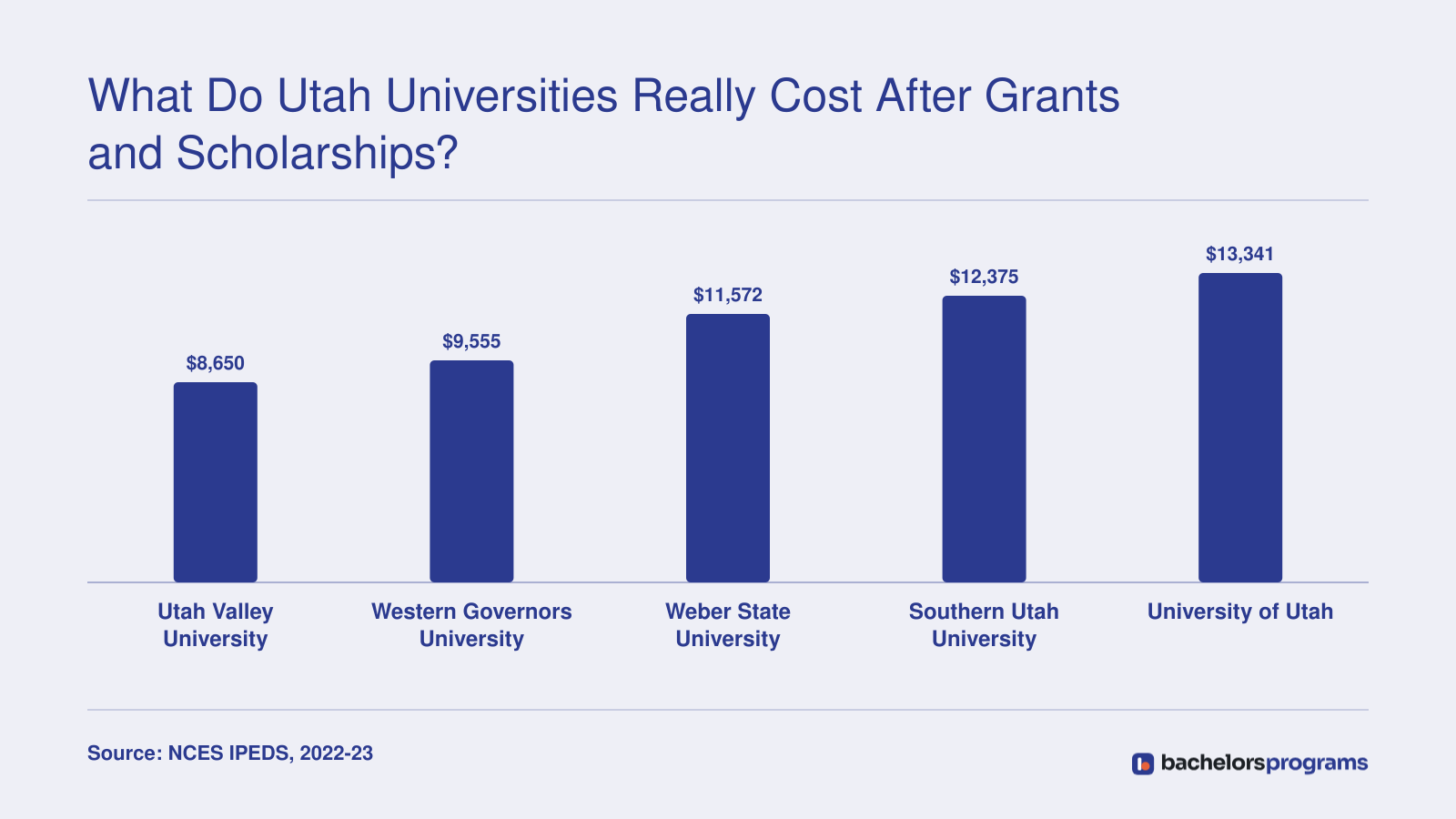
What Do Utah Universities Really Cost After Grants and Scholarships?
Net price is what students actually pay after grants and scholarships are subtracted from tuition, fees, housing and other costs, so it usually lands well below a school's sticker tuition. In 2022-23 federal data, net price ranged from $8,650 at Utah Valley University to $13,341 at the University of Utah, and Utah State University reports its figure by family income, from $9,601 for families earning under $30,000 to $17,671 for those earning over $110,000. These averages describe first-time, full-time undergraduates who received grant aid, so an online transfer or part-time student may pay a different amount; run each school's net price calculator for a personal estimate.
Financial Aid and State Grants for Utah Online Students
Online students draw on the same pool of federal, state and school money as on-campus students, and it all starts with the FAFSA. Students at accredited schools can receive Pell Grants and federal loans when enrolled at least half time. The maximum Pell Grant for 2026-27 is $7,3951, but that figure is for full-time, full-year enrollment. Your actual award depends on your Student Aid Index, enrollment intensity and cost of attendance.
Utah State Aid
The Utah Promise Scholarship is a last-dollar award for Utah residents.2 It covers tuition and mandatory fees left over after Pell, institutional scholarships and other grants. Published criteria at Utah public schools point to family income and assets each under $100,000 on the FAFSA, and awards can run up to four years.2 There is no single statewide dollar amount, since the award equals whatever balance remains. Utah State University also describes a separate Utah State Promise that requires Pell eligibility, covers eight semesters and is not open to returning students. Rules differ by institution, so confirm yours.
The Utah Opportunity Scholarship is built for recent high school graduates. It requires a Utah high school diploma, a 3.3 cumulative GPA, advanced coursework, a FAFSA and an application in senior year. It lasts four semesters and generally requires full-time enrollment. Adult and part-time online students should not count on it.
Other Sources of Money
- Institutional scholarships: Many Utah schools offer awards for transfer students and returning adults. Ask the aid office what applies to online enrollment.
- Employer tuition assistance: Many Utah employers offer tuition benefits. Ask HR about annual caps, approved schools and any repayment terms if you leave.
Check Deadlines Early
Priority deadlines for aid and scholarships often fall before regular admission deadlines, and Utah does not appear to have one statewide date for every public institution. File your FAFSA as early as it opens and look up each school's priority date, so you are not left competing for what remains.
Transferring Credits Into a Utah Online Bachelor's Program
Transfer credit is where an online bachelor's degree in Utah gets cheaper or gets stuck. A transferring course rarely vanishes outright; more often it lands as an elective that clears no major requirement, costing you a semester rather than a fee. Utah's public system reduces that risk through common course numbering, the Utah Transfer Guide, and general education alignment across its institutions.
How General Education and Associate Degrees Transfer
General education coursework completed at one Utah public institution is generally transferable within the system1, and a completed general education package or an approved associate degree usually counts as a transfer milestone. Salt Lake Community College and Snow College both award transfer-oriented associate degrees.2 Treat that as a strong starting position, not a guarantee: confirm through the Utah Transfer Guide and the receiving school that each course applies to your specific major. Transferability and applicability are different questions, and the second one is the one that decides your graduation date.
Limits to Check Before You Enroll
- Lower-division caps: Utah does not publish one systemwide maximum for community college credit, so ask each program how many lower-division credits it accepts.
- Residency requirement: every degree requires a set number of credits earned at the school granting it. Transfer credit does not waive that, and the number lives in the current catalog.
- Upper-division minimums: majors set their own floor for credits taken at the upper level, which shapes how much of an associate degree can count.
Credit for Prior Learning
Utah institutions award credit for documented college-level learning from AP exams (about $90 each), CLEP exams (90 to 120 minutes, roughly $90, with fee waivers available, a minimum score of 50, and a cap of 10 semester hours per test), military training evaluated through ACE recommendations, DSST exams, employer training, professional licensure, and portfolio-assessed work experience.3 Once prior learning credit sits on a Utah public transcript, it moves between system schools like any other coursework.4 A single exam can remove a course from your plan, so ask which ones your program accepts before you register.
Request an Unofficial Evaluation First
Before you apply, send transcripts to an online admissions advisor and ask for an informal credit review in writing. You will learn your transferable total, what falls into electives, and how many terms remain, all before you pay an application fee.
What Is the Best Online College in Utah? How to Choose
The best online college in Utah depends on the student. A working parent finishing a degree needs something different from a recent high school graduate who wants a full online experience. Instead of a single winner, use the criteria below to compare schools on your own terms.
Start With Accreditation
Confirm that the school holds regional accreditation through the Northwest Commission on Colleges and Universities (NWCCU). Then check for program-level accreditation where your field requires it. Nursing students should look for CCNE or ACEN approval, and business students often look for AACSB. Unaccredited credits rarely transfer and can limit licensure and graduate school options.
Weigh Cost and Format
- Total cost: Compare net price after grants and scholarships, not the published sticker price.
- Pricing model: Flat-rate tuition rewards students who take heavier course loads, while per-credit pricing suits those who study part-time.
- Format fit: Asynchronous courses let you work on your own schedule. Live sessions add structure but fix your hours. Ask whether any campus visits, labs, proctored exams or clinical placements are required.
- Transfer friendliness: Ask how many prior credits the school accepts and whether an evaluation is free before you apply.
Check Support for Online Learners
Online students do best when the school supports them directly. Ask about dedicated advisors, online tutoring, career services open to distance students, and how often courses start. More frequent start dates, such as multiple terms a year, shorten the wait to begin or resume.
Look at Outcomes
Graduation rates and median earnings show how well a school serves its students after enrollment. Both are reported for Utah universities below. Treat them as one input alongside cost, format and accreditation, and weigh them for the specific school you are considering.
Admissions Requirements and Start Dates for Utah Online Students
Each Utah public university sets its own admission rules, so treat this as a starting checklist and confirm the details with the admissions office of every school on your list.
- Test scores are optional at most campusesThe University of Utah, Utah State, Weber State, Utah Valley, Southern Utah and Utah Tech all allow test-optional applications. The University of Utah still requires ACT or SAT scores from homeschoolers, GED or HiSET recipients and graduates of non-accredited high schools. Utah Valley requires scores for merit scholarships, and Utah State recommends them for academic scholarships.
- GPA expectationsAt Utah State, first-year applicants with a 2.8 to 4.0 GPA are admitted in good standing. Applicants between 2.0 and 2.79 may be considered for Earned Admission. Most associate degrees and certificates at USU Eastern and USU Blanding are open enrollment. Transfer applicants should ask each school for its college-GPA standard.
- Documents to gatherGather official high school transcripts or a GED, plus transcripts from any college you attended. File the FAFSA for federal aid, and prepare proof of Utah residency if you want in-state tuition. Utah State charges nonresidents a $50 application fee.
- Deadlines and start datesThe University of Utah accepts the Beehive Application or Common App starting August 1, with a December 1 early action date and an April 1, 2026 final deadline for fall 2026. SUU Online offers multiple start dates in a 100% online, accelerated, self-paced format with no class meetings or fixed deadlines.
- Program prerequisitesSome majors add their own requirements. RN-to-BSN programs, for example, generally expect an active, unencumbered RN license.
Utah RN Licensure Requirements for RN-to-BSN Students
Graduation, Retention and Earnings Outcomes at Utah Universities
Federal outcome data show wide differences among Utah's universities, and the value of an online bachelor's degree depends on which one awards it.
What the Federal Data Shows
The latest College Scorecard release available in 2026 reports three measures for undergraduates: graduation rate, first-year retention and median earnings 10 years after entry.
- University of Utah: 70% graduation rate, 86% first-year retention, $67,170 median earnings.1
- Utah State University: 59% graduation rate, 71% retention, $54,022 median earnings.
- Utah Tech University: 38% graduation rate, 68% retention, $44,570 median earnings.
Why Some Graduation Rates Look Lower
Those figures describe each school's undergraduate population as a whole, not its online cohort. Federal graduation rates have traditionally tracked first-time, full-time students, a group that open-access and online-heavy universities serve in smaller proportions. Adult learners, part-time students and transfers can fall outside the measure or be counted on a different timeline. A lower rate at a school built for working adults therefore says less about teaching quality than about whom the school enrolls. Retention figures are similarly weighted toward full-time behavior.
Accreditation and Licensure Matter More Than the Format
For online students, the decisive outcome question is whether the program is accredited and whether it satisfies Utah licensing rules. A nursing, teaching or accounting bachelor's degree from a regionally accredited Utah university keeps licensure and graduate study open; a program without the right programmatic accreditation can close those doors regardless of its earnings figure. Earnings also reflect occupation and local labor market conditions, so compare programs in the same field before drawing conclusions.
Accreditation status and licensure pass rates deserve more weight than a single salary number. A degree that qualifies you for the credential you need is the outcome that matters.
Utah Job Outlook for Bachelor's-Level Occupations
This occupation posts about 570 openings a year across Utah, among the most of any bachelor's-level role tracked by the state.
Colleges in Utah with the most bachelor's programs
| School | City | Type | Bachelor's programs | Online | Net price / yr | Grad rate |
|---|---|---|---|---|---|---|
| Utah Valley University | Orem | Public | 114 | 23 | $6,376 | 45% |
| Utah State University | Logan | Public | 104 | 22 | $14,936 | 59% |
| University of Utah | Salt Lake City | Public | 99 | 8 | $16,200 | 65% |
| Brigham Young University | Provo | Private nonprofit | 95 | 1 | $15,564 | 81% |
| Weber State University | Ogden | Public | 85 | 16 | $10,258 | 46% |
| Southern Utah University | Cedar City | Public | 81 | 14 | $10,462 | 61% |
| Utah Tech University | Saint George | Public | 73 | 7 | $16,039 | 38% |
| Westminster University | Salt Lake City | Private nonprofit | 36 | 1 | $27,094 | 64% |
| Western Governors University | Salt Lake City | Private nonprofit | 35 | 35 | $12,548 | 46% |
| Ensign College | Salt Lake City | Private nonprofit | 12 | 2 | $10,824 | 43% |
| Neumont College of Computer Science | Salt Lake City | Private for-profit | 5 | 0 | $35,205 | 63% |
| Snow College | Ephraim | Public | 4 | 0 | $5,552 | 46% |
| Joyce University of Nursing and Health Sciences | Draper | Private for-profit | 3 | 3 | $28,039 | 54% |
| Eagle Gate College-Murray | Murray | Private for-profit | 2 | 2 | $27,345 | 48% |
| Provo College | Provo | Private for-profit | 2 | 2 | $27,053 | 51% |
Program counts are the verified bachelor's listings in our directory; net price is the school-wide average a first-time undergraduate paid after aid, and graduation rate the share finishing within six years (College Scorecard).
Utah Online College FAQs
These answers cover the questions Utah online students ask most often. Policies vary by school and program, so confirm details with an admissions advisor before you enroll.
How long does it take to finish an online bachelor's degree in Utah?
Are there 100% online bachelor's degrees in Utah with no campus visits?
Can I attend a Utah online college while living in another state?
Is an online degree from a Utah public university labeled "online" on the diploma?
Compare programs nationwide
Many Utah residents study online. Every ranked list above has an online lens, or browse every field.
Online bachelor's degrees Browse all fields