Online Colleges and Bachelor's Degree Programs in Wisconsin
Every verified bachelor's program at a college in Wisconsin: 1,800+ programs at 40+ colleges, with the online options, net price and graduation rates behind each one.

A Wisconsin adult with 60 credits and a full-time job faces a specific problem: finding an online bachelor's that is respected by employers, priced sensibly, and willing to count the coursework already completed. Credit loss is where most returning students lose real money, often a full semester's worth.
The Universities of Wisconsin, the state's private colleges, and several statewide collaborative programs all offer online or hybrid routes. The state's transfer system is also more connected than most, which gives returning students more leverage than they tend to assume.
Still, price and credit acceptance vary sharply from one program to the next, so the cheapest sticker rate rarely tells the whole story.
Key Points
- WTCS liberal arts associate degrees transfer up to 72 credits into UW.
- Most Universities of Wisconsin Online Collaboratives courses run asynchronously.
- Fees and remaining credits can outweigh a lower per-credit tuition rate.
Popular degrees in Wisconsin
Bachelor's degrees in Wisconsin by field
Business & Management
- Marketing56 programs
- Business Administration48 programs
- Management34 programs
- Accounting33 programs
- Finance33 programs
- Logistics & Supply Chain Management22 programs
- Human Resource Management or HR Management22 programs
- Analytics22 programs
Science & Engineering
- Biology31 programs
- Chemistry30 programs
- Mathematics28 programs
- Biochemistry25 programs
- Environmental Science19 programs
- Physics17 programs
- Anthropology15 programs
- Natural Resources or Conservation14 programs
Education & Teaching
- Science29 programs
- Elementary Education28 programs
- Secondary Education24 programs
- Mathematics Education23 programs
- Special Education19 programs
- English Education18 programs
- Physical Education14 programs
- Early Childhood Education or Child Development11 programs
Liberal Arts & Humanities
- English38 programs
- Literature or English Literature27 programs
- History24 programs
- Spanish22 programs
- Philosophy21 programs
- Global Studies11 programs
- Gender & Sexuality Studies9 programs
- Interdisciplinary Studies7 programs
Arts & Design
- Art or Art Studies37 programs
- Fine Arts or Studio Art31 programs
- Graphic Design20 programs
- Audio & Music10 programs
- Art History8 programs
- Media Arts or Digital Media8 programs
- Game Programming & Development7 programs
- Interior Design5 programs
Computers & IT
- Computer Science43 programs
- Artificial Intelligence12 programs
- Information Technology12 programs
- Cybersecurity11 programs
- Software Development & Engineering7 programs
- Computer Engineering7 programs
- Computer Information Systems6 programs
- Innovation or Technological Entrepreneurship5 programs
Communications & Media
- Communications42 programs
- Journalism20 programs
- Public Relations10 programs
- Communication Disorders9 programs
- Speech Pathology7 programs
- Professional Writing3 programs
- Business Communications3 programs
- Social Media2 programs
Social Work & Social Sciences
- Sociology35 programs
- Social Work22 programs
- Political Science, Government18 programs
- Human Services8 programs
- Public Policy1 program
Nursing
- Bachelor of Science in Nursing33 programs
- Nursing (RN to BSN)16 programs
- Accelerated BSN (ABSN)12 programs
- LPN/LVN to BSN4 programs
Healthcare
- Exercise & Sports Science22 programs
- Health Sciences14 programs
- Public Health9 programs
- Speech Pathology7 programs
- Health Education7 programs
- Community Health3 programs
- Respiratory Care Therapy1 program
Criminal Justice & Law
- Criminal Justice18 programs
- Criminal Justice Administration7 programs
- Legal Services6 programs
- Criminology6 programs
- Forensic Science6 programs
- Legal Studies6 programs
- Paralegal3 programs
- Corrections2 programs
Psychology
- General Psychology34 programs
- Applied Psychology1 program
- Clinical Psychology1 program
Natural & Applied Sciences
- Agriculture or Agricultural7 programs
- GIS and Geoscience6 programs
- Oceanography or Ocean or Marine Biology2 programs
- Neuroscience1 program
Religion & Theology
- Christian Studies or Religious Studies8 programs
- Christian Ministry or Ministry Leadership2 programs
Counseling
- Substance Abuse Counseling3 programs
- Behavioral Health Science1 program
How Online Bachelor's Degrees Work in Wisconsin
Wisconsin students reach an online bachelor's degree through three kinds of providers, and the type you choose shapes cost, credit rules, and pacing.
Three Types of Providers
- Universities of Wisconsin campuses: Several campuses run their own online programs, taught by the same departments that teach on campus and billed through that campus.
- System-wide collaborative programs: UW Extended Campus delivers online degrees that multiple campuses share, including UW Flexible Option, a competency-based format where you progress by demonstrating mastery rather than by logging seat time.
- Private nonprofit colleges: Many have adult-focused online divisions, with their own tuition structures, start dates, and transfer policies.
Freshman-Entry vs. Degree-Completion
Some online bachelor's programs admit students straight out of high school and cover all four years. Most Wisconsin online options, however, are degree-completion programs. They assume you arrive with an associate degree or a block of earlier credits and are built to finish the upper-level coursework. If you have no prior college credit, confirm that a program accepts first-year students before you apply.
Is an Online Degree Respected?
An online diploma from a UW campus is the same degree as the on-campus version. The diploma carries no "online" notation, and the curriculum and faculty standards come from the same institution. Regional accreditation, not delivery format, is what employers and graduate schools check, so confirm that any school you consider holds it.
"Online" Can Mean Hybrid
The label does not always mean fully remote. Some programs ask for occasional campus visits, in-person labs, or practicums, especially in health, education, and applied science fields. Check each program's requirements before you commit, since travel and scheduling can affect both cost and your work life. The Online Formats, Residency Rules, and Student Support section covers these arrangements in detail.
What an Online Bachelor's Degree Costs in Wisconsin
The lowest per-credit rate does not always produce the cheapest degree. Fees, program-specific pricing and the number of credits you still need can move the final bill more than a small gap in tuition. One pattern helps Wisconsin shoppers: many Universities of Wisconsin online programs charge a single flat rate whether or not you live in the state, so the usual out-of-state premium often disappears.
Per-Credit Tuition at Universities of Wisconsin Online Options
The rates below come from each school's official tuition page and reflect 2026 pricing. UW-Milwaukee's figures come from its Fall 2026 tuition and fees schedule. In every case listed, resident and nonresident students pay the same rate.
- UW Extended Campus Sustainable Management: $460 per credit, with no added course or program fees. Textbooks are purchased separately.
- UW Extended Campus Applied Computing: $525 per credit.
- UW-Whitewater College of Business and Economics online courses: $433 per credit.
- UW-Milwaukee fully online majors: $395 per credit for fields such as English, History, Psychology and Sociology.
- UW-Milwaukee program-specific rates: $350 for Criminal Justice and Social Work, $400 for the General Business BBA, $410 for Therapeutic Recreation and $525 for the Applied Computing collaborative.
Estimated Total Tuition
Multiplying the rate by the credits you need gives a rough tuition figure. Treat these numbers as estimates only. They leave out fees, books and any credit you transfer in. Many adult learners arrive with prior credit, so the 60-credit figure is often the more realistic one for them.
- $395 per credit: about $47,400 for 120 credits, or $23,700 for 60
- $433 per credit: about $51,960 for 120, or $25,980 for 60
- $460 per credit: about $55,200 for 120, or $27,600 for 60
- $525 per credit: about $63,000 for 120, or $31,500 for 60
Fees and Pricing Models to Compare
Tuition is only part of the bill. Ask every school about these added costs:
- Technology or distance-ed fees: UW-Milwaukee adds a $20 Instructional Technology fee per online or hybrid credit. That comes to roughly $1,200 over 60 credits, and the school has no credit plateau.
- Course materials: Textbooks, software and some class-specific materials fees are billed separately.
- Proctoring: Some online exams require a proctoring service, which may carry its own charge.
- Graduation fees: Some schools charge a fee when you apply to graduate.
The UW Flexible Option uses a different model. Instead of billing per credit, it charges a flat price for each subscription period. Students who finish more competency sets in one period lower their effective cost per credit. Confirm the current subscription price on the program's official page before comparing it with per-credit options.
Wisconsin private nonprofits with adult online divisions, such as Concordia University Wisconsin, Marian University and Lakeland University, set their own per-credit rates. Review each school's official tuition page for the current academic year, then compare costs after institutional aid rather than on sticker price alone.
Financial Aid, State Grants, and Net Price for Online Students
Do online students in Wisconsin qualify for the same financial aid as students who sit in a classroom? Most of the time, yes, but the details depend on the school, your enrollment level, and which state programs you match.
Federal Aid Starts With the FAFSA
Online students enrolled at accredited Wisconsin colleges qualify for federal aid, including Pell Grants and federal student loans, once they file the Free Application for Federal Student Aid. Pell is prorated by enrollment intensity, and each institution defines what counts as half-time, so the school's own credit load, not a universal formula, decides your award. Pell can reach students below half-time under the program's rules, though the amount drops. The lifetime limit is 12 full-time semesters, or 600 percent of eligibility.4
What the Wisconsin Grant Covers
The Wisconsin Grant, administered by the state's Higher Educational Aids Board, is for Wisconsin residents studying at UW campuses, Wisconsin Technical College System schools, eligible tribal institutions, or Wisconsin-based nonprofit independent colleges.1 Maximum awards for 2026-27 run $3,700 at UW schools, $1,752 at WTCS schools, $2,450 at tribal institutions, and $4,850 at private nonprofits, with smaller second-tier amounts paid only when funds remain.2 Awards are need-based and calculated from your FAFSA results, cover up to 10 semesters, and are prorated across full-time (12 or more credits), three-quarter (9 to 11), half-time (6 to 8), and less than half-time (5 or fewer) enrollment.2 Taking a program online does not automatically make you eligible, so confirm the rules with the financial aid office.1 File early: priority deadlines differ by campus, and the money is finite.3
Military Benefits, Employer Aid, and Net Price
Veterans can stack the Post-9/11 GI Bill with the Wisconsin GI Bill, which provides tuition remission at UW and WTCS campuses, and National Guard members should ask about tuition grants. Adult learners should also check whether an employer offers tuition assistance.
Net price is sticker price minus grants and scholarships. The College Scorecard figure reflects first-time, full-time students, so someone transferring credits and studying online part-time may see a different number. Run the net price calculator for each school on your list, and ask about transfer and adult-learner scholarships.
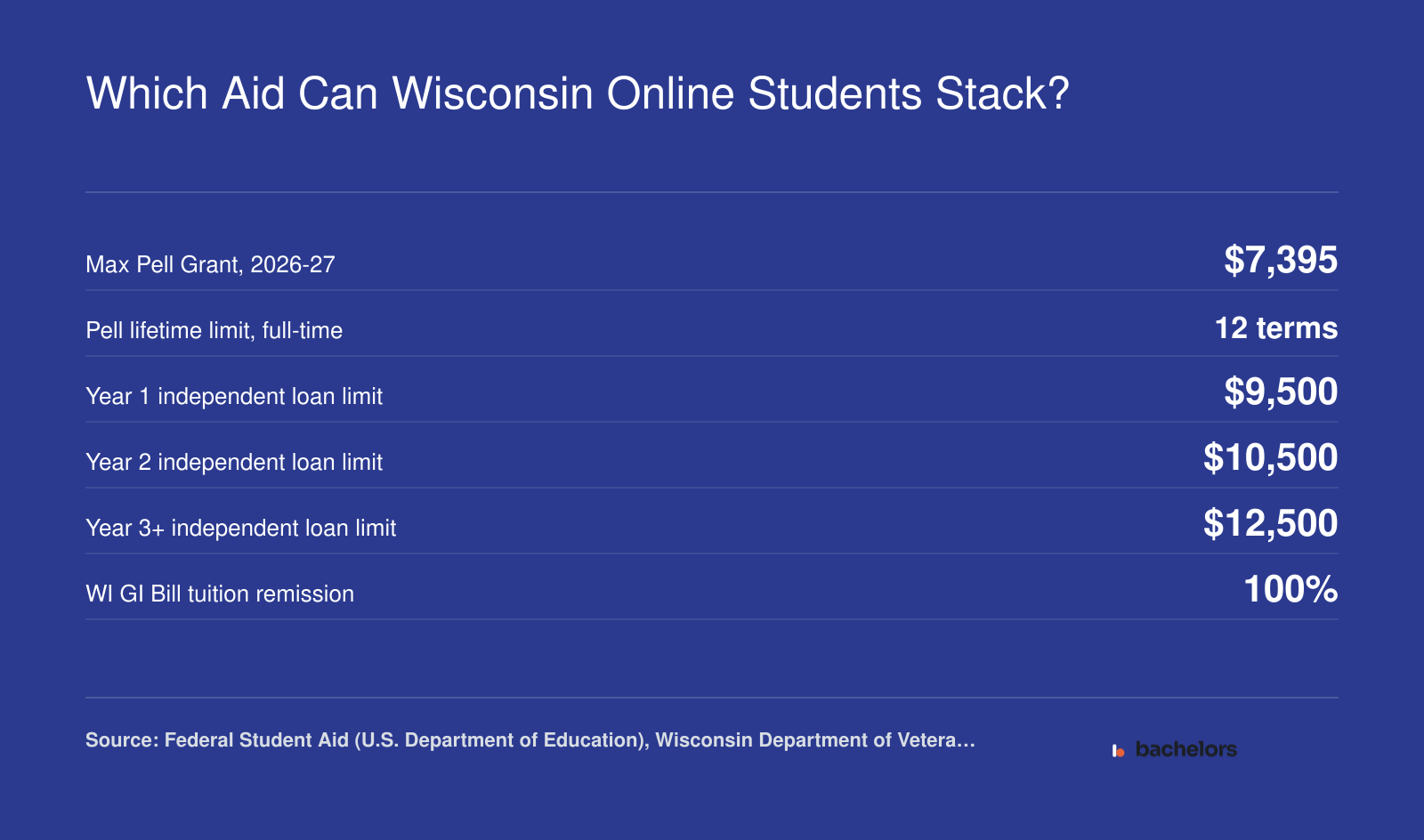
Which Aid Can Wisconsin Online Students Stack?
Most online and adult undergraduates can stack a Pell Grant with federal Direct Loans, though Pell goes only to students without a bachelor's degree, part-time enrollment lowers the award, and loans cannot exceed your cost of attendance minus other aid. Eligible Wisconsin-resident veterans and qualifying dependents may add the Wisconsin GI Bill, which can remit full tuition and segregated fees for undergraduate credits at Universities of Wisconsin and Wisconsin Technical College System schools. Guard members can pair the Wisconsin National Guard Tuition Grant with Federal Tuition Assistance when tuition is not fully covered. Wisconsin Grant amounts vary by school and need, so confirm current awards with HEAB and verify service and residency rules with the Wisconsin Department of Veterans Affairs before you budget.
Transferring Credits Into a Wisconsin Online Bachelor's
Transferring credits into an online Wisconsin bachelor's means showing a receiving university what you have already learned, course by course, and getting that work counted toward your degree instead of repeated. Wisconsin has built more structure around that process than most states.
The State's Transfer Framework
The Transfer Information System (TIS) is the public database where you check how a specific course at a Universities of Wisconsin campus or a Wisconsin Technical College System district will be treated elsewhere, including published agreements and course equivalencies.1 Above that sits the UW-WTCS Universal Credit Transfer Agreement, in effect since September 2021, which guarantees that a defined set of core general education courses transfers between all UW universities and all WTCS districts.2 The current version requires at least 72 credits of core general education coursework to be transferable, a standard that took hold with the 2022-23 academic year.3 Moves from one UW campus to another run through system transfer policy, so general education and program requirements completed at one university generally carry to the next.
Caps, Residency, and Applied Credit
Generally up to 72 degree credits from non-baccalaureate institutions, including WTCS liberal arts and collegiate transfer programs, may transfer into a UW university, and a campus may accept more where it judges that appropriate.4 That ceiling does not change residency rules, which are set institution by institution and degree by degree.5 Confirm the minimum credits you must earn at the school issuing your diploma before you commit. Liberal arts and college-parallel work moves most cleanly. Occupational and technical courses are handled more narrowly: UW Oshkosh, for example, transfers approved University Studies Program coursework from WTCS applied associate programs and reviews other occupational courses case by case.6
Completion Degrees That Take an Applied Associate as a Block
Applied-studies completion degrees exist for technical college graduates whose coursework does not map neatly onto a liberal arts major. UW Oshkosh's Bachelor of Applied Studies in Leadership and Organizational Studies recognizes most WTCS applied associate degrees in transfer, and other UW campuses offer comparable applied-studies routes.6 Ask each one how your specific associate degree maps before you apply.
Other Credit You May Already Hold
- College courses in high school: Early College Credit Program and Start College Now coursework may count.
- Exams: AP and CLEP scores.
- Military training: evaluated through the Joint Services Transcript.
- Prior learning: portfolios assessed for documented experience.
Before you apply, ask for an unofficial evaluation of your transcripts. It usually costs nothing and tells you how many credits you actually bring.
Wisconsin Transfer Routes Compared
For most students, the WTCS liberal arts or pre-professional associate degree saves the most credits: it is built to match the first two years of UW general education, typically brings junior standing, and allows up to 72 transferable credits. Applied associate degrees, high school dual credit, and individual WTCS courses can still count, but the receiving UW campus reviews them course by course, so fewer credits may apply directly to your major. Rules for military credit, prior learning credit, and private college transfer are set by each school, so confirm them with your target program before you enroll.
| Transfer Route | Best For | How Credits Apply | Key Limit or Cap |
|---|---|---|---|
| WTCS liberal arts or pre-professional associate (A.A. or A.S.) to a UW bachelor's | Students who plan from the start to transfer to a four-year UW university | Block transfer: a qualifying associate degree is treated as fulfilling UW general education breadth requirements, and students should enter with junior-level status | Generally up to 72 credits from non-baccalaureate schools; UW campuses may accept more where appropriate, subject to residence requirements |
| Universal Credit Transfer Agreement (UCTA) courses between WTCS and UW | Students who want predictable transfer of specific WTCS courses to any UW university | Course by course from a designated list, typically counting toward general education or general degree requirements | No separate UCTA credit cap is published; courses must be on the approved list |
| WTCS applied associate degree to a UW BAAS or similar completion program | Working adults and technical graduates finishing a bachelor's through a completion pathway | General education courses in communications, behavioral and social sciences, math, and natural sciences may transfer; occupational and technical courses are reviewed course by course for equivalence | No single systemwide cap; credit depends on the quality, comparability, and applicability of each course |
| Early College Credit Program (ECCP) credit to a UW campus | High school students who completed approved college-level coursework | Credit is generally awarded when a course is similar in nature, level, and content to one in the UW curriculum; the home campus completes the full evaluation after admission | No systemwide ECCP cap; total credit awarded can vary by campus |
| Start College Now credit to a UW campus | High school students who took college courses through Start College Now | The receiving UW university evaluates official transcripts and applies courses using its own equivalencies and degree requirements | No program-specific cap; the receiving campus's transfer rules decide what counts |
Degree Completion Programs for Adults and Returning Students
Degree-completion programs are built for adults who already have college credit and want to finish. That includes people with some college but no degree, associate degree holders, and working professionals who need a bachelor's to move up. Entry expectations vary by program. UW Online Collaborative bachelor's programs, for example, generally look for an associate degree or roughly 45 to 60 transferable credits, and applicants with fewer than 60 may be considered for provisional admission. The home campus makes the final call on which credits count.
How Long Completion Takes
A common benchmark is about two years of full-time study when you arrive with 60 transfer credits. Part-time students should plan on longer, and the exact pace depends on how many credits the school accepts and how many courses you take at once. No single completion time applies to every UW program. UW-Platteville's online BS in Applied Computing, built for students with 60 or more credits, advertises completion in as little as 16 months, but that is a fast-track minimum, not a typical result.
That program also shows how the format helps working adults. Courses run eight weeks, are asynchronous, and are accessible around the clock. Shorter terms with frequent start dates let you take one or two courses at a time, then pause or speed up as work and family allow.
UW Flexible Option
The UW Flexible Option works differently from a term-based program. It is competency-based: you move through sets of competencies at your own pace and advance when you show mastery, rather than when a semester ends. Tuition is tied to subscription periods instead of per-credit billing, so a student who moves quickly can cover more material for the same price. Confirm the current subscription length, price, assessment format, and available bachelor's areas on the official Flexible Option page, since those details change and should not be assumed.
It tends to suit self-directed learners with real work experience who can already demonstrate what they know. It is a weaker fit for people who want fixed deadlines, steady instructor contact, or a cohort to keep them on track. Flexible Option is separate from the eight-week, term-based completion programs described above.
Re-Entry Support
Returning students should ask about success coaches, advising built for adult learners, and any pathway for students who stopped out and want to return. Those supports often matter as much as the schedule.
Admissions Requirements and Application Timing
Most Wisconsin online bachelor's programs admit transfer and returning students on a few common criteria. The thresholds below come from UW-Madison, UW-Whitewater, and UW Extended Campus. Confirm the details for your specific program before you apply.
- High school credentialUW-Whitewater asks online transfer applicants for an official final high school transcript, GED, or HSED.
- Official transcripts from every collegeUW-Whitewater requires official transcripts from every college or university you attended. Collaborative programs review your prior coursework the same way.
- Minimum GPAUW-Whitewater sets a 2.0 cumulative GPA for most online programs. UW Extended Campus collaborative completion programs look for a 2.0 GPA in general education courses.
- Credits for completion-track eligibilityUW-Madison and UW Extended Campus completion programs generally expect an associate degree or about 45 to 60 transferable general education credits. Most collaborative programs open bachelor's-level courses after 45 to 54 credits. UW-Whitewater requires at least 12 transferable credits.
- Test scoresCollaborative programs do not require the ACT or SAT if you hold an associate degree, a bachelor's degree, or equivalent coursework. UW-Madison sets its own policy, so check with the program directly.
- Application feeMost collaborative applicants pay no fee. Exceptions include UW-Madison ($80), UW-La Crosse ($25), and UW-Eau Claire ($25 for Fall 2026).
- Deadlines and start datesCollaborative materials are generally due two to four weeks before classes, depending on the home campus. Fall 2026 classes began September 8. Flexible Option programs run in 12-week subscription periods, with applications due about one month before each period starts.
Online Formats, Residency Rules, and Student Support
Online delivery in Wisconsin is now mostly asynchronous, and that default has changed who can realistically finish a bachelor's degree.
Asynchronous by default, live sessions by exception
Most Universities of Wisconsin Online Collaboratives programs run asynchronous coursework, meaning you log in on your own schedule within weekly deadlines instead of at a fixed class time. Some programs and individual courses add synchronous pieces, and no single attendance policy covers every online bachelor's program, so confirm the expectation before you enroll. For a night-shift nurse or a parent arranging childcare, that detail decides whether a term is workable at all. Pacing varies too: the system runs semester-based and competency-based options, and UW-Milwaukee's RN-to-BSN uses subscription periods of about 12 weeks rather than a standard eight- or 16-week term.
Where "online" still means showing up
- Nursing: UW-Milwaukee's RN-to-BSN is fully online with no campus requirement, but the NURS 445X capstone practicum is self-sourced. You locate the project and a qualified preceptor in your own workplace or community.
- Education and sciences: field placements, student teaching, lab requirements, and short on-campus intensives can carry in-person hours. Ask for the requirement in writing, with hours and locations.
Two meanings of residency
Academic residency is how many credits you must complete through the school itself rather than transfer. State authorization is separate: whether the program may legally enroll you where you live, which matters if you are outside Wisconsin or plan to move mid-degree.
What to ask about support
- Coaching: Success Coaches are the first contact for program questions and resources.
- Home campus services: advising, career services, library access, financial aid, and the diploma come from your home campus, not the collaborative.
- Tech help: the help desk at 1-877-724-7883 covers Canvas, textbooks, course tools, and virtual labs.
- Also ask: tutoring, proctoring options, and support hours in your time zone.
Earnings Payoff for Wisconsin Bachelor's Graduates
Graduation Rates, Outcomes, and How to Choose a Program
A program with a strong reputation but a weak completion record is a warning; a program with a modest name and solid outcomes may be the better bet. Wisconsin online bachelor's programs vary widely on both counts, so the work is knowing what the published numbers actually describe.
Read the rates for what they measure
Regional accreditation from the Higher Learning Commission is the baseline for any Wisconsin college you consider, and program-level accreditation matters in fields that require it: CCNE for nursing, AACSB for business. Without those, credits and credentials may not travel.
Retention and graduation rates come from IPEDS, and the definitions are narrow.1 The six-year graduation rate tracks full-time, first-time degree-seeking students completing within 150 percent of normal time, and the retention rate tracks that same population returning for a second fall. Transfer students and part-time adult learners are largely outside those cohorts, which describes many online completion students. Look at transfer-out figures and Pell-recipient graduation rates as well, and cross-check earnings with the College Scorecard. The Scorecard profile for UW-Stout, for instance, shows 57 percent graduated, 25 percent transferred out, 18 percent withdrew, 1 percent still enrolled, and 77 percent of first-year students returning.2 Treat that as one campus snapshot rather than a system benchmark.
A five-point decision framework
- Total cost after credit transfer: the sticker rate per credit means little if you lose a semester of credits.
- Credit applicability: find out which credits will count before you apply.
- Format fit: asynchronous, eight-week accelerated, or competency-based terms each suit different schedules.
- Required in-person components: clinicals, labs, and practicums can override a fully online promise.
- Outcomes data: retention, completion, and earnings for the specific program, not just the university.
Next steps
Run the college's net price calculator, request a written transfer evaluation, and file the FAFSA. Then compare your shortlist program by program against the same five criteria.
Colleges in Wisconsin with the most bachelor's programs
| School | City | Type | Bachelor's programs | Online | Net price / yr | Grad rate |
|---|---|---|---|---|---|---|
| University of Wisconsin-Whitewater | Whitewater | Public | 102 | 16 | $14,158 | 59% |
| University of Wisconsin-Madison | Madison | Public | 98 | 7 | $17,354 | 90% |
| University of Wisconsin-Milwaukee | Milwaukee | Public | 88 | 17 | $15,014 | 49% |
| University of Wisconsin-Green Bay | Green Bay | Public | 82 | 27 | $13,369 | 48% |
| University of Wisconsin-Oshkosh | Oshkosh | Public | 76 | 10 | $14,305 | 46% |
| Marquette University | Milwaukee | Private nonprofit | 74 | 1 | $31,487 | 83% |
| University of Wisconsin-La Crosse | La Crosse | Public | 70 | 1 | $16,210 | 71% |
| University of Wisconsin-Eau Claire | Eau Claire | Public | 70 | 5 | $16,550 | 64% |
| University of Wisconsin-Parkside | Kenosha | Public | 64 | 19 | $11,772 | 40% |
| University of Wisconsin-River Falls | River Falls | Public | 63 | 2 | $14,054 | 57% |
| Concordia University-Wisconsin | Mequon | Private nonprofit | 63 | 15 | $36,201 | 68% |
| University of Wisconsin-Platteville | Platteville | Public | 63 | 11 | $16,032 | 56% |
| University of Wisconsin-Stevens Point | Stevens Point | Public | 60 | 9 | $14,559 | 51% |
| Carroll University | Waukesha | Private nonprofit | 59 | 0 | $15,193 | 71% |
| Edgewood University | Madison | Private nonprofit | 58 | 5 | $26,113 | 60% |
Program counts are the verified bachelor's listings in our directory; net price is the school-wide average a first-time undergraduate paid after aid, and graduation rate the share finishing within six years (College Scorecard).
Questions About Online Bachelor's Degrees in Wisconsin
These answers cover the questions Wisconsin online students ask most often. Details vary by university and program, so confirm specifics with the school you are considering.
How long does it take to finish an online bachelor's degree in Wisconsin?
Are online degrees from Wisconsin public universities respected?
Can I keep working full-time while enrolled in a Wisconsin online bachelor's program?
What happens to my Wisconsin Grant or federal aid if I move out of Wisconsin mid-degree?
Compare programs nationwide
Many Wisconsin residents study online. Every ranked list above has an online lens, or browse every field.
Online bachelor's degrees Browse all fields