Online Colleges and Bachelor's Degree Programs in New Mexico
Every verified bachelor's program at a college in New Mexico: 440+ programs at 18 colleges, with the online options, net price and graduation rates behind each one.
New Mexico residents with a bachelor's degree earn a median of $60,989 a year, against $35,761 for those who stopped at high school. For most working adults in the state, the real question is not whether the credential pays, but whether it can be finished online, affordably, without leaving Gallup or Las Cruces for a campus apartment in Albuquerque.
Public universities carry most of the state's online enrollment, and several charge one flat per-credit rate regardless of residency. State aid can erase much of that tuition for eligible residents. Eligibility, though, turns on credit load and enrollment status, not on whether a course happens to meet online.
Key Points
- New Mexico's Opportunity Scholarship covers tuition and mandatory fees at public colleges.
- NMSU Global, UNM Online and WNMU charge flat rates regardless of residency.
- Bachelor's holders in New Mexico earn a median $60,989, about 70.5% more.
Popular degrees in New Mexico
Bachelor's degrees in New Mexico by field
Business & Management
- Business Administration18 programs
- Marketing10 programs
- Accounting8 programs
- Finance8 programs
- Management8 programs
- Digital Media or Digital Marketing5 programs
- Entrepreneurship3 programs
- International Business3 programs
Science & Engineering
- Mathematics11 programs
- Natural Resources or Conservation9 programs
- Electrical Engineering or Electronics Engineering or Electronic Systems Engineering Technology8 programs
- Biology8 programs
- Environmental Science7 programs
- Anthropology6 programs
- Engineering Technology6 programs
- Chemistry6 programs
Education & Teaching
- Elementary Education10 programs
- Early Childhood Education or Child Development9 programs
- Secondary Education8 programs
- Mathematics Education7 programs
- Science7 programs
- Physical Education7 programs
- Special Education6 programs
- English Education4 programs
Arts & Design
- Art or Art Studies11 programs
- Fine Arts or Studio Art7 programs
- Media Arts or Digital Media3 programs
- architecture or architectural3 programs
- Creative Writing2 programs
- Art History2 programs
- Graphic Design1 program
- Cinematography1 program
Liberal Arts & Humanities
- History5 programs
- English5 programs
- Literature or English Literature5 programs
- Spanish4 programs
- Native American Studies or American Indian or Indigenous3 programs
- General Studies2 programs
- Philosophy2 programs
- Gender & Sexuality Studies2 programs
Nursing
- Bachelor of Science in Nursing18 programs
- Nursing (RN to BSN)5 programs
- LPN/LVN to BSN1 program
- Accelerated BSN (ABSN)1 program
Communications & Media
- Journalism9 programs
- Communications5 programs
- Communication Disorders3 programs
- Speech Pathology3 programs
- Public Relations2 programs
- Strategic Communications1 program
Social Work & Social Sciences
- Sociology10 programs
- Social Work6 programs
- Political Science, Government4 programs
Computers & IT
- Computer Science4 programs
- Information Technology3 programs
- Innovation or Technological Entrepreneurship3 programs
- Cybersecurity2 programs
- Software Development & Engineering2 programs
- Computer Engineering2 programs
- Computer Information Systems2 programs
- Artificial Intelligence1 program
Healthcare
- Exercise & Sports Science4 programs
- Nutrition3 programs
- Health Education3 programs
- Public Health2 programs
- Health Sciences1 program
- Speech Pathology1 program
- Community Health1 program
Criminal Justice & Law
- Criminal Justice5 programs
- Forensic Science3 programs
- Fire Science or Fire Administration2 programs
- Corrections1 program
- Criminology1 program
Psychology
- General Psychology7 programs
- Addiction Psychology1 program
Counseling
- Mental Health Counseling2 programs
- Substance Abuse Counseling1 program
Natural & Applied Sciences
- Agriculture or Agricultural2 programs
- GIS and Geoscience1 program
How Online Bachelor's Degrees Work in New Mexico
An online label does not always mean zero time on campus. In-person, clinical, practicum, student-teaching, proctoring, and residency requirements differ by program and change often, so a generic overview will not tell you what a specific degree demands. The only reliable answer comes from the program itself, in writing.
Check Each School's Own Materials
Start with the official program page and academic catalog at NMSU Global, UNM Online, New Mexico Highlands University, ENMU, and Northern New Mexico College. Search each for "clinical," "practicum," "student teaching," "proctoring," "campus residency," and "in-person requirement." Then contact admissions or the program coordinator and ask for current requirements in writing.
The label alone can mislead. UNM's RN-to-BSN is described as 100% online, a 30-credit degree completion program for registered nurses with CCNE accreditation.1 Even so, confirm directly whether any clinical hours, residency, or proctored exams apply. NMSU Global also uses an "Online With Residency" label for some offerings, which shows that residency expectations can sit inside an online format.
Verify Accreditation and Expectations
Use independent sources to check what a school tells you:
- Institutional accreditation: Look up the school in the Higher Learning Commission's institution lookup at hlcommission.org. NMSU and New Mexico Highlands University both list HLC accreditation.2
- Nursing: Check for programmatic accreditation from CCNE or ACEN. Highlands' baccalaureate nursing program is CCNE-accredited.2
- Teacher education: Look for CAEP accreditation or approval through the New Mexico Public Education Department.
- Career context: The Bureau of Labor Statistics Occupational Outlook Handbook at BLS.gov explains typical education and licensure expectations for a field. It does not replace school-specific requirements.
Questions to Ask Before You Apply
- Are there required on-campus days, clinical placements, practicum hours, student teaching, proctored exams, or residency requirements?
- Does the program meet New Mexico licensure or certification requirements?
- Does the school arrange clinical or school placements, or do you find them yourself?
- Can you see the answers in writing, with the date they apply to?
Get program answers from the school. For licensure questions, go to the New Mexico Board of Nursing or the Public Education Department. Placements you must arrange yourself can add weeks to your timeline, so ask early.
Online College Tuition in New Mexico: Cost per Credit and Total Price
NMSU Global Campus, UNM Online and Western New Mexico University charge one flat online rate regardless of residency, while Eastern New Mexico University and New Mexico Highlands University charge out-of-state students more. The 120-credit column multiplies the per-credit rate by a full degree and leaves out fees, so a transfer student bringing in an associate degree usually pays for only 60 or fewer credits, roughly half the figure shown. Program-specific rates, such as nursing differential tuition, can run higher than these standard undergraduate rates, so confirm the price for your exact major.
| School / Online Division | In-State Per Credit | Out-of-State Per Credit | Online or Distance Fees | Est. Tuition for 120 Credits |
|---|---|---|---|---|
| NMSU Global Campus (rate published fall 2026; source: NMSU Global Campus Tuition Costs and Financial Aid) | $395.40 (flat rate, any residency) | $395.40 (flat rate, any residency) | $25.00 per credit (2025 schedule) | $47,448 |
| UNM Online (rate published fall 2026; source: UNM Online Accelerated Online Program Tuition Rates) | $398.74 (flat rate, any residency) | $398.74 (flat rate, any residency) | Charged each semester; amount not listed in the published schedule | $47,849 |
| New Mexico Highlands University (rate published fall 2026; source: NMHU Tuition and Fees) | $303.35 | $508.35 | $10.00 per credit | $36,402 in-state; $61,002 out-of-state |
| Eastern New Mexico University Online (2025-26; source: ENMU Undergraduate Tuition and Fees) | $174.75 | $257.25 | $120.00 per credit | $20,970 in-state; $30,870 out-of-state |
| Western New Mexico University Online (rate published fall 2026; source: WNMU Online Programs Tuition and Fees) | $328.78 ($1,972.68 per 6 credits; flat rate, any residency) | $328.78 ($1,972.68 per 6 credits; flat rate, any residency) | $30.00 per credit | $39,454 |
Which Online College in New Mexico Is Cheapest for In-State Students?
The lowest sticker price and the lowest total bill are rarely the same thing, and New Mexico's online options show it. Among the public universities with full published figures, Western New Mexico University (WNMU) has the lowest base rate. Western New Mexico University (WNMU) charges about $328.78 per credit.1 The University of New Mexico (UNM) lists $346.10 per credit for 1 to 14 hours in 2026-27, and its Accelerated Online Program sections run $398.74 per credit.2 New Mexico Highlands University charges $303.35 per credit in state and $508.35 out of state, plus a $10 per credit online fee for Fall 2026.3
Treat that as a starting point, not a verdict. The published figures don't line up cleanly enough to support a firm ranking.
Why Sticker Price Misleads
Several factors move the real cost:
- Fees: WNMU adds a $30 per credit online fee and a $26.66 per credit course-materials fee.1 UNM adds a technology fee on its accelerated online sections.
- Billing structure: UNM uses flat rates at 6 to 9 credits and at 15 or more ($5,191.50 per term in 2026-27), so heavier course loads can lower the per-credit cost.2
- Program differentials: Nursing, business and other programs may carry their own rates. Confirm these with the program itself.
- Credits still needed: A school that accepts more of your prior credit can beat a cheaper per-credit rival.
How Aid Can Narrow the Gap
For eligible residents, the Opportunity Scholarship or the Lottery Scholarship can cover part or all of tuition. When that happens, a $20 or $30 per credit difference between schools matters less than which school accepts your credits and which fees remain. Run the net price, what you actually pay after aid, before you commit.
The Community-College-First Route
For many students, the lowest total-cost path is about 60 credits at a New Mexico community college, then transfer to finish the bachelor's online. Published resident rates make the case:
- Central New Mexico Community College (CNM): $76 per credit in 2026-27.4
- San Juan College: $61 per credit, plus a flat general fee ($91 for 4 credits or fewer, $215.25 above that).5
At those rates, 60 credits comes to roughly $3,660 at San Juan College or $4,560 at CNM in tuition alone, before fees. The same 60 credits at a university's online rate would run well over $19,000. Confirm that your community college credits apply to your intended major before you enroll.
The New Mexico Opportunity Scholarship and Free Tuition for Online Students
Financing an online bachelor's degree out of pocket is a different calculation from financing it with state aid. For many residents, the Opportunity Scholarship can cover the whole tuition bill, though the fine print about online formats matters.
Can New Mexico Residents Get Free Tuition for an Online Bachelor's Degree?
Often, yes, with one caveat. For 2026-27, the scholarship covers up to 100% of tuition and required fees at participating New Mexico public colleges and universities.1 The state's materials name those institutions without setting a separate online rule, and they do not clearly confirm that every fully online format qualifies. Confirm with the school's financial aid office that your specific online program qualifies before you enroll.
Who Is Eligible
- Residency: You must be an established New Mexico resident. Ask your school how it verifies residency.
- Credit load: Enroll in at least 6 credit hours per term.1 Full-time and part-time students both qualify, and summer attendance is allowed.2
- Academic standing: Keep a 2.5 cumulative GPA and stay enrolled each continuous semester until you finish.3
- Returning adults: Adult learners going back to school are covered, and there is no income requirement.4
- Prior credits: Students without a completed degree can still qualify. Published limits are 90 attempted credits for an associate degree and 160 for a bachelor's1, although the state's descriptions of this rule differ in wording. Anyone who already holds a bachelor's degree should confirm their status with the school.
What It Covers and What It Does Not
The award targets tuition and mandatory fees. Books, housing, transportation and living costs are not established as covered, so plan for them separately. The scholarship can be combined with other aid, including Pell Grants and the Lottery Scholarship, which helps cover costs beyond tuition.1 The state does not publish a single dollar cap for 2026-27.
How to Apply
No separate scholarship application is required. Complete the FAFSA, or the New Mexico alternative application if you are not eligible for federal aid, and then follow your school's own financial aid steps and deadlines. The school uses that information to determine your award.
Funding Can Change
The scholarship depends on annual legislative funding, so rules and award details can shift from one year to the next. Confirm current terms with your school's financial aid office before you commit to a program.
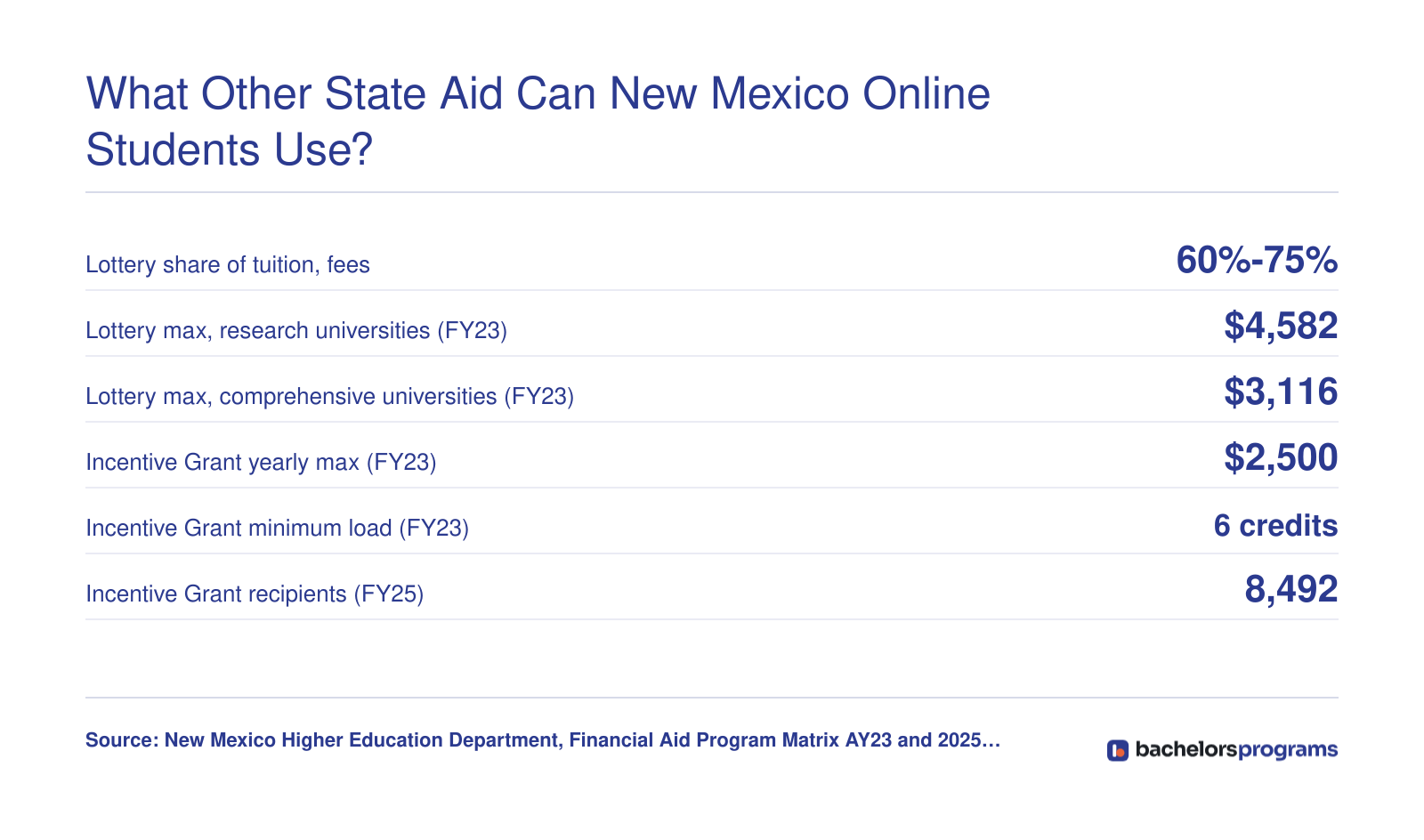
What Other State Aid Can New Mexico Online Students Use?
Beyond the Opportunity Scholarship, the Legislative Lottery Scholarship is a first-dollar award for recent New Mexico high school graduates and honorably discharged veterans, and the need-based Student Incentive Grant can be packaged with other state aid. Award amounts below are the most recent published by the state and may change for 2026-27. Employer tuition assistance and federal GI Bill benefits may also help, so ask your school's financial aid office how they combine with state awards.
Transferring Credits to Online Colleges in New Mexico
How many credits will a New Mexico university actually accept from my community college transcript?
Usually more than students expect, but not always where they want them. Three separate rules decide the answer: the statewide course-numbering framework, the receiving school's residency rule, and how the credit gets applied to your major.
The statewide transfer framework
New Mexico's General Education Curriculum is organized into Areas I through VII1, and the New Mexico Common Course Numbering System assigns lower-division academic courses a shared four-letter prefix and four-digit number2. When you finish a commonly numbered course, a participating public institution must treat it as equivalent to its own same-numbered version, subject to published exceptions. The state catalog lists almost 3,000 common courses and more than 9,000 mapped institutional courses, with shared learning outcomes running around 80 percent.3
One wrinkle: UNM splits Area V into VA Humanities and VB Second Language, and its Area VII Flexible Credits block requires 6 credits rather than the standard allocation. Students who transfer before completing general education may be able to apply Area VB toward Area V Humanities or Area VII.
How many credits transfer, and how many must you finish in residence?
New Mexico does not publish a single statewide maximum. Caps are set campus by campus, and documented limits at four-year schools commonly land in the mid-60s to high-60s for two-year coursework, with a higher ceiling on total transfer credit. Residency rules matter just as much. At NMSU's Las Cruces campus, transfer students still need at least 48 upper-division credits in courses numbered 300 or above, plus 30 of their last 36 credit hours through NMSU.4 Online arms such as NMSU Global, UNM online, NMHU online and ENMU online do not all spell out caps and residency the same way, so confirm in writing.
Credit for what you already know
Prior-learning credit is where policies diverge most. CLEP and AP exams, portfolio assessment, and ACE-evaluated military credit through the Joint Services Transcript are all commonly considered, and RN-to-BSN programs often award credit for an active nursing license. Treat these as likely but not guaranteed to count toward major, upper-division or final-credit requirements.
Ask for the evaluation before you apply
A transcript evaluation is the step students skip. Credits that are accepted can still land as free electives rather than major requirements, which quietly lengthens your degree. Request an unofficial evaluation from each online program before you apply, and ask specifically how each course maps. Degree-completion formats such as a Bachelor of Applied Science or an interdisciplinary bachelor's are built around two-year technical credit and are often the smoothest landing spot for transfer students.
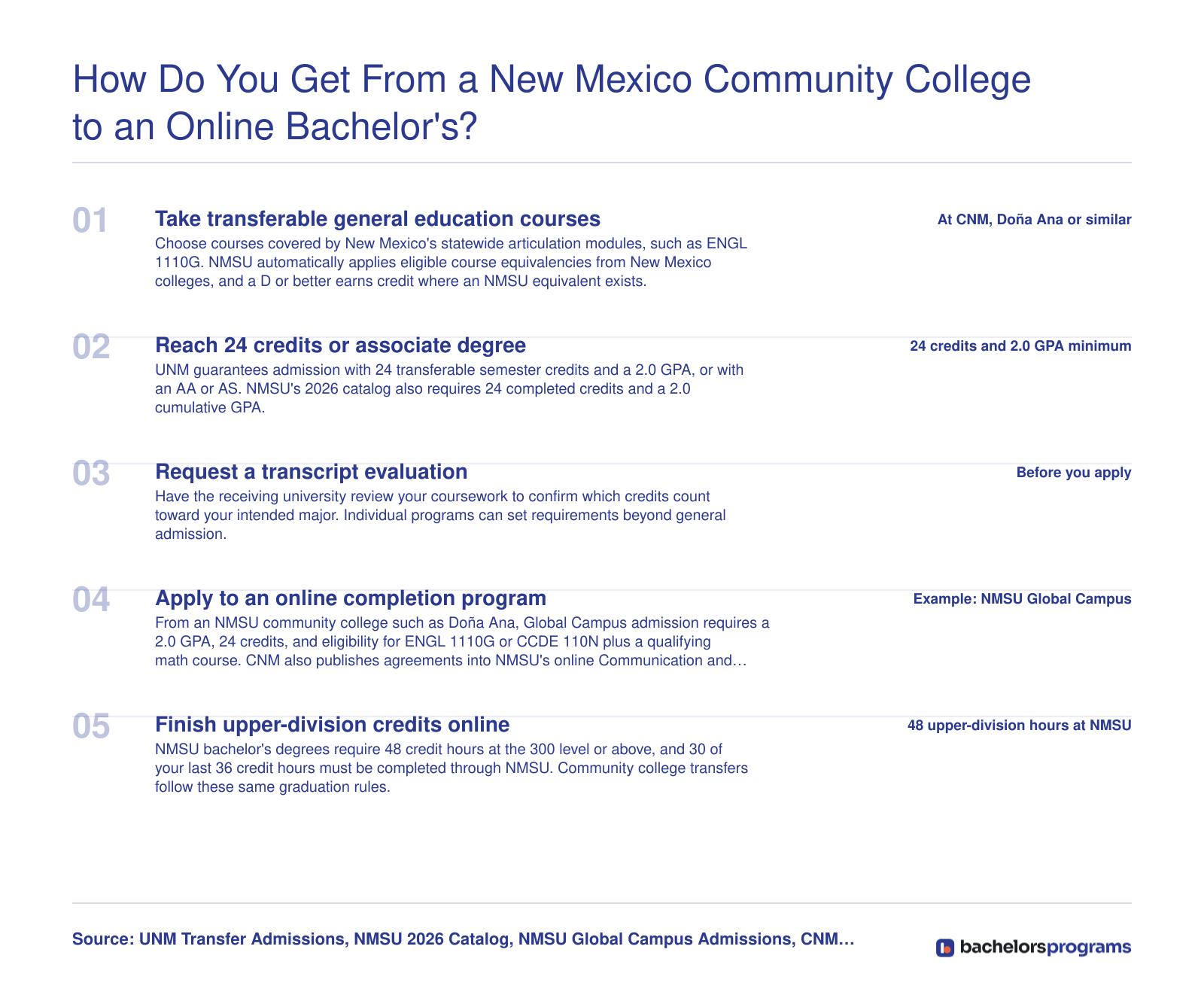
How Do You Get From a New Mexico Community College to an Online Bachelor's?
New Mexico transfer runs through school-specific agreements, not one statewide 2+2 guarantee, so the order of your steps matters. Following a published articulation or pathway agreement, such as CNM's agreements with NMSU, NMHU and WNMU, reduces the risk of losing credits when you move into an online completion program.
Admissions, Start Dates and Support for Online Students
Requirements differ by school, so check each catalog before you apply. The details below come from NMSU Global and UNM Online for 2026-27.
- High school credentialNMSU Global asks first-year applicants for a diploma from an accredited high school. UNM Online applicants with fewer than 24 transferable credits submit official high school transcripts or GED scores. If you hold a HiSET, confirm with the school that it is accepted.
- Minimum GPA and test scoresNMSU Global admits first-year students who meet one of these: a 2.5 cumulative GPA, a top 20% class rank, an ACT of 21 or an SAT of 1060. Applicants with a 2.75 or higher GPA do not need test scores.
- Transfer standardsBoth schools set a 2.0 cumulative college GPA for transfer applicants. UNM Online also requires at least 24 transferable credits, or an associate degree from an accredited community college. NMSU Global requires that you be eligible to return to your last school.
- Application fee and deadlinesNMSU Global waives the fee on your first application and admits on a rolling basis. Spring 2027 enrollment opens November 12. UNM Online charges $25. It has no strict deadline but recommends applying by May 1 for fall and by mid-November for spring.
- Start datesUNM Online runs full terms and half terms. Fall 2026 halves begin August 17 and October 12. Spring 2027 halves begin January 18 and March 22.
- Remote supportUNM Online requires a new student orientation before you can register. Ask each school about online advising, tutoring, library access, computer and webcam requirements, and how exams are proctored before you enroll.
New Mexico Teacher Licensure at a Glance
Completion Time, Graduation Rates and Career Outcomes
How long does an online bachelor's degree in New Mexico actually take? The honest answer depends less on the delivery format than on how many credits you bring and how many you can carry each term.
Four Years, Two Years, or Fourteen Months
A first-time student enrolled full time in a 120-credit bachelor's degree should plan on about four years. Transfer students who arrive with an associate degree or roughly 60 credits can often finish the remaining major and upper-division work in 18 to 24 months of full-time study, though part-time enrollment stretches that window.
RN-to-BSN programs are the clearest example of accelerated completion. Eastern New Mexico University's BSN completion uses eight-week classes and can be finished in four semesters, about 16 months, once general-education requirements are done. New Mexico Highlands University describes its mostly online RN-BSN, 32 credits, as finishable in about 14 months. A 2026 nursing-program directory estimates most RN-to-BSN options for New Mexico nurses take 12 to 18 months part-time, with some full-time students finishing in 9 to 12 months. That directory figure is an estimate, not a statewide statistic.
What the Completion Data Show
The standard graduation measure is the six-year rate, which IPEDS tracks for first-time, full-time students through 150% of normal program time. Institutional rates vary, so ask each university for its most recent cohort figure. New Mexico's fall 2024 full-time retention rate across postsecondary institutions was 68.2%, meaning about one in three full-time students did not return; that figure is not limited to public universities. Eastern New Mexico University's 2024-2025 BSN completers averaged 2.7 years, and 82% studied part-time, a useful reminder that part-time online students finish more slowly. Comparable online-only completion data is not published in a consistent form, so treat marketing claims about faster online degrees with caution.
Outcomes and Licensure
For licensed New Mexico nurses, an RN-to-BSN adds credentials without requiring a new license. Teacher candidates should confirm that their online program leads to New Mexico licensure. Bachelor's-degree holders generally out-earn high school graduates over a career, but the gap varies by field and no single New Mexico figure should drive your choice.
The Earnings Gap a Bachelor's Degree Closes in New Mexico
New Mexico residents age 25 and older with a bachelor's degree earn a median of $60,989 a year, compared with $35,761 for high school graduates. That is about 70.5% more.
How to Choose the Right Online Program in New Mexico
The Opportunity Scholarship covers tuition and mandatory fees at New Mexico's public colleges, so the program you choose has to fit the number of credits you can carry each term.
Match the Format to Your Situation
- Adult degree completers: Ask how many credits from an associate degree or earlier coursework will transfer, whether the school runs 8-week accelerated starts, and how a part-time load affects the Opportunity Scholarship award. A program that accepts 60 transfer credits but only starts twice a year can still take longer than one with rolling starts.
- Recent high school graduates: The New Mexico Lottery Scholarship expects full-time enrollment and a minimum college GPA. If you plan to work, weigh whether a hybrid or campus-based first year keeps you eligible before you commit to a fully online schedule.
- Community college transfers: Follow a published articulation pathway, confirm the credit cap for your major, and check residency rules before you apply. Ask for the transfer map in writing.
Check Program-Specific Requirements
Working nurses should confirm that an RN to BSN program arranges clinical or practicum hours near them and holds nursing accreditation from CCNE or ACEN. Future teachers should ask where student teaching is placed, since that semester is almost always completed in person near a New Mexico school district.
Four Steps to Close the Decision
1. File the FAFSA by New Mexico's April 1 state aid priority date so the Opportunity and Lottery awards can be calculated. 2. Request unofficial transcript evaluations from two or three schools, then compare how each one counts your prior credits. 3. Compare net price after state and institutional aid rather than published tuition. 4. Get every in-person requirement, including labs, proctored exams, clinicals and student teaching, confirmed in writing before you enroll.
Colleges in New Mexico with the most bachelor's programs
| School | City | Type | Bachelor's programs | Online | Net price / yr | Grad rate |
|---|---|---|---|---|---|---|
| New Mexico State University | Las Cruces | Public | 103 | 17 | $8,889 | 55% |
| University of New Mexico | Albuquerque | Public | 91 | 15 | $15,489 | 55% |
| Eastern New Mexico University | Portales | Public | 67 | 37 | $4,904 | 45% |
| New Mexico Highlands University | Las Vegas | Public | 50 | 8 | $14,838 | 26% |
| Western New Mexico University | Silver City | Public | 32 | 12 | $8,522 | 32% |
| University of the Southwest | Hobbs | Private nonprofit | 31 | 28 | $16,927 | 17% |
| Navajo Technical University | Crownpoint | Public | 19 | 5 | $5,338 | 12% |
| New Mexico Institute of Mining and Technology | Socorro | Public | 17 | 0 | $9,873 | 57% |
| Northern New Mexico College | Espanola | Public | 17 | 9 | $7,276 | 29% |
| Institute of American Indian and Alaska Native Culture and Arts Development | Santa Fe | Public | 5 | 0 | $12,570 | 15% |
| Brookline College-Albuquerque | Albuquerque | Private for-profit | 4 | 4 | $37,459 | 47% |
| Pima Medical Institute-Albuquerque | Albuquerque | Private for-profit | 1 | 1 | $21,084 | — |
| New Mexico State University-Dona Ana | Las Cruces | Public | 1 | 0 | $6,048 | — |
| University of New Mexico-Gallup Campus | Gallup | Public | 1 | 0 | $4,868 | — |
| University of New Mexico-Valencia County Campus | Los Lunas | Public | 1 | 1 | $5,714 | — |
Program counts are the verified bachelor's listings in our directory; net price is the school-wide average a first-time undergraduate paid after aid, and graduation rate the share finishing within six years (College Scorecard).
Compare programs nationwide
Many New Mexico residents study online. Every ranked list above has an online lens, or browse every field.
Online bachelor's degrees Browse all fields