Online Colleges and Bachelor's Degree Programs in Tennessee
Every verified bachelor's program at a college in Tennessee: 2,100+ programs at 40+ colleges, with the online options, net price and graduation rates behind each one.

Tennessee's public two-year colleges are tuition-free for recent high school graduates through Tennessee Promise, but the four-year online bachelor's market behaves nothing like that. Across the state's public universities, per-credit rates, distance-education fees, and how state grant rules treat online enrollment differ campus to campus.
The practical tension is that an online bachelor's in Tennessee is rarely one price or one set of rules. Transfer credit, TN eCampus registration, and credit-hour load move the finish date and the bill more than the sticker rate does.
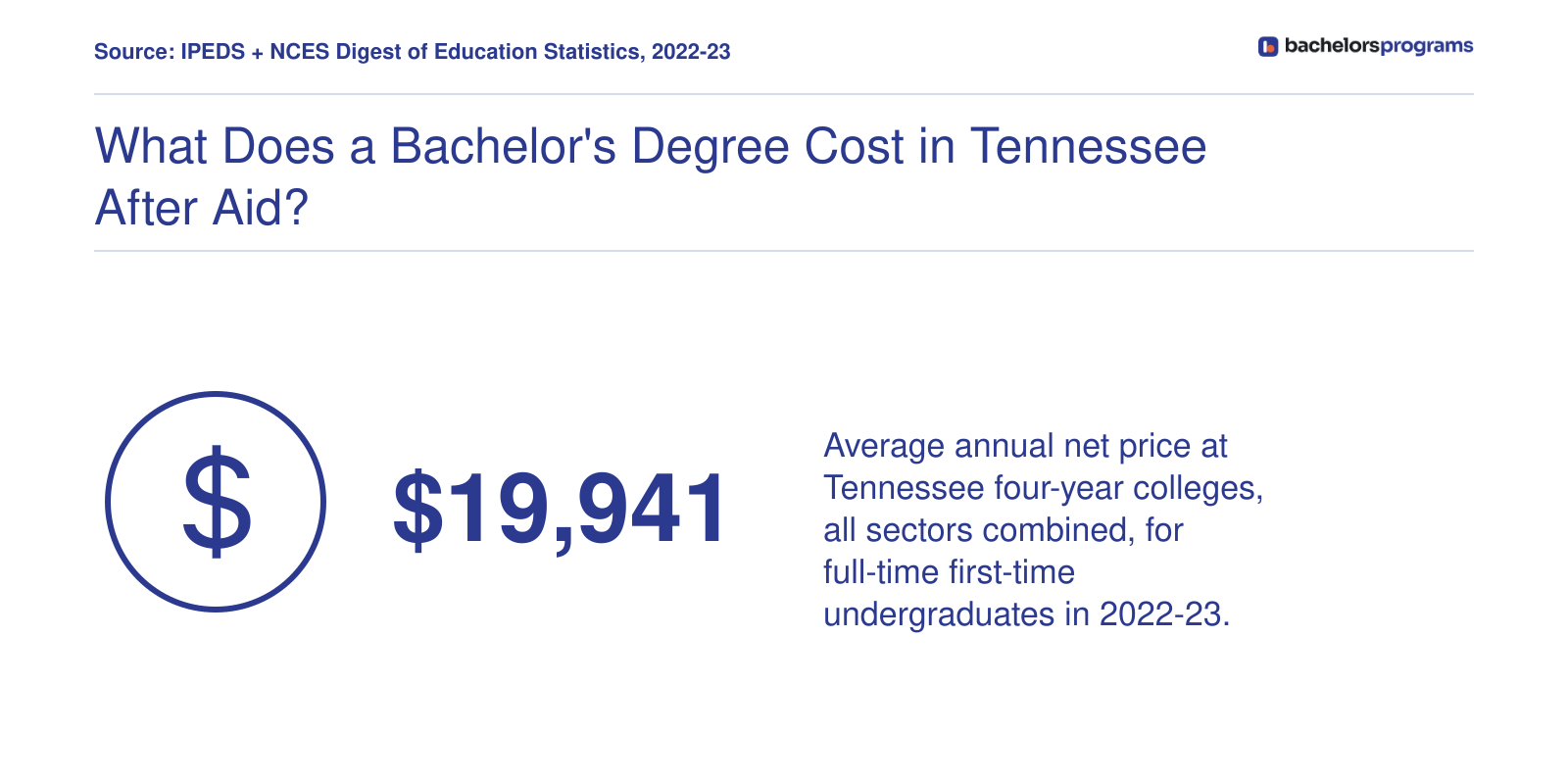
Average annual net price after grants at the state's four-year institutions ran $19,941 in 2022-23, and the spread around that average is wide.
Key Points
- Tennessee four-year colleges averaged a $19,941 annual net price in 2022-23.
- All-online GI Bill terms cut housing pay to half the national average.
- The Tennessee Transfer Pathway carries 60 community college credits into specific majors.
Popular degrees in Tennessee
Bachelor's degrees in Tennessee by field
Business & Management
- Business Administration61 programs
- Marketing48 programs
- Finance36 programs
- Management36 programs
- Accounting33 programs
- Sports Management25 programs
- Human Resource Management or HR Management25 programs
- Logistics & Supply Chain Management24 programs
Science & Engineering
- Biology42 programs
- Mathematics42 programs
- Chemistry36 programs
- Physics25 programs
- Biochemistry24 programs
- Geosciences16 programs
- Electrical Engineering or Electronics Engineering or Electronic Systems Engineering Technology16 programs
- Engineering Technology15 programs
Education & Teaching
- Science52 programs
- Special Education33 programs
- Elementary Education30 programs
- Secondary Education28 programs
- Mathematics Education27 programs
- English Education25 programs
- History Education25 programs
- Physical Education22 programs
Liberal Arts & Humanities
- English43 programs
- Literature or English Literature35 programs
- History34 programs
- Spanish20 programs
- Philosophy17 programs
- Interdisciplinary Studies13 programs
- Humanities8 programs
- General Studies7 programs
Arts & Design
- Art or Art Studies44 programs
- Fine Arts or Studio Art30 programs
- Media Arts or Digital Media24 programs
- Graphic Design21 programs
- Audio & Music20 programs
- Art History10 programs
- Creative Writing9 programs
- Fashion Design5 programs
Computers & IT
- Computer Science39 programs
- Cybersecurity20 programs
- Information Technology14 programs
- Artificial Intelligence12 programs
- Computer Information Systems12 programs
- Computer Engineering10 programs
- Software Development & Engineering8 programs
- Innovation or Technological Entrepreneurship8 programs
Communications & Media
- Communications33 programs
- Journalism24 programs
- Public Relations16 programs
- Professional Writing6 programs
- Speech Pathology6 programs
- Communication Disorders5 programs
- Social Media3 programs
- Technical Communication3 programs
Nursing
- Bachelor of Science in Nursing42 programs
- Nursing (RN to BSN)21 programs
- Accelerated BSN (ABSN)14 programs
- LPN/LVN to BSN11 programs
Social Work & Social Sciences
- Sociology28 programs
- Political Science, Government26 programs
- Social Work23 programs
- Human Services3 programs
- Disability Studies2 programs
- Public Policy1 program
Criminal Justice & Law
- Criminal Justice31 programs
- Criminal Justice Administration11 programs
- Criminology10 programs
- Forensic Science9 programs
- Homeland Security6 programs
- Legal Studies3 programs
- Legal Services2 programs
- Corrections2 programs
Healthcare
- Exercise & Sports Science29 programs
- Health Sciences13 programs
- Public Health10 programs
- Nutrition6 programs
- Health Education6 programs
- Speech Pathology4 programs
- Respiratory Care Therapy3 programs
- Community Health3 programs
Psychology
- General Psychology34 programs
- Applied Psychology3 programs
- Industrial Organizational Psychology3 programs
- Developmental Psychology2 programs
- Counseling Psychology2 programs
- Child Psychology1 program
- Sport Psychology1 program
- Clinical Psychology1 program
Religion & Theology
- Christian Studies or Religious Studies18 programs
- Christian Ministry or Ministry Leadership13 programs
Natural & Applied Sciences
- Agriculture or Agricultural15 programs
- GIS and Geoscience8 programs
- Neuroscience4 programs
- Oceanography or Ocean or Marine Biology2 programs
How Online Bachelor's Degrees Work in Tennessee
"Fully online" and "mostly online" are not the same product, and in Tennessee the difference usually shows up after you enroll. Before comparing price tags, know what format you are buying and who is selling it.
Three Formats Behind One Label
- Fully online: All coursework is delivered remotely, usually asynchronously, though some courses schedule live sessions at fixed times.
- Hybrid: Most instruction happens online, but labs, residencies, or weekend intensives bring you to campus on a set schedule.
- Degree completion: Built for students who already hold an associate degree or a stack of earned credit, these programs start you in upper-division coursework rather than at the beginning.
The catch is that many Tennessee programs marketed as online still carry in-person obligations. Nursing has clinical placements, education majors complete student teaching in a K-12 classroom, and plenty of departments require proctored exams, whether in a campus lab or through webcam monitoring. A university can be "online friendly" at the institutional level while the specific major you want meets on campus six Saturdays a term. Verify format at the program level, with the department, not from the admissions landing page.
How the Three Sectors Differ
In-state public institutions fall into three groups: the University of Tennessee System, the locally governed universities that were once part of the Board of Regents, and the TBR community colleges. Public universities generally price online credit by the credit hour, often with a defined online or distance rate, and they are the most predictable on transfer because state articulation policy ties them together.
Private nonprofit colleges in Tennessee tend to post a single sticker price and then discount it heavily with institutional aid, so the published number tells you very little until you have an award letter. Many run small, cohort-based online completion tracks for working adults.
For-profit and national online universities compete on enrollment flexibility, frequent start dates, and generous credit-for-prior-learning policies. They are also the sector where transfer credit tends to travel least well if you later move to a public university, so confirm how your credits will be treated before you commit.
Confirm Accreditation Before Anything Else
SACSCOC is the regional accreditor for Tennessee institutions, and institutional accreditation is what makes federal aid and credit transfer possible. Look the school up in the U.S. Department of Education's DAPIP database rather than trusting a seal on a website. Then check whether your field needs programmatic accreditation too: ABET for engineering and computing, CCNE for nursing, CAEP for teacher preparation.
Four questions decide the rest, in this order: what it costs after aid, how much credit transfers in, how long it takes to finish, and what you have to show up for in person.
What Online Bachelor's Degrees Cost at Tennessee Public Universities
Your real tuition bill depends far more on the credits you still need than on which public university you pick. Use this formula: per-credit rate × credits remaining + any online or distance fees. A transfer student with 60 credits left pays roughly half of what a first-time student needing all 120 pays at the same rate. At $490 per credit, 60 credits comes to about $29,400. At $536, it comes to about $32,160.
Published Online Rates at Tennessee Publics
These are per-credit undergraduate figures from each school's own tuition or bursar page. They come from different terms and include different fee components, so treat them as starting points rather than exact matches.
- Tennessee State University (Summer 2026, TSU Bursar): $455 per credit in-state ($325 tuition plus a $130 online fee).1 Out-of-state: see school.
- University of Tennessee, Knoxville (2026, UTK One Stop): $490 per credit for Tennessee residents and $565 for out-of-state students.2 The total itemizes tuition, a $100 online-support fee and library charges.
- Tennessee Tech University (Fall 2026/Spring 2027): $536 per credit for residents ($383 tuition plus a $153 online course fee).3 Tuition is capped at 12 hours, though Tennessee Tech notes some exclusions apply.
- Tennessee Tech, TN eCampus courses (2025-26): $514 per credit for residents and $654 for domestic out-of-state students, including a $147 online course fee.4
- UT Chattanooga (FY2025-26): a $56 per-credit online-support fee for students in state-approved online programs, with no credit-hour cap.5 Full tuition: see school.
- UT Martin, University of Memphis Global, MTSU, ETSU, Austin Peay: see school. UT Martin bills online credits per hour with no cap.
In-State, Out-of-State or One Flat Rate
Some public universities charge a single online rate (often called an e-rate) no matter where you live. Others keep a resident and nonresident split. Among the schedules above with published out-of-state figures, the nonresident charge runs $75 to $140 more per credit. Ask the bursar which model your specific program uses, because one campus can price institutional online courses and TN eCampus courses differently.
Watch the Fees and the Billing Model
Online fees can add $100 or more per credit at some campuses. Check two details on any tuition page:
- Per credit or banded: A cap means full-time students stop paying added tuition after a set number of hours. A no-cap schedule bills every credit.
- Fee scope: Some fees apply only to students admitted to an approved online degree. On-campus students taking a single online course may pay the regular schedule plus an online-support fee.
Lowest Sticker Price Is Not Lowest Cost
On published per-credit figures, Tennessee State's in-state rate is the lowest verified here. That comparison stops at sticker price, though. HOPE, Reconnect, Pell Grants and veteran benefits can shrink your bill dramatically, so net price after aid is the number that should drive your decision.
What Does a Bachelor's Degree Cost in Tennessee After Aid?
Across the 48 Tennessee four-year institutions that reported net price in 2022-23 IPEDS data, the average annual net price (cost of attendance minus grants and scholarships) for full-time, first-time undergraduates was $19,941, with a median of $19,755. That statewide figure blends public and private campuses. For comparison, national averages for 2021-22 were $15,200 at public four-year colleges, $24,400 at for-profit colleges and $29,700 at private nonprofit four-year colleges, a public-to-private nonprofit gap of about $14,500 a year. These figures describe all undergraduates rather than online students specifically, and your own net price can land well above or below them depending on family income, because lower-income students typically qualify for more grant aid.
Financial Aid for Online Students: HOPE, Reconnect, Promise and Veteran Benefits
When every course in your term is online, the Post-9/11 GI Bill still covers tuition and fees at the same rate it would for classroom instruction1, but the monthly housing allowance is cut to 50 percent of the national average2. For 2025-26 that works out to a maximum of $1,169 per month3, and the rate set for August 2026 through July 2027 is $1,2614. That rule is why so many veterans take one seated class per term: a single in-person course restores the higher resident housing rate.
Start with the FAFSA
Every path below runs through the Free Application for Federal Student Aid. The FAFSA opens the Pell Grant, the Tennessee Student Assistance Award and most institutional need-based aid, and online students are evaluated on the same terms as on-campus students, provided they meet each program's enrollment-level rules. File it early. State money is limited and awarded on a first-come basis in many cases, not just on need.
State aid: HOPE, Promise and Reconnect
The Tennessee HOPE Scholarship is administered by the Tennessee Student Assistance Award office's parent agency, TSAC, which publishes current award amounts by class level and by enrollment intensity each year. HOPE scales with how many credit hours you carry, so a half-time online load usually draws less than a full-time one. TSAC also runs a nontraditional HOPE award aimed at adults who did not move straight from high school into college, which is the route most working online students should ask about.
Here is the misconception worth clearing up: Tennessee Promise and Tennessee Reconnect are community college and TCAT programs. They fund associate degrees, diplomas and certificates, not a bachelor's. Reconnect can pay for your first two years at a community college, and those credits can then transfer into an online bachelor's at a four-year university, which stretches the same dollars considerably further than paying four years of university tuition.
Military and veteran benefits
Beyond the GI Bill, Tennessee participates in the VETS campus program, which recognizes institutions that support student veterans, and the state offers its own veteran grant programs, including the Helping Heroes Grant. Ask a school's certifying official which state awards your program qualifies for. Also ask whether the school takes part in the Yellow Ribbon Program, which can cover tuition above the GI Bill cap at participating institutions, and whether it charges a flat military rate for online terms. Housing payments arrive at the end of each month, are prorated when a term starts or ends mid-month, and stop during breaks between semesters5, so budget accordingly.
One call before you enroll
Before you pay a deposit, call the financial aid office and confirm, in writing, that your specific online program and planned credit load qualify for each state award you are counting on. Enrollment-level definitions vary, and a program that is fully online may be treated differently from a hybrid one.
TN Ecampus: What It Is and Whether It Leads to a Bachelor's Degree
TN eCampus is the Tennessee Board of Regents' shared online program: a cooperative catalog of online courses drawn from participating public colleges and universities in the state. Courses are designed to match their campus equivalents, the participating institutions are accredited by the Southern Association of Colleges and Schools, and the catalog runs to more than 450 online courses.1
Who actually awards your degree
The point that trips people up is enrollment. You do not apply to TN eCampus as a separate university. You enroll through a home institution, meaning the Tennessee public college or university where you are admitted, registered, and billed, and that home institution typically awards the credential.1 Advising, financial aid processing, and graduation paperwork all run through it rather than through a central office.
Programs and how they are delivered
TN eCampus is built around degree completion, not first-time freshman admission.1 The strongest fit is someone who has already earned credits at a Tennessee community college or another regionally accredited school and wants to finish a bachelor's degree online. Program titles, concentrations, and admission rules change, so confirm current availability with your home institution before you plan around a specific major.
Online delivery is also not the same as fully asynchronous. Proctored exams, identity verification, and testing-center requirements vary by course and by institution. Ask each program which courses require a proctor or a scheduled exam session before you enroll.
What TN eCampus costs
There is no single statewide per-credit rate. Charges follow your home institution's schedule and vary by residency and fee structure. Tennessee Tech, for instance, lists roughly $514 per credit for in-state undergraduates on its 2025-2026 schedule2, with a separate per-credit online course fee, while University of Memphis lists $545 per credit in state for 2026-20273, again with an online fee on top. Compare those published totals against the same school's campus-based online rates before assuming the shared catalog is the cheaper route.
One option among several
Under the FOCUS Act, several universities that once sat under TBR governance now set their own online programs and rates. Treat TN eCampus as one path to a Tennessee bachelor's degree, not the only one.
From Community College to Bachelor's: The Tennessee Transfer Pathway
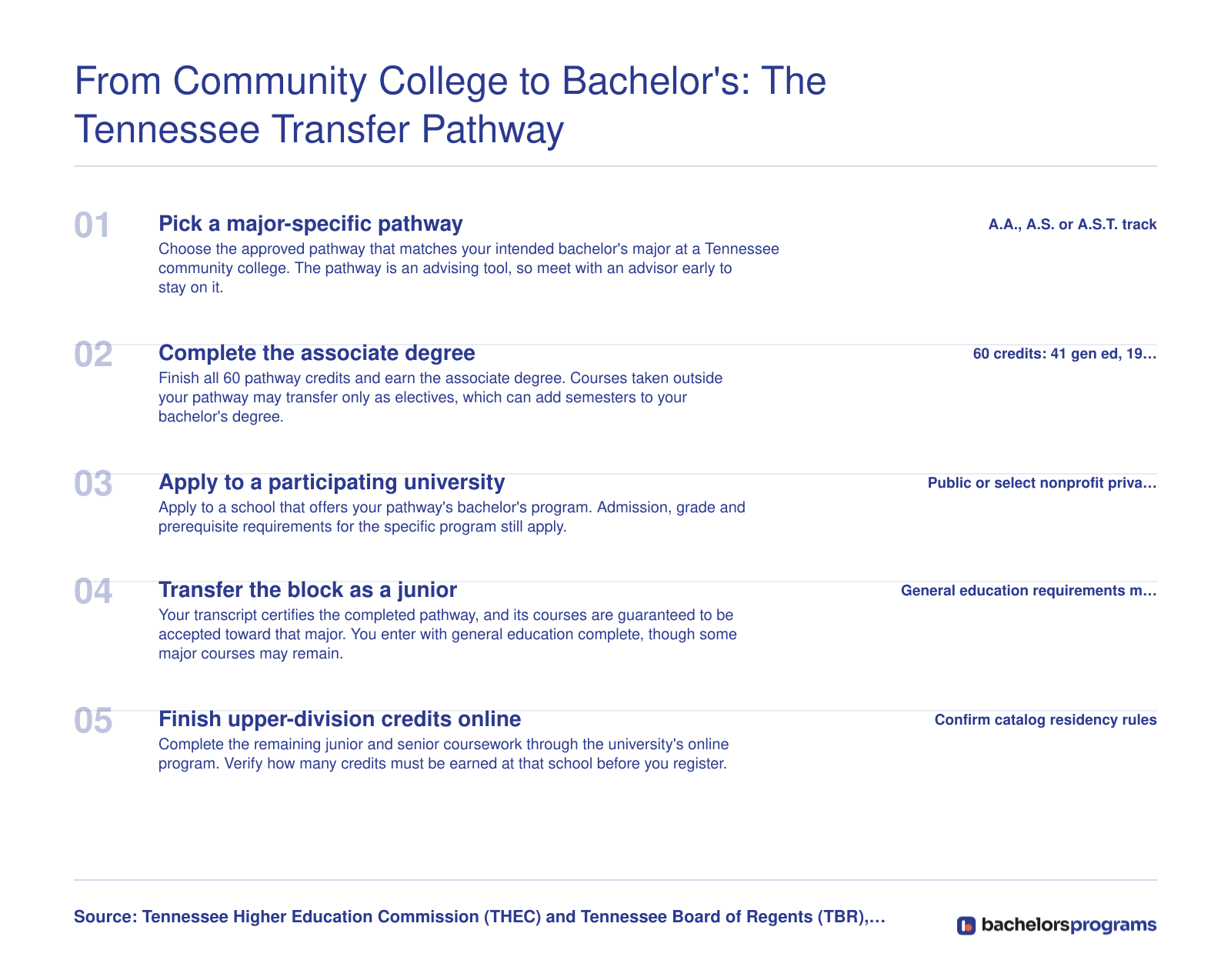
The Tennessee Transfer Pathway lets community college students plan their first 60 credits so they carry into a specific bachelor's major. The guarantee covers Tennessee public universities and select nonprofit private colleges that participate. There is no single statewide cap on transfer credits or minimum number of credits you must earn at the degree-granting school, so check the receiving university's catalog for both before you enroll.
How Long It Takes to Finish an Online Bachelor's Degree in Tennessee
A Tennessee bachelor's degree is built on about 120 credit hours, and how you spread those hours across terms shapes your finish date more than which online format you choose.
Three Timelines, One Degree
- First-time, full-time: 15 credits a semester over two semesters is 30 credits a year, a four-year finish.
- Three-term load: 12 credits per term across fall, spring and summer is 36 credits a year, roughly three and a third years.
- Part-time working adult: 6 credits per term is 18 credits a year, so five to six-plus years, longer if you sit out summers.
- Transfer or degree-completion: arriving with 60 or more credits leaves about two years of full-time work.
State transfer reporting has long shown transfer students taking closer to 10 semesters than the 9 typical of students who started at the university, though that 2010 figure does not separate full-time from intermittent enrollment.1
Accelerated Terms and Mastery-Based Pacing
Seven- and eight-week terms with year-round starts let you stack more terms into a calendar year, but they shorten the degree only if you stay enrolled back to back and the courses you need run in sequence. Competency-based programs take another route: Western Governors University requires at least 12 competency units per six-month term,2 most courses are worth 2 to 4 units toward a 120-unit bachelor's,3 and students who demonstrate mastery can add more. WGU reports a median bachelor's completion around 24 months, and students entering without an associate degree typically take 2 to 2.5 years.4 Its business pages report 61% finishing within 19 months3; its IT page puts most students near 39 months.5 Those are WGU-wide and program-specific figures, not a Tennessee guarantee.
Outside Credit and the Residency Cap
Prior learning assessment, CLEP and DSST exams, military transcripts and industry certifications can erase a semester or more. Most colleges cap how much outside credit they will apply and require a share of the major completed in residence, so ask for the cap and whether it reaches upper-level coursework.
The Aid Clock Runs Too
Tennessee HOPE and similar awards carry term and attempted-credit-hour limits, so a slow part-time pace can exhaust eligibility before you reach the finish. Confirm how part-time enrollment and summer terms count before you build a schedule.
Admissions Requirements and In-Person Obligations
Tennessee's online bachelor's programs admit students under two different sets of rules, and knowing which set applies to you saves weeks of wasted paperwork.
Freshman vs. transfer admission
First-time freshmen are reviewed on high school performance: GPA, coursework, and sometimes an ACT or SAT score. Many Tennessee public universities now run test-optional or test-flexible policies, so a solid high school record can carry an application without a test score.
Transfer and adult students are judged differently, usually on college GPA and credit already earned. A 2.0 college GPA is a common floor, though some programs, especially in business and health fields, expect more. Students with no prior credit may be admitted on the freshman standard instead, so confirm which category you fall into before you apply.
Deadlines and start dates
Online programs often run rolling admission or several start terms per year, while some campuses hold firm fall and spring deadlines. Apply six to eight weeks before a term begins. That window covers transcript delivery from every school you've attended, financial aid processing, and any placement or advising steps.
What "online" may still require in person
- Clinical and practicum hours: RN-to-BSN and other health programs typically require supervised hours at a partner site.
- Student teaching: Education majors complete field placements in schools regardless of how coursework is delivered.
- Proctored exams: Some courses use testing centers or remote proctoring software.
- Orientation or residencies: A few programs ask for a campus visit or short intensive session.
Check state authorization
If you live outside Tennessee, confirm the program is authorized to enroll residents of your state. Licensure-track fields such as nursing and teaching are the most restricted, because state boards set their own requirements. Requirements shift, so verify GPA cutoffs, deadlines, and clinical obligations directly with each program before you commit.
Graduation Rates and Outcomes for Tennessee Online Learners
No single dataset captures how Tennessee's online students fare, so the most useful skill is knowing where each piece of evidence lives. National figures give a baseline: in fall 2024, full-time retention across 4,783 U.S. institutions was 77.9% (provisional).1 Use that as a yardstick, then look up the schools you are considering.
Where to Look
- IPEDS College Navigator: Best for first-year retention (full-time and part-time) and graduation rates. Keep in mind that graduation rates track full-time, first-time cohorts, which describes few adult online learners.
- IPEDS Outcome Measures: Best for part-time and transfer students. It covers four entering groups (full-time and part-time, first-time and non-first-time), split by Pell status, with 4-, 6-, and 8-year award rates.1
- College Scorecard: Best for institution-level completion and earnings. It also shows how many students transferred, remained enrolled, or have unknown status.
- THEC: Best for state context, including fiscal-year degree completions by institution and program. Its completion measure counts awards conferred in a year, so it is not a cohort graduation rate.2
- BLS.gov: Best for occupational wages and job outlook in the field you plan to study.
Check the Schools Directly
Visit the sites of University of Memphis, MTSU, Austin Peay, WGU Tennessee, and Bethel University, and search for institutional research, fact book, or consumer information pages. Look for program-level online completion or retention disclosures. Federal data often blends online and on-campus students, so the school may be the only place that separates them.
What to Ask Admissions
- Are retention and graduation figures reported separately for fully online students?
- What share of online entrants are transfers or part-time, and how do they finish?
- How long does the typical online student take to complete this specific degree?
- Does your institutional research office publish online-only outcomes, and can I see them?
For licensure-bound fields such as nursing or education, check the relevant accreditor or professional association for exam pass rates and placement data. Then triangulate: compare the federal figures, the THEC context, and the school's own numbers. If they disagree, ask why before you enroll.
Questions to Ask Yourself
Does a lower per-credit rate still win once you count the credits each school will accept?
Does your field require hands-on hours you must complete somewhere in Tennessee?
Would a school with lower overall graduation rates but strong adult-learner support serve you better than a traditional campus's online arm?
Checklist: How to Choose the Right Online Program in Tennessee
Before you apply, confirm each item below for every school on your shortlist. Get answers in writing whenever you can.
- Accreditation, verifiedConfirm the school holds SACSCOC or other recognized institutional accreditation by checking the U.S. Department of Education's DAPIP database. If your career requires it, such as nursing, teaching or social work, also confirm programmatic accreditation.
- Your tuition rate in writingAsk whether you will pay in-state, out-of-state or a flat online e-rate, and get a full list of online, technology and course fees.
- Net price comparisonsRun the net price calculator at two or three schools and compare what you would actually pay after grants, not just the sticker price.
- A written transfer credit evaluationGet an evaluation that shows which credits count toward your major, not just which ones transfer as electives.
- Aid eligibilityConfirm that your program and planned enrollment load qualify for HOPE, TSAA, Pell or GI Bill benefits, since part-time status can affect some awards.
- In-person requirementsAsk about clinicals, proctored exams or residencies, and find out who arranges placements.
- Support and technologyCheck for online advising, tutoring and career services, and review the device and software requirements.
- Your next stepRequest information and a degree audit from your top two schools, and file the FAFSA as early as possible for the aid year. Some state aid, including TSAA, can run out.
Colleges in Tennessee with the most bachelor's programs
| School | City | Type | Bachelor's programs | Online | Net price / yr | Grad rate |
|---|---|---|---|---|---|---|
| Middle Tennessee State University | Murfreesboro | Public | 121 | 20 | $13,359 | 54% |
| East Tennessee State University | Johnson City | Public | 118 | 14 | $15,983 | 53% |
| The University of Tennessee-Knoxville | Knoxville | Public | 105 | 10 | $18,976 | 74% |
| Tennessee Tech | Cookeville | Public | 97 | 4 | $14,246 | 58% |
| University of Memphis | Memphis | Public | 94 | 28 | $12,397 | 51% |
| Austin Peay State University | Clarksville | Public | 88 | 23 | $9,735 | 40% |
| The University of Tennessee-Chattanooga | Chattanooga | Public | 88 | 8 | $14,265 | 50% |
| Lipscomb University | Nashville | Private nonprofit | 82 | 9 | $24,739 | 72% |
| Belmont University | Nashville | Private nonprofit | 77 | 1 | $33,147 | 71% |
| The University of Tennessee-Martin | Martin | Public | 74 | 2 | $10,701 | 53% |
| Union University | Jackson | Private nonprofit | 68 | 6 | $27,171 | 66% |
| Lee University | Cleveland | Private nonprofit | 64 | 7 | $18,878 | 63% |
| Tennessee State University | Nashville | Public | 63 | 7 | $15,796 | 34% |
| Trevecca Nazarene University | Nashville | Private nonprofit | 59 | 7 | $16,813 | 53% |
| Southern Adventist University | Collegedale | Private nonprofit | 58 | 2 | $24,345 | 49% |
Program counts are the verified bachelor's listings in our directory; net price is the school-wide average a first-time undergraduate paid after aid, and graduation rate the share finishing within six years (College Scorecard).
Compare programs nationwide
Many Tennessee residents study online. Every ranked list above has an online lens, or browse every field.
Online bachelor's degrees Browse all fields