Online Colleges and Bachelor's Degree Programs in Maine
Every verified bachelor's program at a college in Maine: 540+ programs at 18 colleges, with the online options, net price and graduation rates behind each one.

UMaine Online is not a separate college. It is one gateway into online courses and bachelor's programs from the University of Maine System's seven campuses, so a student in Presque Isle or a shift worker in Bangor can finish a degree without relocating.
For most adult learners here, the decision narrows to two numbers: the per-credit rate, and how many credits already on a transcript will actually count.
Maine's pricing models split sharply on the first. UMPI's YourPace charges a flat $1,800 per eight-week session regardless of how many courses you finish, while other campuses bill by the credit, so pace changes the total.
Key Points
- UMaine Online links degrees from seven NECHE-accredited University of Maine System universities.
- UMPI's YourPace charges a flat $1,800 per 8-week session.
- No system-wide transfer cap exists: each campus reviews credit course by course.
Popular degrees in Maine
Bachelor's degrees in Maine by field
Business & Management
- Marketing14 programs
- Business Administration13 programs
- Management9 programs
- Sports Management7 programs
- Accounting7 programs
- Economics7 programs
- Finance6 programs
- Sustainability or Environmental Management6 programs
Science & Engineering
- Biology14 programs
- Mathematics13 programs
- Environmental Science9 programs
- Chemistry9 programs
- Biochemistry8 programs
- Physics6 programs
- Natural Resources or Conservation6 programs
- Anthropology5 programs
Education & Teaching
- Secondary Education16 programs
- Science13 programs
- Elementary Education11 programs
- English Education9 programs
- Special Education8 programs
- Mathematics Education6 programs
- History Education5 programs
- Physical Education5 programs
Liberal Arts & Humanities
- English12 programs
- Literature or English Literature10 programs
- History8 programs
- Philosophy5 programs
- Spanish5 programs
- Gender & Sexuality Studies5 programs
- Global Studies4 programs
- African and African American Studies3 programs
Arts & Design
- Art or Art Studies15 programs
- Fine Arts or Studio Art14 programs
- Media Arts or Digital Media8 programs
- Audio & Music4 programs
- Art History4 programs
- Graphic Design3 programs
- Creative Writing3 programs
- Digital Photography1 program
Computers & IT
- Computer Science8 programs
- Cybersecurity4 programs
- Innovation or Technological Entrepreneurship4 programs
- Artificial Intelligence3 programs
- Computer Information Systems3 programs
- Software Development & Engineering2 programs
- Computer Engineering2 programs
- Information Technology1 program
Social Work & Social Sciences
- Political Science, Government10 programs
- Social Work7 programs
- Sociology7 programs
- Human Services2 programs
Nursing
- Bachelor of Science in Nursing11 programs
- Nursing (RN to BSN)5 programs
- Accelerated BSN (ABSN)5 programs
- LPN/LVN to BSN1 program
Healthcare
- Exercise & Sports Science6 programs
- Health Sciences6 programs
- Public Health3 programs
- Health Education3 programs
- Nutrition2 programs
- Health Informatics1 program
- Speech Pathology1 program
Criminal Justice & Law
- Criminal Justice5 programs
- Criminology2 programs
- Forensic Science2 programs
- Legal Services1 program
- Cybercrime1 program
- Corrections1 program
- Homeland Security1 program
- Criminal Justice Administration1 program
Natural & Applied Sciences
- Oceanography or Ocean or Marine Biology7 programs
- Agriculture or Agricultural3 programs
- Neuroscience3 programs
- GIS and Geoscience1 program
Psychology
- General Psychology9 programs
- Forensic Psychology2 programs
- Clinical Psychology1 program
Communications & Media
- Communications3 programs
- Public Relations1 program
- Business Communications1 program
- Communication Disorders1 program
- Speech Pathology1 program
Counseling
- Substance Abuse Counseling1 program
- Mental Health Counseling1 program
How Online Bachelor's Degrees Work in Maine: Fully Online, Hybrid and Competency-Based
Three Formats, Defined
- Fully online: All coursework happens online, and no campus visits are required.
- Hybrid: Online courses are mixed with some in-person sessions, on campus or at a site you arrange.
- Competency-based: You advance by demonstrating mastery rather than logging seat time. UMPI's YourPace is the Maine example. Confirm current details with the university before you plan around it.
Synchronous vs. Asynchronous
Synchronous classes meet at set times through video. Asynchronous classes let you move through lectures and assignments on your own schedule, provided you meet the weekly deadlines. For a working parent, asynchronous courses usually fit around shifts and school pickups. Synchronous sessions can still work if they fall in the evening. Some programs mix both, so look at the meeting times listed for each course before you register.
Can You Finish Completely Online?
Often, but not always. Many business, psychology and liberal studies degrees can be completed online. Fields tied to professional licensure usually require supervised, in-person hours.
The University of Southern Maine's RN-to-BSN shows how this works. Coursework is 100% online, and some courses have virtual meeting times. Required practicum courses, however, take place at a healthcare facility in the student's state of residence. Published program information does not state the number of practicum hours, so ask the program directly.
Education (student teaching) and social work (field placement) programs typically carry similar requirements. The University of Maine System sources reviewed here do not spell out hours or placement formats for those degrees, so treat those details as something to verify. In general, placements are arranged near where you live rather than on campus, but the program must approve the site.
Proctored exams are another variable. No systemwide rule was identified, so confirm with the instructor or department whether a course requires one.
One more rule: the University of Maine System requires 30 residency credits, and up to 6 earned at another system campus may count toward them.
Read the Label Carefully
On a program page, "online" may mean 100% online or online coursework plus placements. Look for words like practicum, clinical, field experience, student teaching or proctored exam. If the page is unclear, ask admissions for the full list of in-person requirements before you apply.
Are Maine's Online Colleges Accredited? How to Verify NECHE and Programmatic Accreditation
Is University of Maine online accredited? Yes.2 UMaine Online is not a separate online school. It is a gateway to courses and degrees offered by the University of Maine System's seven universities: UMaine, USM, UMA, UMF, UMFK, UMPI and UMM. All seven share one unified institutional accreditation from the New England Commission of Higher Education (NECHE), granted in July 2020.1 NECHE lists the system as a member. It continued that accreditation in March 2023 after a comprehensive evaluation that year, and the next full review is scheduled for fall 2032.1 An online degree from any of these campuses carries the same accreditation as the on-campus version.
Maine's community colleges are generally regionally accredited as well. Still, confirm each college's current status in the NECHE directory rather than assuming it.
Why Programmatic Accreditation Matters
Institutional accreditation covers the whole university. Programmatic accreditation covers a single field. In licensed professions, it can decide whether you qualify for a licensing exam or a graduate program.
- Nursing: Look for CCNE or ACEN. USM's bachelor's in nursing is CCNE-accredited and approved by the Maine State Board of Nursing. UMA's nursing program has held ACEN accreditation since 2014, so check ACEN's directory for its current term.
- Social work: Most licensure paths expect a CSWE-accredited degree. USM's BSW was reaccredited in 2021 for eight years, through 2029. UMaine's program is due for its next CSWE review in 2027. Both are primarily campus-based.
- Education and business: Look for CAEP accreditation or Maine Department of Education approval for teacher preparation, and AACSB or ACBSP for business. Status varies by degree, so confirm it on the specific program page.
Verify Any School in Three Steps
- Search NECHE: Look up the institution in the commission's directory and note its status and next review date.
- Search DAPIP: The U.S. Department of Education's accreditation database confirms whether the accreditor is federally recognized.
- Search the programmatic accreditor: CCNE, ACEN, CSWE, CAEP, AACSB and ACBSP each publish searchable lists of accredited programs.
A Warning on Transfer Credit
Credits from nationally accredited or unaccredited schools may not transfer to Maine's public universities. If you might move from one school to another later, verify accreditation before you pay for a single course.
Online Tuition per Credit at Maine's Public Universities (2026)
For online students, compare the per-credit rate rather than a yearly sticker price, since many online learners enroll part time and pay by the credit. The figures below come from published 2026-27 schedules (with USM's 2025-26 rates shown to illustrate year-over-year change) and serve as a lookup reference, not a ranking. Most University of Maine System campuses price online courses at their own standard per-credit rate, while USM applies a single online rate to fully online programs regardless of residency, so confirm the exact rate for your program. Mandatory fees come on top of tuition: USM adds $113 per credit, Maine's community colleges list $1,276 a year in fees for 2026-27, and technology or online course charges can vary by campus and program, so ask each school's student accounts office for your full cost per credit.
| Institution | In-State Per Credit | Out-of-State or Online Rate Per Credit | Pricing Model | Notable Fees |
|---|---|---|---|---|
| University of Southern Maine (2026-27, tuition plus fees) | $463 ($350 tuition + $113 mandatory fees) | $1,142 ($1,029 tuition + $113 mandatory fees) | Per credit; rate varies by residency, major (differential level) and delivery mode; fully online programs use one online rate for all residency statuses | $113 per credit in mandatory fees |
| University of Southern Maine (2026-27, tuition only) | $329 to $370, depending on differential level | $970 to $1,086, depending on differential level | Differential tuition levels by undergraduate program; separate e-tuition rate for online programs | Mandatory fees billed in addition to tuition |
| University of Southern Maine (2025-26, tuition only) | $316 to $355, depending on differential level | $931 to $1,043, depending on differential level | Differential tuition levels by undergraduate program; separate e-tuition rate for online programs | N/A |
| University of Maine at Presque Isle, YourPace (University of Maine System) | Not priced per credit | Flat rate beginning at $1,800 per 8-week session | Flat rate per 8-week session rather than per credit | N/A |
| Maine Community College System (lower-division benchmark, 2026-27) | $96 | $192 | Per credit for both on-campus and online courses | $1,276 in annual fees; no per-credit fee figure published |
What a Full Bachelor's Degree Can Cost: Three Paths Compared
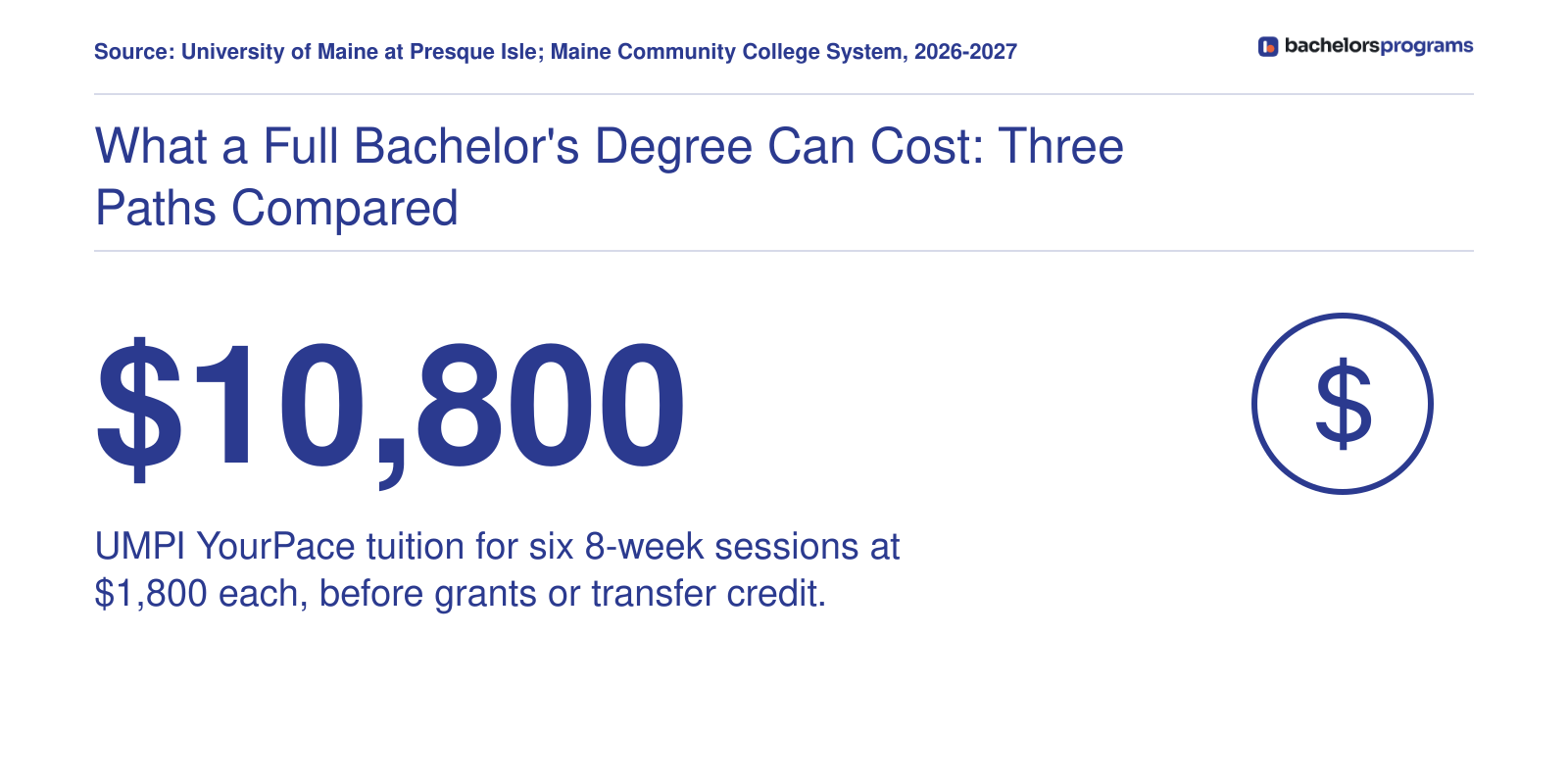
For a fast, self-directed student, UMPI's YourPace is the cheapest path to a Maine bachelor's degree. It charges a flat $1,800 per 8-week session no matter how many courses you finish, so six sessions (one year) total $10,800 ($1,800 times 6), and each extra session adds $1,800. UMPI advertises a bachelor's for $10,200 or less, but that is a marketing estimate, not a guarantee; your total depends on prior credit, study time and courses completed per session. The community college route starts lower: 60 credits at an in-state rate of $96 per credit come to $5,760 in tuition, plus $1,276 in annual fees billed separately, with the remaining credits charged at the university's rate. Every figure here is tuition only, before grants.
Net Price, Financial Aid and Maine State Grants for Online Students
The tuition posted on a university's website and the tuition you actually pay are rarely the same, and the gap between them is the number that matters. Sticker price is the published cost per credit or per year before anything is subtracted. Net price is what remains after grants and scholarships you do not repay, and it is the only figure worth comparing across schools. A program with a higher posted rate can easily cost less once aid is applied, so judging options by sticker price alone tends to steer you toward the wrong choice.
Do Online Students Qualify for the Maine State Grant?
The Maine State Grant is need-based aid administered by FAME for Maine residents enrolled as undergraduates who have not already earned a bachelor's degree.1 Applicants need a high school diploma or GED, acceptance or enrollment in an eligible undergraduate program, and demonstrated financial need established through the FAFSA. State law authorizes part-time awards, though FAME sets the operating criteria, and awards run for no more than one academic year, which means you reapply annually.1 Because the rules around credit load, program type and fully online enrollment are set by FAME rather than fixed in statute, confirm your specific situation with your campus financial aid office or FAME directly before assuming you are covered. The Maine State Grant application deadline for 2026-27 is November 13, 2026, so treat filing as a fall task rather than a summer one.
Federal Aid Works the Same Online
Online students at accredited institutions file the identical FAFSA as on-campus students. For the 2026-27 award year, the maximum Federal Pell Grant is $7,395.2 Your actual award depends on your Student Aid Index, cost of attendance, whether you enroll full-time or part-time, program length and how much Pell eligibility you have left. Pell is meant for undergraduates with exceptional need who have not earned a degree, and it can be used at online schools, community colleges, career and trade schools, and four-year institutions.3 The lifetime cap is the equivalent of 12 full-time terms, roughly six years, so part-time enrollment stretches that window.4
Maine Programs Worth Investigating
Maine has historically offered an education-related tax benefit for graduates who live and work in the state, and the Maine National Guard and Maine's community college system have run their own tuition programs. Terms change year to year, so verify current rules with the administering agency rather than relying on older write-ups.
Run the net price calculator on each university's site, then file the FAFSA as early as the window opens.
Transfer Credit and Degree Completion: From Community College or Some College to a Bachelor's
How many transfer credits will a Maine public university actually accept toward a bachelor's degree?
There is no single system-wide cap. Each University of Maine System campus evaluates credit course by course, and a course can land as a direct equivalent, a general education match, a subject elective, or a plain elective. Only some of those move you toward graduation.
Residency, grades and the transfer floor
Transferable coursework generally needs a C- or better from an institution accredited by a recognized body (CHEA or the U.S. Department of Education), with an official transcript on file before credit posts. Remedial and developmental courses can be eligible at that same C- threshold. Residency is the hard floor: every UMS university requires at least 30 credits earned at the degree-granting campus, 25 percent of a 120-credit degree, and some require three upper-division courses in-house. Individual programs may add rules on top.
MCCS to UMS: the transfer block and Transfer ME
The MCCS General Education Transfer Block is the cleanest path. Finish at least 34 general education credits with a C- or better in every MCCS course and the block satisfies UMS general education, though the receiving campus may still require up to 11 of its own specified credits. Transfer ME goes further for selected associate programs: students who opt in are identified after 30 credits and can be admitted directly where an aligned program exists, then continue in good standing at the Maine public university they choose with no new application, fee, essays, letters or transcripts. It rests on more than 180 articulation agreements. Confirm your program is on the eligible list, since the pathway is not universal.
Prior learning and completion programs
Prior learning assessment covers CLEP, DSST, AP and IB exams, military training, and portfolios built from work experience and industry credentials. Adults with scattered credit should look at completion options such as the liberal studies and applied studies degrees at the University of Maine at Augusta and the University of Southern Maine, and get an informal read on their transcript before applying, while there is still time to compare.
The most common way students lose a semester is quiet: credits transfer as electives, the total looks healthy, and none of it satisfies the major. Ask in writing which requirement each course clears.
Admissions Requirements and Start Dates for Online Students
Admissions steps for Maine's online bachelor's programs are similar across schools, but details vary by university and program. Use this checklist to gather what you need, and confirm every point with the admissions office before you apply.
- Application route and feeUniversity of Maine System campuses accept the Common App or the system's own application. Check each university's site for the current fee and ask whether you qualify for a fee waiver.
- Proof of high school completionHave your diploma or HiSET/GED scores ready. Ask admissions whether your program is test-optional for 2026 entry.
- College transcripts and GPATransfer students should request official transcripts from every college they attended and ask about the minimum GPA for transfer admission.
- Deadlines and term startsAt UMA, UMPI and USM, fall 2026 classes began August 31, and spring classes start January 19, 2027. Ask whether your program uses rolling admission or priority deadlines, and apply well before your target term.
- Flexible and accelerated startsUMPI's fully online, self-paced YourPace program lists start dates of August 31, October 26 and January 11. Some students can finish in as few as 12 months. For other programs, ask whether 7- or 8-week accelerated terms are offered.
- Program-specific extrasRN-to-BSN programs typically require an active RN license. Education and social work programs often require background checks.
Graduation Rates and Career Outcomes for Maine Graduates
The numbers that look most official are not always the ones that fit an online learner. Graduation and retention rates for Maine's public universities are built around a student most online bachelor's seekers are not: someone who starts college right after high school and attends full time.
What the Headline Rates Show
The University of Maine, the flagship of a seven-university public system, shows a six-year graduation rate of 56% on College Scorecard.1 A secondary presentation of 2025 federal data lists 57.3%.2 First-year retention is 80% on Scorecard1 and 83.4% in that same secondary source.2 The gaps likely reflect different data releases, so treat these as a range, not a single fixed figure. The University of Maine at Presque Isle, which serves more adult and part-time students, shows 51.5% for its six-year rate in a secondary source.
Standard rates count only first-time, full-time students who start in the fall. Part-time students, transfers and returning adults are left out. A school with many of them can look weaker on paper than its results for those students warrant.
A Better Lens: Outcomes Measures
Federal Outcomes Measures track part-time and transfer students as well as first-time, full-time ones, over longer windows. If you plan to study online while working, check these figures where they are published. The University of Maine's Office of Institutional Research and Assessment also posts reports on recent graduates' employment, residence, income and graduate enrollment. No source reviewed here gives a system-wide share of graduates working in Maine.
Earnings Context
Scorecard lists median earnings 10 years after entry of $59,140 for University of Maine students who received federal aid.1 At Presque Isle, a secondary source reports $40,956 for working former students who received federal aid. Earlier Scorecard releases showed lower numbers for UMaine, so earnings shift by cohort. These figures describe all students, not online graduates specifically, and no source here shows online graduates earning more or less than on-campus peers.
Look Up a Specific Program
- Search the school by name on College Scorecard.
- Open the field-of-study section and select the credential level, bachelor's.
- Compare median earnings and typical debt by major, noting where results are suppressed for small groups.
Earnings Snapshot for Maine Bachelor's Graduates
A bachelor's degree carries a clear earnings premium in Maine, which matters when you weigh the cost of an online program against what it can pay back.
How to Choose the Right Maine Online Program for Your Situation
Starting a bachelor's degree from scratch and finishing one you already began are two different problems, and the right Maine program depends on which one describes you. Four filters sort the options quickly: prior credits, budget, schedule and field requirements.
Prior Credits
If you hold 60 or more credits or an associate degree, start with degree completion programs and ask for a transcript evaluation before you apply. That review shows how much of your work counts and how many credits remain. If you are starting from zero, consider beginning at a Maine Community College System campus, then transferring. The first two years usually cost less, and you can confirm the transfer pathway before you commit.
Budget
Compare net price, not tuition. Sticker rates ignore grants, scholarships and state aid, and those can shift the real cost a good deal from one school to the next. Self-paced, disciplined students may save the most with competency-based flat-rate pricing, where you pay per term and can move through material you already know. That model rewards momentum and punishes stalling, so be honest about your habits.
Schedule Flexibility
Decide how much structure you need:
- Asynchronous classes: You complete work on your own timeline within weekly deadlines, which suits shift work and caregiving.
- Synchronous classes: Scheduled live sessions add accountability and interaction, but they require fixed hours.
- Term length and start dates: Short terms and multiple start dates let you begin sooner and pause with less disruption.
Field Requirements
Licensure fields such as nursing, teaching and social work need programmatic accreditation and local placements. An online degree still requires in-person clinical hours or student teaching, usually near where you live. Before enrolling, confirm that the program has placement support in your region of Maine, and ask who arranges sites if you live far from campus. A program that cannot place you locally can stall your degree, whatever its other strengths.
Questions to Ask Yourself
Does your field require in-person clinical, practicum or student teaching hours?
Do you already have enough credits to enter a degree completion program?
Can you stay on pace without weekly deadlines?
Have you filed the FAFSA ahead of the Maine State Grant deadline?
Colleges in Maine with the most bachelor's programs
| School | City | Type | Bachelor's programs | Online | Net price / yr | Grad rate |
|---|---|---|---|---|---|---|
| University of Maine | Orono | Public | 79 | 2 | $17,510 | 55% |
| University of Southern Maine | Portland | Public | 67 | 47 | $13,596 | 40% |
| University of New England | Biddeford | Private nonprofit | 50 | 0 | $38,107 | 68% |
| Saint Joseph's College of Maine | Standish | Private nonprofit | 49 | 7 | $27,555 | 66% |
| Thomas College | Waterville | Private nonprofit | 49 | 0 | $18,885 | 54% |
| University of Maine at Presque Isle | Presque Isle | Public | 47 | 25 | $7,035 | 52% |
| Husson University | Bangor | Private nonprofit | 36 | 4 | $21,005 | 59% |
| Bowdoin College | Brunswick | Private nonprofit | 29 | 0 | $14,398 | 95% |
| Colby College | Waterville | Private nonprofit | 28 | 0 | $17,180 | 89% |
| University of Maine at Farmington | Farmington | Public | 27 | 0 | $16,857 | 52% |
| University of Maine at Augusta | Augusta | Public | 25 | 22 | $10,924 | 27% |
| Bates College | Lewiston | Private nonprofit | 23 | 0 | $29,351 | 90% |
| Unity Environmental University | New Gloucester | Private nonprofit | 10 | 9 | $19,104 | 29% |
| Beal University | Bangor | Private for-profit | 9 | 9 | $40,109 | 36% |
| Maine College of Art & Design | Portland | Private nonprofit | 6 | 0 | $38,338 | 52% |
Program counts are the verified bachelor's listings in our directory; net price is the school-wide average a first-time undergraduate paid after aid, and graduation rate the share finishing within six years (College Scorecard).
Frequently Asked Questions About Online Colleges in Maine
These answers cover the questions Maine online students ask most often about accreditation, cost, tuition rates for out-of-state residents, and state grant eligibility. Confirm details with the school and the funding agency before you apply.
Is University of Maine online accredited?
What is the cheapest online bachelor's degree in Maine?
Can out-of-state students get in-state or reduced tuition for Maine online programs?
Can I use Maine State Grant money if I attend part-time online?
Compare programs nationwide
Many Maine residents study online. Every ranked list above has an online lens, or browse every field.
Online bachelor's degrees Browse all fields