Best Accelerated BSN (ABSN) Programs in Colorado
Compare 8 accredited Accelerated BSN (ABSN) programs in Colorado, with net price after aid, graduation rates, earnings and debt from IPEDS and the U.S. College Scorecard.
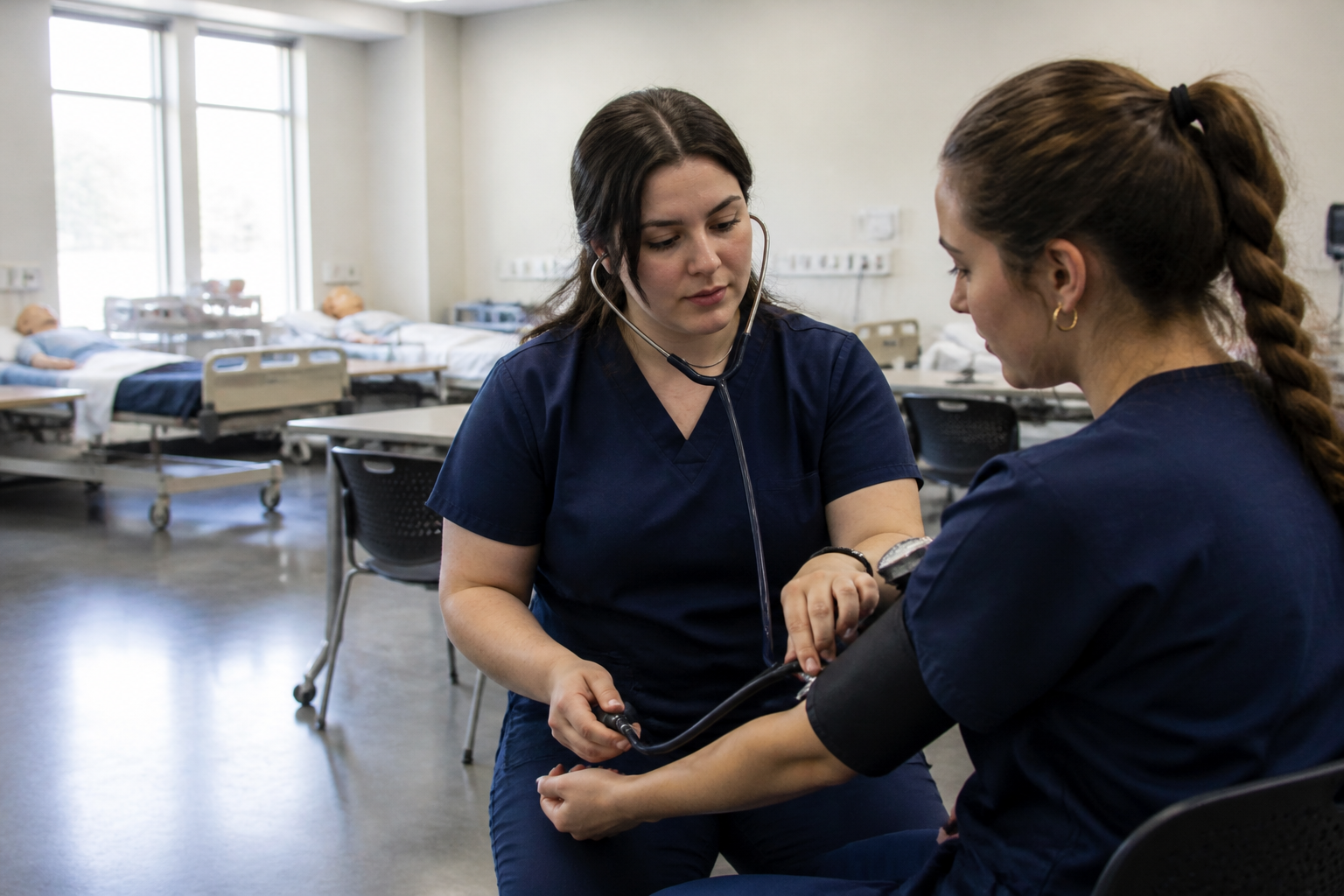
Colorado's accelerated BSN programs run from about 12 months at CU Anschutz to 21 months at Denver College of Nursing. Cost swings just as widely, from $25,293 in total program cost at Colorado State University Pueblo to $52,863 at Denver College of Nursing.
These programs serve career changers who earned a bachelor's in a different subject and want to become RNs without repeating four years. Delivery splits between on-campus cohorts, as at Colorado State University Pueblo, and hybrid formats at the University of Northern Colorado and Denver College of Nursing, with in-person clinicals either way.
Seats are limited. Colorado State University Pueblo accepts 40 students a year, and several schools require prerequisite science courses before you can apply.
Key Points
- Colorado ABSNs run 12 to 18 months, but faster isn't always cheaper.
- Graduates file a two-part Colorado State Board of Nursing licensure application.
- School choice, not nursing itself, drives most of the ABSN payoff.
Colorado's Top Accelerated BSN Schools for Second-Degree Students, Ranked
Colorado's accelerated BSN market is small and varied. The seven programs below all enroll second-degree students into a fast track to RN licensure, but they differ sharply in length, price, format and clinical footprint. Each entry notes what the school is known for, how its accelerated option is structured, and the admission details that tend to decide a student's choice.
Regis University
#1Denver, CO · ~$18,000/yr (est.)
Best for: Career changers eyeing a master's next
Regis University is a private Jesuit institution in Denver whose Loretto Heights School of Nursing runs one of the state's few one-year accelerated BSN options. The program threads three graduate-level nursing courses through the undergraduate curriculum at undergraduate tuition, so graduates leave with a head start on a master's degree. Applicants come through NursingCAS with transcripts, a resume, an essay and two professional or academic recommendations, and employees of HealthONE may qualify for a tuition discount through the university's health-system partnership. Regis also maintains traditional and other BSN pathways for students who need a different entry point.
- One-year, campus-based option for non-nursing bachelor's degree holders
- Includes three graduate-level nursing courses billed at undergraduate tuition
- Those graduate courses count for double credit toward a master's degree
- Admission weighs GPA, resume and relevant experience
- HealthONE employees may receive a 10% tuition discount on eligible programs
- Application through NursingCAS with an essay and two recommendations
- Part of the Loretto Heights School of Nursing
University of Colorado Denver/Anschutz Medical Campus
#2Denver, CO · $10,000 – $15,000/yr (est.)
Best for: Second-degree students drawn to interprofessional training
The University of Colorado's nursing school sits on an academic medical campus shared with medicine, pharmacy and public health programs, and it is the largest of the state's public nursing schools. The UCAN Pathway compresses the BSN into 12 months of full-time study with the same clinical hours as the traditional track, taught primarily at the Legacy Campus in Lone Tree. Students take courses alongside pharmacy, medicine and public health students, which is the program's main draw for career changers who want an interprofessional grounding. Prerequisite science coursework must be finished before a spring or fall cohort starts.
- 12-month, full-time cohort for non-nursing bachelor's degree holders
- 126 total credit hours with spring and fall starts
- Clinical simulation plus direct patient care in diverse settings
- Interprofessional coursework with pharmacy, medicine and public health students
- Primarily taught at the Legacy Campus in Lone Tree
- Same clinical hours as the traditional BSN
- Prerequisite courses required before entry
University of Northern Colorado
#3Greeley, CO · $18,000/yr (est. net price)
Best for: Hybrid learners in Northern Colorado
The University of Northern Colorado in Greeley delivers its second-degree BSN as a hybrid cohort that mixes online coursework with in-person classes in Greeley or at the Loveland Center, plus clinical placements along the Front Range. At 20 months it runs longer than the state's one-year options, but the partly online schedule and 71-credit curriculum suit students who cannot relocate for school. The program is CCNE accredited and reports first-time NCLEX pass rates of 95 to 100 percent. Admission requires a 3.0 GPA and completed prerequisite science courses, and students move through as a tight cohort with no non-nursing coursework.
- Hybrid format: online coursework plus in-person classes in Greeley or Loveland
- 20-month, 71-credit program starting in summer
- Program reports first-time NCLEX pass rates of 95 to 100 percent
- $495 per credit with financial aid available
- Minimum 3.0 GPA and prerequisite courses required
- Cohort model with 100% nursing coursework
- Clinical experiences across Northern Colorado
- Faculty include MSNs, APRNs, DNPs and PhDs
University of Colorado Colorado Springs
#4Colorado Springs, CO · $10,000 – $24,000/yr (est.)
The University of Colorado Colorado Springs runs a 16-month, full-time accelerated option for career changers, with a summer start and a schedule built around clinical skills, patient safety and evidence-based practice. Prerequisite science courses must fall within the last 10 years, and applicants also complete a TEAS exam and a background check. The program admits students who hold a prior bachelor's degree at a 3.0 GPA, and a second pathway exists for applicants with substantial prior credits. Because the cohort starts only in summer, planning the application calendar matters as much as the coursework.
- 16-month, full-time on-campus program with a summer start only
- 68 total credits in the accelerated option
- Prior bachelor's degree with a minimum 3.0 GPA required
- TEAS exam and background check required
- Prerequisite courses must be completed within 10 years
- Two application cycles allowed per year
- Prepares graduates for RN licensure with a clinical skills focus
Colorado State University Pueblo
#5Pueblo, CO · $10,000/yr (est. net price)
Colorado State University Pueblo keeps its accelerated pathway small, admitting roughly 40 students a year into a rolling cohort built around Monday and Wednesday classes with clinical shifts on the remaining weekdays. That schedule suits students who need predictable days for work or family obligations, and the ACEN-accredited program leans on simulation labs and rotations at partner hospitals. Pueblo's published tuition is among the lowest of the Colorado public universities in this guide, which makes it a frequent value pick for students who do not need a metro campus. Graduates are prepared for the NCLEX and for roles in hospitals, community agencies and schools.
- Classes Mondays and Wednesdays with clinical shifts on other weekdays
- About 40 students admitted each year
- Rolling start date with an October 1 application deadline
- Hands-on clinical experiences and simulation labs
- Rotations at partner hospitals and community sites
- ACEN-accredited accelerated pathway
Metropolitan State University of Denver
#6Denver, CO · $15,000/yr (est. net price)
Metropolitan State University of Denver runs its Accelerated Nursing Option as a four-term continuous program on a downtown campus built around commuting and transfer students. Students complete 32 prerequisite credits before starting 63 credits of nursing coursework that includes summer study, so the calendar stays full once the cohort begins. The option is approved by the Colorado State Board of Nursing and accredited by CCNE, and the program reports first-time NCLEX pass rates between 93 and 98 percent from 2022 through 2025. Cohorts currently start in spring, with a planned shift to fall starts beginning in fall 2027.
- Second-degree option for career changers with a non-nursing bachelor's degree
- 32 prerequisite credits plus 63 credits of nursing coursework
- Four continuous terms, including summer coursework
- Program reported first-time NCLEX pass rates of 93 to 98 percent, 2022 to 2025
- Cohorts begin in spring, with fall starts planned from 2027
- Approved by the Colorado State Board of Nursing and CCNE accredited
- Multicultural graduation requirement built into the curriculum
Denver College of Nursing
#7Denver, CO
Denver College of Nursing is a single-purpose nursing school in downtown Denver that admits students holding either an associate or a bachelor's degree in another field. Its BSN runs seven quarters of nursing coursework after transfer credit, with four start dates a year and a hybrid mix of classroom instruction, labs and group learning. Entry is comparatively open on cumulative GPA, but the prerequisites are specific: 56 semester credits of science and support courses taken within seven years, plus an entrance exam. Total program tuition is $59,930, and the college reports an alumni network of more than 7,000.
- Seven quarters of nursing coursework, finishing in as little as 21 months
- 180 total credits: 100 at DCN plus 80 transfer credits
- Four start dates a year across the Denver and Houston campuses
- Hybrid instruction with labs, group learning and a capstone
- Minimum 2.0 cumulative GPA plus 56 semester credits of prerequisites
- Entrance exam: Wonderlic SLE score of 22 or the HESI A2
- Total program tuition of $59,930
- Transfer credit accepted through Sophia and StraighterLine
Cost & outcomes by school
Federal data for the highest-earning Accelerated BSN (ABSN) programs, independent of the ranking above. Earnings are this field's bachelor's graduates four years after completing where the Scorecard reports them, else the school's undergraduate median.
| School | Net price / yr | Grad rate | Earnings | Debt | Grads/yr | Format |
|---|---|---|---|---|---|---|
| Denver College of Nursing CO | — | — | $81,809 | $26,500 | 646 | Hybrid |
| Regis University CO | $18,397 | 61% | $72,105 | $25,000 | 1,070 | Campus |
| University of Colorado Denver/Anschutz Medical Campus CO | $11,900 | 46% | $64,270 | $20,500 | 5,026 | Campus |
| Colorado State University Pueblo CO | $10,051 | 40% | $55,563 | $21,500 | 1,186 | Campus |
| University of Colorado Colorado Springs CO | $15,788 | 47% | $54,659 | $20,000 | 3,854 | Campus |
| University of Northern Colorado CO | $17,760 | 51% | $52,231 | $20,470 | 2,832 | Hybrid |
| Metropolitan State University of Denver CO | $15,327 | 32% | $52,093 | $21,500 | 5,218 | Campus |
| Platt College-Aurora CO | — | — | — | — | — | Campus |
Sources: U.S. Department of Education. Net price, graduation rate, earnings and debt: College Scorecard (earnings and debt for this field's bachelor's graduates where reported, else school-wide); graduates: IPEDS. A dash means no figure is reported.
Cost, debt & payoff
Median earnings of this field's bachelor's graduates (4 yrs after completing, else the school's undergraduate median) vs. their median federal loan debt · U.S. College Scorecard
Across these programs the median graduate earns about $55,563 and finishes with roughly $21,500 in debt — a ratio that clears a common rule of thumb (keep debt below first-year salary). Net price and debt vary widely school to school, so check the per-school figures in the table above before you shortlist.
Colorado Accelerated BSN Schools Compared: Format, Selectivity and Completions
Most search results show one Colorado accelerated BSN program at a time, so this grid puts every ranked school side by side using 2024 federal data from IPEDS and the College Scorecard. Most of the schools here are in Denver, and Denver College of Nursing and Regis University graduate the most nursing bachelor's students, while Greeley, Colorado Springs and Pueblo give students outside the metro area public options. Admission and graduation rates cover each whole institution rather than the ABSN alone, and completions count all bachelor's-level registered nursing graduates, not just second-degree students.
| School | City | Format | Public or Private | Admission Rate (School-Wide) | Nursing Bachelor's Completions | Graduation Rate (School-Wide) |
|---|---|---|---|---|---|---|
| Regis University | Denver | On campus | Private | 86.5% | 290 | 61.0% |
| University of Colorado Denver/Anschutz Medical Campus | Denver | On campus | Public | 74.7% | 243 | 46.1% |
| University of Northern Colorado | Greeley | Hybrid | Public | 85.9% | 178 | 51.2% |
| University of Colorado Colorado Springs | Colorado Springs | On campus | Public | 97.4% | 200 | 46.9% |
| Colorado State University Pueblo | Pueblo | On campus | Public | 94.9% | 139 | 39.7% |
| Metropolitan State University of Denver | Denver | On campus | Public | 98.8% | 97 | 31.5% |
| Denver College of Nursing | Denver | Hybrid | Private | N/A | 435 | N/A |
How Long a Colorado Accelerated BSN Takes and What It Really Costs
The fastest ABSN is not automatically the cheapest, and Colorado's options sit on both sides of that tradeoff.
Length and Start Dates
Colorado accelerated BSNs typically run 12 to 21 months of full-time, year-round study. CU Anschutz takes 12 months and starts twice a year, in Spring and Fall. CSU Pueblo runs 14 months and UCCS 16 months, each with a Summer start. MSU Denver is four semesters with one annual start, Fall beginning in 2027. Denver College of Nursing is the longest at 21 months, but it offers four starts a year, which helps if you miss a cycle. Regis University lists a December 1, 2026 deadline for May 2027 entry.
A start date is not an application deadline. Confirm the cutoff and remaining seats before planning around any cohort.
Format and Clinical Travel
Check each school's page to see whether coursework is campus-based or hybrid. Either way, labs and simulation happen in person, and clinical rotations are held at hospital sites around Colorado, so expect to travel and plan for gas, parking and flexible childcare.
What It Costs Beyond Tuition
Program totals vary widely:
- CSU Pueblo: $25,293
- UCCS: $32,776
- CU Anschutz: $40,854 for Colorado residents, or $33,198 with the College Opportunity Fund stipend
- MSU Denver: up to $42,206, a nonresident estimate that includes fees (residents may pay less)
- Denver College of Nursing: $52,863
Tuition is only part of the bill. CU Anschutz adds a $140 one-time matriculation fee, term fees ($382 in Fall, $222 in Spring and Summer), roughly $2,000 for books and supplies, and per-term health insurance that can be waived with proof of comparable coverage. Across every school, also budget for uniforms, background checks, immunizations, and the NCLEX-RN and licensure fees after graduation.
Paying for It
Federal student loans are open to second-degree students, but Pell Grants generally end after a first bachelor's degree. Colorado residents at MSU Denver and CU Anschutz may benefit from the College Opportunity Fund. UCCS lists Western Undergraduate Exchange (WUE) savings for eligible students from Western states. Ask each financial aid office about ABSN-specific scholarships, and ask your employer about tuition support, since many hospital systems offer it.
Holding down a job during an ABSN is hard at this pace. Add rent, food and transportation for 12 to 21 months to your budget, because living costs can rival tuition on the shorter programs.
Colorado Accelerated BSN Schools With the Lowest Price Tags
The figures below are each school's average net price after aid from U.S. Department of Education data (IPEDS and College Scorecard, 2024). That number averages what students pay across the whole institution after grants and scholarships, so it is a useful way to compare schools but not an exact quote for an accelerated BSN. Before you decide, pair this table with the program-specific tuition and fees covered in the previous section.
| School | City | Format | Average Net Price After Aid |
|---|---|---|---|
| Colorado State University Pueblo | Pueblo | On campus | $10,051 |
| University of Colorado Denver/Anschutz Medical Campus | Denver | On campus | $11,900 |
| Metropolitan State University of Denver | Denver | On campus | $15,327 |
| University of Colorado Colorado Springs | Colorado Springs | On campus | $15,788 |
| University of Northern Colorado | Greeley | Hybrid | $17,760 |
Related Articles
Colorado Board of Nursing Approval, Accreditation and NCLEX-RN Licensure for ABSN Graduates
A twelve- to twenty-one-month accelerated BSN is only a good deal if it ends with a license. If a program cannot get you to the exam, its speed is worth nothing, so check approval status as closely as you check tuition.
Why Board Approval Comes First
To sit for the NCLEX-RN and hold a Colorado RN license, you must finish a prelicensure nursing program approved by the Colorado Board of Nursing, which operates under the Division of Professions and Occupations at DORA. Approval and accreditation are separate statuses. A program can be Board-approved without national accreditation, and accreditation alone does not replace Board approval. Check both before you apply.
What Accreditation Shows for These Schools
CCNE's Colorado directory lists Denver College of Nursing with baccalaureate nursing accreditation from February 22, 2021, through December 31, 2026, with a review period in Spring 2026. Because that window closes at the end of this year, confirm the current status directly with the school and the directory before enrolling. The University of Northern Colorado's program listing describes its second-degree nursing program as CCNE accredited. For Regis University, the University of Colorado Denver/Anschutz Medical Campus, the University of Colorado Colorado Springs, Colorado State University Pueblo and Metropolitan State University of Denver, this research did not confirm accreditation status, so look each one up yourself.
- CCNE and ACEN directories: Search by institution, state or degree level, and note whether a program is fully accredited or only a new applicant, since applicant status is not a guarantee.1
- Board of Nursing list: Confirm the specific accelerated track appears among Colorado's approved prelicensure programs, not just the school's name.
NCLEX-RN Pass Rates
The rankings used here carry no NCLEX-RN pass-rate figure for these schools. The University of Northern Colorado's own listing claims a 95% licensure pass rate, a school-reported number worth verifying. For every program, look to the Board of Nursing's published pass-rate reports and compare first-time test takers over several years.
The Licensure Sequence After Graduation
The general path runs in four steps: apply to the Board for licensure by examination, complete the fingerprint background check, register for the NCLEX-RN, then receive your license once you pass. Fees, timing and any Nurse Licensure Compact details change, so confirm current requirements with the Board before you graduate.
Becoming a Licensed RN in Colorado After an ABSN
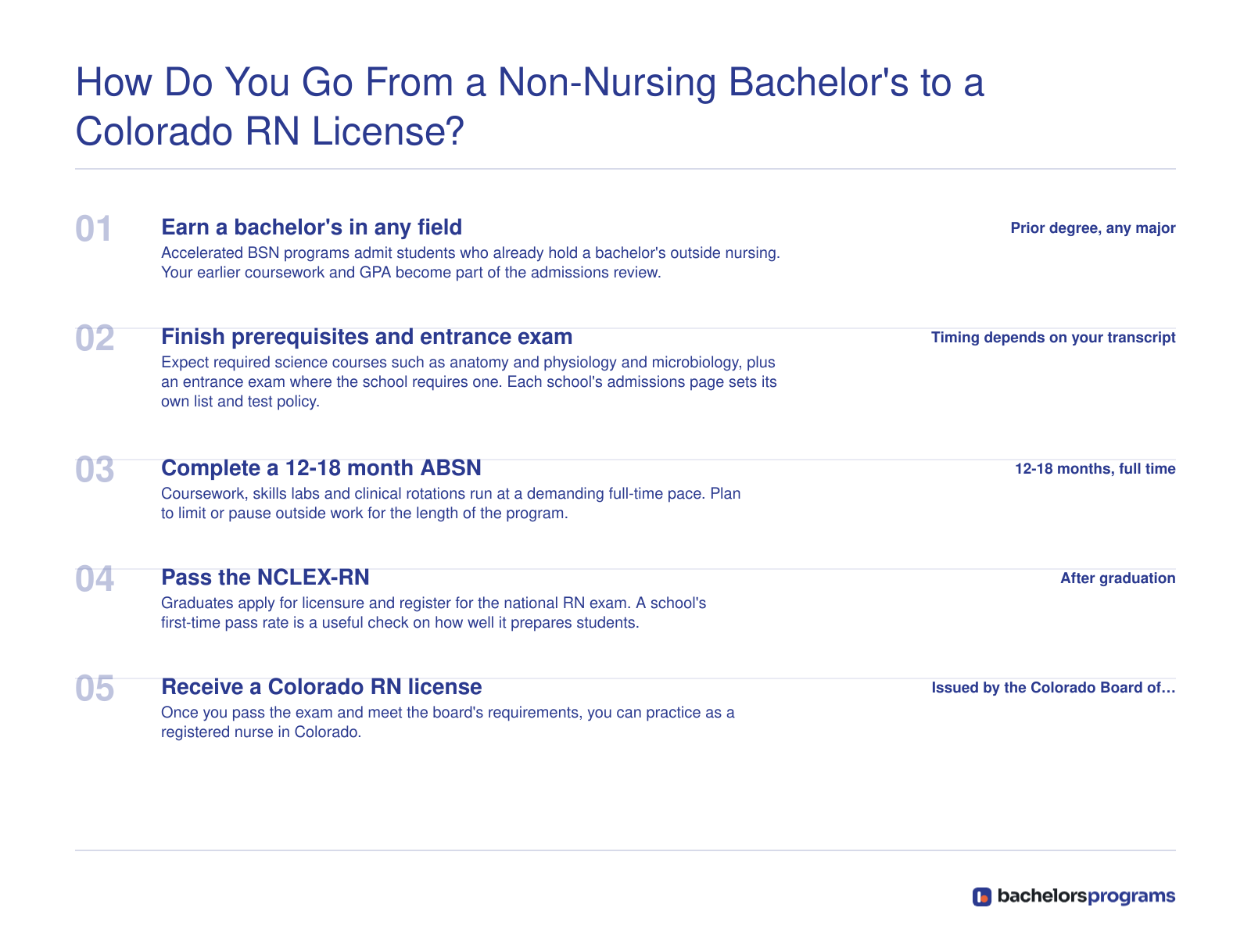
How Do You Go From a Non-Nursing Bachelor's to a Colorado RN License?
Every accelerated BSN in Colorado follows the same basic sequence, from Regis University to Metropolitan State University of Denver. The prerequisites stage is where most applicants lose time. Missing science courses, old credits a school won't accept or a retaken entrance exam can delay your start, so audit your transcript against each school's list before you apply.
Is an Accelerated BSN Worth It in Colorado? Earnings, Debt and Payoff
For most second-degree students in Colorado, an accelerated BSN pays off, but the size of that payoff depends far more on which school you pick than on whether you pick nursing at all.
What Nursing Graduates Earn Five Years Out
Program-level earnings for nursing completers, five years after finishing, cluster in the low-to-mid $80,000s across the schools ranked here, and each carries a different debt load:
- Regis University: $86,645 five years after finishing, with median borrowed debt of $25,000 and a $265 monthly payment across ten years.
- Colorado State University Pueblo: $84,461, against $24,111 in median debt and $256 a month.
- Metropolitan State University of Denver: $83,865, with $22,195 in debt and a $235 monthly payment.
- Denver College of Nursing: $80,769, paired with $29,090 in median debt and the heaviest payment here, $308.
- University of Colorado Colorado Springs: $80,208, alongside the lowest debt figure, $19,500, and the lightest payment of the group at $207.
The earnings spread between the highest and lowest figure is about $6,400 a year. The debt spread is wider, near $9,600. Those are the numbers graduates actually carry, and they matter more than sticker tuition, which financial aid can shrink substantially.
The Profession-Wide Payoff
Statewide, registered nurses earned a median of $100,260 a year as of May 20251, and the Denver-Aurora-Centennial metro came in at $101,130.2 Five-year graduate earnings sit below those medians because the state figure blends in nurses with a decade or more at the bedside. The Colorado Department of Labor and Employment publishes both ten-year projections for 2024-2034 and short-term forecasts through 20273, which are the right tools for judging hiring conditions where you plan to work.
Weighing the Intensity
Twelve to twenty-one months of full-time study leaves little room for paid work, and clinical schedules are not flexible. What you buy is time: you reach RN wages two years or more before a traditional four-year route would finish, so the monthly payment arrives while you are earning a nurse's salary rather than a student's.
What Registered Nurses Earn in Colorado
Picking the Colorado ABSN School That Fits Your Budget, Schedule and Clinical Needs
Regis University's ABSN and the University of Colorado Denver's accelerated pathway both sit in the Denver metro, but they are not interchangeable: tuition, cohort start dates and clinical partners differ enough that a spreadsheet beats a brochure.
Start With Net Price, Not Sticker Price
Compare program-specific tuition and the net price each school publishes after aid. A public option such as Metropolitan State University of Denver, University of Northern Colorado or Colorado State University Pueblo may land below a private program, but a private school's extra start dates can shorten a wait that costs you a year of RN salary. Run both scenarios before deciding the cheaper headline number wins.
Map the Clinical Commute
Rotations happen in person at partner hospitals and clinics, and hybrid coursework does not remove that travel. Ask each program where recent cohorts were placed and how far students drove. A campus an hour from home can turn a fast schedule into a logistics problem.
Match Deadlines to Your Prerequisites
Line up cohort start dates and application deadlines against the term in which you will finish prerequisite science courses. Missing a deadline by two weeks can push your start back a full cycle, so build the timeline backward from the application date rather than forward from today.
Verify Approval and Outcomes
Confirm the program is approved by the Colorado Board of Nursing and holds nursing accreditation, then read the Board's NCLEX-RN pass-rate reports for recent cohorts instead of trusting a viewbook.
Your Next Step
Shortlist two or three schools from the rankings above, request information from each, and attend an ABSN info session. Bring the same three questions to every one: where will I do clinicals, what will the total cost be, and when is the next start date I can realistically make?
Compare Accelerated BSN (ABSN) programs on the data that matters
Explore more Nursing majors or browse every field of study.
All Nursing programs Browse every field of study