Best Accelerated BSN (ABSN) Programs in Florida
Compare 23 accredited Accelerated BSN (ABSN) programs in Florida at 20 colleges, with net price after aid, graduation rates, earnings and debt from IPEDS and the U.S. College Scorecard.
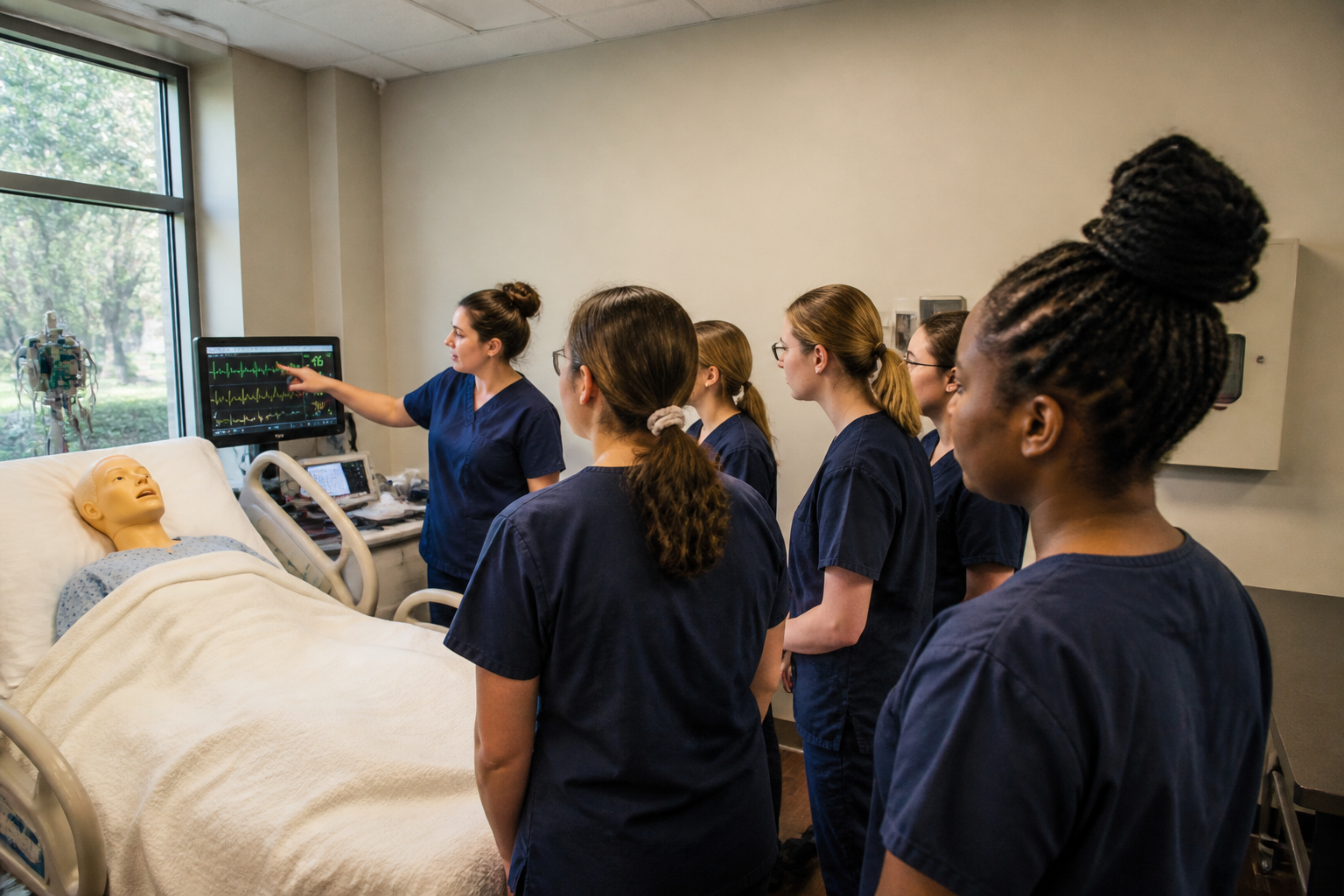
Second-degree nursing has long been a route into the RN workforce for adults whose bachelor's degree is in something other than nursing. Accelerated BSN (ABSN) programs in Florida build on that earlier degree, so students skip general education and complete nursing coursework in usually 12 to 18 months of full-time study, not four years.
The tension is intensity against income. Cohorts are fixed, clinical hours are heavy, and Florida Atlantic University advises against working during the program. Cost varies widely too, from public tuition at the University of Florida to private pricing at the University of Miami.
Seats are also limited. Florida International University admits one cohort a year, so the application calendar can matter as much as the degree.
Key Points
- Florida ABSN programs typically run 12 to 18 months of full-time study.
- Among ranked schools, West Coast University-Miami posts the highest first-year graduate earnings.
- Florida Board of Nursing approval, not accreditation, unlocks your NCLEX-RN eligibility.
Florida's 10 Top-Ranked Accelerated BSN Programs for Career Changers
Florida's accelerated BSN programs are built for people who already finished a bachelor's in something else and want an RN license without starting over. The ten schools below run from large public research universities to private and small-college options, spread across Gainesville, Orlando, Miami, Tampa, Boca Raton and Fort Lauderdale.
University of Florida
#1Gainesville, FL · ~$4,800/yr (est.)
Best for: North Florida career changers near academic hospitals
The University of Florida runs its accelerated BSN inside a flagship academic health system, with cohorts on the Gainesville campus and at UF Health Jacksonville. The Jacksonville site gives North Florida career changers a route into a major teaching hospital without relocating. Admission is holistic, and the nursing school holds CCNE accreditation.
- CCNE accredited nursing program
- Entrance exam required: HESI
- No minimum HESI score to clear
- Holistic admission review
- 3.0 GPA minimum for applicants
- Cohorts in Gainesville and at UF Health Jacksonville
- Background check and drug screening required
- Scholarships and financial aid available
University of Central Florida
#2Orlando, FL · ~$10,000/yr (est.)
Best for: Central Florida switchers wanting frequent start dates
UCF is one of the largest public universities in the country, and its Orlando campus sits in a dense hospital and simulation market. The accelerated second degree track admits three times a year, which helps if you are timing a career switch around a job or a lease. Honors thesis work is available for students who may want graduate study later.
- Accredited by ACEN and CCNE
- Three start terms: fall, spring and summer
- 2.5 GPA minimum
- No thesis or capstone required
- Honors undergraduate thesis option
- Equipment fee of $25 to $50 per term
- Mandatory drug screening
- Prepares graduates for the NCLEX-RN
Florida International University
#3Miami, FL · ~$9,000/yr (est.)
Best for: Miami second-degree students wanting one tight cohort
FIU educates a large share of Miami's nursing workforce from its Biscayne Bay Campus, and the accelerated option is reserved for people who already hold a bachelor's in another field. The cohort moves as one dedicated group each year, so classmates go through clinicals together. The nursing school is a major pipeline into South Florida hospitals and community clinics.
- Built for students who already hold a bachelor's degree
- Classes held at the Biscayne Bay Campus
- One start per year, in fall
- Limited-access, competitive admission
- Prepares graduates for the NCLEX-RN
- Eligible for Florida RN licensure
University of South Florida
#4Tampa, FL · ~$10,000/yr (est.)
USF spreads its second degree pathway across three campuses, so students around Tampa Bay can study closer to home. The program is pitched as a launch point both for hospital practice and for graduate work in nursing practice, education or research. Advisors are assigned to second degree students, and applications run through NursingCAS.
- Offered on all three USF campuses
- Two starts per year, summer and fall
- Apply through NursingCAS
- Foundation for MSN, DNP and PhD study
- Dedicated advisors for second degree students
- Scholarships and financial aid available
- Prepares graduates for the NCLEX-RN
Florida Atlantic University
#5Boca Raton, FL · $4,900 – $17,000/yr (est.)
FAU's Christine E. Lynn College of Nursing pairs a caring, holistic philosophy with a competitive accelerated track on the Boca Raton and Davie campuses. The college is blunt about the workload: class and clinical time can run 24 to 40 hours a week. A personal interview is part of the admission decision.
- CCNE accredited
- Two starts per year, fall and spring
- Personal interview required
- Limited-access admission with few spots
- Clinical and class time runs 24 to 40 hours weekly
- Working while enrolled is discouraged
- Nursing courses are nontransferable
- Boca Raton and Davie campus locations
University of Miami
#6Coral Gables, FL · $37,000/yr (est. net price)
The University of Miami is the private research option here, and its accelerated BSN draws on the University of Miami Health System plus more than 200 clinical partners. Students train in a dedicated simulation hospital on campus. U.S. News places the BSN program 19th nationally, and the school offers housing resources and advising built around career changers.
- Over 200 clinical partners, including UHealth
- Training in the on-campus Simulation Hospital S.H.A.R.E.
- Two starts per year, spring and summer
- BSN program ranked 19th by U.S. News
- Housing resources for accelerated students
- Dedicated advising and financial aid support
- Designed for students with a prior bachelor's degree
- Accepting applications for Spring 2027
Herzing University-Tampa
#7Tampa, FL · ~$20,000/yr (est.)
Herzing's Tampa campus is organized around adult learners, with rolling admissions and a nursing program that accepts military benefits. Students can transfer up to 90 credits and bank dual credit toward an MSN, which shortens the runway if graduate school is already in view. Clinical training happens with community partners and in high-fidelity simulation labs.
- Rolling admissions with no fixed deadline
- TEAS entrance exam required
- 2.5 GPA minimum
- Transfer up to 90 credits
- Dual credit option toward an MSN
- Military benefits accepted
- High-fidelity simulation labs
- Waived enrollment fee
Miami Dade College
#8Miami, FL · $2,800 – $10,000/yr (est.)
Miami Dade College's Benjamín León School of Nursing is the low-cost public route into nursing in Miami, with small cohorts and clinical placements across local health systems. A mandatory three-day boot camp and a compliance tracking system make sure students arrive at clinicals prepared. Financial aid and scholarships are available to eligible students.
- Mandatory three-day nursing boot camp
- CPR and BLS certification required
- Background screening and drug screening required
- Health records and vaccinations tracked in Complio
- Non-refundable deposit due on acceptance
- Clinical training at Miami-area healthcare facilities
- Small cohorts with dedicated faculty
- Financial aid and scholarships available
Nova Southeastern University
#9Fort Lauderdale, FL · ~$30,000/yr (est.)
Nova Southeastern runs its accelerated nursing track at Fort Myers and Miami, giving students a private-school option outside the Coral Gables core. Faculty mentoring and simulation-heavy instruction run through the curriculum, and hospital partners fund scholarships that lower the price. NCLEX readiness work is built into the final terms.
- Instruction at Fort Myers and Miami sites
- Two starts per year, fall and winter
- High-fidelity simulation technology
- Scholarships from hospital partners
- NCLEX readiness preparation built in
- Clinical rotations across diverse settings
- Prior bachelor's degree required
- Expert faculty mentorship
Keiser University-Ft Lauderdale
#10Fort Lauderdale, FL · ~$30,000/yr (est.)
Keiser University's Fort Lauderdale campus structures nursing around four-week terms with one class at a time, a format built for working adults and career changers. The accelerated BSN includes dedicated clinical placement services and small classes. Up to 12 transfer credits can come with you, and military benefits are accepted.
- Four-week course terms, one class at a time
- 3.0 GPA minimum
- Entrance exam required
- ACEN accredited nursing program
- Up to 12 transfer credits accepted
- Dedicated clinical placement services
- Small class sizes
- Military benefits accepted
Cost & outcomes by school
Federal data for the highest-earning Accelerated BSN (ABSN) programs, independent of the ranking above. Earnings are this field's bachelor's graduates four years after completing where the Scorecard reports them, else the school's undergraduate median.
| School | Net price / yr | Grad rate | Earnings | Debt | Grads/yr | Format |
|---|---|---|---|---|---|---|
| West Coast University-Miami FL | $32,539 | 33% | $102,672 | $32,946 | 522 | Campus |
| University of Miami FL | $37,244 | 84% | $75,328 | $17,500 | 8,524 | Campus |
| University of Florida FL | $6,541 | 91% | $71,588 | $15,000 | 20,320 | Campus |
| University of Florida FL | $4,815 | 85% | $71,588 | $15,000 | 2,228 | Campus |
| Jacksonville University FL | $25,180 | 51% | $68,010 | $22,000 | 1,284 | Campus |
| Galen College of Nursing-Tampa Bay FL | $28,197 | 63% | $61,480 | $24,166 | 220 | Campus |
| Florida International University FL | $9,288 | 74% | $60,249 | $16,500 | 22,694 | Campus |
| Nova Southeastern University FL | $30,371 | 63% | $59,209 | $24,250 | 4,286 | Campus |
| University of Central Florida FL | $10,411 | 78% | $58,308 | $18,190 | 30,370 | Campus |
| University of South Florida FL | $9,812 | 77% | $57,743 | $17,988 | 20,676 | Campus |
| Florida Atlantic University FL | $8,752 | 63% | $56,746 | $17,236 | 11,620 | Campus |
| Barry University FL | $22,613 | 38% | $55,966 | $26,997 | 856 | Campus |
Sources: U.S. Department of Education. Net price, graduation rate, earnings and debt: College Scorecard (earnings and debt for this field's bachelor's graduates where reported, else school-wide); graduates: IPEDS. A dash means no figure is reported.
Cost, debt & payoff
Median earnings of this field's bachelor's graduates (4 yrs after completing, else the school's undergraduate median) vs. their median federal loan debt · U.S. College Scorecard
Across these programs the median graduate earns about $58,308 and finishes with roughly $20,899 in debt — a ratio that clears a common rule of thumb (keep debt below first-year salary). Net price and debt vary widely school to school, so check the per-school figures in the table above before you shortlist.
Cheapest Accelerated BSN Programs in Florida
The public options below post the lowest average net price after aid in federal IPEDS and College Scorecard data, a figure that describes each institution as a whole rather than the ABSN alone, shown here with median federal debt for nursing bachelor's completers. ABSN-specific charges sit on top of standard tuition: the University of Florida lists 2026 resident tuition of $212.74 per credit for its 60-credit, four-semester program, plus semester fees of $690 to $1,301.56 and a $30 ExamSoft charge each term (all estimates subject to change), and programs commonly add clinical, lab, simulation, uniform and background-check costs. Public schools generally beat private ones on sticker price (the University of Miami's 55-credit ABSN carries $43,260 in tuition plus a $1,440 nursing fee), but compare total program cost, not annual tuition, before you commit.
| School | City | Average net price after aid (institution-wide) | Median federal debt at completion (nursing bachelor's) | Published ABSN tuition | Program length |
|---|---|---|---|---|---|
| University of Florida | Gainesville | $4,815 | $16,500 | $212.74 per credit (Florida residents, 2026); $1,029.53 per credit (nonresidents) | 4 semesters, 60 credits |
| Miami Dade College | Miami | $5,463 | $9,687 | N/A | N/A |
| Florida Atlantic University | Boca Raton | $8,752 | $17,050 | N/A | 4 semesters, 60 credits |
| Florida International University | Miami | $9,288 | $13,750 | N/A | 4 semesters, 58 credits |
| University of South Florida | Tampa | $9,812 | $15,250 | N/A | 16 months |
Accelerated BSN Admissions: Prior Bachelor's, Prerequisites, GPA and Test Policy
An accelerated BSN application is really two applications in one: proof of a bachelor's degree in a field other than nursing, and proof that you finished the required science and social science courses at the grades each school demands. Florida programs evaluate both before they look at anything else.
The Prior Degree
The University of Florida requires a completed non-nursing bachelor's degree or higher, and the University of Miami specifies a non-nursing bachelor's from a regionally accredited institution. Florida Atlantic University likewise requires a bachelor's degree in hand.1 Deadlines and conditional-admission policies vary by cycle, so confirm with each school whether coursework still in progress can be counted at the time you apply.
Prerequisite Courses and Grades
The science core is consistent across Florida. UF lists anatomy and physiology I and II with labs, microbiology with lab, statistics, human growth and development, and human nutrition. Miami adds chemistry with lab and introduction to psychology, and treats human anatomy and human physiology as separate requirements; if your school combined them, Miami expects both A&P I and II with lab for equivalency. Both schools require a C or better in every prerequisite. Miami permits only one prerequisite failure to be repeated, and caps the age of chemistry, anatomy, physiology, microbiology and nutrition at 10 years.
GPA, Testing and Clearances
- Grade point minimums: UF sets 3.0 on the most recent 60 undergraduate credits (or 3.0 cumulative in a completed graduate degree). Miami's admissions page states a 3.0 prerequisite GPA. FAU requires a 3.0 cumulative undergraduate GPA plus a 3.0 science GPA across A&P I and II, microbiology, chemistry, college algebra or higher, and statistics.1
- Entrance exam: UF requires the HESI A2 by the application deadline. Other Florida programs handle entrance testing differently, so verify before you register for an exam.
- Clearances: UCF requires background checks and drug screening before admission and on demand afterward, with a 2.5 GPA floor for progression.
These requirements shift from one admission cycle to the next. Read the current admissions page for every school on your list before you register for a prerequisite.
ABSN Pace and Cost: Program Length, In-State Tuition and Financial Aid
The real trade-off in an accelerated BSN is time against income: you finish a nursing degree in roughly a year to a year and a half, but you give up most of your earning capacity while you do it. Published lengths differ for real reasons, and knowing what the compressed calendar costs in practice separates a plan that works from one that stalls halfway through.
Why Program Lengths Differ
Published durations vary because schools count semesters, not months. The University of Florida's accelerated BSN runs 15 months across four consecutive full-time semesters, covering 60 credits and 765 planned clinical hours, with a May start. The University of Central Florida's second-degree option also uses a four-semester curriculum built around a single annual summer intake, and Florida International University's accelerated option is likewise structured as four terms. A program that starts in summer and runs straight through, with no break between terms, lands closer to 12 months; one that observes a winter or summer pause stretches to 15 or 16. Credit totals are similar across programs, so the calendar, not the workload, drives the headline number.
What Full-Time Pace Actually Means
Full-time here is not a figure of speech. The University of South Florida's accelerated pathway reports more than 990 clinical hours including simulation, finishing with a 270-hour preceptorship. The University of Miami schedules between 140 and 336 hands-on clinical hours per semester. Add didactic class time, skills labs and exam preparation, and most schools advise against outside employment outright.
Tuition and Aid for Second-Degree Students
Public universities such as UF, UCF, FIU, USF and Florida Atlantic charge in-state rates only to students who meet Florida residency requirements, while out-of-state students pay substantially more; private options including the University of Miami, Nova Southeastern and Keiser set their own prices regardless of residency. A prior bachelor's does not automatically disqualify you from federal Direct Loans, but eligibility depends on your school's determination and your remaining borrowing limits, so confirm with the financial aid office before you commit. UCF names Helene Fuld Health Trust and Student Success scholarships for second-degree students; the ABSN application deadline is April 1, 2026. Florida's nursing scholarship program offers up to $8,000 per year for up to two years at approved programs, in exchange for 12 months of qualifying service per year funded; failing that commitment triggers repayment with 18 percent interest.
Budget for rent, insurance and groceries across the full 12 to 18 months as if you will earn nothing, because most students earn close to it.
Related Articles
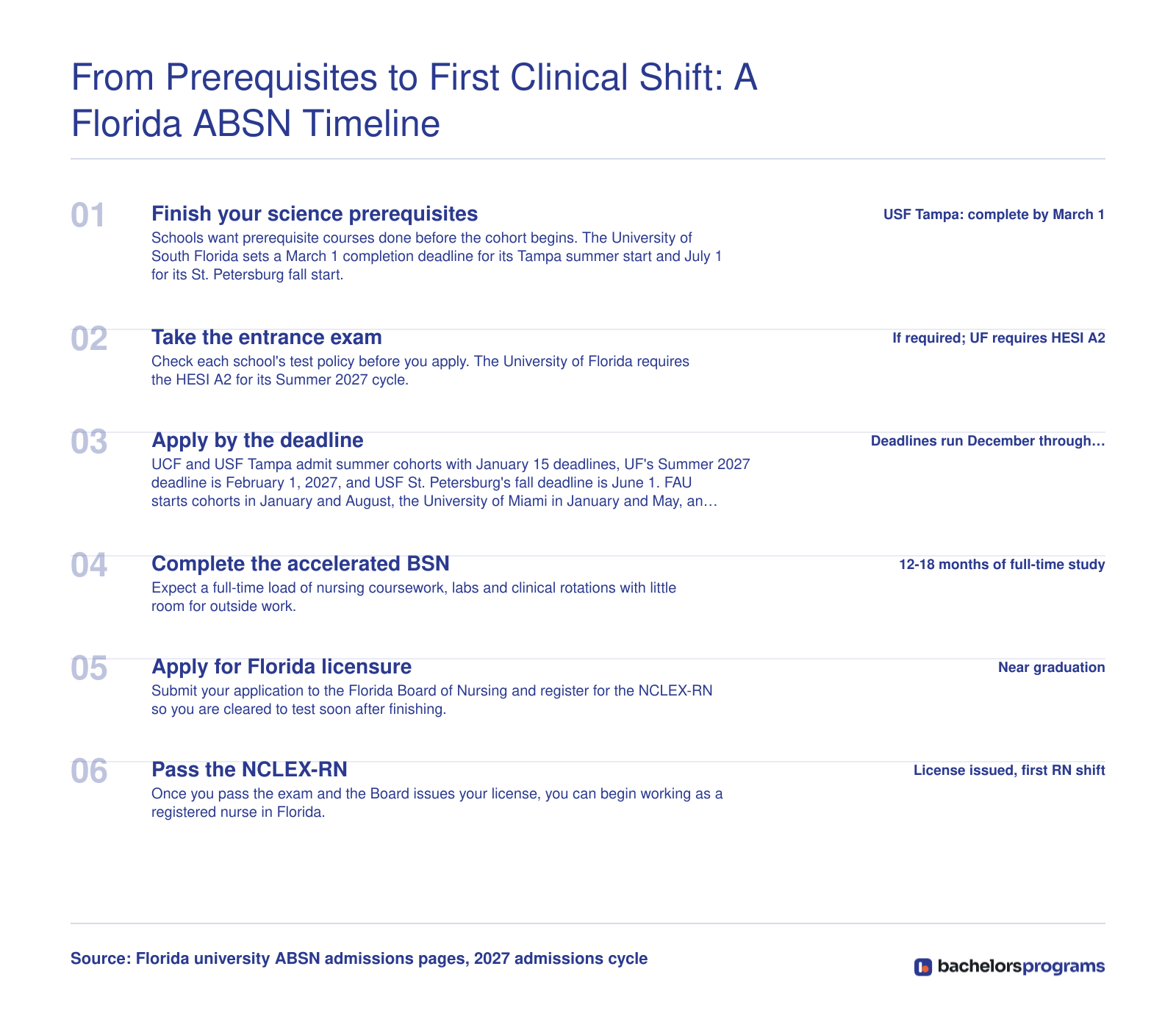
From Prerequisites to First Clinical Shift: A Florida ABSN Timeline
Getting from a non-nursing bachelor's to a Florida RN license follows a fixed order, and the application window is where most delays happen. Many accelerated BSN programs admit only one or two cohorts a year, so missing a single deadline can push your start back 6-12 months. Plan backward from your target cohort.
Florida ABSN Graduates With the Highest Earnings
The table pairs each school's median graduate earnings with the median federal loan debt its nursing graduates carried at completion and the estimated monthly payment on that debt over a standard 10-year plan, so you can weigh pay against borrowing. Each earnings figure lists its measurement window. These are U.S.
| School | Location | Median Graduate Earnings | Earnings Measured | Median Federal Debt at Completion | Median Monthly Loan Payment |
|---|---|---|---|---|---|
| West Coast University-Miami | Doral, FL | $110,377 | Five years after finishing | $34,145 | $362 |
| Miami Dade College | Miami, FL | $106,415 | Four years after finishing | $9,687 | $103 |
| Keiser University-Ft Lauderdale | Fort Lauderdale, FL | $99,079 | Five years after finishing | $27,427 | $291 |
| Rasmussen University | Ocala, FL | $94,955 | Five years after finishing | $25,000 | $265 |
| Florida International University | Miami, FL | $93,759 | Five years after finishing | $13,750 | $146 |
Highest First-Year Graduate Earnings Among Ranked Florida Programs
Among the ranked Florida schools, West Coast University-Miami reports the highest median first-year earnings for its nursing bachelor's graduates.
Florida Board of Nursing Approval and NCLEX-RN Licensure for ABSN Graduates
Board approval and national accreditation are separate gates, and only the first makes a Florida ABSN graduate eligible for the NCLEX-RN.
Two Gates, Not One
Florida prelicensure nursing programs must hold Florida Board of Nursing approval under Florida Statutes §464.019.1 That approval is the state's baseline for licensure eligibility. After approval, a program must obtain an NCSBN NCLEX code before the Board posts its approved status.2 CCNE or ACEN accreditation is a national, program-level credential that matters for graduate school applications and for some employers, but it does not replace Board approval for NCLEX-RN eligibility. Graduates of a Florida-approved program qualify; the Board also recognizes some accredited programs that hold an NCSBN NCLEX code, though national accreditation by itself is not the full alternative pathway. Check both: the Board's list of approved education and training programs for approval, and the Board's accreditation search or the accreditor's own directory for accreditation.
From Diploma to Test Day
For an ABSN graduate, eligibility follows a fixed sequence: - Graduation: complete a prelicensure program approved by the Florida Board. - Application: file the Florida nursing examination application with the Board. - Screening: complete fingerprinting and a background check. - Registration: register with Pearson VUE, then wait for authorization to test.
The Pass-Rate Rule
Under §464.019, an approved program's first-time NCLEX-RN pass rate must stay within 10 percentage points of the same-calendar-year average for comparable U.S.-educated first-time takers.1 A program below that benchmark enters an extension and must reach at least 60% for the most recent calendar year while satisfying a majority of Board criteria.1 The Board publishes quarterly and cumulative first-time rates, so applicants can review the reports rather than rely on a single headline number.3 Ask each school directly for its ABSN-track first-time pass rate, since published figures can blend traditional and accelerated cohorts.
Florida RN Licensure at a Glance
How to Choose an Accelerated BSN School in Florida
The first choice is structure versus flexibility. A campus cohort gives you fixed schedules, classmates and faculty in the room. A hybrid model moves lectures online and puts you in charge of your own pace, workable for disciplined students juggling a job or family, punishing for procrastinators in a program that runs 12 to 18 months.
Match Geography to Your Next Job
You will live near your clinical sites for the full program, so check where each school's partner hospitals are. Tampa Bay, Miami-Dade and Broward, Orlando and Gainesville are very different markets. Programs such as USF and Herzing University-Tampa, or FIU, the University of Miami, Miami Dade College and West Coast University-Miami, place you in clinical networks that often become your first employer.
Compare Total Cost, Not Annual Tuition
Accelerated programs compress tuition into fewer terms, so a per-year figure misleads. Use the cheapest-programs table for total program cost, then check the net price figures in the rankings to see what students actually pay after aid. Add living costs for the months you will not be able to work.
Plan Around Selectivity and Start Dates
Apply to two or three programs with different start terms. A single application to one fall cohort can cost you a year if you are waitlisted. Pairing a selective public option like UF or UCF with a program that starts at another time of year keeps your timeline moving.
Your Next Step
Confirm that each school's program has Florida Board of Nursing approval and the appropriate nursing accreditation. Then build a shortlist of programs whose prerequisite rules match your transcript, so you apply where you are already eligible rather than spending a semester on courses you did not need.
Compare Accelerated BSN (ABSN) programs on the data that matters
Explore more Nursing majors or browse every field of study.
All Nursing programs Browse every field of study