Best Accelerated BSN (ABSN) Programs in Illinois
Compare 17 accredited Accelerated BSN (ABSN) programs in Illinois, with net price after aid, graduation rates, earnings and debt from IPEDS and the U.S. College Scorecard.
A non-nursing bachelor's degree can become an RN license in as little as 12 months, but what that shortcut costs varies widely. Published tuition at the Illinois schools ranked here runs from about $12,100 at Southern Illinois University Edwardsville to $53,700 at Loyola University Chicago. Timelines vary too, from a 12-month track at Southern Illinois University-Carbondale to roughly 16 to 24 months at Eastern Illinois University.
Compare programs on admissions, pace and cost, state approval, and NCLEX-RN licensure.
Most of these programs are intensive, full-time sequences, so the real cost of switching careers often includes stepping back from paid work.
Key Points
- Most Illinois ABSN programs run 12 to 18 months of full-time study.
- Elmhurst's online ABSN still requires two campus residencies plus 450 clinical hours.
- IDFPR program approval determines whether graduates can sit for the NCLEX-RN.
Best Accelerated BSN Schools in Illinois: The 10 Programs We Rank Highest
A place on this list comes from a blend of what students actually pay, how many students finish at the university, and how the program is delivered. Ten Illinois schools cleared that bar for 2026, from a 12-month campus track in Carbondale to a largely online option out of Elmhurst. Each entry says who the program suits and what the university's own numbers show.
Bradley University
#1Peoria, IL · ~$23,000/yr (est.)
Best for: Career changers seeking trauma-center clinicals
Bradley University is a private university in Peoria whose accelerated BSN runs 15 months on campus, with clinical work from the first semester. Students rotate through two major hospitals, including a Level 1 trauma center, and a children's hospital affiliated with St. Jude. Specialties such as ICU, pediatrics, mental health and surgery are built into the curriculum, and the university graduates 76% of its students.
- 15-month, campus-based program in Peoria
- Clinical experience starts in the first semester
- Clinical sites include two major hospitals and a Level 1 trauma center
- Children's hospital affiliation with St. Jude
- Specialty exposure in ICU, pediatrics, mental health and surgery
- Bachelor's degree and prerequisite courses required
- Scholarships and financial aid available
- ACEN accredited
Lewis University
#2Romeoville, IL · ~$17,000/yr (est.)
Best for: Working adults needing evening and weekend classes
Lewis University, based in Romeoville, delivers its accelerated BSN at Oak Brook and at St. Augustine College in Chicago, with daytime, evening and weekend classes in 8-week terms. A full-time student can finish in as few as five semesters, while a part-time plan stretches to seven or eight. Admission is holistic, though the TEAS exam and a 3.0 GPA are required, and the university graduates 67% of its students.
- CCNE accredited
- Full-time track in as few as 5 semesters
- Part-time option extends to 7 to 8 semesters
- 8-week accelerated courses
- Daytime, evening and weekend classes
- Courses at Oak Brook and St. Augustine College in Chicago
- Two pathways: Degree Completion and Career Transition
- TEAS entrance exam and 3.0 GPA minimum
Illinois State University
#3Normal, IL · ~$19,000/yr (est.)
Best for: Illinois residents wanting a large public campus
Illinois State University in Normal runs its accelerated BSN through the Mennonite College of Nursing, starting each summer and finishing 15 months later. Simulation labs use high-fidelity manikins and virtual reality, and leadership development is threaded through the curriculum. Illinois residents pay $11,215 in tuition and fees against $22,863 for nonresidents, and the university graduates 65% of its students.
- CCNE accredited through the Mennonite College of Nursing
- 15-month program starting each summer
- Simulation labs with high-fidelity manikins and virtual reality
- Leadership development and peer mentorship built in
- In-state tuition $11,215; nonresident $22,863
- Bachelor's degree required for admission
Elmhurst University
#4Elmhurst, IL · ~$24,000/yr (est.)
Elmhurst University offers a mostly online accelerated BSN built for career changers, with live Zoom sessions, asynchronous coursework and two required residencies in its Simulation Center. The 16-month program arranges at least 450 clinical hours through a dedicated placement team and is open to residents of Illinois and four neighboring states. Students are advised not to plan on working while enrolled, and the university graduates 70% of its students.
- CCNE accredited
- 16-month, 60-credit online program
- 17 courses with two start dates a year
- Two on-campus residencies in the Simulation Center
- At least 450 clinical hours with placement support
- Open to residents of Illinois, Indiana, Iowa, Missouri and Wisconsin
- Live Zoom sessions plus asynchronous coursework
- 3.0 GPA minimum and no application fee
Southern Illinois University-Carbondale
#5Carbondale, IL · $10,000 – $15,000/yr (est.)
Southern Illinois University Carbondale runs the shortest option on this list, a 12-month accelerated track open to bachelor's degree holders and to students who have completed at least 70 credit hours. Simulation space includes medical-surgical, ICU and home health rooms, and clinical rotations are preceptor-led in acute care settings. In-state tuition and fees are $9,638, and the university graduates 62% of its students.
- CCNE accredited
- As little as 12 months to complete
- Open to bachelor's holders or students with 70+ credit hours
- Simulation labs for medical-surgical, ICU and home health
- Preceptor-led clinical rotations in acute care
- Scholarships available
Saint Xavier University
#6Chicago, IL · ~$11,000/yr (est.)
Saint Xavier University sits on Chicago's southwest side and packs its accelerated BSN into 15 months with no breaks, starting in summer. Classes are small, clinical rotations run through Chicago-area hospitals, and students can add a minor in gerontology. Tuition and fees are $37,755, and the university graduates 57% of its students.
- 15-month, full-time program with no breaks
- 60 total credit hours
- Starts in summer
- Small classes with close faculty interaction
- Clinical rotations at Chicago-area hospitals
- Simulation and Integrated Learning Center
- Optional minor in Gerontology
- Student Nurses Association for networking
Southern Illinois University Edwardsville
#7Edwardsville, IL · $10,000 – $15,000/yr (est.)
Southern Illinois University Edwardsville finishes its accelerated BSN in three semesters plus a summer session, with classes that can run up to five days a week. Clinical experiences are built into each term, and graduates can continue into nursing administration, nurse educator or family nurse practitioner pathways. In-state tuition and fees are $8,918, the lowest among the public universities here, and the university graduates 57% of its students.
- CCNE accredited
- Three semesters plus one summer session
- Fall start with full-time enrollment
- Classes can meet up to five days a week
- Clinical experiences included every term
- Graduate pathways in nursing administration, nurse educator and FNP
Loyola University Chicago
#8Chicago, IL · ~$36,000/yr (est.)
Loyola University Chicago offers its 16-month accelerated BSN in hybrid or fully on-campus form, with a 120-hour clinical role transition course in the final semester. Clinical partners across the Chicago area, simulation labs and virtual reality supply the hands-on side, and the curriculum carries a Jesuit social justice thread. Tuition and fees are $53,710, the highest here, and the university graduates 73% of its students.
- CCNE accredited
- 16-month program for second-degree students
- Hybrid or fully on-campus options
- 120-hour clinical role transition in the final semester
- Simulation labs and virtual reality learning
- Clinical placements across Chicago-area partner facilities
- Rooted in the Jesuit tradition of social justice
Eastern Illinois University
#9Charleston, IL · $14,000 – $16,000/yr (est.)
Eastern Illinois University in Charleston takes a slower route, roughly 16 to 24 months, and is built squarely for people who already hold a non-nursing bachelor's degree. The program builds on prior coursework and leads to eligibility for the NCLEX-RN. In-state tuition and fees are $9,848, and the university graduates 47% of its students.
- CCNE accredited
- Roughly 16 to 24 months to finish
- Built for graduates of a non-nursing bachelor's
- Leads to NCLEX-RN eligibility and RN licensure
- Coursework builds on prior academic experience
Olivet Nazarene University
#10Bourbonnais, IL · $21,000/yr (est. net price)
Olivet Nazarene University in Bourbonnais runs a 16-month hybrid accelerated BSN in which theory is delivered online and clinical practice happens in person. The 63-credit sequence ends with a capstone synthesis course, and science prerequisites can be attempted only twice. Tuition and fees are $37,910, and the university graduates 61% of its students.
- CCNE accredited
- 16-month, 63-credit program
- Hybrid format: online theory plus hands-on clinical practice
- Capstone synthesis course required
- Science prerequisites limited to two attempts
- Open to non-nursing bachelor's holders and students with 60+ credits
Cost & outcomes by school
Federal data for the highest-earning Accelerated BSN (ABSN) programs, independent of the ranking above. Earnings are this field's bachelor's graduates four years after completing where the Scorecard reports them, else the school's undergraduate median.
| School | Net price / yr | Grad rate | Earnings | Debt | Grads/yr | Format |
|---|---|---|---|---|---|---|
| Lakeview College of Nursing IL | — | — | $84,522 | $15,000 | 68 | Campus |
| Blessing Rieman College of Nursing and Health Sciences IL | — | — | $72,430 | $13,000 | 144 | Campus |
| Loyola University Chicago IL | $36,079 | 73% | $71,530 | $24,157 | 5,740 | Hybrid |
| Methodist College IL | $41,787 | 20% | $69,800 | $31,250 | 172 | Hybrid |
| Bradley University IL | $22,719 | 76% | $66,852 | $27,000 | 1,898 | Campus |
| Lewis University IL | $17,028 | 67% | $66,099 | $21,500 | 2,274 | Campus |
| Illinois State University IL | $19,398 | 65% | $62,117 | $20,482 | 8,890 | Campus |
| Elmhurst University IL | $24,185 | 70% | $61,462 | $20,489 | 1,686 | Online |
| Trinity College of Nursing & Health Sciences IL | — | — | $58,743 | $24,000 | 42 | Campus |
| Saint Xavier University IL | $10,970 | 57% | $58,656 | $22,223 | 1,486 | Campus |
| Southern Illinois University Edwardsville IL | $14,889 | 57% | $56,346 | $20,500 | 4,128 | Campus |
| Southern Illinois University-Carbondale IL | $13,297 | 62% | $53,390 | $21,543 | 4,052 | Campus |
Sources: U.S. Department of Education. Net price, graduation rate, earnings and debt: College Scorecard (earnings and debt for this field's bachelor's graduates where reported, else school-wide); graduates: IPEDS. A dash means no figure is reported.
Cost, debt & payoff
Median earnings of this field's bachelor's graduates (4 yrs after completing, else the school's undergraduate median) vs. their median federal loan debt · U.S. College Scorecard
Across these programs the median graduate earns about $60,103 and finishes with roughly $21,522 in debt — a ratio that clears a common rule of thumb (keep debt below first-year salary). Net price and debt vary widely school to school, so check the per-school figures in the table above before you shortlist.
Cheapest Accelerated BSN Programs in Illinois by Published Cost
The schools below are ordered by average net price after aid, drawn from 2024 U.S. Department of Education IPEDS and College Scorecard data, with tuition and fees (before aid) shown beside it so you can see how much aid narrows the gap. Public universities (Eastern Illinois, SIU Carbondale and SIU Edwardsville) post similar sticker prices and net prices between $12,786 and $14,889, while private Saint Xavier pairs the highest tuition and fees (before aid) at $38,945 with the lowest average net price after aid at $10,970, a sign of heavy institutional aid. Treat every figure as a school-wide published average rather than an ABSN quote; Saint Xavier, for example, lists $50,900 in total program tuition for its accelerated BSN, so confirm per-credit ABSN pricing directly with each school.
| School | City | Sector | Format | ABSN Length (School-Reported) | Average Net Price After Aid | Tuition and Fees (Before Aid) |
|---|---|---|---|---|---|---|
| Saint Xavier University | Chicago | Private nonprofit | Campus | 15 months | $10,970 | $38,945 |
| National Louis University | Chicago | Private nonprofit | Hybrid | Just over 5 quarters | $12,641 | $13,245 |
| Eastern Illinois University | Charleston | Public | Campus | About 16 to 24 months | $12,786 | $13,377 |
| Southern Illinois University-Carbondale | Carbondale | Public | Campus | 12 months | $13,297 | $13,334 |
| Southern Illinois University Edwardsville | Edwardsville | Public | Campus | Three semesters plus one summer session | $14,889 | $12,092 |
Related Articles
Getting Into an Illinois ABSN: Prior Bachelor's, Science Prerequisites, GPA and Entrance Exams
Second-degree nursing admissions are still rule-driven, even as some schools describe their review as holistic. Lewis University, for one, says its process considers life experience, but the baseline requirements decide who reaches that stage.
The Bachelor's Degree Rule
Yes, you can enter an accelerated BSN in Illinois with a non-nursing bachelor's degree. That is the core eligibility rule. Elmhurst University states that a prior bachelor's in any field is accepted. Olivet Nazarene University and Eastern Illinois University both frame their programs for graduates whose first degree is outside nursing, and Southern Illinois University Edwardsville runs a post-baccalaureate track. Confirm each school's accreditation language for your degree-granting institution on its admissions page.
Science Prerequisites
Bradley University, Lewis, Elmhurst and Olivet all list prerequisite courses as a requirement. Nursing programs commonly ask for:
- Anatomy and physiology I and II
- Microbiology
- Chemistry
- Statistics
- Nutrition and lifespan development, at many schools
Grade minimums and course-recency windows are set school by school, so check the current prerequisite sheet before you enroll in anything. Olivet adds a detail worth planning around: science prerequisites are limited to two attempts.
GPA and Entrance Exams
A 3.0 is the minimum GPA published by both Lewis and Elmhurst. Treat it as a floor rather than a target, since competitive cohorts often admit applicants above it. Schools differ on whether the number applies to your cumulative record, your prerequisites, or both, so read that line closely.
For testing, Lewis requires the TEAS. Elmhurst's program information does not list an entrance exam alongside its other requirements, and the remaining schools here should be checked individually. Some ask for TEAS or HESI A2 scores, others rely on GPA and prerequisites, and policies can change between application cycles. Ask admissions directly whether a test is required, whether scores can be retaken, and how long they stay valid.
One Practical Tip
Finish your sciences at an Illinois community college before applying. The cost per credit is typically far lower than at a private university, and you can document grades before the deadline. First confirm in writing that your target ABSN accepts those specific courses, and aim to earn strong grades on the first try, because some programs cap repeat attempts.
How Fast and How Much: ABSN Length, Start Dates, Total Cost and Financial Aid in Illinois
An Illinois ABSN is a full-time commitment, and two numbers decide whether you can do it: months and total cost.
Twelve to Eighteen Months, Full-Time
Most accelerated BSN programs in Illinois run 12 to 18 months of continuous full-time study. Illinois State University packs 65 credits into 15 months and begins in summer; its application for Summer 2027 opened August 1, 2026. Saint Xavier University also runs a 15-month, 60-credit sequence with a summer start, while Elmhurst University spreads 60 credits across 16 months and offers fall and spring entry. Southern Illinois University Carbondale advertises a 12-month track for the fastest finish. Deadlines vary widely, so work backward from your target start term and expect to apply many months ahead. Plan around that calendar: a missed summer deadline can cost you a full cycle.
Public Versus Private Tuition
Published in-state tuition separates the two sectors sharply. At the public universities on this list, it runs from about $12,100 at Southern Illinois University Edwardsville to about $14,400 at Illinois State. Private tuitions run from about $38,900 at Olivet Nazarene to about $53,700 at Loyola University Chicago; Bradley, Elmhurst, Lewis, and Saint Xavier sit in the $38,900 to $43,000 band. Those are tuition stickers, not bills.
Budget for fees beyond tuition: lab and clinical course fees, uniforms and shoes, background check and drug screen, an ATI-style testing package, and NCLEX-RN registration. Illinois State's published pages, for example, do not itemize program-specific fees, so have each aid office send you itemized costs.
Aid for Second-Degree Students
A prior bachelor's generally disqualifies you from federal Pell Grants. Federal Direct Unsubsidized Loans are typically still available to second-degree students, but confirm your eligibility with each financial aid office before committing.
The Illinois Nursing Education Scholarship Program, administered by ISAC, supports baccalaureate nursing students who meet Illinois residency, financial need, and academic progress rules, and it carries a work agreement or repayment obligation. ISAC's posted 2025-26 deadlines fell in spring 2025; confirm the current cycle directly with ISAC.1 Individual schools may also offer donor or merit scholarships; ask specifically what is available to second-degree students.
Can You Work?
Programs generally discourage outside employment once clinicals begin. The schedule is the reason: daytime rotations, lab hours, and coursework leave little room for a job. Treat work as a budget question you answer before enrolling, not a scheduling detail you solve later.
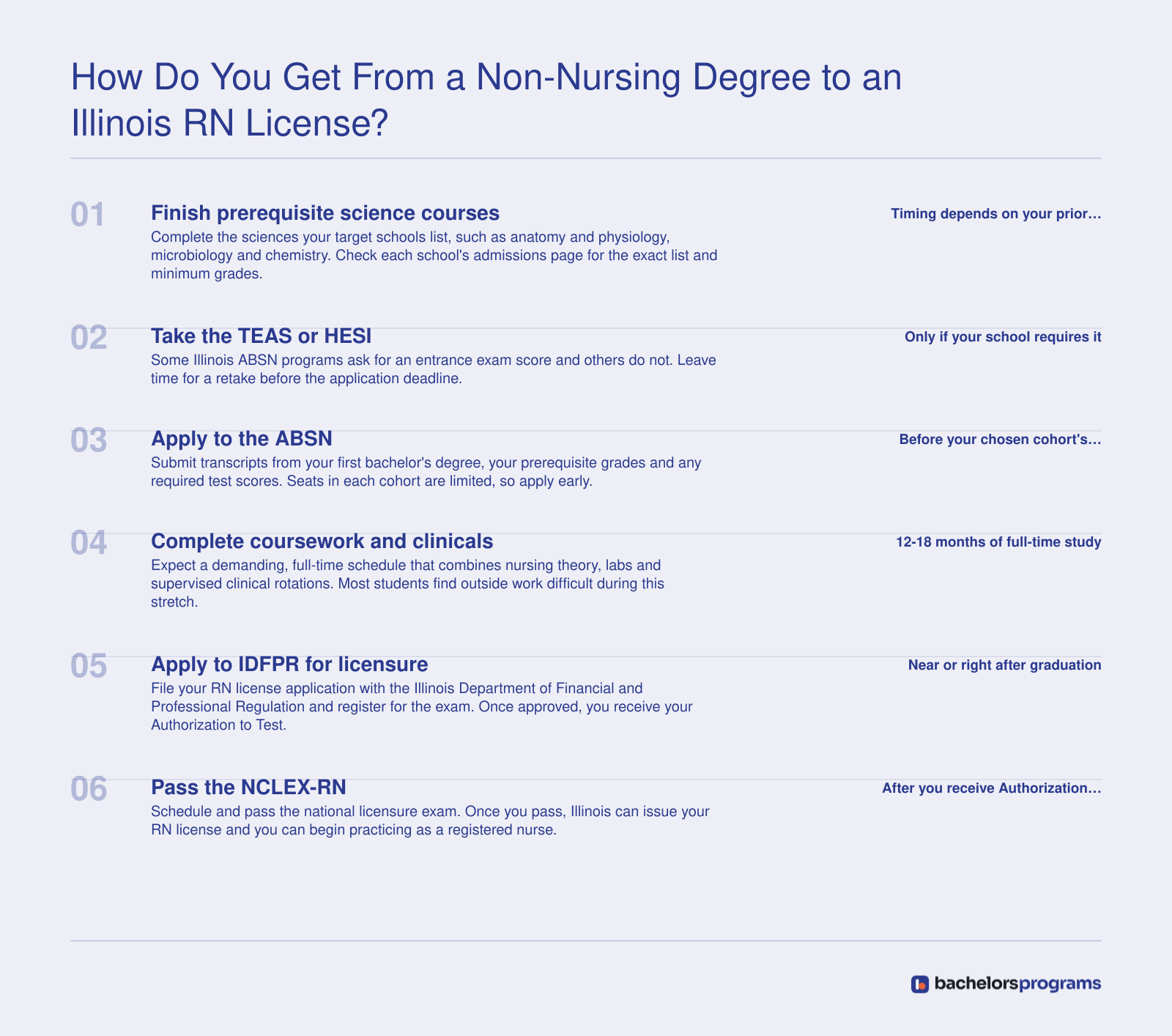
How Do You Get From a Non-Nursing Degree to an Illinois RN License?
Every Illinois ABSN follows the same basic path from your first bachelor's degree to a registered nurse license. Because most programs admit students in cohorts with fixed start dates, work backward from the start date you want so your prerequisites, any entrance exam and your application are finished in time.
Is Your ABSN Approved and Accredited? Checking IDFPR Status, CCNE/ACEN and NCLEX-RN Results
Before you compare price or pace, confirm that a program clears two independent hurdles. State approval decides whether you can sit for the licensing exam. National accreditation signals that the program meets professional standards, which matters for graduate school admission and some employers' hiring preferences.
Two Checks, Two Different Agencies
The Illinois Department of Financial and Professional Regulation (IDFPR), through the Board of Nursing, approves prelicensure nursing programs. Graduating from an approved program is what qualifies you to take the NCLEX-RN and apply for an Illinois RN license. Programmatic accreditation comes separately, from either the Commission on Collegiate Nursing Education (CCNE) or the Accreditation Commission for Education in Nursing (ACEN). At most universities, the ABSN track is covered by the school's accredited baccalaureate nursing program rather than accredited on its own, so directory listings usually read "BSN," not "accelerated."
What the Schools Report
Elmhurst University and Loyola University Chicago both appear on IDFPR's approved prelicensure list with an accelerated BSN designation as of 2025. Elmhurst states that its online ABSN is CCNE accredited. Lewis University, Southern Illinois University-Carbondale and Saint Xavier University also describe their accelerated programs as CCNE accredited. For the other schools here, confirm status directly using the steps below.
Reading NCLEX-RN Numbers Carefully
Loyola reports a 93.7% first-time NCLEX-RN pass rate for 2023, though its disclosure does not make clear whether that figure covers only accelerated graduates or all BSN graduates. Elmhurst reports an 86% pass rate for 2023 among online ABSN graduates, without specifying whether it counts first-time testers only.
For context, IDFPR's 2025 report puts the Illinois RN pass rate at 85% across 6,351 candidates, against a national rate of 87% across 192,911 candidates. Illinois programs must maintain a first-time pass rate of at least 75% to stay in good standing, so a school hovering near that line deserves pointed questions.
A Three-Step Verification Method
- Search the accreditor directories: Look up the school on the CCNE and ACEN websites and confirm the baccalaureate nursing program shows a current accreditation term.
- Check the IDFPR list: Find the school on the Board of Nursing's approved nursing education programs list and note whether an accelerated option is named.
- Find the school's NCLEX disclosure: Look for first-time pass rates with a reporting year, and ask admissions whether the figure separates ABSN graduates from traditional BSN students.
If a school cannot point you to all three, ask why before you pay a deposit.
Illinois RN Licensure at a Glance
Campus, Hybrid or Online? Where Illinois ABSN Coursework and Clinicals Really Happen
Elmhurst University promotes its accelerated BSN with 100% online coursework, yet the same program requires two on-campus residencies and 450 hours of supervised clinical practice. That gap between the brochure and the calendar is the thing to watch when you compare Illinois delivery formats.
No Illinois ABSN runs entirely online
An RN license requires supervised direct patient care, so every accelerated BSN has to build in hands-on hours. Hybrid programs shift the didactic lectures online, often with live video sessions, and keep skills labs, simulation and rotations in person. Loyola University Chicago lists both hybrid and on-campus options for its 16-month ABSN, combining simulation labs with a 120-hour role-transition practicum. Olivet Nazarene describes its format as online theory delivered alongside clinical practice. Read any "online ABSN" claim as "online lectures," never as "no commute."
Where the labs and clinicals actually meet
Campus-based programs here, including Illinois State, Bradley, Saint Xavier, Southern Illinois University Carbondale and Southern Illinois University Edwardsville, keep students on site for coursework and lab work. Illinois State runs 15 months beginning in summer, uses high-fidelity manikins and virtual reality at simulation sites in Bloomington-Normal and Springfield, and places students in Dedicated Education Units for clinical work. Geography separates the schools sharply: Loyola's rotations sit in the Chicago area across major academic medical centers, with location preferences considered, while Saint Xavier sends students to Chicagoland hospitals and SIU Carbondale leans on preceptor-led experiences closer to its downstate campus.
The one rule that cuts through the brochures
Pick the program whose skills lab and clinical sites you can realistically reach every week for 12 to 18 months. Hybrid lectures save commuting time; a clinical assignment three hours from home does not.
Questions to Ask Yourself
Can you go 12 to 18 months without a full-time paycheck?
Are your anatomy and physiology, microbiology and chemistry credits recent and graded high enough?
Do you need clinical sites in the Chicago area, or can you commute or relocate downstate?
Which cohort start lines up with the term your prerequisites wrap up?
Matching an Illinois ABSN to Your Budget, Location and Timeline
The right Illinois ABSN is the one that fits your wallet and your commute first, because the schools here are close enough in quality that logistics usually decide it.
If Budget Comes First
Start with the public universities. Southern Illinois University Edwardsville lists in-state tuition of $12,092, followed by Southern Illinois University-Carbondale at $13,334, Eastern Illinois University at $13,377 and Illinois State University at $14,410. Private options publish different figures: Saint Xavier University lists $50,900 in total program tuition and Elmhurst University $50,000. Annual and total-program numbers are not directly comparable, so get an ABSN-specific cost sheet from each school.
If Location Comes First
- Chicago metro: Saint Xavier University and Loyola University Chicago in the city, Lewis University in Romeoville (with courses at Oak Brook and Chicago), and Elmhurst University in Elmhurst.
- Central and downstate: Bradley University in Peoria, Illinois State University in Normal, Eastern Illinois University in Charleston, Southern Illinois University-Carbondale, and Southern Illinois University Edwardsville.
- South of the Chicago area: Olivet Nazarene University in Bourbonnais.
Gauging Competitiveness
Institution-wide admit rates give rough context only, since ABSN cohorts are usually tighter than the university overall. Southern Illinois University Edwardsville admits about 97.5 percent of applicants, Illinois State about 88.2 percent, Loyola about 81.6 percent, and Olivet about 55.9 percent. Apply to two or three programs, and choose ones with different start dates. Illinois State and Saint Xavier start in summer, Southern Illinois University Edwardsville in fall, and Elmhurst in fall and spring, so one missed deadline does not cost you a year.
Your Next Steps
- Request an ABSN-specific cost sheet from each school you are considering.
- Confirm Illinois Department of Financial and Professional Regulation (IDFPR) approval and CCNE or ACEN accreditation status.
- Attend an information session and ask about clinical placements.
- Calendar every application and prerequisite deadline.
Compare Accelerated BSN (ABSN) programs on the data that matters
Explore more Nursing majors or browse every field of study.
All Nursing programs Browse every field of study