Best Accelerated BSN (ABSN) Programs in Iowa
Compare 9 accredited Accelerated BSN (ABSN) programs in Iowa, with net price after aid, graduation rates, earnings and debt from IPEDS and the U.S. College Scorecard.
An accelerated BSN, an ABSN, compresses a nursing bachelor's into about 12 to 18 months for students who arrive with a bachelor's in something else. In Iowa, Allen College, Drake University, and the University of Northern Iowa list 12-month tracks, while Loras College runs a 3+1 pathway and Iowa State University's new A-BSN enrolls its first class in summer 2027.
Speed is only half the decision. Average net price after aid across the schools ranked here runs from $15,901 a year at the University of Northern Iowa to $29,127 at Drake University, and most expect prerequisite science courses done first.
The diploma is not the finish line: Iowa RN licensure still requires passing the NCLEX-RN.
Key Points
- University of Northern Iowa has the lowest net price: $15,901 per year.
- Northwestern College nursing graduates earn a $71,479 median one year out.
- Expect a completed bachelor's and 3.0 minimum GPA at Iowa State.
The Best Accelerated BSN Schools in Iowa, Ranked
Nine Iowa colleges offer an accelerated route from a prior bachelor's degree to a BSN, and the order here rewards affordability, on-time completion, and how graduates fare after the degree. Every card below carries the same fields so a small Sioux City college and a private Des Moines university can be compared side by side.
St Luke's College
#1Sioux City, IA · ~$20,000/yr (est.)
Best for: Career changers who prefer small cohorts
St. Luke's College is a small, single-focus health sciences college in Sioux City where the ABSN packs 56 nursing credits into three back-to-back semesters after 64 prerequisite credits. Schools offering this program graduate 64.7% of students, and nursing graduates earned a median $85,214 four years after finishing, with $15,000 in median debt. Best suited to self-directed students who want a compact cohort and a short, intense calendar.
- CCNE accredited and Iowa Board of Nursing approved
- 56 nursing credits across three back-to-back semesters
- 64 prerequisite credits required before entry
- 2.8 GPA minimum plus an entrance exam (ACT)
- 120 total credit hours
- Prepares graduates for the NCLEX-RN
Mercy College of Health Sciences
#2Des Moines, IA · ~$27,000/yr (est.)
Best for: Working adults balancing jobs and clinicals
Mercy College of Health Sciences in Des Moines runs a one-year ABSN that pairs online lectures with in-person labs and starts cohorts in fall, spring, and summer. Schools offering this program graduate 65.5% of students. Nursing graduates earned a median $71,148 four years after finishing and $66,309 one year after finishing, with $14,745 in median debt, among the lightest loan loads here.
- One-year, 52-credit program
- Start dates in fall, spring, and summer
- 3.0 prerequisite GPA minimum
- Program-reported 88% licensure pass rate
- Program-reported 91.8% completion rate
- Online lectures with in-person skills labs
- CCNE accredited
Allen College
#3Waterloo, IA
Best for: Certified nursing assistants pursuing an RN
Allen College in Waterloo runs a 12-month, three-semester ABSN with 540 clinical hours and a 225-hour internship under an RN preceptor, reviewing applications on a rolling basis. Program-level earnings came in at a median $73,177 four years after finishing and $65,924 one year after finishing, with $18,750 in median debt. It suits applicants who already hold CNA or patient care certification and want an immersive, fast route.
- 12-month, three-semester full-time track
- 540 clinical hours plus a 225-hour precepted internship
- Summer and fall start dates
- Rolling admissions with decisions in three to four weeks
- About 70 general education credits required
- CNA or HSP certification needed before starting
- Clinical placements include Blank Children's Hospital in Des Moines
- ACEN and CCNE accredited
Iowa State University
#4Ames, IA · $19,000/yr (est. net price)
Iowa State's A-BSN is a 15-month, cohort-based program in Ames built with Mary Greeley Medical Center, and its first class is set for summer 2027, so it is new rather than proven. Schools offering this program graduate 75.3% of students, the strongest institutional completion rate in this group. It fits applicants who want a research-university setting and central Iowa clinical partners and are comfortable joining an early cohort.
- 15-month, full-time second-degree program
- 57 nursing credits and 600+ experiential hours
- Single summer start with a fixed cohort
- Academic-practice partnership with Mary Greeley Medical Center in Ames
- Requires a non-nursing bachelor's degree and CNA credentials
- First class scheduled to enroll in summer 2027
- Financial aid available
Drake University
#5Des Moines, IA · $25,000 – $30,000/yr (est.)
Drake University in Des Moines delivers a 12-month ABSN with roughly 600 clinical hours, Broadlawns Medical Center as its primary site, and a three-day live NCLEX review before graduation. Schools offering this program graduate 74.0% of students, and the program reports a 72% licensure pass rate. It suits students who want hospital, pediatric, and community clinical variety inside a private university.
- 12-month program, 120 total credit hours
- About 600 clinical hours
- Broadlawns Medical Center as the primary clinical site
- Three-day live NCLEX review before graduation
- Program-reported 72% licensure pass rate
- Iowa Board of Nursing approved
- ACEN accredited
- Immersive final preceptor practicum
University of Northern Iowa
#6Cedar Falls, IA · $10,000 – $22,000/yr (est.)
The University of Northern Iowa in Cedar Falls delivers its ABSN in 12 months on the same curriculum and tuition as its traditional BSN, plus 412.5 clinical hours and a 150-hour residency. Schools offering this program graduate 67.9% of students. Choose it for public-university pricing, renovated simulation labs, and a cohort that moves through the year together.
- 12-month program with a fall start
- 412.5 clinical hours across acute, pediatric, obstetric, and community settings
- 150-hour residency in acute or critical care
- 87.5 nursing lab hours in renovated simulation labs
- Prior bachelor's degree or 70+ credits required
- Same tuition as UNI's traditional BSN
- Cohort-based structure
Graceland University-Lamoni
#7Lamoni, IA · ~$19,000/yr (est.)
Graceland University in Lamoni runs an accelerated on-campus BSN that can be finished in 18 or 24 months, a slower option than the 12-month programs above. Schools offering this program graduate 41.9% of students, the lowest completion rate in this group. Nursing graduates earned a median $80,619 four years after finishing, with $21,212 in median debt. It suits students who want a longer runway on a residential liberal arts campus.
- 18-month or 24-month completion options
- $745 per credit plus an $1,800 program fee each trimester
- 61 prerequisite credit hours required
- 2.5 GPA for the January start, 2.75 for June
- Two start dates per year, spring and summer
- Capstone required
- BSN taught on the Lamoni campus from fall 2025
Northwestern College
#8Orange City, IA · ~$26,000/yr (est.)
Northwestern College in Orange City teaches nursing through a three-year plan of study that begins with high school prerequisites, so it is a different path from the second-degree ABSNs listed above. Schools offering this program graduate 66.1% of students, and nursing graduates earned a median $71,322 four years after finishing, with $23,249 in median debt. Suits high school students planning early rather than career changers.
- Earns the BSN in three years instead of four
- A passed CNA course is required; the college does not offer one
- At most 30 new nursing students admitted each year
- Apply by April before high school graduation
- Three years of the same foreign language required
- Two summer courses needed if the language requirement is short
- CCNE accredited
Loras College
#9Dubuque, IA · ~$21,000/yr (est.)
Loras College in Dubuque pairs three years of undergraduate study with Mercy College of Health Sciences' 12-month BSN under a 3+1 agreement, with clinical rotations at MercyOne Dubuque. Schools offering this program graduate 67.6% of students. It fits first-time students who want two degrees in four years, not graduates returning for a second bachelor's.
- Two degrees in four years, all on the Loras campus
- 12-month nursing component starts in summer
- Clinical rotations at MercyOne Dubuque
- 3.0 GPA minimum
- Partnership with Mercy College of Health Sciences
- Pre-health advisor guides prerequisites and application
Cost & outcomes by school
Federal data for the highest-earning Accelerated BSN (ABSN) programs, independent of the ranking above. Earnings are this field's bachelor's graduates four years after completing where the Scorecard reports them, else the school's undergraduate median.
| School | Net price / yr | Grad rate | Earnings | Debt | Grads/yr | Format |
|---|---|---|---|---|---|---|
| Drake University IA | $29,127 | 74% | $71,901 | $23,000 | 1,802 | Hybrid |
| Allen College IA | — | — | $71,261 | $18,750 | 260 | Campus |
| Iowa State University IA | $18,589 | 75% | $63,386 | $22,869 | 11,024 | Campus |
| Mercy College of Health Sciences IA | $26,924 | 66% | $62,234 | $14,745 | 492 | Hybrid |
| St Luke's College IA | $19,820 | 100% | $61,033 | $15,000 | 36 | Campus |
| Loras College IA | $20,716 | 68% | $58,289 | $26,000 | 770 | Campus |
| University of Northern Iowa IA | $15,901 | 68% | $55,177 | $19,691 | 4,674 | Campus |
| Northwestern College IA | $25,907 | 66% | $49,802 | $23,249 | 628 | Campus |
| Graceland University-Lamoni IA | $18,504 | 42% | $47,361 | $21,212 | 496 | Campus |
Sources: U.S. Department of Education. Net price, graduation rate, earnings and debt: College Scorecard (earnings and debt for this field's bachelor's graduates where reported, else school-wide); graduates: IPEDS. A dash means no figure is reported.
Cost, debt & payoff
Median earnings of this field's bachelor's graduates (4 yrs after completing, else the school's undergraduate median) vs. their median federal loan debt · U.S. College Scorecard
Across these programs the median graduate earns about $61,033 and finishes with roughly $21,212 in debt — a ratio that clears a common rule of thumb (keep debt below first-year salary). Net price and debt vary widely school to school, so check the per-school figures in the table above before you shortlist.
Cheapest Accelerated BSN Programs in Iowa by Net Price
The University of Northern Iowa in Cedar Falls has the lowest cost of the schools here, with an average net price after aid of $15,901 per year, followed by Graceland University-Lamoni at $18,504 and Iowa State University at $18,589. These figures come from 2024 IPEDS and College Scorecard data from the U.S. Department of Education. The average net price after aid reflects what aided undergraduates pay across each school, so treat it as a campus-wide benchmark rather than a quote for the ABSN itself, and read it alongside median debt, which appears for nursing bachelor's graduates where federal data reports it. Accelerated BSN tuition can differ from these institution-wide averages (UNI, for example, says its ABSN carries the same tuition as its traditional BSN), so see the pace and cost section below for program-level pricing.
| School | Average net price after aid (per year, institution-wide) | In-state tuition and fees (per year, institution-wide) | Median debt, nursing bachelor's graduates | Median debt, all undergraduate completers | ABSN length (per school) |
|---|---|---|---|---|---|
| University of Northern Iowa (Cedar Falls) | $15,901 | $9,936 | N/A | $19,691 | 12 months |
| Graceland University-Lamoni (Lamoni) | $18,504 | $20,950 | $20,313 | $21,212 | 18 or 24 months |
| Iowa State University (Ames) | $18,589 | $10,787 | N/A | $22,869 | 15 months |
| St Luke's College (Sioux City) | $19,820 | $24,175 | $21,900 | $15,000 | N/A |
| Loras College (Dubuque) | $20,716 | $39,824 | N/A | $26,000 | 12 months |
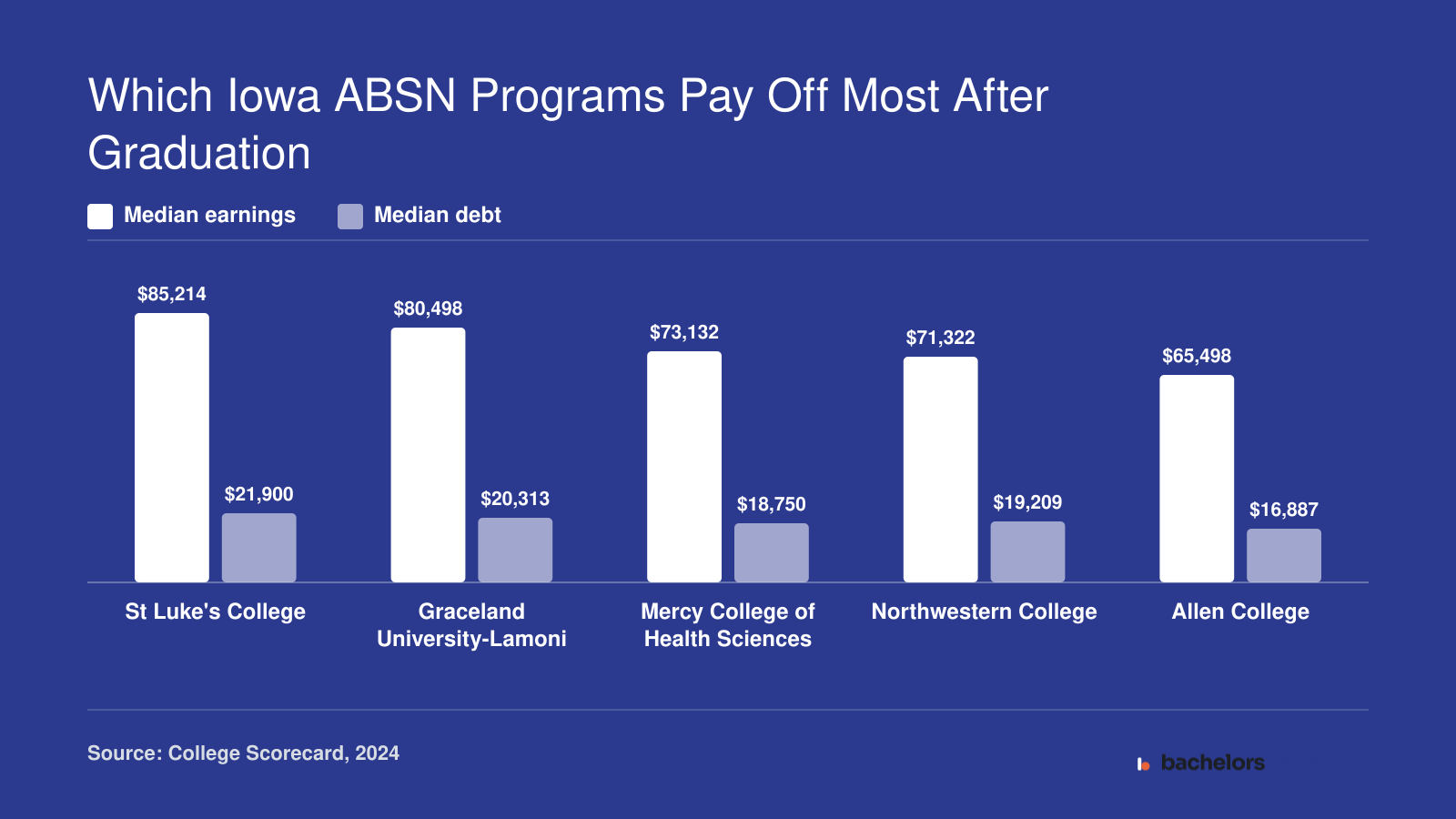
Which Iowa ABSN Programs Pay Off Most After Graduation
Median earnings for bachelor's nursing graduates at these schools range from $65,498 to $85,214. The window is four years after completion at St Luke's College and Northwestern College, and five years after completion at Graceland University-Lamoni, Mercy College of Health Sciences and Allen College. With median debt between $16,887 and $21,900, graduates at each school earn roughly 3.7 to 4 times their typical borrowing in a year, which suggests a career changer can pay down an accelerated BSN loan quickly. These figures cover each school's full bachelor's nursing cohort, not the accelerated track alone.
Getting Into an Iowa Accelerated BSN: Bachelor's, Prerequisites, GPA, and Tests
Iowa State University's accelerated BSN requires a completed bachelor's degree and a minimum 3.0 GPA, the firmest entry bar among the published requirements covered here.
Do You Need a Bachelor's Degree?
Not always. Iowa State asks for a finished bachelor's. The University of Northern Iowa accepts either a bachelor's or at least 70 college credits that meet its requirements, including general education, electives, and nursing prerequisites. Drake University's catalog sets the bar at 70 undergraduate credit hours, including 40 semester credit hours of general electives, and does not state that a prior degree is required. If you already hold a non-nursing bachelor's, you clear that hurdle at all three. If you are still short of a degree, UNI and Drake are the realistic paths.
Science Prerequisites and Grade Minimums
Anatomy and physiology with labs appears on every list. Drake wants a full year: one semester of anatomy and one of physiology, each with a lab. A combined sequence counts only if both semesters are complete. Beyond that, expect some mix of:
- Chemistry (Iowa State specifies 4 credits with lab)
- Microbiology (Iowa State lists 2 lecture credits plus 1 lab credit)
- Statistics, nutrition, and psychology
- Medical terminology, plus pathophysiology at UNI
A grade of C or higher is the floor for prerequisites at Drake, Iowa State, and UNI. Drake also accepts AP credit with a score of 4 or higher.
GPA, Entrance Exams, and the CNA Requirement
UNI applies its 3.0 minimum to prerequisite coursework specifically. Drake sets no minimum GPA, though a 3.0 calculated through NursingCAS is considered competitive. The published requirements at these three schools do not list a TEAS or HESI exam, but confirm with admissions before applying, since policies can change.
Iowa State adds a CNA qualification: a CNA course or certificate completed within five years before you apply, or an active listing on the Direct Care Worker Registry. Most nursing programs also expect background checks and immunization records before clinicals. For Allen College, Mercy College of Health Sciences, and the other schools here, review each admissions page directly.
Related Articles
ABSN Pace and Price in Iowa: 12 to 18 Months, Tuition, and Financial Aid
Iowa's accelerated nursing field has shifted in the past few years, with the University of Northern Iowa adding an ABSN alongside long-running options at private colleges and health system schools. For second-degree students, that growth matters mostly for timing and price.
How Long It Takes
Most accelerated BSN tracks in Iowa compress the nursing core into 12 to 18 months of continuous full-time study, with no summers off. Drake University, Allen College, and the University of Northern Iowa all list 12-month formats; Mercy College of Health Sciences sets its own cohort calendar, so confirm the length with the school directly. A few routes on this list run longer by design: Graceland University-Lamoni offers a two-year on-campus accelerated BSN, and Loras College structures nursing as a 3+1 sequence. Confirm the calendar with the admissions office, since cohort start dates shift and listed lengths vary between directories and the schools' own pages.
What Tuition Looks Like
Mercy College of Health Sciences publishes an ABSN rate of $810 per credit hour for 2026-2027, above its general undergraduate rate of $770 per credit. Third-party listings place Drake near $750 per credit and Allen College around $729 per credit with a separate nursing program fee charged each semester, but those figures are not school-confirmed here and totals circulating for Allen's program disagree by a wide margin. UNI's program is new enough that a finalized resident per-credit ABSN rate has not surfaced in published materials, so request a written cost estimate before committing. Ask every school for total credits, program fees, and clinical costs, not just the headline rate.
Working and Paying for It
Accelerated cohorts typically schedule classes and clinical rotations across the full week, which leaves little room for a regular job. Programs commonly advise limiting outside employment, and that guidance is worth asking about directly.
- Pell Grant: Students who already hold a bachelor's degree are generally ineligible.
- Federal loans: ABSN students borrow at undergraduate limits through Direct Unsubsidized loans; Grad PLUS is not available for a bachelor's-level program.
- Other sources: Institutional nursing scholarships and employer tuition assistance from Iowa health systems can close part of the gap.
Accelerated BSN Length, Format, Start Terms, and Clinical Sites in Iowa
A hybrid label never means a nursing degree you finish from your laptop. Iowa ABSN coursework may move online in places, but skills labs, simulation, and supervised clinical rotations happen in person, on the school's schedule, at sites the program assigns. Build your application timeline around that reality first.
Program Details Schools Publish
- Drake University (Des Moines): 12 months, campus-based delivery, rolling applications. Roughly 600 hours combine simulation, lab, and clinical experience. Cohort size: not published.
- Allen College (Waterloo): three semesters across 12 consecutive full-time months, in-person coursework with patient contact beginning in the first semester. Summer and fall starts, rolling review once a file is complete (expect three to four weeks for a decision). The accelerated track carries 540 hands-on clinical and simulation hours plus a 225-hour final-semester internship with an assigned RN preceptor. Placements run through acute care, specialty care, and community-based agencies rather than a single named hospital. Cohort size: not published.
Confirm the Rest Directly
Structure varies widely among the other options here. Graceland University runs an accelerated two-year BSN on its Lamoni campus, Northwestern College offers a three-year plan of study in Orange City, and Loras College uses a 3+1 pathway in Dubuque. St Luke's College in Sioux City, Mercy College of Health Sciences and Drake in Des Moines, Iowa State in Ames, and the University of Northern Iowa in Cedar Falls each set their own start terms and deadlines. Those dates shift year to year, so verify them with the admissions office before you build an application timeline.
First-Year Earnings for Iowa ABSN Graduates
Northwestern College nursing graduates report the highest median earnings among the schools here, at $71,479 one year after finishing.
Iowa Board of Nursing Approval and the Road to NCLEX-RN Licensure
Why Approval Comes First
A fast program only pays off if it ends in a license, so confirm a school's approval and accreditation before you compare speed or price. In Iowa, graduating from a Board-approved nursing program is what qualifies you to apply for RN licensure and sit for the NCLEX-RN. National nursing accreditation from CCNE or ACEN matters later. Many master's and doctoral nursing programs expect a BSN from an accredited program, and eligibility for federal financial aid depends on a school's accreditation standing. Before applying to Drake, Allen College, Mercy, Iowa State or any program here, check two places: the Iowa Board of Nursing's list of approved programs and the accreditor's online directory.
Where UNI's New ABSN Stands
The Iowa Board of Nursing approved the University of Northern Iowa's BSN proposal and curriculum on April 5, 2023. UNI reports that its baccalaureate nursing program is ACEN-accredited. The Board will conduct a site-visit evaluation after the first nursing cohort graduates. UNI's 12-month ABSN, which the Iowa Board of Regents approved, enrolled its first cohort for an August 2026 start. UNI expects to begin publishing licensure exam results in fall 2027.
NCLEX-RN Pass Rates
Allen College appears in the Board's first-time candidate report and posted a 94.7% first-time rate for 2025. Mercy College of Health Sciences recorded 88.1% for 2025 on its BSN line, which is reported separately from its LPN and associate degree results. Both figures cover each school's full pre-licensure BSN, not ABSN students alone.
Steps to Your Iowa RN License
- Graduate: Complete your ABSN at a Board-approved program.
- Apply: Submit a licensure application to the Iowa Board of Nursing.
- Screen: Complete fingerprinting and the criminal background check.
- Register: Sign up for the NCLEX-RN through Pearson VUE.
- Pass: Pass the NCLEX-RN to earn your Iowa RN license.
Iowa RN Licensure at a Glance
How We Ranked Iowa ABSN Schools
Brand name or bottom line: this list favors the second. You have already paid for one bachelor's degree. What an accelerated BSN costs and what it leads to should count for more than a school's reputation.
What Goes Into the Ranking
- Net price: The average cost of attendance after grants and scholarships are subtracted.
- Graduation rate: How often students at the institution complete their degrees.
- Earnings and debt: Program-level median earnings and median debt from the U.S. Department of Education.
- Delivery format: Whether the program runs fully on campus or blends in hybrid or online coursework.
Where the Numbers Fall Short
These completion and cost figures describe the whole institution, not the nursing program alone. A school's ABSN cohort may finish at a different rate or pay a different price than its undergraduates overall. Earnings windows also vary by program. Some figures reflect the first year after graduation, and others cover a longer stretch. Use these numbers to compare schools side by side, not as a promise of your own outcome.
Verify Before You Apply
Admissions requirements, tuition, start terms, and licensure details come from each school's official pages and from the Iowa Board of Nursing. These details can shift from one admission cycle to the next. Before you submit an application, confirm prerequisites, deadlines, and current costs directly with the program you're considering, whether that's Allen College in Waterloo or Drake University in Des Moines.
Compare Accelerated BSN (ABSN) programs on the data that matters
Explore more Nursing majors or browse every field of study.
All Nursing programs Browse every field of study