Best Accelerated BSN (ABSN) Programs in Nevada
Compare 4 accredited Accelerated BSN (ABSN) programs in Nevada, with net price after aid, graduation rates, earnings and debt from IPEDS and the U.S. College Scorecard.
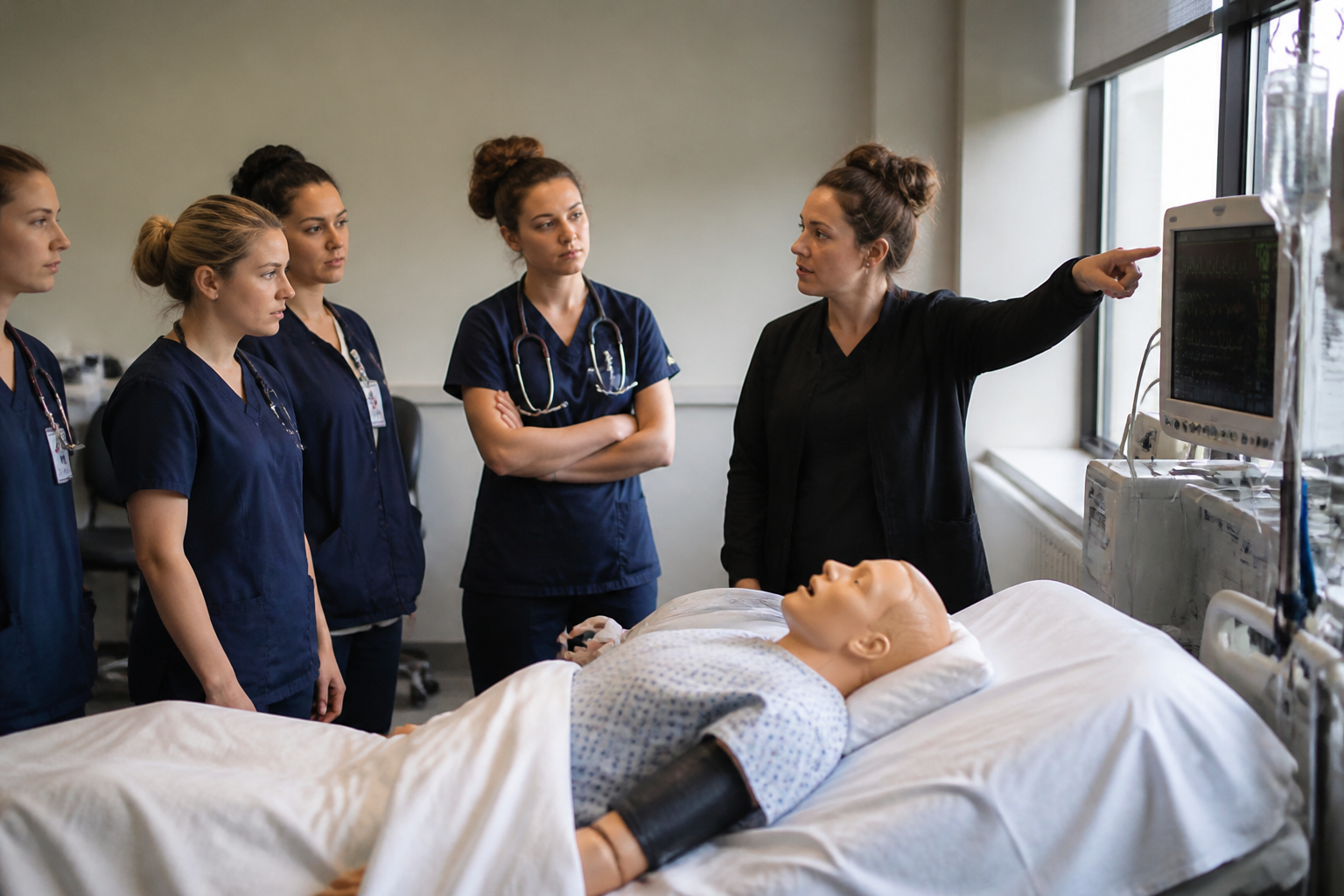
Sixteen months at University of Nevada-Reno or 18 months at Roseman University of Health Sciences: that is the full-time span between a non-nursing bachelor's and eligibility for the NCLEX-RN in Nevada.
The price gap is wider than the calendar gap. Annual net price across the schools ranked here runs from $6,615 at College of Southern Nevada to $25,000 at Roseman, where published program tuition is $65,600.
CSN's listing is an RN to BSN track for nurses who already hold a license. Career changers starting without one are limited to the direct-entry tracks at Reno and Roseman.
Key Points
- University of Nevada-Reno's accelerated BSN runs 16 months of full-time study.
- University of Nevada-Reno pairs the lowest net price with top first-year earnings.
- Graduates apply through the Nevada Nurse Portal after passing the NCLEX-RN.
Nevada's Leading Accelerated BSN Schools, Ranked
Each school below earned its spot on what a second-degree student actually pays, how the institution performs overall, and how its nursing completers fare after finishing. Nevada's accelerated BSN field is small, so the list is short: one public research university, one private health-sciences school in Henderson, and one community college whose accelerated nursing option serves licensed RNs rather than career changers starting from scratch. In-state rates at the public options sit far below the private program's total tuition, and the format line on each card tells you which route fits your situation.
University of Nevada-Reno
#1Reno, NV · $16,000/yr (est. net price)
Best for: Career changers drawn to rural healthcare
The University of Nevada, Reno runs its accelerated BSN through a CCNE-accredited nursing school, with the 16-month sequence offered on the main Reno campus or at a Lake Tahoe site built around rural and mountain-community care. Applicants need prerequisite science coursework, a 2.8 GPA and a TEAS score, and the school allows up to 16 prerequisite credits to be in progress when you apply. The school's overall graduation rate is 61%, and federal data show median earnings of about $85,733 one year after completion for bachelor's nursing graduates, with median federal debt of roughly $19,500.
- CCNE-accredited 16-month program for second-degree students
- Reno campus or Lake Tahoe site with a rural healthcare focus
- Minimum 2.8 GPA plus prerequisite science coursework
- TEAS entrance exam required; retake allowed once per cycle
- Up to 16 prerequisite credits may be in progress at application
Roseman University of Health Sciences
#2Henderson, NV
Best for: Working adults juggling job and school
Roseman University of Health Sciences is a private health-sciences institution whose Henderson campus offers an ABSN that finishes in under 18 months, with on-campus and hybrid-online formats and four start dates a year. Admission requires 49 prerequisite semester credits, a GPA just under 2.8, a TEAS score and an interview, and the program reports a 99.25% NCLEX pass rate for 2025 with 93.1% of graduates hired within a year. Federal data show median earnings of about $85,166 one year after completion for bachelor's nursing graduates, with median federal debt of roughly $25,000.
- Completes in under 18 months, on-campus or hybrid-online
- Henderson campus option alongside the Utah site
- Four start dates a year with rolling admissions
- 49 prerequisite semester credits and a 2.75 GPA minimum
- TEAS score of 58.7% plus an admissions interview
- $65,600 total program tuition across 18 months
- 99.25% NCLEX pass rate reported for 2025
- Block System lets students focus on one subject at a time
College of Southern Nevada
#3Las Vegas, NV · $4,400 – $13,000/yr (est.)
Best for: Licensed RNs adding a bachelor's degree
College of Southern Nevada is the state's large urban community college, and its bachelor's nursing option is an RN-to-BSN completion degree with an accelerated track rather than a pre-licensure accelerated BSN for career changers. Coursework runs online with community-based clinical experiences, and admission requires an unencumbered Nevada RN license, so readers who do not yet hold a nursing license should look to the two programs above instead. The school's overall graduation rate is 19%, a figure that reflects a very large, part-time-heavy open-access population rather than this program alone.
- ACEN-accredited RN-to-BSN with an accelerated track
- 120 credits: 70 lower-division, 41 nursing, 9 electives
- Fully online coursework plus community-based clinical hours
- Requires an unencumbered Nevada RN license to enroll
- Admits ADN-prepared registered nurses, not new nursing students
- Capstone presentation and a Nevada Constitution credit required
Cost & outcomes by school
Federal data for the highest-earning Accelerated BSN (ABSN) programs, independent of the ranking above. Earnings are this field's bachelor's graduates four years after completing where the Scorecard reports them, else the school's undergraduate median.
| School | Net price / yr | Grad rate | Earnings | Debt | Grads/yr | Format |
|---|---|---|---|---|---|---|
| Roseman University of Health Sciences NV | — | — | $120,163 | $25,000 | 580 | Hybrid |
| Galen Health Institutes-Las Vegas NV | $24,190 | — | $61,480 | $24,166 | — | Campus |
| University of Nevada-Reno NV | $15,927 | 61% | $60,614 | $18,922 | 7,188 | Campus |
| College of Southern Nevada NV | $6,615 | 19% | $38,087 | $8,000 | 384 | Online |
Sources: U.S. Department of Education. Net price, graduation rate, earnings and debt: College Scorecard (earnings and debt for this field's bachelor's graduates where reported, else school-wide); graduates: IPEDS. A dash means no figure is reported.
Cost, debt & payoff
Median earnings of this field's bachelor's graduates (4 yrs after completing, else the school's undergraduate median) vs. their median federal loan debt · U.S. College Scorecard
Across these programs the median graduate earns about $61,047 and finishes with roughly $21,544 in debt — a ratio that clears a common rule of thumb (keep debt below first-year salary). Net price and debt vary widely school to school, so check the per-school figures in the table above before you shortlist.
Nevada ABSN Schools Compared Side by Side: Price, Selectivity, and Outcomes
The grid below draws on 2024 IPEDS and College Scorecard data from the U.S. Department of Education. Tuition figures are annual, the admission and graduation rates cover each institution as a whole, and median debt reflects graduates of the specific nursing program where it is published. The widest cost gap is in-state tuition, which runs from $4,358 at College of Southern Nevada to $44,900 at Roseman University of Health Sciences; Roseman also lists $65,600 in total tuition for its 18-month ABSN. University of Nevada-Reno is the only school here with a published admission rate (73.7%), but that figure covers all undergraduates, and ABSN cohorts are far smaller and admit a much narrower share of applicants. College of Southern Nevada's listed program is an online RN to BSN track for nurses who already hold a Nevada RN license, not a second-degree entry route for career changers.
| School | City | Format | In-State Tuition | Out-of-State Tuition | Average Net Price | Admission Rate (Institution-Wide) | Graduation Rate (Institution-Wide) | Program Median Debt |
|---|---|---|---|---|---|---|---|---|
| University of Nevada-Reno | Reno | Campus | $9,578 | $27,720 | $15,927 | 73.7% | 61.2% | $19,500 |
| College of Southern Nevada | Las Vegas | Online (RN to BSN) | $4,358 | $13,024 | $6,615 | N/A | 19.1% | N/A |
| Roseman University of Health Sciences | Henderson | Hybrid | $44,900 | $44,900 | N/A | N/A | N/A | $25,000 |
Getting in: Prior Bachelor's, Science Prerequisites, GPA, and Test Policy at Each Nevada ABSN School
One Nevada accelerated BSN wants a completed bachelor's in another subject; the other wants a specific count of credits. So the first admissions question is which set of requirements you actually meet.
University of Nevada, Reno: the completed-degree route
UNR's Orvis School of Nursing requires a prior bachelor's degree, finished by the end of the spring semester before the program begins. Prerequisite coursework, each with a minimum grade of C: MATH 126 or higher, CHEM 121A/L, BIOL 223A/L, BIOL 224A/L, BIOL 251A/L, NUTR 223, HDFS 201, a communication course, and NURS 407. A second tier accepts a C-: CH 203 or the U.S. Constitution course, PSC 100 or the Nevada Constitution, PSY 101 or SOC 101, and statistics. You need a 2.8 GPA across the required coursework. The ATI TEAS is required at a minimum total score of 65 percent, and it must be taken within one year before you apply.
Roseman University, Henderson: the credit-threshold route
Roseman's ABSN page sets a minimum of 49 semester credits rather than a completed bachelor's degree, which leaves room for applicants still finishing a degree or transferring credit from earlier coursework. Prerequisites: 16 credits of physical and biological science, including 12 credits of anatomy, physiology, and microbiology with labs; 6 credits of social science; 3 credits of statistics; 6 of English; 6 of humanities; 9 of electives; and 3 covering the U.S. and/or Nevada Constitution. Minimum cumulative GPA is 2.75. The TEAS is required for all nursing applicants at a minimum overall score of 58.7 percent, and it may not be taken more than three times in a calendar year.
What to confirm before you apply
- Finish versus in progress: UNR lets you apply while your final degree term is underway, provided the degree posts by the end of spring. At Roseman, the 49 credits are the floor, so map your transcript against the category breakdown early.
- Science course timing: ask each admissions office which listed courses must carry a final grade at application and which may be in progress.
- Cohort drift: GPA floors, TEAS cutoffs, and attempt limits can change from cohort to cohort, so verify them on each school's admissions page before you register for a test or a course.
ABSN Pace and Cost in Nevada: 12 to 18 Months, Tuition, and Financial Aid
An accelerated BSN in Nevada compresses nursing school into a full-time sprint for graduates of other bachelor's programs, and its pace and price move together. The shorter the calendar, the fewer terms of fees you pay, but tuition and living costs land in a tighter window.
Published Tuition and Program Length
Roseman University's Henderson ABSN runs 18 months, with Summer 2026, Fall 2026, and Spring 2027 cohort starts. Its published 2026-2027 tuition is $65,600; adding the listed seating, technology, nursing lab, and graduation charges brings the total to $69,550 before Year 2 health insurance, which is still to be determined and can be waived with timely proof, and before books and living costs.
The University of Nevada, Reno offers a 16-month accelerated BSN at its Reno and Lake Tahoe campuses. UNR also plans a 12-month accelerated second-bachelor's BSN at Reno, with the first cohort starting Fall 2027 and applications open January 1 through February 8, 2027. UNR lists in-state tuition and fees of $9,578 and a net price of $15,927; those are university-wide figures, not a published ABSN program total.
College of Southern Nevada posts the lowest net price in the ranking data at $6,615, with in-state tuition and fees of $4,358. Its accelerated track is an RN-to-BSN program for licensed nurses, so it does not compress a second bachelor's into the same 12-to-18-month window.
Why the Short Calendar Changes the Budget
A 12-month program costs less in living expenses than an 18-month one, but the tuition bill arrives faster. Full-time study also leaves little room to work, so the real budget has to cover tuition, fees, and several months of living costs at once. That is why aid and payment timing matter as much as the sticker price.
Aid, Debt, and Benefits
Federal Direct Loans are the main route for many second-degree students, assuming the program participates and you file the FAFSA. Pell Grants are generally not available to students who already hold a bachelor's degree. Ask each nursing school about its own scholarships and check state nursing scholarship options. Nevada hospitals may offer tuition assistance tied to an employment commitment. VA and GI Bill benefits are program-specific, so confirm approval with the school's certifying official before you count on them.
Where the ranking data reports it, the median federal debt of UNR completers is $19,500, with a median 10-year repayment near $207 a month; that is an institution-wide figure, not the ABSN cohort's own. Compare that monthly figure with a Nevada RN starting salary before you commit.
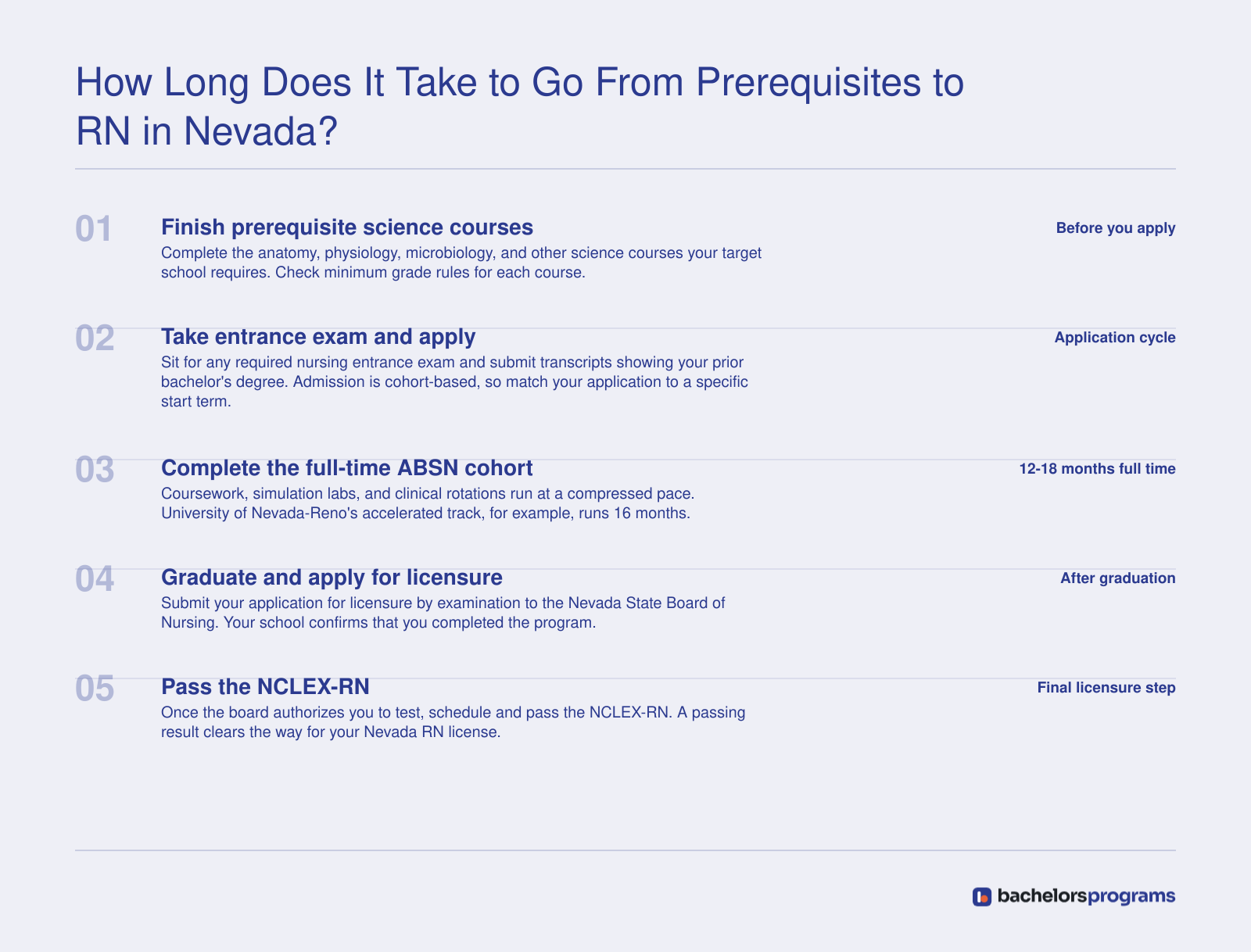
How Long Does It Take to Go From Prerequisites to RN in Nevada?
Most Nevada ABSN students move through the same five stages, from finishing science prerequisites to sitting for the NCLEX-RN. Exact timelines vary by school and start term, so check each program's application deadlines and cohort calendar before you plan your year.
Related Articles
Campus Time, Simulation, and Clinical Rotations: What a Nevada ABSN Week Looks Like
Can you keep a job while you complete a Nevada ABSN? Short answer: plan on very little outside work, and ask each school directly. Both programs describe themselves as intensive, and neither published admissions page sets a clear work policy or mentions per diem or weekend options.
Roseman University of Health Sciences (Henderson)
Roseman offers its Accelerated Bachelor of Science in Nursing in two formats. On-campus students attend didactic, lab, group work, and clinicals in person. Didactic classes run Monday through Friday, roughly 8 a.m. to 3 p.m., and skills lab can spill into after-hours time.
Hybrid students take lectures online, using a mix of live and self-paced sessions with weekly checkpoints. Assessments, group work, skills lab, simulation, and clinicals still happen in person. The hybrid format also calls for two to three multi-day on-campus skills and simulation sessions each semester, so out-of-town students should budget for travel. One practicum block carries 0.4 simulation-lab credits, or 12 contact hours.
Clinical placements fall in Southern Nevada and Utah, at Roseman campuses and affiliated sites. Roseman's published pages do not name its partner hospitals. Utah rotations could mean travel or temporary relocation. Roseman's catalog describes clinical blocks of two to four weeks, using 3x12, 4x10, or 5x8 shift patterns. That catalog dates to 2018-2019, so confirm current patterns, including any nights or weekends.
University of Nevada, Reno
The Accelerated Second Bachelor's BSN is in-person in Reno and runs year-round across Fall, Wintermester, Spring, and Summer terms, with no long summer break. UNR confirms hands-on clinical learning, but its ASBSN page does not give simulation hours, weekly class time, shift schedules, or clinical partners. Ask admissions where placements occur (Reno, the Tahoe area, or farther) and whether evening or weekend shifts are required.
Questions to Ask Before You Apply
- How many hours per week do students typically spend in class, lab, and clinical?
- Do clinical sites require driving beyond your home city?
- Do current students work, and in what capacity?
What Nevada ABSN Completers Earn in Their First Year
Federal outcomes data tracks what nursing bachelor's graduates earn soon after finishing. Among the Nevada schools ranked here, University of Nevada-Reno posts the highest first-year figure.
Nevada Board of Nursing Approval and NCLEX-RN Licensure for ABSN Graduates
An accelerated BSN gives you a nursing degree, not a nursing license. The license comes from the Nevada State Board of Nursing after you pass the NCLEX-RN, the national exam every new registered nurse must clear.2 Nevada calls this route licensure by examination, and accelerated graduates follow the same steps as traditional BSN students.
Verify Approval and Accreditation Yourself
The Board requires RN applicants to graduate from a program accredited by a nationally recognized nursing-accrediting association.3 Its FY 2024-2025 annual report counts 17 fully approved nursing programs statewide, but that total spans every program type, not just accelerated tracks.1 Before applying to the University of Nevada-Reno's 16-month accelerated BSN or Roseman University of Health Sciences' ABSN in Henderson, check two things:
- Board approval: Find the program on the Nevada State Board of Nursing's list of approved education programs.
- National accreditation: Search the CCNE and ACEN online directories and confirm the accreditation covers the BSN.
College of Southern Nevada's bachelor's option is an RN to BSN, designed for nurses who already hold a license, so it is not a route to first-time licensure.
The Licensure-by-Examination Steps
- Apply: Submit the Board's RN application and fee.
- Register: Sign up for the NCLEX-RN with Pearson VUE at nclex.com.2
- Fingerprint: Electronic fingerprinting is available only if you are in Nevada.2 If you completed fingerprints for the Board within the previous six months, you do not need to resubmit.
- Transcript: Your school must send an official transcript showing your nursing degree.
Once the Board has everything, it makes you eligible and Pearson VUE issues your Authorization to Test. You must take the exam within 90 days.2 Plan for a gap afterward: the Board does not issue a permanent license until state and FBI fingerprint reports arrive, which can take up to four months.2
Reading NCLEX Pass Rates Carefully
The Board publishes NCLEX pass rates by school and exam type, with reports covering 2016 through 2025.3 Those reports separate first-time testers, repeaters, and total candidates, and the three rates can differ sharply. Small graduating classes can push a rate up or down from one year to the next, and the figures generally reflect the whole school rather than the accelerated track alone. For the clearest picture, ask each admissions office for its ABSN cohort's first-time pass rate over several years.
Nevada RN Licensure by Examination at a Glance
Matching a Nevada ABSN School to Your Budget, Location, and Timeline
Which Nevada ABSN school fits your budget, your zip code, and your calendar? The answer depends on which of those three limits matters most to you.
Guided Picks by Reader Profile
- Lowest net price among the two direct-entry tracks: University of Nevada-Reno. Its in-state tuition and fees run $9,578 a year, while Roseman University of Health Sciences lists $65,600 in tuition and $69,550 as the total program cost. Roseman does offer scholarships and financial aid.
- Best for Southern Nevada residents: Roseman in Henderson, with an on-campus or hybrid-online format and an 18-month program. College of Southern Nevada in Las Vegas is the lower-cost local option, but its track is an RN to BSN for working nurses, not a second-degree path for career changers.
- Best for Northern Nevada or Tahoe: University of Nevada-Reno, which lists both Reno and Lake Tahoe campus options.
- Shortest program or earliest start: Reno's accelerated BSN runs 16 months, and its 12-month second-bachelor's track opens with a Fall 2027 cohort. Roseman runs 18 months but starts new cohorts in summer, fall, and spring, so you may find an earlier entry point there.
Both Reno and Roseman require the TEAS, but their GPA floors differ: 2.8 at Reno and 2.75 at Roseman.
Apply Broadly and Plan Prerequisites Early
Cohort seats are limited, so apply to more than one cohort, and to more than one school if you can. Reno's posted deadline for the Fall 2027 cohort is February 8, 2027, so build your prerequisite timeline around it. Finish or enroll in remaining science prerequisites at least one term before each deadline. Reno lets applicants have up to 16 prerequisite credits in progress, but a finished course still looks stronger than one under way.
Your Next Step
Start this week with three actions:
- Request program information from each school you are considering.
- Attend an info session to see the format, cohort schedule, and campus options.
- Verify your prerequisites with an admissions advisor, since transcripts and course age can change what counts.
That conversation will tell you which start date is actually open to you.
Compare Accelerated BSN (ABSN) programs on the data that matters
Explore more Nursing majors or browse every field of study.
All Nursing programs Browse every field of study