Best BSN Programs in Hawaii
Compare 6 accredited Bachelor of Science in Nursing (BSN) programs in Hawaii at 4 colleges, with net price after aid, graduation rates, earnings and debt from IPEDS and the U.S. College Scorecard.
Hawaii BSN applicants face two entry models. At the University of Hawaii at Manoa and the University of Hawaii at Hilo, you complete prerequisites, sit the TEAS, and compete for a cohort seat. At Chaminade University of Honolulu, you enter a lock-step four-year track with a graduation guarantee. Manoa's nursing program lists a 3.0 GPA minimum and a 10.5% acceptance rate.
The programs ranked below are traditional pre-licensure BSN programs, ordered by NCLEX-RN performance. Seats in the state are limited, and exam results, cost, and entry route rarely point to the same school.
Key Points
- Schools here are ranked by first-time NCLEX-RN pass rate.
- University of Hawaii at Manoa admits some freshmen directly into nursing.
- Hawaii RN applicants pay $40 plus a $60 nursing center fee.
Hawaii BSN Schools With the Top NCLEX-RN Pass Rates
This list orders Hawaii's traditional BSN programs by NCLEX-RN first-time pass rate, with CCNE accreditation and completion outcomes used to break ties when results are close. Each entry notes what the school reports, what it costs a Hawaii resident, and how many students it graduates overall. Licensed RNs and second-degree students should know that RN-to-BSN and accelerated BSN programs have their own dedicated pages and are not ranked here.
Chaminade University of Honolulu
#1Honolulu, HI · $25,000 – $30,000/yr (est.) · NCLEX-RN pass rate 93.3% (2-yr weighted avg)
Best for: Direct-entry students wanting a lock-step path
Chaminade is a private Marianist university in Honolulu whose BSN is direct-entry and lock-step, so students begin nursing coursework in their first year rather than competing for a seat after a separate pre-nursing sequence. Small classes and assigned faculty mentoring are part of the pitch, backed by a four-year graduation guarantee. The school graduates 55% of students overall, reports a 93.3% NCLEX-RN pass rate, and charges $30,760 in tuition with a net price after aid of roughly $28,860.
- Direct-entry, four-year lock-step curriculum
- CCNE accredited program
- Clinical rotations in maternal-newborn, pediatric, psychiatric and public health nursing
- Prerequisite courses required before the nursing sequence
- Four Year Graduation Guarantee for students who stay on track
- Values-based Marianist education with small classes
Hawaii Pacific University
#2Honolulu, HI · $30,000/yr (est. net price) · NCLEX-RN pass rate 76.8% (2-yr weighted avg)
Best for: Students planning to continue into graduate nursing
Hawaii Pacific University runs its BSN through the Nursing department on a Honolulu campus, and the university also offers MSN and DNP options for students who plan to keep going after licensure. The catalog entry is lean on program detail, so prospective students should confirm prerequisites and clinical hour requirements directly with the department. HPU graduates 35% of students overall and reports a 76.8% NCLEX-RN pass rate, with tuition of $33,792 and a net price after aid near $29,660.
- Offered through the university's Nursing department
- Catalog status active for the 2026-27 academic year
- Standard BSN designation with no concentration track
University of Hawaii at Manoa
#3Honolulu, HI · $15,000 – $20,000/yr (est.) · NCLEX-RN pass rate 65.4% (2-yr weighted avg)
Best for: Residents targeting a highly selective public cohort
UH Manoa is the state's public research flagship, and its School of Nursing gives Honolulu students several ways in: a three-year traditional cohort for current and former college students, a high school direct entry route, and the Hawaii Statewide Nursing Consortium curriculum shared with neighbor island campuses. Admission is genuinely competitive, with priority for Hawaii residents. The university graduates 64% of students overall and reports a 65.4% NCLEX-RN pass rate, at $11,304 in-state tuition and a net price after aid around $15,660.
- Three-year, in-person, full-time cohort for current and former college students
- TEAS entrance exam required
- 120 total credit hours
- 3.0 GPA minimum; admitted students average a 3.94 combined GPA
- Acceptance rate of about 10.5%
- Priority given to Hawaii resident applicants
- Four-year route for students entering straight from high school
- One start date per year, in fall
- Hawaii residency required
- Cohort-based structure with pre-major advising available
- Consortium curriculum shared across UH campuses
- 32 prerequisite credits required
- TEAS or NLN exam must be completed before November
- TEAS scores remain valid for three years
- Application due January 5
University of Hawaii at Hilo
#4Hilo, HI · ~$12,000/yr (est.)
UH Hilo is the only baccalaureate nursing program on the outer islands, and it leans into that with a transcultural curriculum built around rural and multi-ethnic community care. Cohorts stay small, roughly 30 students on the Hilo campus, and a High School Direct Entry pathway lets qualified local graduates reserve a seat instead of reapplying as sophomores. The university graduates 48% of students overall, charges $7,344 in in-state tuition with a net price after aid near $11,860, and no NCLEX-RN pass rate is reported for this campus in the data used here.
- Transcultural curriculum focused on rural and multi-ethnic communities
- Only baccalaureate nursing program on the outer islands
- Cohort of about 30 students on the Hilo campus
- TEAS entrance exam required
- High School Direct Entry pathway for Hawaii high school graduates
- Simulation lab with high-fidelity manikins
- Rural clinical placements and community health screenings
Cost & outcomes by school
Federal data for the highest-earning Bachelor of Science in Nursing (BSN) programs, independent of the ranking above. Earnings are this field's bachelor's graduates four years after completing where the Scorecard reports them, else the school's undergraduate median.
| School | Net price / yr | Grad rate | Earnings | Debt | Grads/yr | Format |
|---|---|---|---|---|---|---|
| Hawaii Pacific University HI | $29,657 | 35% | $59,593 | $22,000 | 1,098 | Campus |
| University of Hawaii at Manoa HI | $15,664 | 64% | $57,624 | $18,500 | 6,874 | Campus |
| Chaminade University of Honolulu HI | $28,856 | 55% | $52,343 | $23,250 | 598 | Campus |
| University of Hawaii at Hilo HI | $11,856 | 48% | $47,856 | $20,500 | 1,164 | Campus |
Sources: U.S. Department of Education. Net price, graduation rate, earnings and debt: College Scorecard (earnings and debt for this field's bachelor's graduates where reported, else school-wide); graduates: IPEDS. A dash means no figure is reported.
Cost, debt & payoff
Median earnings of this field's bachelor's graduates (4 yrs after completing, else the school's undergraduate median) vs. their median federal loan debt · U.S. College Scorecard
Across these programs the median graduate earns about $57,624 and finishes with roughly $19,500 in debt — a ratio that clears a common rule of thumb (keep debt below first-year salary). Net price and debt vary widely school to school, so check the per-school figures in the table above before you shortlist.
Our NCLEX-RN Scoring Method for Hawaii BSN Schools
Every BSN graduate must pass the NCLEX-RN before working as a registered nurse, so first-time exam results are the clearest measure of how well a program prepares its students. Those results drive this list.
How the Score Is Weighted
First-time NCLEX-RN pass rates supply about three quarters of the total score. We use the Hawaii state board's latest three years of results and weight each year by the number of graduates who tested. A year with a large group of test takers counts for more than a year with only a handful.
Program accreditation, along with a minor completion and retention measure, accounts for the rest. They work mainly as tie-breakers when two schools post similar exam results.
Sources and Limits
Exam results come from the state board's NCLEX-RN reports. Completion and retention figures come from IPEDS and College Scorecard. Those graduation rates describe the whole institution, not the nursing program alone, which is why that piece carries so little weight.
The ranking covers traditional pre-licensure BSN programs only. Pass rates appear exactly as the ranking data reports them, with nothing estimated or rounded up. Because small graduating classes can swing a pass rate from one year to the next, treat narrow gaps between neighboring schools as modest differences. The ranking cards show each school's figure.
BSN Admissions in Hawaii: Prerequisites, GPA, and Entry Type
In Hawaii, the question that shapes your application strategy is not whether you can get into the university but when you enter the nursing major. The University of Hawaii campuses answer it in different ways.
Direct Freshman Entry or Upper-Division Application
UH Manoa's traditional pre-licensure BSN is a competitive application to a three-year, full-time cohort rather than a freshman admit, though the campus also runs a separate high school direct entry in nursing route. UH Hilo's Basic BSN is primarily an upper-division application after roughly two years of general education and health sciences pre-core coursework, and Hilo adds a Hawaii high-school direct-entry pathway for eligible graduates who file the School of Nursing application and keep up the continuation requirements.
The Prerequisite Science Core and GPA
Expect anatomy and physiology with labs, microbiology, and chemistry, plus general education coursework such as statistics. Hilo lists BIOL 243/243L, BIOL 244/244L, BIOL 275/275L, CHEM 141, NURS 203, and NURS 348, with a C or better required in the biology, chemistry, and nursing courses; up to 16 prerequisite credits may be outstanding, no more than 8 of them in required science. Manoa requires at least 16 prerequisite credits at the time you apply, including a physiology lecture, a physiology lab, and MICR 130. On GPA, Manoa asks for 3.0 cumulative across all undergraduate work and 3.0 across prerequisites, while Hilo requires 2.7 cumulative and 3.0 in all BSN natural science courses, with direct-entry students held to a 3.0 every semester.
Entrance Exam Policy
The TEAS is the entrance exam at both UH campuses. Manoa requires the ATI-TEAS at 78% overall plus at least two of four subject minimums (Reading 83.3%, Math 86.7%, Science 66.7%, English and Language Use 80%). Hilo requires the TEAS and will not accept a score below 70%, and it weighs natural science performance and TEAS results heavily. Hawaii Pacific University and Chaminade University of Honolulu set their own prerequisite lists and testing policies, so confirm the current requirements on each school's nursing admissions page before you plan a semester.
Why Prerequisite Grades Decide the Outcome
Competition concentrates at the upper-division gate, where seats are limited and every applicant has cleared the same general education requirements. A single C in anatomy and physiology can be the difference between a cohort seat and another year of waiting. Take the sciences when you can protect the grade, watch the deadline on the application cycle (Manoa's closes in January), and treat the TEAS as a scored requirement rather than a formality.
Questions to Ask Yourself
Would you rather lock in a direct-admit seat as a freshman, or compete for an upper-division slot after two years of prerequisites?
Do you qualify for Hawaii residency tuition, and if not, would a regional exchange discount or a private school's flat rate close the gap?
Are you willing to start at a UH community college and transfer prerequisites to save money?
Which island do you want to live on for the clinical portion of your BSN?
BSN Cost in Hawaii: Tuition, Net Price, and State Aid
On price, the cheapest BSN program in Hawaii is the University of Hawaii at Hilo, at $7,838 in annual in-state tuition and fees and an approximate average net price of $11,856 after aid, according to U.S. Department of Education IPEDS and College Scorecard data. The ranking shifts for nonresidents: Chaminade University of Honolulu and Hawaii Pacific University charge every student one rate, so UH Manoa's out-of-state price ($34,218) is higher than Chaminade's ($30,874). Treat net price as a campus-wide average, not a quote, and remember that island housing, food, and transportation can cost more than tuition, so budget from your first prerequisite through graduation, including fees such as UH Hilo's $500 per-semester nursing professional fee. For Hawaii-linked aid, the state's Healthcare Education Loan Repayment Program, administered by the UH John A. Burns School of Medicine, paid nurses an average of $41,300 in 2026 in exchange for two years of service in Hawaii; the federal Nurse Corps Scholarship (tuition, fees, and other educational costs) and the Native Hawaiian Health Scholarship Program for Native Hawaiian students are also worth a look.
| School | Sector | In-State Tuition and Fees (per year) | Out-of-State Tuition and Fees (per year) | Average Net Price After Aid (approximate) | Cost Notes |
|---|---|---|---|---|---|
| University of Hawaii at Hilo | Public | $7,838 | $20,798 | $11,856 | $500 per-semester nursing professional fee; books estimated at $400 to $600 |
| University of Hawaii at Manoa | Public | $12,186 | $34,218 | $15,664 | Lower resident rate applies to Hawaii residents |
| Chaminade University of Honolulu | Private nonprofit | $30,874 | $30,874 | $28,856 | Same rate for residents and nonresidents |
| Hawaii Pacific University | Private nonprofit | $34,392 | $34,392 | $29,657 | Same rate for residents and nonresidents |
Related Articles
How Long It Takes to Earn a BSN in Hawaii
A traditional BSN in Hawaii typically takes about four years from the first prerequisite course to the last clinical rotation. The split between prerequisite study and the nursing cohort is where schools differ.
Prerequisites Versus the Nursing Cohort
University of Hawaii at Manoa gives the clearest timeline. Its School of Nursing describes prerequisites as roughly 1 to 2 years (about 2 to 4 semesters, depending on course load), followed by a nursing major of 3 years, or 6 semesters, full-time.
Hawaii Pacific University requires all prerequisites to be finished no later than the semester before the nursing program starts, but it does not fix a number of prerequisite semesters. Chaminade University of Honolulu sets a minimum grade of B- in its listed science prerequisites (anatomy and physiology, microbiology, chemistry and others) for transfer credit to count toward pre-major requirements.1 For University of Hawaii at Hilo, confirm the prerequisite and nursing-major length directly on the nursing department page before planning around a four-year timeline.
Start Terms and Missed Cycles
Manoa admits its traditional BSN cohort in the fall (August) only, so a missed deadline usually costs a full year. HPU's 2026 competitive pathway for transfer and current students lists an effective Spring 2027 term, which points to more than one entry point, though that document alone does not establish every cohort start. Check each school's admissions page for current start terms.
From Graduation to RN License
After graduating, you apply to the Hawaii Board of Nursing for licensure by exam, and your school confirms your degree. The Board then authorizes you to test, and you schedule the NCLEX-RN. Scheduling and licensing steps often take a few weeks to a couple of months in total, depending on how quickly paperwork is complete and how soon you test. Your license is issued after you pass.
What Stretches the Timeline
- Transfer credit gaps: Courses that don't match a school's list, or fall below the minimum grade, may need to be retaken.
- Part-time prerequisites: Taking one or two courses a term can push prerequisites well past two years.
- Waitlists and competitive cohorts: Not being admitted on your first try adds another application cycle.
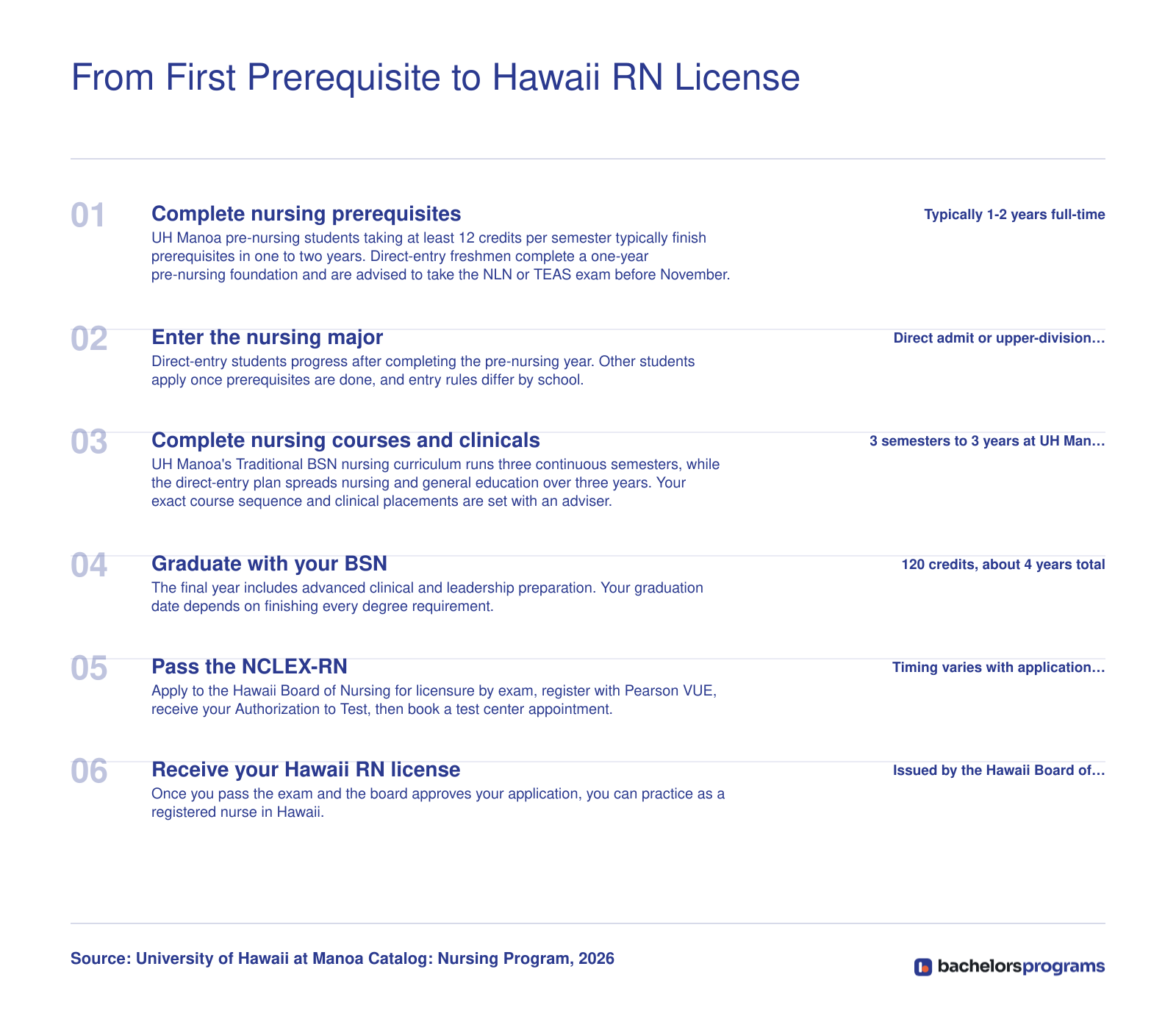
From First Prerequisite to Hawaii RN License
This timeline turns the duration answer above into six stages, using the University of Hawaii at Manoa's published sample plans as the reference point. Full-time study from first prerequisite to BSN takes about four years at UH Manoa. Licensure steps follow, and their timing depends on application processing rather than a fixed calendar.
Hawaii Board of Nursing Approval and NCLEX-RN Licensure
Approval and accreditation sound like the same credential, but they answer different questions. Treating one as a proxy for the other is the quickest way to misread a Hawaii BSN program.
Board Approval Is the Licensure Gate
The Hawaii Board of Nursing recognizes the pre-licensure RN programs at Hawaii Community College, Kapiolani Community College, Kauai Community College, Maui College, University of Hawaii at Hilo and University of Hawaii at Manoa, and it lists Hawaii Pacific University and Chaminade University of Honolulu as baccalaureate nursing programs. For BSN entry, that means Manoa, Hilo, HPU and Chaminade all lead to NCLEX-RN eligibility. Hawaii requires licensure applicants to graduate from a state-approved or nationally accredited program, and the approved pathways include baccalaureate, graduate-level pre-licensure, associate-degree and diploma programs.
CCNE and ACEN: Two National Seals
CCNE and ACEN are separate national nursing accreditors, and their seals are not interchangeable. Manoa's BSN is CCNE-accredited. HPU's BSN is CCNE-accredited, with a term running through June 30, 2027 and a site visit scheduled for fall 2026. Chaminade's BSN is CCNE-accredited, with a term through June 30, 2028 and a site visit in fall 2027. Hilo's public materials conflict: its catalog describes the BSN as ACEN-accredited, while a program page says CCNE. Treat that as a status to confirm, not a detail to assume.
Why Both Seals Matter
Board approval is what makes you eligible for the NCLEX-RN. Accreditation affects federal student aid, admission to graduate nursing programs and how employers read your degree; Magnet-recognized hospitals commonly expect a BSN from an accredited program. Before you enroll, check the Board's recognized-program list and the accreditor's directory, then ask the school to confirm the BSN's current status in writing.
Hawaii RN Licensure by Exam at a Glance
Quick Answers for Hawaii BSN Applicants
These answers cover the questions applicants ask most often. Policies change by cycle, so confirm details with each school's admissions office before you apply.
Can mainland students apply to BSN programs in Hawaii as nonresidents?
Which Hawaii BSN program is the best overall?
Can I take prerequisites at a UH community college and transfer into a BSN?
Compare Bachelor of Science in Nursing (BSN) programs on the data that matters
Explore more Nursing majors or browse every field of study.
All Nursing programs Browse every field of study