Best BSN Programs in Nebraska
Compare 16 accredited Bachelor of Science in Nursing (BSN) programs in Nebraska at 12 colleges, with net price after aid, graduation rates, earnings and debt from IPEDS and the U.S. College Scorecard.
A Nebraska hospital will hire an RN with a bachelor's or an associate degree, but nobody works before passing the NCLEX-RN. Among the pre-licensure programs ranked here, first-time pass rates run from 87.1% to 97.5%, a ten-point spread that outweighs a few thousand dollars of tuition difference.
Exam performance sets the order of the ranking. Admission models, net price after aid, and Board of Nursing licensure each get their own treatment further down; the list covers traditional pre-licensure routes only, since licensed RNs and second-degree students have faster paths of their own.
Nebraska's shortage of nurses is real, but hiring managers still screen on the license, and the license begins with the exam.
Key Points
- Nebraska Wesleyan University posts the top graduate earnings among traditional BSNs.
- Nebraska Methodist College's direct-entry BSN runs 8 semesters over 4 years.
- Nebraska RN licenses come from DHHS, after a Board-approved program.
Top NCLEX-RN Outcomes: The 10 Best BSN Schools in Nebraska
Nebraska's pre-licensure BSN programs are ordered here by first-time NCLEX-RN pass rates, the clearest signal of whether a program's graduates clear the exam that stands between them and an RN license. Each card below covers a different nursing school, from Jesuit and liberal arts campuses in Omaha and Lincoln to freestanding health professions colleges and a 3+1 dual degree partnership. Licensed RNs who want to add a bachelor's should compare RN-to-BSN programs, and second-degree students should compare accelerated BSN programs; both routes are covered on their own pages.
Creighton University
#1Omaha, NE · $30,000 – $35,000/yr (est.) · NCLEX-RN pass rate 88%
Best for: High school seniors seeking direct entry
Creighton University is a Jesuit university in Omaha whose nursing college is among the most established in the state. Its BSN is direct entry, so freshmen begin nursing coursework in year one instead of applying again to an upper division. The program builds in 1,000 clinical hours, a guaranteed preceptorship, and the option of a semester abroad without delaying graduation. The school's overall graduation rate is about 83 percent.
- CCNE accredited
- Direct entry for freshmen
- 128 total credit hours over four years
- 1,000 clinical hours across six specialty areas
- Guaranteed 224-hour preceptorship
- First-time NCLEX-RN pass rate of 88% in the ranking data
- No entrance exam required, test optional
- Does not admit transfer students
Nebraska Wesleyan University
#2Lincoln, NE · ~$18,000/yr (est.)
Best for: Students wanting a liberal arts foundation
Nebraska Wesleyan University is a private liberal arts university in Lincoln that folds nursing into its Archway general education curriculum. The traditional BSN sequences pathophysiology, pharmacology, and health assessment into medical-surgical, mental health, and women's and children's health rotations, with a capstone and a dedicated NCLEX-RN prep course at the end. Students must earn a C+ or better in every nursing course. The school's overall graduation rate is about 66 percent.
- CCNE accredited
- Traditional BSN plan of study
- C+ or better required in every nursing course
- Dedicated NCLEX-RN preparation course
- Capstone internship built into the degree
- Global health course required
- Archway liberal arts curriculum integrated
- Prerequisite courses required before the nursing sequence
Bryan College of Health Sciences
#3Lincoln, NE · $25,000 – $30,000/yr (est.)
Best for: Learners drawn to small clinical groups
Bryan College of Health Sciences is a freestanding health professions college in Lincoln, with a second site in Hastings and clinical sections kept deliberately small. The BSN centers on more than 1,000 clinical hours and a 1:7 faculty ratio in clinical groups, plus skills and simulation labs on campus. A 12-month accelerated track serves students who already hold a bachelor's degree. The school's overall graduation rate is around 70 percent.
- More than 1,000 clinical hours
- Clinical groups run at a 1:7 faculty ratio
- Skills labs and a simulation center on campus
- Spring and fall start terms
- Two campus locations, Lincoln and Hastings
- Program reports a 100% licensure pass rate
- Free tuition for two years through the Bryan Nursing Access Program
- 12-month full-time track
- Starts in fall
- 1,000 clinical hours
- Prerequisite courses required
- Clinical groups run at a 1:7 faculty ratio
- Complimentary transcript evaluation
College of Saint Mary
#4Omaha, NE · $17,000/yr (est. net price)
College of Saint Mary is a Catholic university in Omaha with a women-centered undergraduate model and a nursing program rooted in the Mercy tradition. Clinical placement begins in the first semester, supported by simulation labs that mirror patient scenarios. An LPN to BSN track gives licensed practical nurses credit for their experience. Every admitted full-time student receives a merit scholarship, and the school's overall graduation rate is about 61 percent.
- Early clinical immersion from the first semester
- 123 total credit hours over four years
- Rolling admissions with fall and spring starts
- 3.0 GPA minimum plus prerequisite courses
- Program reports a 97.5% first-time NCLEX pass rate
- Merit scholarship for every admitted full-time student
- Advanced simulation labs
- Program materials list ACEN accreditation
- Credit awarded for LPN experience
- 122 total credit hours
- Rolling admissions with fall and spring starts
- Select classes available online
- 3.0 GPA minimum plus prerequisite courses
- Program reports a 97.5% licensure pass rate
Nebraska Methodist College
#5Omaha, NE · ~$22,000/yr (est.)
Nebraska Methodist College is a health sciences college in Omaha with clinical ties to Methodist Hospital and Children's Hospital. Its BSN runs 127 credit hours with population-focused clinical work, a simulation center, and a senior preceptorship alongside practicing RNs. The college admits students with a 2.5 GPA and reports a 96% job placement rate within six months of graduation. A Spanish minor is available alongside the nursing major.
- CCNE accredited
- $623 per credit
- 127 total credit hours
- 2.5 GPA minimum
- Rolling admissions
- Program reports a 93.3% NCLEX pass rate for 2024
- Senior preceptorship at major Omaha hospitals
- No CNA prerequisite required
Union Adventist University
#6Lincoln, NE · $20,000 – $25,000/yr (est.)
Union Adventist University in Lincoln runs the oldest BSN program in Nebraska, dating to 1896, and keeps its cohorts small. The four-year plan mixes general education with nursing courses and roughly 900 clinical hours in Lincoln hospital systems. Two start dates a year give applicants some flexibility, and an LPN and RN to BSN completion option serves licensed nurses. The school's overall graduation rate is about 52 percent.
- CCNE accredited
- Oldest BSN program in Nebraska, founded 1896
- Cohort based with two start dates per year
- 900 clinical hours in major Lincoln hospitals
- Program reports a 97.06% licensure pass rate
- May 2024 graduates passed first try at a 100% rate, per the program
- LPN and RN to BSN completion option
- Holistic admission review
Clarkson College
#7Omaha, NE · $15,000 – $20,000/yr (est.)
Clarkson College is a health professions college in Omaha that delivers its BSN in a hybrid format with full-time and part-time options. Students take nursing coursework every semester across eight semesters and 120 credits, with on-campus skills and simulation labs and clinical placements that start early. Three start dates a year and rolling admissions make it one of the more flexible schedules in the state. The school's overall graduation rate is close to 47 percent.
- 120 total credit hours across eight semesters
- Hybrid format with full-time and part-time options
- Three start dates per year
- Rolling admissions
- 2.5 GPA minimum
- $691 per credit
- Program reports a 97% licensure pass rate
- No prerequisites required
Midland University
#8Fremont, NE · $25,000 – $30,000/yr (est.)
Midland University is a private university in Fremont whose traditional BSN spends the first year on prerequisites and the next three on nursing theory, clinical work, and simulation. Rotations run in Fremont and Omaha, and students practice in a hospital simulation lab at Methodist Fremont Health. A one-on-one senior practicum pairs each student with a registered nurse preceptor. The school's overall graduation rate is about 42 percent.
- One year of prerequisite coursework before nursing courses
- Clinical rotations in Fremont and Omaha
- Simulation lab inside Methodist Fremont Health
- One-on-one senior practicum with an RN preceptor
- Transfer credits accepted
- Dedicated academic advisers and peer tutoring
Concordia University-Nebraska
#9Seward, NE · ~$24,000/yr (est.)
Concordia University, Nebraska in Seward partners with Creighton University on a 3+1 dual degree for students who want a small Christian liberal arts campus before clinical training. Three years in Seward cover general education and nursing prerequisites, then the fourth year moves to Creighton's accelerated nursing program in Omaha. Graduates earn a biology bachelor's from Concordia and a BSN from Creighton. The program requires a 3.0 GPA and lists the Nebraska Nursing Scholarship for state residents.
- Dual degree: BSN from Creighton and biology BA from Concordia
- Three years in Seward, one year in Creighton's accelerated BSN
- 149 total credit hours
- 3.0 GPA minimum plus prerequisite courses
- CCNE accredited
- 14:1 student-to-faculty ratio
- Nebraska Nursing Scholarship available to residents
- Live on campus for the first three years
Bellevue University
#10Bellevue, NE · ~$18,000/yr (est.)
Bellevue University is a private university in Bellevue whose nursing degree is an online RN to BSN built for licensed registered nurses rather than first-time students. The 127-credit curriculum adds leadership, health policy, and evidence-based practice coursework, and closes with a practicum arranged in the student's own community. Nurses who already hold an associate degree or diploma can finish the bachelor's without relocating.
- Fully online for licensed registered nurses
- 127 total credit hours
- Practicum in the student's local area with a preceptor
- Evidence-based practice project in the final term
- Leadership, health policy, and management focus
- Transfer credits accepted
Cost & outcomes by school
Federal data for the highest-earning Bachelor of Science in Nursing (BSN) programs, independent of the ranking above. Earnings are this field's bachelor's graduates four years after completing where the Scorecard reports them, else the school's undergraduate median.
| School | Net price / yr | Grad rate | Earnings | Debt | Grads/yr | Format |
|---|---|---|---|---|---|---|
| University of Nebraska Medical Center NE | — | — | $76,833 | $15,000 | 946 | Campus |
| Creighton University NE | $31,568 | 83% | $73,911 | $25,000 | 2,742 | Campus |
| Bryan College of Health Sciences NE | $26,919 | 70% | $70,845 | $24,985 | 240 | Campus |
| Nebraska Methodist College NE | $21,863 | 60% | $65,071 | $23,417 | 450 | Campus |
| Clarkson College NE | $19,241 | 47% | $64,876 | $23,716 | 354 | Hybrid |
| Bellevue University NE | $17,550 | 33% | $61,289 | $20,000 | 4,536 | Online |
| Nebraska Wesleyan University NE | $18,327 | 66% | $56,405 | $26,970 | 698 | Campus |
| Union Adventist University NE | $23,716 | 52% | $55,045 | $27,000 | 212 | Campus |
| College of Saint Mary NE | $16,590 | 61% | $54,338 | $24,250 | 208 | Campus |
| Doane University NE | $26,364 | 57% | $53,316 | $25,000 | 472 | Online |
| Concordia University-Nebraska NE | $23,965 | 65% | $52,415 | $25,750 | 484 | Hybrid |
| Midland University NE | $26,267 | 42% | $52,163 | $26,134 | 568 | Campus |
Sources: U.S. Department of Education. Net price, graduation rate, earnings and debt: College Scorecard (earnings and debt for this field's bachelor's graduates where reported, else school-wide); graduates: IPEDS. A dash means no figure is reported.
Cost, debt & payoff
Median earnings of this field's bachelor's graduates (4 yrs after completing, else the school's undergraduate median) vs. their median federal loan debt · U.S. College Scorecard
Across these programs the median graduate earns about $63,083 and finishes with roughly $24,618 in debt — a ratio that clears a common rule of thumb (keep debt below first-year salary). Net price and debt vary widely school to school, so check the per-school figures in the table above before you shortlist.
Inside Our Scoring: Exam Results First, Accreditation and Completion as Tie-Breakers
Why the Exam Carries the Most Weight
A BSN's first job is getting its graduate licensed, so exam results dominate the score behind this list. NCLEX-RN first-time pass rates supply roughly three quarters of each school's score.
The rate is weighted by the number of test takers and covers three years of results. Weighting by the number of candidates keeps a very small cohort from swinging the score, and the multi-year window absorbs one rough graduating class. A program posting strong numbers year after year, across many test takers, scores higher than one with a single good year and a thin cohort behind it.
The Tie-Breakers
Programmatic accreditation (CCNE or ACEN) earns meaningful credit, since it signals a curriculum built to national nursing standards and keeps graduate study open. A modest amount goes to completion and retention, though those graduation rates are institution-wide, not nursing-specific, so they describe the wider campus rather than the BSN cohort alone.
What the Score Leaves Out
Sticker price earns no points. Neither does a famous name. Those angles appear in the cost and earnings tables on this page, where tuition, net price after aid, and graduate earnings sit side by side. The score answers one narrower question: how reliably do this program's graduates pass the exam that lets them practice?
Cheapest BSN Schools in Nebraska by Net Price After Aid
The schools below are sorted by average net price after aid, which is what students paid after grants and scholarships, according to IPEDS and College Scorecard (2024) data from the U.S. Department of Education. Your own cost will vary with household income. Every school in this table is a private nonprofit that also appears in the NCLEX-RN ranking above, and Nebraska Wesleyan University shows why sticker price misleads: it has the highest listed tuition here but the second-lowest net price. Bellevue University's lower-cost online RN to BSN serves already licensed RNs, so it is not compared here with pre-licensure BSN programs.
| School | City | Sector | In-State Tuition and Fees | Average Net Price After Aid (varies by income) | Median Federal Debt at Completion (BSN program) |
|---|---|---|---|---|---|
| College of Saint Mary | Omaha | Private nonprofit | $24,510 | $16,590 | $32,312 |
| Nebraska Wesleyan University | Lincoln | Private nonprofit | $43,572 | $18,327 | $20,875 |
| Clarkson College | Omaha | Private nonprofit | $16,104 | $19,241 | $27,125 |
| Nebraska Methodist College | Omaha | Private nonprofit | $17,885 | $21,863 | $25,000 |
Related Articles
BSN Admissions in Nebraska: Prerequisites, GPA, and Direct Admit vs. Upper-Division Entry
Nebraska's BSN programs sort into two admissions models, and the difference shapes your first two years. In a direct-admit program, freshmen enter the nursing major right away. In an upper-division program, students finish prerequisites first, then apply competitively to the nursing sequence. The schools ranked here do not all label themselves clearly, so read each program page before you apply.
Direct Admit and Upper-Division Entry
Creighton University describes direct entry for freshmen, with no entrance exam required and a test-optional policy. That means a high school senior can be admitted to the nursing major without a second application later. Nebraska Wesleyan University is the clearest upper-division example on this list: students complete 17 to 21 credits of prerequisites, earn at least a C in each, and then apply for competitive review.
Several other BSN schools here publish prerequisite courses but do not plainly label their entry model. College of Saint Mary lists prerequisite courses and a 3.0 GPA minimum, with rolling admissions and fall and spring starts. Nebraska Methodist College lists a 2.5 GPA minimum and prerequisite courses, and notes no CNA prerequisite. Bryan College of Health Sciences publishes spring and fall start terms but no minimum GPA or entrance exam policy in the material reviewed. Union Adventist University did not establish a published GPA or test policy in the material reviewed. If a page does not state the model, treat it as unconfirmed rather than assuming direct admit.
Prerequisites, GPA, and Tests
Prerequisite coursework at Nebraska BSN schools commonly includes anatomy and physiology, microbiology, chemistry, and statistics. Nebraska Wesleyan publishes the most specific list: BIO 1080 and lab, BIO 1090 and lab, BIO 1100 and lab, CHEM 1110 or CHEM 1000, and HHP 1910. Its minimum cumulative GPA is 3.0, and its 2026-2027 materials mention an entrance exam but name neither TEAS nor HESI and say nothing about an ACT or SAT policy. Creighton states no entrance exam is required. Where a school publishes no test policy, do not assume one exists.
Deadlines and the Competitive Gap
Nebraska Wesleyan accepts applications from November 1 to February 1 for an August start. Nebraska Methodist lists a July 10, 2026 application date and rolling admissions. College of Saint Mary uses rolling admissions. Admitted Nebraska Wesleyan students also need CPR certification, a CNA course, a background check, a drug screen, and immunization records. A published minimum GPA is only a floor: Nebraska Wesleyan reviews prerequisite GPA, overall GPA, and admission-question responses, so a 3.0 does not guarantee a seat. Plan for the competitive number, not the minimum.
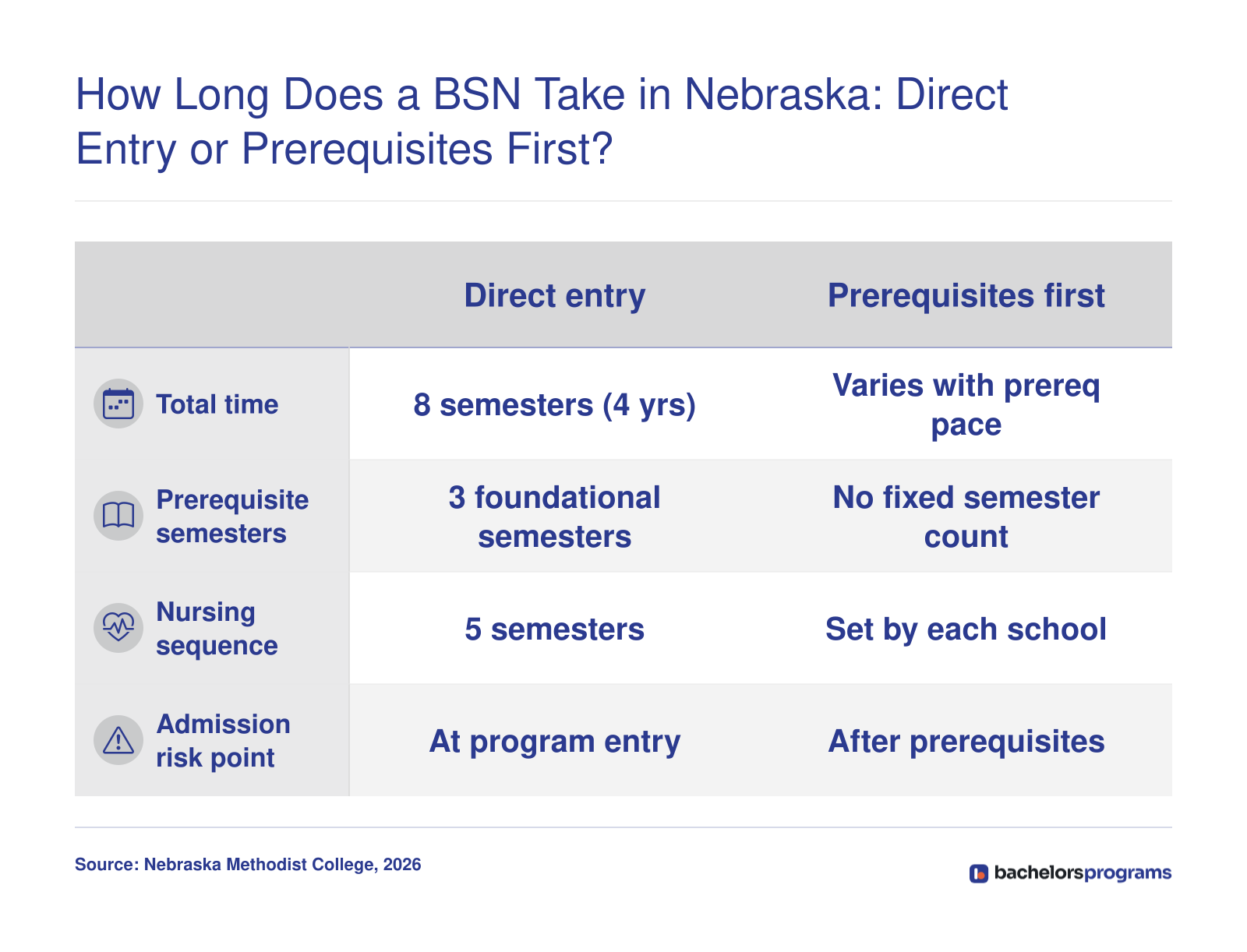
How Long Does a BSN Take in Nebraska: Direct Entry or Prerequisites First?
Nebraska Methodist College publishes a direct-entry BSN that runs 8 semesters over 4 years: 3 semesters of foundational courses, then 5 semesters of nursing and clinical coursework. On a prerequisites-first track, you complete science and general education courses, apply to nursing, and only then start the nursing sequence; school pages often list the length of that sequence but give no fixed semester count for the prerequisites, so total time depends on how fast you finish them. If you take prerequisites in summer terms or bring in transfer credit, you can shorten that first phase and reach the nursing sequence sooner.
BSN Cost in Nebraska: Tuition, Net Price, and State Grants
The sticker price on a Nebraska BSN is not the number most families end up paying. Published tuition tells you what a college asks before aid; net price tells you what students actually pay after grants and scholarships. Compare both, then layer in state grants and loan repayment.
Sticker Price vs. Net Price
The public colleges in the ranking publish in-state tuition and fees of roughly $3,360 to $3,840 a year. The private BSN colleges here post sticker prices from about $17,885 to $48,856. That gap looks enormous, and it is, but aid closes part of it. After grants and scholarships, the private BSN colleges show average net prices from about $16,590 to $31,568. The public colleges' net prices run roughly $5,235 to $9,171. Use those net figures as your working budget, not the sticker number. Net price is an average, not a promise; your package depends on the FAFSA and each college's aid formula.
Pell Share and Need-Based Aid
Pell share shows which campuses enroll the most lower-income students. Among the private BSN colleges here, College of Saint Mary (49.0%) and Bryan College of Health Sciences (46.9%) enroll the largest shares of Pell-eligible students; Creighton University sits lowest at 28.9%, with Nebraska Methodist College at 42.2% and Nebraska Wesleyan University at 46.6%. A high Pell share often signals that a campus directs substantial need-based aid to students who qualify. It is not a quality score. It is a clue about how much institutional aid may be in play.
State Grants and Loan Repayment
- Nebraska Opportunity Grant: For Nebraska residents without a prior bachelor's or graduate degree who show high financial need, with a FAFSA filed every year.1 Award amounts are set annually, so compare the grant line on each aid letter rather than assuming a fixed figure.
- Nebraska Career Scholarship: Up to $10,000 a year at participating private colleges and up to $15,000 a year at community colleges for high-wage, high-skill, high-demand programs.1 Those are annual maximums, not guaranteed awards; confirm whether a specific BSN program qualifies for 2026.
- Loan repayment: The Nebraska State Loan Repayment Program lists BSN-prepared RNs among eligible professions and pays $30,000 a year for three years, $90,000 total, with a 50% employer match. The NHSC Nebraska program pays $25,000 a year for two to four years, $50,000 to $100,000. Both depend on an approved shortage-area site.
Costs Beyond Tuition
Budget for clinical fees, uniforms, background checks, CPR certification, the NCLEX-RN exam fee, and Nebraska licensure fees. Each school publishes its own fee schedule, and lab and clinical charges vary widely. Ask for the total cost of attendance, not just tuition, before you commit.
The Top Earnings Figure Among Nebraska BSN Schools
Among the traditional pre-licensure BSN programs in this earnings data, Nebraska Wesleyan University posts the highest graduate earnings.
Nebraska Board of Nursing Approval and NCLEX-RN Licensure
Every Nebraska RN license is issued by the DHHS Licensure Unit, and the path to it runs through a program the Nebraska Board of Nursing has approved. Approval is the state's finding that a pre-licensure program meets its educational standards. Graduating from an approved program is what makes you eligible to take the NCLEX-RN. Before you apply anywhere, check the school against the Board's current list of approved baccalaureate programs and note the date posted on it, since programs can be added, placed on conditions, or removed.
Approval vs. Accreditation
Board approval is a state permission. National accreditation from the Commission on Collegiate Nursing Education (CCNE) or the Accreditation Commission for Education in Nursing (ACEN) is a separate, voluntary quality review. Accreditation is not what lets you test for licensure, but it carries weight later. Many graduate nursing programs expect a degree from an accredited school, and some employers and tuition-benefit programs ask for it. Confirm both statuses for any school you are considering.
Steps to Licensure by Examination
- Apply: Submit the Nebraska nursing license application to the DHHS Licensure Unit, with all required documentation, including your final transcript.
- Background check: Fingerprints can be taken in any state. They go to the Nebraska State Patrol with a processing fee, and you need a valid photo ID when they are taken.
- Register for the exam: Register with Pearson VUE. You can do this at any point during the application.
- Authorization to Test: Once Nebraska confirms you meet every requirement and your VUE registration is complete, Pearson VUE emails your Authorization to Test (ATT).
- Test and license: Take the NCLEX-RN; the license is issued once you pass and the remaining requirements are met.
If you need a retake, expect to submit a new license application with the current fee and register with Pearson VUE again. Fee amounts change, so use the DHHS fee schedule rather than a figure from a third-party page.
Multistate Practice
Nebraska has adopted the Nurse Licensure Compact, and its RN licenses can be multistate or single-state. A multistate license lets you practice in other compact states while Nebraska is your state of residence. If you move to another compact state, you apply for a license there within 60 days.1 The Legislature passed LB867 in 2026, which touches on compact-related statute language, so confirm Nebraska's current compact status with DHHS before you plan around a multistate license.
For how each school's graduates have fared on the exam, use the NCLEX-RN figures in the ranking above.
Nebraska RN Licensure by Exam at a Glance
Nebraska BSN Questions Answered: Length, Price, Online Options, and Campus Choices
Nebraska BSN decisions come down to a handful of practical questions, and the figures behind the ranking answer them more reliably than recruitment brochures do.
Which Nebraska programs lead on NCLEX-RN results, and which tops the list?
Creighton University leads with an 88% first-time NCLEX-RN pass rate across 108 candidates, the highest figure on this page. The Omaha campus adds 1,000 supervised clinical hours, a simulation center, and freshman direct entry. Exam outcomes carry the most weight in the ranking, and each school's reported rate appears on its ranking card above.
What should I expect to pay for a BSN in Nebraska after aid?
Budget roughly $16,590 to $31,568 a year in net price after financial aid. College of Saint Mary lands lowest, followed by Bellevue University at $17,550, Nebraska Wesleyan at $18,327, and Clarkson College at $19,241. Creighton's $31,568 is the high end. Sticker tuition misleads here, because aid packages close much of the private-college gap.
How many years does a BSN take on each entry route?
Four years either way, but the clock starts differently. Direct-admit students begin nursing coursework in year one: Creighton's 128-credit plan and College of Saint Mary's 123-credit plan both run eight semesters. Prerequisite-first programs spend the first year on sciences and general education before the nursing sequence, so a late change of major can add a term.
Do Nebraska nursing schools admit freshmen straight into the BSN?
Several do. Creighton lists direct entry for freshmen, College of Saint Mary starts clinical immersion in the first semester, and Clarkson College requires no prerequisites before admission. Others use upper-division entry: Midland University asks for a year of prerequisite coursework first, Nebraska Wesleyan requires prerequisite courses, and Concordia University-Nebraska runs a 3+1 dual degree.
Is a fully online pre-licensure BSN available in Nebraska?
No. Pre-licensure students complete supervised clinical hours in person, and programs here log 900 to 1,000 of them. Hybrid delivery is the realistic flexible option: Clarkson College and Concordia University-Nebraska combine online coursework with on-campus labs and clinical placements. Fully online BSN study is the RN-to-BSN route, built for licensed nurses rather than first-time students.
How do Omaha, Lincoln, and regional campuses compare?
Omaha offers the widest spread of prices: College of Saint Mary at $16,590 net, Clarkson at $19,241, Nebraska Methodist at $21,863 with clinicals across major Omaha hospitals, and Creighton at $31,568. Lincoln runs Nebraska Wesleyan ($18,327), Union Adventist ($23,716), and Bryan ($26,919), which logs 1,000 clinical hours. Fremont, Seward, and Bellevue add options at $26,267, $23,965, and $17,550.
Compare Bachelor of Science in Nursing (BSN) programs on the data that matters
Explore more Nursing majors or browse every field of study.
All Nursing programs Browse every field of study