Best BSN Programs in New Hampshire
Compare 11 accredited Bachelor of Science in Nursing (BSN) programs in New Hampshire at 10 colleges, with net price after aid, graduation rates, earnings and debt from IPEDS and the U.S. College Scorecard.

NCLEX-RN pass rates among the schools ranked here run from 85.2 percent to 100 percent, a spread of nearly 15 points that matters when the license is the whole point of a traditional pre-licensure BSN in New Hampshire.
The order follows state board pass rates as reported, with accreditation and completion as tie-breakers. Cost, graduate earnings, admissions by school, and Board of Nursing licensure come next. RN-to-BSN and accelerated routes are covered near the end, not ranked.
In a state this small, the decision can come down to a few points of pass rate, a few thousand dollars of net price, and each school's entry rules.
Key Points
- Schools here are ordered by first-time NCLEX-RN pass rate, not reputation.
- Confirm both New Hampshire Board of Nursing approval and national accreditation.
- New Hampshire RN applicants by exam must submit FBI fingerprint cards.
Top NCLEX-RN Pass Rates: 10 New Hampshire BSN Programs Ranked
First-time NCLEX-RN results are the closest thing New Hampshire has to a public scorecard for its BSN programs, and they say more about how a school prepares students than any brochure does. The ten schools below are the state's traditional pre-licensure programs, public and private, from Plymouth to Durham to Nashua. Pass rates are quoted exactly as the state board data reports them, with no rounding up.
Plymouth State University
#1Plymouth, NH · $15,000 – $20,000/yr (est.) · NCLEX-RN pass rate 100%
Best for: In-state students on a public-campus budget
Plymouth State University is a public campus in Plymouth, and its nursing department reports a 100% NCLEX-RN first-time pass rate for the cohort it tracks, the highest figure in this ranking. The four-year BSN runs 120 credits and moves pre-nursing students automatically into the major as sophomores, with a B- required in every prerequisite. The school's graduation rate is 52%, and in-state tuition of $14,626 is the lowest among the public universities listed here.
- CCNE accredited and fully approved by the New Hampshire Board of Nursing
- 120 credits over four years at 15 credits a semester
- Pre-nursing pathway with automatic sophomore entry into the major
- B- required in every prerequisite; 2.67 GPA in the major and overall
- $550 per semester program fee covers ATI NCLEX review and clinical tools
- On-campus simulation center with dedicated lab space
- Prepares students for NCLEX-RN licensure in New Hampshire
- For licensed RNs holding an associate degree
- Up to 57 transfer credits accepted; 60 to 90 credits considered for RNs
- Cohort-based structure with a clinical leadership course
- Zoom attendance option for the RN to BSN track
Saint Anselm College
#2Manchester, NH · ~$35,000/yr (est.) · NCLEX-RN pass rate 96.6%
Best for: Private-college seekers wanting small clinical groups
Saint Anselm College in Manchester is a private residential college that pairs a 96.6% NCLEX-RN first-time pass rate with an 80% graduation rate, the strongest completion figure on this list. Clinical rotations begin in the spring of sophomore year, and students work at a 7:1 student-to-instructor ratio before finishing a 195-hour preceptorship. The institution-wide average net price after aid is about $34,800, well above the public options here.
- CCNE accredited; clinicals start spring of sophomore year
- 7:1 student-to-instructor ratio in clinical sections
- 195-hour preceptorship with one-on-one mentoring in New England hospitals
- Simulation labs with advanced patient simulators
- Spanish minor designed for nursing majors
- Global seminar that includes a clinical rotation in Costa Rica
- Recent employers include Massachusetts General and Beth Israel Deaconess
- Graduates have gone on to Boston College and Yale for advanced degrees
University of New Hampshire
#3Durham, NH · $24,000/yr (est. net price) · NCLEX-RN pass rate 91%
Best for: Students needing a part-time BSN option
The University of New Hampshire in Durham runs the state's flagship public BSN, a 128-credit program with both full-time and part-time enrollment and a 91% NCLEX-RN first-time pass rate. A senior capstone, a high-fidelity simulation lab, and clinical placements across acute care, community and mental health settings anchor the degree. The university's graduation rate is 76%, and in-state tuition is $19,202.
- CCNE accredited; 128 total credit hours
- Full-time and part-time enrollment available
- 2.5 GPA minimum plus a required senior capstone
- High-fidelity simulation and diverse clinical placements
- Honors-in-Major option, undergraduate research and study abroad
- Prepares graduates for NCLEX-RN licensure
- Active nursing student organizations on campus
Colby-Sawyer College
#4New London, NH · ~$27,000/yr (est.) · NCLEX-RN pass rate 88.6%
Colby-Sawyer College in New London is a small private school whose BSN leans on clinical placements at Dartmouth Hitchcock Medical Center and a simulation center with 12 monitoring beds. Its 88.6% NCLEX-RN first-time pass rate comes alongside a 57% graduation rate, and a senior-year preceptorship pairs each student with a practicing nurse. The institution-wide average net price after aid is about $27,400.
- CCNE accredited and approved by the New Hampshire Board of Nursing
- Clinical rotations at Dartmouth Hitchcock Medical Center
- Simulation center with 12 monitoring beds
- Senior-year preceptorship with a nurse-preceptor
- Test optional with no entrance exam; rolling admissions
- 2.7 GPA minimum plus prerequisite coursework
- NCLEX preparation begins in the first nursing course
- Small classes with expert faculty; program recognized 30+ years
Rivier University
#5Nashua, NH · ~$28,000/yr (est.) · NCLEX-RN pass rate 83.8%
Rivier University in Nashua describes itself as preparing the largest number of nurses in New Hampshire, and its BSN graduates posted an 83.8% NCLEX-RN first-time pass rate in the data used here. The program is ACEN accredited, admits on a rolling basis with test scores optional, and places students at Boston Children's, Massachusetts General and Elliot Health System. The school's graduation rate is 52%, and the institution-wide average net price after aid is about $28,100.
- ACEN-accredited on-campus BSN in Nashua
- Rolling admissions; standardized test scores optional for nursing
- Nursing Simulation and Clinical Education Center after a $5 million renovation
- Clinical sites include Mass General, Boston Children's and Elliot Health
- More than $19 million in institutional aid awarded annually
- Coursework prepares students for NCLEX-RN licensure
- Career paths in med-surg, pediatric, oncology and school nursing
Keene State College
#6Keene, NH · $18,000/yr (est. net price) · NCLEX-RN pass rate 73.7%
Keene State College is a public campus in Keene where nursing classes are capped at 32 students and the professors who run clinicals also teach the classroom courses. The BSN passed 73.7% of first-time NCLEX-RN takers in the data used here, the lowest figure among the ranked pre-licensure programs, and it asks for a 3.3 GPA plus prerequisites. The school's graduation rate is 60%, and in-state tuition of $14,784 keeps it among the cheaper public entries.
- CCNE accredited BSN with a high-fidelity simulation lab
- Classes capped at 32 students
- 3.3 GPA minimum plus prerequisite courses
- Faculty who teach clinicals also teach classroom sections
- Peer tutoring and a close-knit cohort model
- $1,000 scholarship offered for a campus visit
- Graduates work in ICU, emergency and labor and delivery
University of New Hampshire College of Professional Studies Online
#7Manchester, NH · ~$11,000/yr (est.)
UNH College of Professional Studies in Manchester is an alternate route rather than a pre-licensure program: it runs an online RN to BSN for graduates of the Community College System of New Hampshire who already hold a nursing license. New Hampshire CCSNH graduates can receive scholarships that bring per-credit tuition down to the community college rate, and rolling admission lets students start in any term. Because it enrolls practicing nurses rather than first-time exam candidates, it sits outside the pass-rate comparison above, and the school's graduation rate is 30%.
- Online RN to BSN built for CCSNH associate degree graduates
- CCNE accredited; rolling admissions with starts in any term
- Active RN license and NCLEX-RN completion required for full admission
- Conditional admission possible before passing the licensing exam
- CCSNH graduates in New Hampshire can reduce tuition to the CCSNH rate
- Applicants with a prior bachelor's degree take only 30 nursing credits
- 2.0 or better required in each course; RN license maintained to progress
New England College
#8Henniker, NH · $27,000/yr (est. net price)
New England College in Henniker runs an accelerated three-year BSN on a 12-month academic calendar, with three paid immersive clinical experiences worth 36 credits at partner hospitals. Placement sites include Catholic Medical Center, Cheshire Medical Center, Concord Hospital, Elliot Hospital and Portsmouth Regional Hospital. Students must hold or obtain a New Hampshire LNA license before the first clinical, and the college's graduation rate is 35%.
- CCNE accredited and approved by the New Hampshire Board of Nursing
- Three-year, cohort-based BSN on a 12-month calendar
- 124 total credits across three trimesters per year
- Paid immersive clinicals: 36 credits in three cooperative experiences
- Hospital partners include Catholic Medical Center and Concord Hospital
- New Hampshire LNA license required before the first clinical placement
- Test optional with holistic review and two letters of recommendation
Southern New Hampshire University
#9Manchester, NH · $37,000/yr (est. net price)
Southern New Hampshire University in Manchester offers its BSN as an online RN to BSN for licensed nurses, granting 45 credits for an unencumbered RN license and accepting up to 90 transfer credits overall. Eight-week terms and a $354 per-credit rate let working nurses finish in about a year, and an accelerated RN to MSN pathway is available. It enrolls practicing RNs rather than first-time candidates, so it is listed here as an alternate route; the university's graduation rate is 43%.
- Online RN to BSN; 120 credits with up to 90 transfer credits
- 45 credits awarded for an unencumbered RN license
- 8-week terms; finish in as little as one year
- $354 per credit, no application fee and no essay
- 2.5 GPA minimum plus an active unencumbered RN license
- CCNE accredited with an accelerated RN to MSN pathway
- No entrance exam required; test scores optional
Franklin Pierce University
#10Rindge, NH · ~$27,000/yr (est.)
Franklin Pierce University in Rindge delivers its BSN as a fully online RN to BSN for working nurses, with full-time and part-time study across six academic terms and credit granted for prior certifications and on-the-job training. The nursing programs are ACEN accredited, and the degree closes with a capstone leadership project. The university's graduation rate is 54%, and this pathway serves licensed nurses rather than first-time exam candidates.
- 100% online RN to BSN for nurses with an active license
- Full-time or part-time across six academic terms
- Credit granted for prior certifications, licenses and workplace training
- Capstone leadership project required to finish
- ACEN-accredited nursing programs
- Coursework in evidence-based practice, community health and health policy
Cost & outcomes by school
Federal data for the highest-earning Bachelor of Science in Nursing (BSN) programs, independent of the ranking above. Earnings are this field's bachelor's graduates four years after completing where the Scorecard reports them, else the school's undergraduate median.
| School | Net price / yr | Grad rate | Earnings | Debt | Grads/yr | Format |
|---|---|---|---|---|---|---|
| Saint Anselm College NH | $34,779 | 80% | $73,371 | $27,000 | 1,060 | Campus |
| University of New Hampshire NH | $23,805 | 76% | $66,479 | $26,814 | 6,078 | Campus |
| University of New Hampshire College of Professional Studies Online NH | $10,864 | 30% | $66,479 | $26,814 | 490 | Online |
| Plymouth State University NH | $19,216 | 52% | $57,304 | $26,000 | 1,422 | Campus |
| Keene State College NH | $17,887 | 60% | $54,368 | $25,749 | 1,538 | Campus |
| Franklin Pierce University NH | $27,154 | 54% | $53,353 | $27,000 | 506 | Online |
| Rivier University NH | $28,082 | 52% | $52,248 | $26,956 | 578 | Campus |
| Southern New Hampshire University NH | $36,708 | 43% | $50,318 | $21,082 | 55,836 | Online |
| Colby-Sawyer College NH | $27,431 | 58% | $46,474 | $27,000 | 380 | Campus |
| New England College NH | $26,972 | 35% | $42,092 | $26,000 | 404 | Hybrid |
Sources: U.S. Department of Education. Net price, graduation rate, earnings and debt: College Scorecard (earnings and debt for this field's bachelor's graduates where reported, else school-wide); graduates: IPEDS. A dash means no figure is reported.
Cost, debt & payoff
Median earnings of this field's bachelor's graduates (4 yrs after completing, else the school's undergraduate median) vs. their median federal loan debt · U.S. College Scorecard
Across these programs the median graduate earns about $54,368 and finishes with roughly $26,814 in debt — a ratio that clears a common rule of thumb (keep debt below first-year salary). Net price and debt vary widely school to school, so check the per-school figures in the table above before you shortlist.
New Hampshire BSN Schools at a Glance
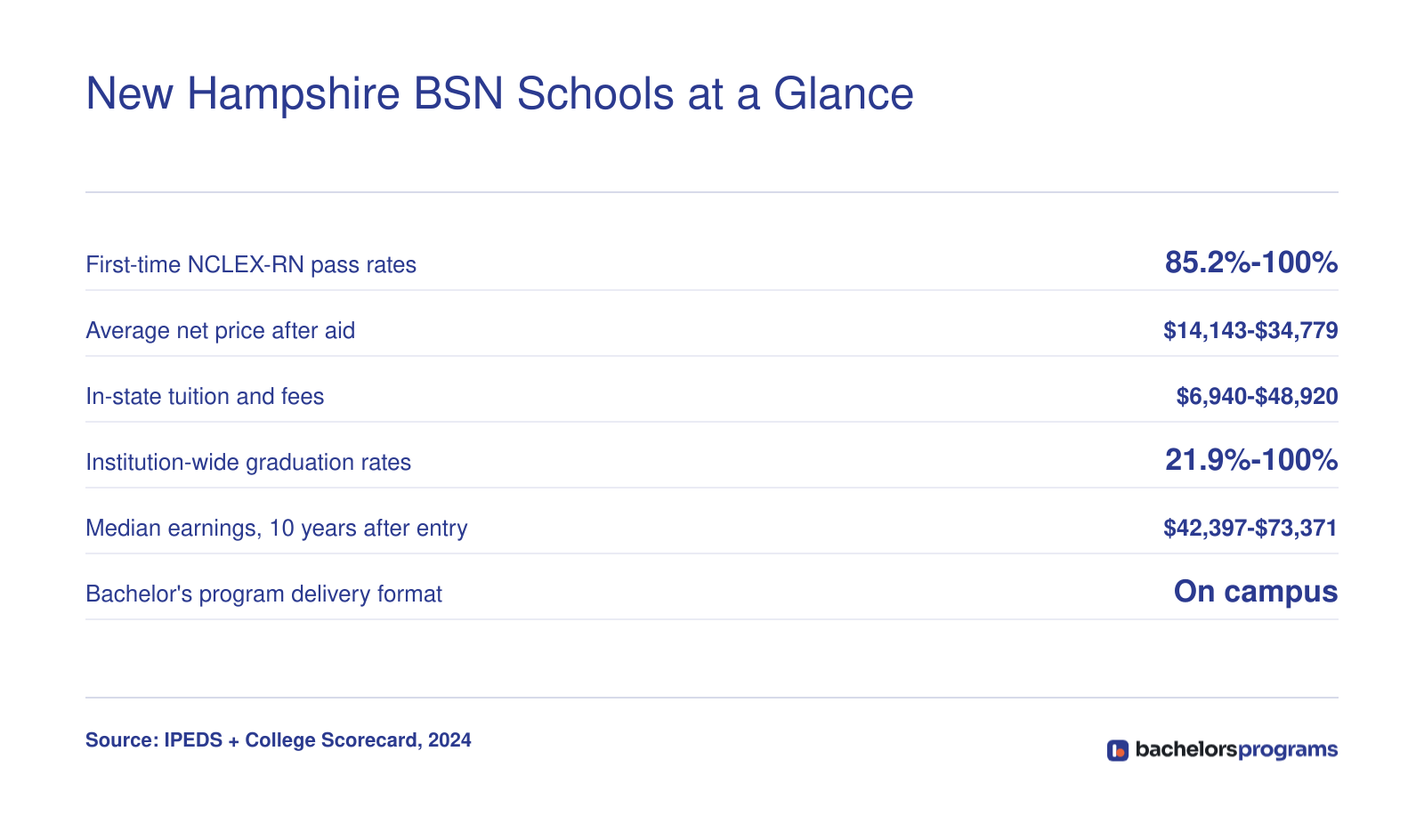
The schools ranked here mix public universities and community colleges with private colleges, and every bachelor's program on the list is taught on campus. Net price is the average annual cost after grants and scholarships, and graduation rates cover each institution as a whole, not just nursing students.
Why First-Time NCLEX-RN Results Decide the Order
What a First-Time Pass Rate Tells You
A nursing degree is only as useful as the license it leads to, and a school's reputation does not always match how well it prepares students for the exam. You cannot work as a registered nurse in New Hampshire until you pass the NCLEX-RN. The share of a school's graduates who pass on their first attempt is the clearest signal of how well its classroom and clinical training prepare people for practice. A first-try pass also means no retake fees, no months of extra study, and no delayed start to your first paycheck.
Read the Numbers in Context
One strong year from a small graduating class can make a program look better than it is. Look at results across several recent years, and note how many graduates sat for the exam. A steady rate built on a large cohort says more than a single standout figure. After pass rates, check programmatic accreditation and how many students actually finish the program. Net price and earnings on each card help you compare value, but they matter only if you reach licensure.
Verify It Yourself
Many "best nursing school" lists name a #1 pick without showing what put it there. You don't have to take any list on faith, including this one. The New Hampshire Board of Nursing publishes NCLEX-RN pass rates for each approved program. Compare its most recent reports against the figures on the ranking cards above before you apply.
Cheapest BSN Programs in New Hampshire After Financial Aid
This table ranks schools by average net price after aid, which is what students actually paid once grants and scholarships were applied, averaged across all family incomes. Published in-state tuition and fees is the sticker price before any aid, and both figures come from federal IPEDS and College Scorecard data. The gap between the two is widest at New England College, a private school whose $41,938 sticker price falls to an average net price of $26,972. At public schools such as Keene State College and Plymouth State University, net price runs higher than tuition and fees because it also counts housing, books, and living costs. Keene State also adds a nursing differential of $551 per semester across its four clinical semesters in 2026-27. Because these averages blend every income level, use each school's net price calculator to estimate your own cost.
| School | Location | Sector | Format | Average Net Price After Aid | Published In-State Tuition and Fees |
|---|---|---|---|---|---|
| University of New Hampshire College of Professional Studies Online | Manchester, NH | Public | Online | $10,864 | $7,724 |
| Keene State College | Keene, NH | Public | Campus | $17,887 | $14,784 |
| Plymouth State University | Plymouth, NH | Public | Campus | $19,216 | $14,626 |
| University of New Hampshire | Durham, NH | Public | Campus | $23,805 | $19,202 |
| New England College | Henniker, NH | Private nonprofit | Hybrid | $26,972 | $41,938 |
What a BSN Costs in New Hampshire: Tuition, Net Price, and State Aid
The sticker price of a New Hampshire BSN is rarely what a student actually pays, and the gap between public and private options is narrower than the headlines suggest.
Public and Private BSN Prices
The public four-year BSN options here publish in-state tuition of $14,626 at Plymouth State University and $19,202 at the University of New Hampshire. Average net price after aid comes to $19,216 at Plymouth State and $23,805 at UNH. Private colleges list higher tuition: Saint Anselm College at $48,920, with an average net price of $34,779, and Colby-Sawyer College at $19,125, with an average net price of $27,431. Aid narrows the gap at some private colleges, but it does not erase it, so compare net figures rather than stickers.
State Aid and Loan Repayment
New Hampshire budget materials describe a scholarship trust fund for state residents at eligible in-state institutions, backed by $15 million in state support in each of fiscal 2026 and 2027 and tied to the University System of New Hampshire. It is not nursing-specific, so confirm that your school and circumstances qualify.
The New Hampshire State Loan Repayment Program, run by the Department of Health and Human Services' Bureau of Rural Health and Primary Care, offers Tier 3 awards of $30,000 to primary-care RNs who commit to 36 months of full-time service at an eligible outpatient site in a medically underserved area, plus $10,000 for a 24-month extension. Applicants must be U.S. citizens and cannot have another unserved loan-repayment obligation. Budget language for the biennium ending June 30, 2027 directs the department not to enroll new participants, so treat the program as a future possibility rather than guaranteed funding.
Costs the Net Price May Not Show
Clinical and lab fees, uniforms, the NCLEX-RN registration fee, and the New Hampshire licensure application fee sit outside the published net price. Budget for them separately.
Compare the Full Cost
A lower annual net price is not automatically the cheaper degree. Multiply each school's net price by the number of years you realistically need to finish, then add the extra costs. A program that takes an additional semester can wipe out the savings from a lower sticker price.
Related Articles
Questions to Ask Yourself
Would you rather enter nursing as a freshman, or compete for an upper-division seat after finishing prerequisites?
Is a slightly lower NCLEX-RN pass rate at a cheaper public school worth the savings over a top-ranked private program?
Can you reach clinical sites near Manchester, Concord, the Seacoast or the Upper Valley without a long commute?
Do you plan to stay and work in New Hampshire after you earn your RN license?
New Hampshire Board of Nursing Approval, Accreditation, and the NCLEX-RN
Applicants often blur two separate checks on a nursing program: state approval and national accreditation. They answer different questions, and you need to verify both.
What Board Approval Means
The New Hampshire Board of Nursing, housed within the Office of Professional Licensure and Certification (OPLC), approves pre-licensure RN programs. Only graduates of an approved program can sit for the NCLEX-RN and apply for a New Hampshire RN license by exam. If a program loses approval, its graduates lose that route.
OPLC publishes an entry-level programs page for RN candidates and a separate program review schedule. That schedule lists Colby-Sawyer College's Traditional BSN at New London with Full Approval, and the University of New Hampshire's BSN at Durham with Initial Full Approval dating to 2003.1 Treat the entry-level programs page as the controlling list, and confirm any school there before you apply.
Approval vs. Accreditation
Accreditation comes from a national body, either the Commission on Collegiate Nursing Education (CCNE) or the Accreditation Commission for Education in Nursing (ACEN). It is voluntary, and it is not the same as state approval. A program can be Board-approved without holding either credential.
It matters because many graduate nursing programs expect an accredited degree, and some employers prefer one. Look up each school you consider in the CCNE and ACEN directories rather than assuming.2 The records available to us do not show that every New Hampshire BSN program holds either credential.
Reading Pass Rates Carefully
Pass rates on this page range from 73.7% to 100%. When comparing them:
- First-time vs. repeat takers: First-time results show how well a program prepares students on the first attempt. Repeat takers can lift or lower a combined figure.
- Cohort size: A small graduating class swings sharply. One or two candidates can move the percentage by several points, so look at more than one year.
- Board standard: Do not read a school's pass rate as the Board's approval threshold. That standard is a separate measure, and OPLC is where to confirm it.
Compact Licensure
New Hampshire has adopted the Nurse Licensure Compact under RSA 326-B:46. A multistate license generally lets a nurse practice in other compact states without applying for separate licenses, though eligibility conditions apply and the list of participating states changes. Confirm current details before relying on it for a move or a travel assignment.
Applying for Your New Hampshire RN License by Exam
Already an RN or Hold Another Degree? Other Paths to a BSN
A traditional BSN is a four-year pre-licensure degree built for students who do not yet hold a nursing license. Clinical hours, general education, and the nursing major run together, and you sit for the NCLEX-RN at the end. That is the route the schools ranked above are built around. Two other kinds of students often land on this page by mistake, and each has a faster option.
If You Already Hold an RN License
Licensed RNs with an associate degree do not need to repeat a pre-licensure program. RN-to-BSN programs accept your existing license and clinical background, then build the upper-division coursework on top of it, usually part time and often online. Our guide to RN-to-BSN programs covers that route.
If You Hold a Bachelor's in Another Field
Career changers with a bachelor's degree already have the general education requirements finished. Accelerated BSN programs compress the nursing sequence into an intensive 12 to 18 months. Our accelerated BSN page lays out what those programs expect.
Your Next Step as a Traditional Applicant
Pick two or three schools from the ranking, confirm whether they admit students as freshmen (direct admit) or at the upper division after prerequisites, and run each school's net price calculator. The calculator result, not the sticker tuition, is the number worth comparing.
New Hampshire BSN Programs: Your Top Questions Answered
These answers cover the questions prospective nursing students ask most often about traditional, pre-licensure BSN programs in New Hampshire. Where a topic has its own section, the answer points you there for the full detail.
Which New Hampshire BSN program has the highest NCLEX-RN pass rate?
What will a four-year BSN cost me in New Hampshire after financial aid?
What GPA and prerequisites do New Hampshire BSN programs expect?
How can I confirm a BSN program is approved by the New Hampshire Board of Nursing?
When are application deadlines for New Hampshire BSN programs?
Where do New Hampshire BSN students complete clinical rotations?
Is a traditional BSN different from an accelerated BSN or an RN-to-BSN?
Compare Bachelor of Science in Nursing (BSN) programs on the data that matters
Explore more Nursing majors or browse every field of study.
All Nursing programs Browse every field of study