Best BSN Programs in Rhode Island
Compare 7 accredited Bachelor of Science in Nursing (BSN) programs in Rhode Island at 6 colleges, with net price after aid, graduation rates, earnings and debt from IPEDS and the U.S. College Scorecard.

One exam stands between a BSN graduate and a Rhode Island RN license, and it reorganizes how the state's nursing schools compare. A short list of traditional pre-licensure programs leaves little margin: first-time NCLEX-RN results, price after aid, and cohort size separate these schools far more than they would in a larger market.
This list ranks traditional four-year BSN programs only, ordered chiefly by first-time NCLEX-RN performance. Accelerated and RN-to-BSN routes serve different students and stand outside it.
Nursing vacancies here go to graduates who pass, not to those who enroll.
Key Points
- NCLEX-RN results drive about three-quarters of each school's ranking score.
- Providence College admits 51% of applicants; Rhode Island College admits 92%.
- Average net price: $9,478 at Rhode Island College, $48,523 at Providence College.
Rhode Island BSN Programs Ranked by NCLEX-RN Performance
Programs appear in descending order of first-time NCLEX-RN pass rate, the outcome that matters most when you compare Rhode Island nursing schools; accreditation and completion inform the order where results are close. Each card also gives net price after aid, the school's graduation rate, admission rate and campus setting so you can weigh outcomes against cost and fit.
University of Rhode Island
#1Kingston, RI · ~$21,000/yr (est.) · NCLEX-RN pass rate 91.6% (3-yr weighted avg)
Best for: Traditional students seeking campus-based clinical training
In Kingston, the University of Rhode Island runs a traditional on-campus Bachelor of Science in Nursing with CCNE accreditation and NCLEX-RN preparation built into the curriculum. Its first-time NCLEX-RN pass rate is 91.6%, the highest among the Rhode Island programs in this list. Net price after aid is $21,440, admission is selective at a 72% acceptance rate, and the school's graduation rate is 73%.
- CCNE accredited
- Prepares students for NCLEX-RN licensure
- Simulation labs plus hands-on clinical placements
- Graduates work in hospitals, clinics, hospices and the armed services
- Expert faculty guidance in a supportive learning environment
Rhode Island College
#2Providence, RI · $9,000/yr (est. net price) · NCLEX-RN pass rate 88.6% (3-yr weighted avg)
Best for: Budget-conscious first-year students in Providence
Rhode Island College in Providence offers an on-campus, four-year, 120-credit BSN with CCNE accreditation, clinical placements across the state and a dedicated simulation center. Its first-time NCLEX-RN pass rate is 88.6%. Net price after aid is $9,478, the lowest among the four-year programs listed, with a 92% acceptance rate and a school graduation rate of 48%.
- CCNE accredited
- Four-year program, 120 total credit hours
- Clinical placements at nationally recognized facilities
- State-of-the-art simulation center
- 30+ full-time nursing faculty
- NCLEX-RN exam preparation
New England Institute of Technology
#3East Greenwich, RI · ~$36,000/yr (est.) · NCLEX-RN pass rate 86.1% (3-yr weighted avg)
Best for: Working RNs completing a degree online
New England Institute of Technology in East Greenwich is a private technical university whose nursing bachelor's is an online RN-to-BSN for licensed registered nurses. Its first-time NCLEX-RN pass rate is 86.1%. Net price after aid is $36,483, the acceptance rate is 67%, and the school's graduation rate is 60%. Working nurses can finish in roughly 14 to 15 months of part-time study.
- Fully online RN-to-BSN for licensed registered nurses
- Part-time pace, completable in as little as 5 terms
- 2.7 cumulative GPA plus prerequisite courses at C+ or better
- 80-hour capstone practicum may be completed in your own workplace
- Average class size of about 15 students
- Transfer credits considered
Community College of Rhode Island
#4Warwick, RI · $7,000/yr (est. net price) · NCLEX-RN pass rate 85.1% (3-yr weighted avg)
Community College of Rhode Island in Warwick is the state's open-admission community college, and its bachelor's-level nursing offering is the fully online RN-to-BSN run in partnership with Rhode Island College. Its first-time NCLEX-RN pass rate is 85.1%. Net price after aid is $6,513, the lowest on this list, and the school's graduation rate is 26%. It is built for licensed nurses rather than first-time nursing students.
- Fully online RN-to-BSN program
- Partnership between CCRI and Rhode Island College
- Designed for working professionals
- Flexible pathway that does not interrupt employment
- Supports Rhode Island healthcare workforce needs
Salve Regina University
#5Newport, RI · ~$37,000/yr (est.) · NCLEX-RN pass rate 84% (3-yr weighted avg)
Salve Regina University in Newport runs a direct-admission, CCNE-accredited BSN on a traditional campus, with an 8:1 clinical student-faculty ratio and a study abroad option in Ireland. Its first-time NCLEX-RN pass rate is 84.0%. Net price after aid is $36,967, the acceptance rate is 68%, and the school's graduation rate is 77%. A separate online RN to B.S. in Nursing serves licensed nurses.
- CCNE accredited
- Direct-admission program
- Four-year program, 120 total credit hours
- 8:1 clinical student-faculty ratio
- Study abroad in Ireland
- High-tech simulation labs
- Test optional admissions
Johnson & Wales University
#6Providence, RI · ~$31,000/yr (est.)
Johnson & Wales University in Providence offers nursing as an accelerated, 16-month bachelor's for people who already hold a degree, delivered in a hybrid format with clinical placements through Brown University Health and Care New England. Net price after aid is $31,027, the acceptance rate is 88%, and the school's graduation rate is 55%. Cohorts enter in fall, spring or summer.
- CCNE accredited
- 16-month accelerated program for bachelor's degree holders
- 3.0 GPA minimum plus prerequisite courses
- Rolling admissions with fall and spring starts
- Cohort model for close collaboration
- Clinical rotations across specialties
- State-of-the-art simulation centers
- Scholarships up to $12,000
Providence College
#7Providence, RI · ~$49,000/yr (est.)
Providence College in Providence teaches a campus-based BSN grounded in the liberal arts and its Dominican Catholic tradition, with 76 credits of nursing coursework and nine clinical experiences, including a rotation at Boston Medical Center. Net price after aid is $48,523, the highest here, with a 51% acceptance rate and a school graduation rate of 86%. The Ben Mondor Center opened in 2025 with a simulation suite.
- 76 credits of nursing coursework
- Nine clinical experiences included
- Clinical rotation at Boston Medical Center
- State-of-the-art simulation suite in the Ben Mondor Center
- Service-learning and study abroad opportunities
- 22 total courses
- Prepares students for NCLEX-RN
Cost & outcomes by school
Federal data for the highest-earning Bachelor of Science in Nursing (BSN) programs, independent of the ranking above. Earnings are this field's bachelor's graduates four years after completing where the Scorecard reports them, else the school's undergraduate median.
| School | Net price / yr | Grad rate | Earnings | Debt | Grads/yr | Format |
|---|---|---|---|---|---|---|
| Providence College RI | $48,523 | 86% | $87,054 | $27,000 | 2,302 | Campus |
| Salve Regina University RI | $36,967 | 77% | $72,975 | $27,000 | 1,108 | Campus |
| University of Rhode Island RI | $21,440 | 73% | $69,743 | $22,250 | 7,734 | Campus |
| Rhode Island College RI | $9,478 | 48% | $56,318 | $20,500 | 2,280 | Campus |
| New England Institute of Technology RI | $36,483 | 60% | $48,684 | $16,668 | 282 | Online |
| Johnson & Wales University RI | $31,027 | 55% | $43,418 | $26,000 | 1,536 | Hybrid |
Sources: U.S. Department of Education. Net price, graduation rate, earnings and debt: College Scorecard (earnings and debt for this field's bachelor's graduates where reported, else school-wide); graduates: IPEDS. A dash means no figure is reported.
Cost, debt & payoff
Median earnings of this field's bachelor's graduates (4 yrs after completing, else the school's undergraduate median) vs. their median federal loan debt · U.S. College Scorecard
Across these programs the median graduate earns about $69,743 and finishes with roughly $26,000 in debt — a ratio that clears a common rule of thumb (keep debt below first-year salary). Net price and debt vary widely school to school, so check the per-school figures in the table above before you shortlist.
How NCLEX-RN Results Shaped This Rhode Island BSN List
A BSN does not become a nursing career until its graduate passes the NCLEX-RN, so the licensing exam carries about three-quarters of each program's score on this list. Everything else counts for far less.
What Drives the Score
First-time NCLEX-RN pass rates come from the state boards' latest three reporting years, weighted so that larger cohorts count for more. Pooling the years this way keeps one small graduating cohort, strong or weak, from swinging a school's result. Accreditation, plus a modest completion and retention component, settles ties when exam performance is close. The pass rate shown on each ranking card comes from that board data.
What Is and Isn't Ranked
Only traditional pre-licensure BSN programs are ranked here. RN to BSN and accelerated BSN programs are excluded and covered on their own pages.
Net price, graduation rate, admission rate, debt and earnings come from the latest College Scorecard snapshot. Keep one limit in mind: graduation rate and net price are institution-wide averages, not BSN-specific figures. A school's overall graduation rate describes the whole campus. Its NCLEX-RN result says more about how well the nursing program itself prepares students for licensure.
Rhode Island BSN Schools at a Glance: Public vs. Private, Selectivity and Debt
Public schools here cost far less after aid than private ones, according to 2024 IPEDS and College Scorecard data from the U.S. Department of Education: Rhode Island College ($9,478) and the Community College of Rhode Island ($6,513) cost a fraction of Providence College ($48,523). Admission rates signal how competitive entry is: Providence College admits about half of its applicants, while Rhode Island College admits most. Graduation rates and median debt in the table describe all students at each school, not BSN graduates alone. For value, the University of Rhode Island pairs a $21,440 net price with a 73.3% graduation rate, while Providence College and Salve Regina post the strongest completion at a higher cost.
| School | City | Public or Private | Average Net Price | Admission Rate | Graduation Rate (Institution-Wide) | Median Federal Debt (All Completers, Institution-Wide) |
|---|---|---|---|---|---|---|
| University of Rhode Island | Kingston | Public | $21,440 | 72.2% | 73.3% | $22,250 |
| Rhode Island College | Providence | Public | $9,478 | 91.8% | 48.1% | $20,500 |
| New England Institute of Technology | East Greenwich | Private nonprofit | $36,483 | 66.7% | 59.5% | $16,668 |
| Community College of Rhode Island | Warwick | Public | $6,513 | N/A | 26.2% | $10,920 |
| Salve Regina University | Newport | Private nonprofit | $36,967 | 68.2% | 76.9% | $27,000 |
| Johnson & Wales University | Providence | Private nonprofit | $31,027 | 88.4% | 55.4% | $26,000 |
| Providence College | Providence | Private nonprofit | $48,523 | 50.9% | 85.8% | $27,000 |
BSN Admissions in Rhode Island: Prerequisites, GPA and Entry Type
Is it hard to get into nursing school in Rhode Island? It depends on which gate you mean. Published acceptance rates range from 51% at Providence College to 92% at Rhode Island College, with Salve Regina near 68%, the University of Rhode Island near 72% and Johnson & Wales near 88%. Those are college acceptance rates, not nursing-seat rates, and nursing admission is a separate step.
Direct entry versus upper-division
Salve Regina offers no traditional pre-licensure BSN; its nursing pathway is an RN-to-BSN for licensed nurses. Rhode Island College uses upper-division progression: admission to the college does not guarantee a nursing seat, and students submit a separate nursing application after prerequisites. The materials reviewed for URI and Providence College do not spell out which entry model they use, so confirm that before applying. Johnson & Wales runs an accelerated BSN for second-degree students; CCRI and New England Institute of Technology offer RN-to-BSN completion routes. None is a freshman direct-entry comparison.
Prerequisites, GPA and tests
Rhode Island College publishes the clearest rules. Its nursing application for Fall 2026 entry was due April 15, 2026. Applicants need Biology 201/202, Biology 203/204, Chemistry 121 and Psychology 230, each with at least a C, completed within 10 years or in progress. The prerequisite group requires a 2.67 GPA. RIC coursework requires a 3.0 RIC cumulative GPA; transfer and second-degree applicants need a 3.0 cumulative GPA across all colleges, maintained through the semester.
Salve's RN-to-BSN, for licensed nurses, requires an associate degree or diploma, an RN license and a 2.7 GPA. Salve's RN-to-BSN materials list no TEAS or HESI rule; its minimum GPA is 2.7. RIC publishes no TEAS or HESI rule, and its 2026 SAT/ACT policy was not established. URI and Providence College state no minimum nursing GPA or entrance-test rule, and their 2026 SAT/ACT policies were not established.
Before you enroll
- Treat the C minimum as a floor, not a target. Science grades carry weight in progression decisions.
- Confirm whether admission is to the college or to the nursing major, and read progression rules before paying a deposit.
Related Articles
BSN Cost in Rhode Island: Tuition, Net Price and State Aid
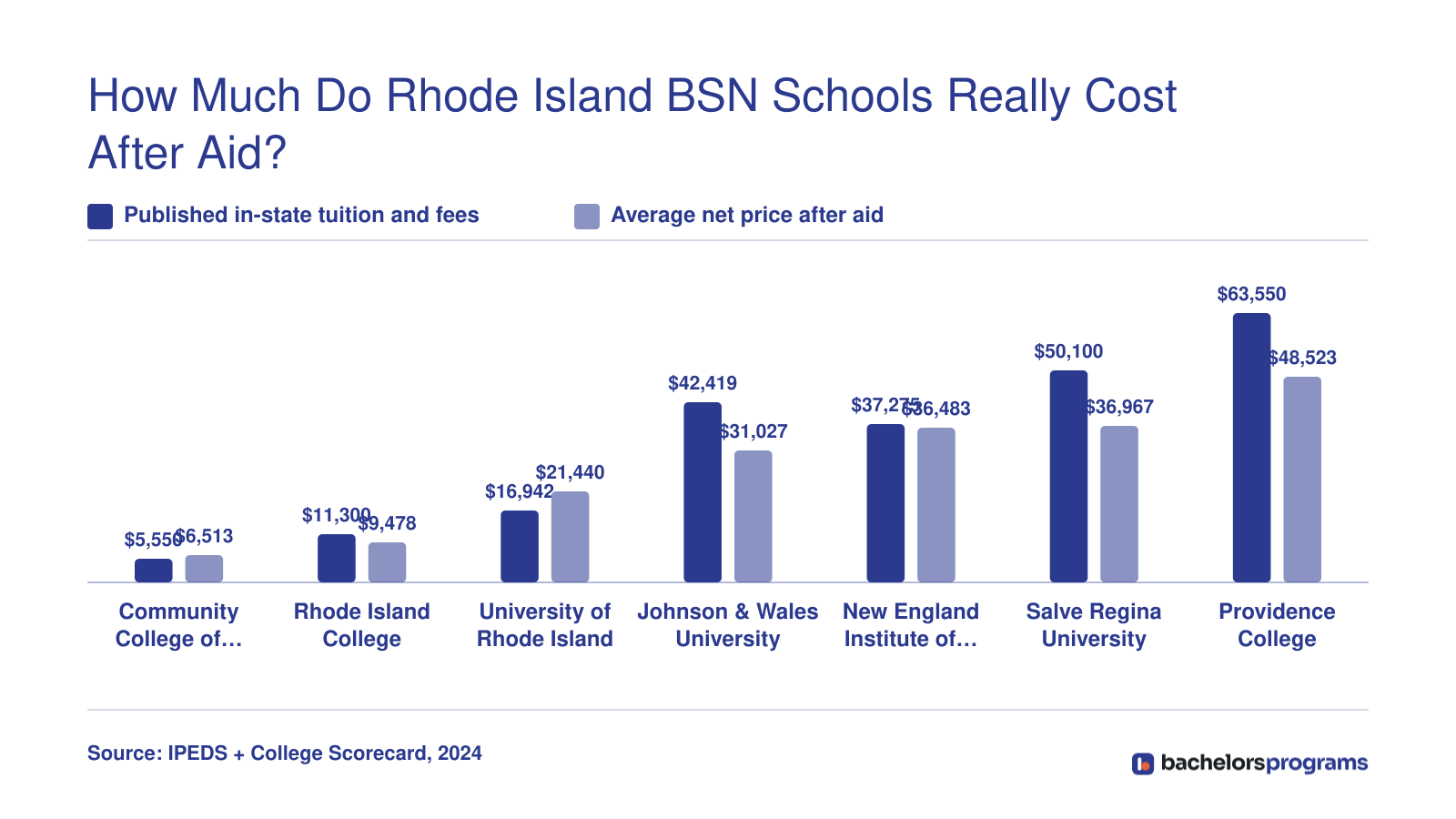
Public vs. private is the biggest cost divide among Rhode Island BSN schools. Published yearly tuition and fees run from $11,300 at Rhode Island College to $63,550 at Providence College, with the University of Rhode Island at $16,942 in the public middle. Net price after aid is the better measure, and it is an institution-wide average, not a nursing-specific figure. It runs from $9,478 at Rhode Island College to $21,440 at the University of Rhode Island, and from $36,483 at New England Institute of Technology to $48,523 at Providence College. Salve Regina University sits at $36,967.
What Four Years Actually Costs
Multiply net price by four for a rough total. Rhode Island College comes to about $37,912. Providence College comes to about $194,092. The University of Rhode Island lands near $85,760.1 Treat these as planning estimates, since your own aid package decides the real number.
Nursing Costs Families Miss
Tuition is only part of the bill. Nursing adds charges that general net price figures do not capture:
- Program differentials: The University of Rhode Island lists a $950-per-semester Nursing Differential Charge for Years 2 through 4 in its 2026-27 schedule, on top of tuition and a registration fee.2
- Testing and review materials: Rhode Island College bills nursing students each semester for these resources. Ask the school for the current amount.
- Clinical readiness items: Uniforms, background checks and immunizations vary by school and clinical site.
- Licensure costs: Budget for NCLEX prep and the exam registration fee (about $200), plus the state licensing fee.
Rhode Island State Aid
Several state-level options exist: the Hope Scholarship at Rhode Island College, grants through the Rhode Island Office of the Postsecondary Commissioner, and the Rhode Island Department of Health's Health Professional Loan Repayment program. Award amounts, eligibility rules, deadlines and any service commitments change, so confirm each one with the school's financial aid office before counting on it. File the FAFSA early, because most institutional and state aid starts there.
How Much Do Rhode Island BSN Schools Really Cost After Aid?
Private schools publish high sticker prices, then discount them heavily with institutional grants and scholarships. That is why Providence College drops from $63,550 in tuition and fees to a $48,523 average net price, and Salve Regina University falls from $50,100 to $36,967. Net price is an institution-wide average for aided undergraduates, not a nursing-specific figure. It also folds in housing, books and other costs, which is why it can run higher than tuition at public schools such as the University of Rhode Island. Figures come from the 2024 College Scorecard snapshot.
Rhode Island Board of Nursing Approval and NCLEX-RN Licensure
Are Rhode Island BSN programs approved by the Board of Nursing? Program approval comes from the Rhode Island Board of Nurse Registration and Nursing Education, which operates within the Rhode Island Department of Health (RIDOH). You must graduate from a state-approved nursing program to qualify for an RN license. Graduates of the schools ranked here sit the NCLEX-RN, but check each program's current standing with RIDOH before you enroll, since approval status can change.
Approval vs. Accreditation
State approval makes you eligible to test for licensure. National accreditation is a separate, voluntary review of program quality. The University of Rhode Island, Rhode Island College (accredited through Fall 2028) and Salve Regina University list CCNE accreditation for the BSN. New England Institute of Technology lists ACEN accreditation, so confirm that it covers the BSN specifically. Accreditation matters if you plan to pursue graduate nursing study, because many graduate programs expect an accredited BSN, and some employers screen for it.
From Graduation to License
- Apply: Submit your application to the Rhode Island board and pay the $135 fee.
- Background check: Complete a fingerprint-based BCI/FBI check.
- Transcripts: Have your nursing program send official transcripts.
- Register: Sign up with Pearson VUE for $200 (nonrefundable). That fee rises to $350 on February 1, 2027.
- Test: Once RIDOH confirms eligibility, Pearson VUE emails your Authorization to Test. Schedule and pass the NCLEX-RN.
Budget at least $335 before background-check costs. A retake requires another $135 application fee plus a new Pearson VUE registration.
What Pass Rates Show
NCLEX pass rates track first-time test takers over set reporting years. In a small cohort, a handful of results can swing the figure sharply. The rate also says nothing about students who left the program before graduating.
Rhode Island RN Licensure at a Glance
Questions to Ask Yourself
Would you rather lock in a nursing seat as a freshman, or compete for one after prerequisites?
Is in-state public tuition your deciding factor, or could aid at a private school close the gap?
Do you want a large public research campus or a small private campus with tighter cohorts?
How much weight will you give NCLEX-RN results compared with proximity to the hospitals where you want to work?
Rhode Island BSN Questions, Answered
What is the best nursing school in Rhode Island for a BSN?
Can a Rhode Island RN license be used to work in other states?
Where do Rhode Island BSN students complete clinical rotations?
Compare Bachelor of Science in Nursing (BSN) programs on the data that matters
Explore more Nursing majors or browse every field of study.
All Nursing programs Browse every field of study