Best BSN Programs in Vermont
Compare 3 accredited Bachelor of Science in Nursing (BSN) programs in Vermont, with net price after aid, graduation rates, earnings and debt from IPEDS and the U.S. College Scorecard.
A traditional BSN in Vermont is a four-year pre-licensure degree with a heavy clinical component: the University of Vermont program carries 594 supervised hours, Vermont State University's 600. Few schools here offer it, so the question of the best BSN program in Vermont comes down to price, admission odds and clinical access.
The order comes from NCLEX-RN results, not reputation, and it clears up one recurring confusion: consolidation has reshaped Vermont State University's BSN, and older pages still name campuses that no longer exist. The 2026 status descriptions here follow each school's current pages.
What separates these programs is arithmetic more than curriculum: credit hours, clinical hours and the net price left after VSAC aid.
Key Points
- Vermont State University charges $11,952 in-state tuition and fees, the lowest here.
- Norwich's $49,740 sticker price falls to a $22,257 average net price.
- Board of Nursing approval, not CCNE accreditation, unlocks NCLEX-RN eligibility.
Vermont BSN Schools
Vermont's traditional pre-licensure BSN options come down to three campuses, three clinical networks, and three very different price points. Each entry below covers what the program actually puts in front of students, from supervised clinical hours to simulation labs, alongside the cost and completion numbers families ask about first. Licensed RNs finishing a bachelor's should see our RN-to-BSN page, and second-degree students should see the accelerated BSN page; neither pathway appears in this list.
University of Vermont
#1Burlington, VT · $19,000 – $46,000/yr (est.)
Best for: Students aiming for academic medical centers
The University of Vermont is the state's flagship public research university, and its Burlington campus puts nursing students inside an academic medical center environment. Students train through the UVM Health Network, a six-hospital Vermont system that includes a Level 1 trauma center, a children's hospital, and a cancer center. Clinical placements also reach community settings such as a nurse practitioner-led primary care clinic, which suits students who want rural and public health experience. The school's institution-wide graduation rate is 79 percent.
- CCNE accredited
- 123 total credit hours
- 594 faculty-supervised clinical hours starting sophomore year
- 126-hour senior practicum
- Clinical partnerships with UVM Health Network
- Simulation labs plus travel study and exchange options
- Sigma Theta Tau honor society and undergraduate research
- Compassionate Care for Nurses wellness course
Norwich University
#2Northfield, VT · $22,000/yr (est. net price)
Best for: Learners who prefer small, structured classes
Norwich University is a private university in Northfield with a long military and engineering heritage and a residential campus culture. Its four-year BSN sends students to Dartmouth-Hitchcock and UVM Medical Center for clinical work and emphasizes leadership, global perspective, and technology skills such as electronic health records. Small cohorts and a 13-to-1 student-faculty ratio mean faculty know students by name. The school's institution-wide graduation rate is 60 percent.
- CCNE accredited four-year campus program
- Clinical affiliations with Dartmouth-Hitchcock and UVM Medical Center
- State-of-the-art simulation labs
- Electronic health records training built into the curriculum
- Focus on leadership and global perspectives
- Experiential learning environments with expert faculty
Vermont State University
#3Randolph, VT · $15,000 – $20,000/yr (est.)
Best for: Cost-conscious Vermont residents
Vermont State University is the state's public university system, with the nursing program based in Randolph and clinical placements reaching regional referral centers in Vermont and neighboring New Hampshire. The BSN pairs simulation center work with more than 600 clinical hours and keeps class sizes small. It publishes a locked tuition rate and a 1+1+2 pathway that lets working students build from practical nursing to the associate degree and then the BSN. The school's institution-wide graduation rate is 47 percent.
- Locked tuition rate
- 600 or more clinical hours at regional medical centers
- Two tracks: four-year BSN or 1+1+2 pathway
- Small class sizes with experienced faculty
- Capstone required
- Trailblazer Scholarship up to $10,000
- Over 80% of students receive financial aid
- Fall start with one admission date per year
Cost & outcomes by school
Federal data for the highest-earning Bachelor of Science in Nursing (BSN) programs, independent of the ranking above. Earnings are this field's bachelor's graduates four years after completing where the Scorecard reports them, else the school's undergraduate median.
| School | Net price / yr | Grad rate | Earnings | Debt | Grads/yr | Format |
|---|---|---|---|---|---|---|
| Norwich University VT | $22,257 | 60% | $65,575 | $25,000 | 1,366 | Campus |
| University of Vermont VT | $19,343 | 79% | $62,472 | $20,951 | 5,908 | Campus |
| Vermont State University VT | $18,212 | 47% | $50,331 | $15,000 | 1,298 | Campus |
Sources: U.S. Department of Education. Net price, graduation rate, earnings and debt: College Scorecard (earnings and debt for this field's bachelor's graduates where reported, else school-wide); graduates: IPEDS. A dash means no figure is reported.
Cost, debt & payoff
Median earnings of this field's bachelor's graduates (4 yrs after completing, else the school's undergraduate median) vs. their median federal loan debt · U.S. College Scorecard
Across these programs the median graduate earns about $62,472 and finishes with roughly $20,951 in debt — a ratio that clears a common rule of thumb (keep debt below first-year salary). Net price and debt vary widely school to school, so check the per-school figures in the table above before you shortlist.
How Exam Results, Completion and Accreditation Shape This List
A single pass rate can flatter a small cohort; a multi-year record weighted by test-takers is harder to game. That distinction sets the order.
What Moves a BSN Program Up or Down
Three quarters of the score comes from first-time NCLEX-RN results. We use the state board's most recent three years of outcomes, weighted by how many candidates sat for the exam, so a strong year with a handful of test-takers does not outweigh a steady record with a full class. Accreditation, completion, and retention make up the rest and mainly settle close calls.
Context You See, Not Weight You Feel
Each card also shows federal College Scorecard context: net price after aid, institution-wide graduation rate, median debt, and earnings for graduates. These details help you compare the financial picture and the broader campus, but they carry little or no ranking weight. Use them as a reality check on cost and debt, not as a reason a program moved. A school with a lower sticker price does not jump ahead because of it.
Where the BSN Numbers Stop
Neither the graduation rate nor the net price describes the nursing program specifically; both cover the whole institution. The list covers traditional pre-licensure BSN programs only. RN-to-BSN and accelerated BSN tracks serve licensed RNs and second-degree students through separate routes, so they sit outside this ranking. Accreditation is treated as a baseline requirement, not a trophy: a program needs it to appear.
Other Vermont BSN lists often publish a rank and stop there. Here the arithmetic is on the page, and the final judgment stays with you.
CCNE-Accredited BSN Programs in Vermont: Campus, Entry Model and 2027 Status
CCNE accreditation and Vermont Board of Nursing approval are separate checks: state approval lets graduates sit for the NCLEX-RN, while national accreditation is what many graduate nursing schools, military and VA employers, and some hospital hiring policies look for. Vermont State University's nursing program holds preaccreditation from the National League for Nursing Commission for Nursing Education Accreditation (NLN CNEA), not CCNE, and it keeps Vermont State Board of Nursing approval. Its official Nursing, B.S.N. page (reviewed October 27, 2026) describes a traditional four-year BSN delivered at the Castleton campus but does not say whether the program is taking new students for fall 2026 or the 2026-27 year, so confirm directly with Vermont State admissions before relying on any third-party claim either way.
| School | CCNE Accreditation | VT Board of Nursing Approval | Campus | Entry Model | 2026-27 Enrollment Status |
|---|---|---|---|---|---|
| University of Vermont | Department of Nursing listed in the CCNE directory; status details and next review year not published | Not published | Burlington | Not published | Not published |
| Norwich University | School of Nursing listed in the CCNE directory (checked October 31, 2026); BSN-specific status and next review year not published | Approved by the Vermont State Board of Nursing, Office of Professional Regulation | Northfield | Traditional BSN; direct admit vs. upper-division not published | Not published |
| Vermont State University | Not CCNE-accredited; holds NLN CNEA preaccreditation | Approved; all Vermont State nursing programs maintain Vermont State Board of Nursing approval | Castleton campus, Castleton (university based in Randolph) | Traditional four-year BSN with in-person-plus delivery | Not stated on the official program page as of October 27, 2026 |
Getting Into a Vermont BSN: Prerequisites, GPA, Testing and Direct Admit
The University of Vermont admitted 65.3 percent of applicants in the latest federal data, Norwich University 74.4 percent and Vermont State University 81.7 percent. Those rates cover each whole institution, so the nursing major may be more competitive than the headline number. For anyone asking whether it is hard to get into nursing at UVM, the answer is that the university is moderately selective overall, and the nursing-specific bar is not fully spelled out in the public pages we could verify.
University of Vermont
UVM's catalog points to biology and chemistry preparation for the College of Nursing and Health Sciences. It recommends physics, biology, chemistry and math through trigonometry. A 3.0 GPA appears in the catalog, but it is unclear whether that is the freshman BSN minimum. The catalog lists January 15 for regular first-year applicants and November 1 for Early Decision. Treat those as typical dates to confirm for the 2026 cycle, not as BSN-specific deadlines. SAT/ACT policy and the direct-admit structure for nursing were not established, so check the nursing admissions page directly.
Norwich University
The available official pages do not establish high school prerequisites, a minimum GPA, a testing policy, a direct-admit structure or deadlines for the four-year BSN. The no-SAT/ACT statement you may see applies to the RN-BS for applicants who already hold an associate degree, not to freshmen.1 Ask admissions for the current BSN requirements before you plan around any of this.
Vermont State University
Vermont State is the most specific. Its first-year guidance prefers four years of English, three of math, three to four of social science and two to three of lab science. For the BSN, it looks for a cumulative high school GPA of 3.0 or higher with strong math and science grades. Tests are required only for programs that have a testing requirement, and none was identified for the BSN. Most programs admit on a rolling basis. The December 1 nursing priority date applies to the associate nursing program, not expressly the BSN. The school describes two tracks, a four-year BSN and a 1+1+2 pathway, so confirm which one you are applying to.
Once admitted, students need a 2.8 cumulative GPA, B- or higher in nursing-major courses and C+ or higher in required math and science. Science courses must have been completed within 10 years before admission.
A Practical Tip on Direct Admit
A program that admits you to nursing as a freshman protects your seat. One that makes you compete for upper-division entry after prerequisites puts your place in clinical coursework at risk if your science grades slip. Ask each school in writing whether the nursing seat is guaranteed at admission, and what GPA keeps it.
Questions to Ask Yourself
Do you want a guaranteed nursing seat as a freshman, or can you compete for upper-division entry?
Would you thrive at a large research university or a smaller private or military college?
Are you a Vermont resident, or would out-of-state pricing change your math?
Can you handle clinical rotations that may require travel across rural Vermont?
Vermont BSN Program Tuition Comparison: Sticker Price, Net Price and VSAC Aid
Vermont State University is the lowest-cost route to a traditional BSN here, and the gap widens once aid is counted.
Sticker Price and Net Price
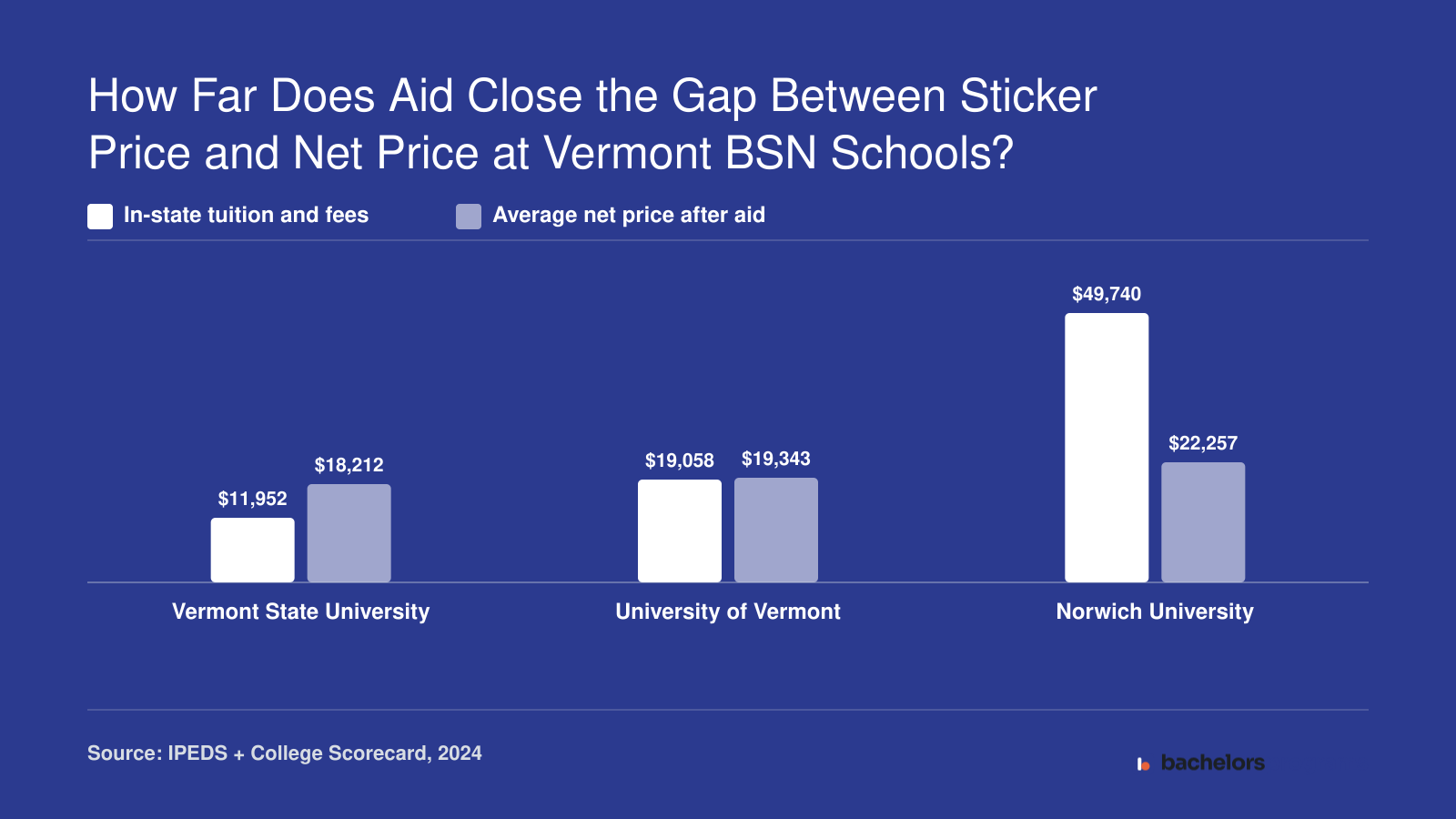
Vermont State University's 2026-27 in-state total is $16,368, $11,088 in general tuition plus $5,280 in program tuition. The University of Vermont (UVM) lists $16,938 in-state and $46,655 out-of-state. Norwich University charges one rate, $49,740, regardless of residency.
Net price is what students pay after grants, and it narrows the spread:
- Vermont State University: $18,212 average net price.
- University of Vermont: $19,343 average net price.
- Norwich University: $22,257 average net price.
These are institution-wide averages across all students, not a personal quote. Income and aid change it, so work out your own number with each school's net price calculator.
Nursing-Specific Costs
Nursing can cost more than the base rate suggests. UVM's 2026-27 pages list resident tuition of $16,938, a $2,908 comprehensive fee and a separate $1,000 nursing program fee. Vermont State's 2026-27 page places the Nursing B.S.N. under expanded program tuition, which brings in-state total tuition to $16,368 before fees. Norwich's current campus rates and any nursing fees were not confirmed, so ask the school directly.
Uniforms, background checks, immunizations, clinical supplies and exam prep are not itemized on the pages reviewed. Budget for them anyway. The national NCLEX-RN registration fee is $200, separate from any Vermont licensing fee.
Vermont Aid and Debt
Vermont residents who file the FAFSA and apply through the Vermont Student Assistance Corporation (VSAC) may qualify for the need-based Vermont Grant. Amounts and deadlines change yearly, so confirm them on VSAC's site. Vermont State also advertises a Trailblazer Scholarship of up to $10,000. Vermont has had loan repayment options for health care workers, but eligibility and award terms for new nurses could not be verified here. Check with VSAC and the Vermont Department of Health before counting on one.
Scorecard reports median federal debt at the program level for nursing graduates who borrowed:
- Vermont State University: $25,250, about $268 a month over 10 years.
- University of Vermont: $25,000, about $265 a month.
- Norwich University: $27,000, about $286 a month.
For a Vermont resident, Vermont State has the lowest average net cost at $18,212, with UVM close behind.
How Far Does Aid Close the Gap Between Sticker Price and Net Price at Vermont BSN Schools?
The widest gap is at Norwich University, the private school here. Its $49,740 published tuition and fees drop to an average net price of $22,257, which puts it within a few thousand dollars of the public options. At Vermont State University and the University of Vermont, net price runs above in-state tuition because it covers the full cost of attendance (housing, food and books) minus grants. Net price is an average across undergraduates, calculated separately for public and private schools, and your own figure will shift with family income.
Related Articles
From BSN Graduate to Vermont RN: Board of Nursing Approval and the NCLEX-RN
Does graduating from a CCNE-accredited BSN program make you a Vermont RN? Not by itself. Two separate checks apply, and they do different jobs.
Approval vs. Accreditation
Vermont Board of Nursing approval is what makes a program's graduates eligible to sit for the NCLEX-RN in the state. CCNE accreditation is a voluntary national quality review. It signals that a program meets professional standards, but it does not replace state approval. Vermont also requires you to pass the NCLEX-RN within five years of graduating.
The Licensure Sequence
- Apply: Submit an application for licensure by examination through the Vermont Office of Professional Regulation (OPR) online services, with an official transcript. The fee is $75 and non-refundable. If you already have an OPR account, use it rather than creating a second.
- Register: Sign up with Pearson VUE, which handles NCLEX registration, scheduling and payment. The current fee is $200.
- Receive your Authorization to Test: Once Vermont deems your application complete enough to approve eligibility and your Pearson VUE registration is in, Pearson VUE emails the Authorization to Test. No fixed turnaround is published.
- Sit for the exam: Schedule and take the NCLEX-RN.
- Receive your license: OPR issues the license once all requirements are satisfied.
Fingerprints and Background Checks
Your initial application starts a criminal background check, and Vermont requires fingerprint-supported FBI checks for nursing licensure.1 After you answer the FBI-release questions, a Fingerprint Authorization Certificate arrives at your OPR-account email, generally within 3-5 business days. Print and sign it, then bring it to a Vermont Identification Center or a local law-enforcement agency that offers fingerprinting. Some locations submit the materials for you, while others have you mail them. Collection fees vary by provider.1 Keep your receipt and upload it to OPR. Results can take up to 12 weeks after fingerprint information reaches the state.
If everything is complete except license verification or background-check results, Vermont can issue a 90-day provisional license. Finish the background check within that window, or you cannot work in Vermont until results arrive.
The NCLEX-RN pass rates cited above come from the ranking data and reflect first-time test takers.
Vermont RN Licensure Essentials
Vermont BSN Questions, Answered
What is the best BSN program in Vermont?
Which Vermont nursing schools are CCNE accredited?
How much does a BSN cost in Vermont?
What NCLEX-RN pass rates do Vermont BSN programs report?
Is it hard to get into nursing school at UVM?
How long does it take to get a BSN in Vermont?
Is Vermont State University's nursing BSN open to new students for 2026-27?
Can a Vermont RN license be used to practice in other states?
Compare Bachelor of Science in Nursing (BSN) programs on the data that matters
Explore more Nursing majors or browse every field of study.
All Nursing programs Browse every field of study