Best Accelerated BSN (ABSN) Programs in Arizona
Compare 6 accredited Accelerated BSN (ABSN) programs in Arizona, with net price after aid, graduation rates, earnings and debt from IPEDS and the U.S. College Scorecard.

A traditional BSN takes four years. An accelerated BSN compresses the nursing core into 12 to 18 months of full-time study, but it assumes you already finished a bachelor's in something else. In Arizona, it is the quickest route to NCLEX-RN eligibility.
The trade-off is intensity. Annual in-state tuition at the ranked schools runs roughly $11,600 to $18,500, and the pace leaves little room for outside work.
Admission is the real bottleneck. Prerequisite sciences, GPA minimums, and limited cohort seats decide who starts, and the 12-to-18-month clock only begins after that.
Key Points
- The University of Arizona ranks first and arranges students' clinical placements.
- Northern Arizona University requires a completed bachelor's before the program starts.
- Arizona State Board of Nursing approves programs campus by campus.
Top-Ranked Accelerated BSN Schools in Arizona for Second-Degree Students
The University of Arizona takes the top spot because it removes the hardest logistical burden from a second-degree student's plate: the college arranges clinical placements rather than leaving students to find their own, and it pairs that with an integrative health focus none of the other three programs offer. All four schools here are built for people who already hold a bachelor's degree in another field, so what separates them is format, class size, and how much of the clinical search the school handles.
University of Arizona
#1Tucson, AZ · ~$17,000/yr (est.)
Best for: Career changers interested in integrative health
Arizona's flagship public research university, offering the accelerated BSN in a hybrid format that blends online coursework with in-person labs and clinicals. The integrative health emphasis is the clearest differentiator: the curriculum treats mental, physical, and spiritual well-being as part of clinical care rather than a side topic. The college arranges clinical placements at Arizona hospitals and clinics, so students are not left to cold-call sites, and simulation labs with virtual reality scenarios sharpen clinical judgment before real patients. A network of more than 10,000 alumni gives graduates a broad professional base across the state.
- CCNE accredited
- Hybrid format mixing online and in-person learning
- Integrative health emphasis on mental, physical, spiritual care
- More than 600 clinical hours at Arizona hospitals and clinics
- Clinical placements arranged by the college
- Simulation labs plus virtual reality scenarios
- Alumni network of more than 10,000
- Financial aid and scholarships available
Northern Arizona University
#2Flagstaff, AZ · ~$14,000/yr (est.)
Best for: Learners who want small mentored cohorts
A public university based in Flagstaff, with the accelerated BSN taught at its North Valley campus in the Phoenix area. Cohorts stay small and faculty mentorship is built into the model rather than promised in a brochure. The curriculum leans into culturally responsive care, with a deliberate focus on rural and Indigenous communities and the health disparities they face. Clinical rotations span hospitals, clinics, schools, and public health settings, and the program is positioned as a pathway toward graduate nursing study.
- CCNE accredited
- North Valley campus, serving the Phoenix area
- Small class sizes with faculty mentors
- Focus on rural and Indigenous health
- Simulation labs and a wide range of clinical sites
- Pathway to graduate nursing programs
Grand Canyon University
#3Phoenix, AZ · ~$22,000/yr (est.)
Best for: Working adults needing hybrid flexibility
A private, Christian-affiliated university in Phoenix that runs one of the largest nursing operations in the state. The accelerated BSN is hybrid: theory online, with skills labs, simulation suites, and clinical rotations at nearby healthcare facilities. It is a cohort-style program, and the university advises against holding a job while enrolled because of the pace. GCU has been institutionally accredited since 1968 and also operates ABSN learning sites outside Arizona.
- CCNE accredited
- Hybrid: online theory with in-person labs and clinicals
- Simulation suites for supervised skills practice
- Clinical rotations at nearby healthcare facilities
- Coursework in pathophysiology and pharmacology
- Cohort model; working while enrolled is generally not advised
- 123 total credit hours
- Institutionally accredited since 1968
Arizona State University
#4Scottsdale, AZ
One of the largest public universities in the country, and the Edson College of Nursing route is built squarely for people changing fields. The accelerated BSN accepts students who already hold a bachelor's in another subject, and also those who complete 70 credit hours in an Edson College major. The program itself is 50 credit hours and ends with a Bachelor of Science in Nursing, after which graduates sit for the NCLEX-RN. ASU also runs a traditional prelicensure BSN and a concurrent enrollment pathway with community college nursing programs.
- 50 credit hours
- Up to 70 Edson College credits accepted
- Graduates earn a BSN and sit for the NCLEX-RN
- Practice as an RN after passing licensure
- Same college offers traditional prelicensure BSN option
- Concurrent enrollment route with community college ADN programs
Cost & outcomes by school
Federal data for the highest-earning Accelerated BSN (ABSN) programs, independent of the ranking above. Earnings are this field's bachelor's graduates four years after completing where the Scorecard reports them, else the school's undergraduate median.
| School | Net price / yr | Grad rate | Earnings | Debt | Grads/yr | Format |
|---|---|---|---|---|---|---|
| Arizona State University AZ | $14,967 | 68% | $62,668 | $19,500 | 30,826 | Campus |
| Arizona State University AZ | — | — | $62,668 | $19,500 | 19,802 | Campus |
| University of Arizona AZ | $16,674 | 68% | $59,979 | $19,620 | 17,352 | Campus |
| Northern Arizona University AZ | $14,158 | 61% | $54,384 | $19,000 | 10,620 | Campus |
| Grand Canyon University AZ | $22,472 | 44% | $42,186 | $22,114 | 30,574 | Hybrid |
| Brookline College-Tucson AZ | $22,871 | 48% | $29,576 | $9,500 | — | Hybrid |
Sources: U.S. Department of Education. Net price, graduation rate, earnings and debt: College Scorecard (earnings and debt for this field's bachelor's graduates where reported, else school-wide); graduates: IPEDS. A dash means no figure is reported.
Cost, debt & payoff
Median earnings of this field's bachelor's graduates (4 yrs after completing, else the school's undergraduate median) vs. their median federal loan debt · U.S. College Scorecard
Across these programs the median graduate earns about $57,182 and finishes with roughly $19,500 in debt — a ratio that clears a common rule of thumb (keep debt below first-year salary). Net price and debt vary widely school to school, so check the per-school figures in the table above before you shortlist.
Our Scoring Approach for Arizona ABSN Schools
Every school here had to clear one bar first: an accelerated, second-degree BSN pathway built for people who finished a bachelor's in another discipline. Cost and outcomes only came into play after a program passed that test.
Where the Numbers Come From
We drew on College Scorecard institution and program outcomes, IPEDS tuition and fees, and each school's official program page. The institutional Scorecard snapshot used here is from 2024. Where a program page and a federal dataset describe the same thing differently, the school's own page governs program details such as format and start dates.
What Each Metric Means
- Tuition: The published in-state and out-of-state undergraduate tuition and fees. Treat it as a starting point, because pricing for an accelerated sequence can differ from the standard undergraduate rate.
- Net price: An institution-wide average after grants and scholarships. It is not a quote, and your own figure depends on your aid package and residency.
- Graduation rate: Measured across the whole institution, not the ABSN cohort. It signals how well a university supports students overall, not how a single accelerated class performs.
Why the List Is Short
Only programs actually offered in Arizona were eligible. Campus-based and hybrid formats both qualified, but a school with an ABSN elsewhere in the country did not earn a place unless it runs one here. The list is short by design: every entry is a program you can enroll in without leaving Arizona.
Accelerated BSN Admissions in Arizona: Bachelor's, Science Prerequisites, GPA, and Test Policy
Northern Arizona University is the strictest on prior education, requiring a finished bachelor's degree by the program start, while Arizona State University and Grand Canyon University also consider applicants without one if they meet other eligibility rules. The figures below come from each school's official admissions pages and are posted minimums, not targets: competitive applicants usually exceed them with higher prerequisite grades and stronger TEAS or HESI A2 scores. Plan to finish lab sciences early and confirm deadlines directly with each school, since seats in accelerated cohorts fill quickly.
| School | Prior Bachelor's Required? | Key Prerequisites | Minimum GPA | Entrance Exam | Prerequisite Age Limit |
|---|---|---|---|---|---|
| Arizona State University (Scottsdale) | No. Designed for students with a bachelor's in another discipline, but first-bachelor's students who meet eligibility requirements may also be considered | All 17 critical/prerequisite courses; three of the four lab science courses and at least five other critical courses must be completed by the applicable deadline | 3.25 select GPA and 3.25 prerequisite GPA | TEAS required; minimum accepted score of 58.7%; multiple attempts allowed | Not stated for prerequisite credits; TEAS scores must be no more than 2 years old |
| Northern Arizona University (Flagstaff) | Yes. Bachelor's must be completed by the start of the program | BIO 181 or CHM 130 with CHM 130L; BIO 201 and 201L; BIO 202 and 202L; BIO 205 and 205L; BIO 320 or NUR 370; NTS 135 or an advisor-approved human nutrition course; PSY 101; PSY 240; STA 270 or PSY 230 | 3.0 or higher for all nursing requirements and prerequisite courses | Proctored HESI A2 required | Not stated |
| Grand Canyon University (Phoenix) | No. A completed non-nursing bachelor's or at least 60 non-nursing college credits qualifies; applicants with fewer than 60 transfer credits may be eligible if other requirements are met | Nine prerequisite courses/labs and 10 general education courses before starting core nursing courses | 3.0 cumulative | HESI A2 required | Prerequisites must have been completed within the past seven years to transfer |
First-Year Paychecks for BSN Completers at Ranked Arizona Schools
Among the schools ranked here, Grand Canyon University's nursing bachelor's completers report the highest median pay one year after finishing.
Related Articles
Campus vs. Hybrid ABSN Options in Arizona: Clinicals, Start Dates, and Deadlines
Arizona's accelerated BSN options now split between campus-based cohorts and hybrid formats, a division that shapes your weekly schedule. Arizona State University runs its 12-month, 50-credit ABSN at Downtown Phoenix and West Valley, plus a Learn Where You Live option that pairs live online sessions with in-person labs and clinicals. The University of Arizona's 15-to-16-month pathway is hybrid and based at its Gilbert distance campus. Grand Canyon University also uses a hybrid model, with learning sites in Chandler, Phoenix, and Tucson. No Arizona ABSN is fully online; clinical hours are completed in person.
Where Clinicals Happen
ASU assigns Spring 2027 Learn Where You Live cohorts to Ganado, Gila County (Payson and Globe), Parker, or Tucson, while metro Phoenix students rotate within the Downtown Phoenix, West Valley, and Polytechnic footprints. The University of Arizona arranges placements at Arizona hospitals and clinics. Grand Canyon sends students to Arizona healthcare organizations for clinicals. If you live outside Phoenix or Tucson, budget for travel and ask how far you could be placed before you accept a seat.
Start Dates and Deadlines
ASU publishes the clearest calendar: Spring 2027 begins in January, with a Sept. 1, 2026 priority deadline, and Fall 2027 begins in August, with a Feb. 1 deadline. Later ASU applications are reviewed space-available only if all advancement requirements can be completed before the program starts. The University of Arizona lists fall, spring, and summer starts but no specific 2027 dates or deadlines, and caps its cohort at 72. Grand Canyon reports three starts per year without 2027 dates, deadlines, or a published cohort number. Deadlines can fall months ahead of a start, so work backward from your target term.
Competitive by Design
Limited clinical seats keep admission tight. ASU calls its ABSN competitive with limited space, and the University of Arizona's 72-student cap shows how finite a cohort can be.
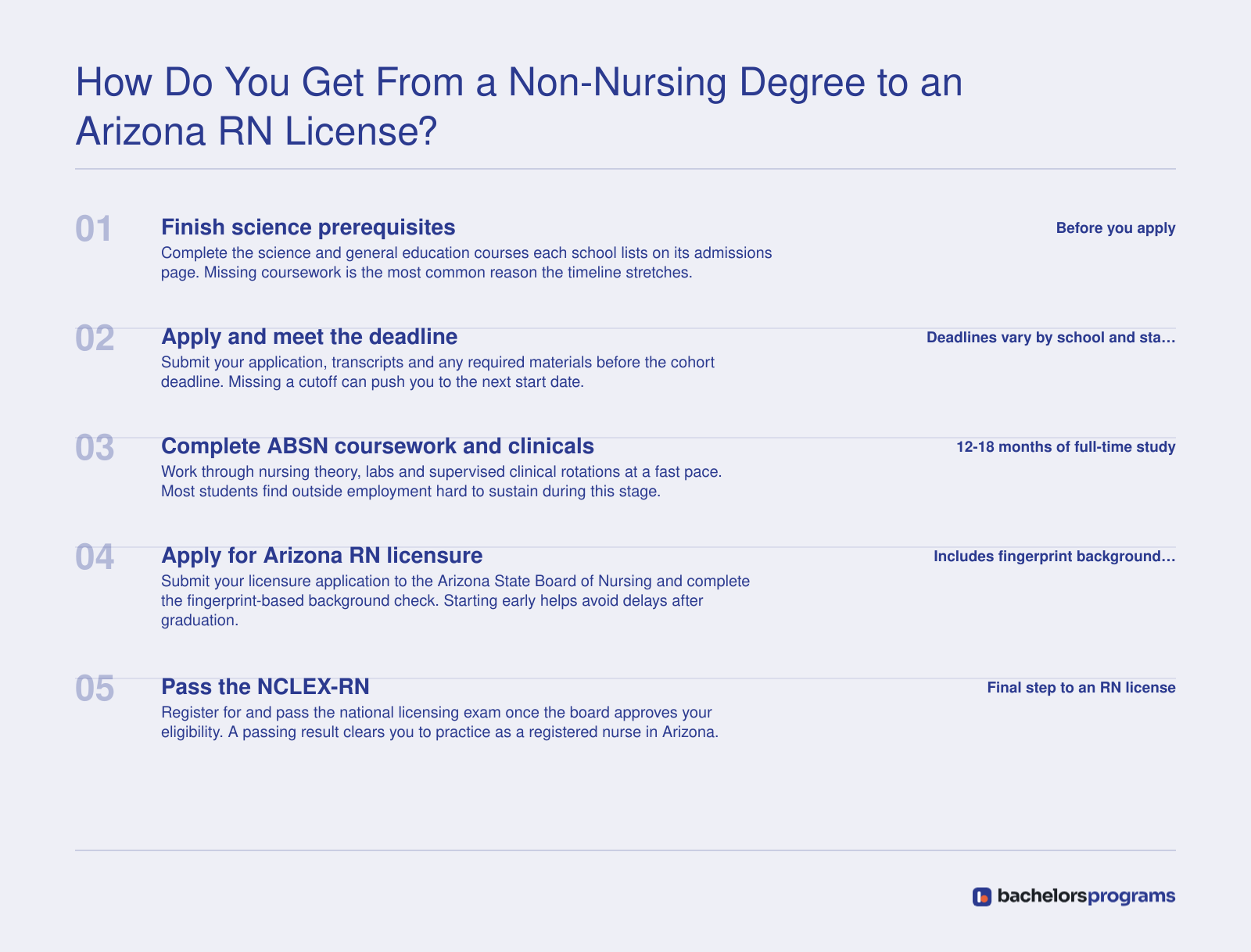
How Do You Get From a Non-Nursing Degree to an Arizona RN License?
The 12-18 month figure attached to every accelerated BSN in Arizona describes only the nursing program itself, so the clock does not start until you have been admitted and your first term begins. Before that, most second-degree applicants need to finish science prerequisites such as anatomy and physiology or microbiology, and fitting those courses in around work, then waiting for grades to post before an application deadline, often adds several months to the full timeline. Plan backward from your target start date at the University of Arizona, Northern Arizona University, Grand Canyon University or Arizona State University, and count the prerequisite stretch as part of your real path to licensure.
Arizona State Board of Nursing Approval, CCNE Accreditation, and NCLEX-RN Results
Arizona approves nursing programs campus by campus, so a university's main-site approval does not automatically cover every accelerated BSN location it lists.
Why Approval and Accreditation Are Separate Checks
Board approval is what makes graduates eligible for the NCLEX-RN in Arizona. CCNE or ACEN accreditation is a separate check, and it affects graduate school admission, some employers, and military or federal jobs. A Board approval page does not establish national accreditation.
Approval and Accreditation Status by Program
- Arizona State University: Arizona State Board of Nursing Full Approval through June 30, 2034, with listings for Phoenix, Polytechnic, West and an accelerated BSN at Lake Havasu. The Board result does not establish CCNE or ACEN status, so confirm with the program and the accreditor's directory.
- Grand Canyon University: Arizona State Board of Nursing Full Approval through June 30, 2031 for Chandler and Sun City BSN-Accelerated listings. A secondary source describes the Phoenix pre-licensure BSN as CCNE-accredited; confirm campus coverage in the official CCNE directory.
- University of Arizona and Northern Arizona University: check current Board approval and national accreditation through the Board's program search and the CCNE or ACEN directory before you apply.
NCLEX-RN Results: Read Them With Care
Use pass rates only where the Board or school publishes them. ASU's Q1 2025 listing shows zero candidates and a 0.00% figure, which is not a representative rate. A report citing Board data gives GCU Tucson 100% over the last seven quarters, with no candidate count; a compilation citing Board data gives GCU Phoenix 94.4% for 2025, also without a candidate count. Treat these as published snapshots, not verified annual rates for every campus. The Board's quarterly and annual reports are the place to confirm current figures. If a current rate is not posted for a campus, ask the program in writing and check the Board's latest report yourself.
Arizona Licensure Steps and Compact Practice
Apply to the Arizona State Board of Nursing, submit a fingerprint card for the background check, and register for the NCLEX-RN. Apply early, because authorization to test depends on the Board completing its review. Arizona is a Nurse Licensure Compact state, so an Arizona RN license supports multistate practice in other compact states.
Questions to Ask Yourself
Can you stop working, or cut back sharply, for 12 to 18 months?
Are your anatomy, physiology, and microbiology credits recent enough to count?
Would a hybrid ABSN with clinicals in a different city save you money, or just add commute time?
If you aren't admitted this cycle, is a later start or a pricier school the better fallback?
Picking the Arizona ABSN That Fits Your Schedule, Budget, and Admission Odds
Start With Where You Live
Campus formats such as Northern Arizona University in Flagstaff and Arizona State University's Phoenix-area sites expect you on site most days; the University of Arizona's 15-to-16-month pathway is hybrid and based at its Gilbert distance campus. Grand Canyon University's Phoenix ABSN and other hybrid formats move much of the lecture content online, but clinical rotations still happen in person, so map drive times to those sites before you settle on a start date.
Budget for the Full Stretch, Not Just Tuition
Accelerated students typically step out of the workforce for 12 to 18 months. Pair in-state tuition with living costs across that entire period, then compare the net price figures in the ranking. Net price is an average across students who receive aid, not a quote for your household, so ask how the aid office reviews second-degree applicants for scholarships. Compare total cost of attendance, borrowing included, rather than the tuition line alone.
Improve Your Admission Odds
- Apply broadly: Two or three applications protect you from a single waitlist decision.
- Exceed the minimum: A posted GPA floor is a cutoff, not a target; a science GPA above the requirement does more work than a polished essay.
- Show healthcare exposure: CNA or patient-care work and sustained volunteering signal that you understand what bedside nursing actually feels like.
Be Candid About Working
Most accelerated programs discourage outside employment once clinicals begin. Weekend or per-diem shifts are the realistic ceiling for many students; ask current students how that balance held up and whether the schedule leaves room for one shift a week.
Move This Month
Call each target admissions office, confirm which prerequisites you still owe, and note the next deadline and whether applications are reviewed on a rolling basis.
Arizona ABSN Questions Prospective Students Ask Most
These answers cover the questions second-degree applicants raise most often. Program details change by term, so confirm specifics with each school's admissions and financial aid offices before you apply.
How many months does an accelerated BSN take in Arizona?
Can I enter an Arizona accelerated BSN without a finished bachelor's degree?
What does an accelerated BSN cost in Arizona?
Are Arizona's accelerated BSN programs CCNE accredited?
Is it realistic to hold a job during an accelerated BSN?
Do science prerequisites expire for Arizona ABSN applicants?
Can federal financial aid cover a second bachelor's degree in nursing?
Will an Arizona RN license let me practice in other states?
Compare Accelerated BSN (ABSN) programs on the data that matters
Explore more Nursing majors or browse every field of study.
All Nursing programs Browse every field of study