Best BSN Programs in Arizona
Compare 23 accredited Bachelor of Science in Nursing (BSN) programs in Arizona at 21 colleges, with net price after aid, graduation rates, earnings and debt from IPEDS and the U.S. College Scorecard.

A pre-licensure BSN is a four-year bachelor's degree that qualifies graduates to sit for the NCLEX-RN, the exam every Arizona registered nurse must pass before licensure. The real question is which program gets you through it on the first try.
The ranking orders traditional BSN programs mainly by first-time NCLEX-RN pass rate, and the schools on it sit in Phoenix, Tucson, Mesa, Sierra Vista and Holbrook. Separate tables cover affordability and earnings. Licensed RNs and second-degree students belong in RN to BSN or accelerated BSN programs instead.
With first-time pass rates here running from 94.7 to 98.6 percent, cost and admission odds often separate these schools more than the exam does.
Key Points
- Arizona State University requires a 3.50 prerequisite GPA and 58.7% TEAS score.
- Grand Canyon University's BSN graduates post the highest program-level median earnings.
- Licensure by exam in Arizona costs $300, plus up to $50 for fingerprints.
Top NCLEX-RN Outcomes: 10 Arizona BSN Programs Ranked
Arizona's BSN programs are ordered here by NCLEX-RN first-time pass rates, the measure that carries most of the weight, drawn from the state board's latest three years of results and weighted by how many graduates sat for the exam. Where pass rates sit close together, accreditation and completion rates settle the order. Six of the schools below offer a traditional pre-licensure BSN, and the other four award the degree through an RN-to-BSN completion route for licensed nurses, noted in their entries.
Grand Canyon University
#1Phoenix, AZ · ~$22,000/yr (est.) · NCLEX-RN pass rate 94.4% (3-yr weighted avg)
Best for: Transfer students with prior college credit
The largest pre-licensure BSN in Arizona by test takers, and the NCLEX-RN results hold at that scale: 94.4% first-time passes across 810 candidates. The CCNE-accredited program runs 123 credits with up to 90 transferable, 15-week semesters and a Transition to Practice residency. The school's institution-wide graduation rate is 43%.
- 123 total credits; up to 90 transfer credits accepted
- CCNE accredited
- 15-week semesters on the Phoenix campus
- Transition to Practice nurse residency in the final term
- Immersive simulation suites plus hospital, outpatient and community clinicals
- 2.5 GPA minimum; ACT or SAT scores accepted
- Capstone evidence-based project
University of Arizona
#2Tucson, AZ · ~$17,000/yr (est.) · NCLEX-RN pass rate 92.5% (3-yr weighted avg)
Best for: Applicants set on a large public flagship
Tucson's flagship posts a 92.5% first-time NCLEX-RN pass rate across 504 candidates, backed by more than 600 clinical hours plus simulation and virtual reality labs. A second pathway in Gilbert runs the BSN with an integrative health emphasis over 15 to 16 months. The school's institution-wide graduation rate is 68%.
- Tracks: Integrative Health (Gilbert, hybrid, 15-16 months)
- More than 600 clinical hours
- CCNE accredited
- Virtual reality scenarios and simulation labs
- Clinical partnerships with major Arizona health systems
Arizona College of Nursing-Tempe
#3Tempe, AZ · $32,000/yr (est. net price) · NCLEX-RN pass rate 89.2% (3-yr weighted avg)
Best for: Career changers wanting year-round start dates
A single-purpose nursing school in Tempe built for speed: three years to the BSN, no prerequisite coursework, new sessions every eight weeks and night classes for general education. First-time NCLEX-RN pass rate is 89.2% over 235 candidates. The school's institution-wide graduation rate is 89%.
- Three-year BSN; no prerequisite coursework required
- New sessions every eight weeks
- Night classes available for general education courses
- High-fidelity simulation labs plus clinical rotations in year three
- CCNE accredited
- NCLEX-RN preparation built into the curriculum
Chamberlain University-Arizona
#4Phoenix, AZ · ~$40,000/yr (est.) · NCLEX-RN pass rate 89% (3-yr weighted avg)
Chamberlain's Phoenix campus follows its national three-year, 122-credit model: no prerequisites, a HESI A2 entrance exam, evening and weekend classes and a clinical network of 51 partners. First-time NCLEX-RN pass rate is 89% across 230 candidates. The school's institution-wide graduation rate is 50%.
- 122 credits completed in three years
- No prerequisites; HESI A2 entrance exam
- Evening and weekend class options
- Clinical network of 51 partner sites
- CCNE accredited
- Average class size of about 20
- LPN to BSN option available
Northern Arizona University
#5Flagstaff, AZ · ~$14,000/yr (est.) · NCLEX-RN pass rate 88.8% (3-yr weighted avg)
Northern Arizona University spreads its CCNE-accredited BSN across Flagstaff, Tucson, Phoenix and Yuma, with a curriculum weighted toward rural and Indigenous health and small cohorts. First-time NCLEX-RN pass rate is 88.8% across 339 candidates, and in-state tuition is among the lowest in this group. The school's institution-wide graduation rate is 61%.
- CCNE accredited
- Campus options in Flagstaff, Tucson, Phoenix and Yuma
- HESI entrance exam required
- Curriculum emphasis on rural and Indigenous health
- Simulation labs and clinical placements across Arizona
- Small cohorts with named faculty advisors
- For students who already hold a bachelor's degree
- Three start dates a year at the North Valley campus
- HESI entrance exam and prerequisite coursework required
Arizona College of Nursing-Tucson
#6Tucson, AZ · ~$37,000/yr (est.) · NCLEX-RN pass rate 87.8% (3-yr weighted avg)
The Tucson campus runs the same three-year, no-prerequisite BSN as its Tempe sibling, with six start dates a year, a 2.8 GPA floor and NCLEX-RN preparation from the first term. First-time pass rate is 87.8% over 101 candidates, and the small cohorts keep faculty access close.
- Three-year BSN; no prerequisite coursework
- Six start dates a year
- HESI entrance exam; 2.8 GPA minimum
- Asynchronous online classes for non-clinical coursework
- NCLEX-RN preparation from the first term
- Guided hands-on simulation labs
GateWay Community College
#7Phoenix, AZ · $10,000 – $15,000/yr (est.) · NCLEX-RN pass rate 97.4% (3-yr weighted avg)
GateWay's BSN is an RN-to-BSN completion route in Phoenix for nurses already licensed: 120 credits, 62 to 75 block credits awarded for an associate degree or diploma, and three courses with in-person lab or clinical time. It is a candidate for ACEN accreditation, and the institution-wide net price after aid is about $13,300. The school's institution-wide graduation rate is 29%.
- 120 total credits; 62-75 block credits for an associate degree or diploma
- Open to RNs with an active, unencumbered license
- Full-time and part-time sequences; part-time runs at 11 credits or less
- Three courses include in-person lab, simulation or clinical hours
- Coursework in leadership, public health, informatics and ethics
- Advanced Nursing Capstone
- Candidate for initial ACEN accreditation
- MaricopaNursing associate degree graduates get priority placement
Cochise County Community College District
#8Sierra Vista, AZ · ~$8,000/yr (est.) · NCLEX-RN pass rate 96% (3-yr weighted avg)
Cochise College in Sierra Vista runs its BSN entirely online as an RN-to-BSN route: 124 credits over four semesters, two start dates a year and coursework in leadership, evidence-based practice and community care design. It is an ACEN initial accreditation candidate, with a site visit set for October 2026. The school's institution-wide graduation rate is 30%.
- 124 credits across four semesters
- Fully online for licensed Arizona RNs with an associate degree
- Start dates in August 2026 and January 2027
- Leadership, research and evidence-based practice, community care design
- ACEN initial accreditation candidate; site visit October 6-8, 2026
- Official transcripts from every prior college required
Pima Medical Institute-Mesa
#9Mesa, AZ · $21,000/yr (est. net price) · NCLEX-RN pass rate 92% (3-yr weighted avg)
Pima Medical Institute's Mesa campus delivers the BSN as a one-year, fully online RN-to-BSN for licensed nurses: 41 credits, a leadership capstone and a mentor-based project built around the student's own workplace. Coursework covers healthcare policy, informatics and quality improvement. The school's institution-wide graduation rate is 67%.
- 41 credits over about one year, three semesters
- Fully online for licensed registered nurses
- Capstone in interprofessional leadership
- Mentor-based experiential project in the student's own workplace
- Coursework in healthcare policy, informatics, quality improvement and transcultural health
- CCNE accredited; tablet included in program tuition
Carrington College-Tucson
#10Tucson, AZ · ~$34,000/yr (est.) · NCLEX-RN pass rate 87.6% (3-yr weighted avg)
Carrington College's Tucson campus offers the BSN as a roughly 12-month online RN-to-BSN for working nurses, covering healthcare systems, advanced health assessment, population health and evidence-based leadership, with projects drawn from the student's own practice. The school's institution-wide graduation rate is 66%.
- About 12 months, fully online
- Built for licensed registered nurses
- Coursework in healthcare systems, advanced health assessment and population health
- Community and population health projects
- Prepares for charge nurse and case manager roles
Cost & outcomes by school
Federal data for the highest-earning Bachelor of Science in Nursing (BSN) programs, independent of the ranking above. Earnings are this field's bachelor's graduates four years after completing where the Scorecard reports them, else the school's undergraduate median.
| School | Net price / yr | Grad rate | Earnings | Debt | Grads/yr | Format |
|---|---|---|---|---|---|---|
| Chamberlain University-Arizona AZ | $40,096 | 50% | $92,405 | $20,919 | 472 | Hybrid |
| Arizona State University AZ | $14,967 | 68% | $62,668 | $19,500 | 30,826 | Online |
| Arizona State University AZ | — | — | $62,668 | $19,500 | 19,802 | Online |
| University of Arizona AZ | $16,674 | 68% | $59,979 | $19,620 | 17,352 | Campus |
| Northern Arizona University AZ | $14,158 | 61% | $54,384 | $19,000 | 10,620 | Hybrid |
| GateWay Community College AZ | $13,339 | 29% | $46,147 | $6,750 | — | Hybrid |
| Grand Canyon University AZ | $22,472 | 44% | $42,186 | $22,114 | 30,574 | Campus |
| Yavapai College AZ | $8,683 | 34% | $39,890 | $9,000 | 100 | Online |
| Pima Medical Institute-Mesa AZ | $21,461 | — | $38,673 | $9,500 | — | Online |
| Pima Medical Institute-Tucson AZ | — | 72% | $38,673 | $9,500 | 1,038 | Online |
| Cochise County Community College District AZ | $7,929 | 30% | $38,033 | $6,750 | — | Online |
| University of Phoenix-Arizona AZ | $13,520 | 21% | $37,752 | $31,553 | 27,122 | Hybrid |
Sources: U.S. Department of Education. Net price, graduation rate, earnings and debt: College Scorecard (earnings and debt for this field's bachelor's graduates where reported, else school-wide); graduates: IPEDS. A dash means no figure is reported.
Cost, debt & payoff
Median earnings of this field's bachelor's graduates (4 yrs after completing, else the school's undergraduate median) vs. their median federal loan debt · U.S. College Scorecard
Across these programs the median graduate earns about $38,673 and finishes with roughly $9,500 in debt — a ratio that clears a common rule of thumb (keep debt below first-year salary). Net price and debt vary widely school to school, so check the per-school figures in the table above before you shortlist.
Behind the List: NCLEX-RN Results First, Completion and Accreditation as Tie-Breakers
An Arizona BSN earns its place here by turning students into licensed RNs, so first-time NCLEX-RN results set the order.
How the Score Works
About three-quarters of each school's score comes from first-time NCLEX-RN pass rates across the latest three reporting years. Each rate is weighted by how many students sat the exam, so one strong or weak year in a small cohort can't swing the outcome. Accreditation and completion or retention make up the rest and settle close calls.
Exam results lead for a simple reason. A BSN that doesn't produce licensed nurses has failed at its core job. Many "best" lists never show their inputs. This one puts the pass rate on every ranking card so you can check it yourself.
Other Figures You'll See
- Net price: the average amount students pay after grants and scholarships.
- Earnings and debt: program-level figures from the federal College Scorecard.
- Graduation and admission rates: institution-wide figures that describe the whole school, not the nursing program alone.
What the Numbers Can't Tell You
The net price figure is an average across students, not a quote for you. Your aid package will depend on income, residency and enrollment status. Some programs have no published Scorecard earnings, and those rows appear without the figure rather than with an estimate.
BSN Admissions in Arizona: Prerequisites, GPA, and Direct Admit vs. Upper-Division Entry
Arizona State University asks Clinical Nursing Program BSN applicants for a 3.50 minimum GPA in select prerequisite courses and a TEAS score of at least 58.7%.1 Those two numbers show how much of BSN admission in Arizona rides on grades earned before any nursing coursework begins.
Common Prerequisites
ASU lists 35 prerequisite credits.1 They include anatomy and physiology (BIO 201 and 202), chemistry (CHM 101), microbiology (MIC 205/206), nutrition (NTR 241), lifespan development (CDE 232), PGS 101, statistics, and two health care courses (HCR 220 and HCR 240). The University of Arizona covers similar ground: composition, chemistry, anatomy and physiology, biology, microbiology, statistics, lifespan development, and nutrition.
GPA and Entrance Tests by School
- Arizona State University: The prerequisite GPA minimum is 3.50, and the TEAS is required with a 58.7% minimum.1 ASU's degree page lists no application deadline.
- University of Arizona: Transfer applicants need a 3.6 cumulative GPA in transfer coursework, although the catalog cites 3.0 to apply. First-year direct admits face no published minimum GPA. Tests are optional, and no TEAS or HESI A2 requirement appears for the traditional BSN.
- Northern Arizona University: Prerequisites must be completed at 3.0 or higher. No more than five can be in progress when you apply, and all must be finished by the program start. A proctored HESI A2 is required, but NAU publishes no minimum score and no separate science GPA.
- Grand Canyon University and Arizona College of Nursing: Confirm prerequisites, GPA floors, and test rules on each school's admissions page.
Direct Admit vs. Upper-Division Entry
UArizona offers direct admission to high school seniors, transfer students, and current students. Students admitted this way take lower-division and BSN coursework in their first four semesters. The first-year priority deadline was Nov. 1, 2026, and later applications are reviewed as space allows. Transfer deadlines are Feb. 1 for summer or fall and Oct. 1 for spring.
ASU and NAU use upper-division entry. You complete prerequisites first and then compete for a clinical seat. NAU's fall application window runs Feb. 1 to March 25, with HESI A2 testing from Feb. 6 to April 1.2 Spring, summer compressed, and North Valley cohorts each have separate windows.
Why Admission Is Competitive
The number of clinical placements limits how many students each program can take. At upper-division schools, admission to the university does not include admission to nursing. A second application follows, and it is judged on prerequisite grades and test scores.
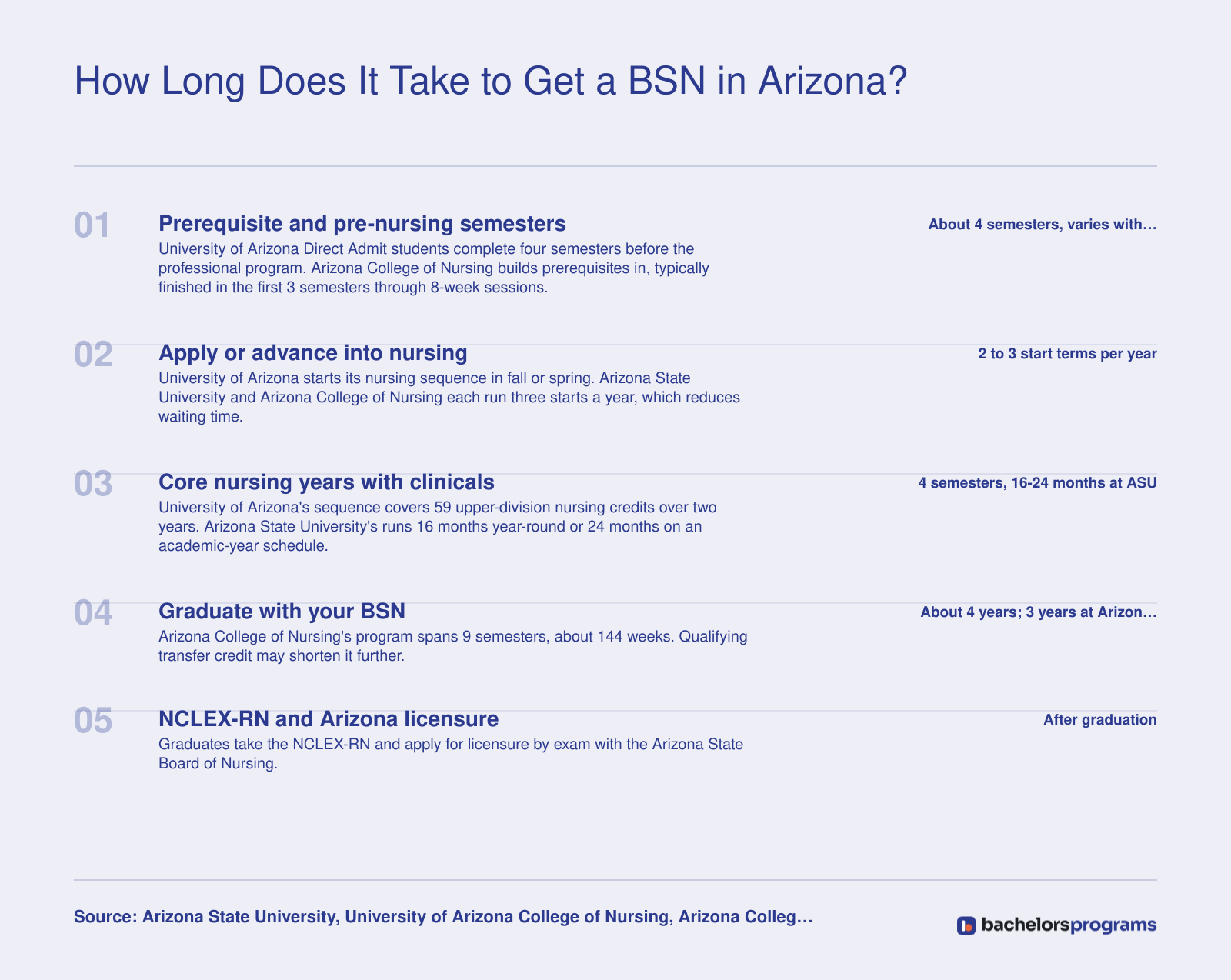
How Long Does It Take to Get a BSN in Arizona?
A traditional BSN in Arizona takes about four years, including prerequisites and the nursing sequence. Year-round schedules, multiple start terms, and transfer credit can shorten it. Fall and spring starts with no summer classes keep it closer to four years.
Related Articles
BSN Cost in Arizona: In-State Tuition, Net Price After Aid, and State Grants
What an Arizona BSN really costs you is set by net price, not sticker price. Tuition is the published rate. Net price is what an average student pays after grants and scholarships, and the two can sit far apart.
Sticker Price vs. Net Price
Arizona State University lists Fall 2026 resident undergraduate tuition at $6,089 for students taking 7 or more hours, before fees.2 Total tuition and fees run from $6,768 to $7,363 depending on campus and student category.3 Private schools generally publish higher sticker prices, so compare their net price figures rather than their tuition pages.
The net prices in the data are institution-wide averages, not quotes for a nursing program. Even so, they show the spread. Pima Community College averages $3,405, Central Arizona College $4,714, and Mohave Community College $5,974. Pell share hints at how much grant aid is typical: about 91 percent of Pima students and 93 percent of Central Arizona students receive Pell Grants. A high Pell share means aid is common there, though your own award depends on your FAFSA.
Arizona State Aid
The Arizona Promise Program, run through the Arizona Board of Regents, is a last-dollar scholarship at ASU, Northern Arizona University, and the University of Arizona.1 It covers tuition and fees left after other aid, but not housing, meals, parking, or books.1 Eligibility requires:
- Arizona residency
- An Arizona high school diploma
- A GPA of at least 2.5
- Pell Grant eligibility
File the FAFSA by April 1 of senior year for priority.1 For other state grants or nursing-specific scholarships and loan-repayment programs, confirm current rules with each school's financial aid office and the Arizona Commission for Postsecondary Education before counting on them.
Costs Beyond Tuition
BSN students should also budget for clinical fees, uniforms, background checks and fingerprinting, and NCLEX and licensure fees. Amounts vary by school, so ask each program for its list.
The table ranks the most affordable options by net price.
Most Affordable BSN Programs in Arizona by Net Price
These are the lowest-cost options on this page, sorted by average net price after aid (institution-wide), drawn from 2024 U.S. Department of Education IPEDS and College Scorecard data. Every school here except University of Phoenix-Arizona is public, and the community colleges post in-state tuition under $3,000 a year. Most of these lowest-cost programs are RN to BSN tracks that require an active RN license, so Northern Arizona University is the option here for students starting a traditional BSN. On NCLEX-RN results, GateWay Community College (97.4 percent), Cochise College (96 percent), Northern Arizona University (88.8 percent) and Yavapai College (84.2 percent) pair low cost with strong licensure outcomes. See the ranking above for how each compares.
| School | City | Sector | Program Entry | In-State Tuition and Fees | Average Net Price After Aid (Institution-Wide) |
|---|---|---|---|---|---|
| Cochise County Community College District (Cochise College) | Sierra Vista | Public | RN to BSN (RN license required) | $2,280 | $7,929 |
| Yavapai College | Prescott | Public | RN to BSN (RN license required) | $2,948 | $8,683 |
| GateWay Community College | Phoenix | Public | RN to BSN (RN license required) | $2,358 | $13,339 |
| University of Phoenix-Arizona | Phoenix | Private for-profit | RN to BSN (RN license required) | $9,552 | $13,520 |
| Northern Arizona University | Flagstaff | Public | Traditional BSN (accelerated option also offered) | $13,009 | $14,158 |
Top Program-Level Earnings Among Arizona BSN Graduates
Among the BSN programs with federal earnings data, Grand Canyon University's graduates post the highest program-level median.
Arizona RN Licensure by Exam at a Glance
Quick Answers for Arizona BSN Applicants
Which Arizona BSN programs have the strongest NCLEX-RN results?
Is it hard to get into a BSN program in Arizona?
Are there campus BSN programs in both Phoenix and Tucson?
Compare Bachelor of Science in Nursing (BSN) programs on the data that matters
Explore more Nursing majors or browse every field of study.
All Nursing programs Browse every field of study