Best Accelerated BSN (ABSN) Programs in Arkansas
Compare 4 accredited Accelerated BSN (ABSN) programs in Arkansas, with net price after aid, graduation rates, earnings and debt from IPEDS and the U.S. College Scorecard.
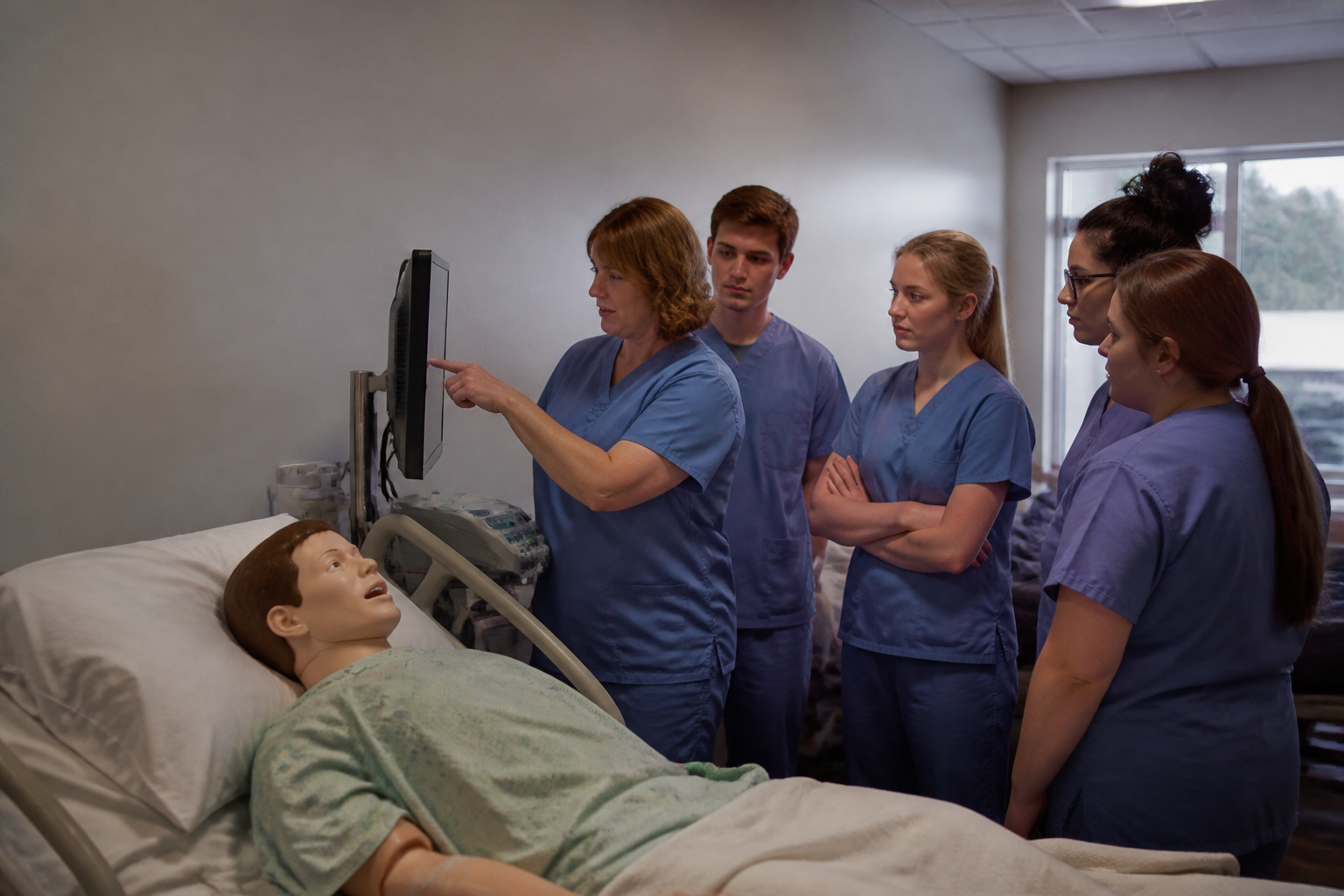
In Arkansas, a bachelor's degree in another field is a head start toward becoming a registered nurse, not a sunk cost. Accelerated BSN programs credit that prior degree and compress the nursing core into roughly 12 to 18 months of full-time study, ending in eligibility for the NCLEX-RN.
The tradeoff is intensity. Arkansas State University's hybrid ABSN packs 67 credit hours and 750 lab, clinical and field hours into 15 months, and Harding University's runs 16 months. Keeping a full-time job through either schedule is rarely realistic.
Timing is the other constraint. The University of Arkansas for Medical Sciences sets a March 1 application deadline, so prerequisite science courses must be finished or underway well before that date.
Key Points
- Harding University charges every ABSN student the same $25,962 annual rate.
- Arkansas State's hybrid ABSN still requires 750 in-person lab and clinical hours.
- Apply through the Arkansas Nurse Portal about 60 days before graduation.
Arkansas's Top Accelerated BSN Programs in Arkansas
Four Arkansas schools admit second-degree students into an accelerated BSN, and the differences that decide the choice are financial and structural: what a career changer actually pays and how reliably students at that school finish a bachelor's degree. Three are public institutions and one is private, and every one of these programs puts students in a lab or a clinical setting in person. Each card shows the school's in-state tuition, its average net price after aid and its graduation rate, so you can compare cost and completion side by side.
Arkansas State University
#1Jonesboro, AR · $8,000 – $15,000/yr (est.)
Best for: Working adults with weekend clinical availability
Arkansas State University is a public university in Jonesboro whose accelerated BSN runs as a hybrid: didactic nursing courses online, with labs, clinicals and field hours completed in person on weekends. The school's graduation rate is 55%, and the average net price after aid is about $12,400 a year. The ABSN is billed at one flat per-credit rate for all U.S. residents, which keeps the total predictable for career changers who relocate to attend.
- Hybrid format: online didactic courses with in-person labs and clinicals
- 750 lab, clinical and field hours, including Friday through Sunday clinicals
- School arranges all clinical placements, with a possible Memphis option midway
- $20,234 total program tuition, or $302 per credit hour
- $30 application fee and financial aid available
- Cohort-based structure with two nursing start dates per year
- ACEN accredited, with NCLEX test prep built into coursework
- Bachelor's degree in any subject accepted
Harding University
#2Searcy, AR · ~$22,000/yr (est.)
Best for: Northwest Arkansas career changers
Harding University is a private Christian university in Searcy whose accelerated BSN blends online coursework with onsite labs and clinical rotations, supported by a clinical network that reaches Northwest Arkansas and a satellite location in Rogers. The school's graduation rate is 69%, and the average net price after aid is about $22,100 a year. Three start dates each year and no waitlist make it a practical choice for applicants who want to begin without sitting out a cycle.
- Hybrid model pairing online coursework with onsite labs
- Three start dates per year and no waitlist
- Simulation labs for supervised practice before patient care
- Clinical rotations at Northwest Arkansas health care facilities
- Dedicated admissions counselors from the first inquiry
- Requires 64 non-nursing credits or a prior bachelor's degree
- Accelerated Bachelor of Science in Nursing accredited by the ACEN
University of Arkansas for Medical Sciences
#3Little Rock, AR
Best for: Students seeking an academic medical center setting
The University of Arkansas for Medical Sciences is the state's academic health sciences university, and its accelerated BSN is based at the Northwest Regional Campus in Fayetteville rather than in Little Rock, so students train inside a health sciences center without leaving Northwest Arkansas. The program is a full-time, campus-based cohort for people who already hold a bachelor's degree in another field. Monthly information sessions walk prospective applicants through the process before the October application window opens.
- Full-time, campus-based cohort at the Northwest Regional Campus in Fayetteville
- No entrance exam required for admission
- 58 hours of prerequisite coursework before entry
- Clinical rotations across Northwest Arkansas
- Monthly information sessions for prospective applicants
- Application opens October 1 and closes March 1
- Accredited by the Commission on Collegiate Nursing Education
- Financial aid available to qualified students
University of Arkansas-Fort Smith
#4Fort Smith, AR · ~$11,000/yr (est.)
The University of Arkansas-Fort Smith is a public regional university offering a campus-based accelerated BSN built around clinical training and simulation. The school's graduation rate is 38%, and the average net price after aid is about $10,600 a year. Applicants apply to the university and to the accelerated program separately, and the curriculum is designed to lead into graduate nursing study for students who want to continue past the RN credential.
- Full-time, immersive format with hands-on clinical training and simulation
- 120 total credit hours
- Coursework emphasizes critical thinking, evidence-based practice and holistic care
- Pathway to graduate nursing programs such as MSN, nurse practitioner or DNP
- Separate applications required to the university and to the ABSN program
- Commission on Collegiate Nursing Education accredited
- Prepares graduates for hospitals, clinics, emergency departments and home health
- Application deadline March 1
Cost & outcomes by school
Federal data for the highest-earning Accelerated BSN (ABSN) programs, independent of the ranking above. Earnings are this field's bachelor's graduates four years after completing where the Scorecard reports them, else the school's undergraduate median.
| School | Net price / yr | Grad rate | Earnings | Debt | Grads/yr | Format |
|---|---|---|---|---|---|---|
| University of Arkansas for Medical Sciences AR | — | — | $73,827 | $14,000 | 1,272 | Campus |
| Harding University AR | $22,130 | 69% | $52,876 | $26,500 | 1,610 | Hybrid |
| Arkansas State University AR | $12,366 | 55% | $42,617 | $20,500 | 3,914 | Hybrid |
| University of Arkansas-Fort Smith AR | $10,574 | 38% | $41,102 | $18,250 | 1,246 | Campus |
Sources: U.S. Department of Education. Net price, graduation rate, earnings and debt: College Scorecard (earnings and debt for this field's bachelor's graduates where reported, else school-wide); graduates: IPEDS. A dash means no figure is reported.
Cost, debt & payoff
Median earnings of this field's bachelor's graduates (4 yrs after completing, else the school's undergraduate median) vs. their median federal loan debt · U.S. College Scorecard
Across these programs the median graduate earns about $47,747 and finishes with roughly $19,375 in debt — a ratio that clears a common rule of thumb (keep debt below first-year salary). Net price and debt vary widely school to school, so check the per-school figures in the table above before you shortlist.
Who Qualifies for an Accelerated BSN in Arkansas
Accelerated nursing education has moved from a niche option for career changers to a recognized second-degree pathway, and Arkansas ABSN admissions now assume applicants have already completed college-level work.
At Arkansas State University, Harding University, the University of Arkansas for Medical Sciences, and the University of Arkansas-Fort Smith, the accelerated BSN is a second-degree track. The baseline requirement is a completed bachelor's degree in a field other than nursing. Your major is rarely the deciding factor: admissions committees look at your overall GPA and your performance in prerequisite science courses, which typically include anatomy and physiology, microbiology, chemistry, and statistics. Those courses must be finished before you enroll, and some schools require them before you apply.
Without a Bachelor's Degree
Can you get an accelerated BSN in Arkansas without a bachelor's degree? Generally no. The format condenses the upper-division nursing curriculum into 12 to 18 months on the assumption that general education and sciences are already done. Readers without a degree should compare traditional BSN and ADN routes, while licensed practical nurses can look at LPN-to-RN bridge options that award credit for experience.
The Time Commitment
Plan for full-time, year-round study. Coursework, labs, and clinical shifts are scheduled during weekdays, and the pace leaves little room for outside work. Prerequisites, GPA minimums and entrance-exam rules vary from school to school, so compare them before you apply.
How We Weighed Each Arkansas ABSN Program
You can compare ABSN programs by reputation, or by what you will pay and how students fare. This ranking takes the second approach. An accelerated BSN is a major financial commitment for career changers, and few resources put Arkansas options side by side on cost and outcomes in one place.
What We Looked At
- Published tuition: The sticker price each school lists for its accelerated BSN, including in-state and out-of-state rates where they differ.
- Average net price: What students typically pay after grants and scholarships, a closer read on real cost.
- Graduation and retention: How many students stay enrolled and finish, a signal of institutional support.
- Delivery format: Whether coursework is campus-based or hybrid, which affects relocation and scheduling.
- Earnings and debt: College Scorecard figures that show whether typical borrowing lines up with likely pay.
Where the Numbers Have Limits
Graduation rates and median debt describe each institution as a whole, not the ABSN cohort alone, so treat them as context rather than a program verdict. Net price is an approximate average that blends many students' aid packages, and your own figure may land higher or lower.
Federal data also cannot tell you how a program admits students, how long it runs or whether it holds state approval. We checked prerequisites, program length and Arkansas State Board of Nursing approval against each school's own pages and state sources. Confirm them directly before you apply, since start dates and requirements can change.
Getting Into an Arkansas ABSN: Prerequisites, GPA and Testing by School
What do you actually need on your transcript before an Arkansas accelerated BSN will consider you? Every program here assumes a completed bachelor's degree, but the details differ by school. Each figure below comes from the school's own admissions page.
Requirements School by School
- University of Arkansas for Medical Sciences: A bachelor's degree or higher is required. Applicants need 58 semester hours of general prerequisite education courses finished before admission, and those hours may come from the earlier degree. The minimum is a 2.5 in the prerequisite courses (C or better in each) and a 2.5 cumulative GPA. The ATI TEAS is not required. Applications open October 1 and close March 1, with a summer start.
- Arkansas State University: A bachelor's degree from an accredited university is required. All prerequisites must be done before you apply, each with a C or better. The minimums are a 2.5 across all undergraduate work and a 3.0 across the prerequisite courses. Entrance exam and deadline: Not published.
- Harding University: Prior bachelor's requirement, prerequisites, minimum GPA, entrance exam and deadline: Not published.
- University of Arkansas-Fort Smith: Prior bachelor's requirement, prerequisites, minimum GPA, entrance exam and deadline: Not published.
For those two schools, confirm every detail on the admissions page before you plan your coursework.
Common Prerequisites
Arkansas State's list shows the typical core: microbiology with lab, Anatomy/Physiology I and II with labs, a chemistry course with lab, statistics, two composition courses, psychology and sociology. UAMS packages similar general education work into its 58-hour total. Check each school's list against your transcript course by course.
Practical Tips
- Finish prerequisites first: Both schools with published rules expect them completed before admission, so schedule science labs well ahead of the application window.
- Watch the prerequisite GPA: Both schools set a separate floor for prerequisites, and Arkansas State's is higher (3.0) than its overall minimum. A strong degree GPA will not offset weak science grades.
- Apply early: UAMS opens applications October 1 for a summer cohort, so gather transcripts in the fall.
Related Articles
ABSN Pace and Cost in Arkansas: Program Length, Tuition and Aid
A 12-month program and a 16-month program both end at the same RN license, but the calendar and the cost along the way differ sharply.
How Long Arkansas ABSN Programs Run
The University of Arkansas for Medical Sciences lists its accelerated BSN at 12 months, though separate UAMS materials describe a 15-month schedule for the Northwest Arkansas cohort. Arkansas State runs 15 months over 67 credits, with back-to-back seven-week courses. University of Arkansas-Fort Smith also reports 15 months, across 120 total credit hours, and Harding University takes 16 months with three start dates a year. Every one is a full-time load, so confirm your cohort's calendar before committing.
What the Degree Costs
A-State publishes a flat $302 per credit for all U.S. residents, or $20,234 for the 67-credit nursing core. That covers the core only; added courses can raise it. The school says fees are included but also lists possible extra costs for Kaplan prep, testing, clinical requirements, uniforms, CPR, immunizations, liability insurance, books, the NCLEX and licensure.
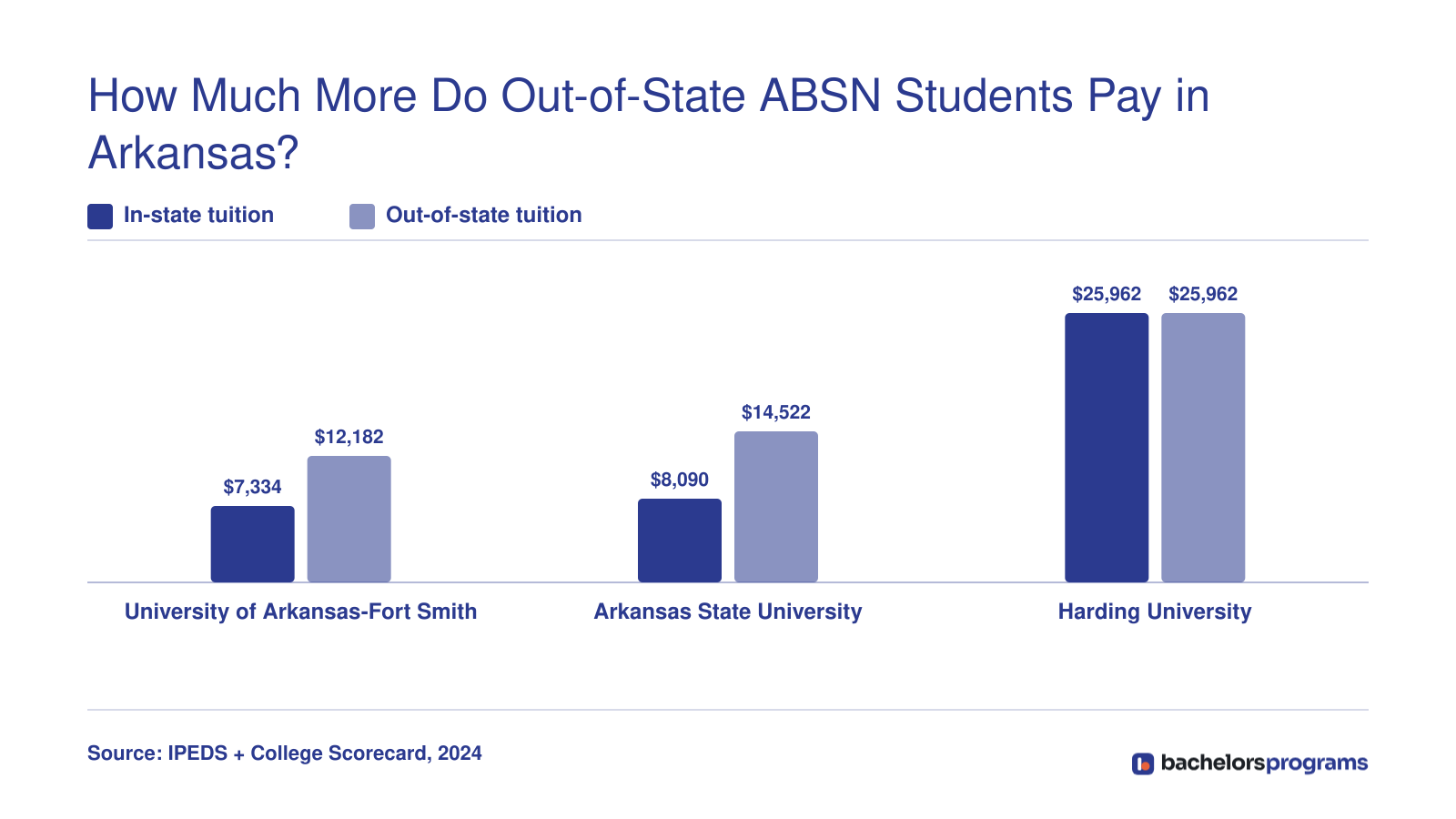
UAFS separates residency, at about $7,334 a year in state and $12,182 out of state, with a published net price near $10,574, the lowest of the schools here. Harding charges the same $26,262 either way, with a net price around $22,130. UAMS publishes no complete 2026-27 program total and has not confirmed its nursing per-credit rates for that year. Living costs are not published in a comparable form, so budget separately.
Aid for Second-Degree Students
A prior bachelor's generally rules out Pell Grants, but you can still borrow through Direct Unsubsidized loans plus Grad PLUS or Parent PLUS where applicable.
- UAMS scholarships: the College of Nursing application opens April 1 for 2026-27. In 2026 the Jones Charitable Trust funded $2,000 for each of the 25 Northwest Arkansas ABSN students, split $1,000 by semester.
- Loan programs: the Arkansas Graduate Nursing Education Student Loan and Scholarship Program (fall 2026 applications open May 11, 2026), the Nurse Faculty Loan Program, and UAMS Nurse Recruitment.
- Service forgiveness: the Chancellor's Scholarship covers up to three years in exchange for a three-year commitment to practice in Arkansas.
Median federal debt for graduates of these schools runs roughly $24,300 to $30,000.
How Much More Do Out-of-State ABSN Students Pay in Arkansas?
At the public universities, nonresidents pay a clear premium: about $4,848 more per year at University of Arkansas-Fort Smith and about $6,432 more at Arkansas State University. Private Harding University charges the same $25,962 rate to every student, so residency does not change the price. These are annual published tuition and fees before grants or scholarships, not net price, and they may differ from a specific ABSN program's per-credit charges.
Hybrid vs. Campus-Based ABSN Formats and Clinical Placements in Arkansas
Arkansas State University's accelerated BSN moves its didactic courses online, yet students still complete 750 combined lab, clinical and field hours in person over 15 months. Simulation, skills labs and hospital rotations all happen face to face, and no accelerated BSN on this list is fully online.
What Hybrid Means at Arkansas Schools
A-State and Harding are both listed as hybrid programs, while UAMS and UAFS are campus-based. At A-State, lectures and coursework are online while lab and simulation sessions run in Jonesboro; the first two practicum courses use simulation before students step onto hospital floors. Harding pairs flexible online coursework with required on-site labs in Searcy.
Where Clinicals Happen
A-State arranges placements for students rather than requiring them to source sites. Rotations run in Jonesboro and across Northeast Arkansas, with a possible Memphis option partway through. Early clinicals fall on set Friday-to-Sunday weekends; from the second term, shifts run 12 hours a day and can land on any day. Each practicum credit equals 30 in-person hours.
UAMS coordinates clinical education in Northwest Arkansas around its Fayetteville campus. UAFS delivers hands-on clinical and simulation training on campus or at program-arranged in-person sites, with facilities assigned by the program rather than the student.
On-Campus Time and Relocation
Plan for repeated travel or an actual move. A-State's lab work is anchored in Jonesboro, Harding's in Searcy, UAMS's in Fayetteville and UAFS's in Fort Smith. If you live outside those regions, assume in-person attendance continues throughout the program, not just at orientation, and ask each school how many campus days a semester requires before you commit.
What Arkansas BSN Completers Earn One Year Out
Federal outcomes data tracks how nursing bachelor's graduates fare in the job market.
Arkansas Board of Nursing Approval and NCLEX-RN Licensure for ABSN Graduates
Board approval is the single credential that turns a nursing degree into a license: only graduates of programs approved by the Arkansas State Board of Nursing are eligible to apply for the NCLEX-RN in Arkansas. Accreditation from CCNE or ACEN sits alongside that approval and matters for graduate school admission, military and federal employment, and transfer of credit later on.
Checking Approval and Accreditation
Arkansas State University's Accelerated BSN Hybrid is ACEN-accredited, under an accreditation that covers the university's nursing programs at State University and West Memphis1. For Harding University, the University of Arkansas for Medical Sciences and the University of Arkansas-Fort Smith, confirm current accreditor and Board standing directly on each school's nursing page and on the Board's program roster before you deposit. Approval status can change between catalog cycles, so verify it in the year you intend to enroll rather than trusting a screenshot from an older application season.
What the Pass-Rate Question Really Needs
First-time NCLEX-RN pass rates for these specific accelerated cohorts are not published here, and a statewide figure tells you little about a small second-degree class. The Arkansas State Board of Nursing is the authoritative source for exam outcomes, and admissions staff will usually share recent cohort results on request.
The Path From Graduation to License
- Apply twice: Submit the licensure-by-examination application and fees through the Arkansas Nurse Portal, and register with Pearson for the NCLEX-RN before or at the same time.
- Background checks: Arkansas requires state and federal checks, fingerprinted by approved LiveScan (ink cards are not accepted). Checks must be no older than 12 months, come through the Board itself, and clear before a permanent license is issued. Offenses listed in ACA 17-3-102 can bar licensure, though a waiver is sometimes possible.
- Test and license: Once eligible, you receive an Authorization to Test, sit for the NCLEX-RN, and the Board issues the RN license. Arkansas participates in the Nurse Licensure Compact, so residents may qualify for a multistate license.
Arkansas RN Licensure at a Glance
Compare Accelerated BSN (ABSN) programs on the data that matters
Explore more Nursing majors or browse every field of study.
All Nursing programs Browse every field of study