Best BSN Programs in Arkansas
Compare 19 accredited Bachelor of Science in Nursing (BSN) programs in Arkansas at 15 colleges, with net price after aid, graduation rates, earnings and debt from IPEDS and the U.S. College Scorecard.
A BSN pays off only when it ends in an RN license, and in Arkansas that comes down to one exam. First-time NCLEX-RN pass rates among the nursing programs ranked here span 91.5% to 98.9%, a spread wide enough to reshape a graduate's first year.
The ranking covers traditional pre-licensure BSN programs at Arkansas schools and orders them mainly by that pass result, with net price, early graduate earnings, admission requirements and Board of Nursing approval as secondary factors.
Arkansas hospitals hire on licensure, not on the diploma. A failed first attempt means remediation, a delayed start date, and a delayed paycheck.
Key Points
- First-time NCLEX-RN results from three recent years drive the ranking.
- University of Arkansas at Little Rock tops early BSN graduate earnings.
- Arkansas BSN admission usually happens after prerequisites, not at freshman enrollment.
Best NCLEX-RN Outcomes: 10 Arkansas BSN Programs Ranked for 2027
The ten programs below are ordered by first-time NCLEX-RN pass rates reported to the Arkansas State Board of Nursing across the three most recent testing years, weighted by the size of each testing cohort. Accreditation status and completion and retention results break ties among schools that land close together. Every entry is a traditional pre-licensure BSN taught on an Arkansas campus; licensed RNs should see our RN-to-BSN page, and career changers who already hold a bachelor's degree should look at our accelerated BSN page.
Arkansas Tech University
#1Russellville, AR · $10,000 – $15,000/yr (est.) · NCLEX-RN pass rate 98.9% (3-yr weighted avg)
Best for: LPNs seeking advanced placement into a BSN
Arkansas Tech pairs one of the state's larger nursing pipelines with unusually broad entry points: high school graduates, LPNs, and licensed RNs all have a route into the BSN. The Russellville campus runs simulation labs and clinical rotations at regional health care facilities, and the program carries both ACEN accreditation and Arkansas State Board of Nursing approval. Acceptance is close to open at roughly 96 percent, and about three quarters of first-year students return, which makes it an accessible high performer on this list.
- ACEN accredited and approved by the Arkansas State Board of Nursing
- Clinical simulation labs plus rotations at partner health care facilities
- Open to high school graduates, LPNs, and licensed RNs
- LPNs receive advanced placement into the program
- Full-time and part-time options available
- Three concentration options
- Prepares graduates to sit for the NCLEX-RN
Harding University
#2Searcy, AR · ~$22,000/yr (est.) · NCLEX-RN pass rate 96.8% (3-yr weighted avg)
Best for: Faith-driven students wanting mission-based clinicals
Harding has run a nursing program in Searcy since 1975, and its BSN layers a Christian liberal arts core over a clinical sequence built around service. The traditional track carries 50 credit hours of upper-level nursing coursework plus hospital clinicals, with health care missions offering local and international placements. The university graduates about 69 percent of its students overall, and acceptance sits near 70 percent, so applicants need a stronger academic record than they do at the open-access public options.
- CCNE accredited; nursing program founded in 1975
- 50 credit hours of upper-level nursing coursework
- Clinical hours at area hospitals and modern health care facilities
- Health care missions with local and international placements
- Individualized completion plan for licensed nurses
- Honors College recognition available
- Coursework grounded in Christian principles and a global perspective
Southern Arkansas University
#3Magnolia, AR · $10,000 – $15,000/yr (est.) · NCLEX-RN pass rate 97.1% (3-yr weighted avg)
Best for: South Arkansas students wanting a nearby campus
Southern Arkansas University runs a structured pre-nursing to nursing sequence in Magnolia, and the Wharton Simulation Lab gives students hospital-style practice before they ever reach a patient. Clinical placements send students to partner facilities across Arkansas and Texas, so reliable transportation matters. The university admits roughly three quarters of applicants and graduates about half of its students, which makes it a workable option for applicants with a solid science background and a HESI A2 score to match.
- ACEN accredited; 120 total credit hours
- Pre-nursing foundation in sciences, math, and general education
- Wharton Simulation Lab built to feel like a working hospital
- Clinical placements at partner facilities in Arkansas and Texas
- HESI A2 entrance exam required for admission
- Minimum GPA required in nursing science core courses
- Criminal background check and drug screening required
- Students travel to clinical sites across two states
Ouachita Baptist University
#4Arkadelphia, AR · $20,000 – $25,000/yr (est.) · NCLEX-RN pass rate 96.1% (2-yr weighted avg)
Ouachita Baptist blends a liberal arts core with a Christian perspective, and its nursing building includes simulated hospital rooms and high-fidelity manikins. Students train alongside 15 regional health care partners, and dual-degree options in Psychology or Spanish let strong students add a second credential without extending their time much. Classes stay small in Arkadelphia, and the university graduates about 61 percent of its students overall.
- ACEN accredited four-year BSN
- Nursing Education Center with simulated hospital rooms
- High-fidelity manikins for simulation practice
- Clinical partnerships with 15 regional health care providers
- Dual-degree options in Psychology or Spanish
- Faculty bring 118 years of combined nursing experience
- Coursework includes pathophysiology, community health, and transcultural nursing
University of Arkansas-Fort Smith
#5Fort Smith, AR · ~$11,000/yr (est.) · NCLEX-RN pass rate 94.6% (3-yr weighted avg)
UAFS runs a 120-credit BSN on a Fort Smith campus with a simulation center and clinical placements across the River Valley. Daytime classes and weekend or evening scheduling give working students a way to keep a job while enrolled, and the university advertises employer tuition reimbursement support alongside foundation scholarships. It posts one of the lower net prices on this list and tests a large cohort, which makes the pass rate here statistically sturdy.
- CCNE accredited; 120 total credit hours
- Traditional daytime track plus weekend and evening scheduling
- State-of-the-art simulation center and hands-on clinicals
- Two-step application process; full-time study required
- Employer tuition reimbursement supported
- Coursework covers leadership, evidence-based practice, and culturally sensitive care
- Scholarships and financial aid support available
University of Arkansas for Medical Sciences
#6Little Rock, AR · NCLEX-RN pass rate 91.5% (3-yr weighted avg)
UAMS is the state's academic health sciences center, and its traditional BSN starts only after 58 semester hours of prerequisites, so students arrive at nursing coursework with the sciences already finished. Clinical learning happens inside a large teaching hospital system in Little Rock, and the College of Nursing produces graduating classes among the biggest in Arkansas. Faculty practice and teach in the same health system, which gives students a direct view of how hospital care is actually run.
- Traditional BSN track based in Little Rock
- 58 semester hours of prerequisites before nursing coursework
- Clinical placements within a leading academic health center
- Two concentration options
- Part of Arkansas's academic health sciences center
- Prepares graduates for RN licensure and practice
University of Arkansas at Monticello
#7Monticello, AR · ~$14,000/yr (est.) · NCLEX-RN pass rate 91.2% (3-yr weighted avg)
UAM lays out the BSN as a nine-semester, 120-credit plan that moves from prerequisites into adult, maternal, pediatric, mental health, and population health nursing. A capstone and a dedicated NCLEX preparation component close the sequence, and clinical practicums run throughout rather than clustering at the end. The program holds students to a C-or-better standard in every nursing course, which keeps cohort progress predictable on a small Delta campus.
- Nine-semester, 120-credit plan of study
- Capstone course with dedicated NCLEX preparation
- Clinical practicums across acute, maternal, pediatric, and community settings
- Courses cover adult nursing, mental health, and population health
- Prerequisites require a C or better; no grade below C in nursing courses
- Leadership, research, and evidence-based practice built into the curriculum
University of Arkansas at Little Rock
#8Little Rock, AR · $17,000/yr (est. net price) · NCLEX-RN pass rate 90.3% (3-yr weighted avg)
UA Little Rock structures nursing as a ladder: three years of classroom, clinical, and simulation work in a dedicated simulation hospital, then a final year that can be completed online while graduates work as RNs. That design produces the heaviest NCLEX-RN testing volume in the state, so its results rest on far more candidates than most schools here can show. The metro campus draws commuters and working adults, and roughly 42 percent of students finish a degree.
- Ladder pathway combining an AAS with BSN completion
- Eligible to sit for the NCLEX-RN after year three
- Final BSN year delivered online
- State-of-the-art simulation hospital on campus
- 34 upper-level nursing credits completed online
- Topics include leadership, research, ethics, economics, and wellness
- Students can work as RNs while finishing the degree
University of Central Arkansas
#9Conway, AR · $15,000 – $20,000/yr (est.) · NCLEX-RN pass rate 89.3% (3-yr weighted avg)
UCA runs a CCNE-accredited, Arkansas State Board of Nursing-approved BSN on a residential campus in Conway, about 30 miles north of Little Rock. The curriculum pairs classroom instruction with clinical placements and leans on health sciences facilities and a sizable full-time faculty. Acceptance is comparatively open at around 89 percent, and the university graduates about 54 percent of its students.
- CCNE accredited and approved by the Arkansas State Board of Nursing
- Clinical experiences paired with classroom instruction
- Builds patient care, health assessment, and critical thinking skills
- Access to health sciences facilities and dedicated faculty
University of Arkansas
#10Fayetteville, AR · ~$18,000/yr (est.) · NCLEX-RN pass rate 88.3% (3-yr weighted avg)
The Eleanor Mann School of Nursing has offered its pre-licensure BSN since 2004 and runs it full time over four years: three semesters of prerequisites, then five semesters of sequenced nursing courses with no summer term. Clinical and practicum shifts rotate through hospitals, specialty clinics, and community sites across Arkansas, with simulation using standardized patients, manikins, and screen-based or VR scenarios. Students arrange their own transportation to clinical sites, many of which sit outside Northwest Arkansas, and the university graduates about 71 percent of its students.
- Full-time, on-campus pre-licensure track
- Three semesters of prerequisites, then five semesters of nursing courses
- Clinical and practicum shifts at hospitals, specialty clinics, and community sites
- Simulation with standardized patients, manikins, and screen-based or VR scenarios
- Students provide their own transportation to clinical sites
- No summer semester coursework
- Nursing program launched in 2004
Cost & outcomes by school
Federal data for the highest-earning Bachelor of Science in Nursing (BSN) programs, independent of the ranking above. Earnings are this field's bachelor's graduates four years after completing where the Scorecard reports them, else the school's undergraduate median.
| School | Net price / yr | Grad rate | Earnings | Debt | Grads/yr | Format |
|---|---|---|---|---|---|---|
| University of Arkansas for Medical Sciences AR | — | — | $73,827 | $14,000 | 1,272 | Campus |
| University of Arkansas AR | $18,209 | 71% | $58,191 | $21,500 | 12,696 | Campus |
| John Brown University AR | $20,397 | 72% | $53,907 | $21,250 | 762 | Campus |
| Harding University AR | $22,130 | 69% | $52,876 | $26,500 | 1,610 | Campus |
| Ouachita Baptist University AR | $22,409 | 61% | $51,673 | $21,050 | 954 | Campus |
| University of Central Arkansas AR | $16,511 | 54% | $45,938 | $20,346 | 3,418 | Campus |
| University of Arkansas at Little Rock AR | $17,248 | 42% | $45,265 | $22,000 | 1,838 | Hybrid |
| Henderson State University AR | $23,405 | 37% | $43,459 | $19,500 | 604 | Campus |
| Arkansas State University AR | $12,366 | 55% | $42,617 | $20,500 | 3,914 | Campus |
| Southern Arkansas University AR | $14,027 | 49% | $42,386 | $18,750 | 1,090 | Campus |
| Arkansas Tech University AR | $12,970 | 49% | $41,766 | $21,000 | 1,980 | Campus |
| University of Arkansas-Fort Smith AR | $10,574 | 38% | $41,102 | $18,250 | 1,246 | Campus |
Sources: U.S. Department of Education. Net price, graduation rate, earnings and debt: College Scorecard (earnings and debt for this field's bachelor's graduates where reported, else school-wide); graduates: IPEDS. A dash means no figure is reported.
Cost, debt & payoff
Median earnings of this field's bachelor's graduates (4 yrs after completing, else the school's undergraduate median) vs. their median federal loan debt · U.S. College Scorecard
Across these programs the median graduate earns about $43,459 and finishes with roughly $21,050 in debt — a ratio that clears a common rule of thumb (keep debt below first-year salary). Net price and debt vary widely school to school, so check the per-school figures in the table above before you shortlist.
Behind the List: Why NCLEX-RN Results Carry the Most Weight
The licensing exam is the one outcome every Arkansas nursing graduate shares. A BSN diploma does not become an RN license until the NCLEX-RN is passed, which is why that result anchors the list above.
How the Score Is Built
The first-time NCLEX-RN pass rate makes up about 75% of each school's score. It draws on the latest three years of results from the Arkansas State Board of Nursing. Accreditation and a small completion and retention component make up the rest.
Each year counts in proportion to how many graduates sat for the exam. That matters because a small cohort can post a perfect year on a handful of test takers, while a large program has to sustain strong results across many more students. Weighting by takers keeps one lucky class from outranking a program that delivers consistently.
What the Score Leaves Out
Prestige surveys and faculty counts do not enter the score. Neither do cost or earnings. Those have their own sections, so you can re-sort the schools by what matters most: price, pay, or location.
A Note on the Data
Graduation rates and earnings figures come from the College Scorecard. Some of those numbers describe the whole institution rather than the nursing program alone. Read them as useful context for comparing campuses, not as a forecast for any single nursing cohort.
Cheapest BSN Schools in Arkansas: 5 Lowest Net Prices
University of Arkansas-Fort Smith posts the lowest average net price among the schools here at $10,574 a year, followed by Arkansas State University at $12,366, based on federal IPEDS and College Scorecard data. Net price is an institution-wide average of what students pay for tuition, housing, food, and books after grants, which is why it can run above the tuition column, and your own figure will depend on your family's income. Nursing fees sit on top of base tuition: UAFS charges a $40 per-credit program fee plus a $195 assessment fee, and the University of Arkansas lists a $722 nurse testing fee and a $300 clinical compliance fee for pre-licensure BSN students.
| Rank | School | City | Average Net Price After Aid | Published In-State Tuition and Fees |
|---|---|---|---|---|
| 1 | University of Arkansas-Fort Smith | Fort Smith | $10,574 | $7,334 |
| 2 | Arkansas State University | Jonesboro | $12,366 | $8,090 |
| 3 | University of Arkansas at Pine Bluff | Pine Bluff | $12,653 | $9,375 |
| 4 | National Park College | Hot Springs | $12,720 | $6,050 |
| 5 | Arkansas Tech University | Russellville | $12,970 | $8,674 |
Related Articles
Arkansas BSN Admissions: Prerequisites, GPA, and Direct vs. Upper-Division Entry
Admission to a traditional BSN in Arkansas is usually decided after prerequisites, not at freshman enrollment. Policies change, so confirm every detail on the school's nursing admissions page before you apply.
Two Entry Models
Direct admit means freshmen enter the nursing major from day one. Upper-division means you complete about two years of prerequisites, then apply to the nursing program. The schools whose admissions pages we could confirm are all upper-division: University of Arkansas, University of Arkansas for Medical Sciences (UAMS), and University of Arkansas-Fort Smith. Southern Arkansas University also requires its pre-nursing curriculum before admission. We could not verify the entry model for Arkansas Tech, Harding, Ouachita Baptist, Arkansas State, University of Central Arkansas or the other schools here, so check each page directly.
GPA, Prerequisites, and Testing
- University of Arkansas: 3.0 GPA for consideration, sophomore standing (29 credit hours), ATI TEAS (up to four attempts in 12 months, no minimum score stated), and a Casper assessment.1
- UAMS: 58 semester hours of general prerequisites, a 2.5 GPA, and a C or better in each. TEAS requires 60% unless you hold a bachelor's degree or have a 3.4 cumulative and prerequisite GPA. Take it before March 1 of your application year.
- UA Fort Smith: 2.50 cumulative GPA, a C or better in prerequisites, and 62 hours across the first four semesters. We found no TEAS policy.
- Southern Arkansas University: 2.9 GPA minimum and a HESI entrance exam.
Prerequisites commonly include anatomy and physiology, microbiology, chemistry, and statistics, but exact course lists vary by school. Competitive GPAs are not published for most schools here, so treat each minimum as a floor.
Deadlines and Program Length
University of Arkansas opens its Fall 2027 application on December 15, 2026.1 UAMS ties its testing timeline to March 1. We could not confirm deadlines or start terms for the other schools. A traditional BSN totals 120 credit hours at the University of Central Arkansas and the University of Arkansas, and 122 at Arkansas State University. Harding lists 50 credit hours of upper-level nursing coursework. Expect the nursing major itself to run roughly four semesters after admission, though most schools' exact semester counts are not confirmed here.
One Practical Tip
Prerequisite science grades often matter more than overall GPA. UAMS, for instance, calculates its entering GPA from required general-education prerequisites rather than electives. A strong A in anatomy and physiology or microbiology does more for your file than a high GPA padded with easy electives. Retaking a weak science grade early is usually worth it.
How Selective Are the Top-Ranked Arkansas BSN Schools?
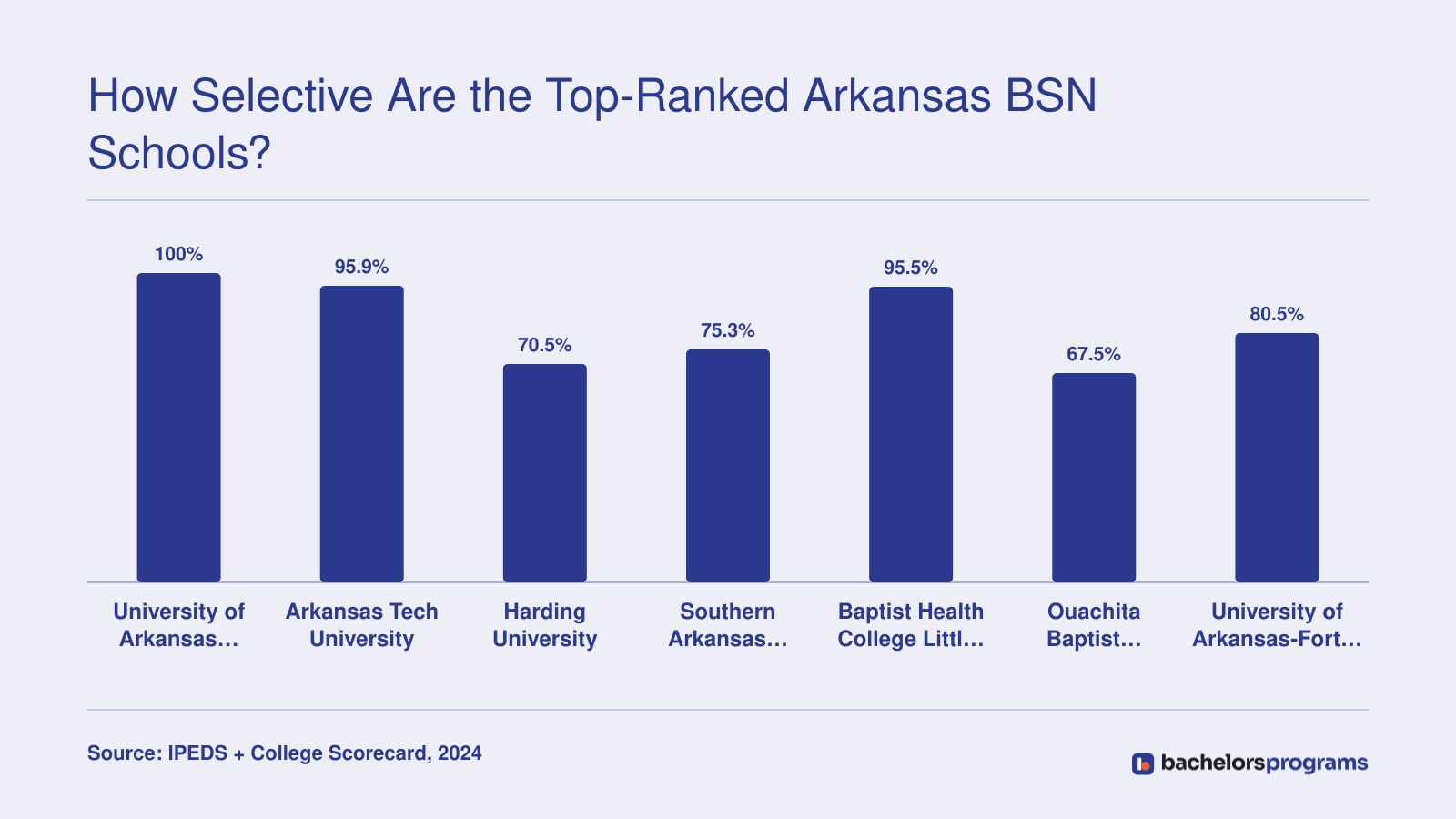
These bars show university-wide acceptance rates, not nursing program admission rates. Most schools here admit a large share of campus applicants, but upper-division BSN programs run their own application after prerequisites are complete, and that step is usually more competitive. A high campus acceptance rate does not guarantee a nursing seat, so check each school's GPA minimum, entrance exam and entry model in the admissions section above.
Paying for a BSN in Arkansas: Tuition, Net Price, and State Grants
Tuition gets the attention, but the figure that decides your budget is net price: what you actually pay once grants and scholarships land. Arkansas publishes both numbers, and the state's aid programs can shift a four-year BSN plan by thousands of dollars.
In-State Tuition vs. Net Price
At the lowest-cost public colleges on this list, published in-state tuition runs from about $2,850 to just over $5,000 a year. Average net price after aid at those same campuses falls between roughly $4,400 and $9,000, which shows how far the sticker price can drift from the real bill. Private universities such as Harding, Ouachita Baptist, and John Brown sit outside the low-cost group, so plan on a higher published rate there and confirm current tuition with each campus directly.
Arkansas Academic Challenge Scholarship
The Academic Challenge is not income-limited, but you must file the FAFSA.1 Eligibility requires Arkansas residency for at least 12 months before enrolling, U.S. citizenship or lawful permanent residence, enrollment in an approved Arkansas program, no prior bachelor's degree, and a 2.5 cumulative GPA.1 Full-time students need 15 credit hours per semester for the full award; 6 to 8 hours earns half.2 The deadline is July 1 each year.1
Four-year amounts step up annually: $2,000, then $4,000, $4,000, and $5,000 in year four.1 Approved nursing programs running on a two-year schedule receive $2,000 and $3,000.3 The state has also announced an ACCESS expansion tied to the Diploma of Merit or qualifying GPA and test scores, with first implementation expected in Fall 2026.
Governor's Distinguished Scholarship
Graduating high school seniors with a 3.5 GPA plus either a 32 ACT composite or 1410 SAT can apply for up to $10,000 a year across four years, a maximum of $40,000, usable toward tuition, mandatory fees, room, and board.4 The deadline is March 1, and the FAFSA is required.4
Budgeting Past Tuition
Budget for lab and program fees, uniforms and clinical shoes, immunizations and background checks, and NCLEX-RN registration plus Arkansas licensure fees across the four years rather than treating them as surprises. A semester-by-semester spreadsheet that matches each aid disbursement to those costs keeps the plan realistic.
First-Year Paycheck for Arkansas BSN Graduates
Among the BSN programs ranked here, University of Arkansas at Little Rock reports the highest early earnings for its nursing graduates.
Arkansas RN Licensure Essentials
Arkansas BSN Questions Prospective Students Ask
These answers cover the questions Arkansas nursing applicants raise most often. For school-specific figures, check the ranking and cost table above, then confirm details on each program's own admissions page.
Which Arkansas BSN program has the highest NCLEX-RN pass rate right now?
Which BSN school in Arkansas costs the least after financial aid?
How many years does a traditional BSN take in Arkansas?
What GPA and prerequisites do Arkansas BSN programs expect?
Must an Arkansas BSN program be approved by the State Board of Nursing for me to sit for the NCLEX-RN?
Does an Arkansas RN license let me practice in other compact states?
Can out-of-state students afford an Arkansas BSN?
Can I take prerequisites at an Arkansas community college and transfer into a BSN?
Compare Bachelor of Science in Nursing (BSN) programs on the data that matters
Explore more Nursing majors or browse every field of study.
All Nursing programs Browse every field of study