Best Accelerated BSN (ABSN) Programs in California
Compare 19 accredited Accelerated BSN (ABSN) programs in California, with net price after aid, graduation rates, earnings and debt from IPEDS and the U.S. College Scorecard.
A bachelor's in a non-nursing field can get you to an RN license in as little as 15 months in California, but the fastest seats are the hardest to win. Cal State LA lists a 15-month ABSN with a total program cost of about $39,615 once related fees and expenses are included, while San Francisco State admits about 40 students a year.
Annual in-state tuition and fees run from about $7,160 to $22,506, and average net prices from under $4,000 to nearly $33,000. Most programs are on campus; San Diego State is hybrid.
All of them lead to the same BRN-approved route to the NCLEX-RN, so cost and cohort size do most of the sorting.
Key Points
- In-state tuition starts near $7,000 a year at Cal State LA.
- SF State, CSUN and Cal State LA each run about 15 months.
- Samuel Merritt graduates post the highest first-year earnings among ranked schools.
Top 10 Accelerated BSN Programs in California for Bachelor's Degree Holders
Ten California schools admit bachelor's degree holders into an accelerated BSN, and they differ sharply in price, pace and selectivity. Several are California State University campuses with in-state tuition well below the private and for-profit schools here; others run shorter calendars but charge per unit at a higher rate. Each card shows the program details alongside school-wide admission and graduation rates, so you can compare fit and cost side by side.
San Diego State University
#1San Diego, CA · $15,000/yr (est. net price)
Best for: Hybrid learners wanting San Diego clinicals
San Diego State pairs a large public university setting with a hybrid ABSN that runs year-round for about 18 months. Didactic classes are online, lab work happens in person at a new Chula Vista facility, and clinical placements put students in regional acute care and community agencies. It is the only program here that states plainly that no entrance exam is required, though it is still pending California BRN approval and CCNE accreditation, so confirm status before you commit.
- Cohort-based program for holders of a bachelor's in any field
- 55 nursing units over 5 semesters, about 18 months
- Hybrid: online didactic with in-person labs in Chula Vista
- At least 900 clinical practicum hours at regional agencies
- 3.0 cumulative GPA and eight prerequisites; no entrance exam
- $1,362 per unit plus a $70 Cal State Apply fee
- Year-round schedule with 8-week summer courses
- Pending California BRN approval and CCNE accreditation
California State University-Fullerton
#2Fullerton, CA · $7,000 – $20,000/yr (est.)
Best for: Career changers wanting a campus-based fall start
Cal State Fullerton runs a two-year accelerated BSN on campus with a single fall intake each year. The School of Nursing pairs coursework with clinical placements, and graduates leave eligible to apply for the California RN license. It posts the largest recent nursing completion count of any CSU campus on this list, which usually means more clinical sites and a broader alumni network across Orange County.
- Two-year accelerated pathway for any bachelor's degree holder
- Single fall start each year
- Campus-based format in Fullerton
- Coursework combined with hands-on clinical experience
- Graduates eligible to apply for the California RN license
- CCNE accredited
Unitek College
#3Fremont, CA · $25,000/yr (est. net price)
Best for: Working LVNs moving into registered nursing
Unitek College is a private, for-profit institution in Fremont whose nursing pathway is built around licensed vocational nurses rather than career changers with a non-nursing degree. Advanced placement lets students skip the first three semesters of a standard BSN and finish in roughly two years. Classes are small, skills labs and simulated practice rooms carry the hands-on load, and tutoring plus career coaching are part of the package.
- LVN to BSN pathway with advanced placement
- Skips the first three semesters of a traditional BSN
- About two years, 82 total credit hours
- Hybrid format with skills labs and simulated practice rooms
- TEAS entrance exam required
- CCNE accredited
- Tutoring, writing and math labs, and career coaching
- Prepares students for the NCLEX-RN
California State University-Stanislaus
#4Turlock, CA · ~$6,000/yr (est.)
Stanislaus State offers one of the shorter accelerated options on this list: a 17-month, full-time second-degree track in Turlock. It asks for a 3.0 GPA and ten prerequisites including anatomy, physiology and microbiology, plus a TEAS score, so it rewards readers who plan science coursework early. Coursework spans adult health, pediatrics, maternal-child and mental health nursing, each backed by a clinical practicum, and the cohort is smaller than at the big metro CSU campuses.
- 17-month full-time Accelerated Second Degree option
- 59 total credit hours
- 3.0 GPA minimum plus ten prerequisite courses
- ATI TEAS score required for admission
- Physical exam, background check, immunizations and CPR required
- Full-time intensive track for non-nursing graduates
- CCNE accredited
California State University-Sacramento
#5Sacramento, CA · $8,000 – $21,000/yr (est.)
Sacramento State runs its accelerated second bachelor's in nursing as a collaboration with CSU Stanislaus, delivered across six semesters. The program is administered through the College of Continuing Education, so confirm how fees and financial aid are handled before you apply. Clinical placements spread across Sacramento-area acute care hospitals, outpatient clinics, schools and community agencies, giving students exposure to a wide range of populations.
- Six-semester second bachelor's program run with CSU Stanislaus
- 55 units of nursing coursework
- Administered through the College of Continuing Education
- Clinicals in hospitals, clinics, schools and community agencies
- Covers adult health, mental health, community health and leadership
- Graduates eligible for California BRN licensure
- CCNE accredited
California State University-Northridge
#6Northridge, CA · ~$7,000/yr (est.)
CSUN's accelerated BSN is a four-semester cohort program for second-degree students, run as a self-support track funded by student fees. The 3.2 GPA minimum is the highest published threshold on this list, and clinical rotations can fall on evenings and weekends, so it suits readers with flexible schedules and reliable transportation. The cohort is capped at 42 students, and the upcoming application window runs from mid-January to early March 2027.
- Four-semester cohort program, 58 total credit hours
- Minimum 3.2 GPA plus science prerequisites
- Self-support program funded through student fees
- Clinical rotations include weekends and evenings
- Cohort capped at 42 students
- Upcoming application window: January 13 to March 2, 2027
- Background check, drug screening and immunizations required
- Access to reliable transportation needed for clinicals
California State University-Los Angeles
#7Los Angeles, CA · ~$4,000/yr (est.)
Cal State LA compresses 57 semester units into 15 months with a summer start and a single cohort each year. It is administered through the College of Professional and Global Education rather than the traditional undergraduate nursing route, and it typically draws roughly 200 applicants for up to 40 seats. Applications go through NursingCAS from November 1 to January 6 for the summer intake, and the school publishes a total program cost near $39,615.
- 15-month, full-time program, 57 semester units
- Summer start with one cohort admitted per year
- Roughly 200 applicants for up to 40 places
- Administered through the College of Professional and Global Education
- NursingCAS application window: November 1 to January 6
- About $39,615 total program tuition at $695 per credit
- Financial aid and scholarships available
- Designed for non-RN bachelor's degree holders
San Francisco State University
#8San Francisco, CA · $10,000 – $15,000/yr (est.)
San Francisco State's accelerated BSN is a 15-month, four-semester track that runs through the summer. Only 40 seats open each year, prerequisites are screened at a 3.0 GPA, and the TEAS benchmark is 78 or higher, making it one of the more selective entries here. Graduates are eligible for RN licensure and for public health nursing certification in California, which opens county and community health roles that hospital-only programs do not always prepare you for.
- 15-month, four-semester track including summer
- Campus-based in San Francisco
- Highly competitive: 40 spaces per year
- 3.0 prerequisite GPA and TEAS score of 78 or higher
- $799 per credit
- California residents only; no international applicants
- Graduates eligible for public health nursing certification
- CCNE accredited
California State University-San Marcos
#9San Marcos, CA · $10,000/yr (est. net price)
Cal State San Marcos runs a five-semester accelerated BSN for non-nursing degree holders, with cohorts in both San Marcos and Temecula. The Temecula site matters if you live in the Inland Empire and want to skip a coastal commute. The program admits in fall, spring and summer, so start dates are more frequent than at most schools here, and active-duty military members receive a tuition discount.
- Five-semester program, 67 total credit hours
- 67 units at $710 per unit
- Start terms in fall, spring and summer
- Cohorts of about 60 students in San Marcos and Temecula
- Tuition discounts for active-duty military personnel
- Prerequisites completed before entry
- Cohort model with a built-in peer support network
- CCNE accredited
West Coast University-Anaheim-Orange County
#10Anaheim, CA · $33,000/yr (est. net price)
West Coast University is a private, for-profit institution, and its Anaheim campus is the Orange County site for the Accelerated Pace BSN. The track is full time and on campus, with simulation labs and clinical placements at local healthcare facilities. Note that the evening/weekend and working professional paces are offered only at the Miami campus, and the accelerated pace itself runs 39 months, noticeably longer than the CSU programs on this list.
- Accelerated Pace BSN: 120 credits over 39 months
- Full-time on-campus study with simulation labs
- Clinical experience at local healthcare facilities
- Offered at the Anaheim (Orange County) campus
- Evening/weekend and working professional paces are Miami-only
- Also lists LPN to BSN and LVN to BSN options
- Prepares students to pursue RN licensure
Cost & outcomes by school
Federal data for the highest-earning Accelerated BSN (ABSN) programs, independent of the ranking above. Earnings are this field's bachelor's graduates four years after completing where the Scorecard reports them, else the school's undergraduate median.
| School | Net price / yr | Grad rate | Earnings | Debt | Grads/yr | Format |
|---|---|---|---|---|---|---|
| Samuel Merritt University CA | — | — | $143,238 | $20,825 | 1,064 | Campus |
| West Coast University-Anaheim-Orange County CA | $32,879 | 60% | $102,672 | $32,946 | 2,566 | Campus |
| West Coast University-Center for Graduate Studies CA | — | — | $102,672 | $32,946 | — | Campus |
| West Coast University-Ontario CA | $49,590 | 39% | $102,672 | $32,946 | 1,988 | Campus |
| American University of Health Sciences CA | — | 50% | $93,610 | $40,326 | 208 | Campus |
| Unitek College CA | $25,179 | 73% | $79,550 | $10,700 | 826 | Hybrid |
| Mount Saint Mary's University CA | $21,413 | 53% | $72,379 | $25,949 | 826 | Campus |
| San Francisco State University CA | $12,278 | 50% | $68,077 | $15,371 | 9,798 | Campus |
| Concordia University-Irvine CA | $28,115 | 58% | $65,083 | $24,247 | 844 | Campus |
| San Diego State University CA | $15,364 | 76% | $64,909 | $15,000 | 18,504 | Hybrid |
| California State University-Sacramento CA | $9,338 | 56% | $64,876 | $15,000 | 14,568 | Campus |
| Westmont College CA | $29,053 | 70% | $64,778 | $23,250 | 830 | Campus |
Sources: U.S. Department of Education. Net price, graduation rate, earnings and debt: College Scorecard (earnings and debt for this field's bachelor's graduates where reported, else school-wide); graduates: IPEDS. A dash means no figure is reported.
Cost, debt & payoff
Median earnings of this field's bachelor's graduates (4 yrs after completing, else the school's undergraduate median) vs. their median federal loan debt · U.S. College Scorecard
Across these programs the median graduate earns about $64,909 and finishes with roughly $17,350 in debt — a ratio that clears a common rule of thumb (keep debt below first-year salary). Net price and debt vary widely school to school, so check the per-school figures in the table above before you shortlist.
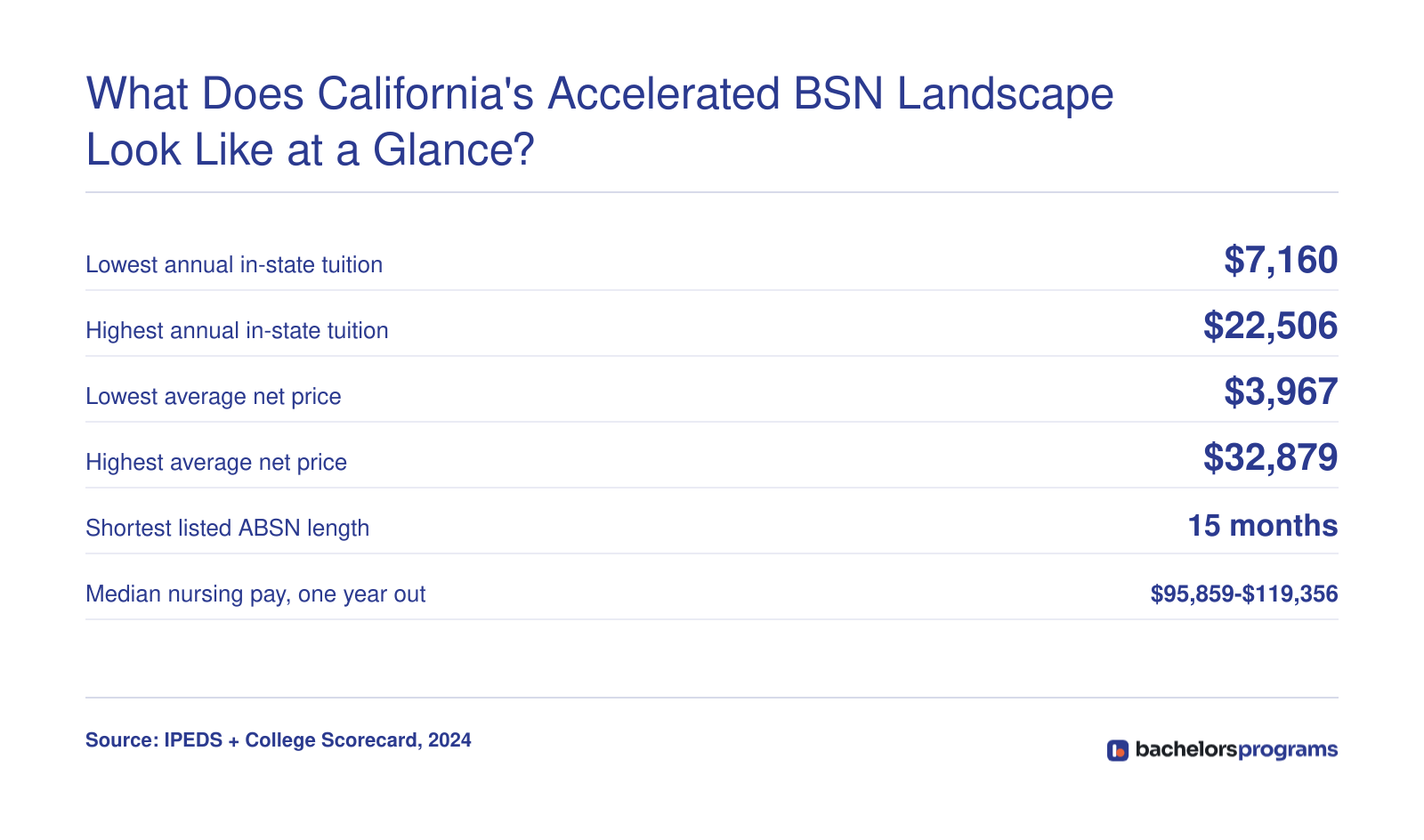
What Does California's Accelerated BSN Landscape Look Like at a Glance?
Costs among the schools ranked here vary widely. Annual in-state tuition and fees range from about $7,000 at Cal State LA to more than $22,000 at West Coast University-Anaheim-Orange County. Net price is each school's campus-wide average after grants and scholarships, so treat it as a benchmark rather than a quote for your accelerated BSN cohort.
Cheapest Accelerated BSN Programs in California
These rows are sorted by average annual net price after aid, a campus-wide figure from 2024 U.S. Department of Education data (IPEDS and College Scorecard), so treat it as a starting point rather than your exact ABSN bill: self-support tracks such as Cal State LA's charge separately, and that program lists $39,615 in total program tuition. Public CSU campuses dominate the low end, but accelerated cohorts admit a limited number of students, often with a single start date each year, so a low sticker price only helps if you can win a seat. Weigh commute, clinical schedules and your admission odds alongside cost, because a slightly pricier program you can actually get into may be the cheaper path to your RN license.
| Rank | School | Location | Average Annual Net Price After Aid | In-State Tuition and Fees (Campus-Wide) | Program Length |
|---|---|---|---|---|---|
| 1 | California State University-Los Angeles | Los Angeles, CA | $3,967 | $7,160 | 15 months |
| 2 | California State University-Stanislaus | Turlock, CA | $6,067 | $8,246 | 17 months |
| 3 | California State University-Fullerton | Fullerton, CA | $6,555 | $7,470 | 2 years |
| 4 | California State University-Northridge | Northridge, CA | $7,021 | $7,458 | 4 semesters |
| 5 | California State University-Sacramento | Sacramento, CA | $9,338 | $8,018 | 6 semesters |
Accelerated BSN Schools Whose Graduates Earn the Most
These are the ranked schools with the highest median earnings for their bachelor's-level registered nursing graduates, based on U.S. The program figures cover all of each school's nursing bachelor's completers at one and five years after completion, not accelerated BSN graduates alone. The institution-wide figure, measured 10 years after entry across every program, is included only as context about the school and does not reflect ABSN graduates' pay. Compared with the cost table above, San Francisco State, Sacramento State and Stanislaus State stand out for value: their nursing graduates earn above $115,000 one year out, and their in-state tuition runs close to $8,000 a year. Samuel Merritt's top-of-list earnings come with a much higher private price.
| Rank | School | City | Nursing bachelor's median earnings, 1 year after completion | Nursing bachelor's median earnings, 5 years after completion | Institution-wide median earnings, 10 years after entry (school context only) |
|---|---|---|---|---|---|
| 1 | Samuel Merritt University | Oakland | $119,486 | $148,857 | $143,238 |
| 2 | San Francisco State University | San Francisco | $117,532 | $144,430 | $68,077 |
| 3 | California State University-Sacramento | Sacramento | $116,001 | $138,606 | $64,876 |
| 4 | California State University-Stanislaus | Turlock | $119,356 | $122,838 | $63,188 |
| 5 | American University of Health Sciences | Signal Hill | $94,816 | $122,088 | $93,610 |
Getting Into a California Accelerated BSN: Degree, Science Prerequisites, GPA and Tests
Admission to a California accelerated BSN turns on three things: a finished degree, a clean run of science prerequisites and a GPA high enough to win a seat in a limited cohort. Most programs are built for people whose first bachelor's is in another field.
The Prior Bachelor's
Most of the schools here want a completed non-nursing bachelor's from a regionally accredited institution. Cal State LA's Fall 2026 accelerated BSN targets applicants with a non-nursing degree, and Cal State Fullerton accepts any bachelor's. Sacramento State, San Francisco State and Stanislaus State also frame their tracks around prior-degree holders. Samuel Merritt is the notable exception: its ABSN does not require a bachelor's and instead accepts 75 semester units (112.5 quarter units). Whether a degree still in progress at application is acceptable varies by school, so check each admissions page.
Science Prerequisites and Grades
Expect anatomy with lab, physiology with lab, microbiology with lab, chemistry with lab, and statistics. Cal State LA also lists critical thinking. Samuel Merritt adds nutrition to its list. Minimum grades differ:
- Cal State LA: C or better in prerequisites, B or better in the four lab sciences, all four finished by the end of the preceding fall term.
- Samuel Merritt: C or better in every prerequisite.
Recency windows for science courses are set school by school, and some programs enforce them, so confirm the limit before you enroll in a class.
GPA and Entrance Exams
A 3.0 is the common benchmark. Cal State LA treats 3.0 as preferred overall and as the minimum for your last 60 semester (90 quarter) units. Samuel Merritt recommends 3.0 on the last 60 units and in its science prerequisites. San Francisco State and San Diego State list a 3.0 minimum, and Cal State Northridge lists 3.2.
Most of these schools require an entrance exam. Cal State LA requires the ATI TEAS and does not accept the GRE. Samuel Merritt requires the HESI A2 or the TEAS, with a score on file at application and 75 percent or better recommended in each subject area. Stanislaus State and San Francisco State also list the TEAS.
How Competitive It Gets
Seats are limited. San Francisco State describes its accelerated cohort as highly competitive, with 40 spaces per year. With seats this limited, a course still outstanding at application can hurt you, and some programs cap how many you may carry. Cal State LA's fall-term deadline for the four lab sciences is one example.
If you take prerequisites at a community college, use ASSIST.org to confirm they transfer as equivalents to your target campus. San Francisco State accepts online prerequisites, but policies on online labs differ, so ask first.
Related Articles
How Fast and How Much: Accelerated BSN Length, Tuition and Aid in California
The Pace: Full-Time, Year-Round
California accelerated BSN programs fit a full nursing major into roughly 15 to 18 months by running straight through summer. Cal State LA, San Francisco State and CSUN each list about 15 months. Stanislaus lists 17 and San Diego State lists 18. CSU San Marcos spans five semesters and 67 units, while Cal State Fullerton and Sacramento State describe longer schedules. Lectures, labs and clinical shifts fill most of the week, and CSUN notes weekend and evening rotations. Even part-time work is rarely realistic, so line up savings or loans before you start.
Tuition: Campus Rates vs. Program Charges
Standard in-state undergraduate tuition at the CSU campuses here runs from $7,164 (Cal State LA) to $8,728 (San Diego State), compared with $22,506 at West Coast University-Anaheim-Orange County. Many CSU accelerated tracks, however, are self-support programs billed per unit, so the campus rate understates the real bill. Published program figures include:
- Cal State LA: $695 per credit and $39,615 in total program tuition
- CSU San Marcos: $710 per unit, about $47,570 in tuition
- San Francisco State: $799 per credit
- San Diego State: $1,362 per credit across 55 credits
Treat these as tuition only and confirm current rates with each school.
Costs Beyond Tuition
Budget for campus and lab fees, uniforms, equipment, background checks, drug screening, physical exams, immunizations, health insurance and CPR certification. After graduation come NCLEX-RN registration and California licensure fees. Rent in the Bay Area or Los Angeles can rival tuition over a 15-month program.
Paying for It
- Federal loans: Holding a prior degree does not by itself disqualify you from Direct Loans if you enroll at least half-time and file the FAFSA.
- Grants: Pell Grants are generally unavailable for a second bachelor's, and Cal Grant generally does not fund students who already hold one.
- State nursing awards: California's BSN Scholarship Program has offered up to $13,000 for one academic year in exchange for two years of direct care in an underserved area. A state BSN loan repayment program has offered up to $15,000 for a 12-month service commitment, aimed mainly at working nurses. Eligibility and funding vary by cycle.
- Other sources: Ask about school scholarships (Cal State LA lists them) and federal HRSA nursing programs.
Highest Early-Career Earnings Among Ranked ABSN Programs
Samuel Merritt University in Oakland posts the strongest first-year earnings among the ranked schools.
Why BRN Approval Matters and How California ABSN Graduates Get Licensed
Every prelicensure RN program in California must be approved by the California Board of Registered Nursing (BRN). Only graduates of a BRN-approved program, or an equivalent program, can apply for licensure by examination. For an ABSN applicant, that approval is the one credential you cannot skip.
Approval vs. Accreditation
BRN approval is the state's authorization for a program to prepare RN candidates. Accreditation from the Commission on Collegiate Nursing Education (CCNE) or the Accreditation Commission for Education in Nursing (ACEN) is a separate, voluntary national review. It does not make you eligible for a license. It often matters later, though, for graduate nursing admission and with some employers. The BRN's own survey lets BSN programs report CCNE, ACEN, NLN-CNEA or no accreditation, so the two statuses do not always travel together.
How to Verify a Program
- BRN approval: Check the BRN's School Approval page. It lists approved prelicensure programs by type, with contact details.
- Accreditation: The BRN's "Accreditation, Attrition, and On Time Completion Rates" report shows separate School Accreditation and Program Accreditation columns. Programs supply this information themselves, so confirm it in the CCNE or ACEN directory and with the school.
- Accelerated track: No single BRN page flags second-degree options. Confirm on the school's website that its approved BSN includes an accelerated track.
Status can change. San Diego State University's accelerated second-degree page, for example, has described that program as pending BRN approval and CCNE accreditation. Check current status before you apply.
From Graduation to the NCLEX-RN
- Apply to the BRN: Submit the application for licensure by examination and pay the required fee.
- Complete fingerprinting: California residents typically use Live Scan. Applicants outside the state may need fingerprint cards instead.
- Register with Pearson VUE: Sign up for the NCLEX-RN and pay the exam fee.
- Receive your Authorization to Test: The BRN must confirm your eligibility, which includes receiving your program's transcripts. After that, you receive an ATT and can schedule your exam.
Comparing Pass Rates
The BRN publishes annual first-time NCLEX-RN pass rates by school. The current tables cover 2020/2021 through 2024/2025. Each period runs July 1 to June 30 and counts all first-time testers, including graduates who delayed testing. The tables do not separate accelerated cohorts from traditional BSN students. The BRN also notes that corrections may follow the October and November releases. Compare several years of pass percentages alongside the number of testers, rather than relying on a single year.
California RN Licensure by Examination at a Glance
Narrowing Your Shortlist: Format, Start Dates, Clinicals and Budget
Four practical factors decide which accelerated BSN fits your life: delivery format, cohort calendar, clinical geography and total cost.
On Campus or Hybrid
Most programs here run on campus. That includes Cal State Fullerton, CSUN, Cal State LA, San Francisco State, Stanislaus State, Sacramento State, Cal State San Marcos, Samuel Merritt University and West Coast University-Anaheim-Orange County. San Diego State University's accelerated second bachelor's uses a hybrid model, with lab training at a Chula Vista facility. Unitek College also lists hybrid delivery, though its pathway is built for licensed vocational nurses. Hybrid never means remote clinicals. Expect regular in-person labs and hospital shifts in either format.
Work Backward From the Deadline
Application calendars vary sharply from school to school:
- Cal State LA: One cohort a year, starting June 2027. Applications go through NursingCAS between November 1, 2026 and January 6, 2027.
- CSUN: The window opens at 9 a.m. on January 13, 2027 and closes March 2, 2027, or sooner if volume is heavy.
- Cal State San Marcos: Fall and spring cohorts run in San Marcos and a summer cohort runs in Temecula. Applications are rolling, but priority deadlines get preference.
- Samuel Merritt: Dates differ by cycle and site.
Pick your target deadline first. Then schedule every remaining science prerequisite so it's finished in time.
Ask Hard Questions About Clinicals
Ask each school whether it guarantees placements and how far you'll travel. CSUN places students across greater Los Angeles, includes evening and weekend rotations, and requires reliable transportation. Cal State San Marcos uses sites in San Diego and Riverside counties and may hold classes at either campus. Cohort size matters too: San Francisco State offers 40 spaces per year.
Price the Whole Timeline
Compare per-credit rates alongside program length:
- Cal State LA: $39,615 in total tuition, at $695 per credit, over 15 months.
- San Francisco State: $799 per credit.
- San Diego State: $1,362 per credit over 18 months.
Add rent and lost wages for every month in school. A slightly pricier program that starts sooner or finishes faster can come out ahead once you're earning an RN paycheck.
Compare Accelerated BSN (ABSN) programs on the data that matters
Explore more Nursing majors or browse every field of study.
All Nursing programs Browse every field of study