Best RN to BSN Programs in California
Compare 49 accredited RN to BSN programs in California, with net price after aid, graduation rates, earnings and debt from IPEDS and the U.S. College Scorecard.

A licensed California RN already has the job. The BSN decides what the next two decades of that job look like: charge nurse, unit educator, Magnet hospital hiring panel, or a master's program that will not admit you without it.
Every program ranked on this page is delivered fully online and holds CCNE accreditation. Hybrid and campus-based tracks were excluded, though some programs still require 90 hours of clinical or practicum work.
Cost, graduation rates, and published earnings set the ranking; admission requirements and credit math decide how long the degree takes, and California employers decide how much it matters.
Key Points
- The lowest-cost online RN to BSN options here are California State University campuses.
- Your ADN and RN license count toward a 120-unit bachelor's degree.
- California doesn't honor multistate licenses: it's outside the Nurse Licensure Compact.
The 10 Best 100% Online RN to BSN Programs in California
Every program below is delivered fully online, so no hybrid or campus-based coursework is required. All ten hold CCNE accreditation and are built for licensed California RNs who are already working. Each entry notes what students pay after aid, the school's institution-wide graduation rate, and what nursing graduates report earning where that figure exists.
World Mission University
#1Los Angeles, CA · ~$16,000/yr (est.)
Best for: Los Angeles nurses wanting a small private program
A small private university in Los Angeles with a CCNE-accredited RN to BSN that keeps the nursing major compact: 31 nursing credits inside a 126-credit degree. Average net price after aid is about $15,785, and the program closes with a capstone and community health field practice. Transfer credit is accepted, and applicants with foreign transcripts submit a credential evaluation.
- 31 nursing course credits within a 126-credit degree
- 2.0 GPA minimum with an associate degree in nursing
- Unencumbered RN license required
- $11,100 total tuition for nursing major courses
- Capstone project and community health field practice
- Transfer credits accepted; credential evaluation for foreign degrees
- $300 application fee, waiver possible
California State University-Stanislaus
#2Turlock, CA · ~$6,000/yr (est.)
Best for: Central Valley nurses staying close to home
Stanislaus State runs its accelerated RN to BSN entirely online and has built a sequential pathway with Modesto Junior College, Merced College and San Joaquin Delta College, letting ADN students take five RN to BSN courses in the summer before they finish the associate degree. Average net price after aid is about $6,067, among the lowest here, and the institution-wide graduation rate is 53 percent. Nursing graduates report median earnings of $119,356 one year after completion and about $233 a month in student loan payments.
- Fully online accelerated RN to BSN
- Sequential pathway with Modesto Junior College, Merced College, San Joaquin Delta College
- Five RN to BSN courses the summer before finishing the ADN
- Curriculum covers leadership, community health and evidence-based practice
- Feeds the MSN Family Nurse Practitioner option at Stanislaus State
California State University-Northridge
#3Northridge, CA · ~$7,000/yr (est.)
Best for: Working RNs wanting asynchronous coursework
CSUN's asynchronous RN to BSN can be finished in as few as three semesters with fall, spring and summer starts, which suits nurses working full schedules. Coursework runs through pathophysiology, health assessment, evidence-based research, leadership and population health, and graduates qualify for the California Public Health Nurse certificate. Average net price after aid is about $7,021 with a 57 percent institution-wide graduation rate; nursing graduates report median earnings of $106,780 one year out and roughly $159 a month in loan payments.
- Asynchronous online classes
- Complete in as few as three semesters
- Three start dates: fall, spring and summer
- Coursework in pathophysiology, research, health assessment and leadership
- Prepares you for the California Public Health Nurse certificate
- Active California RN license required to apply
- Online information sessions and meetings with the department chair
California State University-Chico
#4Chico, CA · ~$14,000/yr (est.)
Chico State's 100% online RN to BSN was built partly to reach rural Northern California nurses who cannot travel to campus. The curriculum covers leadership, community health and evidence-based practice, with advanced simulation built in to sharpen clinical judgment. Average net price after aid runs about $14,480, the institution-wide graduation rate is 63 percent, and nursing graduates report median earnings of $113,181 one year after completion.
- 100% online coursework
- Designed for licensed ADN nurses in rural areas
- Leadership, community health and evidence-based practice focus
- Integrated advanced simulation training
California State University-San Marcos
#5San Marcos, CA · $10,000/yr (est. net price)
Cal State San Marcos structures its ADN to BSN as a part-time, fully online sequence of three semesters split into six eight-week sessions, so a working nurse can keep a full-time job. It is offered through CSUSM Extended Learning and includes a concurrent enrollment option for Palomar Community College nursing students. Average net price after aid is about $10,229, the graduation rate is 55 percent, and nursing graduates report median earnings of $103,799 a year after finishing, with about $257 a month in loan payments.
- Fully online, part-time format
- Three consecutive semesters across six 8-week sessions
- Designed for California licensed RNs and recent ADN graduates
- Offered through CSUSM Extended Learning
- Concurrent enrollment option for Palomar Community College students
- RN license required before the final session
California State University-Channel Islands
#6Camarillo, CA · ~$10,000/yr (est.)
CSU Channel Islands runs an ADN to BSN Track II with full-time and part-time roadmaps plus a bridge part-time option, all delivered online and organized in cohorts with spring, summer and fall starts. Coursework includes epidemiology, community and public health nursing, and healthcare leadership and policy, with clinical placements arranged through Exxat. Average net price after aid is about $9,849 with a 51 percent graduation rate, and nursing graduates report median earnings of $103,484 one year out.
- Full-time and part-time roadmaps plus a bridge part-time option
- Cohort-based with spring, summer and fall start roadmaps
- Coursework in epidemiology, community public health and health policy
- Clinical placements managed through Exxat
- Second bachelor's degree option available
- Sigma Theta Tau International membership by invitation
California Career College
#7Canoga Park, CA · $47,000/yr (est. net price)
A private college in Canoga Park whose online RN to BSN is built to finish in 12 months on a full-time, asynchronous schedule. The ten nursing courses are all taken at the college, though some general education credits transfer if completed in the past five years. Average net price after aid is about $46,880, far above the public options on this list, so weigh the speed against the cost.
- 12-month full-time program
- Asynchronous online classes
- Ten nursing courses completed at the college
- No prerequisites required
- General education credits transfer if taken within five years
- Capstone course included; built on AACN and QSEN standards
California State University-East Bay
#8Hayward, CA · $8,000 – $20,000/yr (est.)
Cal State East Bay's post-licensure RN to BSN is mostly online and finishes in one year full-time or two years part-time, with a single off-campus community experience course. Graduates are eligible for the California Public Health Nursing certificate. Average net price after aid is about $9,320, the institution-wide graduation rate is 48 percent, and nursing graduates report the highest earnings here: a median of $124,392 one year after completion and $150,921 four years out.
- Mostly online coursework
- One year full-time or two years part-time
- One off-campus community experience course
- Eligible for the California Public Health Nursing certificate
- Requires a California RN license and an ADN
California State University-Dominguez Hills
#9Carson, CA · $7,000 – $20,000/yr (est.)
CSUDH delivers its RN to BSN asynchronously through Canvas with fall and spring starts and both part-time and full-time plans. Students complete 90 clinical hours in a community health setting, and the program builds on prerequisite science and communication courses. Average net price after aid is about $8,615, the graduation rate is 43 percent, and nursing graduates report median earnings of $110,626 one year after completion with about $106 a month in loan payments, the lowest reported monthly payment here.
- Asynchronous classes delivered through Canvas
- Fall and spring start dates
- Part-time and full-time enrollment
- 90 clinical hours in a community health setting
- Minimum of two semesters required
- Prerequisite science and communication coursework required
- $70 application fee
Career Networks Institute
#10Santa Ana, CA · ~$50,000/yr (est.)
A private college in Santa Ana offering an RN to BSN completion year of roughly 50 weeks, organized into 10-week course intervals with quarterly starts. Students earn 65 quarter credit units plus a 90-hour community health clinical, and the institution-wide graduation rate is 89 percent. Average net price after aid is about $49,677, the steepest on this list, so most working nurses will want to compare it against the CSU programs before committing.
- About 50 weeks, 12 months total
- 65 quarter credit units
- 10-week course intervals with quarterly starts
- 90-hour community health clinical experience
- 2.0 GPA minimum, 2.5 preferred in nursing courses
- Statement of purpose, interview, CPR card and background check required
- No entrance exam required
Cost & outcomes by school
Federal data for the highest-earning RN to BSN programs, independent of the ranking above. Earnings are this field's bachelor's graduates four years after completing where the Scorecard reports them, else the school's undergraduate median.
| School | Net price / yr | Grad rate | Earnings | Debt | Grads/yr | Format |
|---|---|---|---|---|---|---|
| Samuel Merritt University CA | — | — | $143,238 | $20,825 | 1,064 | Online |
| West Coast University-Anaheim-Orange County CA | $32,879 | 60% | $102,672 | $32,946 | 2,566 | Online |
| West Coast University-Center for Graduate Studies CA | — | — | $102,672 | $32,946 | — | Online |
| West Coast University-Ontario CA | $49,590 | 39% | $102,672 | $32,946 | 1,988 | Online |
| American University of Health Sciences CA | — | 50% | $93,610 | $40,326 | 208 | Online |
| Chamberlain University-California CA | $36,559 | — | $92,405 | $20,919 | 480 | Online |
| Loma Linda University CA | — | — | $89,816 | $20,854 | 586 | Online |
| Charles R Drew University of Medicine and Science CA | $35,558 | 30% | $83,438 | $18,750 | 88 | Campus |
| United States University CA | — | — | $80,980 | $15,244 | 82 | Online |
| San Jose State University CA | $13,760 | 69% | $78,988 | $15,000 | 12,936 | Hybrid |
| Mount Saint Mary's University CA | $21,413 | 53% | $72,379 | $25,949 | 826 | Hybrid |
| California State University-East Bay CA | $9,320 | 48% | $71,401 | $16,544 | 5,754 | Online |
Sources: U.S. Department of Education. Net price, graduation rate, earnings and debt: College Scorecard (earnings and debt for this field's bachelor's graduates where reported, else school-wide); graduates: IPEDS. A dash means no figure is reported.
Cost, debt & payoff
Median earnings of this field's bachelor's graduates (4 yrs after completing, else the school's undergraduate median) vs. their median federal loan debt · U.S. College Scorecard
Across these programs the median graduate earns about $63,188 and finishes with roughly $17,028 in debt — a ratio that clears a common rule of thumb (keep debt below first-year salary). Net price and debt vary widely school to school, so check the per-school figures in the table above before you shortlist.
How This List Was Built: Fully Online, CCNE Accredited RN to BSN Programs in California
Nursing accreditation is between standard cycles: CCNE's 2026 Standards take effect January 1, 2027 for programs evaluated on or after that date. Only programs a working nurse can finish without setting foot in a classroom made the cut here. A program is labeled online only when its delivery data says so, and hybrid formats are excluded.
The Quality Composite
Schools are compared on net price after aid, institution-wide graduation rate (all students at the school, not just nursing majors), and program-level earnings and debt from College Scorecard where those figures are published.
CCNE vs. ACEN
CCNE accredits baccalaureate, graduate, and residency programs, and does not accredit practical, diploma, or associate programs.2 ACEN covers every level from practical nursing through clinical doctorate, and is recognized by the U.S. Department of Education and CHEA.1 For a BSN, either accreditor is legitimate.2 Programmatic accreditation matters most if you later apply to an MSN program, because each MSN program sets its own rule. Many accept either accreditor and some name CCNE, so read the admissions policy of any program you might want.
Data Limits
The published net price averages every student at a school, so ask each program for a personal estimate of your own cost. Some programs have no published earnings figures, and those are judged on the remaining measures.
Most Affordable Online RN to BSN Schools in California
The lowest-cost online RN to BSN options in this ranking are all California State University campuses, ranked by average annual net price after grants and scholarships from the U.S. Department of Education's 2024 IPEDS and College Scorecard data, with published in-state tuition and fees shown beside each for comparison. Net price is an institution-wide average for undergraduates after aid, not a quote for the RN to BSN program, so treat it as approximate. Program pages give a closer estimate: CSU Stanislaus lists $17,370 for its 30-unit online RN-BSN (Spring 2027 application period), and CSU San Marcos estimates about $13,300 for 35 units at $380 per unit, rates it says are subject to change. The private colleges in the ranking do not appear among these lowest-cost rows, which makes public CSU pricing the benchmark to compare against, especially once your ADN credits reduce the units you still need.
| Rank | School | City | Cost Figure Ranked On | Average Net Price After Aid (per year) | Published In-State Tuition and Fees (per year) |
|---|---|---|---|---|---|
| 1 | California State University-Stanislaus | Turlock | Net price after aid | $6,067 | $8,246 |
| 2 | California State University-Northridge | Northridge | Net price after aid | $7,021 | $7,458 |
| 3 | California State University-Dominguez Hills | Carson | Net price after aid | $8,615 | $7,449 |
| 4 | California State University-East Bay | Hayward | Net price after aid | $9,320 | $7,583 |
| 5 | California State University-Channel Islands | Camarillo | Net price after aid | $9,849 | $7,159 |
Related Articles
What California RN to BSN Programs Ask for When You Apply
Admission rules differ from campus to campus, so treat this as a checklist to confirm against each program's current instructions rather than a fixed standard.
- Active RN licenseExpect to hold a current, unrestricted RN license. California State University-Stanislaus requires an active, unrestricted California license with no disciplinary action pending or imposed. Other campuses may let you hold the California license by your second semester.
- ADN or nursing diplomaMost programs build on an associate degree in nursing. CSU Stanislaus also accepts a nursing diploma from a regionally accredited college, with a C or better in each course.
- Prerequisites and GPACSU ADN-to-BSN guidance lists oral communication, written communication, critical thinking, chemistry, statistics, and anatomy, physiology and microbiology with labs. Finishing them does not guarantee admission. GPA minimums vary: CSU Stanislaus asks for a 2.00 overall, while other campuses set higher cutoffs or weigh work experience alongside grades.
- Two-step CSU applicationAt CSU campuses, you file through Cal State Apply and then complete a separate nursing department or supplemental application. Most campuses run fall and spring starts. Application windows and deadlines vary by campus and can change, so check dates a full term ahead.
- Residency and locationSome CSU programs require California residency. If you live outside the state, confirm that a fully online program can enroll students from your state before you apply.
California RN Licensure Rules for Online RN to BSN Students
RN to BSN Program Cost in California: Credits, Pace, and Tuition Help
An RN to BSN is a degree-completion program: your ADN and RN license count toward a 120-unit bachelor's degree, and you pay only for the units you still need. The number depends on how your prior coursework transfers.
How ADN Credits Transfer
California online RN to BSN students typically bring in roughly 56 to 70 semester credits from earlier general education, prerequisites, and ADN nursing courses, though the exact amount depends on the school's course equivalencies and residency rules. Some schools also award block credit for the license itself. National University, for example, grants 21 semester credits. What remains is usually about 30 upper-division nursing units: CSU Stanislaus requires 30, CSU San Marcos 35. If your transcript leaves you short of 120, you may need extra general education units on top.
Pace for Working Nurses
Accelerated tracks can finish in about 12 months (National University advertises as few as 11). Part-time students more often take 18 to 24 months. Asynchronous courses suit shift work because lectures and assignments run on weekly deadlines, not set meeting times, so you can study after a night shift or on days off.
What the Degree Costs
Published totals for these programs vary with units and per-unit rates:
- CSU San Marcos: $380 per unit, about $13,300 for 35 units.
- CSU Stanislaus: about $17,370 for 30 units.
- National University: $337.50 per unit, about $11,138 total.
Public status does not guarantee the lowest price, so compare per-unit rates and total units. Ask each school whether mandatory fees and any extra units to reach 120 are included.
Tuition Help
Many large California health systems, including Kaiser Permanente, Sutter Health, and UC Health, offer tuition assistance. Annual caps and service terms differ, so check with HR before you enroll. On the federal side, Pell Grants may apply if you qualify as an undergraduate. Cal Grant eligibility depends on residency, income, and whether the school qualifies, so confirm it with the financial aid office. HRSA-supported nursing scholarships and loan repayment programs generally come with a service commitment.
Community Health Practicum
Most programs include a community or public health practicum. Ask whether the school arranges your site or expects you to find one, and whether hours at your current employer or a clinic near home can count. Policies differ by program.
What Do Online RN to BSN Programs in California Cost and Pay?
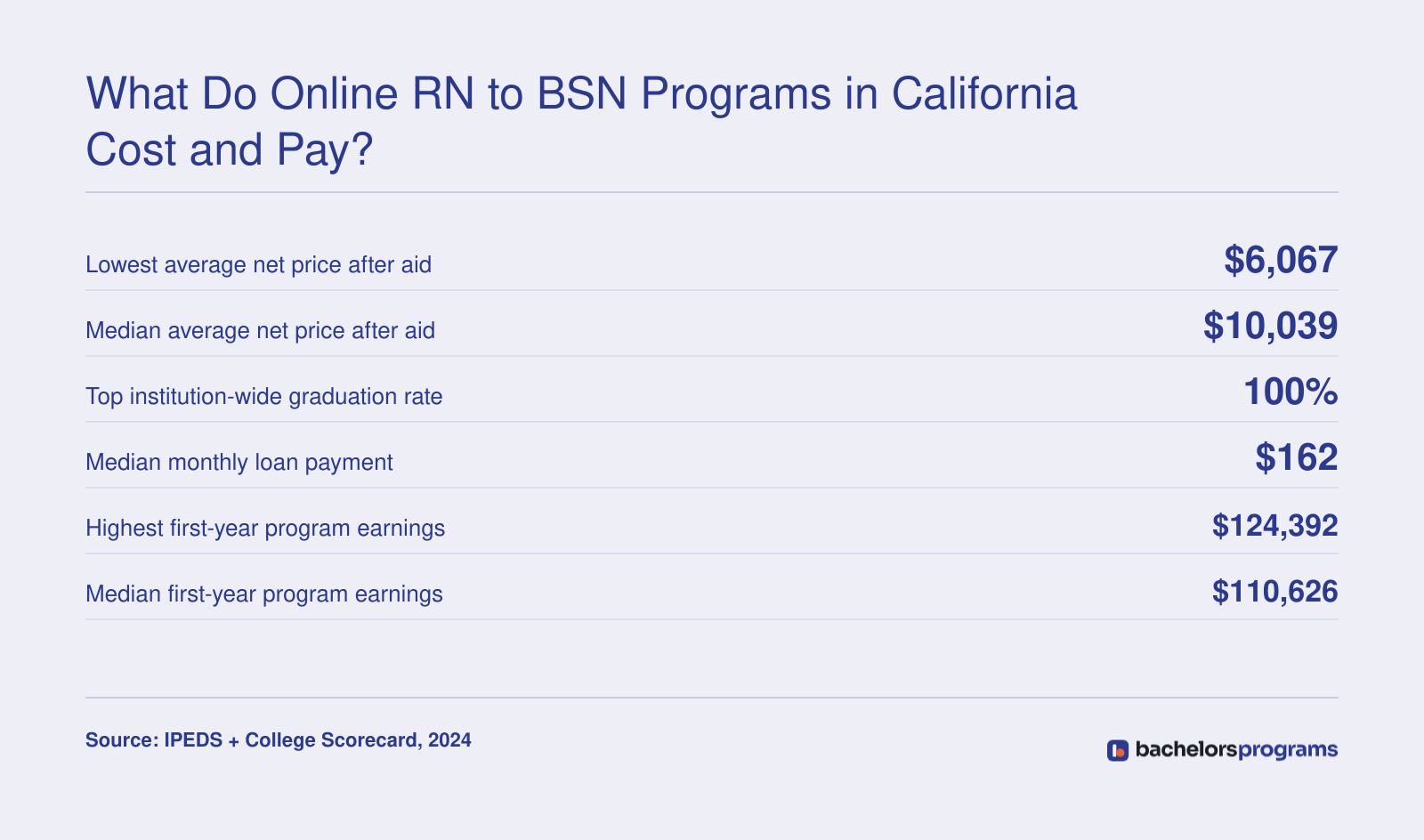
These figures come from the online RN to BSN programs ranked above, so you can read them alongside the earlier discussion of credits, part-time pace, and tuition help. Net price is the average a student pays after grants and scholarships, and the graduation rate covers each whole institution rather than the nursing program alone. Cal State Stanislaus posts the lowest net price, and Cal State East Bay graduates report the highest first-year earnings.
What California RNs Earn
California registered nurses earn well above the national median for the occupation, according to federal wage data.
Why the BSN Matters for California RNs
California's Magnet hospital count depends on who is tallying. A November 2026 report cites 64, UC Davis Nursing's October 2026 page lists 341, and about 10 California organizations hold the higher Magnet With Distinction status.2 The sources don't explain the gap, so treat any single number as approximate.
What Magnet Means for Hiring
ANCC Magnet designation does not require every staff RN to hold a BSN, and it sets no required BSN percentage.1 The Institute of Medicine's 80% BSN goal for 2020 was a workforce target, not a Magnet rule.1 Still, Magnet hospitals increasingly require nurse managers and other leaders to hold a baccalaureate or graduate nursing degree, and BSN preference is spreading across Magnet systems.3 An ADN nurse can work at a Magnet hospital, but individual employers may set stricter hiring, promotion, or deadline rules.
Roles That Open Up
A BSN is often required or preferred for these positions, depending on the employer:
- Charge nurse: Many units favor BSN-prepared nurses for shift leadership.
- Nurse manager: Leadership roles at Magnet hospitals increasingly call for a BSN or graduate degree.
- Case management: Postings frequently list a BSN as preferred.
- Public health nurse: The California Board of Registered Nursing issues the PHN certificate to RNs with an active California license who hold a BSN or MSN from an ACEN-, CCNE-, or NLN-CNEA-accredited school. The BRN also considers equivalent public health coursework with supervised clinical experience. Applicants whose program was outside California must show seven hours of child abuse training. Since January 2025, the certificate stays valid while the RN license is active and no longer needs renewal.
The Path to an MSN
The BSN is also the prerequisite for graduate study. MSN programs commonly expect a BSN from a CCNE- or ACEN-accredited program, so finishing an accredited RN to BSN keeps nurse practitioner, educator, and leadership tracks within reach.
What Changes Within a Year or Two
For a working ADN nurse, the shift is mostly eligibility. After graduating, you can apply for charge, case management, and leadership postings that screen for a BSN, pursue the PHN certificate, and submit MSN applications. You also stay competitive as more hospitals add BSN preferences.
Compare RN to BSN programs on the data that matters
Explore more Nursing majors or browse every field of study.
All Nursing programs Browse every field of study