Best Accelerated BSN (ABSN) Programs in Connecticut
Compare 13 accredited Accelerated BSN (ABSN) programs in Connecticut, with net price after aid, graduation rates, earnings and debt from IPEDS and the U.S. College Scorecard.
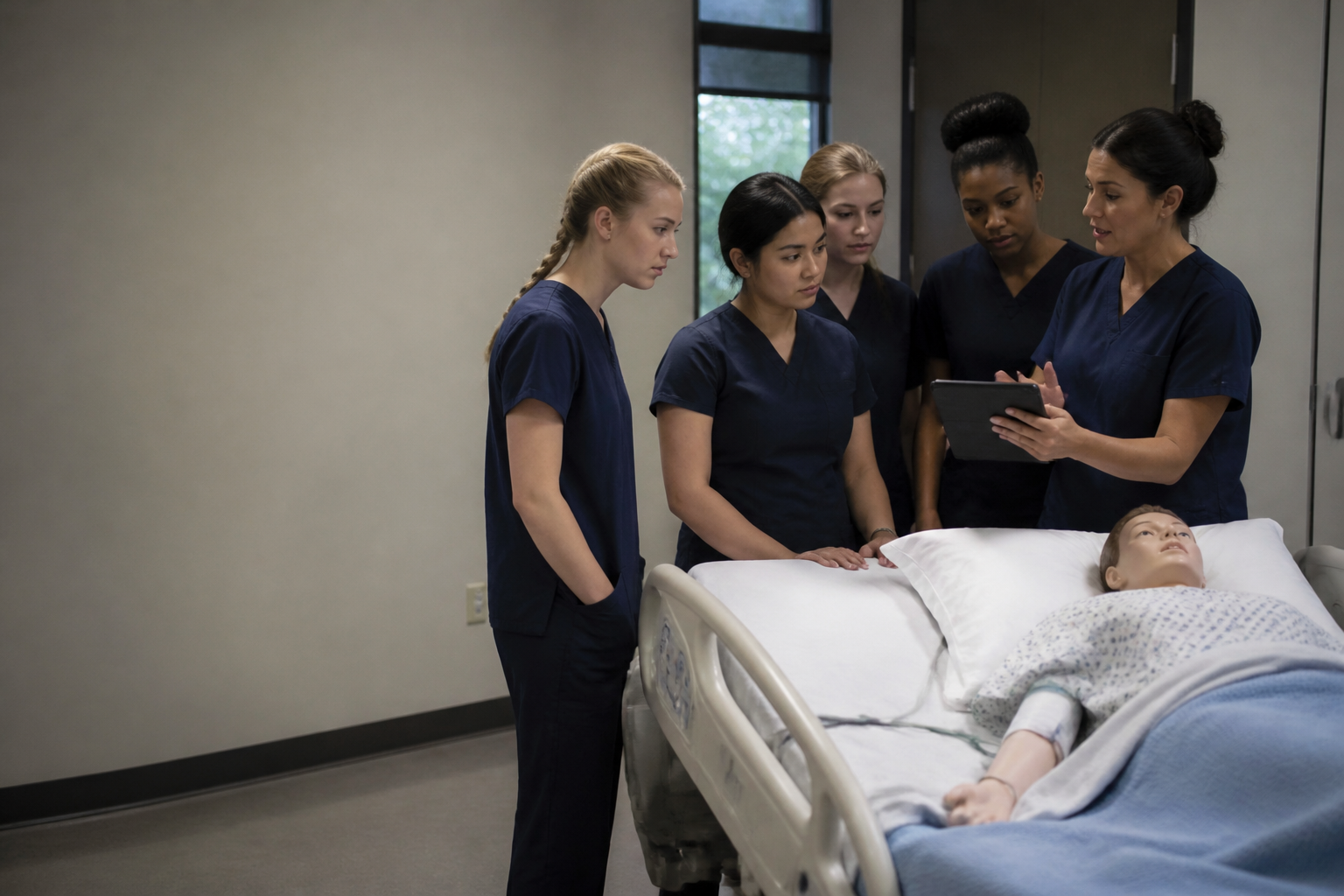
An accelerated BSN takes a bachelor's degree in another field, such as business or psychology, and converts it into eligibility for the RN license in roughly 12 to 16 months of full-time study. Any missing science prerequisites add time before the nursing sequence begins.
Connecticut's ABSN programs sit at both public and private universities, and the price spread is wide. Average annual net prices at the schools ranked here run from about $16,900 to about $48,100, a gap of more than $30,000 a year for nursing sequences of broadly similar length.
Those figures reflect all undergraduates, not ABSN students alone, so they show relative cost rather than a bill. Cohorts run full-time and year-round, which leaves little room for outside work.
Key Points
- Most ABSN tracks take 12 to 18 months; Bridgeport's runs 15.
- Central Connecticut State, Goodwin and UConn blend online coursework with in-person labs.
- Since October 1, 2025, Connecticut-based RNs can request multistate compact licenses.
Connecticut's Accelerated BSN Programs, Ranked for 2027
Every school below admits a bachelor's holder in another field and trains them for the RN license, whether through a campus-based or hybrid accelerated track. Connecticut's accelerated BSN market runs through a small set of public and private institutions clustered in Storrs, Fairfield County, Greater Hartford, and New Haven. The order weighs what a career changer actually pays after aid, how selective the institution is, and how its students finish.
University of Connecticut
#1Storrs, CT · ~$25,000/yr (est.)
Best for: In-state students seeking a public research campus
The state flagship in Storrs and the most prominent public accelerated BSN in Connecticut, with the track also taught at Avery Point and Waterbury so students across the state can stay near home. Average net price after aid is about $25,100, roughly 52% of applicants are admitted, and the school's overall graduation rate is 83%, the highest among the public universities on this list.
- Classes at the Storrs, Avery Point, and Waterbury campuses
- More than 20 community-based clinical partners statewide
- 1,700+ graduates since the program began in 2003
- Simulation labs plus assigned faculty mentors
- Participates in Connecticut's CT Health Horizons tuition support
Fairfield University
#2Fairfield, CT · $48,000/yr (est. net price)
Best for: Fairfield County residents prioritizing hospital placements
A private Jesuit university in Fairfield with a long-running second-degree track and an unusually deep roster of Connecticut hospital partners, from Greenwich and Stamford to Yale New Haven and St. Vincent's. The ABSN is a campus program, the average net price after aid is about $48,100, and roughly a third of applicants are admitted, making it the most selective institution here. The school's overall graduation rate is 84%.
- Connecticut students attend in person; hybrid format applies to the Austin, TX site
- School coordinates clinical placements with 12+ partner hospitals
- Clinical partners include Yale New Haven, Stamford, Greenwich, and Norwalk
- 504 supervised clinical hours
- Spring, summer, and fall start terms in a cohort structure
- 60 total credit hours
- CT Guarantee pathway for eligible community college transfers
Quinnipiac University
#3Hamden, CT · $41,000/yr (est. net price)
Best for: Private-program shoppers wanting flexible start dates
A private university in Hamden whose accelerated students study on the North Haven campus, with January and August starts that give career changers two entry points a year. Average net price after aid is about $40,700, roughly 72% of applicants are admitted, and the school's overall graduation rate is 76%.
- January and August start dates
- Simulation labs on the North Haven campus
- Future Nursing Leader Scholar Program offers scholarships and an MSN pathway
- Clinical experiences with hospital partners across Connecticut
University of Saint Joseph
#4West Hartford, CT · $28,000/yr (est. net price)
A private Catholic university in West Hartford with a comparatively open door for a private accelerated BSN: about 79% of applicants are admitted. Average net price after aid is around $28,000, one of the lowest among the private schools here, and the school's overall graduation rate is 64%. Clinical work starts early rather than waiting until the final terms.
- 53 total credit hours of nursing coursework
- Approved by the Connecticut Board of Examiners for Nursing
- Clinical placements begin early in the course sequence
- Background check, drug screen, and annual CPR certification required
- Progression requires a 2.33 GPA in nursing courses
Central Connecticut State University
#5New Britain, CT · ~$17,000/yr (est.)
A public university in New Britain and the lowest average net price after aid on this list, about $16,900. The accelerated BSN runs as a hybrid, pairing classroom and online work with clinical placements at Greater Hartford partners, and the on-campus health clinic gives students community-based practice. About 73% of applicants are admitted, and the school's overall graduation rate is 48%.
- Hybrid format combining classroom, online, and clinical work
- 60 total credit hours
- High-fidelity simulation and virtual reality labs
- Clinical partners across Greater Hartford
- On-campus community health clinic used for clinical experience
- Winter start term
- On-campus childcare available
Western Connecticut State University
#6Danbury, CT · ~$18,000/yr (est.)
A public university in Danbury running a hybrid accelerated track that mixes online coursework with on-campus classes and regional clinical placements. Average net price after aid is about $17,600, admission is open to about 87% of applicants, and the school's overall graduation rate is 52%. The curriculum spans the full lifespan, from maternal-child to community health.
- Hybrid format pairing online coursework with on-campus classes
- Summer start
- Rotations in medical-surgical, mental health, maternal-child, and community care
- Clinical placements in hospitals and community health settings
Southern Connecticut State University
#7New Haven, CT · ~$21,000/yr (est.)
A public university in New Haven with the most accessible admissions on this list, about 91%. Accelerated students take the same curriculum as the traditional BSN, taught alongside other adults who already hold degrees and bring work experience to the classroom. Average net price after aid is about $20,900 and the school's overall graduation rate is 50%.
- Summer and winter entry terms with separate application deadlines
- Same curriculum as the traditional BSN, delivered at an accelerated pace
- Cohort of adult learners bringing prior work experience
- Theory, clinical practice, and critical thinking threaded together
Sacred Heart University
#8Fairfield, CT · ~$46,000/yr (est.)
A private Catholic university in Fairfield with rolling admissions and a simulation-heavy campus program, including five nursing labs and a high-fidelity simulation center. Average net price after aid is about $46,200, roughly 65% of applicants are admitted, and the school's overall graduation rate is 73%. Clinical placements reach Yale New Haven Hospital and community sites, and there is an optional short intersession abroad.
- Rolling admissions
- Five nursing labs and a high-fidelity simulation center
- Clinical placements include Yale New Haven Hospital and community clinics
- Two-week intersession option in Dingle, Ireland
- CT Guarantee transfer pathway for Connecticut community college graduates
Goodwin University
#9East Hartford, CT · ~$29,000/yr (est.)
A private university in East Hartford built around adult and working students, with a locked tuition rate that removes cost surprises mid-program. Average net price after aid is about $29,200 and the school's overall graduation rate is 58%. Coursework runs as a hybrid with a simulation lab and broad student support services, and military benefits are accepted.
- Locked tuition rate for the full program
- 60 total credit hours
- Simulation lab plus comprehensive student support services
- Military benefits accepted
- Fall start
- Listed among schools in the CT Health Horizons tuition support initiative
University of Bridgeport
#10Bridgeport, CT · $28,000/yr (est. net price)
A private university in Bridgeport with rolling admissions and small accelerated cohorts placed at nearby hospitals. Average net price after aid is about $27,800, about 83% of applicants are admitted, and the school's overall graduation rate is 41%. The 120-credit degree splits general education from nursing coursework, so applicants with prior college credit know what will actually be taught in the accelerated year.
- Rolling admissions
- 120 credits total, split between 64 general education and 56 nursing credits
- Clinical rotations at local hospitals including Bridgeport Hospital
- Small cohorts with personalized instruction
- CT Health Horizons Grant available to eligible students
Cost & outcomes by school
Federal data for the highest-earning Accelerated BSN (ABSN) programs, independent of the ranking above. Earnings are this field's bachelor's graduates four years after completing where the Scorecard reports them, else the school's undergraduate median.
| School | Net price / yr | Grad rate | Earnings | Debt | Grads/yr | Format |
|---|---|---|---|---|---|---|
| Fairfield University CT | $48,095 | 84% | $88,794 | $26,000 | 2,882 | Campus |
| Quinnipiac University CT | $40,675 | 76% | $83,759 | $26,000 | 3,320 | Campus |
| Sacred Heart University CT | $46,174 | 74% | $75,059 | $25,000 | 3,642 | Campus |
| University of Connecticut CT | $25,097 | 83% | $73,997 | $21,500 | 11,874 | Campus |
| University of Connecticut-Avery Point CT | $13,807 | 62% | $73,997 | $21,500 | — | Hybrid |
| University of Connecticut-Waterbury Campus CT | $10,875 | 53% | $73,997 | $21,500 | — | Hybrid |
| University of Connecticut-Stamford CT | $16,798 | 57% | $73,997 | $21,500 | — | Hybrid |
| University of Saint Joseph CT | $27,989 | 64% | $59,908 | $27,000 | 442 | Campus |
| Western Connecticut State University CT | $17,604 | 52% | $59,115 | $24,147 | 1,468 | Hybrid |
| Central Connecticut State University CT | $16,857 | 48% | $58,562 | $22,300 | 3,216 | Hybrid |
| Southern Connecticut State University CT | $20,857 | 50% | $55,043 | $22,250 | 2,964 | Campus |
| University of Bridgeport CT | $27,807 | 41% | $50,323 | $25,750 | 790 | Campus |
Sources: U.S. Department of Education. Net price, graduation rate, earnings and debt: College Scorecard (earnings and debt for this field's bachelor's graduates where reported, else school-wide); graduates: IPEDS. A dash means no figure is reported.
Cost, debt & payoff
Median earnings of this field's bachelor's graduates (4 yrs after completing, else the school's undergraduate median) vs. their median federal loan debt · U.S. College Scorecard
Across these programs the median graduate earns about $73,997 and finishes with roughly $24,147 in debt — a ratio that clears a common rule of thumb (keep debt below first-year salary). Net price and debt vary widely school to school, so check the per-school figures in the table above before you shortlist.
Second-Degree Nursing in Connecticut: Straight Answers Before You Apply
An accelerated BSN in Connecticut serves one kind of applicant: someone who already holds a bachelor's degree in another field and wants the fastest credible route to RN licensure. Eligibility, timeline, work, and licensure are the questions career changers ask first.
Eligibility and Timeline
- Do I need a bachelor's degree? Yes. Southern Connecticut State University requires a BS or BA from an accredited college or university and also considers applicants who are still completing that degree. Sacred Heart University's second-degree track assumes a first bachelor's in some other subject. Your first degree satisfies the general degree requirement, but none of the nursing coursework.
- How long does it take? Count two clocks. The nursing sequence runs 12 consecutive months at Southern Connecticut State and 15 months at Sacred Heart, and neither figure includes prerequisites. If you still need courses such as Anatomy & Physiology I and II, microbiology, chemistry, or statistics, add that time before your start date.
Work, Credits, and Licensure
- Can I work while enrolled? Plan on working little, if at all. A full-time sequence that packs classes, labs, and clinical rotations into 12 to 16 months leaves limited room for a regular job. Ask each program how it views outside employment before you take on regular shifts.
- Will my prior credits transfer? Largely, in the general-education sense. Sacred Heart applies general academic credits from your first degree so you can focus solely on nursing. Southern Connecticut State sets no university-wide transfer limit, though program chairs approve or deny each prerequisite equivalency. Its prerequisites need a C+ or better, science courses must carry 4 credits with an in-person lab, and credits from a previous nursing program will not carry over.
- Am I eligible for the NCLEX-RN? Yes. Completing an approved prelicensure BSN, accelerated or traditional, makes you eligible for the NCLEX-RN, the exam every new RN must pass. Approval from the Board of Examiners for Nursing is a separate checkpoint from the application itself; both get their own section.
Cheapest Accelerated BSN Routes in Connecticut by Net Price
The net price figures below are federal averages of what all undergraduates at each campus paid after grants (2024 IPEDS and College Scorecard data). They are not ABSN sticker prices, and second-degree students often receive less grant aid than first-time freshmen, so your actual cost may run higher. Every low-cost option here is a public university, while on the private side Quinnipiac lists a Fall 2026 total program cost of $59,860 that bundles required meal-plan and credit-overload charges, and Fairfield prices its four-semester program at $14,330 per semester for 2026-27 before fees and annual increases. Use this table to build a shortlist, confirm the full program bill with each school, and see the tuition and financial aid section later on this page for ways to close the gap.
| School | City | Average net price after aid (all undergraduates) | Published in-state undergraduate tuition and fees (per year) | Published total ABSN program tuition | ABSN length |
|---|---|---|---|---|---|
| University of Connecticut-Waterbury Campus | Waterbury | $10,875 | $18,140 | Not published | 12 months |
| University of Connecticut-Avery Point | Groton | $13,807 | $18,140 | Not published | 12 months |
| University of Connecticut-Stamford | Stamford | $16,798 | $18,150 | Not published | 12 months |
| Central Connecticut State University | New Britain | $16,857 | $13,050 | Not published (CCSU's Estimated Program Costs page lists an ATI learning package at $700 per payment, three payments, 2026-27) | 15 months |
| Western Connecticut State University | Danbury | $17,604 | $13,401 | Not published | 15 months |
ABSN Admissions in Connecticut: The Checklist Every Applicant Needs
Use this checklist alongside each school's admissions page. Requirements below come from current published criteria at Southern Connecticut State, Central Connecticut State, and Quinnipiac. Confirm details directly with the other programs ranked here.
- A completed non-nursing bachelor's degreeCentral Connecticut State requires a BA/BS in another discipline from a regionally accredited institution. Quinnipiac requires an accredited bachelor's degree. Southern Connecticut State expects the BA/BS to be conferred by the deadline for your application term.
- Science and support prerequisitesSouthern lists BIO 200, BIO 201, BIO 120, and CHE 120. Each science course must carry 4 credits with an in-person lab, and online labs are not accepted. Central lists CHEM 161, CHEM 162, BMS 102/103, BIO 122/BMS 201, CHEM 210, and PSY 136, all finished before entry. Quinnipiac requires every prerequisite to be completed within the last five years and before the program starts.
- Minimum GPA of 3.0Southern, Central, and Quinnipiac each set a 3.0 cumulative floor. Southern calculates it from all accredited postsecondary coursework. Central requires 3.00 both at Central and across all institutions attended.
- Prerequisite grades and entrance examsSouthern requires a C+ in every prerequisite, including lecture and lab. It allows no more than two repeated courses and requires no TEAS or HESI. Central requires a C+ in sciences and CHEM 210 and a C in PSY 136. Its nursing admissions page lists a 70% ATI TEAS minimum, so ask whether that applies to the ABSN. Quinnipiac requires a B- or better.
- Application window and documentsSouthern's Summer 2027 cohort application opened July 16, 2026, and closes December 15, 2026. Central's window runs June 1 to September 1. Check each portal for required essays, recommendations, or interviews.
Related Articles
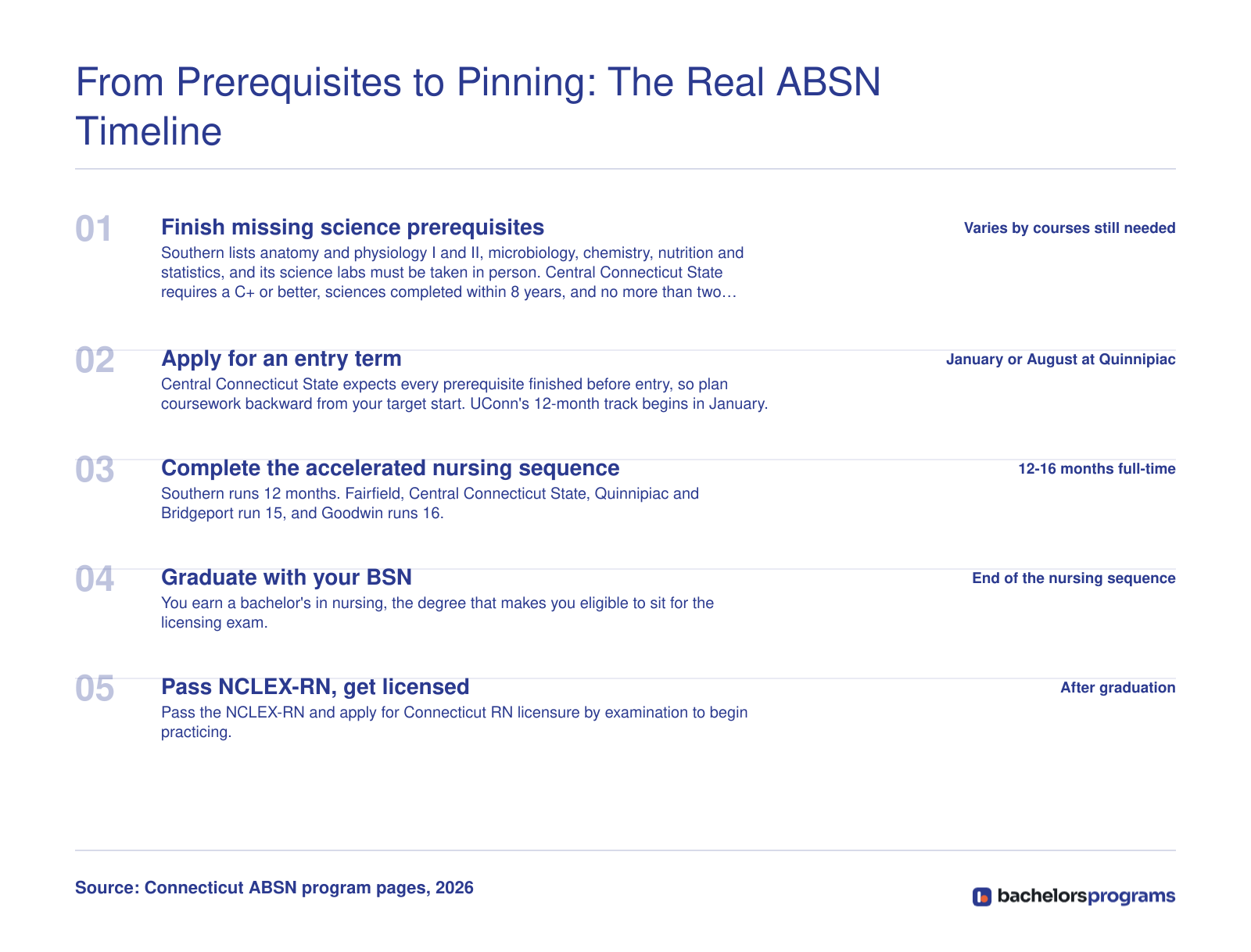
From Prerequisites to Pinning: The Real ABSN Timeline
Connecticut ABSN durations count only the nursing sequence, so any missing science courses add time before you start. Southern Connecticut State and Fairfield run on campus, while Central Connecticut State, Goodwin and UConn blend online coursework with required in-person labs, simulation and clinicals. No program here moves clinical training fully online.
ABSN Pace and Cost in Connecticut: Tuition, Fees, and Financial Aid
An accelerated BSN in Connecticut is a full-time, year-round financial commitment, not a part-time course load you can fold around a job. Most ABSN tracks compress the nursing major into 12 to 16 months, and the University of Bridgeport's 15-month sequence for non-nursing bachelor's holders shows the shape: consecutive terms, no summer off, and clinical shifts that can land on nights or weekends. Budget your life around that schedule before you compare tuition.
Public and Private Totals
Public options such as University of Connecticut, Central Connecticut State University, Western Connecticut State University and Southern Connecticut State University charge in-state rates that usually sit well below private totals at Fairfield, Quinnipiac, Sacred Heart, Saint Joseph and Bridgeport. The gap is real, but the sticker price is not the whole spend. Add uniforms, background checks and health clearances, exam prep, NCLEX-RN registration, and Connecticut licensure fees. Ask each program for a total cost sheet rather than tuition alone.
Aid for a Second Bachelor's
Pell Grants are off the table once you hold a bachelor's degree; the $7,395 maximum for 2026-2027 applies to first-bachelor's study. Federal Direct Unsubsidized Loans are the workhorse: second-bachelor's students are generally undergraduates, with aggregate caps of $31,000 for dependent and $57,500 for independent students, a $23,000 subsidized maximum, and prior borrowing counts. Grad PLUS is built for graduate study, not this degree. Connecticut Health Horizons offers tuition reimbursement if you meet one criterion, such as an Alliance district address, income at the Pell threshold, pay below a living wage, or hardship. HRSA Nurse Corps can cover tuition and fees plus a $1,490 monthly stipend with a two-year service commitment at a critical shortage facility. HRSA loan repayment through an eligible employer such as CT DMHAS repays 60% of qualifying loans for a two-year commitment, with a possible 25% in year three. AACN and NSNA awards are also worth checking.
Ask Before You Enroll
Ask every hospital recruiter and program coordinator one question: is ABSN tuition paid upfront or reimbursed after grades post, and what work commitment comes with it? A hospital-sponsored cohort can beat a patchwork of loans, but only if the terms fit your post-graduation plans.
Connecticut Nurse Licensure Compact Status for New RNs
Connecticut Board of Nursing Approval, Accreditation, and the NCLEX-RN
A program can carry national accreditation and still stand differently with the state, and for NCLEX-RN eligibility the state's standing is what counts. Treat the two as separate checks.
Two Seals, Two Jobs
Approval from the Connecticut Board of Examiners for Nursing is what makes graduates eligible for the NCLEX-RN. National accreditation from the Commission on Collegiate Nursing Education (CCNE) or the Accreditation Commission for Education in Nursing (ACEN) is a quality credential that employers and graduate schools look for.
Goodwin University is the one ranked school where both are clearly documented. Its baccalaureate nursing program, including the ABSN, is CCNE-accredited, and the Board has listed its ABSN on conditional approval over a first-time pass rate requirement. A June 2026 Board agenda indicates Goodwin met the 80 percent first-time standard for May 2025 through April 2026, but confirm its current status directly. For the other schools here, including UConn and its regional campuses, Fairfield, Quinnipiac, Saint Joseph, Sacred Heart, Bridgeport, and the Central, Southern, and Western Connecticut State campuses, do not assume identical status. Ask each school for its current approval and accreditation in writing.
From Graduation to License
- Graduate: Complete an approved ABSN program and have your school confirm completion.
- Apply to DPH: File for Connecticut RN licensure by examination with the Department of Public Health.
- Register with Pearson VUE: Sign up for the NCLEX-RN and pay the exam fee.
- Test and license: Once you pass and your file is complete, Connecticut issues the license.
Checking Pass Rates
Connecticut's Department of Public Health publishes a first-time NCLEX-RN pass rate chart by program, drawn from Board of Examiners data. It separates traditional baccalaureate and accelerated programs, covers 2022 through 2026, and shows "No data" where a result is missing. Open the most recent year, and compare reporting periods carefully, since a Board agenda and the DPH chart can cover different windows. The Board expects at least 80 percent of first-time test takers to pass.
Before You Apply to a New Cohort
New or recently launched ABSN cohorts may not yet have a track record or a settled approval. Verify the program's standing with the Board before you pay a deposit.
Connecticut RN Licensure by Examination at a Glance
How to Pick the Right Connecticut ABSN: Budget, Schedule, and Clinical Geography
A Connecticut ABSN chosen for its price tag is a different program from one chosen for its start date. Decide which constraint actually binds before you compare anything else.
Start With the Constraint That Binds You
If tuition is the hard limit, begin with the public options on the cheapest routes list: UConn, Central Connecticut State, Western Connecticut State, and Southern Connecticut State. If timing matters more, look for programs with more than one annual cohort. UConn's second-degree track starts in January across Avery Point, Stamford, Storrs, and Waterbury, which helps only if a winter start fits your calendar. Quinnipiac runs 15 months with a cohort of roughly 30 to 36 students.
Map the Commute Before the Curriculum
Clinical placements, not the curriculum, often decide which 15-month program is workable. University of Saint Joseph places students at Connecticut sites within about an hour of West Hartford. Sacred Heart's Fairfield campus draws placements from settings that include St. Vincent's, Yale New Haven, and Connecticut Children's. Quinnipiac reports more than 300 clinical affiliation sites, with partners across Hartford HealthCare and Yale New Haven. Fairfield reports 504 clinical hours, but its site list includes Texas locations, so confirm which placements are actually in Connecticut. A named hospital is not a guaranteed assignment, so ask how sites are allocated.
Cohort Size, Format, and Your Paycheck
Smaller cohorts can mean more faculty attention and fewer seats. Hybrid formats cut driving time for lectures but still require in-person labs and clinicals. If you must keep any income, choose the longest format you can tolerate, usually 15 months rather than 12, and budget savings for the whole stretch.
Your Next Step This Week
Build a shortlist of three. On each school's program page, confirm the prerequisite science courses, the next application deadline, and Connecticut Board of Nursing approval status. Then rank your choices by total cost and daily commute, not by brochure polish.
Compare Accelerated BSN (ABSN) programs on the data that matters
Explore more Nursing majors or browse every field of study.
All Nursing programs Browse every field of study