Best BSN Programs in Connecticut
Compare 23 accredited Bachelor of Science in Nursing (BSN) programs in Connecticut at 19 colleges, with net price after aid, graduation rates, earnings and debt from IPEDS and the U.S. College Scorecard.

First-attempt NCLEX-RN results now separate Connecticut's BSN programs more sharply than tuition does, with pass rates at the schools included here spanning 87.5% to 97.2%.
Only traditional pre-licensure BSN programs are compared. Net price after aid across them runs from roughly $11,500 to $48,000 a year, so the strongest licensure record and the smallest bill rarely land at the same address. Entry model adds a third variable: some campuses admit freshmen straight into nursing, while others require a second application at the upper division.
In Connecticut hiring, the license carries more weight than the school name, and the first attempt is the one employers see.
Key Points
- Private net price averages about $38,135, versus about $21,186 at publics.
- In-state tuition at Connecticut public universities runs about $13,400 to $21,000.
- Licensed by NCLEX-RN, Connecticut nurses renew yearly, usually in their birth month.
Top NCLEX-RN Pass Rates: 10 Connecticut BSN Schools Ranked
Every card below centers on a single number: the first-time NCLEX-RN pass rate reported for the school's Connecticut BSN graduates, shown exactly as the state board data gives it. Alongside that figure you will find net price after aid, the share of applicants admitted as a selectivity signal, and the institution-wide graduation rate, so cost and admission odds can be weighed against exam results. Across these ten schools the pass rates run from about 86 to 97 percent, and the spread in price is wider than the spread in results.
Western Connecticut State University
#1Danbury, CT · ~$18,000/yr (est.) · NCLEX-RN pass rate 97.2% (3-yr weighted avg)
Best for: Public-university students who prefer small cohorts
Western Connecticut State University is a public university in Danbury whose BSN begins nursing coursework in the sophomore year and runs three years of theory paired with clinical practice. Students complete 120 credits, with placements arranged through healthcare agencies in Danbury, Waterbury and New Haven. Classes are kept small and faculty are described as readily accessible, a combination that suits students who want a public-university price with closer instructor contact.
- CCNE accredited; 120 total credit hours
- Nursing coursework begins in the sophomore year
- 3.0 GPA minimum plus prerequisite science courses
- Clinical placements in Danbury, Waterbury and New Haven
- Three years of nursing courses built on theory and clinical practice
- Smaller class sizes with faculty who are readily accessible
University of Saint Joseph
#2West Hartford, CT · $28,000/yr (est. net price) · NCLEX-RN pass rate 94.4% (3-yr weighted avg)
Best for: Direct-admission seekers avoiding a second application
University of Saint Joseph is a private university in West Hartford with more than 60 years of nursing graduates behind it. Its BSN admits students directly as first-years, so no second application is needed to enter the nursing major, and clinical placements run through Hartford Hospital and Saint Francis Hospital. Licensed-route and second-degree students can take a separate 15-month accelerated option instead.
- CCNE accredited four-year on-campus program
- Direct admission, so no secondary application is needed
- 3.0 GPA minimum plus prerequisite courses
- SAT scores accepted, and the program is test optional
- Clinical placements at Hartford Hospital and Saint Francis Hospital
- Simulation laboratory for supervised hands-on practice
- Rolling admissions decisions
- 15-month path for students who already hold a bachelor's degree
- 53 total credit hours
- 3.0 GPA minimum with a C or better in prerequisite sciences
- Science prerequisites must be completed within eight years
- Competitive admission on a space-available basis
- Background check and health requirements before clinicals
Sacred Heart University
#3Fairfield, CT · ~$46,000/yr (est.) · NCLEX-RN pass rate 94.4% (3-yr weighted avg)
Best for: Nursing students wanting clinical hours abroad
Sacred Heart University is a private university in Fairfield whose BSN blends biological, behavioral, social and nursing sciences with practice in hospitals, community clinics and extended care facilities. Five nursing labs and high-fidelity simulation rooms give students a place to build clinical judgment before they work with patients. Juniors and seniors can earn clinical hours abroad in Jamaica, Guatemala or Dingle, Ireland.
- CCNE accredited on-campus BSN
- Five nursing labs and high-fidelity simulation rooms
- Clinical rotations in hospitals, community clinics and extended care facilities
- Juniors and seniors can earn clinical hours in Jamaica, Guatemala or Ireland
- Pathway into the university's master's nursing programs
- Faculty are active practicing professionals
Fairfield University
#4Fairfield, CT · $48,000/yr (est. net price) · NCLEX-RN pass rate 92.7% (3-yr weighted avg)
Fairfield University is a private Catholic university in Fairfield, and its Egan School of Nursing pairs a liberal arts core with early clinical work. Students complete 504 clinical hours and 112 lab hours through guaranteed placements that include Yale New Haven and Bridgeport Hospital. Small classes, assigned faculty advisors and simulation facilities keep that clinical work closely supervised, and study abroad options in Australia and Italy are available.
- CCNE accredited; 85 total credit hours
- 504 clinical hours plus 112 lab hours
- 100 percent clinical placement guaranteed at partner hospitals
- Study abroad options in Australia and Italy
- Simulation facilities that mirror clinical practice
- Faculty advisors provide individualized attention
Southern Connecticut State University
#5New Haven, CT · ~$21,000/yr (est.) · NCLEX-RN pass rate 91.3% (3-yr weighted avg)
Southern Connecticut State University in New Haven runs its BSN as an upper-division program built on a liberal arts and science foundation, with theory courses paired with hospital and community clinical practice. It carries several entry points at once: direct admission for high school seniors, a transfer pathway, and a part-time evening and weekend track for working adults. An Early College for Nursing option lets high school students bank credits toward the degree before they enroll.
- Upper-division BSN built on a liberal arts and science foundation
- Direct admission for high school seniors
- College admission pathway for transfer students
- Part-time evening and weekend track for working adults
- Early College for Nursing lets high schoolers earn credit
- TEAS entrance exam required; 3.0 GPA minimum
- Nursing prerequisites can be taken at community colleges
University of Connecticut
#6Storrs, CT · ~$25,000/yr (est.) · NCLEX-RN pass rate 90.3% (3-yr weighted avg)
The University of Connecticut in Storrs offers a four-year traditional BSN that starts nursing coursework in the first year and layers it onto a broad arts and sciences base. Hands-on training happens in the Clinical Simulation Learning Center, followed by small-group clinicals at more than 70 affiliate healthcare agencies within a 75-mile radius. The program admits for fall only and adds options such as the Honors Program and experiential global learning.
- Four-year, full-time traditional track at the Storrs campus
- Nursing courses begin in the first year
- Clinical Simulation Learning Center plus small-group clinicals
- More than 70 affiliate healthcare agencies within 75 miles
- Fall-only admission; 3.0 GPA minimum for transfer applicants
- Prerequisites in biology and chemistry; no letters of recommendation
- Honors Program and experiential global learning options
University of Hartford
#7West Hartford, CT · $30,000/yr (est. net price) · NCLEX-RN pass rate 87.5% (2-yr weighted avg)
The University of Hartford in West Hartford runs a 121-credit BSN that puts students into clinical settings from sophomore year onward. Coursework moves through pathophysiology, pharmacotherapeutics, adult health, maternal and child nursing, population health and a capstone seminar. Simulation labs, faculty mentoring and tutoring carry students through the clinical sequence.
- 121-credit four-year BSN; CCNE accredited
- Clinical experience starts in the sophomore year
- 2.7 GPA minimum; no entrance exam required
- Capstone seminar in the final year
- Coursework covers pathophysiology, pharmacotherapeutics and adult health
- Tutoring and faculty mentoring built into the program
- Test optional, with one letter of recommendation
- Student Nursing Association and summer internships
University of Connecticut-Avery Point
#8Groton, CT · $10,000 – $15,000/yr (est.) · NCLEX-RN pass rate 96.5% (3-yr weighted avg)
The University of Connecticut's Avery Point campus in Groton hosts the CEIN program, a 12-month full-time route to a nursing bachelor's degree for people who already hold a bachelor's in another field. Coursework and clinical experiences build safe practice, patient advocacy and teamwork, with a clinical placement team coordinating sites. Graduates earn a bachelor's degree in nursing and are eligible to sit for the NCLEX-RN. Students weighing this route against a traditional four-year BSN should read it as a second-degree option, not an entry point for first-time college students.
- 12-month, full-time program for bachelor's degree holders
- Held at the Groton campus
- Awards a bachelor's degree in nursing
- Clinical placement team coordinates sites
- Prepares students to sit for the NCLEX-RN
- Integrates arts, sciences and humanities into nursing practice
Quinnipiac University
#9Hamden, CT · $41,000/yr (est. net price) · NCLEX-RN pass rate 86.3% (3-yr weighted avg)
Quinnipiac University in Hamden runs a competency-based BSN that threads critical thinking, ethics, informatics and holistic care through the curriculum. Students train in high-fidelity simulation labs and complete clinical rotations across more than 300 affiliates that range from hospitals to home health agencies. A first-year Living-Learning Community gives new students a built-in support network from the start.
- CCNE accredited, competency-based BSN
- Clinical rotations across more than 300 affiliates
- High-fidelity simulation labs with manikins
- First-year Nursing Living-Learning Community
- Endorsed by the American Holistic Nurses Credentialing Corporation
- Curriculum includes ethics, informatics and holistic care
- 70,000+ alumni network
Central Connecticut State University
#10New Britain, CT · ~$17,000/yr (est.) · NCLEX-RN pass rate 86.1% (3-yr weighted avg)
Central Connecticut State University in New Britain admits to its BSN through four pathways: first-year students, transfer students, re-entry students and continuing Central students. Applicants finish prerequisites in general and organic chemistry, biomolecular science and lifespan development, then compete for seats with a 3.0 GPA and a TEAS score of at least 70. Once admitted, students practice in simulation suites and can join Sigma Theta Tau and the Student Nursing Association.
- Four admission pathways: first-year, transfer, re-entry and continuing Central
- 3.0 cumulative GPA and TEAS score of at least 70 required
- Application deadline of March 15
- Prerequisites in general and organic chemistry, biomolecular science and lifespan development
- Simulation suites and nursing lab for clinical practice
- Sigma Theta Tau Honor Society and Student Nursing Association
Cost & outcomes by school
Federal data for the highest-earning Bachelor of Science in Nursing (BSN) programs, independent of the ranking above. Earnings are this field's bachelor's graduates four years after completing where the Scorecard reports them, else the school's undergraduate median.
| School | Net price / yr | Grad rate | Earnings | Debt | Grads/yr | Format |
|---|---|---|---|---|---|---|
| Fairfield University CT | $48,095 | 84% | $88,794 | $26,000 | 2,882 | Campus |
| Quinnipiac University CT | $40,675 | 76% | $83,759 | $26,000 | 3,320 | Campus |
| Sacred Heart University CT | $46,174 | 74% | $75,059 | $25,000 | 3,642 | Campus |
| University of Connecticut CT | $25,097 | 83% | $73,997 | $21,500 | 11,874 | Campus |
| University of Connecticut-Avery Point CT | $13,807 | 62% | $73,997 | $21,500 | — | Campus |
| University of Connecticut-Waterbury Campus CT | $10,875 | 53% | $73,997 | $21,500 | — | Campus |
| University of Connecticut-Stamford CT | $16,798 | 57% | $73,997 | $21,500 | — | Campus |
| Charter Oak State College CT | $15,815 | 67% | $64,209 | $18,683 | 898 | Online |
| University of Hartford CT | $30,282 | 54% | $60,823 | $27,000 | 1,626 | Campus |
| Albertus Magnus College CT | $34,028 | 52% | $60,144 | $30,964 | 482 | Campus |
| University of Saint Joseph CT | $27,989 | 64% | $59,908 | $27,000 | 442 | Campus |
| Western Connecticut State University CT | $17,604 | 52% | $59,115 | $24,147 | 1,468 | Campus |
Sources: U.S. Department of Education. Net price, graduation rate, earnings and debt: College Scorecard (earnings and debt for this field's bachelor's graduates where reported, else school-wide); graduates: IPEDS. A dash means no figure is reported.
Cost, debt & payoff
Median earnings of this field's bachelor's graduates (4 yrs after completing, else the school's undergraduate median) vs. their median federal loan debt · U.S. College Scorecard
Across these programs the median graduate earns about $59,908 and finishes with roughly $25,150 in debt — a ratio that clears a common rule of thumb (keep debt below first-year salary). Net price and debt vary widely school to school, so check the per-school figures in the table above before you shortlist.
Inside Our Scoring: Why First-Try NCLEX-RN Results Come First
A program's reputation and a graduate's license are two different measures, and only one of them puts a nurse at the bedside. A nursing degree only pays off once you hold a license, so the first-attempt NCLEX-RN result carries most of the weight here.
Where the Weight Sits
Roughly three quarters of each score comes from the NCLEX-RN first-time pass rate, drawn from three years of state board results and adjusted for how many candidates sat the exam. The remainder splits between accreditation status and a smaller completion and retention component. A program whose graduates need a second attempt still leaves a gap between commencement and a first paycheck.
Where the Numbers Come From
Three sources sit behind every entry: state nursing board NCLEX-RN results, College Scorecard institution and program outcomes, and IPEDS tuition and net price figures. Net price reflects a sector average rather than a single program's sticker price, and graduation rates are school-wide, not nursing-specific, so treat both as context rather than a precise forecast.
What Is Scored
Only traditional pre-licensure BSN programs enter the ranking. RN-to-BSN and accelerated second-degree programs are scored on separate pages, since their students arrive with a license or a prior degree and their outcomes answer a different question.
Lowest Net Price: 5 Cheapest BSN Schools in Connecticut
These schools are sorted by average net price after aid, which is what students actually paid once grants and scholarships were subtracted. Published tuition and fees show the in-state sticker price, and median debt covers all borrowers school-wide, not nursing graduates alone (IPEDS and College Scorecard 2024 data). A large aid package at a private school can still leave a bigger bill than a public campus whose price starts low, so compare net price rather than award size, and see the cost section below for Connecticut state grants that can lower these figures further.
| School | City | BSN Route at This Campus | Published Tuition and Fees (In-State) | Average Net Price After Aid | Median Debt (School-Wide) | Pell Grant Share |
|---|---|---|---|---|---|---|
| University of Connecticut-Waterbury Campus | Waterbury | Traditional BSN track | $18,140 | $10,875 | $21,500 | 45.5% |
| University of Connecticut-Avery Point | Groton | Accelerated second-degree (CEIN/BS) | $18,140 | $13,807 | $21,500 | 45.5% |
| Charter Oak State College | New Britain | Online RN to BSN for licensed nurses | $8,506 | $15,815 | $18,683 | 67.5% |
| University of Connecticut-Stamford | Stamford | Traditional BSN track | $18,150 | $16,798 | $21,500 | 45.5% |
| Central Connecticut State University | New Britain | Traditional BSN | $13,050 | $16,857 | $22,300 | 56.5% |
Related Articles
Getting Into a Connecticut BSN: Prerequisites, GPA, Test Policy and Entry Model
Do you apply to a Connecticut BSN as a high school senior, or after two years of prerequisites?
The answer depends on the school, and the difference shapes both your risk and your timeline.
Direct admit versus upper-division entry
A direct-admit program admits you to the nursing major as a first-year student. Your seat is held, but you still have to clear progression standards. Southern Connecticut State University admits high school seniors directly and then requires six of nine prerequisites, a 3.0 cumulative GPA, a B- in each prerequisite, and no more than two repeats.
An upper-division model works the other way. You enroll at the university first, complete a set of science and psychology courses, then apply to the nursing major. The University of Hartford follows this pattern: BIO 122, CH 114, CH 136, BIO 212 and PSY 105 at C+ or better, plus a 2.67 cumulative GPA.
Direct admit lowers the risk of being shut out of the major later. Upper-division entry adds a second gate, but it gives you a year to prove yourself before committing.
What the published policies say
Southern asks for a 3.4 high school GPA and four years of English, three years of math, two or more years of lab science and three years of social sciences. SAT and ACT scores are optional, and not submitting them is not penalized.
Hartford publishes a 2.67 threshold, accepts C+ in the five prerequisite courses, and is test optional. It recommends four years of English, three of social studies, three of math, two of a foreign language and three lab sciences.
Beyond Southern and Hartford, the traditional-BSN GPA and test policies at the other schools ranked here vary or are not published. Do not assume a common cutoff.
How hard is it?
School-wide admission rates mislead, because nursing admission is often more competitive than the university's overall rate. Southern admits roughly 92% of applicants overall, yet its BSN direct admit asks for a 3.4. Hartford admits about 96% overall, then applies a 2.67 threshold. The direct-admit route at Southern is the steeper published path; elsewhere the real gate often arrives in year two.
BSN Program Cost in Connecticut: Tuition, Net Price and State Grants
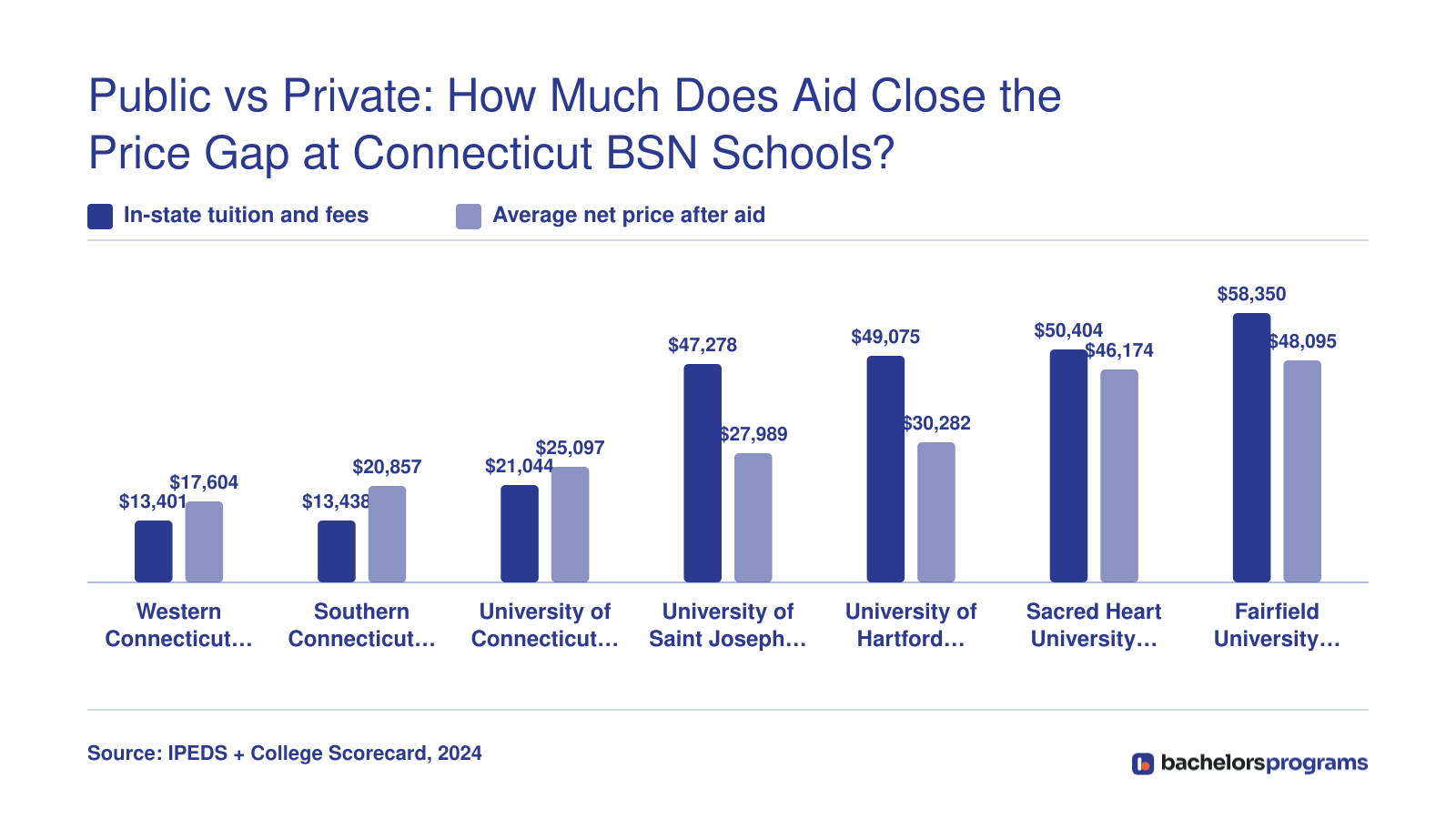
Public vs private is the biggest cost decision for a Connecticut BSN. Annual in-state tuition at Western Connecticut State University, Southern Connecticut State University and the University of Connecticut runs from about $13,400 to $21,000. At University of Saint Joseph, University of Hartford, Sacred Heart University and Fairfield University, it runs from roughly $47,300 to $58,400.
Net price after aid
Aid narrows that gap but does not close it. Average net price at the public schools here ranges from about $17,600 (Western) to $25,100 (UConn). Among the private schools, it ranges from about $28,000 (Saint Joseph) to $48,100 (Fairfield), with Hartford near $30,300. On average, private net price lands about $17,000 per year above public.
These are sector-level averages across all aided students, so your own offer can land well above or below them. Compare award letters, not sticker prices.
Connecticut state aid
The Roberta B. Willis Need-Based Scholarship, run by the Office of Higher Education, pays up to $5,250 per year for four-year programs (and $4,650 for two-year programs). A separate Need/Merit component exists. Check the Office of Higher Education for current income, residency and FAFSA deadline rules, and file your FAFSA early.
The state's nursing-specific help comes after graduation:
- Nursing Education Loan Repayment: repays 60% of qualifying loans for a two-year service commitment, with a possible additional 25% for a third year, for RN program graduates.
- Health Professional Shortage Area repayment: up to $50,000 for qualifying work in shortage areas.
- Student Loan Reimbursement Program: up to $5,000 per year and $20,000 total for Connecticut residents under the income caps ($125,000 single, $175,000 married).
Stacking aid
Apply for everything at once. Federal Pell, Willis and institutional grants can combine, and the schools that enroll the most Pell recipients are Southern Connecticut (about 57%), Western Connecticut (56%) and Saint Joseph (54%). Those schools tend to package aid heavily for lower-income students, so ask each financial aid office how it layers state and institutional awards on top of Pell.
How much does a BSN cost in Connecticut?
Plan on roughly $17,600 to $25,100 per year net at a public school and $28,000 to $48,100 at a private one, before any state aid.
Public vs Private: How Much Does Aid Close the Price Gap at Connecticut BSN Schools?
Sticker tuition at the private schools charted here averages about $51,277, compared with about $15,961 at the public universities. After grants and scholarships, that gap narrows by roughly half: private net price averages about $38,135, against about $21,186 at the publics. Net price is an institution-wide average for aided first-year students and includes living costs, which is why it can exceed tuition at the public schools. Treat it as a benchmark, not a quote for any individual student.
State Approval, CCNE Accreditation and NCLEX-RN Results for Connecticut BSN Schools
A program can be legal to attend and still fall short of what you want from it. Connecticut BSN schools are judged on two separate layers, and each one protects a different part of your future.
Two Layers, Two Purposes
The Connecticut Board of Examiners for Nursing approves RN education programs, and graduates of an approved program can sit for the NCLEX-RN in Connecticut. This approval is the legal gate. The Board expects at least 80% of a program's graduates to pass the NCLEX-RN on the first attempt. A program that falls short can be placed on conditional approval, which may last one year, and the Board can require special reports or site visits.
National accreditation by the Commission on Collegiate Nursing Education (CCNE) or the Accreditation Commission for Education in Nursing (ACEN) is voluntary. It matters for graduate school admission, employer preference and some aid eligibility.
Where the Ranked Schools Stand
The Connecticut Department of Public Health lists Fairfield University, Southern Connecticut State University and the University of Connecticut among approved baccalaureate programs. The University of Hartford's program materials also state Board approval. For the remaining schools, confirm status on the state's approved-program list before you apply, since the list is updated and conditional designations can change.
CCNE-Accredited Programs and Their NCLEX-RN Rates
The schools below describe their BSN programs as CCNE accredited. Their first-time NCLEX-RN pass rates, as shown in the ranking above, are:
- Western Connecticut State University: 97.2%
- University of Saint Joseph: 94.4%
- Sacred Heart University: 94.4%
- Fairfield University: 92.7%
- University of Hartford: 87.5%
Southern Connecticut State University (91.3%) and the University of Connecticut (90.3%) are Board approved. Check the CCNE directory for their current accreditation term before you rely on it for graduate study plans.
If you plan to pursue an MSN or DNP later, treat CCNE or ACEN status as a firm requirement. Board approval, by contrast, is the floor for everyone.
Connecticut Registered Nurse Licensing Essentials
Connecticut BSN Questions Readers Ask Most
Which Connecticut school has the highest NCLEX-RN pass rate for BSN graduates?
What does a BSN at a Connecticut public university cost after financial aid?
Which BSN programs in Connecticut hold CCNE accreditation?
How competitive is admission to a Connecticut BSN program?
Is Connecticut part of the Nurse Licensure Compact?
Can I transfer into a Connecticut BSN program after starting at another college?
Does Connecticut offer loan repayment help for nurses who work in the state?
How long must I live in Connecticut to qualify for in-state tuition at a public university?
Compare Bachelor of Science in Nursing (BSN) programs on the data that matters
Explore more Nursing majors or browse every field of study.
All Nursing programs Browse every field of study