Best Accelerated BSN (ABSN) Programs in Georgia
Compare 16 accredited Accelerated BSN (ABSN) programs in Georgia, with net price after aid, graduation rates, earnings and debt from IPEDS and the U.S. College Scorecard.

Mercer University finishes its second-degree BSN in 12 months, Valdosta State University takes about 15, and Kennesaw State University runs four semesters. For a graduate with a non-nursing bachelor's, Georgia ABSN programs offer the fastest credible route to an RN license, typically 12 to 18 months of full-time study. That schedule has a real price, and tuition is only part of it.
The speed comes with conditions. Published GPA minimums run from 2.75 to 3.2, several schools require the TEAS or HESI, and science prerequisites often have to be recent.
A short program does not mean a short admissions process. Prerequisites and GPA still decide who gets a seat.
Key Points
- Mercer University runs three yearly ABSN starts; Georgia Southern runs one.
- Gordon State's $8,105 net price covers RN-to-BSN completion, not second-degree study.
- Hybrid is Georgia's most flexible ABSN format; clinicals remain in person.
Best Accelerated BSN Schools in Georgia: 10 Programs Ranked for Second-Degree Students
This is the shortlist a careful career changer would build: what students actually pay after aid, how many new nurses each school turns out, and how hard the door is to open. Every school below is in Georgia, every program is designed for people who already hold a bachelor's in another field, and each entry notes whether the work happens on campus or in a hybrid mix.
Mercer University
#1Macon, GA · ~$24,000/yr (est.)
Best for: Career changers who want a year-round pace
Mercer University is a private institution in Macon whose accelerated BSN track runs on its Atlanta campus and takes about 12 months. Students typically pay roughly $24,199 a year in net price after aid; the university admits about 69% of applicants and reports an institution-wide graduation rate near 70%. Its nursing program produced 217 bachelor's completions in the most recent data, and three start terms a year shorten the wait between acceptance and a first day of class.
- Three-semester, 12-month track for non-nursing bachelor's holders
- Three start terms per year, so cohorts begin sooner
- Online coursework paired with high-tech simulation labs
- Clinical rotations at Atlanta-area healthcare facilities
- Georgia's oldest nursing school
- Prepares graduates to sit for the NCLEX-RN
- Prerequisite courses required before entry
Georgia Southern University
#2Statesboro, GA · $15,000 – $20,000/yr (est.)
Best for: Savannah-area students seeking a large nursing cohort
Georgia Southern University is a public institution based in Statesboro, and its accelerated BSN is taught at the Armstrong-Savannah location. Net price after aid comes to about $23,250, the admission rate is near 88%, and the institution-wide graduation rate is about 55%. The nursing program reported 294 bachelor's completions, more than any other school here, so second-degree students join a large clinical operation.
- 57 credit hours across 12 nursing courses
- Taught at the Armstrong-Savannah location
- 3.2 GPA required across statistics, anatomy, microbiology and related courses
- Admission exam requires at least 75% in each subject area
- Science prerequisites must be completed within five years
- Clinical placements require background check and drug screen
- Readmission possible after two years
Kennesaw State University
#3Kennesaw, GA · ~$15,000/yr (est.)
Best for: Metro Atlanta commuters who prefer in-person labs
Kennesaw State University sits in Kennesaw, part of metro Atlanta, and runs its accelerated BSN on campus across four consecutive semesters. Net price after aid is about $23,833, the admission rate is around 69%, and the institution-wide graduation rate is about 52%. The nursing program reported 240 bachelor's completions in the latest data, and students build hands-on experience across a range of healthcare settings in the region.
- Four-semester accelerated track with no summer breaks
- 3.0 GPA minimum plus 11 prerequisite courses
- ATI TEAS entrance exam required
- Fall and spring start dates
- Transfer credits accepted for prerequisite coursework
- Prior Learning Assessment available
- Curriculum blends humanities with biological and social sciences
- Dedicated advisors from application through graduation
Augusta University
#4Augusta, GA · $8,000 – $25,000/yr (est.)
Augusta University is a public institution in Augusta with a health-sciences focus and a second campus in Athens. Accelerated BSN students pay about $20,500 in net price after aid, among the lower figures on this list, against an admission rate of about 86%. The institution-wide graduation rate is roughly 49%, and the nursing program turned out 193 bachelor's completions. The College of Nursing offers scholarships, and graduates are eligible to sit for the NCLEX-RN.
- CCNE accredited and approved by the Georgia Board of Nursing
- Didactic coursework paired with simulation and clinical rotations
- Emphasis on interprofessional collaboration and evidence-based practice
- Scholarships available through the College of Nursing
- Classroom and clinical education across Augusta and Athens campuses
- Graduates eligible to sit for the NCLEX-RN
University of West Georgia
#5Carrollton, GA · $13,000/yr (est. net price)
University of West Georgia is a public institution in Carrollton with a second nursing site in Newnan. Net price after aid runs about $23,970, the admission rate is near 52%, and the institution-wide graduation rate is about 43%. The nursing program reported 155 bachelor's completions. The university has reported a curriculum revision that trims the pathway to four semesters and adds a spring entry point, so applicants should confirm the current structure before applying.
- CCNE accredited pre-licensure BSN track
- Campuses in Carrollton and Newnan
- Six- or seven-semester path starting in summer or fall
- Minimum program GPA of 2.75
- Prepares graduates for the NCLEX-RN
- Summer and fall admission cycles
University of North Georgia
#6Dahlonega, GA · ~$10,000/yr (est.)
University of North Georgia is a public institution based in Dahlonega and the only school in this group delivering its accelerated BSN in a hybrid format. Students pay about $17,750 in net price after aid, the lowest on this list, with an admission rate near 68% and an institution-wide graduation rate of about 37%. The nursing program reported 209 bachelor's completions, and clinical education is arranged at Northeast Georgia Health System.
- Accelerated track for students with a bachelor's or master's in another field
- Guaranteed clinical placement at Northeast Georgia Health System
- Hands-on lab activities alongside clinical education
- Same BSN degree on a faster timeline
- Supportive learning environment with a defined cohort
Clayton State University
#7Morrow, GA · $5,000 – $10,000/yr (est.)
Clayton State University is a public institution in Morrow, south of Atlanta, and runs its accelerated BSN entirely on campus. Net price after aid is about $25,706, the highest among the schools listed, with an admission rate near 68% and an institution-wide graduation rate of about 40%. The nursing program reported 90 bachelor's completions in the latest data, so cohorts stay small.
- Campus-based program in Morrow
- CCNE accredited nursing program
- Comprehensive curriculum blending theory with supervised practice
- Prepares graduates for registered nurse licensure
- Focus on direct patient care across clinical settings
Valdosta State University
#8Valdosta, GA · $10,000 – $15,000/yr (est.)
Valdosta State University is a public institution in south Georgia whose accelerated BSN starts each May and finishes the following July, roughly 15 months later. Net price after aid is about $24,779, the admission rate is near 72%, and the institution-wide graduation rate is about 42%. The nursing program reported 76 bachelor's completions in the most recent data, and the cohort model keeps second-degree students moving through the same courses together.
- Four-semester program completed in roughly 15 months
- Starts each May with a July graduation
- 15 credit hours per semester
- Cohort model designed for non-nursing bachelor's graduates
- Coursework spans health assessment, pharmacology and medical-surgical nursing
- CCNE accredited
Georgia Southwestern State University
#9Americus, GA · $10,000 – $15,000/yr (est.)
Georgia Southwestern State University is a public institution in Americus with one of the lowest net prices here, about $18,851 after aid. The admission rate is around 75%, the institution-wide graduation rate is about 41%, and the nursing program reported 52 bachelor's completions, the smallest figure on this list. The program holds full approval from the Georgia Board of Nursing and accepts applications twice a year.
- Second Degree BSN with 2.80 overall and 2.80 nursing GPA minimums
- HESI A2 required with a 75% minimum; two attempts allowed in two years
- Science prerequisites must be completed within five years
- Fall deadline February 15; spring deadline October 15
- Full approval from the Georgia Board of Nursing
- Graduates can license in the 42 Nurse Licensure Compact states
- Two BSN reference forms required
- Laptop required for in-class use
Albany State University
#10Albany, GA · ~$12,000/yr (est.)
Albany State University is a public historically Black university in Albany with clinical placements at Phoebe Putney Memorial Hospital. Net price after aid comes to about $25,024 and the institution-wide graduation rate is about 31%. The nursing program reported 92 bachelor's completions in the latest data. Admission requires the TEAS exam, and the accelerated track runs five consecutive semesters starting each fall.
- Five consecutive semesters starting each fall
- 3.0 GPA minimum and prerequisite coursework required
- TEAS entrance exam required
- Clinicals at Phoebe Putney Memorial Hospital
- Coursework covers women's health, pediatrics and geriatrics
- On-campus classes at the West Campus
- Prepares graduates for the NCLEX-RN and graduate nursing study
- ACEN accredited
Cost & outcomes by school
Federal data for the highest-earning Accelerated BSN (ABSN) programs, independent of the ranking above. Earnings are this field's bachelor's graduates four years after completing where the Scorecard reports them, else the school's undergraduate median.
| School | Net price / yr | Grad rate | Earnings | Debt | Grads/yr | Format |
|---|---|---|---|---|---|---|
| Mercer University GA | $23,847 | 70% | $58,354 | $24,199 | 2,446 | Campus |
| Kennesaw State University GA | $15,048 | 52% | $57,552 | $23,833 | 13,804 | Campus |
| Brenau University GA | $18,924 | 33% | $54,003 | $27,000 | 358 | Campus |
| Georgia Southern University GA | $15,267 | 55% | $53,236 | $23,250 | 8,158 | Campus |
| University of North Georgia GA | $9,823 | 37% | $50,135 | $17,750 | 4,502 | Hybrid |
| University of West Georgia GA | $12,786 | 44% | $49,587 | $23,970 | 3,024 | Campus |
| Valdosta State University GA | $10,945 | 42% | $49,361 | $24,779 | 2,970 | Campus |
| Clayton State University GA | $8,365 | 40% | $49,179 | $25,706 | 1,310 | Campus |
| Georgia Southwestern State University GA | $12,019 | 41% | $48,757 | $18,851 | 714 | Campus |
| Augusta University GA | $13,787 | 49% | $48,472 | $20,500 | 1,990 | Campus |
| Reinhardt University GA | $24,425 | 44% | $46,541 | $23,900 | 458 | Campus |
| Shorter University GA | $16,646 | 38% | $44,604 | $25,000 | 450 | Campus |
Sources: U.S. Department of Education. Net price, graduation rate, earnings and debt: College Scorecard (earnings and debt for this field's bachelor's graduates where reported, else school-wide); graduates: IPEDS. A dash means no figure is reported.
Cost, debt & payoff
Median earnings of this field's bachelor's graduates (4 yrs after completing, else the school's undergraduate median) vs. their median federal loan debt · U.S. College Scorecard
Across these programs the median graduate earns about $48,968 and finishes with roughly $23,867 in debt — a ratio that clears a common rule of thumb (keep debt below first-year salary). Net price and debt vary widely school to school, so check the per-school figures in the table above before you shortlist.
Cheapest Accelerated BSN Programs in Georgia: Net Price and Tuition Compared
By average net price, Gordon State College is the least expensive school here at $8,105 a year. Its listed track, however, is an online RN-to-BSN completion program for working RNs, so second-degree applicants who want a campus-based ABSN should look first at Clayton State University ($8,365). Net price is the institution-wide average after grants and aid, from IPEDS and College Scorecard (2024), and tuition and fees are annual undergraduate rates, so neither figure is a quote for any one ABSN student. Some schools charge ABSN tuition per credit or per semester, so a total program cost over 12 to 18 months can differ from these annual figures. Mercer University, for example, publishes one ABSN rate of $1,141.71 per credit across 56 credits and three semesters: $63,935.76 in tuition, or $66,785.76 with $2,850 in required fees. That total excludes the application fee, health insurance, books, uniforms and transportation. At any school, budget separately for background checks, drug screens, ATI or HESI testing and NCLEX-RN registration unless the program confirms they are included.
| School | Location | Format | Average Net Price (after aid, institution-wide) | In-State Tuition and Fees (annual) | Out-of-State Tuition and Fees (annual) | Program Notes |
|---|---|---|---|---|---|---|
| Gordon State College | Barnesville, GA | Online | $8,105 | $3,628 | $10,948 | RN-to-BSN completion track for working RNs; 3 semesters, summer start |
| Clayton State University | Morrow, GA | Campus | $8,365 | $5,180 | $16,532 | Campus-based program preparing graduates for RN licensure |
| University of North Georgia | Dahlonega, GA | Hybrid | $9,823 | $5,285 | $16,503 | Requires a prior bachelor's or master's degree; clinicals at Northeast Georgia Health System |
| Valdosta State University | Valdosta, GA | Campus | $10,945 | $6,124 | $17,836 | 4 semesters (about 15 months) at 15 credit hours per semester; summer start |
| Albany State University | Albany, GA | Campus | $11,898 | $5,656 | $17,008 | 5 semesters with a fall start; TEAS and 3.0 GPA minimum required |
Related Articles
Getting in: Prior Bachelor's, Science Prerequisites, GPA Minimums, and TEAS/HESI Policy for Georgia ABSN Programs
Georgia ABSN programs share a common structure: a finished first degree, a block of science prerequisites, a GPA floor, and an entrance exam. The details differ by school, so build your plan around the programs you will actually apply to.
- A completed bachelor's degree in another fieldKennesaw State and Georgia Southern both build their accelerated BSN around applicants who already hold a bachelor's degree. Confirm on each school's admissions page whether the degree must be finished by the application deadline or by the program start.
- Science and support prerequisitesGeorgia Southern requires Introduction to Statistics I, Anatomy and Physiology I and II with labs, Microbiology with lab, Lifespan Development, and Pathophysiology, all completed by the time you submit. Kennesaw State requires 11 prerequisite courses or approved equivalents, each with a grade of C or better before the program begins.
- GPA thresholdsKennesaw State sets a 3.00 cumulative GPA at the nursing application deadline. Georgia Southern applies a 3.20 GPA across its required prerequisite set. Augusta University and Mercer are reported at 3.00 overall and 3.00 in math and science coursework. Meeting a published floor does not guarantee a seat in a competitive cohort.
- Entrance exam: TEAS or HESI A2Kennesaw State uses the ATI TEAS, taken within five years of the deadline, and strongly recommends a score of 78 or higher. Augusta University (75) and Mercer (76) are reported to use TEAS benchmarks; treat these as targets rather than guaranteed cutoffs. Georgia Southern requires the HESI A2 within the past year, with at least 75 percent in each of the Anatomy and Physiology, Grammar, Reading Comprehension, Vocabulary and General Knowledge, and Math sections.
- The rest of the application packetRead each school's full checklist before you apply. Clinical placement documents, essays, or interviews can carry their own deadlines, and those deadlines may fall well before the cohort start.
Pace and Cost of a Georgia ABSN: 12 to 18 Months, In-State Tuition, Hidden Fees, and Aid
Finishing fast is the whole appeal of an ABSN, but the speed leaves little room to earn a paycheck while you do it. Plan for 12 to 18 months of full-time, year-round study, with classes, simulation labs, and clinical shifts stacked across every term. Most students find steady outside work very difficult, so your budget has to cover living costs as well as tuition.
Public Tuition vs. Private Pricing
Public University System of Georgia schools cost far less. Georgia Southern's 12-month program lists a total of about $10,700, made up of roughly $8,415 in tuition and $2,300 in mandatory fees. Per-credit rates run about $176 at Georgia Southwestern State University (2026-2027), $189 at Valdosta State University (Fall 2026), and $192 at Kennesaw State University (2026-2027). Augusta University posts tuition by the semester, at $13,632. Mercer University, a private school, lists $64,623 for 56 credits and is self-funded. Georgia ABSN totals broadly range from about $20,000 to $60,000 or more, so confirm current figures with each school.
Costs Beyond Tuition
Budget separately for items that rarely appear in headline prices:
- Clothing and gear: uniforms, shoes, a stethoscope, and other clinical equipment.
- Compliance: background checks, drug screening, immunization records, and CPR certification.
- Testing and software: exam-prep and testing platforms that programs often require.
- Licensure: NCLEX-RN registration and Georgia licensure fees after graduation.
Aid for Second-Degree Students
File the FAFSA, but expect no Pell Grant, since you already hold a bachelor's degree. Federal Direct Unsubsidized loans are usually still available, though loans from your first degree count against your limits. From July 1, 2026, covered federal loans carry a $257,500 lifetime maximum and new Grad PLUS loans are eliminated, so ask each financial aid office how it classifies ABSN students.
School scholarships vary, and Mercer does not guarantee institutional aid for its ABSN. Georgia Student Finance Commission service-cancelable loans exist, but check whether your program qualifies and what service you would owe. Some hospital systems offer tuition assistance or tuition-for-service in exchange for a work commitment. Read the terms first, because a missed service year can turn an award into a loan.
When Should You Apply to a Georgia ABSN, and What Comes After?
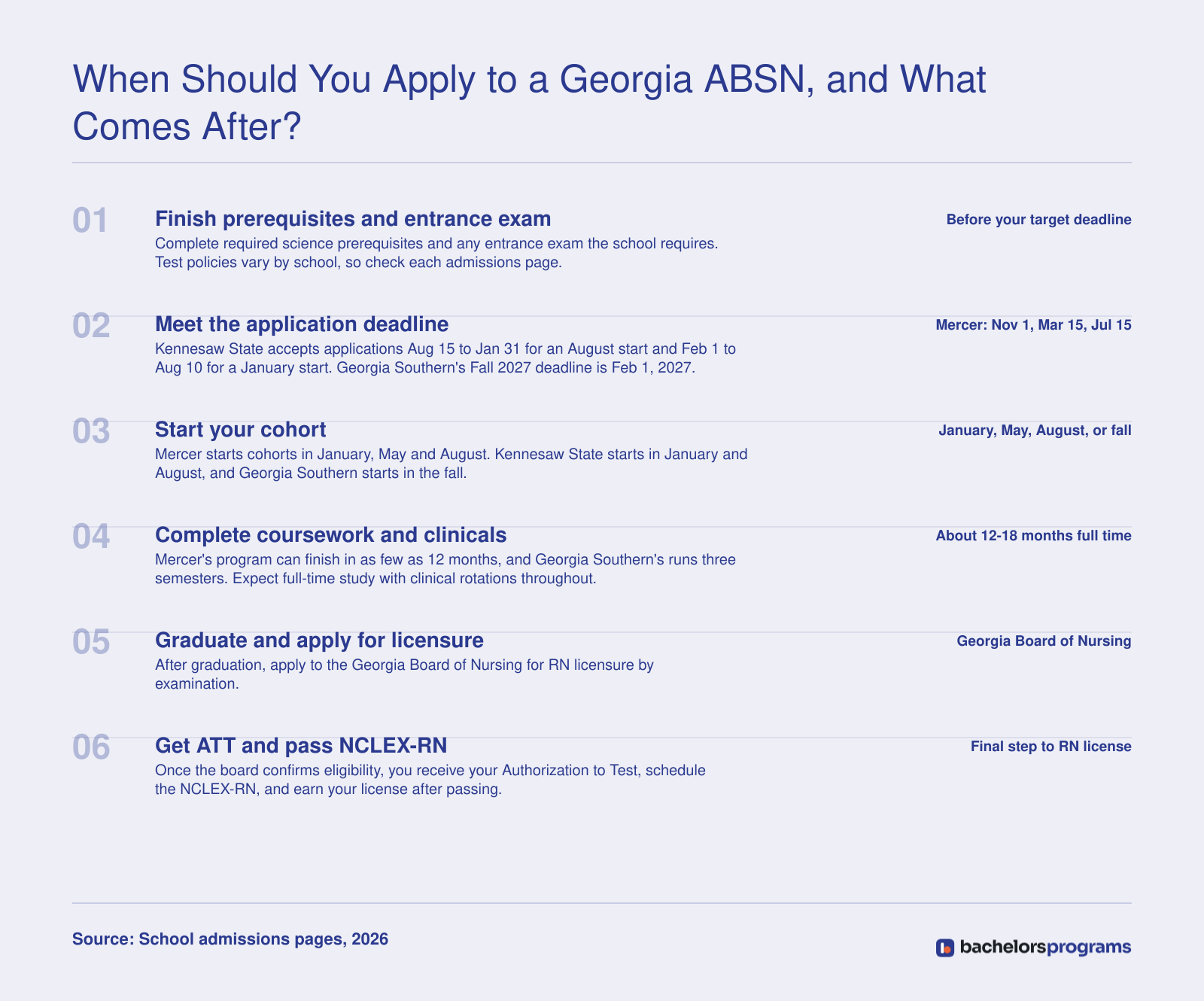
Georgia ABSN timelines depend on how many cohorts a school starts each year. Mercer University runs three starts, Kennesaw State University runs two, and Georgia Southern University admits one fall cohort. Deadlines shift every cycle, so confirm current dates on each school's admissions page before you plan.
Online, Hybrid, and On-Campus ABSN Formats in Georgia: Where Labs and Clinicals Happen
Hybrid delivery is the format shift that matters in Georgia nursing education, and it is narrower than the word "online" suggests.
What "Online" Really Means
None of the Georgia ABSN programs here is fully online. Where a school calls its program online or hybrid, only the didactic coursework moves to a screen. Skills labs, simulation, and clinical rotations are always in person.
Which Schools Use Which Format
Mercer University and the University of North Georgia are the hybrid options here. Mercer delivers coursework online through Canvas, then holds skills and simulation labs at its ABSN Learning Site in Atlanta. UNG pairs online theory with hands-on labs and in-person clinical education.
The other schools, including Georgia Southern, Kennesaw State, Augusta University, University of West Georgia, Clayton State, Valdosta State, Georgia Southwestern, and Albany State, are listed as campus-based. Georgia Southern's program is offered at its Armstrong-Savannah location. Albany State holds on-campus classes at its West Campus.
Where Clinicals Happen
Rotations cluster where the large health systems are. Mercer places students across the Atlanta metropolitan area. Georgia ABSN programs commonly draw on partners such as Emory Healthcare, Piedmont Healthcare, Grady Health System, Wellstar Health System, and Northside Hospital, though published sources do not tie each system to a specific school. Augusta University students train in the Augusta area, and Georgia Southern's Savannah location points to the coastal market.
Placement support varies:
- UNG: Clinical education runs through Northeast Georgia Health System, and 2026 listings describe placement as guaranteed.
- Albany State: Clinicals are listed at Phoebe Putney Hospital.
- Other schools: Published pages do not say whether the school arranges every placement, so ask admissions directly.
The Practical Takeaway
Plan housing and commuting around your clinical sites and lab location, not the online portion. Online lectures can be watched from anywhere, but you will need to be near the lab and hospital rotations for the full length of the program.
Georgia RN Licensure by Examination After an ABSN
Georgia Board of Nursing Approval, CCNE/ACEN Accreditation, and NCLEX-RN Readiness for ABSN Programs
Before you compare tuition or start dates, settle the approval question. In Georgia, the Board of Nursing must approve the prelicensure nursing program before its graduates can sit for the NCLEX-RN.1 A degree from an unapproved program does not lead to licensure, regardless of how strong the coursework looks. Confirm that the approval covers the accelerated track, not just the traditional BSN.
CCNE and ACEN: What Each One Signals
CCNE and ACEN are the two national nursing accreditors. Accreditation affects graduate school admission, employer hiring, and eligibility for some federal aid. Accreditation is separate from state approval, and a school can hold one without the other. Check the accreditor's directory and the program's own page, then ask whether the accreditation covers the accelerated BSN cohort or only the broader prelicensure program. The Georgia Board's approved-schools reference is the place to verify state approval status.2
The 80% Standard and Where to Find Pass Rates
Board rules set a minimum first-time NCLEX-RN pass rate of 80% for any single graduation cohort and 80% across the four most recent years.1 The Board publishes annual pass-rate reports by approved program. Statewide 2025 first-time results were 86.0% for U.S.-educated candidates overall, 86.4% for baccalaureate candidates, and 85.4% for associate-degree candidates. Those are state aggregates, not a program's ABSN result.
One Question to Ask Every School
Ask each admissions office for its most recent first-time NCLEX-RN pass rate for the accelerated BSN cohort specifically. A schoolwide BSN rate can mask a smaller ABSN cohort's performance. Request the cohort size and the year, and compare like with like.
Questions to Ask Yourself
Can you step away from paid work for 12 to 18 months of year-round classes and clinical shifts?
Do your Anatomy and Physiology, Microbiology, and Chemistry credits still fall inside each school's prerequisite window?
Would a lower-cost public program with one annual start date fit your timeline better than a pricier private program with several intakes?
Can you reach clinical sites in metro Atlanta or the school's home region, even if your coursework is hybrid?
Quick Answers for Georgia Accelerated BSN Applicants
These answers cover the questions second-degree applicants ask most often. Policies change by cohort, so confirm details on each school's admissions page before you apply.
Which Georgia ABSN program has the lowest net price?
How many months does an accelerated BSN take in Georgia, from first class to sitting for the NCLEX-RN?
Can I apply to a Georgia ABSN while my science prerequisites are still in progress?
Compare Accelerated BSN (ABSN) programs on the data that matters
Explore more Nursing majors or browse every field of study.
All Nursing programs Browse every field of study