Best BSN Programs in Georgia
Compare 44 accredited Bachelor of Science in Nursing (BSN) programs in Georgia at 38 colleges, with net price after aid, graduation rates, earnings and debt from IPEDS and the U.S. College Scorecard.

A Georgia BSN earns its keep at one moment: the NCLEX-RN. A first-time pass turns four years of coursework into an RN license; a retake costs months of income and a delayed start date.
That is why the ranking here leads with pass rates rather than reputation, with net price, graduate earnings and licensure weighed alongside. Every school listed runs a traditional pre-licensure BSN; licensed RNs and second-degree students have separate RN to BSN and accelerated routes.
Cost matters just as much. Lottery-funded state aid can pull net price well below published tuition, while prerequisite grades decide who gets a seat at all.
Key Points
- Schools here are ranked by graduates' first-time NCLEX-RN pass rates.
- Upper-division BSN entry usually follows about two years of prerequisite coursework.
- Lottery-funded HOPE aid can shrink Georgia BSN costs, but clinical fees remain.
Top NCLEX-RN Pass Rates: 10 BSN Schools in Georgia, Ranked
These Georgia schools report the strongest first-time NCLEX-RN results among their bachelor's nursing cohorts, listed from the highest pass rate to the lowest. Each entry notes how the school runs its BSN, so you can see which campuses, tracks and clinical models fit your situation.
Berry College
#1Mount Berry, GA · $22,000/yr (est. net price) · NCLEX-RN pass rate 100% (3-yr weighted avg)
Best for: High schoolers wanting early direct admission
A private liberal arts college whose CCNE-accredited BSN is expanding to take more students, including transfers entering in either spring or fall. Clinically, students log 650 hours at partner hospitals, complete a capstone research project, and can add a study-abroad immersion in Kenya. Georgia high school seniors who clear the academic bar can claim direct admission as freshmen. The first-time NCLEX-RN pass rate is 100%, and the school's graduation rate is about 69%.
- CCNE accredited BSN
- 650 clinical hours at partner hospitals
- Direct admit for qualifying Georgia high school seniors
- Transfer students may start in spring or fall
- Finish in 3.5 years with AP or dual-enrollment credit
- Capstone research project required
- Study abroad clinical immersion in Kenya
- About 90% of juniors and seniors hold paid clinical jobs
Truett McConnell University
#2Cleveland, GA · ~$22,000/yr (est.) · NCLEX-RN pass rate 98.7% (3-yr weighted avg)
Best for: Faith-centered learners seeking a small-cohort path
A private Christian university whose CCNE-accredited BSN carries a Great Commission minor, so faith formation sits alongside clinical training. Admission to the major is selective, with a 3.0 GPA minimum and the HESI A2 entrance exam, and cohorts stay small with an open-door faculty policy. Students start clinical practice in junior year, log 108 practicum hours on a hospital unit, and finish with a capstone poster symposium. The first-time NCLEX-RN pass rate is 98.7%, and the school's graduation rate is about 38%.
- CCNE accredited BSN
- Great Commission Minor built into the degree
- 3.0 GPA minimum for major admission
- HESI A2 entrance exam required
- 108 practicum hours in a hospital unit
- Clinical practice begins junior year
- Capstone research with poster symposium
- Small classes and open-door faculty policy
Reinhardt University
#3Waleska, GA · $24,000/yr (est. net price) · NCLEX-RN pass rate 98.6% (3-yr weighted avg)
Best for: Applicants who prefer a holistic admission review
A private university whose Cauble School of Nursing runs a CCNE-accredited BSN reviewed through a whole-person admission process rather than a single cut score. The curriculum stresses critical thinking and evidence-based practice across adult care, maternal and newborn care, pediatrics, behavioral health, emergency nursing and community health. Graduates are prepared for generalist practice and for graduate study later on. The first-time NCLEX-RN pass rate is 98.6%, and the school's graduation rate is about 44%.
- CCNE accredited BSN
- Whole-person, holistic admission review
- Clinical rotations in adult, maternal-newborn and pediatric care
- Behavioral health, emergency and community clinical settings
- Prepares generalist novice nurses for NCLEX-RN
- Builds a foundation for graduate nursing study
- Financial aid and scholarships available
Middle Georgia State University
#4Macon, GA · $12,000/yr (est. net price) · NCLEX-RN pass rate 97.5% (3-yr weighted avg)
A public university that spreads its BSN across three Georgia campuses with fall and spring cohort starts, supported by dedicated nursing advisors. Coursework runs from health assessment and pharmacology to medical-surgical and community health, paired with clinical rotations in partner facilities. The university also runs ASN and ABSN tracks, so applicants should confirm they are applying to the BSN. The first-time NCLEX-RN pass rate is 97.5%, and the school's graduation rate is about 25%.
- Cohorts start in fall or spring
- Clinical rotations across three Georgia campuses
- Coursework in health assessment, pharmacology and community health
- Dedicated nursing advisor support
- Virtual information sessions offered
- Study abroad opportunities available
- Prepares students for NCLEX-RN
Columbus State University
#5Columbus, GA · ~$13,000/yr (est.) · NCLEX-RN pass rate 96% (3-yr weighted avg)
A public university whose CCNE-accredited BSN runs 120 credit hours over four years, with clinical rotations in pediatrics, emergency medicine, labor and delivery, surgery and intensive care. Simulation labs and community clinical partners carry much of the hands-on load, and the faculty-to-student ratio is 17:1. Graduates are prepared for registered nurse roles and for leadership or further study. The first-time NCLEX-RN pass rate is 96%, and the school's graduation rate is about 42%.
- CCNE accredited BSN
- 120 credit hours across four years
- Clinical rotations in pediatrics, emergency, labor and delivery, surgery and ICU
- 17:1 faculty-to-student ratio
- Simulation labs plus community clinical partners
- Prepares graduates for hospitals, clinics and school settings
Toccoa Falls College
#6Toccoa Falls, GA · $20,000 – $25,000/yr (est.) · NCLEX-RN pass rate 96.2% (3-yr weighted avg)
A small private Christian college whose CCNE-accredited BSN is a 130-credit prelicensure degree, with 62 of those credits in nursing and 15 in Bible and theology. Clinical placements run through hospitals, outpatient centers and medical offices, and the curriculum covers pathophysiology, pharmacology, maternal-newborn, pediatric and complex care across the lifespan. The application is free. The first-time NCLEX-RN pass rate is 96.2%, and the school's graduation rate is about 44%.
- CCNE accredited BSN
- 130 credit hours, including 62 in nursing
- Faith-based curriculum with 15 hours of Bible and theology
- Clinicals in hospitals, outpatient centers and medical offices
- Prepares nurse generalists for NCLEX-RN practice
- Free application
Abraham Baldwin Agricultural College
#7Tifton, GA · $7,000/yr (est. net price) · NCLEX-RN pass rate 95.4% (3-yr weighted avg)
A public college whose nursing offering is an online RN-to-BSN completion track, built for licensed registered nurses rather than first-time students. The fully asynchronous format can be finished in as few as three semesters, with coursework in leadership, community health and nursing research, and the program joins the USG RN-BSN Collaborative in fall 2026. Students who want a prelicensure BSN should look at the other schools on this list. The school's graduation rate is about 36%, and the reported first-time NCLEX-RN pass rate is 95.4%.
- 100% asynchronous online coursework
- Completable in as few as three semesters
- Designed for licensed RNs returning for the BSN
- Joins the USG RN-BSN Collaborative in fall 2026
- Focus on nursing leadership and community health
- Coursework in advanced anatomy and microbiology
Valdosta State University
#8Valdosta, GA · $10,000 – $15,000/yr (est.) · NCLEX-RN pass rate 94.7% (3-yr weighted avg)
A public university with a CCNE-accredited, Georgia Board of Nursing approved BSN of 120 credit hours built around holism, caring and clinical judgment. Students practice in METI simulation labs and through community clinical partnerships, and a separate accelerated track serves second-degree students. Graduates sit for the NCLEX-RN and move into hospitals, clinics, schools and home health. The first-time NCLEX-RN pass rate is 94.7%, and the school's graduation rate is about 42%.
- CCNE accredited and Georgia Board of Nursing approved
- 120 credit hours
- METI simulation labs for realistic patient encounters
- Clinical partnerships with community providers
- Accelerated track for second-degree students
- Curriculum centered on holism, caring and competence
College of Coastal Georgia
#9Brunswick, GA · ~$15,000/yr (est.) · NCLEX-RN pass rate 95.4% (3-yr weighted avg)
A public college with an ACEN-accredited BSN that leans on simulation labs and clinical rotations with regional healthcare partners in Brunswick, Savannah and Jacksonville. Admission requires the HESI entrance exam and a 2.8 GPA minimum, and the curriculum spans pathophysiology, pharmacology, health promotion, epidemiology, leadership, ethics and community health. Graduates are eligible for the NCLEX-RN and prepared for hospitals, outpatient care and leadership roles. The first-time NCLEX-RN pass rate is 95.4%, and the school's graduation rate is about 26%.
- ACEN accredited BSN
- HESI entrance exam required
- 2.8 GPA minimum
- Simulation labs and clinical rotations with regional partners
- Coursework in pathophysiology, pharmacology, epidemiology and ethics
- Prepares students for NCLEX-RN and graduate study
University of North Georgia
#10Dahlonega, GA · ~$10,000/yr (est.) · NCLEX-RN pass rate 94.5% (3-yr weighted avg)
A public university offering a traditional BSN plus an accelerated track for students who already hold a degree, with rolling admissions and multiple campus locations. Applicants need a 3.0 GPA and the HESI entrance exam, and coursework covers medical-surgical nursing, pharmacology, maternal-child health, community health and evidence-based practice alongside simulation and regional clinical placements. Faculty bring clinical and academic experience to a structured path from prerequisites to licensure. The first-time NCLEX-RN pass rate is 94.5%, and the school's graduation rate is about 37%.
- Traditional and accelerated tracks
- 3.0 GPA minimum
- HESI entrance exam required
- Rolling admissions
- Simulation labs and clinical placements across the region
- Coursework in medical-surgical, pharmacology, maternal-child and community health
- Faculty with clinical and academic expertise
Cost & outcomes by school
Federal data for the highest-earning Bachelor of Science in Nursing (BSN) programs, independent of the ranking above. Earnings are this field's bachelor's graduates four years after completing where the Scorecard reports them, else the school's undergraduate median.
| School | Net price / yr | Grad rate | Earnings | Debt | Grads/yr | Format |
|---|---|---|---|---|---|---|
| Chamberlain University-Georgia GA | $33,188 | 50% | $92,405 | $20,919 | 716 | Hybrid |
| Emory University GA | $22,585 | 91% | $80,137 | $18,250 | 5,808 | Campus |
| Mercer University GA | $23,847 | 70% | $58,354 | $24,199 | 2,446 | Campus |
| Georgia College & State University GA | $20,686 | 64% | $58,140 | $22,250 | 2,266 | Campus |
| Kennesaw State University GA | $15,048 | 52% | $57,552 | $23,833 | 13,804 | Campus |
| Brenau University GA | $18,924 | 33% | $54,003 | $27,000 | 358 | Campus |
| Berry College GA | $22,320 | 70% | $53,800 | $23,250 | 1,300 | Campus |
| Georgia Southern University GA | $15,267 | 55% | $53,236 | $23,250 | 8,158 | Campus |
| LaGrange College GA | $20,875 | 47% | $51,745 | $25,730 | 178 | Campus |
| University of North Georgia GA | $9,823 | 37% | $50,135 | $17,750 | 4,502 | Campus |
| Thomas University GA | $18,499 | 28% | $49,716 | $21,198 | 354 | Online |
| University of West Georgia GA | $12,786 | 44% | $49,587 | $23,970 | 3,024 | Campus |
Sources: U.S. Department of Education. Net price, graduation rate, earnings and debt: College Scorecard (earnings and debt for this field's bachelor's graduates where reported, else school-wide); graduates: IPEDS. A dash means no figure is reported.
Cost, debt & payoff
Median earnings of this field's bachelor's graduates (4 yrs after completing, else the school's undergraduate median) vs. their median federal loan debt · U.S. College Scorecard
Across these programs the median graduate earns about $48,101 and finishes with roughly $23,345 in debt — a ratio that clears a common rule of thumb (keep debt below first-year salary). Net price and debt vary widely school to school, so check the per-school figures in the table above before you shortlist.
Our BSN Scoring Method: NCLEX-RN Results First
Nursing school rankings now lean on measurable outcomes more than reputation. The most honest measure of any Georgia BSN is how its graduates perform on the NCLEX-RN.
How the Score Is Built
First-time NCLEX-RN pass rates carry about three quarters of the weight in each school's score. We use the state board's latest three years of results and weight them by the number of test takers. That way, one strong year from a small cohort cannot carry a program to the top. Accreditation and a small completion and retention component act as tie-breakers when pass rates sit close together.
Public Inputs
Many lists call a school a "top program" without naming a source or a year. Every input here is public: state board pass-rate data, the federal College Scorecard and IPEDS.
Two caveats matter when you read the numbers:
- Graduation rate: This figure covers the whole institution. It does not isolate nursing students.
- Net price: This is an average after grants and scholarships, not a quote for every student.
Who Is Eligible
Only traditional pre-licensure BSN programs qualify. RN to BSN programs, the route for nurses who already hold a license, are excluded. So are accelerated BSN programs for students who already have a bachelor's degree. Both have their own pages.
Most Affordable BSN Schools in Georgia by Net Price
If you are comparing affordable BSN programs in Georgia, the table below lists the lowest-cost schools from our ranking, ordered by average annual net price after grants and scholarships, with published in-state tuition and fees and each school's NCLEX-RN pass rate alongside, based on 2024 IPEDS and College Scorecard data from the U.S. Department of Education. The cheapest BSN programs in Georgia do not trade away exam results: Abraham Baldwin Agricultural College (95.4%), Georgia Highlands College (93.6%) and Clayton State University (92.6%) all post NCLEX-RN pass rates above 90% while keeping net price under $8,400. Keep in mind that net price is an institution-wide average for students who receive aid, not a guaranteed bill, so your own cost will depend on your family income, residency and the grants you qualify for.
| Affordability Rank | School | City | Average Net Price After Aid | In-State Tuition and Fees | NCLEX-RN Pass Rate |
|---|---|---|---|---|---|
| 1 | Dalton State College | Dalton | $5,012 | $3,336 | 85% |
| 2 | Abraham Baldwin Agricultural College | Tifton | $6,842 | $3,268 | 95.4% |
| 3 | Georgia Highlands College | Rome | $6,928 | $3,120 | 93.6% |
| 4 | Gordon State College | Barnesville | $8,105 | $3,628 | 86.2% |
| 5 | Clayton State University | Morrow | $8,365 | $5,180 | 92.6% |
Cost of a BSN in Georgia: Tuition, Net Price and State Aid
In Georgia, the question is not which nursing program is cheap but how much of the bill lottery-funded aid erases before you write the check. Sticker price and final price diverge sharply here.
What the Numbers Look Like
Among the public institutions ranked on this page, published in-state tuition runs from roughly $3,100 a year at Georgia Highlands College and Abraham Baldwin Agricultural College to about $6,100 at Valdosta State University, with Clayton State University, Middle Georgia State University and the University of North Georgia falling between. Net price, which reflects grants and scholarships already applied and folds in living costs, spans a wider band: from under $3,000 at the least expensive schools here to just over $12,000 at Middle Georgia State. Private institutions on this list, including Berry College, Mercer University and Reinhardt University, set their own tuition outside the University System of Georgia rate structure, so their published cost sits well above those in-state figures.
HOPE and Zell Miller
The HOPE Scholarship requires a 3.0 calculated GPA out of high school.1 At public institutions it pays standard undergraduate tuition for hours enrolled, capped at 15 credit hours per term; at private institutions the award is capped at 12 hours.2 You must hold a 3.0 at spring-semester checkpoints and at 30, 60 and 90 attempted hours, and you can regain a lost award only once.3
Zell Miller is the stronger award: a 3.7 GPA plus a 1200 SAT or 26 ACT and four rigor credits, with valedictorians and salutatorians eligible by a separate route.4 It pays full tuition at public institutions and a set tuition assistance amount at privates, and renewal requires a 3.3.5
What That Leaves You
The HOPE Grant covers part of tuition for students without a bachelor's degree, up to 63 paid semester hours, with a 2.0 GPA check at 30 and 60 hours.6 Combined HOPE awards stop at 127 semester hours.6 Award schedules change annually, so confirm current amounts with the Georgia Student Finance Commission.
Hold HOPE through all four years at a public school charging around $5,000 in tuition and you strip roughly $20,000 from the degree, leaving fees, housing and nursing program costs to cover.
Related Articles
Nursing Fees, Uniforms and Clinical Costs That Net Price Leaves Out
Net price tells you what a typical student pays for tuition, fees, housing and books after grant aid. It does not tell you what the nursing major itself adds on top. Once you enter clinical coursework, a separate pile of charges appears: nursing course and lab fees, scrubs and shoes, a stethoscope and physical assessment kit, criminal background screening, drug testing, required immunizations and titers, professional liability insurance, a program ID badge, and standardized testing packages such as ATI or HESI.
What Georgia Schools Publish
Georgia College & State University is unusually direct about this. Its BSN program tells students to budget roughly $2,000 in additional costs across HESI testing, uniforms, a sweep-second watch, assessment equipment, an official picture ID, malpractice and health insurance, background screening, lab fees and clinical travel. That estimate excludes health insurance premiums, and the school notes clinical placements can occasionally require driving up to 100 miles. Kennesaw State requires the ATI TEAS entrance exam, taken within five years of applying, at the student's expense.1 Augusta University also requires the TEAS and charges a $65 application fee, with a $25 supplemental fee for transfer applicants. Several Georgia programs do not post itemized nursing fee sheets at all.
End-of-Program Charges
Budget separately for NCLEX-RN registration through the testing vendor and the Georgia Board of Nursing's licensure application, including fingerprint background check costs.
Before you deposit, email the nursing department and ask for a full cost sheet by semester. Programs that have one will send it.
BSN Admissions in Georgia: Prerequisites, GPA and Entry Type
Georgia BSN admissions force an early decision: apply as a high school senior and claim a seat, or spend roughly two years proving yourself in prerequisite courses before a nursing program will even open your file. Both routes exist in Georgia, and the choice depends on how certain you are about nursing now.
Direct Admit vs Upper-Division Entry
Berry College is the clearest direct-admit option among the schools ranked here, taking high school seniors straight into the BSN track. The University of North Georgia runs the opposite model: upper-division entry, with at least 35 core credit hours finished before you apply, including 12 science credits, 6 English credits and 3 math credits. College of Coastal Georgia also requires prerequisite and core coursework first, though it does not use the upper-division label. Georgia College & State University admits by cohort, and its published material does not spell out a freshman-versus-upper-division entry point.
Prerequisites, GPA and Entrance Exams
Prerequisite lists generally run through anatomy and physiology, microbiology, chemistry, statistics and the core curriculum.
- University of North Georgia: 3.0 GPA; HESI A2 with 75% cumulative and 66% in each section (reading comprehension, vocabulary, math, anatomy and physiology).
- College of Coastal Georgia: 2.8 GPA; HESI score of 80 in the required sections.
- Mercer University: 3.0 recommended; official TEAS composite of at least 76.
- Middle Georgia State University: TEAS preferred at 68 for 2026-2027; HESI A2 accepted as an alternative at 80.
- Georgia College & State University: 3.0 overall; nursing GPA built from Area A math, Area D math and sciences, and Area F courses. The school's published nursing material does not name an entrance exam.
What GPA Do You Need?
Published minimums in Georgia run from 2.8 to 3.0 on a 4.0 scale. Treat those as floors rather than targets: nursing cohorts fill before every eligible applicant is seated, so admitted students generally clear the stated minimum. Institution-wide acceptance rates offer loose context only (Middle Georgia State admits nearly all applicants, while Reinhardt and Berry each take roughly three in five), because a college's overall selectivity is not the same measure as its nursing cohort's.
How Long Does It Take to Get a BSN in Georgia?
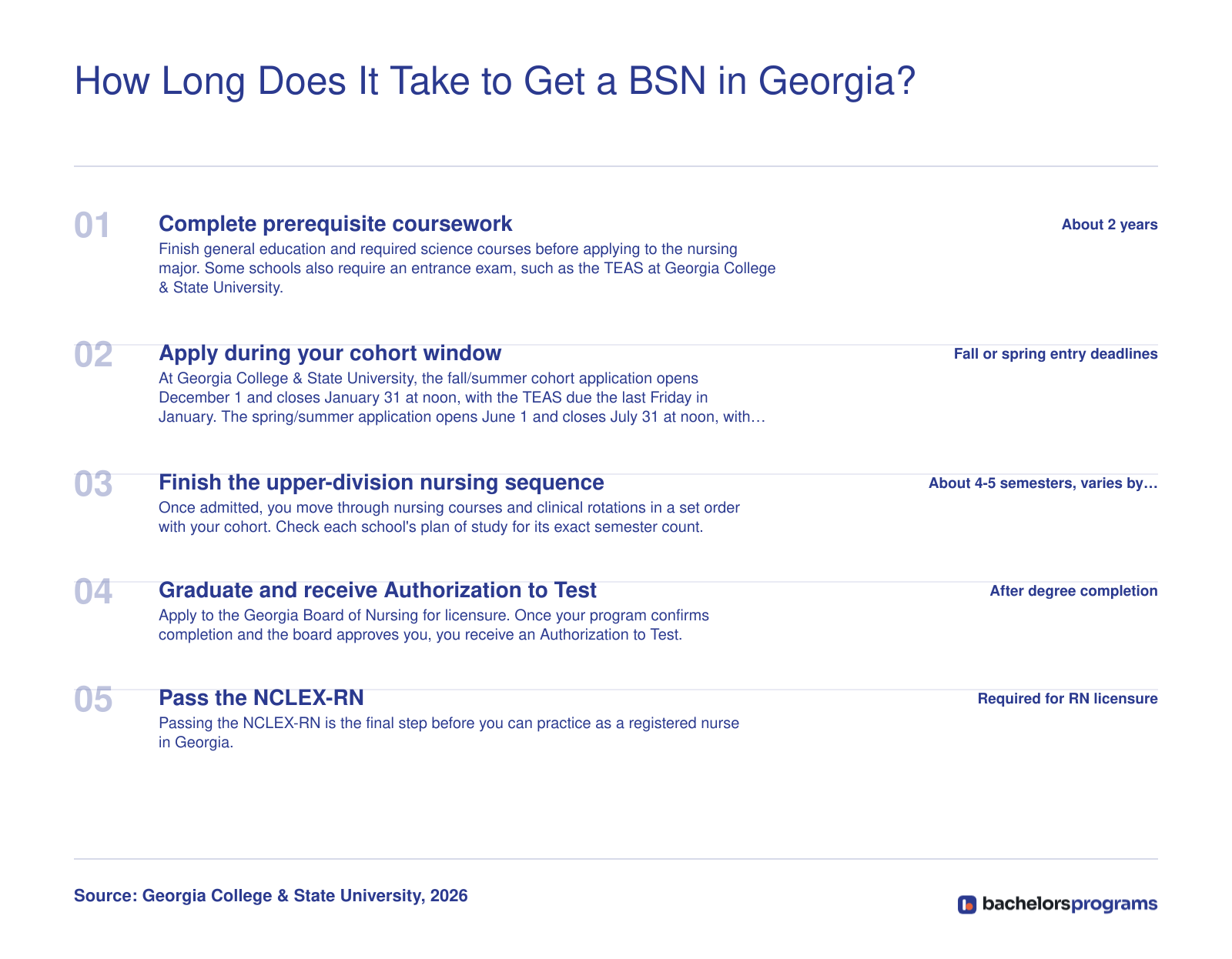
A traditional BSN in Georgia typically takes four years of full-time study. Georgia College & State University, for example, describes its BSN as eight semesters. Plan for longer if unfinished prerequisites or a missed application deadline push your nursing start back a full cycle.
Georgia Multistate RN License: What New BSN Graduates Need
Compare Bachelor of Science in Nursing (BSN) programs on the data that matters
Explore more Nursing majors or browse every field of study.
All Nursing programs Browse every field of study