Best Accelerated BSN (ABSN) Programs in Indiana
Compare 18 accredited Accelerated BSN (ABSN) programs in Indiana at 17 colleges, with net price after aid, graduation rates, earnings and debt from IPEDS and the U.S. College Scorecard.
Indiana's accelerated BSN market splits sharply on price, and the credential at the end is identical either way. Published tuition runs from $8,424 at Indiana University's regional campuses to $48,450 at Valparaiso University, and both routes end at the same NCLEX-RN exam and the same Indiana RN license.
Programs here range from public to private and from campus-only to hybrid: some hold lectures in person, others move coursework online and keep skills labs and clinical rotations on site. Admission thresholds and prerequisite windows vary too.
What does not vary is the compression: eighteen months of full-time study is the ceiling, so the choice narrows to cost, commute, and start date.
Key Points
- Purdue University Northwest posts the strongest first-year earnings among nursing completers here.
- No Indiana ABSN is fully online: labs and clinicals stay in person.
- Indiana's RN licensure application carries a nonrefundable $50 fee.
Indiana's 10 Top Accelerated BSN Programs for Second-Degree Students
A second-degree ABSN is a compressed, expensive purchase, so the differences that matter are how fast you finish, what the net price looks like after aid, and whether the campus fits your life. The ten Indiana programs below run from 13 to 19 months of full-time study, with average net prices after aid spanning roughly $4,000 to $18,600.
Purdue University
#1West Lafayette, IN · ~$15,000/yr (est.)
Best for: Career changers wanting a flagship campus
Purdue's ABSN runs four full-time semesters and 59 credits on the West Lafayette campus, with coursework in pathopharmacology, health assessment and population health plus specialty content in psychiatric mental health and pediatrics. The school graduates 83% of students overall, the highest overall completion rate on this list, and completers can move straight into DNP or PhD study. Average net price after aid is roughly $14,600.
- Four semesters, 59 credit hours, full-time enrollment
- CCNE accredited
- Coursework in pathopharmacology, health assessment and population health
- Specialty content in psychiatric mental health, pediatric and public health nursing
- Clinical leadership and quality improvement threaded through the curriculum
- Prepares graduates for the NCLEX-RN
- Pathway to DNP or PhD study
Ball State University
#2Muncie, IN · $10,000 – $15,000/yr (est.)
Best for: Nurse hopefuls who thrive in small cohorts
Ball State's accelerated second baccalaureate track is a 19-month, cohort-based program in Muncie with two entry points a year and high-fidelity simulation labs. The school graduates 62% of students overall, and the program reports a 94% licensure pass rate. Average net price after aid is about $14,940.
- 19-month, cohort-based accelerated format
- Two start dates per year, fall and spring
- Program reports a 94% licensure pass rate
- High-fidelity simulation labs with small cohorts
- Clinical rotations across medical-surgical, critical care, pediatric and community health
- Prepares graduates for the NCLEX-RN
Indiana University-Indianapolis
#3Indianapolis, IN · $11,000 – $35,000/yr (est.)
Best for: Urban commuters seeking rolling admissions
IU Indianapolis offers the second-degree track across four semesters, summer sessions included, with in-person labs and clinical placements in the state's largest hospital market. The school graduates 54% of students overall, and a 2.7 GPA floor plus a seven-year window on science prerequisites keep the entry bar within reach of career changers. Applications are reviewed on a rolling basis for fall and spring starts.
- Four semesters of full-time study, summer sessions included
- Rolling admissions with fall and spring start dates
- Minimum 2.7 GPA, with a 3.0 GPA expected in nursing prerequisites
- Science prerequisites must be completed within seven years
- In-person labs and clinical placements across Indianapolis
- Prepares graduates for the NCLEX-RN
- Personalized academic advising for second-degree students
Valparaiso University
#4Valparaiso, IN · ~$19,000/yr (est.)
Valparaiso runs a 15-month, 67-credit ABSN that starts in summer, and the program reports a 97% licensure pass rate. The school graduates 70% of students overall, and a sticker tuition near $48,450 settles to an average net price around $18,600 after institutional aid. It suits students who want a shorter calendar and clinical placements at large health systems.
- 15-month program, 67 total credit hours
- Summer start
- 3.0 GPA minimum plus prerequisite coursework
- Program reports a 97% licensure pass rate
- CCNE accredited
- Clinical placements at large health systems plus a professional role practicum
- Coursework spans childbearing families through geriatric care
- For transfer and second-degree students
University of Evansville
#5Evansville, IN · $18,000/yr (est. net price)
Evansville's ABSN is a 16-month, 64-credit hybrid track with 930 clinical and lab hours, spring and fall starts, and a 2.5 GPA minimum that is among the most forgiving on this list. The school graduates 64% of students overall, and the program reports a 100% first-time NCLEX pass rate. Average net price after aid is about $18,500, in line with other private options here.
- 16-month program, 64 total credit hours
- 930 supervised clinical and lab hours
- Spring and fall start dates
- 2.5 GPA minimum plus prerequisite coursework
- Program reports a 100% first-time NCLEX pass rate
- High-fidelity simulation labs
- Clinical rotations at Ascension St. Vincent and Deaconess
- Faculty and preceptor mentorship
Huntington University
#6Huntington, IN · ~$19,000/yr (est.)
Huntington delivers its 13-month ABSN in Fort Wayne through a partnership with Parkview Health and Indiana Tech, a setup that can cover full tuition for eligible students and comes with a guaranteed Parkview job after graduation. The school graduates 64% of students overall, and the program reports 100% job placement. Average net price after aid is roughly $19,300.
- 13-month full-time program
- All classes held in Fort Wayne
- Partnership with Parkview Health and Indiana Tech
- ABSN scholarship can cover full tuition for eligible students
- Guaranteed job with Parkview after graduation
- Program reports 100% job placement
- Clinical work at Parkview facilities
- CCNE accredited and approved by the Indiana State Board of Nursing
Indiana University-Kokomo
#7Kokomo, IN · ~$4,000/yr (est.)
IU Kokomo's 17-month second-degree BSN is the value option on this list, with an average net price after aid of about $3,970, the lowest of the ten. The school graduates 46% of students overall, and admission requires a 3.0 GPA, with a committee waiver available, plus a May 15 deadline for a fall start. Life and physical science prerequisites older than seven years must be retaken before enrollment.
- 17-month second-degree track
- 3.0 GPA minimum, with a waiver possible through committee review
- Fall start with a May 15 application deadline
- Anatomy, physiology, microbiology and upper-division statistics required
- Minimum grade of C in each prerequisite course
- Science and statistics prerequisites expire after seven years
- Criminal background check and drug screen before clinical placement
- CCNE accredited
Marian University
#8Indianapolis, IN · $20,000 – $25,000/yr (est.)
Marian's ABSN is a 16-month hybrid built around asynchronous online coursework, on-site skills and simulation labs, and clinical rotations that begin in the first semester. Three start dates a year in January, May and August make it the most flexible calendar among the Indianapolis entries. The school graduates 67% of students overall, with an average net price after aid near $24,000.
- 16-month hybrid program
- Asynchronous online classes plus on-site skills and simulation labs
- Three start dates per year: January, May and August
- Clinical rotations begin in the first semester
- Indianapolis and Nashville locations
- Transfer admissions path available
- Prerequisite courses offered online
- CCNE accredited
Purdue University Northwest
#9Hammond, IN · ~$6,000/yr (est.)
Purdue Northwest's four-semester ABSN in Hammond puts students in clinical practicum from the first semester and is housed in a designated NLN Center of Nursing Excellence. The school graduates 43% of students overall, and the program reports 97% job placement. Average net price after aid is about $6,080, among the lowest here for a campus-based option.
- Four-semester accelerated track
- Clinical practicum begins in the first semester
- 3.0 GPA minimum plus prerequisite coursework
- ACEN accredited, designated NLN Center of Nursing Excellence
- Home to the Indiana Center for Evidence-Based Nursing Practice
- Program reports 97% job placement
- Fall start
- Prepares students for advanced nursing degrees
Indiana University-Northwest
#10Gary, IN · ~$5,000/yr (est.)
IU Northwest's BA/BS to BSN takes 18 months from a May start, after 56 prerequisite credits, and the program reported a 100% NCLEX pass rate in its 2019-2020 outcomes report. The school graduates 37% of students overall, so ask the department for cohort-level completion figures directly. Average net price after aid is about $5,130, and the campus publishes an Indiana Partners tuition rate for residents of several nearby states that applicants should confirm applies to this track.
- 18-month program starting in May and ending the following December
- 56 prerequisite credit hours before nursing coursework
- 2.5 GPA minimum overall and in prerequisites, 3.0 GPA in general education
- Science, lifespan development and statistics prerequisites expire after seven years
- Program reported a 100% NCLEX pass rate in its 2019-2020 outcomes report
- One repeat allowed per prerequisite course
- ACEN accredited
- Competitive admission with outcomes matching the traditional BSN
Cost & outcomes by school
Federal data for the highest-earning Accelerated BSN (ABSN) programs, independent of the ranking above. Earnings are this field's bachelor's graduates four years after completing where the Scorecard reports them, else the school's undergraduate median.
| School | Net price / yr | Grad rate | Earnings | Debt | Grads/yr | Format |
|---|---|---|---|---|---|---|
| Purdue University IN | $14,600 | 83% | $72,424 | $19,500 | 22,162 | Campus |
| Valparaiso University IN | $18,578 | 70% | $63,191 | $26,942 | 1,066 | Campus |
| Indiana Wesleyan University IN | $22,866 | 67% | $59,986 | $24,250 | 1,062 | Campus |
| Indiana Wesleyan University IN | $16,898 | 35% | $59,986 | $24,250 | 1,860 | Campus |
| Marian University IN | $24,018 | 67% | $58,759 | $27,000 | 1,268 | Hybrid |
| Marian University-Ancilla IN | $19,463 | — | $58,759 | $27,000 | 14 | Online |
| Indiana University-Indianapolis IN | $11,668 | 55% | $55,198 | $20,000 | 6,358 | Campus |
| University of Evansville IN | $18,499 | 65% | $53,770 | $24,606 | 690 | Hybrid |
| University of Indianapolis IN | $21,602 | 56% | $53,610 | $26,864 | 1,580 | Campus |
| Ball State University IN | $14,940 | 62% | $51,833 | $23,250 | 5,632 | Campus |
| Manchester University IN | $18,805 | 46% | $51,504 | $26,854 | 438 | Campus |
| Indiana University-Kokomo IN | $3,968 | 46% | $49,917 | $16,961 | 920 | Campus |
Sources: U.S. Department of Education. Net price, graduation rate, earnings and debt: College Scorecard (earnings and debt for this field's bachelor's graduates where reported, else school-wide); graduates: IPEDS. A dash means no figure is reported.
Cost, debt & payoff
Median earnings of this field's bachelor's graduates (4 yrs after completing, else the school's undergraduate median) vs. their median federal loan debt · U.S. College Scorecard
Across these programs the median graduate earns about $53,690 and finishes with roughly $25,091 in debt — a ratio that clears a common rule of thumb (keep debt below first-year salary). Net price and debt vary widely school to school, so check the per-school figures in the table above before you shortlist.
Most Affordable Accelerated BSN Programs in Indiana
These schools are sorted by average annual net price after grants and scholarships, from federal College Scorecard data, not by published tuition. Both figures are school-wide undergraduate numbers, so an ABSN's own price can run higher: Indiana University's School of Nursing estimates its 16-month accelerated BSN at about $35,000 for Indiana residents, $45,000 for partner-state students and $85,000 for out-of-state students, covering tuition, program, clinical and compliance fees, and books. Also budget for costs an annual tuition figure may not capture, such as uniforms, clinical equipment, the criminal background check and drug screen some programs require for admission, and NCLEX-RN registration, and ask each nursing office for its current fee schedule before comparing offers.
| School | City | Average Net Price After Aid (per year) | Published In-State Tuition and Fees (per year) | ABSN Length | Published ABSN Cost Estimate |
|---|---|---|---|---|---|
| Indiana University-Kokomo | Kokomo | $3,968 | $8,424 | 17 months | N/A |
| Indiana University-Northwest | Gary | $5,130 | $8,424 | 18 months | N/A |
| Purdue University Northwest | Hammond | $6,079 | $8,675 | 4 semesters | N/A |
| Indiana University-Indianapolis | Indianapolis | $11,668 | $10,762 | 4 semesters (about 16 months) | About $35,000 in-state (IU School of Nursing all-in estimate) |
| Purdue University | West Lafayette | $14,600 | $9,992 | 4 semesters (59 credit hours) | N/A |
Top First-Year Earnings Among Indiana Nursing Completers
Purdue University Northwest posts the strongest early-career earnings among the Indiana nursing programs ranked here.
Related Articles
Accelerated BSN Prerequisites and Admission Standards in Indiana
Indiana ABSN programs share a common admissions framework, but the details differ by school. Use this checklist to prepare, then confirm each item on your target program's admissions page.
- A completed non-nursing bachelor's degreeMarian University asks for a non-nursing bachelor's degree or higher from an accredited institution. Expect every program on this list to require a finished first degree before you start.
- Prerequisite science and general education coursesIndiana University's accelerated second-degree bulletin lists anatomy with lab, physiology with lab, microbiology with lab, upper-level statistics, psychology, sociology and English composition, each passed with a C or higher. Other programs commonly add chemistry, nutrition or developmental psychology. Marian requires prerequisites to be finished before enrollment. Recency limits vary, so ask whether older coursework still counts.
- Minimum GPAPublished cumulative minimums run from 2.7 under the Indiana University bulletin to 2.8 at Marian. IU also sets a 3.0 minimum GPA for prerequisite courses. Competitive applicants often exceed these floors.
- Entrance exam policyThe Indiana University bulletin track lists no TEAS or HESI requirement. Some Indiana ABSN programs require the HESI A2 or ATI TEAS. Check policies separately with IU Indianapolis, IU Kokomo and IU Northwest, because campus rules can differ.
- Clinical clearance itemsBefore clinical rotations, schools typically require a criminal background check, a drug screen, current immunizations and CPR certification. A few programs also ask for CNA certification, so verify each school's list early.
When to Apply: Indiana ABSN Deadlines and Start Terms
An accelerated BSN application cycle is the window when a nursing school accepts applications for one cohort, a group of second-degree students who begin nursing coursework together on a fixed date. Missing that window usually means waiting months for the next start.
Start Terms at Indiana Schools
Most Indiana ABSN programs admit one or two cohorts a year. Indiana University-Indianapolis offers both fall and spring entry:
- Fall 2026: Applications ran January 15 to June 15, with nursing courses beginning in August 2026.
- Spring 2026: Applications ran July 15 to November 15, 2025, for a January 2026 start.
Marian University offers more flexibility, with January, May and August starts for its 16-month program in Indianapolis. Dates shift every cycle, so check each nursing school's admissions page directly, including Purdue University, Ball State University and the other schools ranked here.
Prerequisites and Application Method
Aim to finish your science prerequisites before you apply. IU requires a completed 120-credit bachelor's in a non-nursing field and reviews files on a rolling basis. It also sets a mid-July priority date for completing coursework, and applicants still waiting on final grades may be held until seats fill or orientation begins. A complete, early application is your strongest position.
IU uses its own School of Nursing online application rather than NursingCAS. Confirm each program's application route before you start requesting transcripts, since schools manage this process differently.
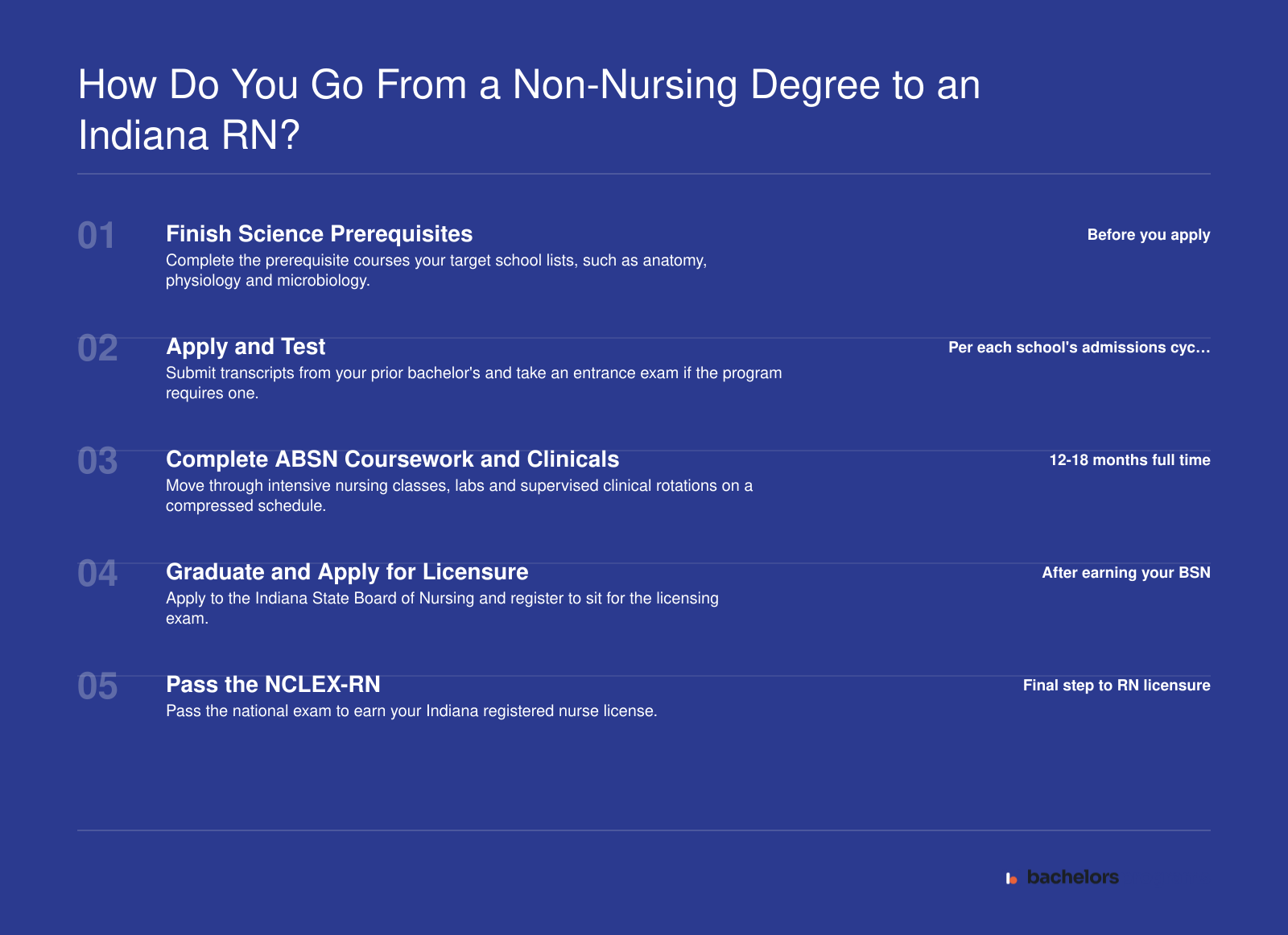
How Do You Go From a Non-Nursing Degree to an Indiana RN?
An accelerated BSN builds on the bachelor's degree you already hold, so the route to licensure is shorter than starting over. The order matters: each step below has to be finished before the next one opens.
ABSN Pace, Cost and Financial Aid in Indiana
An Indiana accelerated BSN compresses the nursing curriculum into 12 to 18 months of full-time study, clinicals included, and the schedule assumes school is your job.
The pace is the real constraint
Clinical rotations follow hospital shifts, often on weekday daytime hours, and course blocks move fast enough that a missed week is hard to make up. Most programs tell students not to hold a steady job during the accelerated year. If you need income, a few weekend shifts are the realistic ceiling, and even that depends on how your clinical block is scheduled. On cost, public universities here charge in-state rates to Indiana residents while private programs run higher, and per-credit pricing varies enough that totals matter more than sticker tuition.
Federal aid for a second bachelor's
Second-degree ABSN students are generally classified as undergraduates for federal loans.1 That means Direct Loan annual limits of $5,500, $6,500, and $7,500 across your years of study, with aggregate caps of $31,000 as a dependent student and $57,500 as an independent one, no more than $23,000 of it subsidized.1 Any federal borrowing for your first degree counts toward those caps, so check your loan history before assuming you have room. Subsidized loans require financial need; unsubsidized loans do not.2 Graduate PLUS is normally not available to you.2
Pell Grants generally end with your first bachelor's3, and Indiana state aid programs, including 21st Century Scholars, are not open to second-degree nursing students. Nursing schools also award their own scholarships, so ask each admissions office what is available.
Indiana programs and employer help
- Indiana State Loan Repayment Program: repays up to $40,000 for two years of full-time primary-care service at an eligible nonprofit site in a designated shortage area, at least 40 hours a week for 45 weeks a year. RNs qualify, but it pays existing loans after the fact, not tuition up front.
- IU Scholars Network: Indiana University-Indianapolis describes a pathway for accepted students who meet its requirements, earn the degree, and become RNs, with a guaranteed full-time position and significant loan repayment.
- Hospitals: tuition reimbursement and loan repayment packages are employer-specific. Ask about service commitments and any repayment clawbacks in writing before you sign.
Online vs. Campus ABSN Options in Indiana
No accelerated BSN in Indiana is fully online, because skills labs and clinical rotations always happen in person. The real choice is between a hybrid track, where lectures move online, and a campus track, where nearly everything is face to face. The format column in the ranked list above shows which schools offer online, campus or both. Figures below come from individual program pages, so treat them as examples rather than rules for every school.
| What to Compare | Hybrid or Online-Format ABSN | Campus-Based ABSN |
|---|---|---|
| How coursework is delivered | 100% online coursework in the published hybrid example | In-person classes on campus, full-time |
| Skills lab requirement | Two in-person on-campus skills weeks in the example | Labs and simulation held on campus as part of the weekly schedule |
| Clinical placements | In person; 570 clinical hours in the example, so confirm how placements are arranged | In person; rotations are arranged through the program, and hour totals vary by school |
| Schedule intensity | 15 months over four semesters; online lectures add flexibility but the pace is still accelerated | 16 months of full-time, in-person study |
| Typical cohort size | Varies by school; check the admissions page | Roughly 40 students a year at a smaller campus to about 180 a year at a larger one |
| Entry bar and cost example | Minimum 2.8 cumulative GPA; $860 per credit hour for 2026-27 | About $35,000 in-state, $45,000 for Indiana Partner States students, $85,000 out-of-state |
Indiana State Board of Nursing Approval, CCNE Accreditation and NCLEX-RN Licensure
Does Indiana State Board of Nursing approval mean the same thing as national nursing accreditation? No, and confusing the two can cost you later.
Two Different Stamps of Approval
The Indiana State Board of Nursing regulates programs that prepare students for initial RN and LPN licensure in the state. Board approval is the credential that lets you sit for the NCLEX-RN after graduation, so an accelerated BSN without it is a dead end. CCNE and ACEN are separate national accreditors. Graduate nursing programs, the military and many hospital systems look for that review when they evaluate your degree, and it often shapes eligibility for tuition reimbursement or an eventual MSN or DNP application.
Checking Status Before You Apply
The Board's 2026 approved program list shows Full Accreditation for Ball State University, Valparaiso University, and Purdue University Northwest, with Marian University listed at Initial accreditation, a status common for newer programs. Large systems appear campus by campus, so look up the exact campus you plan to attend rather than the university name alone.
For national accreditation, go straight to the source: CCNE maintains a searchable directory of accredited baccalaureate programs, and ACEN publishes a comparable list. Search by state and institution, then confirm the status covers the baccalaureate program, not only a graduate track.
NCLEX-RN and Multistate Licensure
The Indiana Professional Licensing Agency publishes program results alongside its approved program list, which is a better reference point than a school's promotional figure. Ask admissions for the most recent first-time pass rate for the accelerated cohort specifically, since it can differ from the traditional BSN track.
Indiana belongs to the Nurse Licensure Compact. If Indiana is your primary state of residence, you can apply for a multistate license that permits practice in other compact states without filing a separate application in each one.
Indiana RN Licensure at a Glance
Compare Accelerated BSN (ABSN) programs on the data that matters
Explore more Nursing majors or browse every field of study.
All Nursing programs Browse every field of study