Best BSN Programs in Indiana
Compare 52 accredited Bachelor of Science in Nursing (BSN) programs in Indiana at 37 colleges, with net price after aid, graduation rates, earnings and debt from IPEDS and the U.S. College Scorecard.

Indiana's top BSN schools sit in a narrow band on the NCLEX-RN: first-time pass rates here run from 93.8 percent at Saint Mary's College to 99.2 percent at the University of Evansville. Small gaps still matter, because a failed first attempt delays your RN license and your first nursing paycheck.
This page ranks only traditional pre-licensure BSN programs, ordered mainly by first-time NCLEX-RN results. Licensed RNs and second-degree students should look to the separate RN-to-BSN and accelerated pages.
Cost, more than exam results, is what separates these schools. Purdue University lists in-state tuition of $9,992, while Saint Mary's College lists $53,230.
Key Points
- First-time NCLEX-RN pass rates drive roughly three quarters of each ranking score.
- Indiana University-Kokomo's $3,968 net price tops an all-public lowest-cost group.
- IU nursing admissions will weight prerequisite GPA 60 percent from Fall 2027.
Top NCLEX-RN Pass Rates: 10 Indiana BSN Programs Ranked
Each position reflects how a school's BSN graduates performed on their first NCLEX-RN attempt across the state board's three most recent reporting years, with accreditation and completion breaking close calls. Every card also notes what the wider university reports for graduation and the details that set the program apart.
University of Evansville
#1Evansville, IN · $18,000/yr (est. net price) · NCLEX-RN pass rate 99.2% (3-yr weighted avg)
Best for: High schoolers set on direct entry
Evansville's BSN graduates posted a 99.2% first-time NCLEX-RN pass rate across the three most recent reporting years, the strongest showing in this group. The private university admits qualified high school seniors straight into nursing, so majors begin nursing coursework in year one rather than competing for a seat later. The university graduates 64% of its students overall, and nursing students can spend a semester at Harlaxton in England without delaying the degree.
- Direct entry for qualified high school students; transfer students need a 2.75 GPA
- Entrance exam required: ACT, SAT or TEAS accepted
- Semester abroad at Harlaxton in England fits the four-year plan
- Faculty-mentored clinical practice alongside natural and behavioral science coursework
- School reports 100% employment or graduate school placement within six months
Indiana Wesleyan University
#2Marion, IN · ~$23,000/yr (est.) · NCLEX-RN pass rate 98.2% (3-yr weighted avg)
Best for: Faith-centered learners wanting a residential campus
Indiana Wesleyan's BSN is a pre-licensure program on the Marion campus, and its graduates cleared the NCLEX-RN on the first try at a 98.2% clip over three years. The Christ-centered curriculum pairs anatomy and pharmacology with simulation lab work and real clinical settings, and the university graduates 67% of its students overall. A three-year fast track and a second-degree transition route let students pick a faster pace when they need one.
- Pre-licensure program on the Marion campus with a state-of-the-art simulation lab
- Minimum 2.8 GPA for admission
- Christ-centered curriculum with NCLEX-RN preparation courses built in
- Locked tuition rate plus need and merit aid
- Plan for Academic Student Success supports students who need extra help
- Three-year accelerated path to the same BSN
- Minimum 2.8 GPA for admission
- Same simulation lab and clinical placements as the traditional track
- Faith-integrated curriculum with virtual reality and simulation work
- Designed for students who already hold a bachelor's degree
- TEAS entrance exam required
- 64 credit hours of nursing coursework
- Prerequisite courses required before starting
- Military benefits and employer tuition reimbursement accepted
Bethel University
#3Mishawaka, IN · $19,000/yr (est. net price) · NCLEX-RN pass rate 98.7% (3-yr weighted avg)
Best for: Hands-on learners who want early clinicals
Bethel's four-year BSN sends students into clinical settings from sophomore year, giving them three full years of supervised practice before graduation. First-time NCLEX-RN results came in at 98.7% across three reporting years, and the university graduates 53% of its students overall. High-fidelity simulation and a cadaver lab support the coursework, and medical mission trips add international experience.
- Four-year program with three full years of clinicals starting sophomore year
- High-fidelity simulation labs and a cadaver lab on campus
- Medical mission trip opportunities
- Faith-based, holistic approach to patient care
- Scholarships and financial aid available
Purdue University
#4West Lafayette, IN · ~$15,000/yr (est.) · NCLEX-RN pass rate 95.3% (3-yr weighted avg)
Purdue admits nursing students directly from high school into a four-year BSN and puts them in the Nursing Center for Education and Simulation early. Graduates cleared the NCLEX-RN on the first attempt 95.3% of the time across three years, and the university graduates 83% of its students overall. Clinical placements run through more than 200 partner agencies, including a family health clinic on campus.
- Direct admission from high school
- Nursing Center for Education and Simulation with treatment-responsive manikins
- Clinical placements with more than 200 partner agencies
- On-campus Family Health Clinic for hands-on practice
- CCNE accredited
University of Southern Indiana
#5Evansville, IN · ~$13,000/yr (est.) · NCLEX-RN pass rate 96.2% (3-yr weighted avg)
USI's BSN graduates passed the NCLEX-RN on their first attempt 96.2% of the time across three years, and the university graduates 48% of its students overall. The program keeps classes small and pairs students with faculty mentors through the clinical years.
- Fall applications run January 1 to April 1, with documents due May 15
- Spring applications run May 1 to August 1, with documents due August 20
- Smaller class sizes with faculty mentoring
- CCNE accredited and approved by the Indiana State Board of Nursing
Indiana University-South Bend
#6South Bend, IN · $9,000/yr (est. net price) · NCLEX-RN pass rate 96.5% (3-yr weighted avg)
IU South Bend runs a four-year entry-level BSN with two years of prerequisites and sciences followed by two years of clinical nursing. First-time NCLEX-RN pass rates reached 96.5% across three years, and the university graduates 40% of its students overall. Admission to the clinical portion is competitive, with a 2.5 cumulative and 2.7 science GPA expected, and a clinical transfer route exists for students coming from another program.
- 120 credit hours: two years of prerequisites, then two years of clinical nursing
- Two start dates each year, fall and spring
- Competitive admission with a 2.5 cumulative and 2.7 science GPA
- Clinical transfer application for students moving from another program
- One-time readmission option
- Pre-nursing track for incoming students who need prerequisites
- Online pathway designed for returning registered nurses
- CCNE accredited
- Prepares graduates for graduate study in nursing
- Focus on leadership, health and wellness, and information management
St. Elizabeth School of Nursing
#7Lafayette, IN · $22,000/yr (est. net price) · NCLEX-RN pass rate 95% (3-yr weighted avg)
St. Elizabeth runs its BSN as a cooperative program with the University of Saint Francis, combining on-campus nursing courses with general education coursework. Graduates passed the NCLEX-RN on the first attempt at a 95.0% rate across three years, and the institution graduates 64% of its students overall. Students choose a two-, three- or four-year plan and finish 120 semester credits in small, closely mentored classes.
- Cooperative program with the University of Saint Francis
- 120 semester credits with two-, three- or four-year completion plans
- TEAS entrance exam required
- Concept-based curriculum built on active, self-directed learning
- Small, engaged classes with individualized faculty attention
Manchester University
#8North Manchester, IN · ~$19,000/yr (est.) · NCLEX-RN pass rate 96.2% (3-yr weighted avg)
Manchester's traditional BSN starts clinical rotations in sophomore year and builds to 756 supervised clinical hours by graduation, with placements spanning rural clinics and urban hospitals. First-time NCLEX-RN pass rates came in at 96.2% across three years, and the university graduates 46% of its students overall. The 120-credit plan closes with a leadership capstone, and admission is test optional with a 3.0 GPA expectation.
- 120 credit hours including 756 clinical hours
- Clinical rotations begin in sophomore year
- Test-optional admission with a 3.0 GPA minimum
- Leadership capstone required in the final year
- CCNE accredited
- Early Assurance option for high school seniors
Anderson University
#9Anderson, IN · ~$25,000/yr (est.) · NCLEX-RN pass rate 95.5% (3-yr weighted avg)
Anderson's four-year BSN pairs clinical placements at regional hospitals with a required intercultural experience that broadens how students see care. Graduates passed the NCLEX-RN on the first attempt 95.5% of the time across three years, and the university graduates 54% of its students overall. Qualified applicants can earn direct admission, and the curriculum closes with a leadership capstone.
- Clinical placements at regional hospitals such as Community Hospital North
- Required intercultural experience
- Direct admission for qualified students
- Leadership capstone in the final year
- CCNE accredited
Saint Mary's College
#10Notre Dame, IN · $25,000/yr (est. net price) · NCLEX-RN pass rate 93.8% (3-yr weighted avg)
Saint Mary's builds its BSN on a liberal arts base and keeps clinical groups to about eight students at hospitals and community sites. First-time NCLEX-RN results reached 93.8% across three years, and the college graduates 69% of its students overall. A dedicated communication course sharpens patient interaction, and students can study abroad in Cyprus, Puerto Rico, Uganda or New Zealand without delaying graduation.
- Clinical groups of about eight students at hospitals and community sites
- Simulation labs at the Center for Healthcare Education
- Study abroad in Cyprus, Puerto Rico, Uganda or New Zealand without delaying graduation
- A dedicated communication course focused on patient interaction
- CCNE accredited
- Liberal arts foundation combined with nursing science
Cost & outcomes by school
Federal data for the highest-earning Bachelor of Science in Nursing (BSN) programs, independent of the ranking above. Earnings are this field's bachelor's graduates four years after completing where the Scorecard reports them, else the school's undergraduate median.
| School | Net price / yr | Grad rate | Earnings | Debt | Grads/yr | Format |
|---|---|---|---|---|---|---|
| Chamberlain University-Indiana IN | $16,149 | — | $92,405 | $20,919 | 88 | Hybrid |
| Butler University IN | $36,041 | 80% | $77,235 | $26,000 | 2,230 | Campus |
| Purdue University IN | $14,600 | 83% | $72,424 | $19,500 | 22,162 | Campus |
| St. Elizabeth School of Nursing IN | $21,827 | — | $65,230 | $26,213 | — | Campus |
| Valparaiso University IN | $18,578 | 70% | $63,191 | $26,942 | 1,066 | Campus |
| Indiana Wesleyan University IN | $22,866 | 67% | $59,986 | $24,250 | 1,062 | Campus |
| Indiana Wesleyan University IN | $16,898 | 35% | $59,986 | $24,250 | 1,860 | Campus |
| Saint Mary's College IN | $25,292 | 69% | $59,354 | $27,000 | 740 | Campus |
| Marian University IN | $24,018 | 67% | $58,759 | $27,000 | 1,268 | Campus |
| Marian University-Ancilla IN | $19,463 | — | $58,759 | $27,000 | 14 | Campus |
| Trine University IN | $25,355 | 64% | $57,165 | $25,000 | 998 | Online |
| University of Saint Francis-Fort Wayne IN | $18,196 | 55% | $55,362 | $25,976 | 586 | Campus |
Sources: U.S. Department of Education. Net price, graduation rate, earnings and debt: College Scorecard (earnings and debt for this field's bachelor's graduates where reported, else school-wide); graduates: IPEDS. A dash means no figure is reported.
Cost, debt & payoff
Median earnings of this field's bachelor's graduates (4 yrs after completing, else the school's undergraduate median) vs. their median federal loan debt · U.S. College Scorecard
Across these programs the median graduate earns about $52,198 and finishes with roughly $24,250 in debt — a ratio that clears a common rule of thumb (keep debt below first-year salary). Net price and debt vary widely school to school, so check the per-school figures in the table above before you shortlist.
Inside Our Indiana BSN Scoring: First-Time NCLEX-RN Results Come First
Pass rates are no longer a footnote in Indiana nursing school research; they are the number families compare first. Our scoring reflects that shift. First-time NCLEX-RN pass rate supplies about three quarters of every program's score, averaged across the state board's three most recent reporting years and weighted by how many graduates actually sat for the exam.
Why Test-Taker Counts Matter
A single strong year from a small cohort can look better than it is. Weighting by test takers keeps a 15-candidate cohort at 100 percent from outranking a program that sent 300 graduates to the exam and passed 94 percent of them. Volume plus consistency is the harder achievement, so the score rewards it. Accreditation status and a modest completion-and-retention component fill out the rest of each score.
Where the Numbers Come From
Pass rates come from state board NCLEX-RN results. The College Scorecard supplies the cost, earnings and debt figures, drawn from the 2024 institutional snapshot and the 2022 outcomes snapshot.
What the Score Leaves Out
Campus culture, clinical placement quality and how hard a program is to get into are not measured here. Ask about travel time to clinical sites, simulation hours and whether the school guarantees placement. Those factors shape your experience as much as a pass rate does.
Cheapest BSN Programs in Indiana: 5 Lowest Net Prices
The figure shown is average net price after aid, from U.S. Department of Education IPEDS and College Scorecard data (2024). Every school in this lowest-cost group is a public institution, and Indiana University-Kokomo leads at $3,968 with a 91.3 percent first-time NCLEX-RN pass rate, so low cost does not have to mean weak exam results. Net price is an institution-wide average for aided students, not a personal quote. Also check each program column: Ivy Tech's listed nursing program is an associate degree, and Purdue University Global's BSN is delivered online.
| School | City | Sector | Nursing Program | Format | Average Net Price After Aid | In-State Tuition and Fees | First-Time NCLEX-RN Pass Rate |
|---|---|---|---|---|---|---|---|
| Indiana University-Kokomo | Kokomo | Public | Bachelor of Science in Nursing | Campus | $3,968 | $8,424 | 91.3% |
| Indiana University-Northwest | Gary | Public | Bachelor of Science in Nursing | Campus | $5,130 | $8,424 | 91.3% |
| Purdue University Northwest | Hammond | Public | Bachelor's Degree in Nursing (Professional Nursing) | Campus | $6,079 | $8,675 | 86.8% |
| Ivy Tech Community College | Indianapolis | Public | Associate Degree in Nursing | N/A | $7,258 | $5,154 | 88.1% |
| Purdue University Global | West Lafayette | Public | Bachelor of Science in Nursing | Online | $7,770 | $10,101 | 86.6% |
Related Articles
BSN Costs in Indiana: Tuition, Net Price and Hoosier State Grants
Indiana's public universities cost far less than its private ones on paper, but aid closes much of that distance. Compare published in-state tuition with net price after aid before you rule any school out.
Tuition vs. Net Price
IU South Bend lists in-state tuition of $8,424, Purdue University $9,992 and the University of Southern Indiana $10,066. Private schools start much higher: Indiana Wesleyan University at $32,352, Bethel University at $34,600, Manchester University at $37,135, and Saint Mary's College at $53,230.
Net price tells a different story. The University of Evansville drops from $44,172 in tuition to an $18,499 net price. Bethel lands at $18,610 and Manchester at $18,805. The public schools sit at $8,653 (IU South Bend), $12,923 (Southern Indiana) and $14,600 (Purdue). Net price folds in living costs, so a public school's figure can run above its tuition. Even so, a gap of roughly $10,000 a year still separates the cheapest public option from the typical private one.
Debt Context
These are institution-wide median federal debt figures for graduates, not BSN-specific: $19,500 at Purdue, $21,355 at IU South Bend and $27,000 at Saint Mary's College. Treat them as a rough guide to borrowing at each school.
Indiana State Aid
The Frank O'Bannon Grant is the state's main need-based award, and in 2026-27 it ranges from $400 to $10,600. The private-school maximum is $10,600 and the public maximum is $5,300. You qualify if you are:
- An Indiana resident as of December 31
- Enrolled full-time in an associate or first bachelor's degree
- Showing financial need on the FAFSA
Renewal depends on completing 30 credits per year, though 24 to 29 credits can still keep full-time status. There is no separate application.
21st Century Scholars can receive up to 100% of tuition for four years. Students must enroll by June 30 of eighth grade, finish high school with Core 40 and a 2.5 GPA, and complete 30 credits each year.
IN-SLRP offers up to $40,000 toward student loans for two years of service. Confirm which nursing roles and sites qualify before you count on it.
Your Next Move
File the FAFSA by April 15 every year. That date keeps both O'Bannon and Scholars funding in play.
Getting Into an Indiana BSN: Prerequisites, GPA, TEAS and Direct Admit vs. Upper-Division Entry
Indiana's largest nursing school is rewriting its standard: the IU School of Nursing shifts to a holistic standard-admission review starting Fall 2027, weighting cumulative GPA at 20 percent and nursing prerequisite GPA at 60 percent. For everyone applying before then, the mechanics come down to one question: when do you actually enter the nursing major?
Direct admit vs. upper-division entry
Direct admit puts you in the nursing major as an incoming freshman, with clinical progression tied to keeping your grades up. Purdue University admits qualified students straight from high school, and University of Evansville and Anderson University both offer direct entry for qualified applicants.
Upper-division entry works differently. You enroll as a pre-nursing student, spend one to two years on prerequisites, then compete for a clinical seat. Indiana University's traditional BSN requires 20 to 24 prerequisite credits, including anatomy and physiology with in-person labs (online labs are not accepted), English composition, introductory psychology and sociology, and a math course, each passed with a C or higher, with the most recent attempt counted. Indiana University-South Bend, Indiana University-Southeast and Indiana State University all use the same pre-nursing-then-apply structure.
What the schools publish
- Indiana Wesleyan University: 2.8 GPA minimum for the pre-licensure BSN.
- Manchester University: 3.0 GPA minimum, required prerequisite coursework, test-optional for university admission.
- Indiana University-South Bend: 2.5 GPA minimum, pre-nursing track, competitive clinical admission.
- University of Evansville: entrance exam required (ACT, SAT or TEAS); transfer applicants need a 2.75 GPA.
- St. Elizabeth School of Nursing: TEAS required for entry.
- Indiana University-Southeast: 2.5 cumulative and 2.7 pre-nursing GPA, plus the HESI; selection weights pre-nursing GPA at 75 percent, HESI reading at 15 percent and HESI math at 10 percent.1
- University of Indianapolis: 2.8 cumulative GPA, a C in every prerequisite, and the HESI.
Treat minimums as floors
Indiana State lists a 2.75 cumulative and 2.5 science prerequisite GPA, but the university notes admitted students typically arrive at 3.5 or above. Indiana University's traditional BSN sets no single cumulative GPA floor and names no entrance exam, so the applicant pool sets the bar instead. Prerequisites and weighting change by catalog year, so confirm every requirement on the school's own nursing admissions page before you register for courses.
Indiana RN Licensure at a Glance
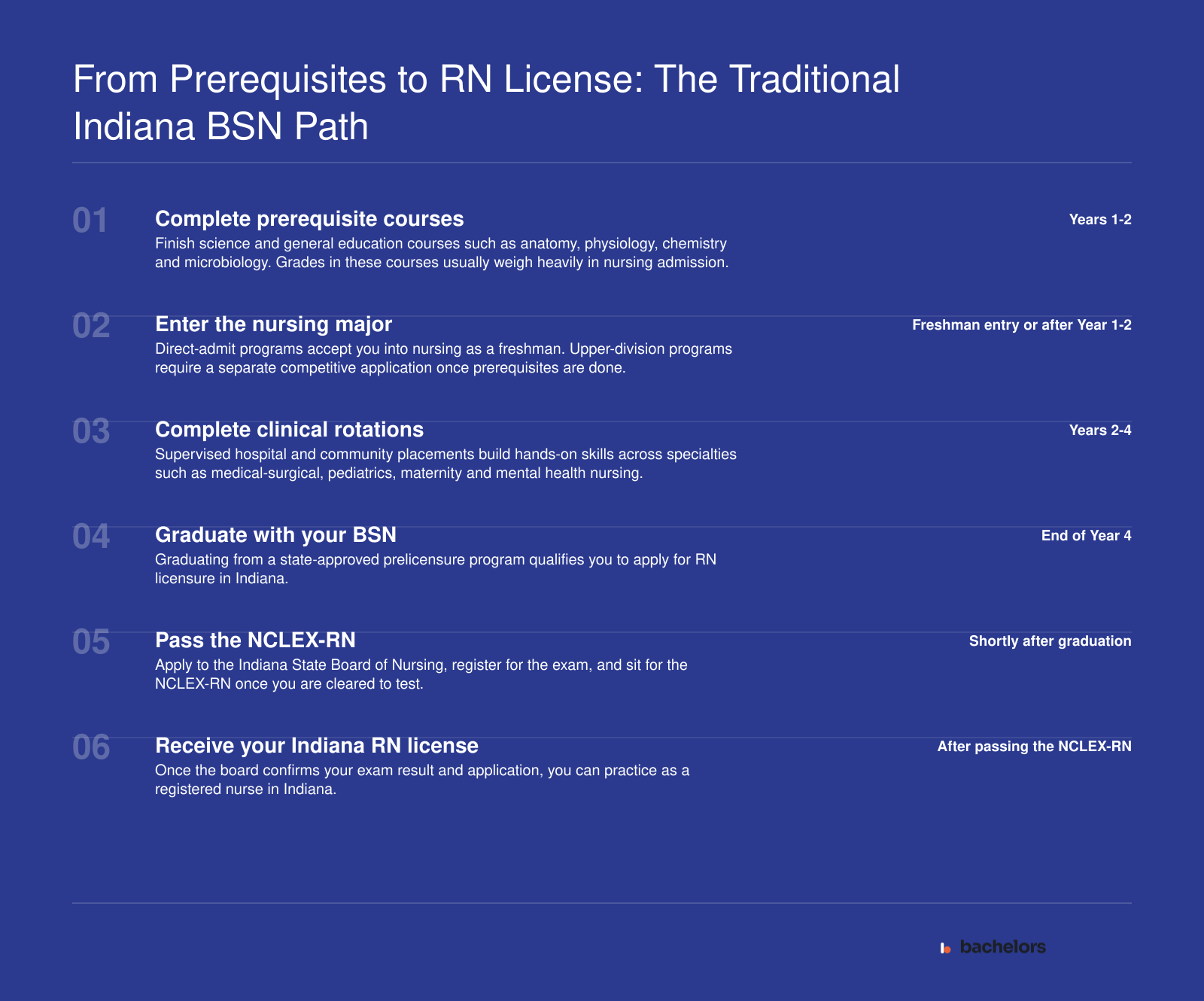
From Prerequisites to RN License: The Traditional Indiana BSN Path
A traditional BSN in Indiana follows a fixed order, and each step depends on the one before it. Missing a prerequisite or an application window can push back clinicals, graduation and your licensing exam.
Indiana RN Pay Benchmark
Before weighing tuition against outcomes, it helps to know what a registered nurse typically earns in Indiana.
Quick Answers for Future Indiana BSN Students
These short answers cover the questions Indiana nursing applicants ask most often. Figures come from this page's ranking data and from the schools' published admissions requirements, so confirm details with each program before you apply.
Which Indiana school posts the strongest NCLEX-RN results for BSN graduates?
What does a traditional BSN cost at Indiana public universities compared with private colleges?
What GPA do Indiana BSN programs typically expect for admission into the nursing major?
Do Indiana nursing schools admit students directly into the BSN as freshmen?
Can you finish a traditional BSN in Indiana in less than four years?
Can an RN licensed in Indiana work in other states through the Nurse Licensure Compact?
Compare Bachelor of Science in Nursing (BSN) programs on the data that matters
Explore more Nursing majors or browse every field of study.
All Nursing programs Browse every field of study