Best Accelerated BSN (ABSN) Programs in Kentucky
Compare 8 accredited Accelerated BSN (ABSN) programs in Kentucky, with net price after aid, graduation rates, earnings and debt from IPEDS and the U.S. College Scorecard.

A 12-month ABSN at Bellarmine University carries $52,490 in total program tuition. Kentucky State University's second-degree BSN lists in-state tuition near $9,400 a year. Same credential, same license, a five-figure spread in what it costs to get there.
The Kentucky schools ranked here run campus, hybrid, and online-plus-lab formats, and most compress the work into roughly 12 to 16 months of full-time, year-round study. That pace leaves little room for a full-time job.
Kentucky Board of Nursing approval and national accreditation decide whether a graduate can sit for the NCLEX-RN at all, so a low sticker price on an unapproved track is no bargain.
Key Points
- Expect full-time, year-round ABSN study with little room for outside work.
- Galen College of Nursing-Louisville offers a three-year BSN track for career starters.
- Kentucky Board of Nursing approval differs from national accreditation, so verify both.
Best Accelerated BSN Schools in Kentucky, Ranked by Cost and Outcomes
Eight Kentucky schools offer a second-degree or accelerated route to a BSN, and they differ sharply: a 12-month private program in Louisville, a 15-month public option with two clinical sites, and a three-year track for career-starters all appear below. Tuition and net price figures are published numbers, with net price shown as the average students pay after grant aid rather than a quote for every applicant. Graduation rates are the institution's overall rate, not a rate for the ABSN cohort alone.
University of Kentucky
#1Lexington, KY · $19,000/yr (est. net price)
Best for: Career-changers set on a large research university
The University of Kentucky anchors this list as the state's flagship public research university, and its Lexington College of Nursing runs a CCNE-accredited accelerated track for people who already hold a bachelor's in another field. Students move through eight consecutive blocks over 16 months, including a summer term, mixing online lecture with face-to-face labs and clinicals. It is also one of the few Kentucky pathways open to active LPNs, military medics and approved dual degree students alongside second-degree applicants.
- 16 months across eight consecutive blocks, including a summer term
- 54 to 55 credits mixing online lecture with in-person labs and clinicals
- 2.5 cumulative GPA minimum, with a C or better in every NUR course
- 120 credit hours required, 30 of the last 36 earned at UK
- State Registered Nurse Aide course required before the nursing sequence
- Open to degree holders, active LPNs, military medics and dual degree students
University of Louisville
#2Louisville, KY · ~$18,000/yr (est.)
Best for: Second-degree students open to Owensboro or Louisville
Louisville's public metropolitan university runs its CCNE-accredited accelerated BSN in 15 months across four intensive semesters that begin in summer. Clinical and lab work happens in person at either the Louisville campus or a second Kentucky site in Owensboro, which widens access for students outside the metro. It is a large, established school of nursing with more than 50 years of history and a curriculum stretching from population health to adult medical management.
- 15 months across four intensive semesters, starting in summer
- More than 500 clinical hours, beginning in the first semester
- Clinical and lab work at the Louisville or Owensboro campus
- High-fidelity simulation labs supplement real-world placements
- CCNE accredited by the Commission on Collegiate Nursing Education
- Coursework spans population health, mental health, pediatrics and adult care
Galen College of Nursing-Louisville
#3Louisville, KY · ~$19,000/yr (est.)
Best for: First-time nursing students wanting frequent start dates
Galen College of Nursing is a nursing-focused institution with a Louisville campus, and its bachelor's program here runs three years rather than the 12 to 16 months common among the second-degree tracks listed above. That makes it a fit for career-starters rather than degree-holders in a hurry, though four start dates a year, a free application with no essays, and an assigned advisor keep the process simple. The program is CCNE accredited and prepares graduates to sit for the NCLEX-RN.
- Three-year full-time BSN track rather than a compressed second-degree format
- Four start dates each year
- TEAS entrance exam required
- Free application with no essays required
- CCNE accredited by the Commission on Collegiate Nursing Education
- On-campus clinical learning labs plus an assigned academic advisor
- Transfer credits may be accepted
Northern Kentucky University
#4Highland Heights, KY · $8,000/yr (est. net price)
Northern Kentucky University sits in Highland Heights, close enough to Cincinnati that its clinical placements stretch across both Northern Kentucky and Greater Cincinnati. Its accelerated BSN is built for people who already hold a non-nursing bachelor's degree, with a 3.0 GPA bar and science prerequisites that must be under five years old at the start of the term. The program is approved by the Kentucky Board of Nursing and holds national nursing accreditation.
- Built for holders of a non-nursing bachelor's degree
- 3.0 GPA minimum on the last 30 credit hours or cumulative
- Science prerequisites must be under five years old at semester start
- C or better required in all prerequisites and co-requisites
- Clinicals across Northern Kentucky and the Greater Cincinnati area
- TOEFL 90 required for applicants whose first language is not English
- Approved by the Kentucky Board of Nursing
Bellarmine University
#5Louisville, KY · ~$21,000/yr (est.)
Bellarmine University's private Louisville campus runs one of the shortest accelerated tracks in the state, a 12-month, 58-credit BSN with a tuition rate locked for the cohort. Clinical rotations are placed with Norton Healthcare and Baptist Health, two of the metro's largest systems, and the university reports a 91.4% first-time NCLEX pass rate. Rolling admissions, two start points a year and a cohort structure suit students who want a defined finish line.
- 12 months and 58 credits, with tuition locked for the cohort
- $905 per credit, or $52,490 in total program tuition
- Rolling admissions with spring and summer start points
- 3.0 GPA minimum plus prerequisite coursework
- Clinical partnerships with Norton Healthcare and Baptist Health
- 91.4% first-time NCLEX pass rate as reported by the university
- CCNE accredited and approved by the Kentucky Board of Nursing
Spalding University
#6Louisville, KY · ~$25,000/yr (est.)
Spalding University in Louisville offers a CCNE-accredited accelerated second-degree BSN at what it describes as Kentucky's longest-standing BSN program. Classes are small, instruction is personalized, and the school layers on several funding routes: a hospital scholars program that can cover full tuition, employer tuition reimbursement, and a scholarship for alumni. It is a practical pick for students who want a hospital employer to share the cost of the degree.
- CCNE accredited second-degree track at a long-standing Louisville BSN program
- Small class sizes with personalized faculty attention
- Hospital scholars program can cover 100% of tuition
- Employer tuition reimbursement supported
- Alumni receive a 10% scholarship
Kentucky State University
#7Frankfort, KY · $5,000 – $10,000/yr (est.)
Kentucky State University in Frankfort offers a one-year second-degree BSN for students who already hold a bachelor's degree from an accredited institution. The ACEN-accredited program leans on a simulation and clinical skills laboratory and coursework in nursing informatics, research application, and leadership and management theory. Published tuition and net price here are the lowest among the Kentucky schools on this list, which makes it a genuine budget route to a second degree.
- One-year accelerated BSN for students who already hold a bachelor's degree
- ACEN accredited
- Simulation and Clinical Skills Laboratory on campus
- Coursework in nursing informatics, research application and leadership
- Resident and non-resident tuition schedules published separately
Georgetown College
#8Georgetown, KY · ~$14,000/yr (est.)
Georgetown College, a small private college north of Lexington, delivers its ABSN through a dual-degree partnership with the University of Kentucky College of Nursing. Students earn a BS in Biomedical Sciences from Georgetown and a BSN from UK, starting with small classes on the Georgetown campus before moving into the UK nursing curriculum. Up to 16 qualified students receive guaranteed seats, which gives the track a defined, structured pipeline.
- 16-month dual-degree track with the University of Kentucky College of Nursing
- Awards a BS in Biomedical Sciences from Georgetown and a BSN from UK
- Guaranteed seats for up to 16 qualified students
- Small classes and personalized instruction before the UK portion
- Online classes paired with in-person labs and clinicals
Cost & outcomes by school
Federal data for the highest-earning Accelerated BSN (ABSN) programs, independent of the ranking above. Earnings are this field's bachelor's graduates four years after completing where the Scorecard reports them, else the school's undergraduate median.
| School | Net price / yr | Grad rate | Earnings | Debt | Grads/yr | Format |
|---|---|---|---|---|---|---|
| Bellarmine University KY | $21,499 | 64% | $62,069 | $25,000 | 1,270 | Campus |
| Galen College of Nursing-Louisville KY | $18,540 | 62% | $61,480 | $24,166 | 2,634 | Campus |
| University of Kentucky KY | $18,851 | 71% | $59,025 | $22,500 | 10,712 | Hybrid |
| University of Louisville KY | $17,988 | 61% | $53,899 | $20,500 | 5,822 | Hybrid |
| Georgetown College KY | $14,095 | 49% | $52,074 | $25,200 | 570 | Online |
| Northern Kentucky University KY | $8,191 | 52% | $50,220 | $23,000 | 4,146 | Campus |
| Spalding University KY | $25,491 | 52% | $49,438 | $25,250 | 266 | Hybrid |
| Kentucky State University KY | $8,040 | 32% | $36,382 | $25,938 | 452 | Campus |
Sources: U.S. Department of Education. Net price, graduation rate, earnings and debt: College Scorecard (earnings and debt for this field's bachelor's graduates where reported, else school-wide); graduates: IPEDS. A dash means no figure is reported.
Cost, debt & payoff
Median earnings of this field's bachelor's graduates (4 yrs after completing, else the school's undergraduate median) vs. their median federal loan debt · U.S. College Scorecard
Across these programs the median graduate earns about $52,987 and finishes with roughly $24,583 in debt — a ratio that clears a common rule of thumb (keep debt below first-year salary). Net price and debt vary widely school to school, so check the per-school figures in the table above before you shortlist.
Accelerated BSN vs. RN-to-BSN and LPN Bridge Programs: Picking the Right Kentucky Track
Searching "accelerated nursing" in Kentucky turns up several program types that sound alike but serve very different students. Matching the program to the credentials you already hold keeps you from applying to the wrong one.
Accelerated BSN (ABSN)
An ABSN is a prelicensure, second-degree Bachelor of Science in Nursing for people who already hold a bachelor's in a non-nursing field. Your prior general education credits carry over, so the coursework centers on nursing science and clinical rotations. Graduates become eligible to sit for the NCLEX-RN. The University of Kentucky, University of Louisville, Northern Kentucky University, Bellarmine University, Spalding University, Kentucky State University and Georgetown College all offer this route.
RN-to-BSN
This track is for nurses who already hold an RN license, often earned through an associate degree, and want the bachelor's credential. It doesn't prepare you for initial licensure, because you've already passed the NCLEX-RN.
LPN Bridges and BSN-to-DNP
PN-to-ASN and other LPN bridges help licensed practical nurses move up to RN eligibility. BSN-to-DNP programs prepare BSN-holding nurses for advanced practice roles such as nurse practitioner.
Quick Self-Sort
- Non-nursing bachelor's, no nursing license: The ABSN is your lane.
- Active RN license: Look at RN-to-BSN programs instead.
- LPN license: An LPN bridge is the more direct fit.
- No bachelor's yet: A traditional prelicensure BSN, such as the 3-year BSN at Galen College of Nursing-Louisville, fits better than an ABSN.
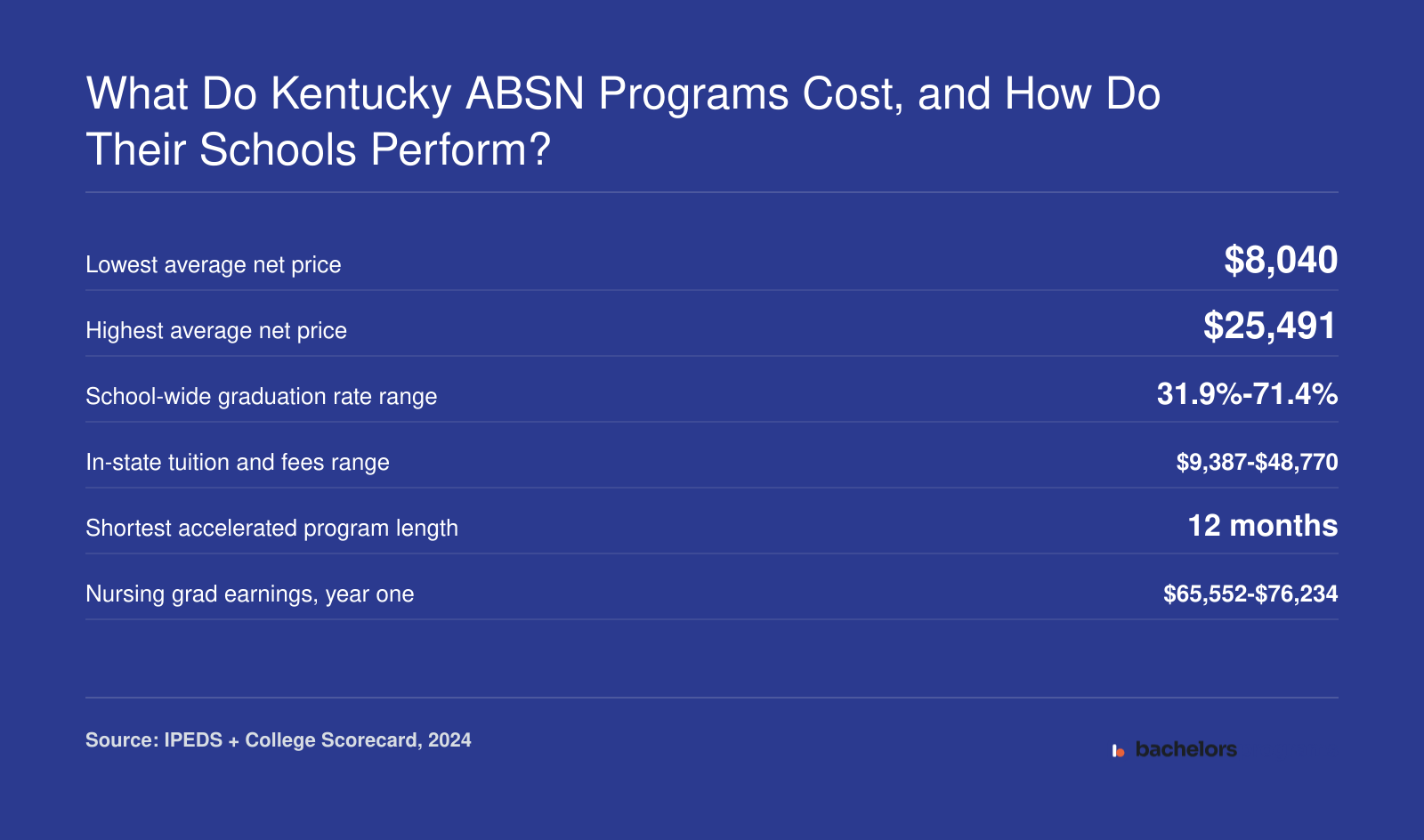
What Do Kentucky ABSN Programs Cost, and How Do Their Schools Perform?
The schools ranked here offer a mix of campus, hybrid, and online-plus-lab formats, and their costs vary widely. Graduation rates below are school-wide figures, not ABSN-specific, and net price is the average annual cost after grants and scholarships. Earnings reflect bachelor's-level nursing graduates one year after completion.
Cheapest Accelerated BSN Programs in Kentucky After Financial Aid
The table ranks the most affordable schools here by average annual net price after grants and scholarships, as reported by IPEDS and the College Scorecard (2024). Net price covers the full cost of attendance, including housing and books, minus aid, so it can run higher than published tuition. Public universities charging in-state rates, led by Kentucky State University and Northern Kentucky University, undercut the private schools on this list, and ABSN-specific costs such as clinical, lab, and testing fees can sit on top of these figures.
| Rank | School | City | Sector | Avg. Annual Net Price After Aid | Published In-State Tuition and Fees | Median Debt, Bachelor's Nursing Graduates |
|---|---|---|---|---|---|---|
| 1 | Kentucky State University | Frankfort | Public | $8,040 | $9,387 | N/A |
| 2 | Northern Kentucky University | Highland Heights | Public | $8,191 | $11,088 | $23,050 |
| 3 | Georgetown College | Georgetown | Private nonprofit | $14,095 | $42,840 | N/A |
| 4 | University of Louisville | Louisville | Public | $17,988 | $13,136 | $19,704 |
| 5 | Galen College of Nursing-Louisville | Louisville | Private for-profit | $18,540 | N/A | $36,303 |
Related Articles
Accelerated BSN Admissions in Kentucky: Prerequisites, GPA, and Entrance Exams
Kentucky ABSN programs share a common framework, but prerequisite lists, GPA floors, and start dates differ by school. Use this checklist to see what the schools ranked here publish, then confirm current details on each admissions page before you apply.
- A completed bachelor's degree in another fieldThe University of Kentucky accepts a BS or BA and treats it as satisfying UK Core. The University of Louisville accepts a prior bachelor's in any field. Kentucky State University requires a bachelor's from an accredited institution. If you are still finishing your first degree, ask each school whether it will consider your application before the degree is conferred.
- Prerequisite science coursesUK requires Human Anatomy, Human Physiology, General Biology, and General Chemistry, each finished before you apply with a C or better. UK also requires a State Registered Nurse Aide course. UofL makes admission contingent on completing all prerequisites before the program begins. Northern Kentucky University expects science prerequisites to be under five years old. Microbiology, statistics, and nutrition are also common requirements, so check each school's list.
- Minimum GPAPublished minimums run from 2.5 to 3.0. UK sets 2.5 for both cumulative and science GPA, while Northern Kentucky University and Bellarmine University each list a 3.0 minimum. UofL describes its admissions as selective.
- Entrance exam policyExam policies vary by school. Galen College of Nursing requires the TEAS for its 3-year BSN. Northern Kentucky University lists an exam requirement and names the TOEFL, an English-proficiency test, so ask NKU whether the TEAS or HESI A2 also applies to you.
- Deadlines, start terms, and clinical clearancesUK opens applications October 15 and closes them March 1 for a fall start. UofL's cohort starts in summer. Bellarmine uses rolling admissions with spring and summer starts. Clinical placements typically require a background check and up-to-date immunizations, so gather those records early.
ABSN Pace and Cost in Kentucky: 12 to 18 Months and What You'll Pay
How long does a Kentucky accelerated BSN take, and can you keep working while you do it? Expect roughly 12 to 16 months of full-time, year-round study, and plan on little or no outside employment.
Pace and Time Commitment
Kentucky State University lists a one-year program. Bellarmine University runs 12 months, Spalding University 13 months (56 credits, June start), the University of Louisville 15 months across four semesters, and both the University of Kentucky (54 credit hours) and Georgetown College 16 months. Northern Kentucky University also runs 16 months with a fall start. Louisville's program includes 500+ clinical hours and starts in May. Courses run back to back through summer, so there is no break to take on extra shifts. Most programs advise against working, and a heavy clinical schedule makes that advice hard to ignore.
Tuition: In-State vs. Out-of-State
Public schools show the biggest residency gap. Published annual tuition and fees run $13,502 in-state and $34,140 out-of-state at the University of Kentucky, $13,136 and $29,482 at the University of Louisville, and $11,088 and $21,912 at Northern Kentucky University. These are general figures, not ABSN-specific totals. Program rates are more precise:
- Louisville: $6,695 per semester for residents and $14,868 for nonresidents at 12 or more credits.
- Northern Kentucky: $472 per credit in-state and $638 out-of-state for 2026-27.
- Spalding: $15,450 per semester plus a $72 per-credit program fee.
- Bellarmine: $52,490 in total program tuition at a locked rate, with no residency split.
Private schools cost more overall but charge everyone the same. Totals cited for some public programs are estimates, so confirm with the school.
Costs Beyond Tuition
Budget for clinical and program fees, uniforms, equipment, books, background checks and health screening. After graduation come the NCLEX-RN registration and Kentucky licensure application fees. Schools set these amounts separately, so ask each admissions office for a current itemized list.
Paying for It
Second-degree students are typically not eligible for Pell Grants, so federal loans and school aid carry most of the load. Bellarmine advertises scholarships up to $45,000 and clinical partnerships with Norton and Baptist Health. Spalding lists a hospital scholars program that covers tuition, employer reimbursement support, and a 10% scholarship for its own alumni. If you work in healthcare now, ask your employer about tuition assistance before you enroll.
Kentucky Board of Nursing Approval, Accreditation, and ABSN NCLEX-RN Pass Rates
Two separate approvals govern a Kentucky ABSN, and they do different jobs. Kentucky Board of Nursing (KBN) approval is state permission for a prelicensure program based in Kentucky to operate and to send its graduates to the NCLEX-RN. Without it, you cannot sit for the exam, no matter how good the curriculum is. National accreditation from the Commission on Collegiate Nursing Education (CCNE) or the Accreditation Commission for Education in Nursing (ACEN) is voluntary, but it is what graduate schools look for when you apply to an MSN or DNP later, and many large hospital systems screen for it too.
What the Schools Report
Several programs here publish their accreditation directly. Northern Kentucky University lists both ACEN and CCNE accreditation. Bellarmine University cites CCNE accreditation alongside Kentucky Board of Nursing approval and posts a 91.4% licensure pass rate for its accelerated track. Spalding University and Galen College of Nursing-Louisville both list CCNE accreditation. Because schools update these statuses on their own schedules, treat any figure you read, here or elsewhere, as a starting point rather than a guarantee.
Reading Pass Rates Correctly
KBN publishes first-time NCLEX-RN pass rates by program, counting candidates who tested between January 1 and December 31 and within one year of finishing. Its current document covers 2021 through 2025, with 2025 the most recent year, and the board's benchmark is 80% or higher. Kentucky State University reports an 88.1% first-time pass rate for 2025 from that KBN data. These rates almost always cover a school's entire prelicensure BSN enrollment, not the accelerated cohort by itself, so an ABSN-specific number usually does not exist.
A Three-Step Verification Routine
- Check KBN first: Search the board's approved nursing programs directory and confirm the program appears with full Approved status.
- Check the accreditor: Look the school up in the CCNE or ACEN directory rather than trusting a logo on a marketing page.
- Check the school's outcomes page: Compare its posted pass rate against the year KBN published.
If a program shows conditional, provisional, or probationary KBN status, slow down. That designation usually follows pass rates below the benchmark and can affect your eligibility timeline.
Kentucky Board of Nursing RN Licensure Path at a Glance
Questions to Ask Yourself
Can you step away from full-time work for 12 to 18 months?
Do you live within commuting distance of the campus where labs and clinicals happen?
Are your science prerequisites recent enough to apply this cycle?
Does lower in-state public tuition outweigh an earlier start date at a private school?
Second-Degree BSN in Kentucky: Common Applicant Questions
These answers cover the questions career changers ask most often before applying. Admissions rules and tuition rates change by cycle, so confirm final details with each school's nursing office.
Can you get an accelerated BSN in Kentucky with a non-nursing bachelor's degree?
How long does an accelerated BSN program take in Kentucky?
Do Kentucky ABSN programs accept prerequisites taken online or at a community college?
Do out-of-state applicants pay more at Kentucky public ABSN programs?
Compare Accelerated BSN (ABSN) programs on the data that matters
Explore more Nursing majors or browse every field of study.
All Nursing programs Browse every field of study