Best BSN Programs in Kentucky
Compare 29 accredited Bachelor of Science in Nursing (BSN) programs in Kentucky at 24 colleges, with net price after aid, graduation rates, earnings and debt from IPEDS and the U.S. College Scorecard.

Which Kentucky BSN programs actually get graduates through the NCLEX-RN on the first try? Among the four-year schools here, pass rates fall between 95.3% and 100%, a narrow band that makes the question harder to answer, not easier.
The ranking below is ordered mainly by NCLEX-RN pass rate and focuses on traditional pre-licensure BSN programs. Licensed RNs and second-degree students have separate routes with their own pages.
Cohort size matters when reading the numbers. The University of Kentucky's figure rests on 842 test-takers, while Kentucky Christian University's rests on 22, so a single failed attempt moves the smaller school's rate far more.
Key Points
- First-time NCLEX-RN pass rates drive roughly three-quarters of each school's score.
- Average net price after aid runs $3,537 to $24,038 yearly.
- Some Kentucky schools admit nursing freshmen directly; others require upper-division entry.
Top 10 Kentucky BSN Programs by NCLEX-RN Pass Rate
These ten Kentucky schools are ordered by the NCLEX-RN first-time pass rate reported for their traditional pre-licensure BSN programs, running from the strongest outcomes down. Each entry gives the pass rate as recorded, the school's public or private status, and the program details that shape the student experience. Where schools post close numbers, institutional accreditation and completion outcomes decide the order.
Northern Kentucky University
#1Highland Heights, KY · $8,000/yr (est. net price) · NCLEX-RN pass rate 99.8% (3-yr weighted avg)
Best for: First-semester clinical learners
A public university in Northern Kentucky with one of the largest pre-licensure BSN cohorts in the state and a 99.8% NCLEX-RN first-time pass rate. Clinical placements begin in the first semester, and students build acute care, intensive care, pediatric, and community health skills in a dedicated simulation center. The university graduates 52% of its students.
- CCNE accredited and approved by the Kentucky Board of Nursing
- Clinical placements begin in the first semester
- Simulation center covers acute care, ICU, pediatrics, and community health
- Faculty mentors and academic advising built into the program
- Prepares for NCLEX-RN and for graduate study in nursing
Kentucky Christian University
#2Grayson, KY · $24,000/yr (est. net price) · NCLEX-RN pass rate 100% (3-yr weighted avg)
Best for: Faith-centered students seeking small cohorts
A private Christian university in Grayson where the prelicensure BSN runs through the Yancey School of Nursing and posts a 100% NCLEX-RN first-time pass rate. Small cohorts, a Bible minor woven into the curriculum, and a preceptored capstone define the experience. The university graduates 37% of its students.
- 120 total credit hours with a fall start
- Minimum 3.0 GPA plus prerequisite coursework
- Entrance exam required: ACT, TEAS, or TOEFL
- Christ-centered curriculum that includes a Bible minor
- Preceptored capstone and clinicals across multiple settings
- Limited enrollment with a personal statement required
- CCNE accredited
Lindsey Wilson University
#3Columbia, KY · ~$15,000/yr (est.) · NCLEX-RN pass rate 98.6% (3-yr weighted avg)
Best for: Rural applicants staying close to home
A private university in Columbia with a campus-based BSN and a 98.6% NCLEX-RN first-time pass rate. Coursework leans on evidence-based practice and critical thinking, with clinical rotations in hospitals, clinics, and community settings across the region. A separate bridge pathway serves licensed nurses who already hold an associate degree.
- CCNE accredited and approved by the Kentucky Board of Nursing
- Campus-based study in Columbia with in-person clinicals
- Prepares students for NCLEX-RN licensure
- RN to BSN pathway available for licensed nurses
- Financial aid available to eligible students
Eastern Kentucky University
#4Richmond, KY · $11,000/yr (est. net price) · NCLEX-RN pass rate 96.6% (3-yr weighted avg)
A public university in Richmond posting a 96.6% NCLEX-RN first-time pass rate across a testing pool of 380 candidates. Two entry points each year, a waived application fee, and low-cost textbooks keep the pre-licensure route accessible. Graduates are hired by regional employers such as Baptist Health and UK HealthCare.
- Two start dates per year, fall and spring
- Minimum 2.5 GPA plus prerequisite courses
- $0 application fee
- Low-cost textbooks through EKU BookSmart
- Small clinical groups taught by dedicated nurse specialists
- Clinical Skills Lab and Simulation Center on campus
- Military tuition discounts and benefits accepted
University of Kentucky
#5Lexington, KY · $19,000/yr (est. net price) · NCLEX-RN pass rate 95.8% (3-yr weighted avg)
A public flagship in Lexington with the largest BSN testing pool in the state and a 95.8% NCLEX-RN first-time pass rate. Students can enter as Pre-Nursing majors, transfer through a standing KCTCS pathway, or join an interprofessional living-learning community. The university graduates 71% of its students.
- No entrance exam required; ACT or SAT is test optional
- 120 total credit hours with a $50 application fee
- Enter as a Pre-Nursing major
- Seamless transfer pathway from KCTCS
- Interprofessional living-learning community
- Mayo Clinic externship opportunity
- Clinical and simulation-based learning throughout
Berea College
#6Berea, KY · ~$6,000/yr (est.) · NCLEX-RN pass rate 95.3% (3-yr weighted avg)
A private work college in Berea where students hold campus jobs and clinical partnerships reach into public health departments and school systems. Its BSN posts a 95.3% NCLEX-RN first-time pass rate. The university graduates 58% of its students, and the program is CCNE accredited and approved by the Kentucky Board of Nursing.
- CCNE accredited and approved by the Kentucky Board of Nursing
- Hands-on work-study experience embedded in the program
- Community partnerships with health departments and school systems
- Internships at VALOR and UPMC
- Sigma Theta Tau honor society membership available
- Prepares students for the NCLEX-RN exam
Campbellsville University
#7Campbellsville, KY · ~$19,000/yr (est.) · NCLEX-RN pass rate 96% (3-yr weighted avg)
A private university in Campbellsville with a 96.0% NCLEX-RN first-time pass rate in our records. Its nursing offering is delivered online through CU Online and, as listed, is built for licensed RNs and ADN students rather than first-time pre-licensure students, so read it as a completion route. The university graduates 42% of its students.
- Fully online delivery through CU Online
- Designed for licensed RNs holding an associate-level nursing degree
- Minimum 2.0 GPA with prerequisite courses graded C or higher
- Concurrent Enrollment Program for ADN and AASN students
- Coursework includes transcultural nursing and community health
- Solid foundation for nurse practitioner study
Murray State University
#8Murray, KY · $10,000 – $20,000/yr (est.) · NCLEX-RN pass rate 94.3% (3-yr weighted avg)
A public university in Murray with a 94.3% NCLEX-RN first-time pass rate and a clearly staged structure: three semesters of prerequisites followed by five semesters of nursing coursework. Fall and spring starts give applicants scheduling flexibility, and clinical placements span healthcare settings across the region. The university graduates 61% of its students.
- Three semesters of prerequisites, then five semesters of nursing
- Fall and spring start dates
- Clinical experiences across regional healthcare settings
- Leadership and evidence-based practice emphasized throughout
- Scholarships and financial aid available
- CCNE accredited
Western Kentucky University
#9Bowling Green, KY · $12,000 – $27,000/yr (est.) · NCLEX-RN pass rate 93.7% (3-yr weighted avg)
A public university in Bowling Green with a 93.7% NCLEX-RN first-time pass rate and a four-semester upper-division nursing sequence. A HESI entrance exam governs admission, and high-achieving first-time freshmen can lock in guaranteed seats. Clinicals rotate through hospitals, nursing homes, schools, and health departments.
- Four-semester program after prerequisite coursework
- HESI entrance exam required for admission
- Guaranteed admission for qualifying first-time freshmen
- Program fee of $575 per semester
- Clinical rotations in hospitals, nursing homes, schools, and health departments
- CCNE accredited
Bellarmine University
#10Louisville, KY · ~$21,000/yr (est.) · NCLEX-RN pass rate 93.8% (3-yr weighted avg)
A private university in Louisville with a 93.8% NCLEX-RN first-time pass rate and a 12:1 student-to-faculty ratio. Clinical placements sit inside the city's major health systems, including Norton Healthcare and Baptist Health, and students train in a high-fidelity simulation lab. The university graduates 64% of its students.
- 120 total credit hours
- 12:1 student-to-faculty ratio
- High-fidelity simulation lab
- Clinicals across Louisville health systems including Norton and Baptist Health
- Military benefits and employer tuition reimbursement accepted
- CCNE accredited and approved by the Kentucky Board of Nursing
Cost & outcomes by school
Federal data for the highest-earning Bachelor of Science in Nursing (BSN) programs, independent of the ranking above. Earnings are this field's bachelor's graduates four years after completing where the Scorecard reports them, else the school's undergraduate median.
| School | Net price / yr | Grad rate | Earnings | Debt | Grads/yr | Format |
|---|---|---|---|---|---|---|
| Bellarmine University KY | $21,499 | 64% | $62,069 | $25,000 | 1,270 | Campus |
| Galen College of Nursing-Louisville KY | $18,540 | 62% | $61,480 | $24,166 | 2,634 | Campus |
| Galen College of Nursing-ARH KY | $21,164 | — | $61,480 | $24,166 | — | Campus |
| Galen Health Institutes-Pikeville KY | $28,475 | — | $61,480 | $24,166 | — | Campus |
| Thomas More University KY | $21,835 | 41% | $59,384 | $26,236 | 560 | Campus |
| University of Kentucky KY | $18,851 | 71% | $59,025 | $22,500 | 10,712 | Campus |
| University of Louisville KY | $17,988 | 61% | $53,899 | $20,500 | 5,822 | Hybrid |
| Northern Kentucky University KY | $8,191 | 52% | $50,220 | $23,000 | 4,146 | Campus |
| Spalding University KY | $25,491 | 52% | $49,438 | $25,250 | 266 | Campus |
| Eastern Kentucky University KY | $11,040 | 50% | $45,795 | $22,500 | 4,850 | Campus |
| University of the Cumberlands KY | $14,107 | 50% | $45,036 | $14,911 | 3,030 | Hybrid |
| Murray State University KY | $9,096 | 61% | $44,737 | $20,500 | 3,138 | Campus |
Sources: U.S. Department of Education. Net price, graduation rate, earnings and debt: College Scorecard (earnings and debt for this field's bachelor's graduates where reported, else school-wide); graduates: IPEDS. A dash means no figure is reported.
Cost, debt & payoff
Median earnings of this field's bachelor's graduates (4 yrs after completing, else the school's undergraduate median) vs. their median federal loan debt · U.S. College Scorecard
Across these programs the median graduate earns about $45,036 and finishes with roughly $22,500 in debt — a ratio that clears a common rule of thumb (keep debt below first-year salary). Net price and debt vary widely school to school, so check the per-school figures in the table above before you shortlist.
How We Scored Kentucky BSN Schools
Roughly three-quarters of each school's score comes from its first-time NCLEX-RN results. That weight reflects what the exam measures: whether graduates can practice safely on day one.
How the Score Is Built
Pass rates come from the latest three years of Kentucky Board of Nursing first-time NCLEX-RN results, with each school weighted by cohort size so a very small cohort cannot swing the outcome. Program accreditation counts next, and completion and retention rates serve as smaller tie-breakers. The mix keeps the focus on licensure while still recognizing programs that support students through to graduation.
What Is Included
Scores draw on state board NCLEX-RN results, College Scorecard institution and program data, and our internal rankings dataset. Only traditional pre-licensure BSN programs are ranked. Licensed RNs and second-degree students still have their own routes and pages.
One caveat applies to every school ranked here: graduation rates and net prices are institution-wide figures, not nursing-specific ones. Treat them as context for the college, not as a direct measure of the nursing program alone. A strong nursing program can sit inside a college with a modest overall graduation rate.
Most Affordable BSN Schools in Kentucky
Average net price is what undergraduates paid after grants and scholarships, averaged across the whole institution. Treat it as an approximate guide, not a quote for the nursing major, which can carry extra program fees. Berea College shows how a private school with a high published tuition can still post the lowest net price once institutional aid is applied, while the public universities below keep tuition and net price in a narrower band. For details on KEES, the College Access Program (CAP) and the Kentucky Tuition Grant (KTG), see the cost and aid section below.
| School | City | Sector | Average net price (after aid, approximate) | Published in-state tuition and fees (annual) | NCLEX-RN pass rate |
|---|---|---|---|---|---|
| Berea College | Berea | Private nonprofit | $6,106 | $51,658 | 95.3% |
| Kentucky State University | Frankfort | Public | $8,040 | $9,387 | 78.4% |
| Northern Kentucky University | Highland Heights | Public | $8,191 | $11,088 | 99.8% |
| Murray State University | Murray | Public | $9,096 | $9,900 | 94.3% |
| Morehead State University | Morehead | Public | $9,793 | $10,024 | 89% |
BSN Cost in Kentucky: Tuition, Net Price, and State Aid
Two numbers decide what a Kentucky BSN really costs: the published tuition rate and the net price left after grants and scholarships. At the four-year schools ranked here, in-state tuition runs from about $10,300 to nearly $52,000, while average net price after aid falls between roughly $6,100 and $24,000. That gap matters: a high sticker price can shrink sharply once institutional aid and state grants apply.
Kentucky Grants: CAP, KTG, and KEES
The College Access Program (CAP) pays up to $5,300 a year at four-year schools and $2,500 at two-year schools for financially needy Kentucky residents who are U.S. citizens, enroll at least six semester hours, and qualify for a Pell Grant.1 The Kentucky Tuition Grant (KTG) pays up to $3,500 a year, but only at eligible Kentucky private colleges; it requires full-time enrollment and is funded by lottery revenue.1 Both are FAFSA-driven, and other aid can reduce what you receive.
KEES rewards high school performance. Awards scale by GPA, roughly $125 to $500 a year, with an ACT bonus of about $393 for a 25 composite.2 A 15 composite, or an SAT equivalent, meets the test threshold.3 Starting with 2026-27, students need at least a 2.75 GPA in a certified Kentucky high school year to earn an award.1 Total KEES can reach $2,500 at two-year and $5,300 at four-year Kentucky colleges.
Nursing-Specific Aid and the Debt Picture
The Kentucky Board of Nursing's Nursing Incentive Scholarship Fund supports nursing study in exchange for a service commitment: one year working as a nurse in Kentucky for each academic year funded. Pell shares among ranked schools that report them run from about 48% to 89%, and median graduate debt among those reporting sits between roughly $8,500 and $23,000. Those are institution-wide figures, not nursing-only, but they show how much aid can change the final bill.
How Much Does Net Price Vary Across Ranked Kentucky BSN Schools?
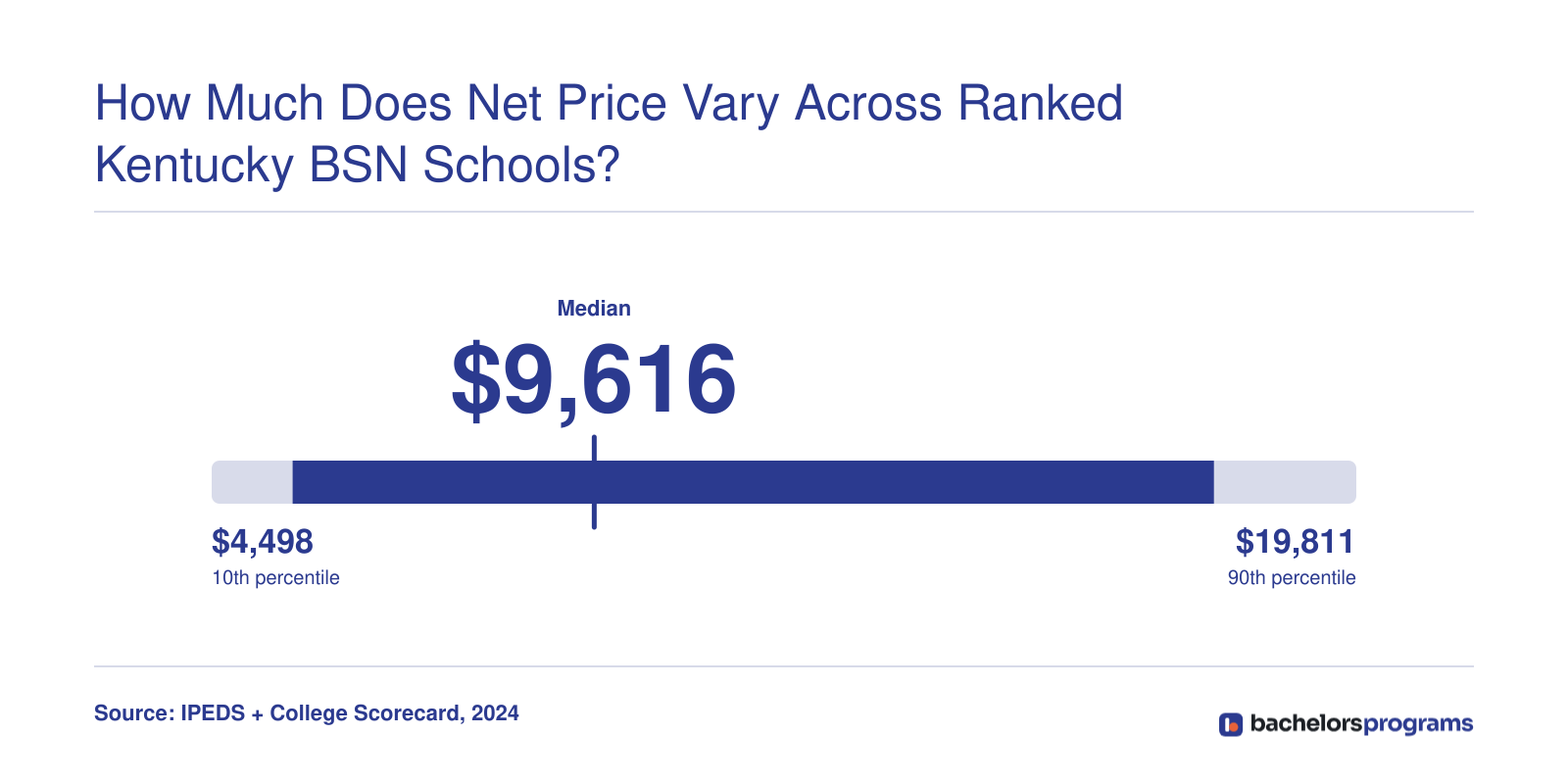
Average net price after grants and scholarships runs from $3,537 to $24,038 a year across the schools ranked here, with a typical (median) figure near $9,616. These are institution-wide averages for all aided undergraduates, not nursing-specific prices. A sticker price can mislead. The University of Kentucky, the public flagship, averages $18,851 after aid. Among private colleges, Berea College averages $6,106 and Kentucky Christian University averages $24,038, so a private school can land well below or above the flagship. Compare each school's net price, not its published tuition.
Related Articles
Top First-Year BSN Earnings in Kentucky
Among the ranked Kentucky schools, one BSN program posts the highest median pay for graduates in their first year of work.
BSN Admissions in Kentucky: Prerequisites, GPA, and Direct vs Upper-Division Entry
Kentucky BSN programs split into two admission models, and the difference affects when you apply to nursing, not just when you apply to college. Some schools admit students directly to the nursing major as freshmen. Others admit them to the university as pre-nursing students and require a second, competitive application to the upper-division nursing major after prerequisites. Read the nursing page, not only the university admissions page, because the two can set different thresholds.
Direct Admission vs Upper-Division Entry
The University of Kentucky is the clearest upper-division example: students enter as pre-nursing majors and later apply to the four-year BSN. Northern Kentucky University and Eastern Kentucky University also build the BSN around prerequisite coursework and a separate nursing application. Kentucky Christian University, Lindsey Wilson University, and Berea College present the BSN as a four-year major, so admission is decided closer to the freshman application, though each nursing department may still enforce progression standards before clinical placements. That second application can add its own deadline, prerequisite GPA, and limited-seat competition.
Published GPA and Test Requirements
Where schools publish a nursing-specific standard, it usually combines a cumulative college GPA with science prerequisites. Eastern Kentucky University lists a 2.5 GPA minimum and required prerequisite courses. Kentucky Christian University lists a 3.0 GPA minimum, required prerequisites, and an entrance exam (ACT, TEAS, or TOEFL). The University of Kentucky describes its four-year BSN as test optional. Across these programs, prerequisite coursework commonly includes anatomy and physiology, microbiology, chemistry, and statistics. A minimum GPA is often a floor, not a guarantee; science grades and repeated coursework can carry extra weight.
Several schools ranked here do not publish a nursing-specific minimum GPA or entrance-exam policy on their program pages. In those cases, the university's general admission standards are the only public benchmark, and they do not guarantee a seat in the nursing major.
Admission Rates Are Context, Not a Nursing Forecast
University-wide admission rates describe the institution, not the nursing program. Berea College admits about 19% of applicants overall, while the University of Kentucky admits about 93% and Northern Kentucky University about 68%. Nursing cohorts are limited, so the major is usually more selective than those numbers suggest.
Kentucky BSN Application Checklist
Most traditional BSN applications in Kentucky ask for the same core documents. Use this list to get organized early, then confirm the exact thresholds and deadlines on each school's nursing admissions page.
- Prerequisite science coursesComplete required courses such as anatomy and physiology, microbiology and chemistry. The required courses and minimum grades vary by program.
- Minimum GPAMeet the program's cumulative and prerequisite GPA floor. Cutoffs differ from school to school, and competitive programs often admit students well above the minimum.
- Entrance exam, where requiredSome nursing programs require a pre-admission test, and others do not. Check each school's current policy before you schedule an exam.
- Official transcriptsRequest transcripts from your high school and from every college you attended. Allow time for them to arrive before the deadline.
- Criminal background check and drug screenClinical placements typically require both. Review each program's timing and any disqualifying findings.
- Immunization recordsGather proof of required vaccines and screenings. Clinical partners set many of these requirements, so confirm the full list with the school.
- CPR/BLS certificationMost programs expect current Basic Life Support certification before clinicals begin. Check which course provider your program accepts.
Kentucky RN Licensure: Board, Fees, and Compact Status
Kentucky BSN Questions Students Ask First
These are the questions prospective nursing students raise most often when comparing traditional BSN programs in Kentucky. Answers draw on the ranking data on this page, Kentucky Board of Nursing rules, and school admissions pages. Policies change by cycle, so confirm details with each school.
Which Kentucky school tops the list for a traditional BSN?
What does a BSN cost a Kentucky resident after financial aid?
Which Kentucky BSN schools post the strongest first-time NCLEX-RN pass rates?
Does my BSN program need Kentucky Board of Nursing approval before I can sit for the NCLEX-RN?
What do Kentucky BSN programs typically require for admission?
Do Kentucky BSN programs require the TEAS or HESI?
Can a Kentucky RN license be used in other states?
Compare Bachelor of Science in Nursing (BSN) programs on the data that matters
Explore more Nursing majors or browse every field of study.
All Nursing programs Browse every field of study