Best Accelerated BSN (ABSN) Programs in Mississippi
Compare 5 accredited Accelerated BSN (ABSN) programs in Mississippi, with net price after aid, graduation rates, earnings and debt from IPEDS and the U.S. College Scorecard.
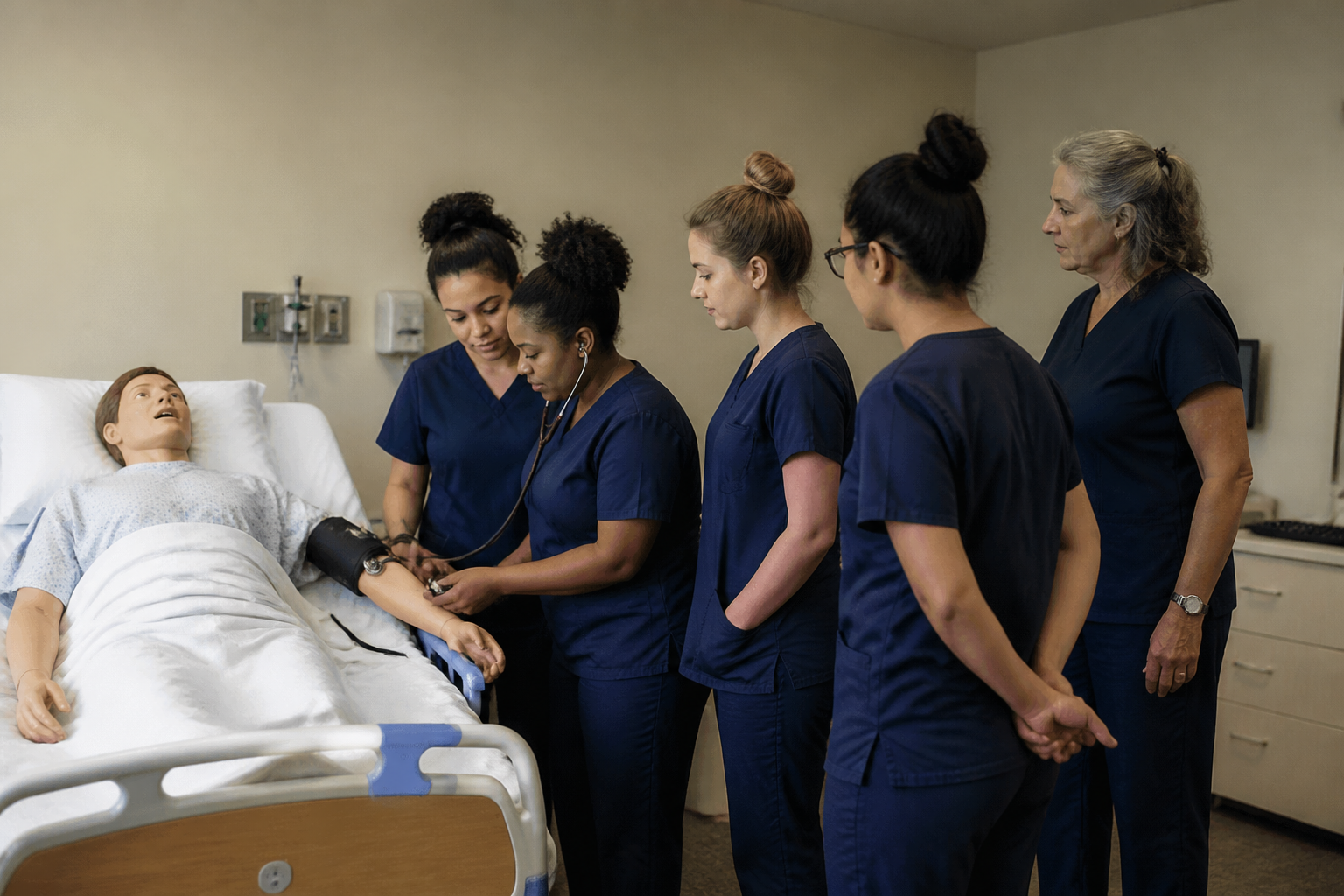
How fast can someone with a degree in another field become a registered nurse in Mississippi? Faster than starting a new bachelor's, but the options are few. Accelerated pathways sit at a handful of universities, with William Carey University in Hattiesburg and the University of Southern Mississippi's program at its Gulf Park campus in Long Beach.
Calendars are rigid. Blue Mountain Christian University admits fall starts only, and Mississippi Christian University closes fall applications March 1 and spring applications October 1. Miss a deadline and the wait runs months.
Cost, prerequisites, and campus format differ more than the shared 12 to 18 month pace suggests.
Key Points
- Mississippi accelerated BSN programs take 12 to 18 months of full-time study.
- University of Southern Mississippi passed all 151 NCLEX-RN takers in 2024.
- Mississippi RN licensure fees total $375, including fingerprinting and Pearson VUE.
Best Accelerated BSN Schools in Mississippi for Second-Degree Students
Every school on this list runs a defined pathway for people who already hold a bachelor's degree in another field, and the order leans on what those applicants actually compare: cost after aid, how many students finish, and whether the format works around a job. Each card gives the campus, the delivery format, an approximate average net price after aid, and a graduation rate that is the institution's overall figure rather than one specific to its nursing program. Prerequisites, program length and licensure outcomes are covered in the sections that follow.
William Carey University
#1Hattiesburg, MS · ~$14,000/yr (est.)
Best for: Working adults needing a hybrid schedule
William Carey University is a private Christian university in Hattiesburg whose nursing school runs a second-degree BSN designed for career changers. Theory is delivered asynchronously online while clinicals take place at partner sites, so students can keep working while they study, and both full-time and part-time pacing are available with spring and fall starts. The program is open to residents of Mississippi and Louisiana, and dedicated second-degree scholarships help offset the cost.
- Second Degree Hybrid Bachelor of Science in Nursing
- Hybrid format: asynchronous online theory plus in-person clinicals
- Full-time and part-time study options
- Two start dates per year, spring and fall
- Minimum 2.8 GPA for admission
- No entrance exam required for admission
- Open to residents of Mississippi and Louisiana
- Scholarships and financial aid available for second-degree students
Mississippi Christian University
#2Clinton, MS · $28,000/yr (est. net price)
Best for: Career changers seeking a faith-based cohort
This private Christian university in Clinton, Mississippi, offers an accelerated BSN built specifically for people who already hold a non-nursing bachelor's degree. The track moves through adult health, pediatrics, mental health and leadership, pairs classroom work with supervised clinical rotations, and folds NCLEX preparation into the curriculum. A faith-based learning environment and a two-deadline admissions calendar shape the experience for a cohort of career changers.
- Designed for students who already hold a non-nursing bachelor's degree
- Minimum 2.5 GPA for admission
- Two entry points each year, fall and spring
- NCLEX preparation built into the curriculum
- Faith-based learning environment
- Supervised clinical rotations included
- Fall deadline March 1, spring deadline October 1
- Nursing program accredited by ACEN
Blue Mountain Christian University
#3Blue Mountain, MS · ~$24,000/yr (est.)
Best for: Hands-on learners who prefer campus labs
Blue Mountain Christian University is a small private campus in Blue Mountain, Mississippi, and its accelerated BSN is reserved for students who already hold a bachelor's degree. Instruction is campus-based and Christ-centered, and students practice in high-fidelity simulation labs before applying those skills in hospitals, clinics and community health settings. A single fall intake and a separate nursing application mark the admissions calendar.
- Designed for applicants who already hold a bachelor's degree
- State-of-the-art simulation labs for supervised practice
- Christ-centered instruction from expert nursing faculty
- One admission cycle per year, starting in the fall
- Separate nursing application required after university admission
- Accredited by the Commission on Collegiate Nursing Education
University of Southern Mississippi
#4Hattiesburg, MS · ~$22,000/yr (est.)
The University of Southern Mississippi is a public research university based in Hattiesburg, and its accelerated BSN is taught at the Gulf Park campus on the Gulf Coast. The second-degree pathway combines classroom instruction with simulation lab work and clinical placements arranged through healthcare partners across South Mississippi. Faculty come from a range of nursing specialties, and the curriculum gives explicit attention to ethics, leadership and research.
- Second-degree pathway for bachelor's holders in another field
- Starts in fall or spring
- Faculty drawn from a wide range of nursing specialties
- Clinical partnerships with South Mississippi healthcare agencies
- Simulation labs for safe, supervised practice
- Coursework in ethics, leadership and research
- Accredited by the Commission on Collegiate Nursing Education
Delta State University
#5Cleveland, MS · ~$14,000/yr (est.)
Delta State University is a public university in Cleveland, in the Mississippi Delta, where the nursing school serves a rural region with well-documented workforce shortages. The accelerated option here is an LPN-to-BSN track, so it is aimed at licensed practical nurses rather than at career changers with no nursing license. Coursework is web-enhanced with monthly on-campus intensives, and clinical placements are arranged near each student's home community.
- Accelerated LPN to BSN track for licensed practical nurses
- Current practical nurse license required for admission
- Web-enhanced coursework with monthly on-campus intensives
- Clinical placements arranged near the student's home community
- Up to 15 credits validated by examination
- Two start dates each year, spring and fall
- Personal statement, resume and interview required
- Accredited by the Commission on Collegiate Nursing Education
Cost & outcomes by school
Federal data for the highest-earning Accelerated BSN (ABSN) programs, independent of the ranking above. Earnings are this field's bachelor's graduates four years after completing where the Scorecard reports them, else the school's undergraduate median.
| School | Net price / yr | Grad rate | Earnings | Debt | Grads/yr | Format |
|---|---|---|---|---|---|---|
| Mississippi Christian University MS | $27,712 | 59% | $47,485 | $22,500 | 1,170 | Hybrid |
| University of Southern Mississippi MS | $21,708 | 49% | $44,140 | $22,500 | 5,022 | Campus |
| William Carey University MS | $14,258 | 60% | $43,087 | $20,832 | 1,020 | Hybrid |
| Delta State University MS | $13,540 | 48% | $41,991 | $20,390 | 826 | Hybrid |
| Blue Mountain Christian University MS | $24,016 | 55% | $40,421 | $18,534 | 324 | Campus |
Sources: U.S. Department of Education. Net price, graduation rate, earnings and debt: College Scorecard (earnings and debt for this field's bachelor's graduates where reported, else school-wide); graduates: IPEDS. A dash means no figure is reported.
Cost, debt & payoff
Median earnings of this field's bachelor's graduates (4 yrs after completing, else the school's undergraduate median) vs. their median federal loan debt · U.S. College Scorecard
Across these programs the median graduate earns about $43,087 and finishes with roughly $20,832 in debt — a ratio that clears a common rule of thumb (keep debt below first-year salary). Net price and debt vary widely school to school, so check the per-school figures in the table above before you shortlist.
What Mississippi ABSN Programs Require Before You Apply
Admission to an accelerated BSN assumes you have already finished a degree and most of the science groundwork. The University of Southern Mississippi publishes the most detailed second-degree requirements among the schools ranked here, so its rules anchor this checklist. Confirm current details directly with any other program on your list.
- A completed bachelor's in another fieldUSM's accelerated program is built for students who already hold a bachelor's degree outside nursing. You must be admitted to USM as a student before you can apply to the nursing program.
- Prerequisite science coursesUSM requires CHE 106 or CHE 110 with the matching lab. Transfer chemistry must be pre-med level, and CHE 100 does not count. Ask the nursing office for the full prerequisite list before you enroll in summer or community college courses.
- Minimum grades and GPAEvery USM prerequisite needs a C or higher. Your GPA on nursing-major prerequisites must be at least 2.5.
- Prerequisite progress at the time you applyYou can apply once at least 75 percent of USM's nursing prerequisites are complete. All prerequisites must be finished before you begin the nursing plan of study. Admission is competitive, and meeting the minimums does not guarantee a seat.
- Entrance examUSM requires a current nursing entrance exam for BSN and ABSN applicants. Check with the school for the specific test it accepts.
- Deadlines and entry termsUSM's nursing deadlines are February 1 for fall entry and September 1 for spring entry. The accelerated program starts in spring and summer, so confirm which deadline matches your intended start before you submit.
- Requirements at the other schoolsWilliam Carey University, Mississippi Christian University and Blue Mountain Christian University each set their own GPA, prerequisite and testing rules. Review each admissions page early so you can plan your prerequisite coursework.
Accelerated BSN Pace and Cost in Mississippi: 12 to 18 Months of Full-Time Study
Accelerated BSN study is a full-time job with a fixed start and finish. The accelerated programs here compress the upper-division nursing sequence into roughly 12 to 18 months, often three continuous semesters with only short breaks. Clinical shifts, simulation labs, exams, and group work overlap, and a missed clinical day is hard to make up. That is why advisers usually discourage outside employment during the sequence. If you must earn, keep it PRN and tell your manager your clinical schedule comes first. A 12-month track saves a year of living costs compared with an 18-month track, but it also forgives fewer setbacks.
Read the cost sheet line by line
Tuition is the headline, not the bill. Ask each school for a semester-by-semester ABSN cost sheet and separate tuition from mandatory program fees. A professional nursing fee can be charged every semester, so multiply it by the number of terms, and do not add it twice if the school folds it into the tuition line. Confirm whether the rate quoted is in-state, out-of-state, or a flat accelerated rate. Then add the costs that fall outside tuition: uniforms and lab apparel, instruments, background check, drug screen, immunizations and compliance tracking, NCLEX-RN registration, and travel or parking for clinical placements. The arithmetic is simple: per-semester tuition times the number of terms, plus the per-semester nursing fee times the same count, plus one-time compliance and exam costs. Then add 12 to 18 months of living expenses. Rent, food, insurance, and transportation do not pause while you study, and a no-work year can cost as much as tuition.
Aid for a second bachelor's
Pell Grants generally do not cover a second bachelor's degree, so plan on loans, scholarships, and savings. Federal Direct Loans may still be available if you enroll at least half time and have aggregate borrowing room left; ask the financial aid office to model the full sequence, not one academic year. State nursing loan and loan-repayment programs are worth asking about, but award amounts, service obligations, and eligible campuses can change. Confirm your campus and cohort qualify in writing before you count the money. Hospital-sponsored scholarships and institutional awards are usually competitive and small, so apply early and keep looking.
Do not use an average net price
An institution-wide average net price is not an ABSN program quote. It blends undergraduate populations and aid packages that may not resemble a second-degree cohort. Use it only as context, and request the program's own cost sheet.
Related Articles
Net Price and Borrowing at Mississippi ABSN Schools
The schools below are sorted from lowest to highest median federal debt for nursing bachelor's completers, using U.S. Department of Education IPEDS and College Scorecard data (2024). Debt and payment figures are program-level for nursing graduates, while net price is each school's average annual cost after grants and scholarships. Median monthly payments on a standard 10-year plan run from $165 at Delta State University to $258 at the University of Southern Mississippi. That is a fixed bill a new RN should plan for alongside rent, insurance and licensure costs before the first paycheck arrives. Because ABSN students already hold a bachelor's degree, add any loans left from your first degree to these amounts when you estimate your total monthly payment.
| School | Program | Average Annual Net Price After Aid | Median Federal Debt at Completion | Median 10-Year Monthly Payment | Debt Basis |
|---|---|---|---|---|---|
| Delta State University (Cleveland) | Accelerated LPN to BSN | $13,540 | $15,610 | $165 | Program-level (nursing bachelor's) |
| Mississippi Christian University (Clinton) | Accelerated BSN | $27,712 | $20,000 | $212 | Program-level (nursing bachelor's) |
| William Carey University (Hattiesburg) | 2nd Degree Hybrid Bachelor of Science in Nursing | $14,258 | $20,832 | $221 | Program-level (nursing bachelor's) |
| University of Southern Mississippi (Hattiesburg) | Accelerated Baccalaureate Degree in Nursing | $21,708 | $24,327 | $258 | Program-level (nursing bachelor's) |
Jackson vs. Oxford vs. Gulf Park: Choosing an ABSN Campus
The Jackson and Oxford campuses each admit one class a year, while USM Gulf Park in Long Beach lists a different pattern. USM's own pages conflict on Gulf Park's entry term: the ABSN page says Fall and Spring, and the undergraduate nursing page says Spring and Summer. Use the ABSN page as your working source, since it is the program-specific page, and confirm the 2026 to 2027 intake with USM admissions before you plan around it.
| Factor | Jackson campus | Oxford campus | USM Gulf Park (Long Beach) |
|---|---|---|---|
| Entry term | Spring, once a year | Fall, once a year | Fall and Spring per the ABSN page (conflicts with the nursing page, so verify) |
| Program length | 12 months | 12 months | 12 months, three semesters of upper-division nursing courses |
| Credits | 76 prerequisite, elective and plan credits, all completed before starting | 76 prerequisite, elective and plan credits, all completed before starting | USM lists 50 credit hours for the pathway; it is unclear whether that is the full second-degree plan or only the nursing component |
| Cost signals | $3,000 professional fee each semester, capped at $9,000; full tuition and fee total not confirmed | $3,000 professional fee each semester, capped at $9,000; full tuition and fee total not confirmed | No official program-specific 2026 total; one third-party estimate puts in-state tuition near $15,591, so treat it as unverified |
| Clinical placements | Sites not named publicly; instruction may fall on weekdays, evenings and weekends | Sites not named publicly; instruction may fall on weekdays, evenings and weekends | Sites not named; USM says clinical experiences match the traditional BSN and partnerships exist |
| Cost of living and commuting | Metro area with a broad choice of housing; plan for commuting between campus and clinical sites | College-town housing can run higher; the program is full-time, so most students live nearby | Gulf Coast housing varies by neighborhood; plan for drives to coastal clinical sites |
| Best fit | Someone relocating to the Jackson metro who wants a Spring start | North Mississippi residents who can begin in a Fall term | Gulf Coast residents, once the entry term is confirmed with USM |
Mississippi Board of Nursing Approval and NCLEX-RN Licensure for ABSN Graduates
The University of Southern Mississippi reported a 100% NCLEX-RN pass rate for its BSN students in 2024, with 151 of 151 test takers passing. It also states that its December ABSN graduates passed on the first attempt at 100% that year, the third cohort in a row. Those are the strongest ABSN-specific results among the schools here.
Why Approval and Accreditation Matter
A program must hold Mississippi Board of Nursing approval for its graduates to be eligible for the NCLEX-RN in the state. CCNE or ACEN accreditation is a separate check. It protects access to federal financial aid and to later graduate study, since many master's and doctoral nursing programs expect a degree from an accredited program.
USM's BSN is CCNE-accredited, with its next review in Spring 2032. For William Carey University, Mississippi Christian University, Blue Mountain Christian University and Delta State University, confirm the current approval and accreditation status on the Board's website and the accreditor's directory before you apply. Do this for the exact track you plan to enter, not just the school.
Reading the Pass Rates
Mississippi's 2025 nursing annual report for public universities lists USM's bachelor-degree program at 99.25% for 2022, 100% for 2023 and 100% for 2024, or 99.77% across 2022 to 2024. The report does not clearly separate first-time testers from repeat testers, so treat these as school-wide BSN figures, not ABSN rates. Look for first-time rates and the year on the Board's reports or each school's nursing page. Do not assume a school's overall BSN rate describes its accelerated cohort.
From Graduation to License
Graduating does not make you an RN. The usual sequence runs as follows:
- Apply: Submit your licensure-by-examination application to the Board, along with any background check requirements.
- Register: Sign up with the NCLEX testing vendor and pay the exam fees.
- Authorization to Test: Once the Board confirms your eligibility and your school verifies your graduation, you receive an ATT. You cannot book a seat without it.
- Schedule and sit: Exam dates depend on seat availability, and results usually follow within days to weeks.
Most graduates plan for a gap of several weeks to a few months between their last day of class and a license in hand, so start paperwork early.
Working Beyond Mississippi
Mississippi belongs to the Nurse Licensure Compact. A multistate license, available when Mississippi is your primary state of residence, lets you practice in other compact states without applying again.
Mississippi RN Licensure Steps at a Glance
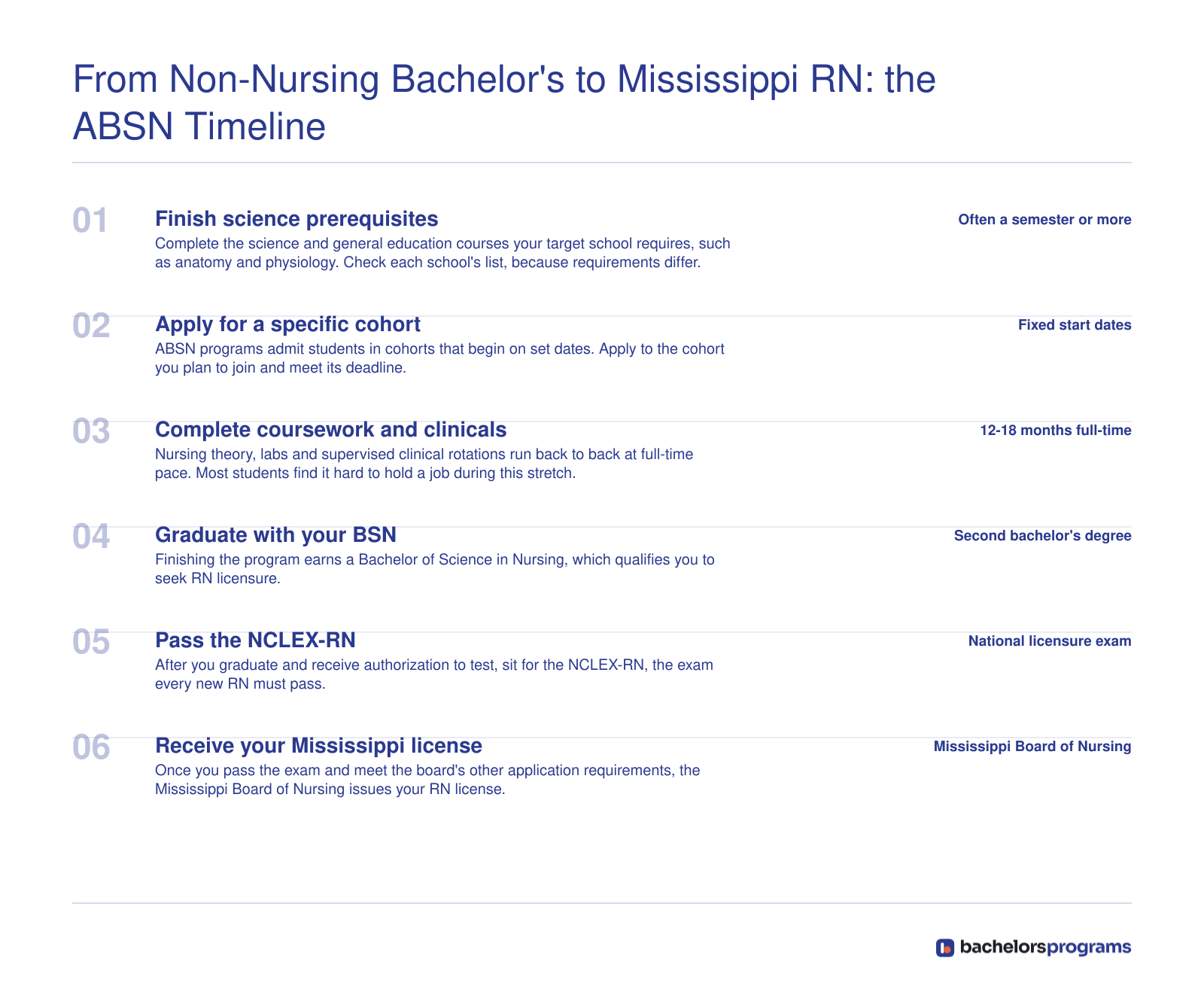
From Non-Nursing Bachelor's to Mississippi RN: the ABSN Timeline
An accelerated BSN takes 12 to 18 months of full-time study, but the path to a Mississippi RN license starts earlier. Prerequisites often add a semester or more before the ABSN clock starts, so count your timeline from your first missing science course.
Early Earnings for BSN Completers in Mississippi
William Carey University posts the highest first-year earnings among the schools here. Medians at the other ranked schools range from $68,221 at Delta State University to $70,068 at the University of Southern Mississippi.
How to Pick the Right Accelerated BSN School in Mississippi
Which accelerated BSN in Mississippi is actually right for you? Rank your priorities in this order, because the first ones can eliminate options before the rest matter.
Decision Criteria, in Priority Order
- Entry term: Pick the cohort your prerequisites can realistically meet. If you still owe anatomy or microbiology, a program starting in eight months beats one you would have to rush toward with a weak lab grade.
- Total out-of-pocket cost: Count tuition, fees, uniforms, exam and licensure costs, and the months you won't be earning. A full-time accelerated schedule leaves little time for paid work, so a year without income can outweigh a tuition gap between schools.
- Campus and clinical region: Clinical rotations shape where you'll spend your hours and often where you get hired. Hattiesburg (William Carey University), Long Beach (University of Southern Mississippi's Gulf Park campus), Clinton (Mississippi Christian University), Blue Mountain (Blue Mountain Christian University) and Cleveland (Delta State University) put you in very different health systems.
- Competitiveness: Compare your prerequisite GPA with what each school asks for, and keep a cushion. A borderline GPA is a reason to retake a course, not to hope.
Compare Total Cost, Then Ask Hard Questions
Tuition alone is a misleading number. Build one spreadsheet row per school with every expected expense and the cost of living near the campus. Then ask each admissions office where students do their clinicals, how far those sites are from campus, and what outcomes data it can share, including NCLEX-RN results and completion rates. A program that answers specifically is usually one that tracks those numbers.
Also confirm the track fits your background. Delta State's accelerated pathway, for example, is built for LPNs, so it suits a different applicant than a second-degree program for career changers.
Apply to Two When You Can
Two applications are a sensible hedge, and the two South Mississippi campuses make pairing easy. Lay the deadlines side by side, then use one set of transcripts, one prerequisite plan, and one personal statement edited for each school. Ask each school when decisions arrive and whether a deposit is due before the other responds, so you never hold an offer you can't compare.
Your Next Step
Email or call the nursing admissions office at your top choice and request an advising appointment or an unofficial transcript review. They can tell you which prerequisites transfer and which cohort you can realistically target.
Compare Accelerated BSN (ABSN) programs on the data that matters
Explore more Nursing majors or browse every field of study.
All Nursing programs Browse every field of study