Best Accelerated BSN (ABSN) Programs in New York
Compare 31 accredited Accelerated BSN (ABSN) programs in New York at 30 colleges, with net price after aid, graduation rates, earnings and debt from IPEDS and the U.S. College Scorecard.
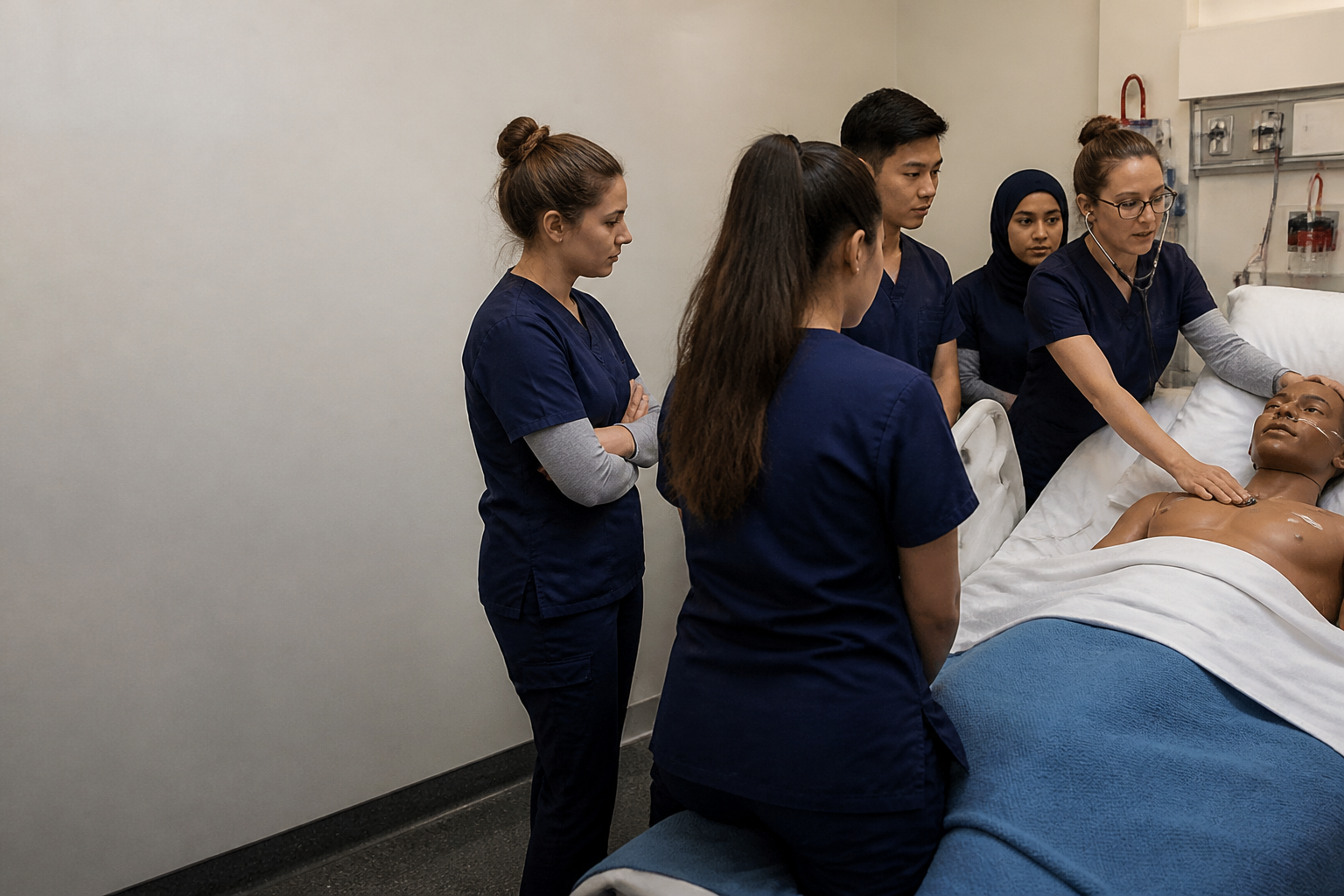
Most New York ABSN programs serve one kind of applicant: someone who already holds a bachelor's degree outside nursing and does not want to repeat four years of general education to become an RN. Instead, nursing coursework is compressed into roughly 12 to 18 months of full-time study, delivered on-site or in a hybrid format.
The tradeoff is intensity. Cohorts run year-round, clinical hours are heavy, and outside work is hard to sustain. Prerequisite sciences and grade floors also decide who gets in, so the real cost of a fast route is paid before the first nursing course begins.
Key Points
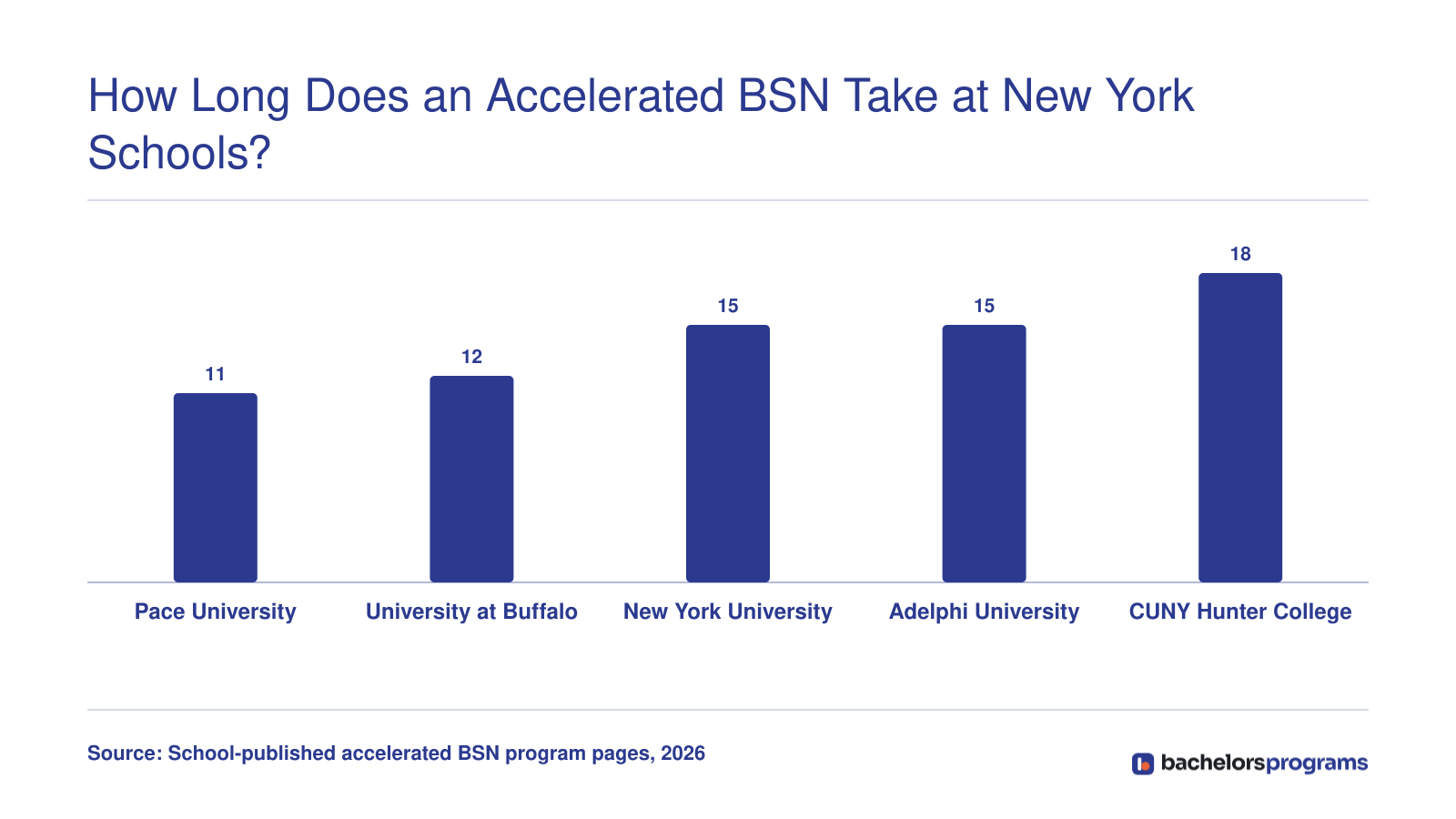
- Pace University's in-person ABSN runs 11 months; most take 12 to 18.
- CUNY and SUNY campuses usually anchor the low end of ABSN pricing.
- After graduating, file Form 1 with NYSED and pay $143 for licensure.
Best Accelerated BSN Schools in New York: Our Ranked List
Ten New York colleges appear below, and the same three questions shaped the order: what a second-degree student is likely to pay after aid, how reliably the institution moves students through to a degree, and how flexibly the program is delivered. Each card carries the school's approximate net price after aid, its overall graduation rate, its format and its city, so you can weigh those numbers against your own priorities.
Binghamton University
#1Vestal, NY · $20,000 – $25,000/yr (est.)
Best for: Upstate New York career changers
A public SUNY research university in Vestal, just west of Binghamton, with nursing taught on a dedicated health sciences campus. Its Decker School of Nursing runs a 12-month Baccalaureate Accelerated Track that folds a complete nursing sequence into a single year for people who already hold a bachelor's degree. Clinical placements are arranged through UHS, Guthrie and SUNY Upstate Medical, so students rotate through hospital, community and long-term care settings before sitting for licensure.
- 12-month Baccalaureate Accelerated Track for second-degree students
- 126 total credit hours in a structured cohort sequence
- 3.0 GPA minimum plus prerequisite science courses
- Clinical partnerships with UHS, Guthrie and SUNY Upstate Medical
- Second bachelor's degree in nursing; prepares for NCLEX-RN
- Health Sciences Campus location with virtual information sessions
CUNY Hunter College
#2New York, NY · ~$3,000/yr (est.)
Best for: Cost-focused NYC career changers
A public senior college in Manhattan and part of the City University of New York, with nursing housed in its Bellevue School of Nursing. The accelerated second-degree track runs 18 months across 51 credits, and clinical schedules can fall on any day or evening, which suits students juggling work or family. Admission is scored on GPA plus an entrance exam, and prerequisite courses must be completed at a B or better with no repeats accepted.
- Accelerated Second-Degree Nursing Program (A2D) over 18 months
- 51 credits leading to a Bachelor of Science in Nursing
- 3.2 GPA minimum; prerequisites require a B or higher
- Entrance exam required; admission based on a composite score
- Fall start with clinical schedules any day or evening
- No repeated prerequisite courses accepted
- U.S. citizenship or residency required
Stony Brook University
#3Stony Brook, NY · ~$19,000/yr (est.)
Best for: Long Island career changers seeking hospital placements
A public research university on Long Island's North Shore with a long-established school of nursing. Its accelerated baccalaureate program is delivered on site and leans on a dense science core in pathophysiology and pharmacology alongside clinical practice. The school's health system relationships include Northwell Health, Memorial Sloan Kettering and Lenox Hill Hospital, giving second-degree students exposure to large New York employers.
- Accelerated Baccalaureate Program in Nursing for non-nursing degree holders
- On-site program leading to RN licensure
- Coursework includes pathophysiology, pharmacology and health care social justice
- Interviews may be required as part of admission
- Clinical partners include Northwell Health and Memorial Sloan Kettering
University at Buffalo
#4Buffalo, NY · $20,000 – $25,000/yr (est.)
The largest campus in the SUNY system, located in Buffalo with a school of nursing that runs one of the state's shortest second-degree routes. The accelerated BS compresses the undergraduate nursing curriculum into 12 months starting each summer, with more than 600 hours of direct patient care. A concept-based curriculum and Dedicated Education Units place students beside practicing nurses rather than in lecture-only coursework.
- 12-month Accelerated BS in Nursing starting each summer
- 59 credit hours, full-time enrollment
- $24,000 total program tuition
- Over 600 clinical hours, including Dedicated Education Units
- Concept-based curriculum for second degree students
- Summer start only
New York University
#5New York, NY · ~$37,000/yr (est.)
A private research university in lower Manhattan whose college of nursing sits in one of the densest healthcare markets in the country. The accelerated 15-month BS runs four consecutive semesters with fall and spring entry points, and students can apply to continue into a dual BS/MS in their third term. No entrance exam is required, though prerequisite courses must be completed within the last ten years and clinical work happens at off-campus facilities across the city.
- Accelerated 15-month BS over four consecutive semesters
- Fall and spring start dates
- No entrance exam required
- Prerequisites must be completed within 10 years
- Option to enter a dual BS/MS in the third term
- Clinical experiences at off-campus healthcare facilities
- Background check and drug test required
University of Rochester
#6Rochester, NY · ~$29,000/yr (est.)
A private research university in western New York with its own medical center anchoring clinical education. The accelerated nursing program offers a 12-month full-time track and a 24-month part-time option, both built around rotations at the University of Rochester Medical Center in med-surg, obstetrics, pediatrics and psychiatry. A partnership with Hobart and William Smith Colleges offers a route into the 12-month program with full tuition coverage tied to a three-year work commitment at selected UR Medicine hospitals.
- 12-month full-time track or 24-month part-time track
- Over 650 clinical hours at the University of Rochester Medical Center
- Rotations in med-surg, obstetrics, pediatrics and psychiatry
- Three start terms per year
- Partnership with URMC for placements and hiring
Touro University
#7New York, NY · $30,000/yr (est. net price)
A private university whose New York nursing program operates from a Times Square location in Manhattan. The accelerated BSN is built for people who already hold a non-nursing bachelor's degree, running four full-time semesters year-round with up to 57 transfer credits applied toward the degree.
- Accelerated BSN taught in person at 3 Times Square in Manhattan
- Four full-time semesters, roughly 15 to 18 months
- 125 total credits; up to 57 transfer credits accepted
- 3.0 GPA minimum plus science prerequisites and TEAS scores
- Cohorts of about 30 students with simulation labs
- Year-round study including summer sessions
- Baccalaureate program pursuing initial CCNE accreditation
CUNY Lehman College
#8Bronx, NY · $3,100/yr (est. net price)
A public senior college in the Bronx and part of the City University of New York. The accelerated BSN packs 75 credits into 15 months starting in summer, with admission handled through Nursing CAS and a March 15 deadline. Placements across the borough's hospitals and community sites give second-degree students a broad clinical range close to home.
- 15-month, 75-credit accelerated BSN starting in summer
- 2.8 GPA minimum with prerequisite science courses
- HESI A2 entrance exam required
- March 15 application deadline through Nursing CAS
- Full-time, cohort-based program with small cohorts
Niagara University
#9Niagara University, NY · ~$17,000/yr (est.)
A private university in western New York, a short drive from Buffalo and the Canadian border. Its accelerated second-degree BSN runs 12 months with 675 clinical hours and rolling admissions, so applicants are not boxed into a single deadline. Small cohorts and a 1:7 student-to-faculty ratio pair with placements at Catholic Health and Erie County Medical Center, and graduates can continue into the university's family nurse practitioner program.
- 12-month Accelerated Second Degree BSN
- 57 credit hours and 675 clinical hours
- Rolling admissions
- Clinical placements with Catholic Health and Erie County Medical Center
- Student-to-faculty ratio of 1:7 in small cohorts
- Pathway into the graduate Family Nurse Practitioner program
- CCNE accredited
Le Moyne College
#10Syracuse, NY · ~$22,000/yr (est.)
A private college in Syracuse with small classes and a health professions focus. Its Accelerated Dual Degree Partnership in Nursing serves people who already hold a bachelor's in another field, pairing clinical practice with coursework in health information systems, health policy and community health. The baccalaureate nursing program is accredited by the Commission on Collegiate Nursing Education.
- Accelerated Dual Degree Partnership in Nursing (A-DDPN)
- Designed for graduates of bachelor's programs in other fields
- Coursework in health information systems, health policy and community health
- Clinical practice included alongside nursing theory
- CCNE-accredited baccalaureate nursing program
- Small class sizes and information sessions available
Cost & outcomes by school
Federal data for the highest-earning Accelerated BSN (ABSN) programs, independent of the ranking above. Earnings are this field's bachelor's graduates four years after completing where the Scorecard reports them, else the school's undergraduate median.
| School | Net price / yr | Grad rate | Earnings | Debt | Grads/yr | Format |
|---|---|---|---|---|---|---|
| SUNY Downstate Health Sciences University NY | — | — | $109,601 | $12,500 | 312 | Campus |
| Upstate Medical University NY | — | — | $92,257 | $15,000 | 148 | Hybrid |
| New York University NY | $37,050 | 88% | $82,509 | $20,500 | 16,368 | Campus |
| Binghamton University NY | $21,620 | 82% | $80,596 | $18,500 | 8,166 | Campus |
| University of Rochester NY | $29,278 | 85% | $79,042 | $21,000 | 4,350 | Campus |
| Molloy University NY | $24,347 | 70% | $77,789 | $27,000 | 1,442 | Campus |
| Adelphi University NY | $30,783 | 67% | $75,482 | $25,000 | 2,360 | Campus |
| Stony Brook University NY | $18,784 | 76% | $74,502 | $18,228 | 10,526 | Campus |
| Wagner College NY | $28,241 | 65% | $74,360 | $25,000 | 636 | Campus |
| Iona University NY | $29,188 | 56% | $73,595 | $25,999 | 1,342 | Campus |
| Yeshiva University NY | $49,965 | 83% | $71,353 | $18,250 | 1,194 | Campus |
| University at Buffalo NY | $20,995 | 75% | $70,814 | $19,000 | 10,464 | Campus |
Sources: U.S. Department of Education. Net price, graduation rate, earnings and debt: College Scorecard (earnings and debt for this field's bachelor's graduates where reported, else school-wide); graduates: IPEDS. A dash means no figure is reported.
Cost, debt & payoff
Median earnings of this field's bachelor's graduates (4 yrs after completing, else the school's undergraduate median) vs. their median federal loan debt · U.S. College Scorecard
Across these programs the median graduate earns about $65,756 and finishes with roughly $22,500 in debt — a ratio that clears a common rule of thumb (keep debt below first-year salary). Net price and debt vary widely school to school, so check the per-school figures in the table above before you shortlist.
Cheapest Accelerated BSN Programs in New York
Public CUNY and SUNY campuses usually anchor the low end of ABSN pricing in New York, and CUNY Hunter College and CUNY Lehman College lead here, but the order below follows the federal data: SUNY Brockport's average net price (U.S. Department of Education IPEDS and College Scorecard, 2024) lands above two private schools, Mercy University and Monroe University. Average net price is what students pay per year after grants and scholarships, and median debt reflects borrowing at graduation across each institution. Because these averages are institution-wide rather than specific to the accelerated program, confirm the per-credit ABSN tuition on each school's bursar page before you budget.
| Rank | School | City | Sector | ABSN Program | Format | Program Length | Average Net Price (per year) | Median Debt at Graduation |
|---|---|---|---|---|---|---|---|---|
| 1 | CUNY Hunter College | New York | Public | Accelerated Second-Degree Nursing Program (A2D) | Campus | 18 months | $2,984 | $11,000 |
| 2 | CUNY Lehman College | Bronx | Public | Accelerated Bachelor of Science in Nursing | Campus | 15 months | $3,148 | $10,950 |
| 3 | Mercy University | Dobbs Ferry | Private nonprofit | Accelerated Second Degree in Nursing | Hybrid | 18 months | $14,072 | $19,637 |
| 4 | Monroe University | Bronx | Private for-profit | Nursing, BS - Accelerated 2nd Degree General Option | Hybrid | N/A | $14,522 | $18,818 |
| 5 | SUNY Brockport | Brockport | Public | Nursing Accelerated (Second Degree) BS to BSN Program | Campus | 15 months | $16,353 | $20,000 |
What New York ABSN Programs Require Before You Apply
A New York ABSN is a second-degree program, so the first requirement is a completed bachelor's degree outside nursing. Adelphi requires a degree from a regionally accredited college, and Stony Brook, Buffalo, and Pace also list a bachelor's as the entry credential. A degree in psychology, business, or English qualifies, provided the science prerequisites are done.
GPA Minimums
Thresholds differ by school:
- Stony Brook University: 2.8 GPA.1
- Adelphi University: 3.0 GPA, counted across all undergraduate work after high school.
- University at Buffalo: 3.3 overall and 3.0 in prerequisites, with each prerequisite course at 2.33 (C+) or better.2
- Molloy University: 3.3 in its 2026-2027 materials, with a C+ minimum in science courses.3
NYU Rory Meyers requires a C or higher in prerequisites.4 It may grant conditional acceptance while courses are still in progress, but everything must be finished before you start.
Prerequisite Recency
Adelphi requires science prerequisites completed within the last 10 years. Pace also wants prerequisites under 10 years old, with a B- in each. Other schools here, including Stony Brook, Buffalo, and NYU, don't state a window on the pages reviewed, so confirm with admissions before you assume old credits count. Buffalo expects four of nine prerequisites done by the deadline, and Stony Brook wants three sciences in hand at application, with its 2026 deadline falling on October 8.
Test Policy
Adelphi does not require an entrance exam. Molloy asks for the TEAS, listing a reading score of 80.9% and a math score of 72%.3 Test rules change by cycle, so check each school's current admissions page for interview, essay, or healthcare-experience expectations before you build your timeline.
ABSN Prerequisite Checklist for New York Applicants
Each school sets its own course list, grade floors, and deadlines, so use this checklist as a starting point and confirm details on every program's admissions page.
- Prior bachelor's degreeAdelphi requires a bachelor's degree from a regionally accredited four-year institution, completed before you start.
- Anatomy & Physiology I and II with labMinimum grades range from C at Stony Brook to C+ at UB and Adelphi to B at SUNY Brockport.
- Microbiology with labAdelphi requires science prerequisites to be completed within the last 10 years.
- ChemistryOften general chemistry. SUNY Brockport specifies a lab.
- StatisticsAn introductory course is typical. SUNY Brockport requires a B in science and math courses.
- NutritionRequired at UB, Adelphi, and SUNY Brockport.
- Developmental or Lifespan PsychologyListed as Lifespan Development at Stony Brook and Developmental Psychology at Adelphi.
- Entrance examTesting policies vary by school, so confirm whether your program requires an exam.
Related Articles
How Long Does an Accelerated BSN Take at New York Schools?
Most accelerated BSN programs in New York take 12 to 18 months of full-time study, and Pace University's in-person track is shorter at 11 months. Pace and Adelphi University (on-site at its Garden City and Manhattan locations) each offer three cohort starts a year. NYU starts cohorts in Fall and Spring and is reported to deliver coursework both online and in person, while University at Buffalo's on-campus program admits one cohort that runs May to May. CUNY Hunter College's 18-month format is the longest charted here.
ABSN Length and Cost: The 12-to-18-Month Sprint and What You'll Pay
Public tuition schedules and private flat-rate pricing look very different on paper, and the gap shapes how you compare programs. Whichever pricing model applies, the pace is the same: full-time, year-round, with few breaks.
The Full-Time Pace
Most accelerated programs run about 12 to 18 months with summer terms included. Coursework, simulation labs, and clinical rotations fill the week, so most programs advise against outside employment. Plan your finances around little or no paid work.
Public vs Private Pricing
For New York residents, SUNY's 2026-27 undergraduate rate is $7,070 in tuition plus $1,830 in fees, or $8,900 a year. Those are typical undergraduate figures, not ABSN-specific totals, so confirm the real price with each SUNY or CUNY campus, such as Hunter College or Lehman College.
Private schools usually charge by the semester:
- Adelphi University: $26,884 per semester for four semesters, or $107,536 total (Summer 2026 to Summer 2027).
- Pace University: $25,330 per semester, listed at $75,900 for the program, which implies three semesters over roughly 12 months.
These are published tuition figures. Whether those figures cover fees, books, and supplies is unclear, so ask each school.
Costs Beyond Tuition
Budget for clinical and lab fees, uniforms, background checks, health clearances, and books. After graduation come NCLEX registration and New York licensure fees. Living costs matter too, since you probably won't be earning.
Aid for Second-Degree Students
FAFSA is the starting point. Federal Direct Unsubsidized loans may be available, depending on your borrowing history and program eligibility. Pell Grants are generally unavailable to students who already hold a bachelor's degree. New York's TAP covers tuition and fees but requires 12 months of state residency, an undergraduate program, and income up to $125,000. The Excelsior Scholarship covers SUNY and CUNY tuition. Neither is guaranteed to second-bachelor's students or to private programs, so check eligibility with each school's financial aid office. Also ask about school-based scholarships.
Hybrid Programs
Hybrid formats move lectures online, but labs, simulation, and clinical rotations remain on-site. Expect a similar length and a fixed schedule, with fewer trips to campus because only coursework moves online.
First-Year Earnings for a Top New York ABSN Program
New York RN Licensure Through the Office of the Professions
New York Board of Nursing Approval, Accreditation, and NCLEX-RN Licensure
The New York State Education Department registers nursing programs before an institution may offer them, and that registration, not accreditation, is what makes an ABSN count toward RN licensure.
Two approvals, two different jobs
The Board of Regents registers degree-credit nursing curricula, and the department's Professional Education Program Review revisits administration, faculty, resources, curriculum, admissions, and student information on a recurring cycle.1 Registration is what makes an ABSN licensure-qualifying: New York RN licensure requires graduation from a program the state accepts, so check that yours appears in the Inventory of Registered Programs before you enroll.1 Out-of-state and online programs need registration or approval for New York clinical rotations, with narrow exceptions for federal Armed Forces and VA facilities.
Accreditation is voluntary and separate. CCNE or ACEN status matters for federal aid eligibility, graduate school, and some employers. A program that names the Board of Regents as its sole programmatic accreditor holds state accreditation rather than CCNE or ACEN, so verify status in the accreditor directories.2
Where to check NCLEX-RN pass rates
The department publishes first-time NCLEX-RN results by program, covering five years and refreshed annually, with each cell showing the pass percentage plus the number passing and the number sitting. Ask the schools ranked here for ABSN-specific first-time results, since an accelerated cohort's numbers can differ from a generic BSN listing. Corrections go to Professional Education Program Review at 518-474-3817 ext. 360.
The compact question
New York is not a Nurse Licensure Compact state in 2026, according to the Office of the Professions' RN FAQ. Your credential is a New York license; practicing elsewhere means a separate application.
Compare Accelerated BSN (ABSN) programs on the data that matters
Explore more Nursing majors or browse every field of study.
All Nursing programs Browse every field of study