Best BSN Programs in New York
Compare 81 accredited Bachelor of Science in Nursing (BSN) programs in New York at 68 colleges, with net price after aid, graduation rates, earnings and debt from IPEDS and the U.S. College Scorecard.

Which New York BSN programs reliably get graduates through the NCLEX-RN on the first attempt? Passing that exam is the gate to a New York RN license, and a four-year degree only pays off if it clears it.
The schools here are traditional pre-licensure BSN programs, compared on first-time NCLEX-RN pass rates, then net price and graduate earnings. RN-to-BSN and accelerated tracks serve licensed nurses and second-degree students separately.
Strong programs cluster closely on pass rates, so cost, admissions model and clinical access often decide the choice.
Key Points
- The ranking weights first-time NCLEX-RN pass rates across three recent years.
- TAP and Excelsior can sharply cut SUNY and CUNY tuition for New Yorkers.
- Under BSN in 10, associate-degree RNs need a bachelor's within ten years.
New York BSN Schools With the Strongest NCLEX-RN Pass Rates
The order below rewards the outcome that matters most on the first day of a nursing career: passing the NCLEX-RN. Hartwick College is the number one nursing school in New York on this list, with a 98.9% first-time pass rate across the latest three years of state board reporting and 122 candidates behind that figure. Every program that follows sits at 91.9% or better, so the separation between schools usually comes down to price, clinical hours and how many students a program actually graduates.
Hartwick College
#1Oneonta, NY · ~$31,000/yr (est.) · NCLEX-RN pass rate 98.9% (3-yr weighted avg)
Best for: Students who want clinicals in semester one
A small private liberal arts college in Oneonta, Hartwick puts nursing students in clinical settings from the first semester and keeps them there: more than 800 supervised hours, then a senior practicum under a nurse preceptor. The program is CCNE accredited, and its first-time NCLEX-RN pass rate is 98.9% across the latest three years of state board data. Clinical affiliations reach hospitals from the Southern Tier to Albany, Rochester, Buffalo and Syracuse. The college graduates 53% of all students overall.
- Clinical placements begin in the first semester
- More than 800 supervised clinical hours before graduation
- Senior independent practicum with a nurse preceptor
- Rural health nursing course combining theory and practice
- Transcultural nursing option, national or international
- Three-year bachelor's degree track available
- $10,000 per year Hartwick Nursing Excellence Scholarship
- CCNE accredited
University at Buffalo
#2Buffalo, NY · $20,000 – $25,000/yr (est.) · NCLEX-RN pass rate 97.6% (3-yr weighted avg)
Best for: Research-minded students eyeing honors admission
The SUNY research campus in Buffalo runs a traditional BSN as a two-plus-two: two years of prerequisites, then two years of upper-division nursing with 600 clinical hours and a capstone. A concept-based curriculum covers informatics, evidence-based research and health systems policy, and clinicals use Dedicated Education Units that mirror real staffing. The first-time NCLEX-RN pass rate is 97.6% over three years from 350 candidates, the largest test-taking pool in the top three. The university graduates 75% of all students overall.
- Two years of prerequisites plus two years of upper-division nursing
- 120 total credit hours, one fall start each year
- 600 clinical hours, including Dedicated Education Units
- Concept-based curriculum spanning informatics and policy
- Honors College guaranteed admission for qualifying students
- Daniel Acker Scholars pathway for eligible applicants
- Capstone required before graduation
- CCNE accredited
Farmingdale State College
#3Farmingdale, NY · $11,000/yr (est. net price) · NCLEX-RN pass rate 97.3% (3-yr weighted avg)
Best for: Long Island students wanting simulation lab training
A SUNY technology college on Long Island, Farmingdale runs a small, competitive pre-licensure BSN built around simulation labs and close faculty contact. Enrollment is capped so each cohort gets focused instruction, and students can join the Chi Gamma chapter of Sigma Theta Tau. The first-time NCLEX-RN pass rate is 97.3% across the latest three years, based on 223 candidates. The college graduates 53% of all students overall.
- Limited cohort size keeps instruction focused
- State-of-the-art simulation laboratories
- Sigma Theta Tau Chi Gamma Chapter membership
- Campus-based, practice-ready curriculum
- Prepares graduates for NCLEX-RN licensure
- CCNE accredited
St. John Fisher University
#4Rochester, NY · ~$29,000/yr (est.) · NCLEX-RN pass rate 96.4% (3-yr weighted avg)
A private university in Rochester, St. John Fisher runs its BSN through the Wegmans School of Nursing with 840 clinical hours and a simulation center modeled on a working hospital unit. Clinical groups stay small, with faculty ratios between 1:5 and 1:8, and students can join health care mission trips abroad. Its first-time NCLEX-RN pass rate is 96.4% across three years from 522 candidates, one of the larger and steadier pipelines in the state. The university graduates 74% of all students overall.
- 840 clinical hours across Rochester-area settings
- Simulation center built to mirror a hospital unit
- Clinical faculty ratios between 1:5 and 1:8
- Health care mission trips abroad
- Precepted role transition course before graduation
- Accelerated pathway into graduate nursing study
- CCNE accredited
Roberts Wesleyan University
#5Rochester, NY · ~$23,000/yr (est.) · NCLEX-RN pass rate 94.7% (3-yr weighted avg)
A private university in Rochester, Roberts Wesleyan serves working nurses: its bachelor's-level nursing offering is a fully online RN to BS completion track rather than a pre-licensure program, so it is the route for readers who already hold a license. Coursework runs asynchronously in cohorts under 20, with 36 credits, 125 non-patient-care clinical hours and a capstone. The program is CCNE accredited and carries no entrance exam requirement. The university graduates 67% of all students overall.
- 100% online, asynchronous coursework
- 36 total credit hours, completable in 12 to 24 months
- 125 non-patient-care clinical hours plus a capstone
- $655 per credit with a 45% tuition discount
- No GRE, GMAT or entrance exam required
- Cohorts typically under 20 students
- CCNE accredited
Stony Brook University
#6Stony Brook, NY · ~$19,000/yr (est.) · NCLEX-RN pass rate 93.5% (3-yr weighted avg)
Stony Brook's School of Nursing runs a two-year basic baccalaureate for students without a prior degree, starting each fall after 57 prerequisite credits, plus a separate 12-month accelerated route for second-degree students who already hold a bachelor's. The basic program is CCNE accredited, requires a 2.8 GPA and three letters of recommendation, and admits through a competitive January application. Across three years and 463 candidates, the first-time NCLEX-RN pass rate is 93.5%. The university graduates 76% of all students overall.
- Two-year curriculum starting each fall
- 57 prerequisite credits required before entry
- 2.8 GPA minimum and three letters of recommendation
- January application deadline for fall entry
- Part-time work possible while enrolled
- CCNE accredited
Plaza College
#7Forest Hills, NY · $15,000 – $20,000/yr (est.) · NCLEX-RN pass rate 94% (3-yr weighted avg)
A small private college in Forest Hills, Queens, Plaza runs its BSN as an upper-division completion program: students arrive with 60 college credits and finish 60 credits of nursing coursework. Full-time students take four weekday semesters, about 16 months, while part-time students use evening and weekend classes over seven semesters. Practice happens in the Center for Healthcare Simulation, classes are small, and tutoring and advising come at no extra cost. The first-time NCLEX-RN pass rate is 94.0% over three years from 103 candidates, and the college graduates 68% of all students overall.
- Upper-division completion program for students with 60 credits
- 60 nursing credits on top of 60 prior college credits
- Full-time finish in four weekday semesters, about 16 months
- Part-time evening and weekend track over seven semesters
- Center for Healthcare Simulation for hands-on practice
- Free tutoring and individual advising
- CCNE accredited
University of Rochester
#8Rochester, NY · ~$29,000/yr (est.) · NCLEX-RN pass rate 93.4% (3-yr weighted avg)
Rochester's School of Nursing offers a 12-month accelerated BSN for college graduates from any field, with 650+ clinical hours at UR Medicine sites and 90 hours in a simulation center, plus a 24-month hybrid version for students who need to keep working. Most faculty are active practitioners, and the school provides one-to-one career support and scholarships that can reach full tuition for UR Nursing Scholars. Across three years and 432 candidates, the first-time NCLEX-RN pass rate is 93.4%. The university graduates 85% of all students overall, the highest rate among these ten schools.
- 650+ clinical hours at UR Medicine sites
- 90 hours in a state-of-the-art simulation center
- Three start dates: January, May and September
- 91% of faculty actively practicing in the field
- One-to-one career support
- Full tuition possible for UR Nursing Scholars
- For graduates of any bachelor's field
- CCNE accredited
- 49 total credit hours
- Hybrid online and onsite format
- Part-time pace at 8 to 9 clinical hours per week
- Two start dates, spring and summer
- 90 lab and skills hours required
- Employer tuition reimbursement supported
- Same curriculum as the 12-month track
CUNY Hunter College
#9New York, NY · ~$3,000/yr (est.) · NCLEX-RN pass rate 91.9% (3-yr weighted avg)
Hunter-Bellevue is CUNY's flagship nursing school, admitting about 100 students a year into a four-year, full-time BSN built on prerequisites in chemistry, psychology and statistics. Admission is competitive and requires a 3.2 GPA plus a nursing entrance exam, and clinical placements run across New York City health systems. The first-time NCLEX-RN pass rate is 91.9% across three years and 409 candidates, and graduates move into hospitals, clinics and community health roles. The college graduates 57% of all students overall.
- Four-year, full-time curriculum with a fall start
- 3.2 GPA minimum plus a nursing entrance exam
- About 100 students admitted each year
- Prerequisites in chemistry, psychology and statistics
- Clinical placements across New York City health systems
- Flagship nursing school of the CUNY system
- Strong foundation for graduate nursing study
- CCNE accredited
SUNY Brockport
#10Brockport, NY · ~$16,000/yr (est.) · NCLEX-RN pass rate 93.2% (3-yr weighted avg)
Brockport runs a traditional BSN that pairs classroom theory with clinical placements in Rochester-area facilities, plus study abroad options in Costa Rica and Peru. Graduates work in trauma centers, hospitals, schools, hospice and home care, and the college's doctoral nursing program gives them a local path to an advanced degree. The first-time NCLEX-RN pass rate is 93.2% over three years from 312 candidates. The college graduates 55% of all students overall.
- Clinical placements with Rochester-area health systems
- Study abroad in Costa Rica or Peru
- Pathway into Brockport's doctoral nursing program
- Graduates hired in trauma centers, hospice and home care
- CCNE accredited
Cost & outcomes by school
Federal data for the highest-earning Bachelor of Science in Nursing (BSN) programs, independent of the ranking above. Earnings are this field's bachelor's graduates four years after completing where the Scorecard reports them, else the school's undergraduate median.
| School | Net price / yr | Grad rate | Earnings | Debt | Grads/yr | Format |
|---|---|---|---|---|---|---|
| Albany College of Pharmacy and Health Sciences NY | $29,882 | 68% | $131,426 | $25,500 | 274 | Hybrid |
| Helene Fuld College of Nursing NY | $47,181 | — | $111,027 | $15,250 | 184 | Campus |
| SUNY Downstate Health Sciences University NY | — | — | $109,601 | $12,500 | 312 | Campus |
| Mount Sinai Phillips School of Nursing NY | — | 100% | $96,980 | $19,750 | 428 | Campus |
| Upstate Medical University NY | — | — | $92,257 | $15,000 | 148 | Hybrid |
| New York University NY | $37,050 | 88% | $82,509 | $20,500 | 16,368 | Campus |
| Binghamton University NY | $21,620 | 82% | $80,596 | $18,500 | 8,166 | Campus |
| University of Rochester NY | $29,278 | 85% | $79,042 | $21,000 | 4,350 | Campus |
| Excelsior University NY | — | — | $78,493 | $13,769 | 4,396 | Online |
| Molloy University NY | $24,347 | 70% | $77,789 | $27,000 | 1,442 | Campus |
| Siena University NY | $33,733 | 75% | $76,079 | $26,561 | 2,000 | Hybrid |
| Adelphi University NY | $30,783 | 67% | $75,482 | $25,000 | 2,360 | Campus |
Sources: U.S. Department of Education. Net price, graduation rate, earnings and debt: College Scorecard (earnings and debt for this field's bachelor's graduates where reported, else school-wide); graduates: IPEDS. A dash means no figure is reported.
Cost, debt & payoff
Median earnings of this field's bachelor's graduates (4 yrs after completing, else the school's undergraduate median) vs. their median federal loan debt · U.S. College Scorecard
Across these programs the median graduate earns about $61,171 and finishes with roughly $21,000 in debt — a ratio that clears a common rule of thumb (keep debt below first-year salary). Net price and debt vary widely school to school, so check the per-school figures in the table above before you shortlist.
Cheapest BSN Programs in New York by Net Price
Average net price after aid is an institution-wide figure from federal IPEDS and College Scorecard data (2024): it reflects what students across the whole school paid on average after grants and scholarships, not a quote for every BSN student. Every school with the lowest net price here is a public CUNY or SUNY campus, with no private college making the cut, and their NCLEX-RN pass rates in the ranking above run from 86.6% at College of Staten Island CUNY to 97.3% at Farmingdale State College, which posts the strongest pass rate in this group despite the highest net price among them. Compare schools on net price rather than sticker tuition: CUNY Hunter College lists $7,382 in in-state tuition and fees, yet its average net price after aid is $2,984.
| School | City | Sector | Program | Average Net Price After Aid | In-State Tuition and Fees | NCLEX-RN Pass Rate |
|---|---|---|---|---|---|---|
| CUNY Hunter College | New York | Public (CUNY) | Bachelor of Science (BS) in Nursing | $2,984 | $7,382 | 91.9% |
| CUNY York College | Jamaica | Public (CUNY) | Generic Nursing Program | $4,456 | $7,358 | 93.3% |
| CUNY Bronx Community College | Bronx | Public (CUNY) | Bachelor of Science in Nursing Dual/Joint with Bronx Community College (hybrid) | $4,462 | $5,206 | 88.4% |
| College of Staten Island CUNY | Staten Island | Public (CUNY) | Bachelor of Science Degree with a Major in Nursing | $5,579 | $7,490 | 86.6% |
| Farmingdale State College | Farmingdale | Public (SUNY) | Nursing | $10,867 | $8,626 | 97.3% |
What a BSN Costs in New York: Tuition, Net Price, TAP and Excelsior
Published Tuition vs. Net Price
The sticker price for a BSN and what a family pays are rarely the same number. Published in-state tuition is the bill before any aid. Net price is what remains after grants and scholarships are subtracted, and it also folds in housing, books and other costs of attendance. A private school such as Hartwick College or St. John Fisher University can look expensive on paper yet land closer to a public campus's cost after institutional aid. Compare the net price figures in the table above, not tuition alone.
TAP: The First Grant to Apply
The Tuition Assistance Program (TAP) is a New York grant run by the Higher Education Services Corporation (HESC), so it does not have to be repaid.1 It is need-based and is applied to tuition before any Excelsior award. HESC sets the income limits and maximum award, and both change, so confirm them on the HESC site before you budget around a specific amount.
Excelsior Scholarship
For 2026-27, Excelsior covers remaining tuition (a last-dollar award) after federal and state grants such as Pell and TAP.2 The main rules:
- Income: Federal adjusted gross income of $125,000 or less.2
- Schools: SUNY and CUNY only, which includes Farmingdale State College, Stony Brook University, CUNY Hunter College and CUNY York College. Private schools on this page do not qualify.1
- Residency: New York resident for 12 continuous months before the award period.1
- Credits: Full-time study (at least 12 credits per term) and at least 30 credits per year toward your degree.2
- Time limit: Up to four years of full-time study for a bachelor's degree.1
- After graduation: Live and work in New York for as many years as you received the award, or the award may convert to a loan.
A Nursing-Specific Option
HESC lists the Nursing Faculty Loan Forgiveness Incentive Program, which is aimed at nurses who teach in New York.4 It is not a freshman-year aid source, but it matters if you plan to move from the bedside into nursing education later.
Your Next Step
In the fall of senior year, file the FAFSA as soon as it opens, then complete the TAP application HESC links to it. Excelsior applications are due June 303, but filing early keeps every award on the table.
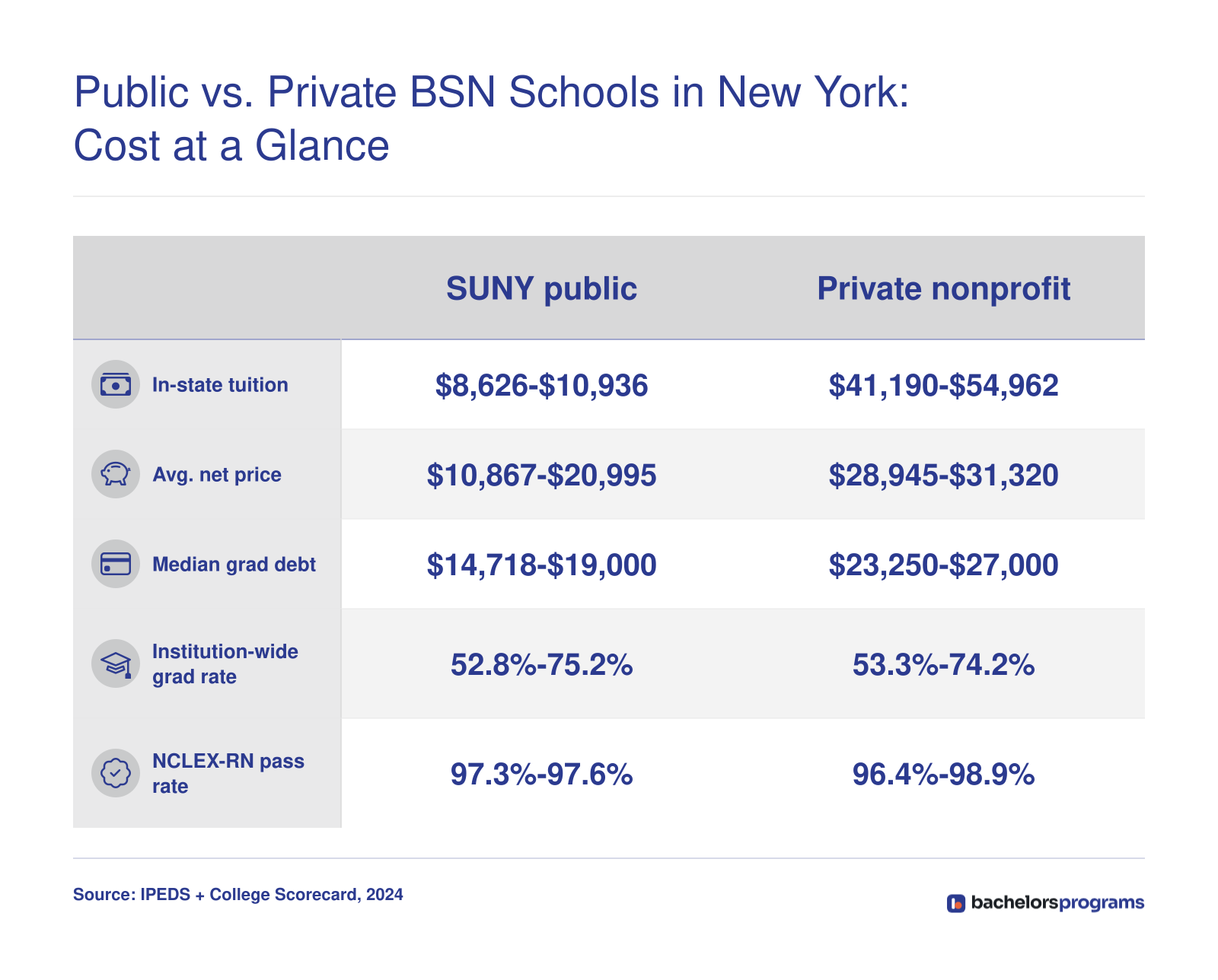
Public vs. Private BSN Schools in New York: Cost at a Glance
This comparison covers the four-year schools ranked here that award the BSN directly: University at Buffalo and Farmingdale State College on the SUNY side, Hartwick College and St. John Fisher University on the private side. Even after financial aid, a family choosing a SUNY campus pays roughly $8,000-$20,000 less per year than at the private options. Graduation and NCLEX-RN results overlap, so the private premium buys a different campus experience, such as smaller classes or added clinical hours, rather than a clearly better shot at licensure.
BSN Admissions in New York: Prerequisites, GPA and Direct Admit vs. Upper-Division Entry
New York BSN admissions now turn on a structural question: whether you enter the nursing major as a freshman or earn a second, competitive admission after prerequisites.
Two entry models, one decision
Direct admit makes the nursing major part of your freshman application. Upper-division entry separates university admission from nursing admission: you take prerequisites first, then apply to the major. New York schools use both approaches, and the difference changes your timeline and your risk. Direct admit removes the second application, but it also asks you to commit to nursing before you have college science grades to show. A traditional BSN is typically a four-year full-time degree, with clinical coursework concentrated in the final two to three years. CUNY Hunter College lists a four-year program; Stony Brook University describes its basic baccalaureate program as a two-year route for students without a prior bachelor's degree.
Prerequisites and entrance exams
Upper-division routes generally expect anatomy and physiology, chemistry, microbiology and statistics before the nursing sequence. CUNY Hunter College requires a nursing entrance exam as part of its competitive process. The TEAS is one common exam, but not every program uses it, so check the requirement for each school. CUNY Hunter College publishes a 3.2 minimum GPA. Stony Brook University lists a 2.8 minimum GPA for its basic baccalaureate program. CUNY Hunter College's nursing cohort is about 100 students. Where a school does not publish a minimum GPA, do not assume a number; the absence of a stated floor is not a guarantee of a lower bar.
Test policy and the second gate
SAT/ACT policies vary. Neither CUNY Hunter College nor Stony Brook University states a current SAT/ACT requirement in the nursing admissions information available, so verify the policy for the cycle you are applying to. In an upper-division program, admission to the university does not guarantee a seat in the nursing major. Plan for the second application early, protect your science grades, and confirm whether your intended school admits freshmen directly or makes you compete again.
Related Articles
Choosing a BSN School in New York: Accreditation, Clinicals and Region
The University at Buffalo publishes "over 600 clinical hours" for its nursing education. That figure is a useful benchmark, but it is not broken out for the Traditional Baccalaureate track, and most schools do not state a single clinical total for the four-year BSN. Compare clinical details school by school instead of assuming they match.
A Short Comparison Checklist
- Accreditation: Confirm the BSN carries CCNE or ACEN accreditation, and that the state has approved the program.
- NCLEX-RN record: Look at results over several years, not one cohort. The ranking above gives each school's figure.
- Clinical sites: Ask which hospitals and community sites students rotate through. New York's 2026 standards call for dedicated clinical hours, exposure to adult acute care, pediatric, psychiatric-behavioral and maternal-newborn settings, and a written clinical agreement.
- Price: Compare public and private net price, not sticker price.
How Region Changes the Experience
New York City programs sit near large academic medical centers. CUNY Hunter College, for example, is reported to place students with NYC Health + Hospitals. Living costs in the city are the trade-off, and they can offset a lower tuition bill.
Long Island programs lean on regional health-system partners, so ask a school such as Stony Brook University which systems and units its students actually use, and how far placements sit from campus.
Upstate campuses, including Hartwick College and St. John Fisher University, generally sit in lower-cost areas. The trade-off is that clinical sites may be a longer drive from campus, so budget for gas, time and a reliable car.
Other Paths Worth Knowing
The programs ranked here are traditional pre-licensure BSN programs. If you already hold an RN license, look at RN-to-BSN programs instead. If you already hold a bachelor's degree in another field, look at accelerated BSN programs. Both tracks sit on separate pages and are not ranked here.
Questions to Ask Yourself
Are you ready to compete for a seat in the nursing major after two years, or do you need a direct-admit program that guarantees one?
Would you rather pay SUNY or CUNY prices and qualify for Excelsior, or does a private school's NCLEX-RN record justify a higher net price?
Do you want clinicals at large New York City medical centers, or would an upstate or Long Island campus with lower living costs suit you better?
New York Board of Nursing Approval and NCLEX-RN Licensure
State approval and national accreditation are two different checks, and a New York BSN graduate needs both. New York does not run a separate board-approval list the way some states do. The State Education Department (NYSED) registers nursing programs, and that registration decides whether your degree counts toward a New York RN license. CCNE or ACEN accreditation is voluntary and national. It does not replace registration, but it matters for employers and for later graduate study.
The Licensing Steps in Order
- Apply to NYSED: Submit Form 1 online with the $143 licensure and first-registration fee, paid by credit card.
- School verification: Your nursing program sends NYSED your education record, usually on Form 2 with an official transcript. Graduates of programs outside the U.S. generally go through CGFNS, with NYSED also pointing to TruMerit or Forms 2F and 3F.
- Register with Pearson VUE: NCLEX registration is separate from your NYSED application. The 2026 fee is $200. Changing your regulatory body or switching between RN and PN exam types after registering costs $50 each, and international scheduling adds $150 where it applies1.
- Receive your Authorization to Test: Schedule the exam within the window it gives you.
- Pass the NCLEX-RN: NYSED then issues your license.
Applicants must be at least 18, of good moral character, and graduates of a NYSED-acceptable program.
Required New York Coursework
New York adds training that many states do not. Child abuse identification coursework is required before you receive a license or limited permit, unless you qualify for an exemption. That exemption applies if you can show you will have no contact with anyone under 18 or with nursing-home or residential-school residents. Infection control coursework is also required, and practicing RNs must repeat it every four years unless exempt. Most programs build the initial coursework into the curriculum or point students to approved providers.
Working Across State Lines
A New York license authorizes practice in New York. Multistate practice depends on the Nurse Licensure Compact, which lets a nurse whose home state belongs to the compact practice in other member states. Confirm New York's current compact status on NCSBN's compact map before planning work in another state. If New York is not a member when you apply, you would generally apply for licensure by endorsement in each additional state.
New York's BSN in 10 Law at a Glance
Compare Bachelor of Science in Nursing (BSN) programs on the data that matters
Explore more Nursing majors or browse every field of study.
All Nursing programs Browse every field of study