Best Accelerated BSN (ABSN) Programs in Ohio
Compare 25 accredited Accelerated BSN (ABSN) programs in Ohio at 22 colleges, with net price after aid, graduation rates, earnings and debt from IPEDS and the U.S. College Scorecard.
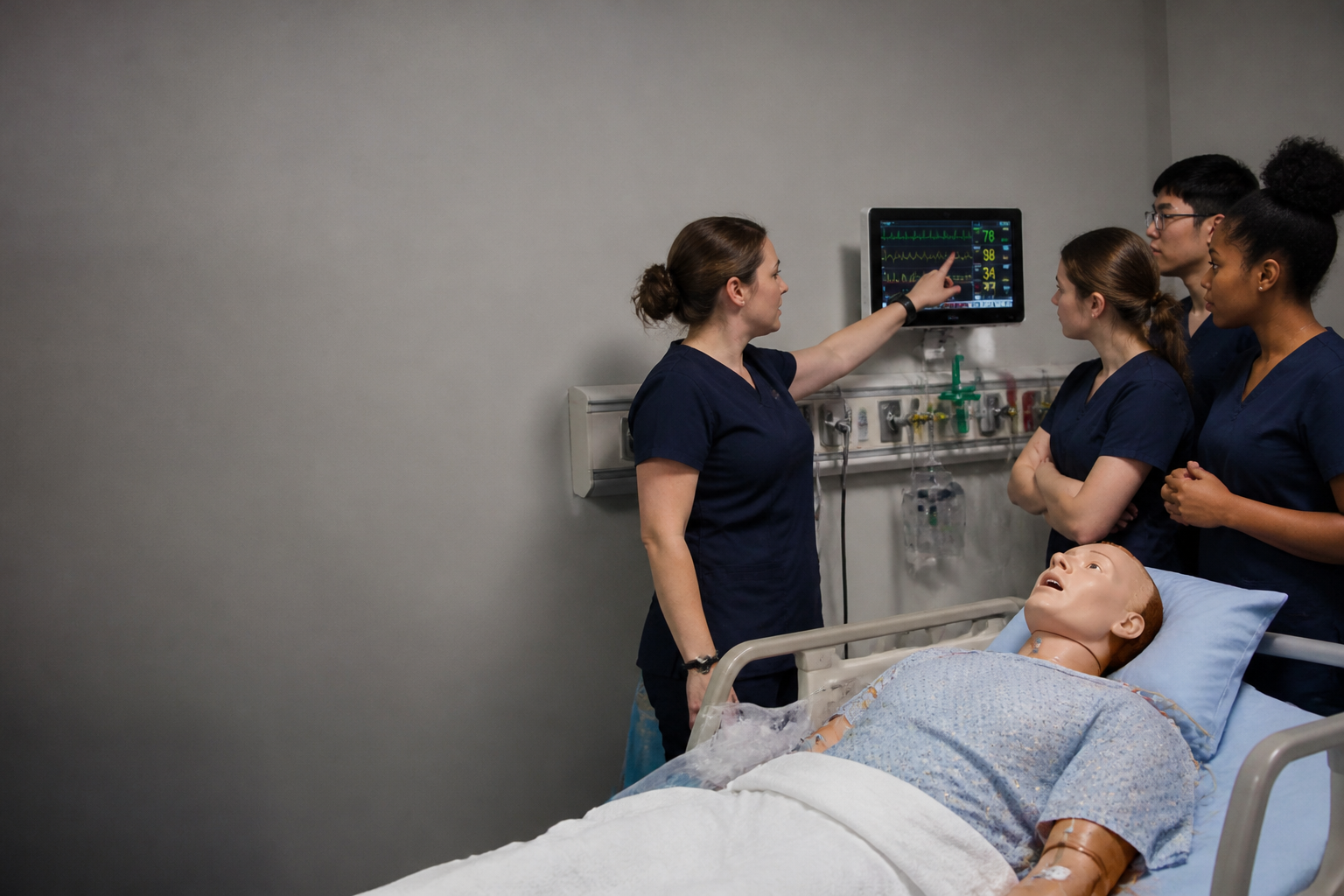
Accelerated BSN programs appeal to Ohio career changers because they are fast, but speed carries a cost: 12 to 18 months of full-time classes and clinicals, with little chance to earn a paycheck along the way. Your existing degree satisfies the general-education requirement, but not the science prerequisites.
Price varies widely. Published program costs run from about $30,000 at Kent State University to $61,677 at Xavier University, and formats range from campus cohorts to hybrid schedules with clinicals bunched into long weekends.
All of them end at the same checkpoint: the NCLEX-RN, the exam that decides whether the compressed timeline paid off.
Key Points
- Mount Carmel College of Nursing has the lowest average net price here: $10,420.
- Kent State runs its accelerated second-degree BSN at both Kent and Stark campuses.
- Before licensure, Ohio RN candidates complete both BCI and FBI fingerprint checks.
The 10 Best Accelerated BSN Schools in Ohio, Ranked
These ten Ohio schools run accelerated BSN programs for people who already hold a bachelor's in another field, and between them they cover every format the state offers: campus cohorts, hybrid programs that pair online lectures with clinical blocks, and one online completion track for licensed nurses. Cost, admission, and graduation figures below come from federal data, so each option can be compared on the same terms.
Ohio State University
#1Columbus, OH · $17,000/yr (est. net price)
Best for: Career changers aiming at academic medical centers
Ohio State runs its ABSN through the College of Nursing as a hybrid, pairing online coursework with labs and clinical placements at the Wexner Medical Center and other partners. The program launched in 2024 to help answer the state's nursing shortage. In-state tuition is $13,244, average net price after aid is about $17,339, the admit rate is 61%, and the school graduates 88% of students.
- Hybrid delivery: online coursework plus in-person labs and clinicals
- Five consecutive semesters, 59 total credit hours
- Clinical placements include the Wexner Medical Center
- Designed for holders of a non-nursing bachelor's degree
- Minimum 3.0 GPA and prerequisite courses required
- One start per year, in summer; $60 application fee
- CCNE accredited and prepares students for NCLEX-RN
Kettering College
#2Kettering, OH · ~$22,000/yr (est.)
Best for: Dayton-area students staying close to home
Kettering College is a private school in the Dayton area and part of the Kettering Health network, so its campus ABSN puts students in clinical settings from the first nursing course onward. Rotations run through Kettering Health hospitals and community facilities. In-state tuition is $16,320, average net price after aid is about $21,650, the admit rate is roughly 77%, and the school graduates 65% of students.
- 15-month program for bachelor's degree holders
- August start with one cohort per year
- Clinical experiences begin in the first nursing course
- Rotations across Kettering Health hospitals and community sites
- ACEN accredited and prepares students for NCLEX-RN
Mercy College of Ohio
#3Toledo, OH · $18,000/yr (est. net price)
Best for: Working adults needing weekend clinical blocks
Mercy College of Ohio in Toledo runs a hybrid ABSN with online lectures and clinicals grouped over long weekends, a schedule built for students who keep working. Mercy Health employees may qualify for full tuition coverage, and cohorts start in May. In-state tuition is $19,470, average net price after aid is about $17,989, the admit rate is 93%, and the school graduates 56% of students.
- Four consecutive semesters of full-time study
- Hybrid format: online lectures with in-person clinicals
- Clinicals grouped over long weekends for working students
- Mercy Health employees may qualify for 100% tuition coverage
- ACEN accredited and prepares students for NCLEX-RN
Mount Carmel College of Nursing
#4Columbus, OH · ~$10,000/yr (est.)
Mount Carmel College of Nursing sits inside the Trinity Health system in Columbus and offers its second-degree program in a 13-month and an 18-month hybrid track, plus an evening and weekend version. Clinical groups run at a 10 to 1 student-to-faculty ratio. In-state tuition is $22,080, but average net price after aid falls to about $10,420, the lowest here; the admit rate is 84% and the school graduates 54% of students.
- 13-month or 18-month hybrid track options
- Online coursework plus campus skills labs and clinicals
- 10 to 1 student-to-faculty ratio in clinical settings
- Part of the Trinity Health system
- ACEN accredited and prepares students for NCLEX-RN
- 18-month track with evening and weekend classes
- Rolling admissions
- Blended online and face-to-face instruction
- Average class size of 30 students
- Built for students balancing full-time work
Kent State University
#5Kent, OH · ~$21,000/yr (est.)
Kent State is a public research university whose campus ABSN draws on more than 750 clinical partners along with simulation and skills labs. Students who already hold a bachelor's enter directly into nursing coursework at the Kent campus. In-state tuition is $13,232, average net price after aid is about $20,787, the admit rate is 86%, and the school graduates 64% of students.
- 15-month ABSN for students who already hold a bachelor's
- Based at the Kent, Ohio campus
- More than 750 clinical partners
- Simulation and skills labs support the curriculum
- CCNE accredited
Ursuline College
#6Pepper Pike, OH · $15,000 – $20,000/yr (est.)
Ursuline College, in Pepper Pike outside Cleveland, runs a full-time ABSN and a part-time version that stretches to 24 months on evenings and weekends, a genuine option for students who cannot stop working. Skills labs use 3D virtual reality, and clinicals include one-on-one preceptorships. In-state tuition is $38,990, average net price after aid is about $16,164, the admit rate is 75%, and the school graduates 67% of students.
- 15-month full-time or 24-month part-time track
- Rolling admissions with January, May, and August starts
- Skills labs with 3D virtual reality technology
- One-on-one preceptorship clinical experiences
- CCNE accredited and approved by the Ohio Board of Nursing
- Curriculum leads to Teams STEPPS certification
Baldwin Wallace University
#7Berea, OH · ~$28,000/yr (est.)
Baldwin Wallace, in Berea near Cleveland, places ABSN students at Cleveland Clinic and University Hospitals in clinical groups of six to eight, with applications reviewed on a rolling basis for an August start. Small groups mean more hands-on time per student. In-state tuition is $39,832, average net price after aid is about $27,603, the admit rate is 76%, and the school graduates 67% of students.
- 15-month, 63-credit program with 700 clinical hours
- Clinical groups of 6 to 8 students
- Rotations at Cleveland Clinic and University Hospitals
- August start with rolling admissions review
- Minimum 2.8 GPA; two letters of recommendation
- Program fee covers textbooks and uniforms
- No transfer credit accepted
University of Akron
#8Akron, OH · $10,000 – $15,000/yr (est.)
The University of Akron is a public university with a full-time, cohort-based ABSN that starts each May, after applicants finish prerequisite sciences such as chemistry, anatomy and physiology, and microbiology. Scholarships are available for admitted students. In-state tuition is $13,135, average net price after aid is about $13,946, the admit rate is 60%, and the school graduates 52% of students.
- Four consecutive semesters, starting each May
- Full-time, cohort-based format
- Prerequisite sciences include chemistry and microbiology
- Minimum 2.8 GPA and one letter of recommendation
- Scholarships available; ACEN accredited
Xavier University
#9Cincinnati, OH · ~$33,000/yr (est.)
Xavier University in Cincinnati folds its accelerated BSN into the university's BSN, teaching a holistic health model through clinical simulation labs and interprofessional coursework shared with other health professions students. In-state tuition is $50,640 and average net price after aid is about $32,997, the highest cost on this list; the admit rate is 86% and the school graduates 69% of students.
- Designed for students who already hold a bachelor's degree
- Clinical simulation labs and interprofessional learning
- Holistic health and wellness curricular model
- Two concentration options within the BSN
- CCNE accredited and prepares students for RN licensure
Felbry College
#10Columbus, OH · $55,000 – $60,000/yr (est.)
Felbry College in Columbus lists an accelerated nursing option that is an RN to BSN completion program, delivered fully online for licensed registered nurses who hold an associate degree or diploma and want the bachelor's credential. It is not a second-degree entry route for career changers who are not yet nurses, which is why it lands last here. In-state tuition is $29,731, the admit rate is 85%, and the school graduates 91% of students.
- Fully online coursework via distance education
- Completes in as little as 16 months (68 weeks)
- Advanced standing for current RN licensure
- Minimum 2.5 GPA; two letters of recommendation
- No NCLEX exam at completion
- Coursework in leadership, policy, and evidence-based practice
Cost & outcomes by school
Federal data for the highest-earning Accelerated BSN (ABSN) programs, independent of the ranking above. Earnings are this field's bachelor's graduates four years after completing where the Scorecard reports them, else the school's undergraduate median.
| School | Net price / yr | Grad rate | Earnings | Debt | Grads/yr | Format |
|---|---|---|---|---|---|---|
| Mount Carmel College of Nursing OH | $10,420 | 54% | $75,103 | $22,082 | 468 | Hybrid |
| The Christ College of Nursing and Health Sciences OH | $18,378 | 56% | $68,303 | $24,250 | 324 | Campus |
| Kettering College OH | $21,650 | 65% | $67,492 | $23,500 | 296 | Campus |
| Mercy College of Ohio OH | $17,989 | 56% | $65,409 | $20,834 | 290 | Hybrid |
| Xavier University OH | $32,997 | 69% | $64,873 | $23,250 | 2,434 | Campus |
| Ohio State University OH | $17,339 | 88% | $60,409 | $19,976 | 23,536 | Hybrid |
| Walsh University OH | $20,493 | 59% | $59,764 | $27,000 | 718 | Hybrid |
| Ursuline College OH | $16,164 | 67% | $56,878 | $26,250 | 412 | Campus |
| Miami University-Hamilton OH | $11,286 | 25% | $55,076 | $23,000 | 850 | Campus |
| Wittenberg University OH | $18,649 | 53% | $54,947 | $27,000 | 694 | Online |
| Capital University OH | $22,576 | 60% | $54,143 | $26,889 | 880 | Hybrid |
| Baldwin Wallace University OH | $27,603 | 67% | $54,122 | $27,000 | 1,574 | Campus |
Sources: U.S. Department of Education. Net price, graduation rate, earnings and debt: College Scorecard (earnings and debt for this field's bachelor's graduates where reported, else school-wide); graduates: IPEDS. A dash means no figure is reported.
Cost, debt & payoff
Median earnings of this field's bachelor's graduates (4 yrs after completing, else the school's undergraduate median) vs. their median federal loan debt · U.S. College Scorecard
Across these programs the median graduate earns about $54,143 and finishes with roughly $24,250 in debt — a ratio that clears a common rule of thumb (keep debt below first-year salary). Net price and debt vary widely school to school, so check the per-school figures in the table above before you shortlist.
What Put These Ohio ABSN Schools in Order: Our Data and Scoring
If you are paying for a second bachelor's degree, should cost and completion count for more than a school's name? Yes, and the ranking above reflects that choice.
The figures come from the U.S. Department of Education's College Scorecard and IPEDS. They cover in-state tuition and fees, average net price after aid, institution-wide graduation rate, admissions rate, and delivery format. Lower cost and stronger completion moved a school up. Brand recognition did not.
Read Two Numbers Carefully
Graduation rate and net price describe the whole institution, not the ABSN cohort. A university's rate also reflects its traditional undergraduates, so treat it as a signal of institutional support, not a promise about your cohort. Net price is an average across students who received aid, not a personal quote. Your actual cost depends on your transfer credits, your aid eligibility, and the program's per-credit rate, so confirm it with the school's financial aid office.
Earnings, Debt, and NCLEX-RN
Program-level earnings and debt also come from Scorecard, but only where a school publishes them. Some schools have no published figure, so their entries rest on the other measures.
NCLEX-RN pass rates did not affect the order. Where the ranking data supplies a pass rate for a school, it is shown exactly as given. Use it as a separate check, alongside Ohio Board of Nursing approval, before you apply.
Lowest-Cost Accelerated BSN Schools in Ohio
Mount Carmel College of Nursing in Columbus is the least expensive school here, with an average net price after aid of $10,420, while Cleveland State University sits at the top of this group at $14,764, a spread of $4,344 a year. Low cost does not mean lower completion: Mount Carmel pairs the lowest price with the highest institution-wide graduation rate in this table (54%), while Kent State University at Stark (37%) and Miami University-Hamilton (25%) post lower rates. All prices and graduation rates are institution-level averages from 2024 IPEDS and College Scorecard data, not ABSN-specific charges, so confirm current costs on each nursing school's accelerated BSN tuition page before you apply.
| Rank | School | City | Program | Format | Program Length | Average Net Price After Aid | Graduation Rate (Institution-Wide) |
|---|---|---|---|---|---|---|---|
| 1 | Mount Carmel College of Nursing | Columbus | Second Degree Accelerated Program (SDAP) | Hybrid | 13-month or 18-month tracks | $10,420 | 54% |
| 2 | Kent State University at Stark | North Canton | Accelerated Second Degree Bachelor of Science in Nursing (ABSN) | Campus | 15 months | $10,897 | 37% |
| 3 | Miami University-Hamilton | Hamilton | Butler Tech/Miami University Early Access BSN 1+3 Pathway | Campus | 3 years | $11,286 | 25% |
| 4 | University of Akron | Akron | Accelerated BSN | Campus | 4 semesters | $13,946 | 52% |
| 5 | Cleveland State University | Cleveland | Accelerated BSN Program | Online, with in-person options | 4 semesters | $14,764 | 51% |
Related Articles
Getting in: Prior Bachelor's, Science Prerequisites, GPA, and Testing for Ohio ABSN Applicants
Accelerated BSN programs in Ohio set their own admissions rules, so read each school's admissions page closely. The details below come from Ohio State, Kent State, and Cleveland State. Confirm current requirements with any other school on this list before you apply.
- A completed bachelor's in another fieldOhio State requires a non-nursing bachelor's from a regionally accredited institution. If the degree is still in progress, it must be conferred by the first month of the program. Cleveland State lets you apply while finishing your bachelor's, but the degree must be complete before you start. Kent State asks for a completed bachelor's.
- Science prerequisites and minimum gradesOhio State requires human anatomy, human physiology, human nutrition, microbiology, psychology, and chemistry, with at least a B- in each. AP scores of 3 or higher may count for chemistry and psychology. Kent State requires anatomy and physiology I and II, microbiology, chemistry, and human growth and development, with at least a C in science and math courses.
- GPA minimumsOhio State requires a 3.0 cumulative GPA across all college work. Kent State requires a 2.75 overall GPA and a 2.75 science GPA. Cleveland State requires a 2.5 cumulative GPA for your bachelor's and a 3.00 GPA in prerequisites.
- Prerequisite timing and entrance testsOhio State requires all prerequisites to be finished by the application deadline, which is January 10, 2027, for the Summer 2027 cohort. Courses still in progress at that date are not considered. Kent State also expects prerequisites to be complete. Neither school's accelerated BSN pages list a TEAS or HESI A2 requirement, so ask each school you apply to about testing.
- Clinical compliance itemsNursing programs commonly require a criminal background check, current immunization records, and other health documents before clinical placements begin. Get each school's compliance list early so these items don't delay your start date.
ABSN Pace and Cost in Ohio: 12 to 18 Months, In-State Tuition, and Financial Aid
An accelerated BSN compresses the nursing half of a four-year degree into roughly 12 to 18 months of full-time, year-round study. There are no summers off: one term rolls into the next, and lectures, skills labs and clinical shifts fill most weekdays. Xavier University's published cost schedule, for example, spreads 63 credits across four consecutive semesters, with 15 to 17 credits in each.1 At that load, holding even a part-time job is very difficult, so plan your savings or borrowing as if you will not earn a paycheck until you pass the NCLEX-RN.
What Ohio ABSN Programs Charge
Public in-state pricing sits well below private tuition:
- Cleveland State University: The online ABSN lists an in-state estimate of $22,334.40 in tuition plus $8,460 in fees, about $30,794.40 total, at $310.20 to $348.98 per credit. Out-of-state students face $31,860 in tuition plus fees. The school notes these 2026 figures are subject to change.
- Kent State University: In-state costs average about $30,000 across the professional nursing sequence. That is an average, not a guaranteed price.
- Xavier University: The private Cincinnati school charges $900 per credit. Its four-semester schedule, built on 2025-2026 rates, shows $56,700 in tuition and $61,677 in semester totals, including a $12.50 ID fee each term.1 The 2026-2027 fee page separately lists a $1,025 nursing program fee and a $350 course materials fee. Ask the school whether those charges are already inside the schedule before you budget.
- Ohio State University: Expect a $60 application fee and a $100 acceptance fee for newly admitted students. Confirm full tuition directly with the College of Nursing.
Prerequisites Add Time and Money
Science prerequisites such as anatomy, physiology and microbiology usually have to be finished before the cohort starts, which can add a semester or more. Xavier prices prerequisite coursework at $550 per credit for 2026-2027, a cost that falls outside the core program total.
How Second-Degree Students Pay
Pell Grants are generally off the table for a second bachelor's degree. Baldwin Wallace University states plainly that post-baccalaureate nursing students do not qualify for federal grants, and most rely on Direct Loans or private loans because federal loans will not cover the full cost. Kent State puts federal loan amounts for degree holders at $5,500 to $12,500 per year. Grad PLUS loans are designed for graduate study, so students in an undergraduate ABSN typically fill any gap with private loans.
Other options worth pursuing:
- School scholarships: Kent State's nursing awards go to students already admitted to the professional sequence.
- Employer commitments: Some hospitals and agencies cover tuition in exchange for several years of post-graduation employment.
- HRSA Nurse Corps Scholarship: This federal program pays tuition and a stipend in return for service at a facility facing a critical nursing shortage.
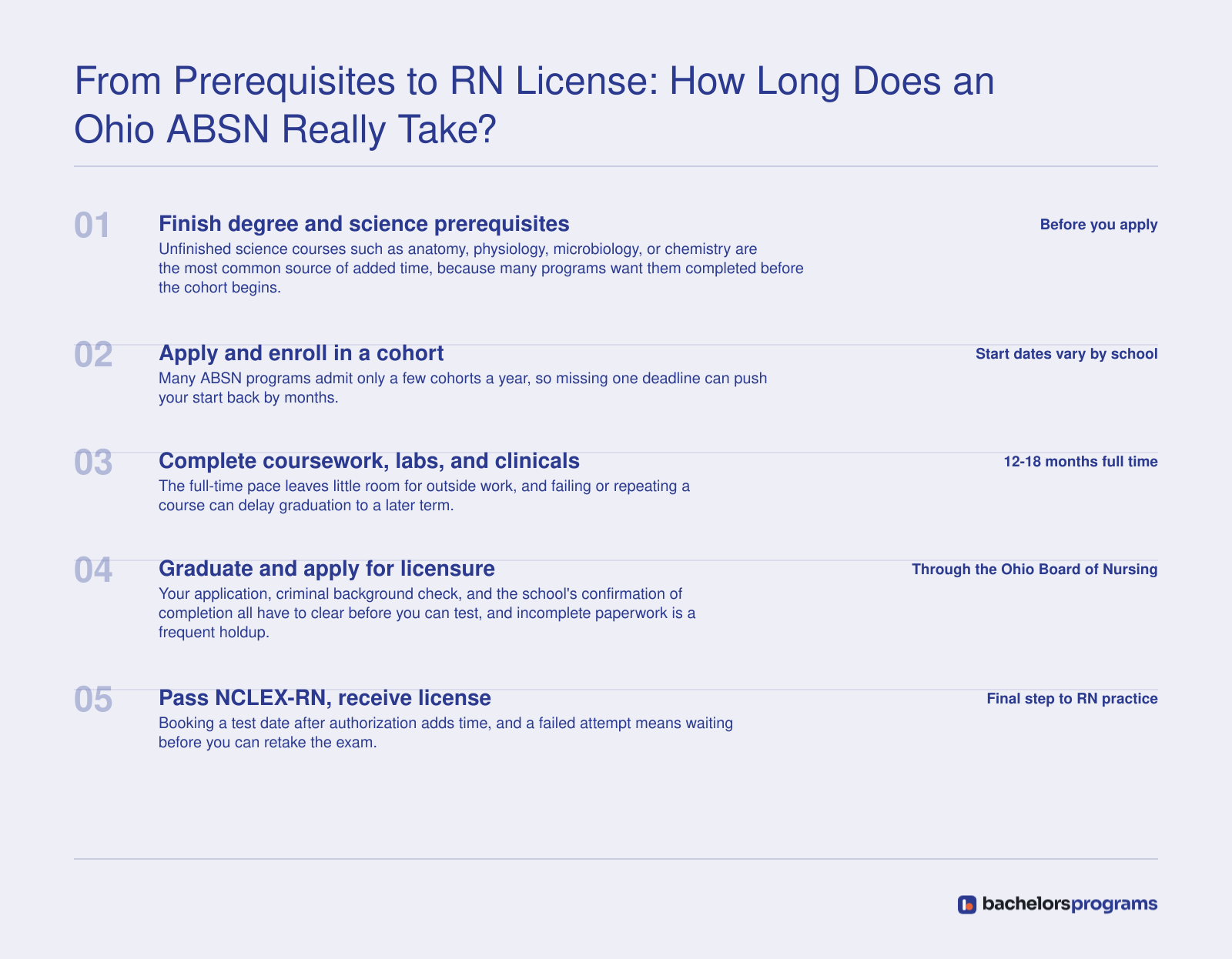
From Prerequisites to RN License: How Long Does an Ohio ABSN Really Take?
An accelerated BSN compresses nursing school into 12 to 18 months, but the full path to an Ohio RN license starts before day one and ends after graduation. Each stage below notes where extra time most often appears, so you can plan your start date and budget with fewer surprises.
Questions to Ask Yourself
Can you stop working, or nearly stop, for 12 to 18 straight months, including summers?
Do your prerequisite grades meet the school's minimum, or will you need a semester of retakes first?
Will a hybrid program's lab immersions and clinical sites be within driving distance of where you live in Ohio?
Does a public school's in-state tuition beat a private school's faster start date once you count lost income?
Ohio RN Licensure at a Glance
Quick Answers for Second-Degree Nursing Students in Ohio
Program length, entry bar, and price vary by school, so check each program's own admissions page before you plan around a single number. These answers use the figures published for the Ohio schools covered here.
How long are accelerated BSN programs in Ohio?
Can I get a BSN in 12 months if I already have a bachelor's degree?
Is an accelerated BSN program hard to get into?
How much do accelerated BSN programs in Ohio cost?
Compare Accelerated BSN (ABSN) programs on the data that matters
Explore more Nursing majors or browse every field of study.
All Nursing programs Browse every field of study