Best BSN Programs in Ohio
Compare 86 accredited Bachelor of Science in Nursing (BSN) programs in Ohio at 76 colleges, with net price after aid, graduation rates, earnings and debt from IPEDS and the U.S. College Scorecard.

Ohio BSN tuition runs from about $6,362 a year at Ohio University-Zanesville to $41,164 at The University of Findlay, and price alone says little about who clears the NCLEX-RN on the first attempt. That gap is the actual decision: pay for a campus with a strong first-time licensure record, or pay less and absorb more risk.
Ordered mainly by NCLEX-RN results, the list covers traditional pre-licensure BSN programs only; RN-to-BSN and accelerated routes serve licensed nurses and second-degree students instead.
Many Ohio hospital systems now prefer or require a BSN for new hires, so the pass rate, not the brochure, is the number that matters.
Key Points
- At $4,687 after aid, North Central State College is the cheapest option here.
- Ohio University lists 121 BSN credits; Ohio State requires at least 122.
- The Ohio Board of Nursing's September 2026 list flags weak NCLEX-RN performers.
Ohio's 10 Strongest BSN Programs by NCLEX-RN Results
Ohio's strongest BSN programs separate less on reputation than on how their graduates perform on the NCLEX-RN, the exam every pre-licensure graduate must pass to earn a registered nurse license. The ten schools below are ordered on first-time NCLEX-RN results across the Ohio Board of Nursing's latest three years of data. Two entries are completion tracks built for licensed RNs rather than first-time students, so read those as a different route to the same credential.
Ohio University-Zanesville
#1Zanesville, OH · $6,000/yr (est. net price) · NCLEX-RN pass rate 100% (3-yr weighted avg)
Best for: Regional-campus students wanting locked tuition
Ohio University's Zanesville campus runs a campus-based BSN with CCNE accreditation, a locked tuition rate and a 16:1 student-to-faculty ratio. Students enter through a selective Pre-BSN major and progress into nursing coursework after meeting GPA and prerequisite requirements, training in three nursing labs with manikins and high-fidelity simulation suites before clinical placements at nearby hospitals and agencies. First-time NCLEX-RN results stand at 100% across the board's latest three years of data, from a 14-candidate cohort.
- CCNE accredited, campus-based BSN with a locked tuition rate
- 2.8 GPA minimum plus prerequisite coursework for the major
- Three nursing labs with manikins and high-fidelity simulation suites
- Clinical experiences at hospitals and agencies near Zanesville
- Prepares graduates for NCLEX-RN and generalist RN practice
- Foundation for master's or doctoral nursing study
Muskingum University
#2New Concord, OH · $20,000/yr (est. net price) · NCLEX-RN pass rate 100% (3-yr weighted avg)
Best for: Small-cohort learners seeking pediatric rotations
Muskingum University in New Concord is fully approved by the Ohio Board of Nursing and CCNE accredited, and keeps classes small with open-door advising. Pediatric practicums run at Nationwide Children's Hospital alongside work in a dedicated nursing laboratory, and the program reports 100% job placement for its graduates. First-time NCLEX-RN results are 100% across the board's latest three years, from 52 candidates.
- CCNE accredited and fully approved by the Ohio Board of Nursing
- Pediatric practicums at Nationwide Children's Hospital
- State-of-the-art nursing laboratory on campus
- Small class sizes with open-door advising
- Program reports 100% job placement for recent graduates
- Coursework tailored to regional healthcare employer needs
Hiram College
#3Hiram, OH · $21,000/yr (est. net price) · NCLEX-RN pass rate 100% (3-yr weighted avg)
Best for: High schoolers ready for direct entry
Hiram College pairs a liberal arts core with a BSN that puts students in clinical settings across Northeast Ohio starting in sophomore year. The 128-credit program offers direct entry for high school students with a 3.5 GPA, a four-year tuition guarantee and an optional biomedical humanities minor, and it is CCNE accredited. First-time NCLEX-RN results are 100% across the board's latest three years, from 31 candidates.
- CCNE accredited; 128-credit four-year program
- Clinical sites across Northeast Ohio, starting sophomore year
- Four-year tuition guarantee
- Direct entry for high school students with a 3.5 GPA
- Optional minor in biomedical humanities
- Student Nurses' Association membership available
Cedarville University
#4Cedarville, OH · ~$24,000/yr (est.) · NCLEX-RN pass rate 97.8% (3-yr weighted avg)
Cedarville University runs a four-year residential BSN that integrates Bible coursework with nursing science, with clinical rotations beginning in the first year and simulation labs before students work with patients. It is CCNE accredited and approved by the Ohio Board of Nursing, and graduates report a 100% placement rate within six months, with alumni hired at Cleveland Clinic and Nationwide Children's Hospital. First-time NCLEX-RN results are 97.8% across the board's latest three years, from 308 candidates, one of the largest cohorts here.
- CCNE accredited and approved by the Ohio Board of Nursing
- Clinical experiences begin in the first year
- State-of-the-art simulation labs before patient contact
- Biblically integrated coursework with faculty mentoring
- Short-term medical mission trips available
- Dual enrollment pathway available
- Graduates hired at Cleveland Clinic and Nationwide Children's Hospital
The University of Findlay
#5Findlay, OH · $25,000 – $30,000/yr (est.) · NCLEX-RN pass rate 98.7% (3-yr weighted avg)
The University of Findlay combines a 120-credit BSN with on-campus simulation and supervised hospital placements, plus an Early Assurance pathway for high school seniors and a study abroad exchange in Japan. Admission is competitive, with a 3.0 GPA minimum and prerequisite coursework, and the program is CCNE accredited and approved by the Ohio Board of Nursing. First-time NCLEX-RN results are 98.7% across the board's latest three years, from 45 candidates.
- CCNE accredited; 120 total credit hours with a fall start
- 3.0 GPA minimum plus prerequisite courses
- Entrance exam required, with TOEFL listed
- On-campus nursing simulation lab
- Early Assurance pathway for high school seniors
- Study abroad exchange in Japan
Washington State College of Ohio
#6Marietta, OH · $8,000/yr (est. net price) · NCLEX-RN pass rate 95.1% (3-yr weighted avg)
Washington State College of Ohio in Marietta runs a hybrid RN-to-BSN completion track for registered nurses who already hold an associate degree or diploma, covering leadership, research, community health and health policy. The 2025 cohort completed at 100%, and the college reports 100% job placement for its 2024 cohort, with local employers including Marietta Memorial Hospital and Camden Clark Medical Center. This is a route for licensed nurses, not a pre-licensure program.
- Hybrid RN-to-BSN for nurses holding an ADN or diploma
- Coursework in leadership, research, community health and policy
- Prepares graduates for MSN or DNP study
- College reports 100% job placement for the 2024 cohort
- 2025 cohort completed at 100%
- Local employers include Marietta Memorial Hospital and Camden Clark Medical Center
Baldwin Wallace University
#7Berea, OH · ~$28,000/yr (est.) · NCLEX-RN pass rate 96.8% (3-yr weighted avg)
Baldwin Wallace University in Berea teaches both a traditional campus BSN and a 15-month accelerated track for second-degree students, with DNP- and MSN-prepared faculty and a director of clinical education who oversees placements. Clinical partners include Cleveland Clinic and University Hospitals, and accelerated students log roughly 700 clinical hours in groups of six to eight. First-time NCLEX-RN results are 96.8% across the board's latest three years, from 62 candidates.
- CCNE accredited traditional BSN track
- Faculty hold DNP and MSN credentials
- Director of Clinical Education oversees placements
- Dedicated coordinator for each track
- 15-month, 63-credit second-degree track
- 700 clinical hours in clinical groups of six to eight
- No entrance exam required; 2.8 GPA minimum
- Clinical partnerships with Cleveland Clinic and University Hospitals
- Choose Ohio First scholarship for Ohio residents
- Concept-based curriculum built for critical thinking
Capital University
#8Columbus, OH · ~$23,000/yr (est.) · NCLEX-RN pass rate 96% (3-yr weighted avg)
Capital University in Columbus builds its BSN around small clinical groups, with a 4:1 student-to-instructor ratio in simulation labs and 1:1 faculty mentoring. Students complete clinicals at Ohio State Wexner Medical Center and Nationwide Children's Hospital, and coursework runs from pathophysiology and psychiatric mental health to community health. The program is CCNE accredited with a 3.0 GPA minimum, and first-time NCLEX-RN results are 96% across the board's latest three years, from 211 candidates.
- CCNE accredited; 3.0 GPA minimum plus prerequisites
- 4:1 student-to-instructor ratio in simulation labs
- 1:1 mentoring by nursing faculty
- Clinicals at Ohio State Wexner Medical Center and Nationwide Children's Hospital
- Coursework spans pathophysiology, psychiatric mental health and community health
- Prepares graduates for hospital, public health and home-health roles
Miami University
#9Oxford, OH · $18,000 – $41,000/yr (est.) · NCLEX-RN pass rate 92.9% (3-yr weighted avg)
Miami University blends a liberal arts core with professional nursing on both the Oxford and Hamilton campuses, including a 1+3 model that lets high school students finish in three years at the regional campuses. Clinical work runs through Dedicated Education Units and hospital partnerships, and the program reports a 99.7% post-graduation success rate. First-time NCLEX-RN results are 92.9% across the board's latest three years, from 374 candidates, the largest cohort on this list.
- CCNE accredited; offered on Oxford and Hamilton campuses
- 1+3 model lets high school students finish in three years at the Regionals
- Dedicated Education Units for immersive clinical work
- Program reports 99.7% post-graduation success rate
- Prepares graduates for medical-surgical, emergency, intensive care or public health roles
Columbus State Community College
#10Columbus, OH · $5,000 – $11,000/yr (est.) · NCLEX-RN pass rate 95.9% (3-yr weighted avg)
Columbus State Community College runs a fully online RN-to-BSN completion program for working registered nurses, delivered in eight-week terms with three courses that include clinical components completed in Ohio. Students can finish in under a year or extend the work to five years, and up to 34 credits are awarded for an associate degree. It is ACEN accredited and aimed at nurses moving into charge nurse and management roles.
- Fully online RN-to-BSN with eight-week terms
- Finish in under a year or extend to five years
- Up to 34 credits awarded for an associate degree
- Three courses include clinical components completed in Ohio
- ACEN accredited; 2.0 GPA minimum
- Employer tuition reimbursement supported
- Five start dates per year
Cost & outcomes by school
Federal data for the highest-earning Bachelor of Science in Nursing (BSN) programs, independent of the ranking above. Earnings are this field's bachelor's graduates four years after completing where the Scorecard reports them, else the school's undergraduate median.
| School | Net price / yr | Grad rate | Earnings | Debt | Grads/yr | Format |
|---|---|---|---|---|---|---|
| Case Western Reserve University OH | $41,190 | 87% | $87,989 | $24,000 | 3,834 | Campus |
| Ohio Northern University OH | $24,478 | 76% | $80,928 | $27,000 | 1,268 | Campus |
| University of Dayton OH | $29,533 | 80% | $75,537 | $23,250 | 4,220 | Campus |
| Mount Carmel College of Nursing OH | $10,420 | 54% | $75,103 | $22,082 | 468 | Campus |
| The Christ College of Nursing and Health Sciences OH | $18,378 | 56% | $68,303 | $24,250 | 324 | Campus |
| Kettering College OH | $21,650 | 65% | $67,492 | $23,500 | 296 | Campus |
| Good Samaritan College of Nursing and Health Science OH | $19,622 | 73% | $66,111 | $20,625 | 36 | Online |
| Mercy College of Ohio OH | $17,989 | 56% | $65,409 | $20,834 | 290 | Campus |
| Xavier University OH | $32,997 | 69% | $64,873 | $23,250 | 2,434 | Campus |
| Aultman College of Nursing and Health Sciences OH | $24,204 | 53% | $63,582 | $20,000 | 54 | Campus |
| John Carroll University OH | $28,746 | 79% | $62,860 | $26,000 | 1,328 | Campus |
| Galen College of Nursing-Cincinnati OH | $28,785 | 57% | $61,480 | $24,166 | 64 | Campus |
Sources: U.S. Department of Education. Net price, graduation rate, earnings and debt: College Scorecard (earnings and debt for this field's bachelor's graduates where reported, else school-wide); graduates: IPEDS. A dash means no figure is reported.
Cost, debt & payoff
Median earnings of this field's bachelor's graduates (4 yrs after completing, else the school's undergraduate median) vs. their median federal loan debt · U.S. College Scorecard
Across these programs the median graduate earns about $51,892 and finishes with roughly $23,125 in debt — a ratio that clears a common rule of thumb (keep debt below first-year salary). Net price and debt vary widely school to school, so check the per-school figures in the table above before you shortlist.
How This Ohio BSN List Was Built
A BSN leads to bedside work only after its graduate passes the NCLEX-RN, so licensure results drive most of this ranking. Every other factor sits behind that single outcome.
What Counts and How Much
- NCLEX-RN first-time pass rate: About 75% of each school's score, drawn from three years of results and weighted by how many graduates sat the exam each year.
- Accreditation: Programmatic accreditation signals that a nursing program meets national standards for curriculum, faculty and clinical training.
- Completion and retention: How many students stay enrolled and finish. A strong pass rate means less if much of the entering class never reaches the exam.
Accreditation and completion together make up the remaining quarter of the score.
Why a Three-Year Average Beats Reputation
Name recognition says little about whether a program's graduates actually get licensed. A single year of results can mislead too, especially at a smaller school where a handful of test takers can swing the pass rate sharply. Pooling three years and weighting each year by cohort size lets every graduate's result count equally and smooths one rough cohort, so a small program isn't judged on its worst year.
Which Programs Were Compared
Only traditional pre-licensure BSN programs were ranked. These programs prepare students with no prior nursing license for the NCLEX-RN. RN-to-BSN programs serve nurses who already hold a license, and accelerated BSN programs serve students with a prior bachelor's degree. Both run on different timelines and admit different students, so they were left out to keep the comparison fair. Each route has its own guide on bachelorsprograms.com.
Lowest Net Price BSN Schools in Ohio
Sorted by average net price after aid (U.S. Department of Education IPEDS and College Scorecard, 2024), the lowest-cost BSN options in Ohio are all public colleges, led by North Central State College at $4,687. No private school's aid brings its net price into this range. Net price is an institution-wide average across all undergraduates, so your own aid package may come in higher or lower. Note that Sinclair, Washington State College of Ohio and Columbus State list their BSN as a degree-completion route for nurses who already hold an RN license. Ohio University-Zanesville pairs the second-lowest net price with a 100% NCLEX-RN pass rate, and every school here posts a rate above 90%. Check the NCLEX-RN ranking above to see which of these schools also made the top tier.
| School | City | Sector | Published in-state tuition | Average net price after aid | NCLEX-RN pass rate | Format |
|---|---|---|---|---|---|---|
| North Central State College | Mansfield | Public | $5,786 | $4,687 | 92.9% | Hybrid |
| Ohio University-Zanesville | Zanesville | Public | $6,362 | $5,746 | 100% | Campus |
| Sinclair Community College | Dayton | Public | $4,809 | $5,992 | 92% | Hybrid (RN to BSN completion) |
| Washington State College of Ohio | Marietta | Public | $4,128 | $7,714 | 95.1% | Hybrid (RN to BSN completion) |
| Columbus State Community College | Columbus | Public | $5,488 | $8,400 | 95.9% | Online (BSN degree completion) |
What a BSN Costs in Ohio: Tuition, Net Price and State Grants
Published tuition at Ohio's public universities sits far below what the state's private colleges charge, a gap wide enough to change where a student applies. Ohio University-Zanesville lists roughly $6,362 a year in tuition for Ohio residents. Hiram College publishes $27,600, Muskingum University $32,665, Cedarville University $37,150 and The University of Findlay $41,164.
What Families Actually Pay
Average net price, the figure left after grants and scholarships, closes part of that distance. Zanesville's average net price lands near $5,746. Muskingum comes in around $19,532, Hiram $21,058, Cedarville $24,468 and Findlay $27,221. Private aid packages can shrink the difference considerably, but on average they rarely erase it, which is why a public regional campus stays the lower-cost route for many Ohio families.
Two State Aid Programs to File For
The Ohio College Opportunity Grant is the state's main need-based award. Under 2026-27 rules from the Ohio Department of Higher Education, Ohio residents working toward an associate degree, a first bachelor's or a nurse diploma qualify if the FAFSA Student Aid Index is $3,750 or less and household income is $96,000 or below. Maximum annual awards run $4,000 at Ohio public universities, $5,000 at Ohio private nonprofits, $2,000 at private for-profits and $600 at selected Pennsylvania colleges.
The Ohio Nurse Education Assistance Loan Program is a forgivable loan for Ohio residents enrolled at least half-time in an approved Ohio nursing program, from LPN through graduate nursing. Borrowers must be U.S. citizens or permanent residents, stay in good academic standing and intend to practice as a clinical nurse in Ohio. Award amounts are reset each year, so confirm current terms with the state before applying.
College Credit Plus and the Costs Beyond Tuition
College Credit Plus lets Ohio students in grades 7 through 12 earn transferable college credit free of tuition1, up to 30 credits a year and 120 overall.2 Early credits usually come from the Ohio Transfer 36 and CTAG menus, which include anatomy and physiology; Ohio University itself asks for 15 completed credit hours before upper-level coursework. Knocking out general-education prerequisites this way can shorten the pre-nursing years.
Budget past tuition as well: nursing lab and clinical fees, uniforms, background checks and immunizations, plus the NCLEX-RN exam and Ohio licensure fees you pay at graduation.
Related Articles
Getting Into an Ohio BSN: Direct Admit, Pre-BSN and Upper-Division Entry
Ohio BSN admission turns on one question: is your clinical seat guaranteed at enrollment, or do you compete for it later? Schools answer differently, and the answer shapes your first two years.
Two Entry Models
Direct admit places you in nursing as a freshman. Hiram College advertises direct entry for applicants with a 3.5 high school GPA, and The University of Findlay offers Early Assurance for high school seniors, though it also describes its process as competitive and lists an entrance exam.
The second model is a pre-nursing major followed by a competitive application to upper-division clinical courses. Ohio State University uses both: a limited direct-admit path and a second-year enrollment process.
What the Published Policies Say
Ohio State's direct admit requires a top 10% class rank, an ACT Math score of at least 26 or SAT Math of at least 610, and prior admission to the Columbus campus as pre-nursing. The second-year route asks for a 3.2 cumulative college GPA, at least 30 credit hours, and a C+ or better in seven prerequisites: human anatomy, human physiology, psychology, sociology, chemistry, biology and English. No TEAS or HESI is required. For Autumn 2026, pre-nursing students enrolled in spring get preference for remaining seats.
Other schools publish less:
- Ohio University: The only published figure is a 2.75 minimum college GPA. The page reviewed does not state prerequisite courses, a test policy, or whether entry is direct or upper-division.
- Ohio University-Zanesville: Lists a 2.75 GPA minimum and required prerequisite courses.
- The University of Findlay: Lists a 3.0 GPA minimum and prerequisite courses.
For most other ranked schools, no current GPA or test policy was established, so check the nursing admissions page directly before you apply. Typical prerequisites across Ohio include anatomy and physiology, chemistry, microbiology and statistics, but the exact list varies by school.
Selectivity Context
Institution-wide admission rates look generous: about 94% at Hiram, 83% at Findlay, 82% at Muskingum University and 65% at Cedarville University. Do not read those as nursing odds. Nursing cohorts are capped by clinical placements and faculty, so entry into the major is often tighter than the university overall.
One Question to Ask
Ask every admissions office whether direct-admit students who maintain a set GPA are guaranteed progression into clinicals. A guarantee at enrollment is not always a guarantee at the sophomore or junior gate, and the answer tells you how much risk you carry.
How Long Does a BSN Take in Ohio, Year by Year?
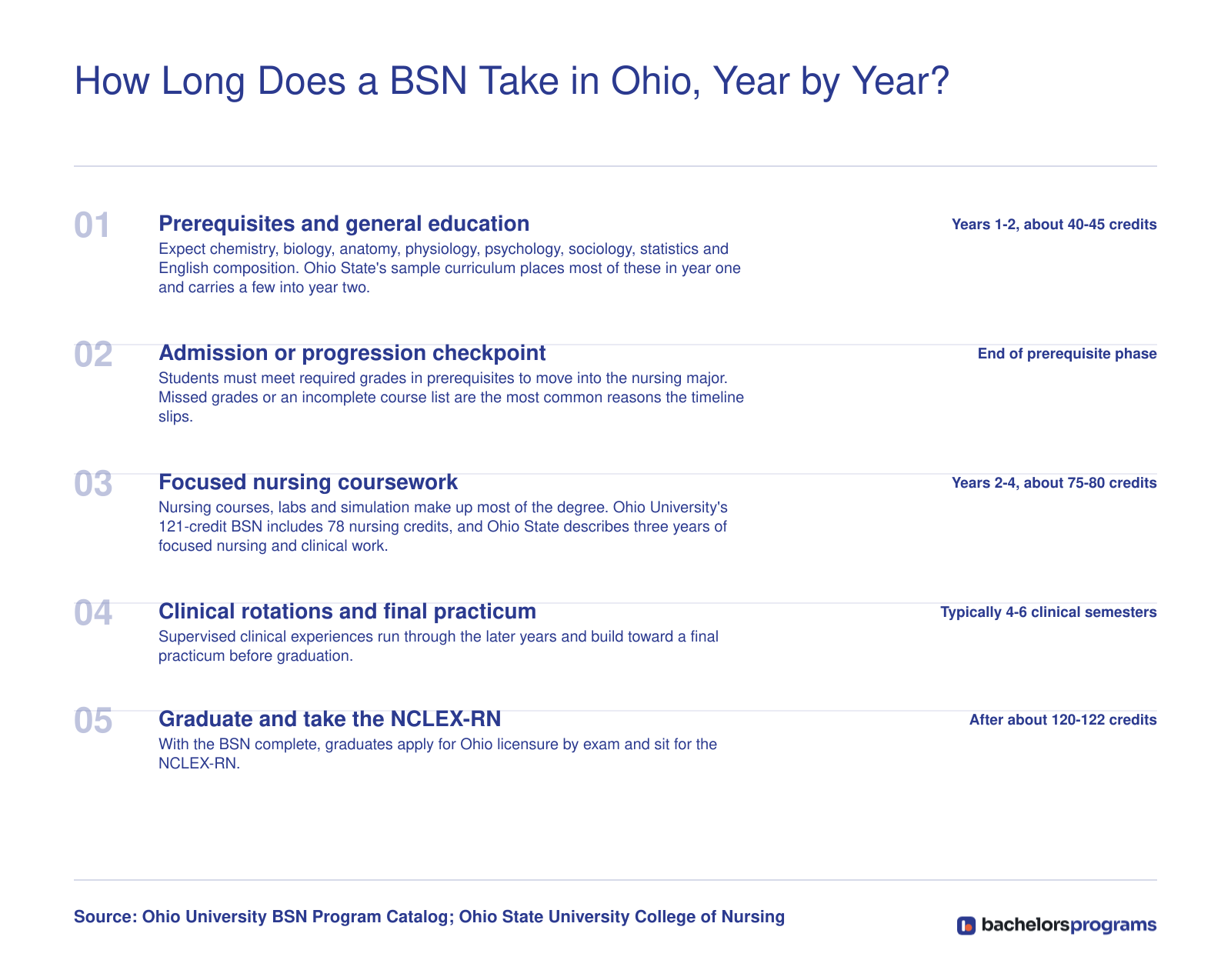
A traditional BSN in Ohio is built as a four-year, roughly 120-122 credit degree, with Ohio University listing 121 credits and Ohio State at least 122. College Credit Plus or transfer credit can shorten the pre-nursing phase by covering general education courses early. Competitive progression, or a wait for an open nursing seat at upper-division schools, can stretch it past four years.
Ohio Board of Nursing Approval, CCNE and ACEN Accreditation
The Ohio Board of Nursing's 2026 approved registered nursing program list, dated September 17, 2026, flags programs with weak NCLEX-RN results; verify a school's approval status rather than assuming it.
Board Approval Comes First
Ohio requires graduation from a Board-approved pre-licensure program before you can take the NCLEX-RN.1 Approval is a legal requirement under Ohio Administrative Code Chapter 4723-5, and programs hold full, provisional or conditional status. Among the schools here, Muskingum University, Cedarville University and The University of Findlay state that they are Board approved, and Ohio University's pre-licensure programs are too.
Accreditation Is a Separate, Voluntary Check
CCNE and ACEN accreditation is a national quality review, not a state mandate. It still matters for admission to graduate nursing study, for some employers and for certain aid. Ohio State and Ohio University hold CCNE accreditation for their baccalaureate nursing programs. Ohio University-Zanesville, Muskingum, Hiram College, Cedarville and Findlay also describe their BSN programs as CCNE accredited. For the other ranked schools, confirm current status directly with the accreditor; approval and accreditation are tracked independently.
Reading Pass Rates Correctly
The Board's benchmark looks at first-time test takers who sit the exam within six months of finishing the program.1 Repeat takers are excluded, so a program's rate can differ from broader figures. A program falls below the benchmark when its first-time rate drops under a set share of the national average for that calendar year. The consequences escalate:
- One year below: an improvement plan and annual report.
- Two consecutive years: a report evaluating that plan, plus added corrective steps.
- Three years: a Board survey visit and possible action on approval status.
- Four years: provisional approval is required.
Because one cohort can swing a result, look at multi-year patterns rather than a single year. The ranking cards above show each school's NCLEX-RN figure and the years it covers. Restoration requires meeting the benchmark for two consecutive years.
Check Before You Apply
Look up each school on the Ohio Board of Nursing's approved program list, then search the CCNE and ACEN directories for the specific BSN you plan to enter. It takes a few minutes and protects your path to licensure.
Ohio RN Licensure by Exam at a Glance
Compare Bachelor of Science in Nursing (BSN) programs on the data that matters
Explore more Nursing majors or browse every field of study.
All Nursing programs Browse every field of study