Best Accelerated BSN (ABSN) Programs in Oklahoma
Compare 4 accredited Accelerated BSN (ABSN) programs in Oklahoma, with net price after aid, graduation rates, earnings and debt from IPEDS and the U.S. College Scorecard.

Sixty prerequisite credit hours, with three of the four required sciences finished before you apply, stand between a second-degree candidate and a seat in the University of Oklahoma Health Sciences Center's accelerated BSN. Oklahoma schools compress the nursing major, not the science groundwork.
Formats vary. The University of Tulsa runs its ABSN online with a one-week on-campus skills bootcamp; Oklahoma City University and OU Health Sciences Center keep cohorts face to face.
The endpoint is identical: a Board of Nursing-approved program, the NCLEX-RN, an Oklahoma license. Prerequisite timing separates applicants who start on schedule from those who wait a year.
Key Points
- Prerequisites usually must be complete or in progress by the application deadline.
- Oklahoma Board of Nursing approval qualifies graduates to sit for the NCLEX-RN.
- Apply for Oklahoma RN licensure about two to four months before graduating.
Oklahoma's Top-Ranked Accelerated BSN Programs, School by School
Four Oklahoma institutions appear in this ranking, each built for people who already hold a bachelor's degree in another field and want an RN license without starting over. The profiles below focus on what each program asks of you in time, credits, and travel, from a 12-month campus program in Oklahoma City to an online track with clinicals placed near home.
University of Tulsa
#1Tulsa, OK · $15,000/yr (est. net price)
Best for: Online learners with nearby clinical sites
The University of Tulsa is a private university in Tulsa whose ABSN is delivered online, with a one-week skills boot camp on campus and clinical rotations arranged in the student's local region. Three cohorts start each year on eight-week terms, and the 60-credit nursing sequence can be finished in roughly 21 months. Graduates receive priority admission to the university's online MSN. Applicants must live within 90 miles of a placement area, which suits Tulsa and Oklahoma City residents but rules out much of the rest of the state.
- 60 total credit hours, with all nursing major credits completed at Tulsa
- $650 per credit, with textbooks included in tuition
- One-week on-campus skills boot camp plus 630 clinical hours
- Three start dates a year on eight-week terms
- ACEN accredited, with a 3.0 GPA minimum for admission
- Clinical placements within 90 miles of Tulsa, Oklahoma City, Dallas, Houston, or St. Louis
- Cohort model with a capstone and the Roy Adaptation Model as its framework
- Priority admission to the online MSN after graduation
Oklahoma City University
#2Oklahoma City, OK · ~$23,000/yr (est.)
Best for: Career changers ready for full-time campus study
Oklahoma City University is a private university in Oklahoma City whose Kramer School of Nursing runs a face-to-face ABSN across three semesters of eight-week blocks. Clinicals happen at major Oklahoma City hospitals, and the program holds approval from the Oklahoma Board of Nursing. Students enter as a cohort after a mandatory on-site orientation and finish with an NCLEX review built into the schedule. It is a full-time commitment of roughly 32 hours a week, with Fall and Spring entry points.
- 12 months across three semesters, with face-to-face courses in eight-week blocks
- 124 total credits, including 56 nursing credits
- Accelerated entrants need at least 68 transferable credits and an associate degree
- $41,370 total program tuition and a $55 application fee
- Fall and Spring starts, with a 3.0 GPA minimum
- Clinicals at major Oklahoma City hospitals and an NCLEX review before graduation
- Approved by the Oklahoma Board of Nursing and ACEN accredited
- Full-time pace of about 32 hours a week, plus a mandatory on-site orientation
University of Oklahoma-Health Sciences Center
#3Oklahoma City, OK
Best for: Students who prefer a summer start
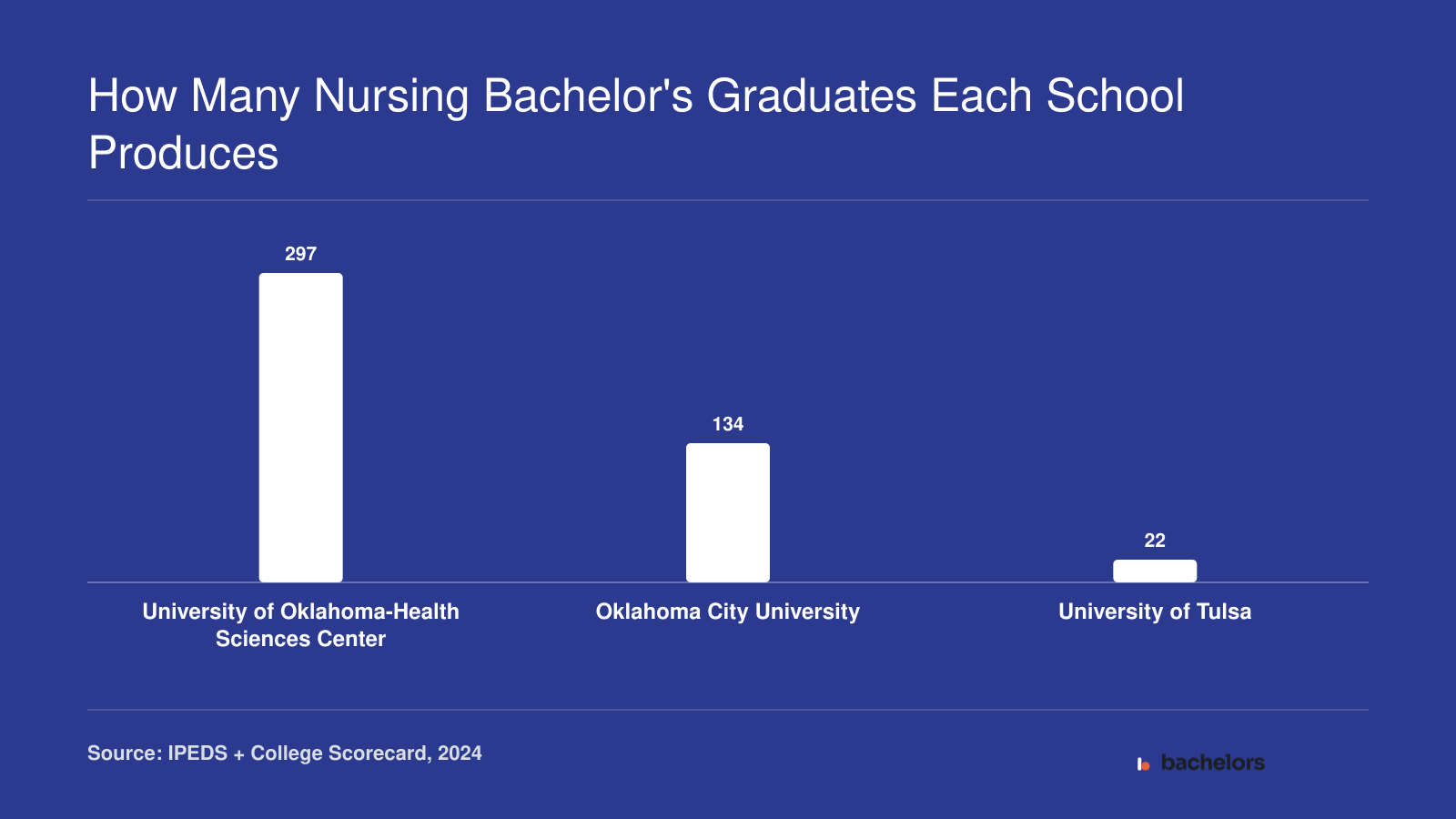
The University of Oklahoma Health Sciences Center is the university's academic medical campus in Oklahoma City, and its College of Nursing runs a 12-month ABSN at Oklahoma City and Tulsa sites in an in-person format. Students begin in summer, finish the following May, and attend full-time only, with one admission cycle each year. Admission leans on GPA in both overall and science coursework, and three of the four required sciences must be finished before applying. Its 297 nursing bachelor's completions make it the largest producer of new BSNs among the schools in this ranking.
- 12 months, running from a summer start through the following May
- 120 total credits: 60 nursing hours plus 60 prerequisite hours
- In-person at Oklahoma City and Tulsa sites, full-time only
- 2.5 cumulative and 2.5 science GPA, with no prerequisite grade below C
- Three of four sciences (chemistry, microbiology, anatomy, physiology) done before applying
- One start date a year, with applications through NursingCAS and a $60 fee
- Holds both ACEN and CCNE accreditation
- Graduates are prepared to sit for the NCLEX-RN
University of Oklahoma
#4Norman, OK · $15,000 – $20,000/yr (est.)
The University of Oklahoma's Norman campus is home to the Fran and Earl Ziegler College of Nursing, whose ABSN track is backed by academic-practice partnerships with Norman Regional Health System and Duncan Regional Hospital. The college has expanded enrollment and simulation facilities in response to Oklahoma's registered nurse shortage, and students train in simulation centers before moving into clinical settings. Because published program details are thinner for the Norman entry than for the Oklahoma City health sciences campus, applicants should confirm cohort location, length, and start terms with the College of Nursing directly.
- Apply by January 15 for the accelerated track
- State-of-the-art simulation center for experiential learning
- Clinical partnerships with Norman Regional and Duncan Regional hospitals
- Part of the Fran and Earl Ziegler College of Nursing
- Enrollment and facilities expanded to address Oklahoma's nursing shortage
Cost & outcomes by school
Federal data for the highest-earning Accelerated BSN (ABSN) programs, independent of the ranking above. Earnings are this field's bachelor's graduates four years after completing where the Scorecard reports them, else the school's undergraduate median.
| School | Net price / yr | Grad rate | Earnings | Debt | Grads/yr | Format |
|---|---|---|---|---|---|---|
| University of Oklahoma OK | $15,300 | 75% | $63,126 | $20,654 | 9,652 | Campus |
| University of Oklahoma-Health Sciences Center OK | — | — | $63,126 | $20,654 | 1,354 | Campus |
| University of Tulsa OK | $15,000 | 72% | $61,408 | $21,500 | 1,202 | Online |
| Oklahoma City University OK | $22,857 | 65% | $54,655 | $20,835 | 718 | Campus |
Sources: U.S. Department of Education. Net price, graduation rate, earnings and debt: College Scorecard (earnings and debt for this field's bachelor's graduates where reported, else school-wide); graduates: IPEDS. A dash means no figure is reported.
Cost, debt & payoff
Median earnings of this field's bachelor's graduates (4 yrs after completing, else the school's undergraduate median) vs. their median federal loan debt · U.S. College Scorecard
Across these programs the median graduate earns about $62,267 and finishes with roughly $20,745 in debt — a ratio that clears a common rule of thumb (keep debt below first-year salary). Net price and debt vary widely school to school, so check the per-school figures in the table above before you shortlist.
What Drove Our Oklahoma ABSN Rankings
The list favors schools where a career changer's money and time are most likely to turn into a nursing license and a paycheck. Five inputs from the College Scorecard shape the order: net price after aid, median federal debt, program-level earnings after completion, nursing bachelor's completions, and graduation rate across the institution.
Where the numbers fall short
Net price and graduation rate describe the whole school, not the ABSN cohort. A university's overall graduation rate says little about how a small second-degree class performs. The Scorecard's nursing figures also cover every BSN completer, including traditional four-year students, so earnings and debt for second-degree students may look different from what is shown.
Treat these figures as a guide for comparison, then confirm details with each nursing office.
Format and eligibility
Format is listed so you can compare campus-based, online, and mixed options. It does not raise or lower a school's rank. A campus program at the University of Oklahoma or Oklahoma City University stands on the same footing as the online-delivered University of Tulsa option.
Only ranked programs approved by the Oklahoma Board of Nursing appear here, so every school on the page can lead to eligibility for the NCLEX-RN.
Related Articles
Oklahoma ABSN Prerequisites and Admission Requirements, School by School
Finishing every prerequisite before you apply and finishing them while you apply are two different strategies, and most Oklahoma ABSN programs accept either. The usual expectation is that required courses are complete or in progress by the application deadline. A prior bachelor's degree opens the door, but prerequisite grades and GPA decide how competitive you are. Each entry follows the school's own admissions page; "not stated" means the page reviewed did not say.
Requirements by School
- Oklahoma City University: Accepts a bachelor's degree in any field from a regionally accredited institution, or an associate of arts or science degree in any field. Microbiology, human anatomy, and human physiology (each with lab) need a B or better. Chemistry with lab needs a C or better. Minimum cumulative GPA is 3.00. Separate science GPA: not stated. Entrance exam: none stated.
- University of Tulsa: Requires a bachelor's degree from a regionally accredited institution. Prerequisites need a C or better, but the page reviewed does not list the courses, so confirm the current list with the program. Minimum cumulative GPA is 3.0. Separate science GPA: not stated. Entrance exam: none stated.
- University of Oklahoma-Health Sciences Center: Prior-degree rule, prerequisite courses, GPA floor, science GPA, and exam policy: not stated in the material reviewed. Check the nursing admissions page directly.
- University of Oklahoma (Norman): Same: not stated in the material reviewed. Confirm all requirements on the university's admissions page.
Grades and Recency Limits
Minimum grades are the clearest filter here. Oklahoma City University holds its anatomy, physiology, and microbiology courses to a B, while Tulsa sets a C floor. Neither page reviewed states a recency window. Many nursing programs do cap how old science credits can be, so if your anatomy or microbiology class is several years old, ask admissions whether it still counts before you pay to retake it.
Policy on entrance exams is also worth confirming. Neither Oklahoma City University nor Tulsa states a TEAS or HESI A2 requirement on the pages reviewed, but that can change by application cycle.
Start Dates, Application Deadlines, and Out-of-State Clinical Travel
The core tradeoff here is speed versus readiness. Aiming for the earliest available cohort shortens your route to an RN license, but applying before your prerequisites are finished can leave you with a conditional offer or a rejection. Accelerated BSN programs generally run in fixed cohorts, so each school's calendar sets the pace for everyone who enters with you.
Timing Your Application
Before you commit, confirm these details directly with the admissions offices at the University of Tulsa, Oklahoma City University, the University of Oklahoma-Health Sciences Center, and the University of Oklahoma:
- Start terms: Whether the ABSN admits once a year or more often, and which term the next cohort begins.
- Deadlines: The application cutoff for that cohort, and whether files are reviewed on a rolling basis.
- Cohort size and waitlists: How many seats each cycle fills, and whether qualified applicants who miss out roll forward to the next start.
- Prerequisite cutoffs: The date by which every science course must be completed or in progress.
These dates change from year to year. Treat any calendar from a prior cycle as a rough guide only.
Planning for Travel and Clinical Time
Ask each program whether any part of the curriculum requires travel beyond the home campus, such as a skills immersion, an orientation week, or a simulation block. A week away can mean lost wages, lodging, and transportation costs on top of tuition. Also ask where clinical rotations are placed. Sites spread across a metro area or in surrounding towns can add significant commuting time to already long clinical days.
Apply Early If Prerequisites Remain
If you still need to finish anatomy, physiology, microbiology, or chemistry, plan to apply one to two admission cycles ahead. That buffer keeps a single low grade or a full course section from pushing your start back by a year.
How Many Nursing Bachelor's Graduates Each School Produces
These counts cover every bachelor's-level nursing completer in the federal snapshot, not only accelerated BSN students, so read them as a measure of each school's overall nursing program size. Size matters for ABSN students: larger programs tend to have wider clinical placement networks, deeper faculty benches, and steadier cohorts from one start date to the next.
Accelerated BSN Pace and Cost in Oklahoma: Tuition, Fees, and Aid
Public in-state pricing and private pricing sit far apart here, and the way each school reports its figure matters as much as the number. Check what each figure includes before you compare totals.
Pace: 12 to 21 Months Is a Target, Not a Rule
Expect full-time, year-round study that leaves little time for a job. Oklahoma City University runs a 12-month, three-semester ABSN. The University of Oklahoma Health Sciences Center lists a 14-month, 60-credit format. The University of Tulsa's online ABSN is longer at 21 months, with 60 credits and 630 clinical hours.
What the Published Prices Cover
- Oklahoma City University: $41,370 total program tuition, which is not all-inclusive. A separate 2025-26 estimate shows $17,500 tuition, $6,105 general fees, $3,515 nursing fees and $14,202 for housing and food, for $41,322 billable. Discretionary costs push that to $51,305.
- University of Oklahoma: $190.20 per credit for residents and $800.95 for nonresidents (2025-26). Fees vary by hours and courses, so a single resident total is not published here. Confirm against the official fee schedule.
- University of Tulsa: $625 per credit for Fall 2025 and later, up from $499 before. That is tuition only; fees are extra.
Institution-wide average net price after aid, which is not an ABSN quote, runs about $15,000 at Tulsa, $15,300 at OU and $22,857 at OCU. Median debt for nursing bachelor's graduates is about $27,000 at Tulsa (roughly $286 a month), $16,915 at OU ($179) and $13,986 at OCU ($148). These cover nursing bachelor's graduates generally, so treat them as context.
Aid for Second-Degree Students
Federal Direct Loans are generally available through the FAFSA, subject to annual and aggregate limits and any earlier borrowing. Pell Grants are rarely an option once you hold a bachelor's degree. The most reliable discounts are school scholarships. OCU lists $17,250 for transfer GPAs of 3.6 or higher and $13,500 for 3.3 to 3.59, which brings its program cost to $24,120 and $27,870. Whether these combine with other aid is not established.
The federal Nurse Corps Scholarship and Loan Repayment programs each require at least two years of service, and repayment can cover up to 85% of loans. Public Service Loan Forgiveness requires 120 qualifying payments. Oklahoma's Nurses Scholarship may be limited to RN-to-BSN students, and hospital tuition sponsorship often requires a two- to three-year work commitment. Confirm ABSN eligibility with each school's financial aid office.
The Payoff: Registered Nurse Pay in Oklahoma
Once you pass the NCLEX-RN and earn your Oklahoma license, here is what registered nurses across the state typically earn.
Oklahoma Board of Nursing Approval, CCNE Accreditation, and NCLEX-RN Results for ABSN Schools
State approval gets you to the licensing exam, but national accreditation decides how far the degree travels afterward. Treat them as two separate checks.
Two Different Credentials
Oklahoma Oklahoma Board of Nursing approval makes graduates eligible to take the NCLEX-RN in the state. CCNE or ACEN accreditation is voluntary and national. It matters when you apply to graduate nursing programs, when a school's financial aid standing is reviewed, and when some employers screen candidates. An ABSN that has only one of the two can still leave you short later.
Status of the Ranked Programs
The Board's 2025 first-time NCLEX-RN report lists Oklahoma City University, the University of Oklahoma (Oklahoma City), and the University of Tulsa, which shows all three are Board-recognized Oklahoma programs.1 The report does not give a separate approval line for each accelerated track, so confirm the ABSN itself with the school. OCU's nursing program is accredited by ACEN. Accreditation details for Tulsa and the two University of Oklahoma programs (Health Sciences Center and Norman) were not established in the data reviewed, so check each school's nursing page for its CCNE or ACEN status. Any out-of-state online program that places you in Oklahoma clinicals must get approval from the Board for those placements, so ask for that in writing.
NCLEX-RN Results in Context
OCU's first-time pass rate was 81.31% in calendar year 2025, with 107 candidates, per the Oklahoma Board of Nursing.1 That figure comes from the Board's program-level report, which does not separate ABSN students from the school's other nursing graduates.1 Read it as a whole-program result, not an accelerated-cohort result. For Tulsa and the University of Oklahoma, the data reviewed did not support a clean 2025 rate, so ask admissions for the latest Board-reported figure and its year.
Verify Before You Apply
- Check the Board list: Find the school on the Oklahoma Board of Nursing's approved-programs list and note its listed status.
- Check the accreditor: Search the accreditor's own directory for the school.
- Ask about the track: Request pass rates for the ABSN cohort, with the reporting year.
Becoming an RN Through the Oklahoma Board of Nursing
Accelerated Nursing in Oklahoma: Answers to Common Questions
These answers cover the questions second-degree students ask most about ABSN programs in Oklahoma. Details come from each school's published program information and can change by cohort, so confirm specifics with admissions before you apply.
How many accelerated BSN programs does Oklahoma have?
How many months does an accelerated nursing program in Oklahoma take?
Can I finish an ABSN in Oklahoma in 12 months?
How much does an accelerated BSN cost in Oklahoma?
Is there an online accelerated BSN option for Oklahoma residents?
Does the Oklahoma Board of Nursing approve these second-degree nursing programs?
Can an associate degree substitute for the prior bachelor's?
Is it realistic to hold a job during an Oklahoma ABSN?
Compare Accelerated BSN (ABSN) programs on the data that matters
Explore more Nursing majors or browse every field of study.
All Nursing programs Browse every field of study