Best Accelerated BSN (ABSN) Programs in Pennsylvania
Compare 33 accredited Accelerated BSN (ABSN) programs in Pennsylvania at 31 colleges, with net price after aid, graduation rates, earnings and debt from IPEDS and the U.S. College Scorecard.
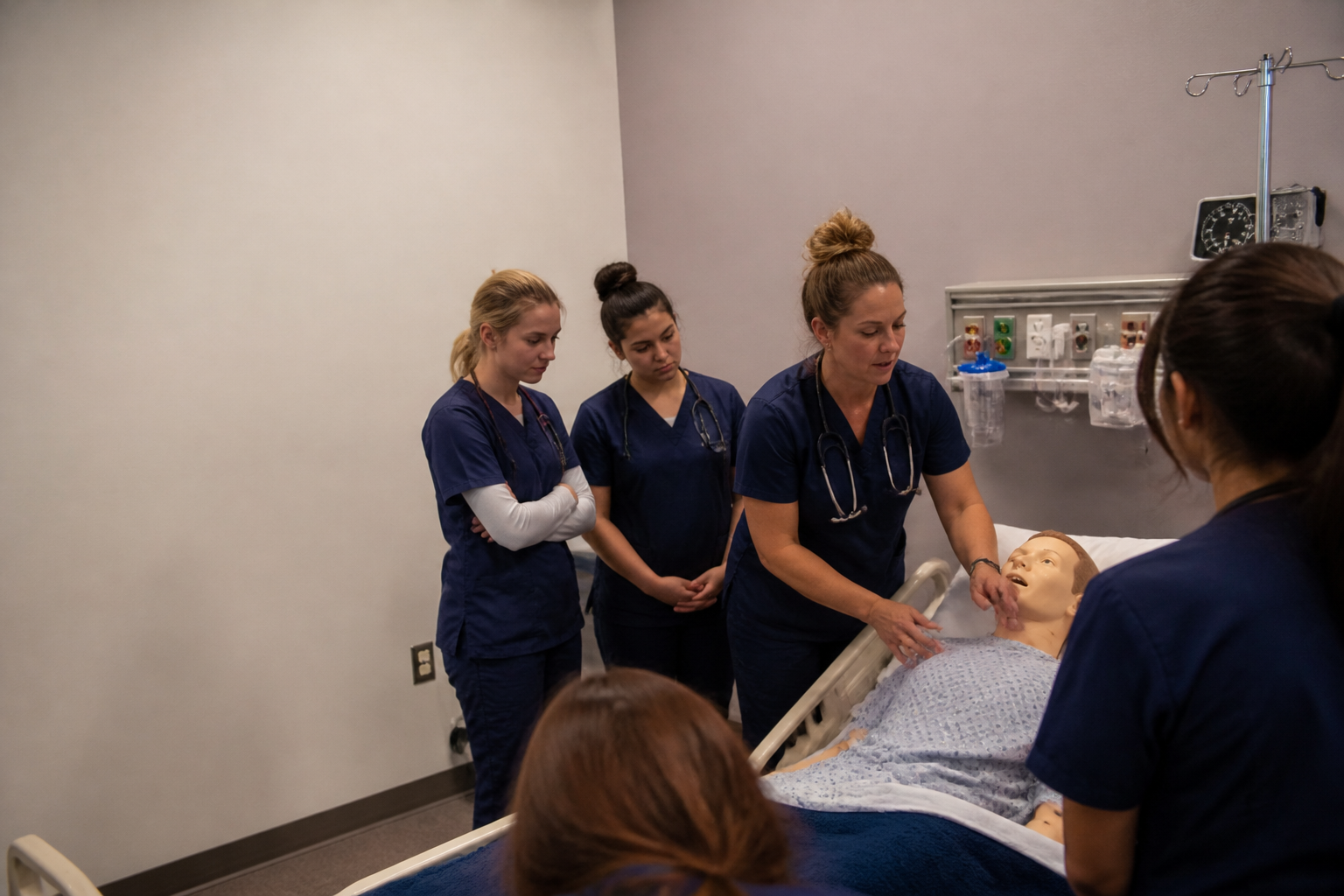
Second-degree nursing now runs as its own admissions track in Pennsylvania, separate from the traditional four-year BSN. A graduate with a bachelor's in business, psychology or biology can skip repeated general education and move straight into nursing coursework. Full-time accelerated BSN study typically takes 12 to 18 months, followed by the NCLEX-RN.
The ranked programs span Philadelphia-area campuses, Pittsburgh and schools elsewhere in the state.
The tradeoff comes at the front end. Science prerequisites must be finished first, many programs expect a GPA near 3.0, and cohorts usually start only once or twice a year. Once classes begin, there is little time left for a job.
Key Points
- Holy Family University's average net price is $13,143 a year after aid.
- Applicants need a non-nursing bachelor's, science prerequisites and about a 3.0 GPA.
- New graduates apply through Pennsylvania's online PALS system, then take the NCLEX-RN.
10 Best Accelerated BSN Schools in Pennsylvania, Ranked
Twenty-nine Pennsylvania institutions offer an accelerated route to a nursing degree, and ten of them stand out once cost after aid, on-time completion and graduate outcomes are read together. Each entry below notes the city, how the program is delivered, what students actually pay after aid, and how the school as a whole fares on graduation. Philadelphia-area readers will find several options clustered in the city itself.
University of Pittsburgh-Pittsburgh
#1Pittsburgh, PA · ~$30,000/yr (est.)
Best for: Career changers wanting big health-system access
The University of Pittsburgh runs its accelerated second-degree BSN on the Oakland campus, drawing on a large academic health system for clinical placements across adult, psychiatric, maternal-child, pediatric and community settings. The program is full-time and in person across three consecutive semesters, with 810 clinical hours and a three-day NCLEX review built in. Pitt reports that clinical sites may sit in Pittsburgh suburbs and that students arrange their own transportation. A guaranteed Conway scholarship accompanies admission.
- One-year, three-semester format with 122 total credit hours
- 810 clinical hours spanning five nursing specialties
- Fall and spring start dates, about 30 students per term
- 36 prerequisite credits required before entry
- Three-day NCLEX-RN review course included
- Guaranteed Conway scholarship for admitted students
Villanova University
#2Villanova, PA · $40,000 – $45,000/yr (est.)
Best for: Students at affiliated liberal arts colleges
Villanova's second-degree BSN sits inside a suburban Philadelphia campus with a close-knit cohort model and faculty willing to bring students into research. The program splits into a 14-month Express Track and a 23-month Flex Track, so the same curriculum can be run full-time or part-time. Villanova holds affiliation agreements with Arcadia, Bucknell, Franklin & Marshall, Gettysburg, Muhlenberg, Saint Joseph's, Shippensburg, Susquehanna and Ursinus, which can streamline admission and waive the application fee. Alumni work at the Hospital of the University of Pennsylvania and Children's Hospital of Philadelphia.
- Express Track finishes in 14 months; Flex Track in 23
- Full-time and part-time enrollment options
- Two concentration options within the BSN
- Affiliation agreements with nine regional colleges
- Application fee waiver for information session attendees
- On-campus simulation center tours available
Duquesne University
#3Pittsburgh, PA · $35,000 – $40,000/yr (est.)
Best for: Career changers wanting clinicals in week one
Duquesne's Pittsburgh campus program starts clinical work in the first week, which appeals to career changers who want hands-on exposure early rather than a long classroom runway. Students choose a 12-month or 16-month full-time track totaling 67 credit hours, with daytime classes and clinicals and preparation for the NCLEX-RN beginning in the first semester. The Learning and Simulation Center, assigned faculty mentors, tutors and academic advisors support a cohort that moves through together, and dedicated on-campus housing is available.
- 12-month or 16-month full-time track, 67 credit hours
- Clinical foundation begins in the first week
- NCLEX-RN preparation begins in the first semester
- Dedicated on-campus housing offered to students
- Faculty mentor, tutors and academic advisor assigned
- Single fall start date each year
Temple University
#4Philadelphia, PA · $23,000 – $39,000/yr (est.)
Temple's accelerated BSN is built for non-nursing bachelor's degree holders and runs 16 months on the Main Campus in Philadelphia, covering 121 credit hours and 973 clinical hours. Clinical partners include Children's Hospital of Philadelphia and Fox Chase Cancer Center, and the Interprofessional Simulation Center in Paley Hall handles lab and scenario work. Admission requires a 3.0 GPA and seven prerequisite science and psychology courses, with no entrance exam, and applications close March 1 for a fall start. A per-semester nursing program fee applies on top of tuition.
- 16-month program, 121 credit hours, fall start
- 973 clinical hours including CHOP and Fox Chase placements
- 3.0 GPA minimum and seven prerequisite courses
- No entrance exam required
- March 1 application deadline each year
- $1,500 nursing program fee per semester
West Chester University of Pennsylvania
#5West Chester, PA · $20,000 – $25,000/yr (est.)
West Chester pairs the BSN with a master's, letting second-degree students earn both credentials in one 24-month cohort rather than returning for a graduate degree later. Undergraduate courses meet in person at the Sciences and Engineering Center & Commons, while master's coursework is fully online or hybrid and clinical placements stay in person. Every course requires a C or better, and the program reports a 97% retention rate and a 95%+ NCLEX pass rate. Graduate assistantships, payment plans and employer tuition reimbursement are all in play, which suits working adults.
- 24-month cohort earning BSN and MSN concurrently
- 58 total credit hours; C or better in every course
- Undergraduate classes in person, master's courses online or hybrid
- 97% retention rate and 95%+ NCLEX pass rate reported
- Employer tuition reimbursement and payment plans supported
- Individual practicum with a preceptor plus group clinicals
Saint Francis University
#6Loretto, PA · $24,000/yr (est. net price)
Saint Francis runs an 18-month second-degree BSN on its small Loretto campus, with clinical groups held to a 1:8 faculty ratio and simulation suites handling skills practice before hospital rotations. The curriculum draws on the AACN Essentials and embeds Franciscan values alongside a liberal arts base. Rolling admissions and up to 68 accepted transfer credits shorten the runway for students who arrive with science coursework already done, and a UPMC partnership scholarship carries a guaranteed job offer.
- 18-month program, 60 credit hours, rolling admissions
- 1:8 faculty-to-student ratio in clinical groups
- Up to 68 transfer credits accepted
- AACN Essentials-based curriculum with Franciscan values
- UPMC partnership scholarship with guaranteed job offer
- 3.0 GPA minimum for admission
Immaculata University
#7Immaculata, PA · ~$24,000/yr (est.)
Immaculata's accelerated second-degree BSN is a 15-month, 55-credit program on a suburban Philadelphia-area campus, with a spring start and one cohort per year. Prerequisite courses are discounted for admitted students, and clinical partnerships with major health systems open loan repayment of up to $40,000. A personal NCLEX success coach and new simulation labs support students through the licensure exam, and the program feeds directly into the university's MSN. It carries a 30-year history of nursing education.
- 15-month, 55-credit program with a spring start
- Total program tuition of $36,975
- Prerequisite courses discounted to $250 per credit
- Loan repayment up to $40,000 through clinical partners
- Personal NCLEX success coach assigned to each student
- Seamless transition into the M.S.N. program
Drexel University
#8Philadelphia, PA · $39,000/yr (est. net price)
Drexel's Accelerated Career Entry program compresses the BSN into 11 months across four consecutive 10-week terms, one of the shortest routes in the state. Students work in simulation spaces in the Health Sciences Building in Philadelphia and can start in September or March under rolling admissions, with deadlines of July 15 for fall and January 15 for spring. Federal loans and scholarships are available, and a clinical training component is offered to international students. A 3.0 GPA minimum applies.
- 11-month program across four 10-week terms
- Fall (September) and spring (March) starts with rolling admissions
- July 15 fall deadline and January 15 spring deadline
- Total program tuition of $54,912
- 3.0 GPA minimum and prerequisites required
- Clinical training component available for international students
Thomas Jefferson University
#9Philadelphia, PA · ~$29,000/yr (est.)
Jefferson's Accelerated BSN Plus awards nine graduate credits alongside the BSN in 12 months, with guaranteed admission to any MSN or DNP specialty except nurse anesthesia for up to two years after graduation. Students train in simulation labs and at Jefferson Health hospitals, and can take a global clinical capstone through a partnership with Gemelli Hospital in Rome. The program runs on the Center City Philadelphia and Horsham campuses, full-time, with a capstone required for completion.
- 12-month program, 60 credit hours, full-time
- Includes 9 graduate credits toward an MSN or DNP
- Guaranteed MSN/DNP admission for up to two years after the BSN
- Global clinical capstone option with Gemelli Hospital in Rome
- Simulation-based clinical training plus Jefferson Health rotations
- Center City Philadelphia and Horsham campuses
Slippery Rock University of Pennsylvania
#10Slippery Rock, PA · ~$20,000/yr (est.)
Slippery Rock's 1+2+1 nursing pathway gives students from AHN, BC3 and CCBC a hybrid accelerated route to the BSN, blending science and nursing fundamentals with clinical decision-making coursework. Faculty who still practice bring current bedside experience into the classroom, and the curriculum emphasizes leadership, community health and evidence-based care. Graduates move into roles such as nurse manager, public health nurse or critical care and oncology positions, and the degree prepares students for graduate work toward nurse practitioner, clinical nurse specialist or nurse educator careers. A 3.6 GPA minimum applies to this pathway.
- 1+2+1 pathway for students from AHN, BC3 and CCBC
- Hybrid delivery mixing in-person and online coursework
- 3.6 GPA minimum for the accelerated pathway
- Coursework in leadership, community health and clinical decision-making
- Prepares graduates for nurse manager and public health roles
- Foundation for nurse practitioner or nurse educator graduate study
Cost & outcomes by school
Federal data for the highest-earning Accelerated BSN (ABSN) programs, independent of the ranking above. Earnings are this field's bachelor's graduates four years after completing where the Scorecard reports them, else the school's undergraduate median.
| School | Net price / yr | Grad rate | Earnings | Debt | Grads/yr | Format |
|---|---|---|---|---|---|---|
| Villanova University PA | $43,756 | 92% | $100,423 | $25,874 | 4,434 | Campus |
| Drexel University PA | $38,509 | 78% | $84,648 | $25,325 | 6,122 | Campus |
| Thomas Jefferson University PA | $28,928 | 69% | $77,449 | $14,744 | 2,132 | Campus |
| Immaculata University PA | $24,258 | 71% | $75,701 | $27,000 | 690 | Campus |
| Duquesne University PA | $37,730 | 78% | $74,742 | $26,244 | 2,802 | Campus |
| Widener University PA | $25,759 | 68% | $70,920 | $27,000 | 1,126 | Campus |
| La Salle University PA | $19,409 | 57% | $67,416 | $25,000 | 888 | Online |
| Gwynedd Mercy University PA | $27,483 | 57% | $67,145 | $25,000 | 584 | Hybrid |
| University of Pittsburgh-Pittsburgh PA | $30,434 | 86% | $66,125 | $24,250 | 12,228 | Campus |
| Misericordia University PA | $37,485 | 72% | $64,313 | $26,973 | 762 | Hybrid |
| Temple University PA | $28,198 | 75% | $63,727 | $24,395 | 10,188 | Campus |
| Wilkes University PA | $27,743 | 63% | $63,454 | $26,000 | 966 | Hybrid |
Sources: U.S. Department of Education. Net price, graduation rate, earnings and debt: College Scorecard (earnings and debt for this field's bachelor's graduates where reported, else school-wide); graduates: IPEDS. A dash means no figure is reported.
Cost, debt & payoff
Median earnings of this field's bachelor's graduates (4 yrs after completing, else the school's undergraduate median) vs. their median federal loan debt · U.S. College Scorecard
Across these programs the median graduate earns about $62,235 and finishes with roughly $25,874 in debt — a ratio that clears a common rule of thumb (keep debt below first-year salary). Net price and debt vary widely school to school, so check the per-school figures in the table above before you shortlist.
Cheapest Accelerated BSN Programs in Pennsylvania
Every school with the lowest average net price here is a private nonprofit. Holy Family University leads at $13,143 a year after grants and scholarships, against published tuition and fees of $35,330, based on 2024 IPEDS and College Scorecard data from the U.S. Department of Education. Because this group is entirely private, the private-sector average net price is the fair figure to compare, and published tuition shows the sticker price before aid. These are institution-wide annual averages, not the price of the ABSN track itself, so program tuition, fees, uniforms, background checks and NCLEX prep will add to your total. The Waynesburg and La Salle programs are designed for licensed RNs, and the pace and cost section below covers program-specific tuition and aid.
| Rank | School | City | Sector | Program | Format | Average Net Price (after aid) | Published Tuition and Fees | Program Length |
|---|---|---|---|---|---|---|---|---|
| 1 | Holy Family University | Philadelphia | Private nonprofit | Second Degree BSN Daytime 14-Month | Campus | $13,143 | $35,330 | 14 months |
| 2 | Waynesburg University | Waynesburg | Private nonprofit | Accelerated BSN as a Second-Degree Program for RNs | Online | $18,235 | $30,480 | 12 to 16 months |
| 3 | York College of Pennsylvania | York | Private nonprofit | Accelerated Bachelor of Science in Nursing | Campus | $18,556 | $25,588 | 17 months |
| 4 | Cedar Crest College | Allentown | Private nonprofit | Accelerated BSN | Campus | $18,659 | $46,314 | 15 months |
| 5 | La Salle University | Philadelphia | Private nonprofit | Nursing, BSN - Accelerated RN to BSN Online | Online | $19,409 | $37,800 | N/A |
Related Articles
ABSN Admissions in Pennsylvania: Prior Bachelor's, Science Prerequisites, GPA and Test Policy
What do you need in hand before you can apply to an accelerated BSN in Pennsylvania? A finished bachelor's degree outside nursing, a block of science prerequisites, and a GPA around 3.0. Drexel, Temple and Villanova publish the most detailed rules, so their policies serve as the benchmark.
The Prior Bachelor's Baseline
Drexel's ACE BSN requires a bachelor's degree. Temple's Accelerated BSN is limited to holders of a non-nursing bachelor's.1 Villanova's Second Degree Accelerated BSN is built for graduates with a bachelor's in another discipline.2 Treat a completed degree as the entry ticket.
Prerequisites and Recency Limits
The usual list includes anatomy and physiology I and II with labs, microbiology with lab, chemistry, statistics, nutrition and developmental psychology.
- Drexel: Adds English composition. At least three of the four science prerequisites, including the A&P sequence, must be finished at application. Anatomy, physiology and microbiology must fall within five years before enrollment. Applications are due July 15 for fall and January 15 for spring, with prerequisites finished by August 15 and February 15.
- Temple: Lists chemistry, A&P, general biology, microbiology, general psychology and developmental psychology. Courses must come from regionally accredited schools and fall within 10 years.1 Five of eight are due at application and the rest by June 15. Pass/credit grades are not accepted.
- Villanova: Lists A&P, chemistry and microbiology with labs, plus theology or religious studies.2 Confirm grade minimums and recency limits with the school.
GPA Expectations
Temple states a 3.0 cumulative GPA and a C or better in each prerequisite, with no separate science GPA.1 Villanova says applicants should have a 3.0 or higher to be considered, and it looks closely at science grades.2 Drexel describes a 3.0 overall and last-60-credit GPA, with B or better in prerequisites, as the profile of its most competitive applicants rather than a hard cutoff. In practice, Drexel's grade bar is the steeper one, while Temple's C floor leaves more room for a weaker early science grade.
Entrance Exam Policy
None of these three admissions pages calls for the TEAS or HESI A2, which spares you a separate study cycle. Drexel does ask non-native English speakers for a passing TOEFL iBT or IELTS score, valid for up to two years. For any other school, check its admissions page before you assume the test is waived.
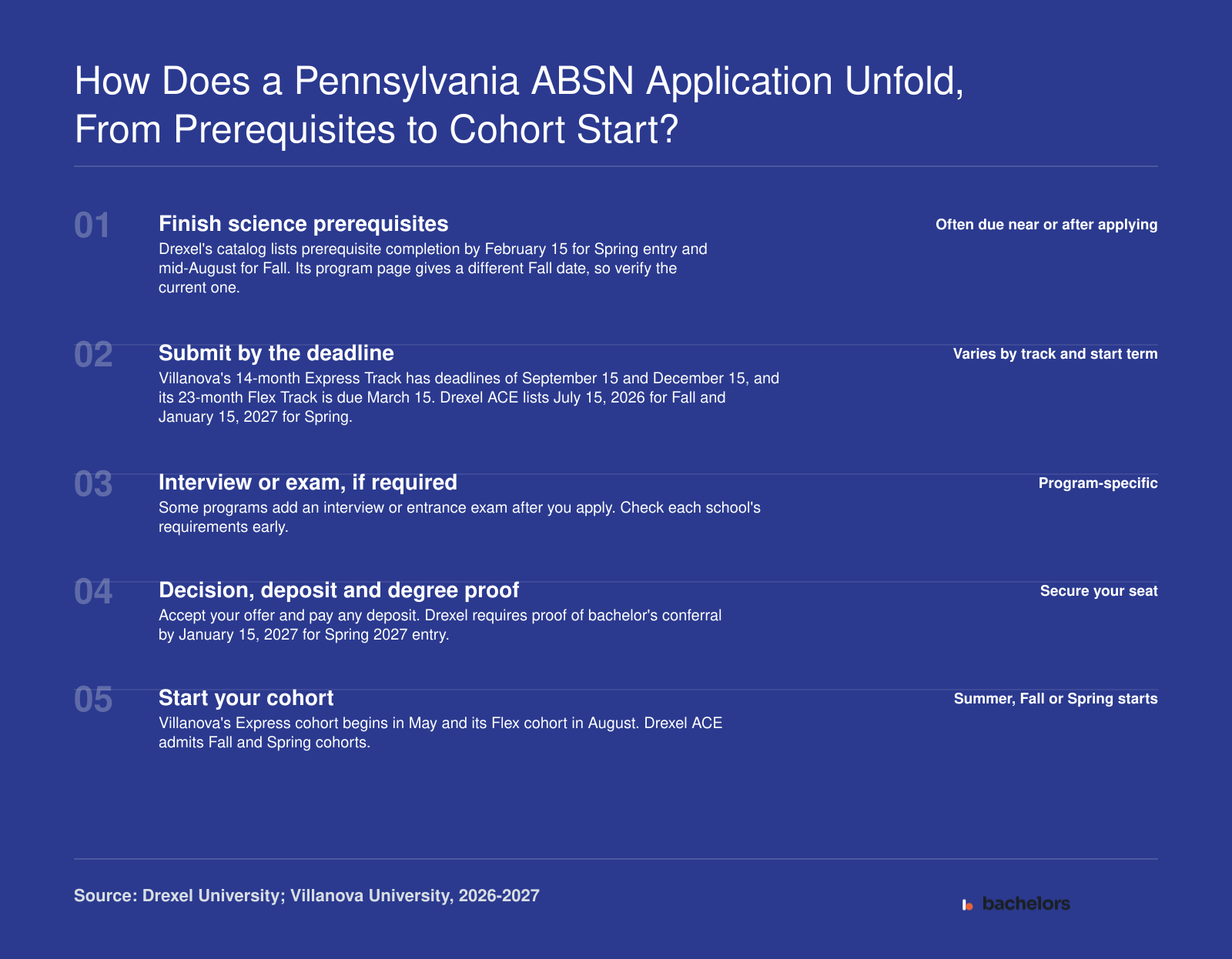
How Does a Pennsylvania ABSN Application Unfold, From Prerequisites to Cohort Start?
Most Pennsylvania ABSN applications follow the same arc, but each school sets its own dates. The windows below come from Drexel and Villanova for the 2026-2027 cycle. Deadlines shift every year, so confirm them on each program's admissions page before you plan.
Questions to Ask Yourself
Are your anatomy, physiology and microbiology credits recent enough to count, or will you need to retake them before the application deadline?
Could you give up a paycheck for 12 to 18 months of full-time classes and clinicals?
Is a clinical placement in Philadelphia, Pittsburgh or another hospital hub realistic from where you live?
Would you pay private-school tuition to start sooner, or wait for a lower-cost public cohort?
ABSN Pace and Cost: How 12- to 18-Month Programs Fit Your Budget
An accelerated BSN compresses the calendar, not the curriculum, and the price tag rarely shrinks along with the timeline. Pennsylvania's second-degree tracks run from under a year to roughly two, and the fastest options are often the most expensive per month of study.
The fastest tracks in the state
Drexel's Accelerated Career Entry program is the quickest route here: 11 months across four consecutive 10-week terms. Villanova's Second Degree Accelerated BSN Express track finishes in 14 months over four semesters1, and Holy Family's daytime Second Degree BSN also runs 14 months. If you need breathing room, both schools publish longer versions of the same degree: Villanova's Flex track spans 23 months over six semesters, and Holy Family runs an evenings-and-weekends option across 22 months.
What the workload actually looks like
Year-round study is the rule, not the exception. Villanova's Express curriculum builds to terms of 18 and 19 credits, and that load sits alongside skills labs, simulation sessions, and clinical rotations scheduled around hospital staffing rather than your preferences. Expect 12-hour shifts, weekend placements, and occasional overnights. Plan to treat the program as your job rather than something you fit around one.
Comparing published prices
Private ABSN tuition in Pennsylvania clusters in the high $40,000s to mid $50,000s:
- Villanova: $55,620 total, billed as $13,905 per semester on the Express track or $9,270 per semester on the Flex track for 2026 cohorts.2
- Drexel: $13,728 per term, roughly $54,912 for the program in 2026-2027, plus a $4,036 program fee in the first term and $50 in each term after.
- DeSales: $48,800 for 2025-2026, paid in four installments of $12,200 that cover nursing coursework, fees, standardized testing, and NCLEX-RN review.
State-owned and state-related schools, including Pitt, Temple, West Chester, and Slippery Rock, price nursing credits separately for residents, so pull each school's current rate sheet before comparing.
Funding a second degree
A federal Pell Grant is generally closed to anyone who already has a bachelor's degree, leaving Direct unsubsidized loans as the federal backbone. Institutional aid matters more here: DeSales lists the Dr. Caroline Hollshwandner and Stabler scholarships at up to $5,000 each, plus health care partners offering up to $65,000 in loan repayment for a three-year work commitment. The affordability table above shows sticker prices; average net price is what families typically pay after aid.
Online Accelerated BSN Programs in Pennsylvania: What's Hybrid and What's Hands-on
Hybrid delivery has changed accelerated nursing, but in Pennsylvania it stops at the lab door. No ABSN in the state is fully online, because simulation, skills labs and clinical rotations all happen in person.
Which Programs Are Hybrid
Hybrid programs move lectures online and keep hands-on work on site. Misericordia (Dallas) delivers lectures online, with labs and clinicals mostly on weekends. Wilkes pairs online coursework with a required two-week residency. Waynesburg blends online didactic courses with campus labs. Cedar Crest offers selected didactic courses online, but its health assessment lab is face-to-face. King's College lists a hybrid ABSN as well.
Campus-based options include Pitt, Villanova, Duquesne, Temple, Saint Francis, Immaculata, Drexel, Jefferson and York.
Prerequisites Online
Many career changers finish prerequisites at community colleges, often online. The catch is labs. Wilkes asks for anatomy and physiology, chemistry and microbiology with labs, and Pitt requires lab-based science as well. Before paying for an online lab science course, ask the admissions office in writing whether that format will be accepted.
Where Clinicals Happen
Clinical sites cluster around each school's region. Pitt places students in the Pittsburgh area and expects them to arrange their own transportation. Temple's sites include CHOP and Fox Chase Cancer Center in Philadelphia. Misericordia places students within 60 miles, and Wilkes uses northeastern Pennsylvania or the Lehigh Valley.
Ask each school whether it assigns placements or expects you to find your own, and how far you may be asked to travel. A hybrid format can save commuting for lectures, but plan for real travel during clinical weeks.
Pennsylvania RN Licensure Essentials for New ABSN Graduates
Quick Answers for Career Changers Eyeing a Pennsylvania ABSN
Three questions come up most often from career changers weighing a Pennsylvania accelerated BSN. Each answer reflects Pennsylvania's current licensing rules and the way these programs are built.
Can I start a Pennsylvania ABSN without finishing a first bachelor's degree?
Will a nursing license earned after a Pennsylvania ABSN let me work in other states?
Is it realistic to hold a job during a 12- to 18-month Pennsylvania ABSN?
Compare Accelerated BSN (ABSN) programs on the data that matters
Explore more Nursing majors or browse every field of study.
All Nursing programs Browse every field of study