Best BSN Programs in Pennsylvania
Compare 93 accredited Bachelor of Science in Nursing (BSN) programs in Pennsylvania at 68 colleges, with net price after aid, graduation rates, earnings and debt from IPEDS and the U.S. College Scorecard.
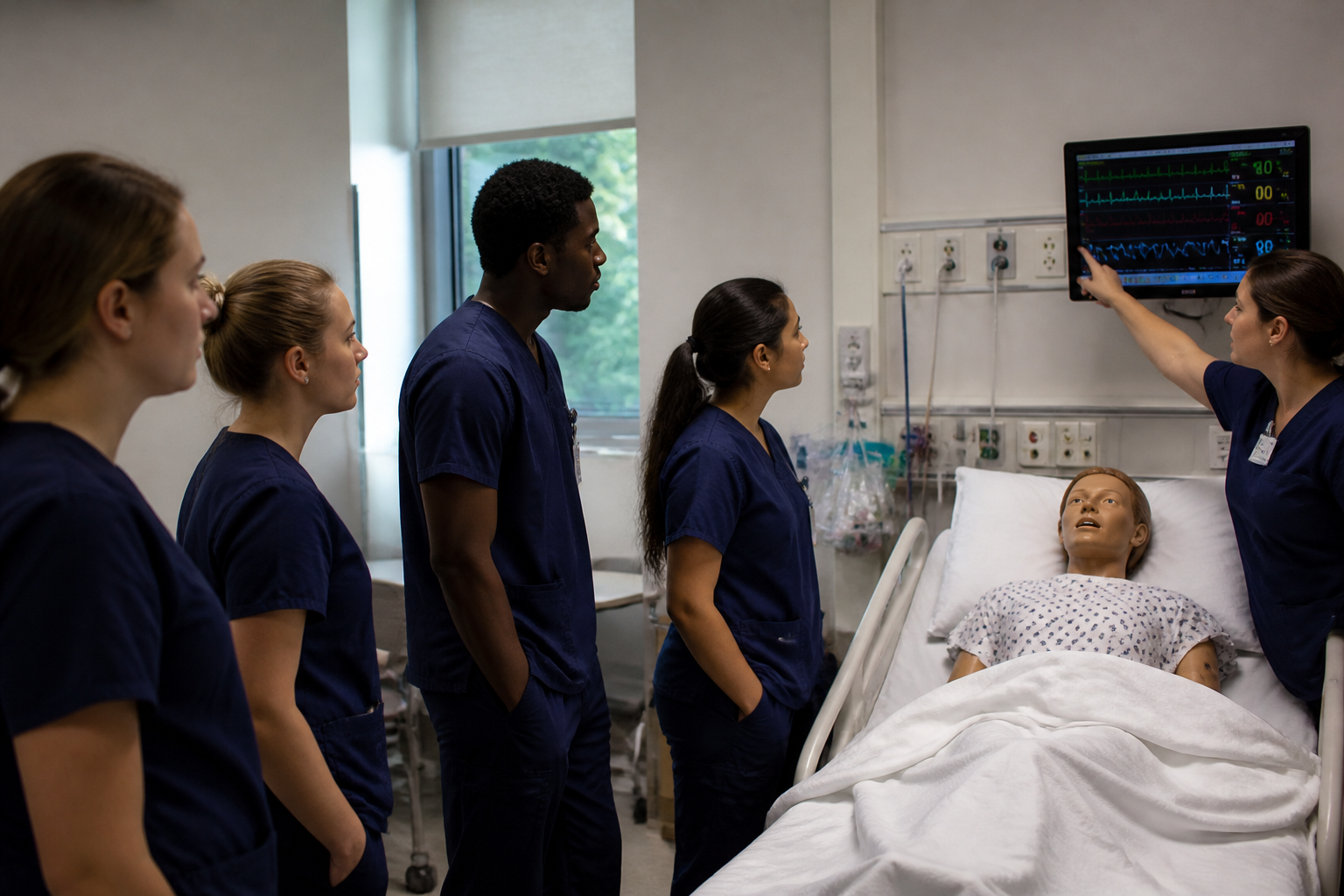
A large cohort and a small one can both post strong NCLEX-RN results, but they are different bets. Duquesne University reports a 96.7% pass rate across 711 candidates, while Cedar Crest College reports 99.4% across 212.
The schools ranked here are traditional prelicensure BSN programs, ordered mainly by first-time NCLEX-RN pass rates. RN-to-BSN completion and accelerated second-degree tracks have their own pages.
Price complicates the comparison. Net cost differs widely across Pennsylvania, and a top pass rate at a high-priced school still has to be weighed against what you will borrow. Employers hire on the RN license, not the diploma.
Key Points
- In-state BSN tuition runs from $41,420 at Marywood to $48,986 at Duquesne.
- A traditional Pennsylvania BSN takes four academic years, near 120 credits.
- Licensure by exam through PALS costs $95, or $135 for multistate.
10 Pennsylvania BSN Programs With the Strongest NCLEX-RN Results
Pennsylvania's strongest traditional BSN programs separate themselves at one point: the NCLEX-RN. The ten below are listed by first-time NCLEX-RN pass rate, with accreditation and completion outcomes settling close results. Each entry notes the campus, how selective the school is, the approximate average net price after aid, and the share of students the school graduates.
Marywood University
#1Scranton, PA · $20,000 – $25,000/yr (est.) · NCLEX-RN pass rate 100% (3-yr weighted avg)
Best for: Scranton-area practical nurses advancing to a BSN
Marywood University in Scranton runs a CCNE-accredited campus BSN and posts a 100% first-time NCLEX-RN pass rate in the ranking data. Admissions are moderately selective at about 61%, with an average net price after aid of roughly $23,400. The school graduates about 72% of its students overall. Licensed practical nurses can build on that base through the LPN to BSN pathway, and the program reports clinical partnerships with six regional hospitals.
- CCNE accredited
- No entrance exam required; test-optional admission
- 120 total credit hours
- 3.0 GPA minimum plus prerequisite courses
- Clinical partnerships with six regional hospitals
- Final-semester internship at Scranton-area health facilities
- LPN to BSN and RN to BSN pathways
- Tracks: critical care, pediatrics
Cedar Crest College
#2Allentown, PA · ~$19,000/yr (est.) · NCLEX-RN pass rate 99.4% (3-yr weighted avg)
Best for: Allentown students wanting flexible start terms
Cedar Crest College in Allentown admits about 84% of applicants, and its ACEN-accredited BSN posts a 99.4% first-time NCLEX-RN pass rate. The average net price after aid is roughly $18,700, among the lowest here. The school graduates about 60% of its students overall. The program builds in 819 clinical hours, a simulation lab open 20 hours a day, and start dates in fall, winter, or summer.
- ACEN accredited
- 819 clinical hours across diverse settings
- Simulation lab open 20 hours daily
- Four-year graduation guarantee
- Direct admission path for select high school students
- $0 application fee
- Full-time or part-time; fall, winter, or summer start
- Five concentration options
Messiah University
#3Mechanicsburg, PA · $25,000 – $30,000/yr (est.) · NCLEX-RN pass rate 98.8% (3-yr weighted avg)
Best for: Faith-centered students seeking a Christian campus
Messiah University in Mechanicsburg pairs a CCNE-accredited BSN with a Christian liberal arts core, and its 98.8% first-time NCLEX-RN pass rate is among the strongest in the state. Admissions are moderately selective at about 79%, with an average net price after aid near $26,500. The school graduates about 75% of its students overall. Clinical placements reach regional hospitals such as Penn State Health Hershey Medical Center, and students can add international nursing experience.
- CCNE accredited
- Clinical placements at regional hospitals such as Penn State Health Hershey
- State-of-the-art simulation labs
- International nursing opportunities
- Sigma Honor Society of Nursing chapter
- Nurses Christian Fellowship weekly Bible study
- Named a Nursing College of Distinction
Alvernia University
#4Reading, PA · ~$28,000/yr (est.) · NCLEX-RN pass rate 98.6% (3-yr weighted avg)
Alvernia University in Reading posts a 98.6% first-time NCLEX-RN pass rate, and its BSN holds CCNE accreditation plus full Pennsylvania State Board of Nursing approval. At about 58%, it is the most selective school on this list, with an average net price after aid of roughly $28,100. The school graduates about 56% of its students overall. Rolling admissions, simulation labs, and an international learning immersion round out the offer.
- CCNE accredited
- Rolling admissions
- Full approval from the Pennsylvania State Board of Nursing
- State-of-the-art simulation labs with personalized mentorship
- International learning immersion
- Colleges of Distinction honor
Duquesne University
#5Pittsburgh, PA · $35,000 – $40,000/yr (est.) · NCLEX-RN pass rate 96.7% (3-yr weighted avg)
Duquesne University in Pittsburgh runs a 134-credit, four-year BSN with placements at more than 50 clinical sites, including a for-credit immersion with UPMC. Its first-time NCLEX-RN pass rate is 96.7% in the ranking data, and the school graduates about 77% of its students overall. Admissions are comparatively open at about 84%, but the average net price after aid is the second highest here at roughly $37,700. Second-degree students have a separate accelerated route with a fall start.
- CCNE accredited
- Four-year, 134-credit program
- Clinical immersion with UPMC
- More than 50 clinical site partners
- Dedicated NCLEX support director
- Holistic nursing approach endorsed by the American Holistic Nurses Credentialing Corporation
- NCLEX preparation begins freshman year
- CCNE accredited
- 67 total credit hours
- Complete in 12 or 16 months
- Fall start; application deadline June 1
- Clinicals begin in the first week
- Conway Scholarship available
- Online prerequisites accepted
West Chester University of Pennsylvania
#6West Chester, PA · $20,000 – $25,000/yr (est.) · NCLEX-RN pass rate 96.5% (3-yr weighted avg)
West Chester University is the public option here, and its CCNE-accredited BSN places students in acute care, community health, school, and veterans hospital settings with a 1:8 clinical faculty ratio. The first-time NCLEX-RN pass rate is 96.5%, and the average net price after aid is roughly $23,300. The school graduates about 71% of its students overall. Admission is competitive even though the overall admit rate sits near 78%.
- CCNE accredited
- No entrance exam required
- 1:8 faculty-to-student ratio in clinical
- On-campus learning laboratory
- Clinical settings include acute care, community health, school and veterans hospitals
- Competitive admission; many graduates pursue graduate study
York College of Pennsylvania
#7York, PA · $15,000 – $20,000/yr (est.) · NCLEX-RN pass rate 96% (3-yr weighted avg)
York College of Pennsylvania runs a 121-credit, four-year BSN with five semesters of clinical rotations and partnerships that include WellSpan. First-time NCLEX-RN pass rates come in at 96%, and the average net price after aid is one of the lowest here at roughly $18,600. The school graduates about 64% of its students overall. A 3.4 GPA minimum applies, and the Nursing Scholars Program awards up to $40,000.
- CCNE accredited
- Four-year, 121-credit program
- 3.4 GPA minimum
- Five semesters of clinical rotations
- Clinical partnerships with WellSpan and other health systems
- Nursing Scholars Program awards up to $40,000
- Transfer up to 75 credits
- Tracks: critical care
Drexel University
#8Philadelphia, PA · $39,000/yr (est. net price) · NCLEX-RN pass rate 95.9% (3-yr weighted avg)
Drexel University in Philadelphia builds up to three paid cooperative education placements into its BSN and also runs a two-year non-co-op track for transfer students. The first-time NCLEX-RN pass rate is 95.9%. The school graduates about 78% of its students overall, the highest completion rate on this list, while the average net price after aid is the steepest at roughly $38,500. Accelerated career entry is a separate route for second-degree students.
- CCNE accredited
- Co-op option with up to three cooperative education placements
- Non-co-op track for transfer students completes in two years full-time
- 6 to 8 students per clinical faculty member
- Clinical rotations across adult health, pediatrics, psychiatric and community nursing
- Four-year and five-year tracks available
- CCNE accredited
- 11-month program across four consecutive 10-week terms
- Rolling admissions with fall and spring starts
- 3.0 GPA minimum plus prerequisite courses
- Requires a prior bachelor's degree
- Day classes five days a week in the Health Sciences Building
Saint Francis University
#9Loretto, PA · $24,000/yr (est. net price) · NCLEX-RN pass rate 95.8% (3-yr weighted avg)
Saint Francis University in Loretto keeps clinical groups at a 1:8 faculty ratio and assigns each student an advisor for the length of the program. The first-time NCLEX-RN pass rate is 95.8%, and the average net price after aid is roughly $23,500. The school graduates about 74% of its students overall. A UPMC partnership brings scholarships and a guaranteed job path for qualifying graduates.
- CCNE accredited
- Clinical groups kept to a 1:8 faculty ratio
- Assigned faculty advisor throughout the program
- UPMC partnership with scholarships and a guaranteed job
- State-of-the-art Experiential Learning Commons
- White Coat Ceremony tradition
- Student Nursing Organization conventions
Neumann University
#10Aston, PA · ~$28,000/yr (est.) · NCLEX-RN pass rate 96.2% (3-yr weighted avg)
Neumann University in Aston keeps a small campus in Delaware County and wraps its BSN in Franciscan values. The first-time NCLEX-RN pass rate is 96.2%, the average net price after aid is roughly $27,800, and the school graduates about 54% of its students overall, the lowest completion rate here. Every faculty member has clinical experience, and clinical partners include Children's Hospital of Philadelphia.
- Military benefits accepted
- 100% of faculty have clinical experience
- Clinical partner: Children's Hospital of Philadelphia
- Franciscan values-centered curriculum
- Small campus with a family-like atmosphere
Cost & outcomes by school
Federal data for the highest-earning Bachelor of Science in Nursing (BSN) programs, independent of the ranking above. Earnings are this field's bachelor's graduates four years after completing where the Scorecard reports them, else the school's undergraduate median.
| School | Net price / yr | Grad rate | Earnings | Debt | Grads/yr | Format |
|---|---|---|---|---|---|---|
| University of Pennsylvania PA | $28,699 | 97% | $111,371 | $15,715 | 7,188 | Campus |
| Villanova University PA | $43,756 | 92% | $100,423 | $25,874 | 4,434 | Campus |
| Saint Joseph's University - Philadelphia PA | $29,689 | 79% | $86,881 | $25,500 | 2,922 | Campus |
| Saint Joseph's University - Lancaster PA | $42,478 | 69% | $86,881 | $25,500 | 292 | Campus |
| Drexel University PA | $38,509 | 78% | $84,648 | $25,325 | 6,122 | Campus |
| Thomas Jefferson University PA | $28,928 | 69% | $77,449 | $14,744 | 2,132 | Campus |
| Immaculata University PA | $24,258 | 71% | $75,701 | $27,000 | 690 | Campus |
| Duquesne University PA | $37,730 | 78% | $74,742 | $26,244 | 2,802 | Campus |
| University of Scranton PA | $32,568 | 80% | $74,652 | $27,000 | 1,522 | Campus |
| Widener University PA | $25,759 | 68% | $70,920 | $27,000 | 1,126 | Campus |
| La Salle University PA | $19,409 | 57% | $67,416 | $25,000 | 888 | Campus |
| Gwynedd Mercy University PA | $27,483 | 57% | $67,145 | $25,000 | 584 | Campus |
Sources: U.S. Department of Education. Net price, graduation rate, earnings and debt: College Scorecard (earnings and debt for this field's bachelor's graduates where reported, else school-wide); graduates: IPEDS. A dash means no figure is reported.
Cost, debt & payoff
Median earnings of this field's bachelor's graduates (4 yrs after completing, else the school's undergraduate median) vs. their median federal loan debt · U.S. College Scorecard
Across these programs the median graduate earns about $62,235 and finishes with roughly $25,500 in debt — a ratio that clears a common rule of thumb (keep debt below first-year salary). Net price and debt vary widely school to school, so check the per-school figures in the table above before you shortlist.
Why NCLEX-RN Results Carry Most of the Weight in Our BSN Ranking
A BSN starts paying off only when the graduate holds a Pennsylvania RN license, and that single fact reshapes how these programs should be compared.
The License Is the Real Finish Line
Coursework, clinical placements and a diploma all matter, but employers hire on the license. The clearest public signal of whether a program's graduates actually get there is its first-time NCLEX-RN pass rate, reported by the state board for each approved program. That record drives most of the ordering in the ranking above: pass rates from the three most recent reporting years carry roughly three quarters of the score, weighted by cohort size so a class of a dozen cannot outrank a program that sends hundreds to the exam each year.
Tie-Breakers and Scope
Programmatic accreditation from CCNE or ACEN holds a meaningful share, with a smaller allowance for completion and retention, since a student who leaves before finishing never sits for the exam.
The comparison covers traditional prelicensure BSN programs only. RN-to-BSN completion tracks for licensed nurses and accelerated second-degree programs for career changers are handled separately and live on their own pages.
A Note on the Numbers
Graduation rates and net prices shown beside each school are institution-wide College Scorecard figures, not nursing-department data. A university's overall completion rate can look very different from its nursing cohort's, so read those as context rather than as a forecast.
5 Lowest Net-Price BSN Schools in Pennsylvania
Average net price comes from the U.S. Department of Education's IPEDS and College Scorecard (2024) data and is an institution-wide figure after grants and scholarships, covering all students rather than nursing majors alone. It is reported for in-state students at public schools and for all students at private nonprofits, and because it includes housing, books, and other living costs, it can run higher than tuition at the public campuses, so your own cost will differ. The institution-wide graduation rate sits alongside as a check on whether a lower price comes with weaker completion odds, and the cost section below explains how PHEAA state grants can lower these figures further.
| School | City | Sector | Average Net Price (after aid) | In-State Tuition and Fees | Graduation Rate | NCLEX-RN Pass Rate |
|---|---|---|---|---|---|---|
| University of Pittsburgh-Bradford | Bradford | Public | $15,350 | $14,770 | 47.6% | 95.9% |
| Indiana University of Pennsylvania | Indiana | Public | $16,804 | $11,380 | 55.5% | 95.6% |
| East Stroudsburg University of Pennsylvania | East Stroudsburg | Public | $18,134 | $11,536 | 43.1% | 95.8% |
| Waynesburg University | Waynesburg | Private nonprofit | $18,235 | $30,480 | 65.5% | 91.7% |
| York College of Pennsylvania | York | Private nonprofit | $18,556 | $25,588 | 64.1% | 96.0% |
BSN Cost in Pennsylvania: Tuition, Net Price, and PHEAA State Grants
Sticker Price vs. Net Price
Among the BSN-granting schools here with published figures, in-state tuition and fees run from $41,420 at Marywood University to $48,986 at Duquesne University. Average net price after grants is a different picture, from $18,659 at Cedar Crest College to $37,730 at Duquesne. Marywood ($23,388), Messiah University ($26,502), and Alvernia University ($28,138) fall in between.
Cedar Crest illustrates the gap: a $46,314 sticker price that falls below $19,000 once institutional aid is counted. Private schools often cut list price this sharply, so do not rule one out on tuition alone. State-related and PASSHE universities generally start from lower published tuition, so compare their net price side by side with any private school on your list.
The PHEAA Pennsylvania State Grant
For 2026-27, PHEAA lists a maximum State Grant of $6,000 per year.1 No separate nursing maximum exists, so BSN students qualify through the general grant. Conditions include:
- Residency: Applicants 18 and older generally need 12 consecutive months in Pennsylvania before the filing deadline.2
- Enrollment: At least half-time (6 credits), in an approved program of two or more academic years.2
- Financial and academic: A FAFSA showing need, no bachelor's degree already earned, and satisfactory academic progress.3
- Out-of-state schools: At least 50% of instruction must be in the classroom.2
For 2026-27, first-time applicants at four-year colleges filed by May 1, 2026, while those entering hospital schools of nursing had until August 1, 2026.4 Renewals were due May 1.4 PHEAA tells late applicants to apply anyway, since awards may remain if funding lasts.
Nursing-Specific Aid and Extra Costs
The new PA Nurse Shortage Assistance Program, run through PHEAA, has $5 million for 2026-27.5 In its first year, up to 200 nursing students may receive up to $10,000 a year toward loan repayment in exchange for a three-year commitment at a participating Pennsylvania hospital.6 Hospitals must match the state funds at least 100%, which could bring repayment to $20,000 a year.5 Confirm the deadline and eligible degree levels with PHEAA before counting on it.
Finally, budget beyond tuition. Uniforms, clinical travel, and NCLEX registration fees all add to the bill.
Related Articles
BSN Admissions in Pennsylvania: Prerequisites, GPA, and Direct Admit vs. Upper-Division Entry
Your path into a Pennsylvania BSN is set mostly by which of two entry models a school uses, so settle that before you compare anything else.
Direct Admit vs. Upper-Division Entry
Direct admit means you apply as a high school senior, start in the nursing program as a freshman, and keep your seat as long as you meet progression standards. Upper-division (competitive progression) means you enroll in the university first, complete prerequisite coursework, and only then apply for a seat in the program, usually after a year or two. The second model carries more risk, because meeting the minimum does not guarantee a seat.
Cedar Crest College advertises a direct admission path, and describes it as open to select students rather than everyone; Penn State also admits BSN students directly, with a December 1 application deadline.1 Cedar Crest also lists required prerequisite courses and a four-year graduation guarantee. Alvernia University advertises rolling admissions. For Marywood University, Messiah University, Duquesne University, and the other schools above, the program data behind this ranking does not label the entry model, so confirm it with each nursing department before you apply.
Prerequisites, GPA, and Test Scores
Four-year nursing programs in Pennsylvania typically look for high school coursework in English, biology, chemistry, and algebra or higher math. Upper-division programs usually add college-level anatomy and physiology, chemistry, and microbiology, often with a minimum grade. Published GPA thresholds vary widely. Competitive upper-division programs often ask for a 3.0 at minimum and a much higher GPA to be competitive, so treat any single number as a floor, not a target.
The same data carries no published minimum GPA or SAT/ACT policy for Marywood, Cedar Crest, Messiah, Alvernia, or Duquesne. Check each admissions page for the current testing policy and cutoffs rather than relying on an estimate.
Reading Selectivity
Overall admission rates give a rough guide. Alvernia admits about 58 percent of applicants and Marywood about 61 percent. Messiah admits about 79 percent, Duquesne about 84 percent, and Cedar Crest about 84 percent. Nursing is often more competitive than these school-wide rates suggest, particularly where clinical seats are capped, so a high overall rate does not guarantee entry to the major.
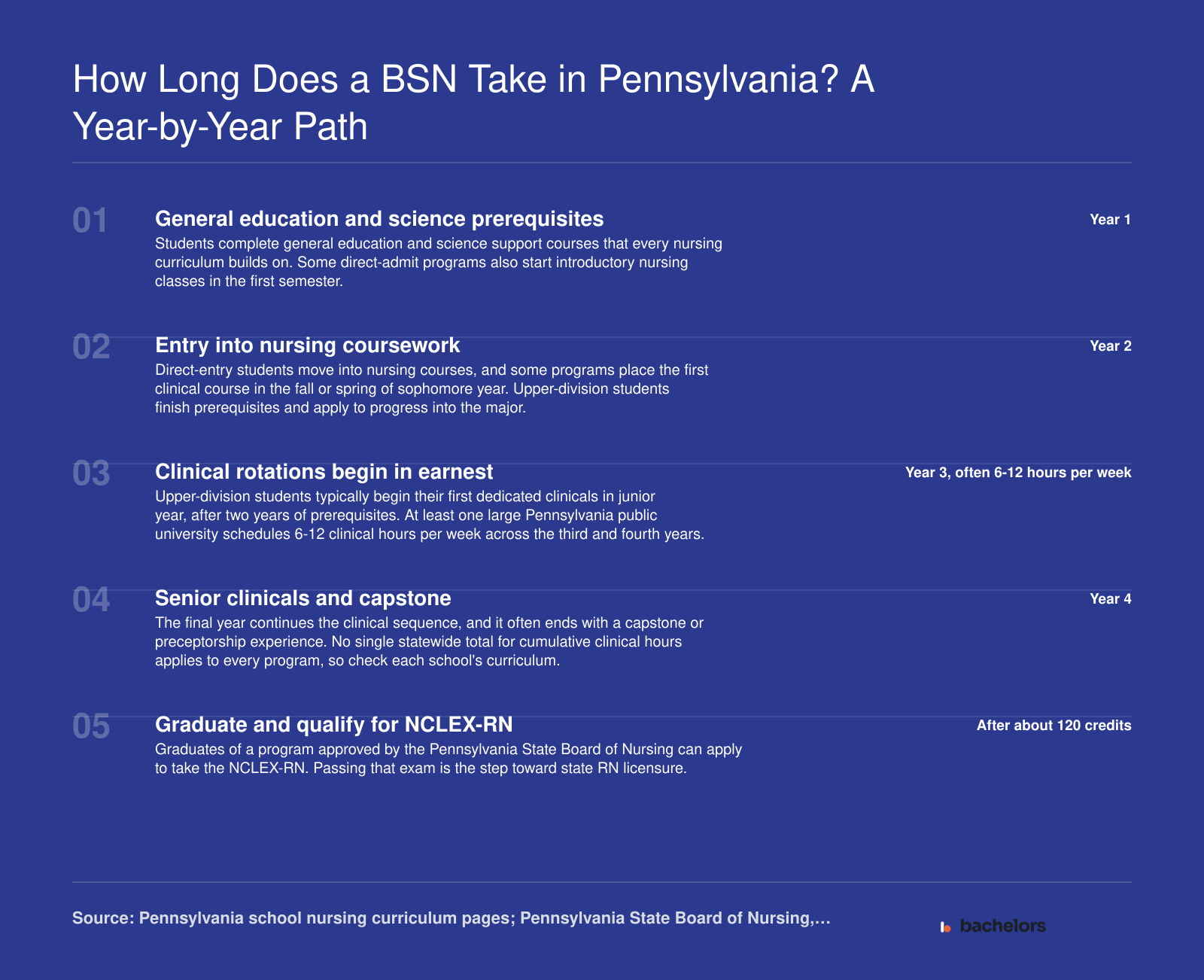
How Long Does a BSN Take in Pennsylvania? A Year-by-Year Path
A traditional BSN in Pennsylvania typically takes four academic years for students who enter after high school, and most curricula land near 120 total credits, though exact totals vary by school. Clinicals start at different points depending on how a program admits students. Direct-admit programs can begin clinicals as early as freshman or sophomore year, while upper-division programs usually wait until junior year.
From BSN Diploma to Pennsylvania RN License
Pennsylvania Board of Nursing Approval, CCNE/ACEN Accreditation, and the NCLEX-RN
Board approval is the state's permission for a nursing program to operate and to prepare graduates for Pennsylvania RN licensure. Accreditation is a separate, voluntary peer review of academic quality. The two are not interchangeable.
Approval vs. Accreditation
The Pennsylvania State Board of Nursing, part of the Department of State, approves prelicensure programs. Only graduates of an approved program are eligible to take the NCLEX-RN in Pennsylvania. CCNE and ACEN are national accreditors. A BSN can be state-approved without holding either one, and accreditation never replaces Board approval. Where accreditation matters is in the details: many graduate schools, some employers, and some aid and tuition-benefit programs look for it.
How to Check a Program Yourself
Don't rely on a school's marketing page alone. Do this instead:
- Board approval: Look up the school on the Pennsylvania State Board of Nursing's list of approved prelicensure programs.
- CCNE: Search the accredited-program directory on the CCNE website.
- ACEN: Search the ACEN directory the same way.
Match the exact campus and degree. A school's approval for one pathway does not automatically cover every other pathway it offers.
How the NCLEX-RN Works
According to NCSBN, the 2026 NCLEX-RN is a computerized adaptive test.1 The exam adjusts to your answers and runs between 85 and 150 items within a five-hour limit, with optional breaks.2 The current test plan is effective April 1, 2026 through March 31, 2029.1 The Next Generation format keeps that adaptive design and builds in clinical judgment, including case studies, alongside 15 unscored pretest items. Scoring is criterion-referenced: you pass by meeting a set standard, not by beating other test takers.2
Reading Pass Rates Wisely
When you review the figures on the ranking cards above, check a few things:
- First-time takers: First-attempt results are the cleaner signal of how well a program prepares students.
- Multi-year trends: One strong or weak year can be noise, so a steady record across several years tells you more.
- Cohort size: At a school with a small graduating class, a handful of results can swing the percentage sharply.
A high rate does not mean every graduate passed, and it is not a full measure of program quality.
Questions to Ask Yourself
If your school uses upper-division entry, what is your backup if you aren't admitted to the nursing major?
Is the NCLEX-RN pass rate strong across several years, or lifted by one good cohort?
After a PHEAA State Grant and institutional aid, what will you actually pay?
Can you reach the clinical sites without a car?
Choosing a Pennsylvania BSN School by Region and Schedule
A program's place on a ranking matters less than which hospitals sit within driving distance of campus. For nursing, geography shapes your clinical rotations, so it deserves real weight.
Match the Region to the Clinical Experience You Want
- Philadelphia area and the southeast: Drexel University in Philadelphia, Neumann University in Aston, and West Chester University of Pennsylvania put students near large academic medical centers, specialty units, and high patient volume.
- Eastern and northeastern Pennsylvania: Cedar Crest College in Allentown, Marywood University in Scranton, and East Stroudsburg University of Pennsylvania draw on regional health systems that blend hospital and community placements.
- Central Pennsylvania: Messiah University in Mechanicsburg, York College of Pennsylvania, and Alvernia University in Reading sit near mid-sized systems where students often rotate through several departments rather than one subspecialty.
- Western Pennsylvania: Duquesne University in Pittsburgh offers a dense urban medical market, while Saint Francis University in Loretto, Waynesburg University, Indiana University of Pennsylvania, and the University of Pittsburgh-Bradford place students in community and rural hospitals where new nurses handle a wider mix of cases.
Weigh Format and Price if You Commute or Work
Every program ranked here runs on campus, with clinical hours scheduled around hospital shifts, so commuting distance is a practical filter, not a detail. Compare the net price and in-state tuition shown in the ranking rather than sticker price: West Chester posts the lowest in-state tuition of the group at $10,775, while York College and Cedar Crest report net prices of $18,556 and $18,659 after aid.
Licensed RNs can follow our separate RN-to-BSN guide. If you hold a bachelor's degree in another field, see our accelerated BSN page instead.
Your Next Step
Shortlist three schools from the ranking above. Confirm each one is approved by the Pennsylvania State Board of Nursing and accredited by CCNE or ACEN, then file the FAFSA as early as possible so you stay eligible for the PHEAA State Grant.
Compare Bachelor of Science in Nursing (BSN) programs on the data that matters
Explore more Nursing majors or browse every field of study.
All Nursing programs Browse every field of study