Best Accelerated BSN (ABSN) Programs in Texas
Compare 22 accredited Accelerated BSN (ABSN) programs in Texas at 21 colleges, with net price after aid, graduation rates, earnings and debt from IPEDS and the U.S. College Scorecard.
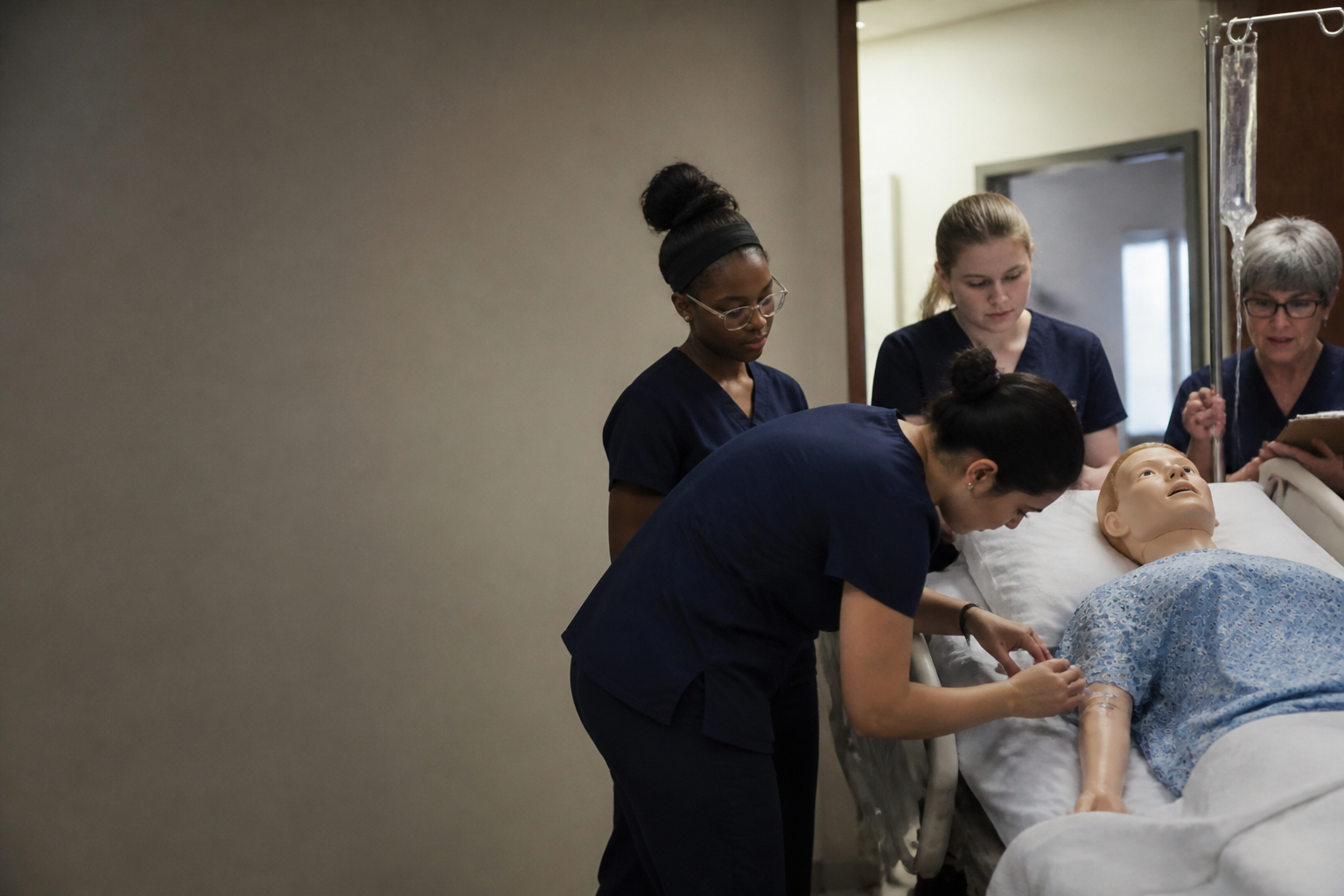
Texas A&M's second-degree BSN packs 61 credit hours into 15 months, built on the premise that your first bachelor's already covered general education, leaving only the nursing core and lab sciences.
Admission turns on that prior degree, completed anatomy, physiology, microbiology and chemistry prerequisites, and a GPA that clears each school's published floor. Cost is where the schools separate: UT Arlington locks its online rate at $425 per credit, while Baylor lists $58,100 for its distance track.
Every path ends at the same licensing requirement. Texas Board of Nursing approval and a passing NCLEX-RN score, not the diploma itself, are what put an RN credential on your license.
Key Points
- Midwestern State University has the lowest annual net price here: $11,656.
- Only Texas Board of Nursing-approved programs qualify graduates for the NCLEX-RN.
- Texas RN applicants must fingerprint through IdentoGo; mailed cards aren't accepted.
10 Best Accelerated BSN Programs in Texas, Ranked
Below are ten Texas schools that admit second-degree students into a bachelor's-level nursing track, laid out side by side with the details that matter most when you compare them. Each entry shows the city, how the program is delivered, the approximate average net price after aid, and the graduation rate at the school offering the program. Both of those figures describe the whole institution, not the accelerated BSN cohort on its own.
Texas A&M University-College Station
#1College Station, TX · ~$21,000/yr (est.)
Best for: Career changers wanting a full campus cohort
Texas A&M University is a large public research institution, and its second-degree BSN is taught at the Round Rock campus north of College Station rather than at the flagship campus itself. Instruction is face to face and pairs simulation labs with clinical experiences each semester, while coursework covers professional nursing, pathophysiology, pharmacology and population health. The BSN Honors Program and U.S. Army AECP eligibility give high-achieving and military-affiliated students additional routes through the degree.
- Face-to-face instruction with simulation labs at the Round Rock campus
- Clinical experiences scheduled in every semester
- Coursework spans professional nursing, pathophysiology, pharmacology and population health
- BSN Honors Program available for high-achieving students
- Army AECP eligibility for military-affiliated students
- Two start dates per year, fall and spring
University of Houston
#2Houston, TX · $10,000 – $23,000/yr (est.)
Best for: Houston-area professionals changing careers
The University of Houston is a large public research university, and its second-degree BSN runs full time at the Sugar Land campus southwest of the main Houston campus. The track is built for career changers who already hold a bachelor's or master's in another field, combining nursing theory with biological science, social science and humanities coursework. Clinical work happens in structured and unstructured settings across the Houston area, and the curriculum is designed to feed directly into RN licensure and later graduate study.
- Face-to-face cohort based at the Sugar Land campus
- Designed for career changers who hold a bachelor's or master's in another field
- Full-time enrollment with one spring start each year
- Clinical placements in structured and unstructured settings
- Coursework integrates biological sciences, social sciences and nursing theory
- Prepares students for RN licensure and graduate study
University of St Thomas
#3Houston, TX · ~$19,000/yr (est.)
Best for: Working adults needing hybrid flexibility
University of St. Thomas is a private Catholic university in Houston, and its accelerated BSN is a hybrid program that pairs online coursework with on-site skills and simulation labs. Students complete clinical placements at Houston-area health systems and can take classes at locations in Midtown Houston, Sugar Land and The Woodlands. Several start dates a year, a pre-ABSN pathway for students finishing prerequisites, and a scholarship partnership with Volunteers of America Texas make the program workable for adults juggling jobs.
- Hybrid format: online coursework with on-site skills labs
- Clinical placements at Houston-area healthcare facilities
- Campus locations in Midtown Houston, Sugar Land and The Woodlands
- Three start dates per year
- Skills and simulation labs taught by experienced nurse educators
- Scholarship partnership with Volunteers of America Texas
- Separate pre-ABSN pathway for students finishing prerequisites at St. Thomas
- CCNE accredited
The University of Texas at Arlington
#4Arlington, TX · ~$14,000/yr (est.)
The University of Texas at Arlington delivers its accelerated BSN online, with coursework done remotely and clinical hours completed at partner hospitals across Texas. The Smart Hospital simulation lab lets students rehearse care before working with patients, and a capstone course closes the program with a transition to practice. Pay-by-the-course tuition, a locked tuition rate and multiple start dates each year make the format easier to finance and schedule.
- Online coursework with clinicals at partner hospitals across Texas
- Smart Hospital simulation lab for hands-on practice
- Capstone course focused on transition to practice
- Pay-by-the-course tuition with a locked tuition rate
- Multiple start dates per year
- Student Success Program support for enrolled students
- ACEN and CCNE accredited
The University of Texas at Tyler
#5Tyler, TX · ~$13,000/yr (est.)
The University of Texas at Tyler anchors its nursing school in East Texas, and the accelerated BSN is one of two bachelor's-level tracks alongside the traditional BSN. Students study at Tyler, Palestine or Longview, and can pick online or on-site delivery plus part-time or full-time pacing. Clinical placements are arranged in the student's own community or through East Texas partner organizations, and a NextGen Hospital simulation and skills lab supports practice time.
- Three East Texas locations: Tyler, Palestine and Longview
- Online or on-site delivery, full-time or part-time
- Clinicals arranged in the student's own community
- NextGen Hospital simulation and skills lab
- CCNE accredited
- U.S. News named its BSN program the top program nationally for 2025
Hallmark University
#6San Antonio, TX · $13,000/yr (est. net price)
Hallmark University is a private San Antonio institution whose nursing school is approved by the Texas Board of Nursing. Students train in hospital-style simulation labs with small class sizes, and recruitment runs year-round with several starts a year. Graduates move into hospitals, public health systems, rehabilitation centers and hospice care, with specialty interests such as cardiac care, trauma care and military nursing supported along the way.
- Texas Board of Nursing approved program
- Hospital-style simulation labs
- Small class sizes
- Year-round recruitment with multiple starts a year
- Specialty paths in cardiac, trauma and military nursing
- More than 15 years educating San Antonio nurses
Baylor University
#7Waco, TX · ~$41,000/yr (est.)
Baylor University is a private Christian research university in Waco, and its distance accelerated BSN is a hybrid track for students who already hold a non-nursing bachelor's. Didactic coursework is delivered online with two required visits to campus, while clinical hours are arranged through the program's placement support. A faith-based curriculum and short course blocks structure the experience, and the cohort is limited to Texas residents.
- Online coursework with two required on-campus visits
- 720 clinical hours with placement support provided
- Faith-based curriculum
- Courses run in short blocks of 3 to 10 weeks
- Open to Texas residents only
- CCNE accredited
Texas Tech University Health Sciences Center
#8Lubbock, TX
Texas Tech University Health Sciences Center is the health sciences campus of the Texas Tech system in Lubbock, and its second-degree BSN blends online nursing theory with clinical instruction supervised by coaches and faculty in students' home communities. Admission runs through a holistic review, and students can complete practice hours at locations across Texas. A separate Veteran to BSN track gives military applicants advanced placement based on demonstrated skills.
- Online nursing theory with clinicals in the student's local community
- Clinical coaches and nursing faculty oversee practice
- Holistic admission review with a required interview
- NLN Center of Excellence
- Financial aid and scholarships available
- Criminal background check required
- CCNE accredited
- Open to all branches of the military
- Advanced placement based on demonstrated skills
- Multiple Texas locations for clinical work
- Military benefits accepted
- Application includes an interview and an essay
- CCNE accredited
The University of Texas Health Science Center at Houston
#9Houston, TX
UTHealth Houston's Cizik School of Nursing runs the Pacesetter accelerated BSN on its Houston campus, with theory taught in person and some sessions online or hybrid. Clinical hours begin in the first semester and include placements in the Texas Medical Center and Greater Houston, and the final semester is fully clinically intensive. Scholarships and financial aid are available, and a university tuition fund covers costs for qualifying students who do not already hold a bachelor's degree.
- Clinical hours begin in the first semester
- 900 clinical hours, including Texas Medical Center placements
- Final semester is fully clinically intensive
- Three start dates per year: fall, spring and summer
- Classes taught by practicing nurses
- CCNE accredited and Texas Board of Nursing approved
- Future Nurses Fund covers tuition for qualifying students without a prior bachelor's
The University of Texas Health Science Center at San Antonio
#10San Antonio, TX
UT Health San Antonio's accelerated track is a full-time, campus-based program built for people who already hold a non-nursing bachelor's degree. Rigorous coursework and clinical experiences prepare students for generalist nursing practice, and students can pursue distinction in research and clinical service along the way. More than 40 scholarship opportunities support students in the San Antonio region.
- Continuous full-time study on the San Antonio campus
- Designed for holders of a non-nursing bachelor's degree
- Option to earn distinction in research and clinical service
- More than 40 scholarship opportunities
- CCNE accredited
Cost & outcomes by school
Federal data for the highest-earning Accelerated BSN (ABSN) programs, independent of the ranking above. Earnings are this field's bachelor's graduates four years after completing where the Scorecard reports them, else the school's undergraduate median.
| School | Net price / yr | Grad rate | Earnings | Debt | Grads/yr | Format |
|---|---|---|---|---|---|---|
| West Coast University-Texas TX | $53,020 | 31% | $102,672 | $32,946 | 672 | Campus |
| Texas Tech University Health Sciences Center TX | — | — | $92,348 | $12,268 | 2,154 | Hybrid |
| The University of Texas Health Science Center at Houston TX | — | — | $88,757 | $13,063 | 520 | Hybrid |
| The University of Texas Health Science Center at San Antonio TX | — | — | $82,206 | $15,000 | 858 | Campus |
| Texas A&M University-College Station TX | $21,315 | 84% | $72,097 | $17,804 | 28,560 | Campus |
| Baylor University TX | $41,104 | 80% | $65,793 | $23,000 | 10,076 | Hybrid |
| The University of Texas at Arlington TX | $13,951 | 54% | $63,199 | $17,527 | 15,038 | Online |
| University of Houston TX | $14,276 | 65% | $62,377 | $18,194 | 18,040 | Campus |
| Galen Health Institutes-Houston TX | $30,222 | — | $61,480 | $24,166 | 4 | Campus |
| Galen Health Institutes-Austin Campus TX | $30,187 | — | $61,480 | $24,166 | 194 | Campus |
| Concordia University Texas TX | $23,131 | 45% | $60,883 | $21,852 | 706 | Hybrid |
| University of St Thomas TX | $19,359 | 69% | $59,224 | $19,928 | 1,234 | Hybrid |
Sources: U.S. Department of Education. Net price, graduation rate, earnings and debt: College Scorecard (earnings and debt for this field's bachelor's graduates where reported, else school-wide); graduates: IPEDS. A dash means no figure is reported.
Cost, debt & payoff
Median earnings of this field's bachelor's graduates (4 yrs after completing, else the school's undergraduate median) vs. their median federal loan debt · U.S. College Scorecard
Across these programs the median graduate earns about $61,480 and finishes with roughly $19,928 in debt — a ratio that clears a common rule of thumb (keep debt below first-year salary). Net price and debt vary widely school to school, so check the per-school figures in the table above before you shortlist.
Cheapest ABSN Programs in Texas
Ranked by average annual net price after grants and scholarships (federal IPEDS and College Scorecard data, which covers all undergraduates rather than ABSN students alone), the public universities here run from $11,656 at Midwestern State University to $14,276 at the University of Houston. Hallmark University, the only private school in this group, has no published sticker price in the federal data, but its $12,513 net price shows how institutional scholarships can pull a private bill close to public-university levels. Where program-specific pricing exists, use it for budgeting: UT Arlington lists $425 per credit, or $21,675 for its 51-credit online track, and a third-party listing puts the University of Houston at $484.82 per credit for Texas residents and $1,043.57 for nonresidents in 2026-27. Confirm the Houston figures and any clinical or course fees with the school before you commit.
| School | Sector | City | Format | Avg. Annual Net Price After Aid | Published ABSN Tuition | Median Debt, Nursing Bachelor's Grads |
|---|---|---|---|---|---|---|
| Midwestern State University | Public | Wichita Falls | Campus | $11,656 | N/A | $20,392 |
| Hallmark University | Private | San Antonio | Campus | $12,513 | N/A | N/A |
| The University of Texas at Tyler | Public | Tyler | Hybrid | $13,323 | N/A | $17,483 |
| The University of Texas at Arlington | Public | Arlington | Online | $13,951 | $425 per credit; $21,675 total for 51 credits | $17,421 |
| University of Houston | Public | Houston (Sugar Land campus) | Campus | $14,276 | $484.82 per credit in-state, $1,043.57 out-of-state (2026-27, third-party listing) | $19,131 |
Related Articles
Getting Into a Texas ABSN: Degree, Prerequisites, GPA, and TEAS
Texas ABSN programs admit career changers who already hold a degree, but each school sets its own prerequisite hours, GPA floors, and entrance-exam rules. Check each school's current admissions page before you apply.
- A completed bachelor's degreeTexas Tech University Health Sciences Center's Second Degree BSN requires a bachelor's degree from an accredited school. UTHealth Houston's Pacesetter ABSN is organized around 60 semester credit hours of prerequisites, so compare its credit requirements with your transcript.
- Prerequisite hours and science coursesTexas Tech requires 55 prerequisite hours, with at least 40 done when you apply and 3 of 5 sciences complete: pathophysiology, microbiology, anatomy and physiology I and II, and chemistry. Baylor's FastBacc requires 52 hours, with 33 done at application, including 2 of 4 sciences totaling 8 hours. Pacesetter requires 48 of its 60 hours by the deadline, including 16 hours of anatomy, physiology, chemistry, and microbiology.
- Minimum GPAPublished minimums run from 2.5 to 3.0. Texas Tech sets a 2.5 cumulative and science GPA and prefers 3.0. Baylor requires a 3.0 in completed prerequisites and a 2.75 in sciences. UTHealth Houston lists a 3.0 for all prerequisites and a 3.0 for prerequisite sciences.
- HESI A2 or TEASBaylor requires the HESI A2 with minimum scores of 80 in English Composite and 80 in Math. UTHealth Houston accepts the HESI A2 or the TEAS and will not accept more than two attempts or scores older than two years.
- Transfer grades and timingTexas Tech and UTHealth Houston require a C or better in every prerequisite. Texas Tech and Baylor require all prerequisites to be finished before the first class.
How Long an Accelerated BSN Takes in Texas and What It Costs
A one-year online program and a 15-month campus cohort both end at the same NCLEX-RN exam, but they place different demands on your calendar and your budget. Most Texas ABSN programs fall between 12 and 18 months of full-time study, and the exact length depends on how each school packs its credits and clinical hours.
Program Length at Three Texas Schools
- The University of Texas Health Science Center at Houston: The Pacesetter ABSN runs 15 months, covering 60 credits across four semesters, with 900 clinical hours that begin in the first semester.
- Baylor University: The online ABSN for non-nursing bachelor's holders is designed as a one-year program, with 62 credits, 720 clinical hours, online coursework, two campus visits and in-person clinicals.
- The University of Texas at Arlington: The accelerated online BSN totals 51 credit hours1, the lightest credit load of these three.
Start Terms and Working While Enrolled
UTHealth Houston admits Pacesetter students in fall, spring and summer, so you don't have to wait a full year for an opening. Confirm start dates directly with each school, since intake calendars change. Whatever the start term, plan around the pace. Packing 60 or more credits and hundreds of clinical hours into roughly a year makes a full-time job hard to hold, and many students drop to part-time work or stop working entirely.
Tuition, Fees, and Extra Costs
Public universities in Texas generally charge residents less than out-of-state students, while private schools such as Baylor charge one rate regardless of residency. UTHealth Houston describes its ABSN tuition as among the lowest in Texas. Before you compare totals, pull each school's 2026-27 tuition schedule and add the costs that sit outside tuition: mandatory nursing fees, uniforms, books, parking, background checks, immunizations, licensure application costs and NCLEX-RN registration.
Financial Aid for Second-Degree Students
With a bachelor's degree already in hand, you generally can't receive a Federal Pell Grant. Federal Direct loans remain the main federal option, subject to lifetime borrowing limits, so check how much eligibility your first degree used up.
School-based aid can do far more. UTHealth Houston's Future Nurses Fund can make tuition and required fees free for qualifying full-time BSN students with gross adjusted income under $100,000. The grant covers four consecutive semesters if you keep meeting academic requirements, requires no separate application, and does not cover books, parking or uniforms. The school's Cizik School of Nursing also lists scholarships from $1,000 up to full tuition, including the Hamill Foundation Scholarship for ABSN students and the Herzstein Charitable Foundation Scholarship for Pacesetter students.
At other schools, ask the financial aid office about ABSN-specific awards, Texas nursing scholarships and any hospital partnerships that trade tuition help for a post-graduation work commitment.
From Non-Nursing Bachelor's to Texas RN: the ABSN Path
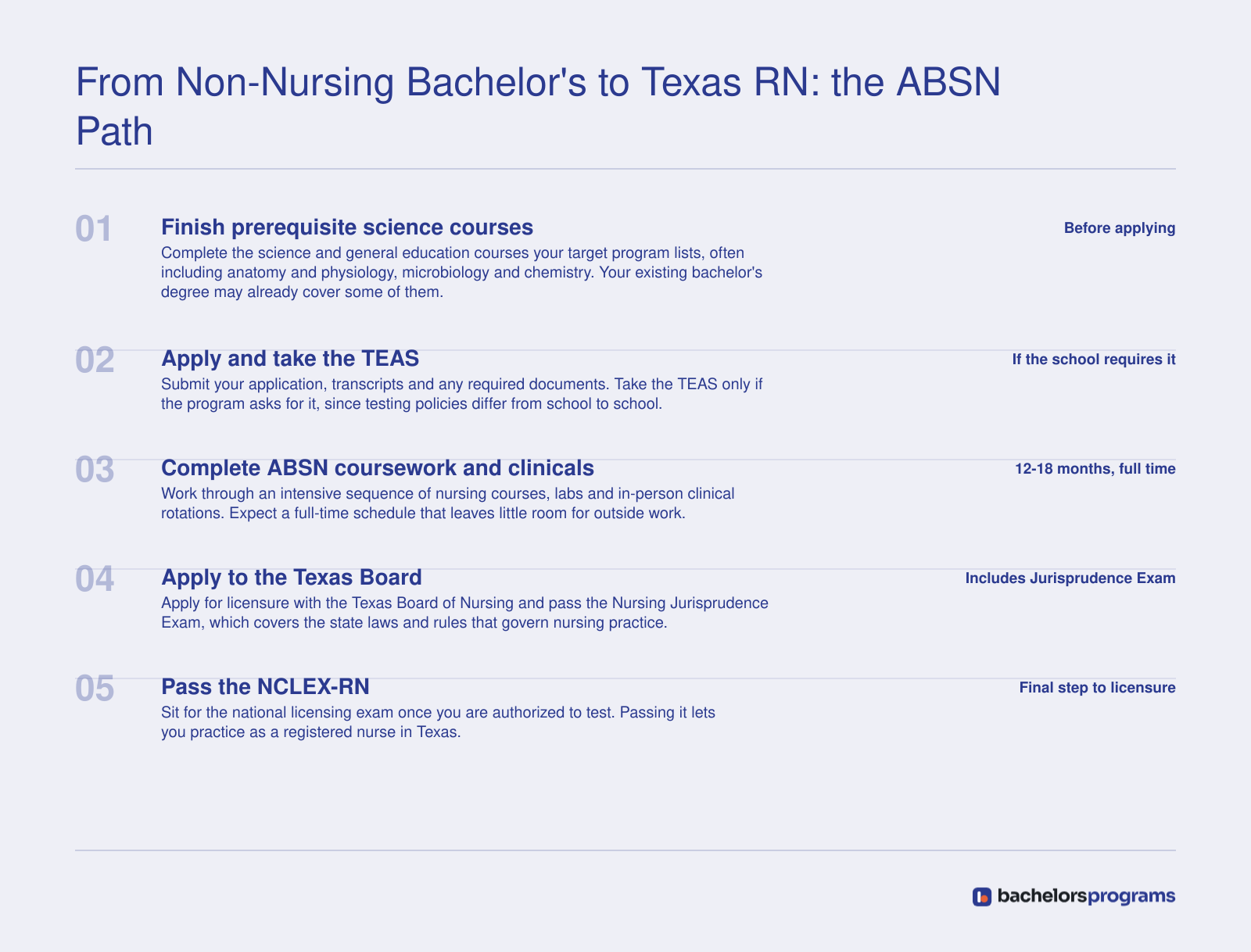
Most Texas ABSN students follow the same basic sequence, from science prerequisites to the NCLEX-RN. Requirements vary by school, so confirm prerequisites, testing policies and timelines directly with each program before you apply.
Texas Board of Nursing Approval, Accreditation, and NCLEX-RN Pass Rates
Will a Texas accelerated BSN actually let me sit for the NCLEX-RN? It will only if the program is approved by the Texas Board of Nursing (BON). To qualify for the exam in Texas, you must complete a BON-approved professional nursing program, and a school's marketing page is not proof of that.
How to Check a Program's Approval
The BON publishes its list of approved professional nursing programs online, with each program's status, such as full approval, initial approval, or a conditional status. Search for the school before you apply and confirm the specific program. UTHealth Houston's 15-month Pacesetter ABSN, for example, sits within a baccalaureate program that is BON-approved and CCNE-accredited. For any other school here, including Texas A&M, the University of Houston, and Baylor, confirm the status yourself rather than assuming it.1 Texas had 136 approved RN programs in FY2025, so the list is long, and statuses can change.
Approval Versus Accreditation
State approval is the legal requirement for licensure eligibility. Accreditation is a separate, voluntary peer review by CCNE or ACEN. It matters for two reasons. Many graduate nursing programs, including nurse practitioner tracks, expect your BSN to come from an accredited program. Some employers, including certain hospital residency programs, also prefer or require it. Check the accreditor's own directory for current status.
What the NCLEX-RN Pass Rate Data Shows
The BON generally reports first-time NCLEX-RN pass rates by school or program, not by ABSN track. The figures below are statewide for FY2025 and cover all approved RN programs together:
- Overall first-time rate: 89.12%
- Quarterly rates: 89.08%, 90.69%, 88.54%, and 88.16%
These are not school-specific, so they are a benchmark rather than a score for any program on this page. No school-level rate with a verified exam year was available for these programs, and none is estimated. For a particular school, open the BON's published NCLEX pass rate reports and read the most recent year, along with the number of first-time candidates. A small cohort can swing a percentage sharply. Because the BON may combine a school's tracks, an ABSN cohort's results can differ from the figure listed for the school overall.
Texas RN Licensure at a Glance
Campus, Hybrid, and Online ABSN Options in Texas: Clinicals and Relocation
Where you physically sit during an accelerated BSN shapes your week more than almost any other detail. Texas programs fall into three patterns, and the label on a program page rarely tells the whole story.
What the three formats mean
Campus programs keep lecture, lab, and clinical hours in one place. Texas A&M's second-degree BSN runs 15 months at its Round Rock campus, the University of Houston's 12-month second-degree BSN meets face to face at its Sugar Land site, and Hallmark University and UT Health San Antonio both list campus-based study.
Hybrid programs put didactic coursework online and keep labs and clinicals in person: the University of St Thomas, UT Tyler, Texas Tech HSC, UTHealth Houston, and Baylor. Baylor's distance ABSN requires two on-campus visits and 720 clinical hours, and admits Texas residents only. UTHealth Houston's Pacesetter track starts clinicals in the first semester and carries about 900 clinical hours.
Online is the loosest label. UT Arlington calls its pathway an Accelerated Online BSN, 15 months and 51 credits, with clinical placements arranged at select partner hospitals in Texas, but the online portion covers coursework. No Texas ABSN can be finished without in-person patient care hours.
Where the programs sit
Houston has the heaviest concentration: the University of Houston, St Thomas, and UTHealth Houston. San Antonio has Hallmark and UT Health San Antonio. UT Arlington and Baylor serve the Dallas-Fort Worth and Waco corridors, Texas A&M draws students to Round Rock outside Austin, Texas Tech anchors Lubbock, and UT Tyler covers East Texas. If relocating is off the table, start with the school nearest you and ask how clinical sites are assigned before you apply.
Deadlines to file against
Texas A&M takes NursingCAS applications by August 1 for spring entry and January 15 for fall. Texas Tech HSC runs three cycles: August 15 for spring, November 15 for summer, and February 15 for fall. UT Arlington lists September 4, 2026 for a September 28 start, December 11, 2026 for January 11, 2027, and February 12, 2027 for March 8, 2027. Each is a hard cutoff, so build backward from the date that fits your life and then confirm the current cycle on the program's own page, because deadlines shift from year to year.
How to Choose an Accelerated BSN School in Texas
Texas ABSN applicants now weigh cost and licensing outcomes about as heavily as a school's name. The programs below differ sharply on both counts: The University of Texas at Arlington runs its accelerated BSN largely online, Baylor's distance format places students with clinical partners away from Waco, and Texas A&M's second-degree BSN runs at the university's Round Rock campus, north of Austin.
Score each program on four tests
- Total cost after aid: tuition and fees for the full accelerated sequence, minus scholarships, employer tuition help, and the federal aid you qualify for.
- Format and clinical fit: whether the program places you at partner hospitals or expects you to arrange your own preceptors, and how far those sites sit from where you live.
- Admission odds: your overall and prerequisite science grades against published minimums, plus whether the TEAS or another entrance exam is required.
- Outcomes: Texas Board of Nursing first-time NCLEX-RN pass rates and the graduate earnings each school reports.
Then compare calendars
Pick three to five programs from the rankings and the cheapest table, line up their deadlines and start terms side by side, and see where the dates let you apply in more than one cycle.
Questions worth asking
At an info session, ask which clinical sites the accelerated cohort actually uses, what NCLEX review the program builds into the schedule, and what share of recent accelerated students finished on time.
Your next step
Request information from your shortlist, attend the sessions, and sketch a prerequisite timeline with course names and target terms, so you know the earliest start date you can realistically reach.
Compare Accelerated BSN (ABSN) programs on the data that matters
Explore more Nursing majors or browse every field of study.
All Nursing programs Browse every field of study