Best BSN Programs in Texas
Compare 97 accredited Bachelor of Science in Nursing (BSN) programs in Texas at 82 colleges, with net price after aid, graduation rates, earnings and debt from IPEDS and the U.S. College Scorecard.
Published tuition for a Texas BSN runs from $9,717 a year at the University of Houston to $61,740 at Texas Christian University, yet both report NCLEX-RN pass rates above 98 percent. Price alone says little about licensure, and a BSN pays off only once the exam is passed.
That is why this list starts with NCLEX-RN results and ranks traditional pre-licensure BSN programs only. Licensed RNs and second-degree students follow separate routes.
Cost, admission model and first-year earnings then separate programs with similar pass rates. Board of Nursing approval stays the fixed requirement: graduates of unapproved programs cannot sit for the exam.
Key Points
- South Texas College posts the lowest net price here: $1,751 yearly.
- Texas licensure applications run through the Texas Nurse Portal for $75.
- Upper-division entry means roughly two years of prerequisites before nursing coursework.
10 Texas BSN Programs With the Highest NCLEX-RN Pass Rates
Every program on this list is a traditional pre-licensure BSN at a Texas school, and the exam that decides whether a graduate can practice is the NCLEX-RN, the licensing test administered for registered nurse candidates. The order follows first-time pass rates on that exam, with accreditation standing and completion outcomes settling the close calls. Rates shown for each school come from the most recent cohorts reported in the underlying data.
Texas State University
#1San Marcos, TX · ~$17,000/yr (est.) · NCLEX-RN pass rate 100% (3-yr weighted avg)
Best for: Pre-nursing students wanting a large public campus
Texas State University anchors its BSN in San Marcos, where pre-nursing students complete prerequisites and then apply into the clinical sequence, with a second site in Round Rock serving the same coursework. The university admits about 89 percent of applicants, so the selective step is the nursing application rather than the university itself. Institutionally, roughly 55 percent of Texas State students finish their degrees.
- CCNE accredited BSN built on clinical practice and patient-centered care
- Enter as a pre-nursing major, then apply to the nursing sequence separately
- Holistic review with conditional admission offers
- Roughly 100 to 150 students admitted in each fall cohort
- Prerequisite courses can be taken at the San Marcos or Round Rock campus
- One start date per year, in the fall
- Prepares students for the NCLEX-RN and RN licensure
University of Houston
#2Houston, TX · $10,000 – $23,000/yr (est.) · NCLEX-RN pass rate 98.4% (3-yr weighted avg)
Best for: Houston locals seeking urban hospital placements
The University of Houston's traditional BSN is built for students who enter as freshmen, with nursing theory woven through four years and the junior and senior years taught face to face at the UH Katy campus. The university admits about 74 percent of applicants and graduates about 65 percent of undergraduates overall. Graduates finish prepared for RN licensure and for further graduate study in nursing.
- Four-year campus-based traditional BSN designed for entering freshmen
- Combines biological and social sciences with nursing theory and practice
- Junior and senior years delivered face to face at the UH Katy campus
- Emphasizes critical thinking, client advocacy and ethical practice
- Prepares graduates for professional practice and graduate study
The University of Texas Medical Branch at Galveston
#3Galveston, TX · NCLEX-RN pass rate 97.7% (3-yr weighted avg)
Best for: Students drawn to an academic medical center
UTMB in Galveston sits inside an academic medical center, so BSN students rotate through the same hospitals where the university trains physicians and other health professionals. The ISLAND Promise initiative, funded by a foundation gift, covers tuition, housing and living support for selected students who commit to two years with UTMB Health after graduation. The program runs three start terms a year and keeps fall cohorts near 130 students.
- CCNE accredited traditional track with a required clinical capstone
- 16-month program totaling 60 credit hours across 16 courses
- TEAS entrance exam and prerequisite courses required
- 2.8 minimum GPA for admission
- Three start terms each year: fall, spring and summer
- Clinical rotations at UTMB Medical Center and Houston-Galveston hospitals
- About 130 students accepted into each fall cohort
- Interprofessional education alongside medicine and health professions students
LeTourneau University
#4Longview, TX · $28,000/yr (est. net price) · NCLEX-RN pass rate 100% (3-yr weighted avg)
LeTourneau University is a private Christian campus in Longview where nursing students spend the first two years on prerequisites and general education before entering the School of Nursing. Admission is selective, with the university admitting about 38 percent of applicants and graduating about 59 percent of its students overall. The BSN is one of several professional programs on a small residential campus, so students move through a structured four-year plan with a tight cohort.
- CCNE accredited BSN delivered on a four-year degree plan
- 122 total credit hours: 67 general education and prerequisite, 55 nursing
- Clinical coursework begins after prerequisites such as anatomy and microbiology
- Built around Texas Board of Nursing competencies
- Coursework aligns with American Nurses Association standards and AACN Essentials
Texas Christian University
#5Fort Worth, TX · $35,000 – $40,000/yr (est.) · NCLEX-RN pass rate 98.3% (3-yr weighted avg)
Texas Christian University runs its BSN from the Harris College of Nursing in Fort Worth, where nursing sits alongside liberal arts and business programs on a residential campus. The university admits about 44 percent of applicants and graduates about 86 percent of students overall, one of the stronger completion records in this group. Nursing coursework is compressed into 29 months, so students move into clinical judgment and reasoning work quickly.
- CCNE accredited traditional BSN completed in 29 months
- Curriculum centers on clinical judgment, reasoning and decision-making
- Simulation labs staffed by educators, researchers and practicing clinicians
- Department Honors available within the nursing major
- Technical standards required before entering clinical work
- Prepares graduates for settings beyond hospitals and extended care
Abilene Christian University
#6Abilene, TX · $25,000 – $30,000/yr (est.) · NCLEX-RN pass rate 99% (3-yr weighted avg)
Abilene Christian University is a private Christian campus in Abilene, and its BSN splits cleanly between two years of prerequisites and two years of nursing coursework. The university admits about 66 percent of applicants and graduates about 59 percent of undergraduates. Medical mission experiences and undergraduate research give students options that a purely clinical program would not.
- CCNE accredited BSN totaling 128 credit hours
- 68 prerequisite credit hours plus 60 nursing major credit hours
- Freshmen can start as pre-nursing and apply after two years
- Clinical training in skills and simulation labs and at regional facilities
- Medical mission experiences available to nursing students
- Undergraduate research opportunities in nursing
Houston Christian University
#7Houston, TX · $21,000/yr (est. net price) · NCLEX-RN pass rate 97.8% (3-yr weighted avg)
Houston Christian University places its nursing students inside the Texas Medical Center for clinical rotations, with partner hospitals that include Memorial Hermann and Texas Children's. Classes stay small enough for faculty mentorship, and a dedicated Clinical Learning Center supports simulation work before students reach patients. Institutionally, HCU admits about 84 percent of applicants and graduates about 49 percent of undergraduates.
- CCNE accredited BSN totaling 121 credit hours
- Clinical rotations at Texas Medical Center hospitals
- Rotations include Memorial Hermann and Texas Children's
- Clinical Learning Center with a state-of-the-art simulation lab
- Small classes with faculty mentorship
- Faith-integrated curriculum with spiritual formation built in
- Work-study options paired with scholarship support
Stephen F. Austin State University
#8Nacogdoches, TX · $14,000/yr (est. net price) · NCLEX-RN pass rate 97.2% (3-yr weighted avg)
Stephen F. Austin State University in Nacogdoches runs a pre-licensure BSN with two entry points a year and a guarantee pathway for strong freshmen. Admission into the nursing sequence is the hard part: a 3.5 prerequisite GPA and a competitive TEAS score are required, and cohorts cap at 80. The university admits about 94 percent of applicants and graduates about 53 percent of undergraduates overall.
- Pre-licensure BSN admitting up to 80 students each fall and spring
- 3.5 minimum prerequisite GPA for admission
- Competitive ATI TEAS score required
- Lumberjack Nursing Guarantee offers assured admission to qualifying freshmen
- 53 credit hours of nursing coursework in the final two years
- Clinical rotations at local facilities with simulation equipment
Texas A & M International University
#9Laredo, TX · $3,600/yr (est. net price) · NCLEX-RN pass rate 96.9% (3-yr weighted avg)
Texas A&M International University serves the Laredo border region, drawing students who want a public university close to home and a clinical network grounded in South Texas. Admission requires a 3.0 GPA and the HESI A2, and applications go through NursingCAS for fall or spring entry. The university itself admits about 44 percent of applicants and graduates about 46 percent of undergraduates.
- 3.0 minimum GPA plus the HESI A2 admission assessment
- Applications submitted through NursingCAS for fall or spring entry
- Texas Board of Nursing clearance required before enrollment
- Transfer students from Texas nursing programs accepted
- Curriculum emphasizes critical thinking, clinical judgment and evidence-based care
- Instruction on the Laredo campus in the College of Nursing and Health Sciences
The University of Texas Health Science Center at Houston
#10Houston, TX · NCLEX-RN pass rate 95.2% (3-yr weighted avg)
UTHealth Houston is a health science center rather than a general university, and its BSN students train entirely within the Texas Medical Center, the largest medical complex in the country. The university covers tuition and required fees for students from households earning under $100,000, which removes tuition from the cost question for eligible students. The program is CCNE accredited and approved by the Texas Board of Nursing, and courses are taught by practicing nurses.
- CCNE accredited and approved by the Texas Board of Nursing
- Clinical placements across the Texas Medical Center
- More than 200 clinical affiliation sites
- Simulation and Clinical Performance Laboratory on campus
- Courses taught by practicing nurses
- Tuition and required fees covered for households earning under $100,000
- 60 credit hours with 900 supervised clinical hours
Cost & outcomes by school
Federal data for the highest-earning Bachelor of Science in Nursing (BSN) programs, independent of the ranking above. Earnings are this field's bachelor's graduates four years after completing where the Scorecard reports them, else the school's undergraduate median.
| School | Net price / yr | Grad rate | Earnings | Debt | Grads/yr | Format |
|---|---|---|---|---|---|---|
| University of North Texas Health Science Center TX | — | — | $93,615 | — | 56 | Campus |
| The University of Texas Medical Branch at Galveston TX | — | — | $92,961 | $13,396 | 664 | Campus |
| Texas Tech University Health Sciences Center TX | — | — | $92,348 | $12,268 | 2,154 | Campus |
| The University of Texas Health Science Center at Houston TX | — | — | $88,757 | $13,063 | 520 | Hybrid |
| The University of Texas Health Science Center at San Antonio TX | — | — | $82,206 | $15,000 | 858 | Campus |
| The University of Texas at Austin TX | $19,857 | 89% | $75,121 | $20,500 | 21,946 | Campus |
| Baptist Health System School of Health Professions TX | — | — | $74,220 | $18,592 | 10 | Online |
| Texas A&M University-College Station TX | $21,315 | 84% | $72,097 | $17,804 | 28,560 | Campus |
| Texas Christian University TX | $36,660 | 86% | $68,424 | $21,500 | 6,344 | Campus |
| Baylor University TX | $41,104 | 80% | $65,793 | $23,000 | 10,076 | Hybrid |
| The University of Texas at Arlington TX | $13,951 | 54% | $63,199 | $17,527 | 15,038 | Campus |
| University of Houston TX | $14,276 | 65% | $62,377 | $18,194 | 18,040 | Campus |
Sources: U.S. Department of Education. Net price, graduation rate, earnings and debt: College Scorecard (earnings and debt for this field's bachelor's graduates where reported, else school-wide); graduates: IPEDS. A dash means no figure is reported.
Cost, debt & payoff
Median earnings of this field's bachelor's graduates (4 yrs after completing, else the school's undergraduate median) vs. their median federal loan debt · U.S. College Scorecard
Across these programs the median graduate earns about $52,946 and finishes with roughly $20,000 in debt — a ratio that clears a common rule of thumb (keep debt below first-year salary). Net price and debt vary widely school to school, so check the per-school figures in the table above before you shortlist.
How the Texas BSN Rankings Were Built: Pass Rates First, Then Completion
Each pre-licensure program here is ranked on one question: how reliably do its graduates pass the NCLEX-RN on the first attempt? The Texas Board of Nursing reports first-attempt results, and they carry real weight: a graduate who passes on the first try starts earning a nursing salary months sooner than one who repeats the exam.
Pass Rates Carry Most of the Weight
First-time NCLEX-RN pass rates supply roughly three quarters of each score, averaged across the board's latest three years and weighted by how many candidates sat the exam each year. Accreditation status plus a modest completion and retention component fill out the rest, so a program with steady pass rates and steady retention outranks one that leans on a single number.
Why a Three-Year, Takers-Weighted Average
One year can flatter a program. A single unusually strong cohort, or one rough spring, can shift a raw pass rate by double digits. Averaging three years smooths that noise, and weighting by candidate count keeps a very small cohort from carrying the same influence as a program sending hundreds of nurses to the exam.
What Does Not Move the Order
Cost, first-year earnings and graduation rate appear on every card, but they do not drive the ranking. Use the cheapest and highest-earnings tables below to re-sort for those priorities.
RN-to-BSN and accelerated second-degree BSN tracks are excluded because their structure differs, not their quality; they are covered on their own pages.
The underlying figures come from Texas Board of Nursing NCLEX-RN results, College Scorecard and IPEDS.
Highest First-Year Earnings Among Texas BSN Graduates
Cheapest BSN Programs in Texas by Net Price
South Texas College in McAllen has the lowest average net price here at $1,751 a year, followed by Lamar State College-Port Arthur at $2,846 and Victoria College at $3,043, according to 2024 IPEDS and College Scorecard data from the U.S. Department of Education. Net price is an institution-wide average of what students pay after grants and scholarships, so your figure will rise or fall with family income, while in-state tuition and fees is the sticker price before any aid is applied. These low-cost schools also post strong NCLEX-RN results, including Victoria College at 99 percent, South Texas College at 97.4 percent and Texas A & M International University at 96.9 percent, so check the NCLEX-RN ranking above to see where each one places.
| School | City | Average Net Price | In-State Tuition and Fees | Graduation Rate (Institution-Wide) |
|---|---|---|---|---|
| South Texas College | McAllen | $1,751 | $4,920 | 27% |
| Lamar State College-Port Arthur | Port Arthur | $2,846 | $1,770 | 45% |
| Victoria College | Victoria | $3,043 | $2,976 | 29% |
| Texas A & M International University | Laredo | $3,637 | $7,894 | 46% |
| Wharton County Junior College | Wharton | $4,666 | $3,192 | 27% |
BSN Tuition Costs in Texas: Sticker Price, Net Price and State Grants
In Texas, the tuition figure a BSN program publishes is the least useful number in the whole cost conversation.
Public vs. Private Sticker Price
Resident tuition at a Texas public university is a fraction of what a private campus charges. Texas State University lists about $11,450 a year for Texas residents, the University of Houston about $9,717 and UTMB Galveston about $12,402. At the private schools ranked here the sticker climbs fast: Texas Christian University around $61,740, Abilene Christian University about $44,200, LeTourneau University roughly $37,160. Public community colleges undercut both, with Kilgore College near $4,056 and Lamar State College-Port Arthur near $1,770.
Net price, what students actually pay after grants and scholarships, closes much of the gap. TCU's average net price lands near $36,660 and ACU's near $26,182, because private colleges fund aid from their own endowments. At the publics the net price figure lands above published tuition instead: Texas State near $16,805 and Houston near $14,276.
Who Pays Resident Rates
Texas public universities charge resident tuition to students who have held Texas domicile for the 12 months before the term begins. Dependent students usually inherit a parent's residency; independent students document their own with a lease, driver's license, employment and tax records. Settle any residency question before you deposit.
State Aid Worth Chasing
The Texas Higher Education Coordinating Board administers the programs that change the arithmetic. The TEXAS Grant serves students at public institutions only.2 The Tuition Equalization Grant is the private-college counterpart, with a regular award near $4,270 and an exceptional-need maximum near $6,405 for 2025-26.1
The Nursing Students Scholarship Program is the one to know for this major. Per-semester maximums run about $5,429 at public universities, $2,134 at public community colleges, $1,833 at public state colleges and $3,203 at private institutions for 2025-26, with similar amounts published for 2026-27.3 It is administered through participating institutions rather than a single statewide application, so ask each nursing department directly.4
State aid is finite and awarded on a priority basis. File the FAFSA, or the TASFA if you are not eligible for federal aid, before the January 15 state priority deadline.5
Budget Beyond Tuition
Clinical supplies, uniforms, background checks, drug screens, immunizations and NCLEX-RN review courses routinely add hundreds to a few thousand dollars.
Related Articles
Getting Into a Texas BSN: Prerequisites, GPA, TEAS and Entry Models
Your path into a Texas BSN starts with one question: does the school place you in nursing as a freshman, or do you earn a seat after finishing prerequisites? The answer shapes your GPA strategy, your timeline and how much risk you carry.
Two Ways In
- Direct admit: The University of Houston's Traditional BSN Track is designed for freshmen and taught face to face, so students enter on a nursing track from the start.
- Prerequisites first: Abilene Christian University lets freshmen begin as pre-nursing students, completing 68 prerequisite credit hours before 60 nursing credit hours. LeTourneau University starts clinicals only after prerequisites are done.
- Upper-division entry: The University of Texas Medical Branch at Galveston admits students to its traditional BSN after prerequisites are complete, then delivers 60 nursing credit hours in a 16-month program.
What the Admissions Pages Ask For
UTMB publishes the most detailed requirements. It sets a 2.8 GPA minimum, requires prerequisite courses, the TEAS entrance exam and a personal statement, and accepts 130 students per fall cohort. TCU lists technical standards applicants must meet. Science prerequisites, typically anatomy and physiology, microbiology and chemistry, carry heavy weight in admissions review. Texas State University and Baylor University did not spell out a GPA cutoff or entrance exam policy in the material reviewed, so confirm with their nursing advisors before planning around a number.
University-wide admission rates give only a rough sense of selectivity: Texas State admits about 89 percent of applicants, the University of Houston about 74 percent, Abilene Christian about 66 percent, TCU about 44 percent and LeTourneau about 38 percent. Acceptance into the nursing major is often tighter than these campus-wide figures suggest.
Non-Academic Requirements
Before clinical rotations, Texas nursing students generally complete a criminal background check connected to Texas Board of Nursing eligibility, along with immunization records and CPR certification. Exact lists and deadlines vary, so read each school's clinical compliance checklist early.
How Long a Texas BSN Takes
A traditional BSN typically takes four years and about 120 credit hours. LeTourneau's degree plan totals 122 credit hours (67 general education, 55 nursing), and Abilene Christian's totals 128. Upper-division students usually spend about two years in the nursing sequence itself; TCU's program runs 29 months, while UTMB compresses its nursing coursework into 16 months.
Licensed RNs should explore RN-to-BSN programs instead, and anyone who holds a bachelor's degree can consider second-degree routes such as the University of Houston's Second Degree BSN or the Pacesetter BSN at The University of Texas Health Science Center at Houston. Both routes are covered on their own pages.
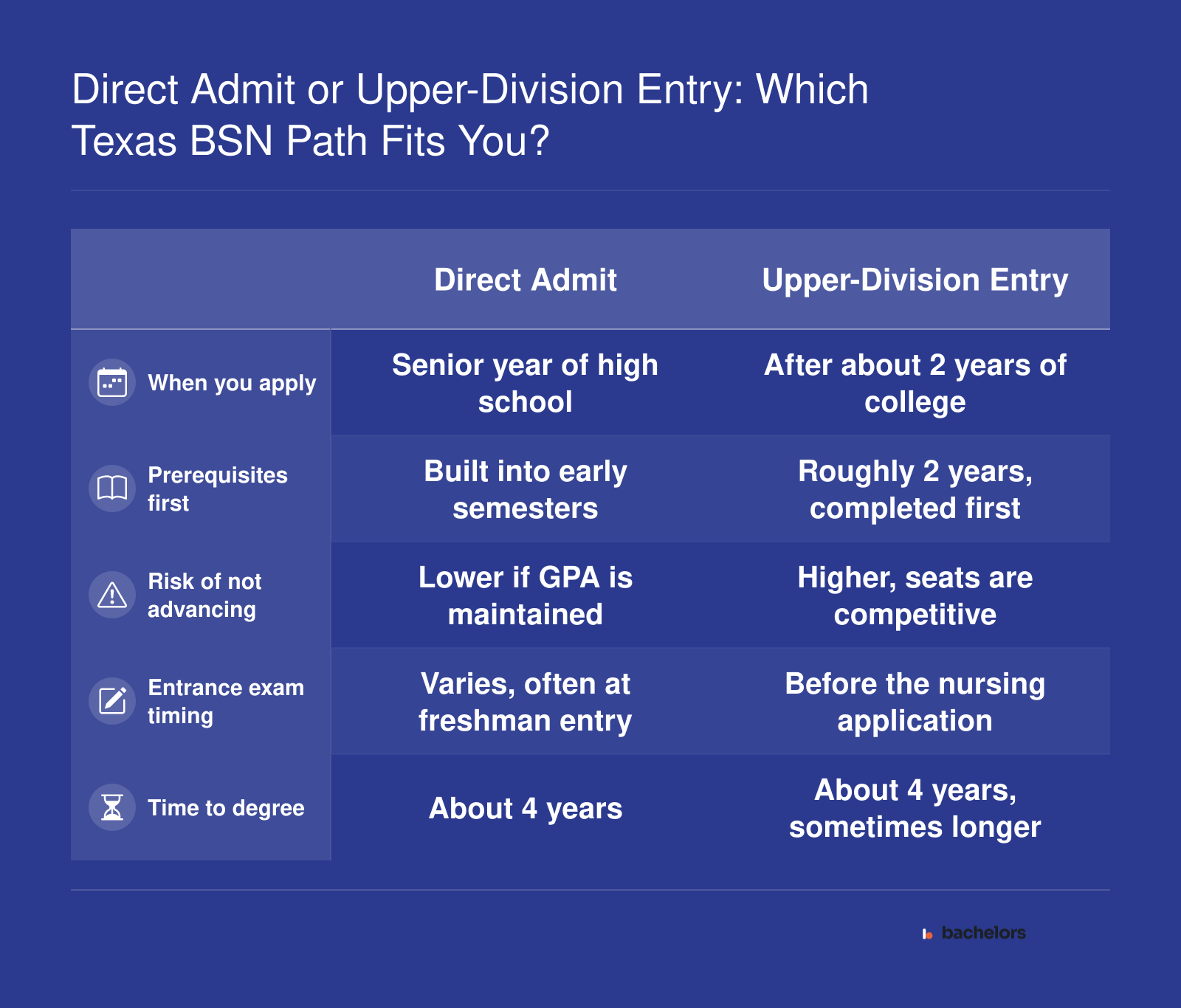
Direct Admit or Upper-Division Entry: Which Texas BSN Path Fits You?
Texas BSN schools generally admit students in one of two ways: directly from high school, or into the nursing major after about two years of college prerequisites. Direct admit tends to suit high-school seniors who want a reserved nursing seat from day one. Upper-division entry often fits transfer and community-college students who can complete prerequisites first and then compete for a spot.
Texas Board of Nursing Licensure Essentials
Texas Board of Nursing Approval and What NCLEX-RN Pass Rates Really Tell You
Why Board approval comes first
Texas requires you to graduate from a pre-licensure program approved by the Texas Board of Nursing (BON) before you can take the NCLEX-RN. That applies to every program operating in the state, whether traditional, hybrid or online. Programs also need authorization from the Texas Workforce Commission or the Texas Higher Education Coordinating Board. The BON does not approve programs based outside Texas, including online programs run from another state.
To check a program, open the Education Programs section of the BON website and find the RN pre-licensure list. Match the school and the specific campus or program, not just the institution name. If a listing's status is unclear, confirm it with the BON or the program directly.
What the Board does when pass rates slip
The BON reports first-time NCLEX-RN pass rates by examination year, January 1 through December 31, which may not line up with a school's cohort year. The standard is a first-time pass rate of at least 80%. A single year below that triggers a Self-Study Report on the causes and a corrective plan.
Repeated shortfalls affect a program's approval status. Two consecutive years below 80% can lead to a warning status, and three can lead to Conditional Approval. The Board also weighs compliance with education rules, accreditation status and complaints. New programs start at Initial Approval and move to Full Approval after the first cohort graduates and meets the standard.
How to read a pass rate
A single percentage is a snapshot. Use it with these checks:
- Trend: Look at several years. A program that holds steady near the top is a safer signal than one that jumped last year.
- Test takers: A small cohort can swing sharply on a few results, so consider how many graduates sat the exam.
- First-time results: Focus on first-attempt passes. They show how well the program prepared students, not how many eventually passed after retakes.
The pass rates in the ranking above run from 92.6% to 100%, so compare schools on trend and cohort size rather than a gap of a point or two.
Accreditation is a separate layer
National accreditation from the Commission on Collegiate Nursing Education (CCNE) or the Accreditation Commission for Education in Nursing (ACEN) is separate from state approval. BON approval is what lets you test for licensure in Texas. Accreditation signals program quality and can matter for graduate study and some employers.
Compare Bachelor of Science in Nursing (BSN) programs on the data that matters
Explore more Nursing majors or browse every field of study.
All Nursing programs Browse every field of study