Best Accelerated BSN (ABSN) Programs in Virginia
Compare 13 accredited Accelerated BSN (ABSN) programs in Virginia at 11 colleges, with net price after aid, graduation rates, earnings and debt from IPEDS and the U.S. College Scorecard.
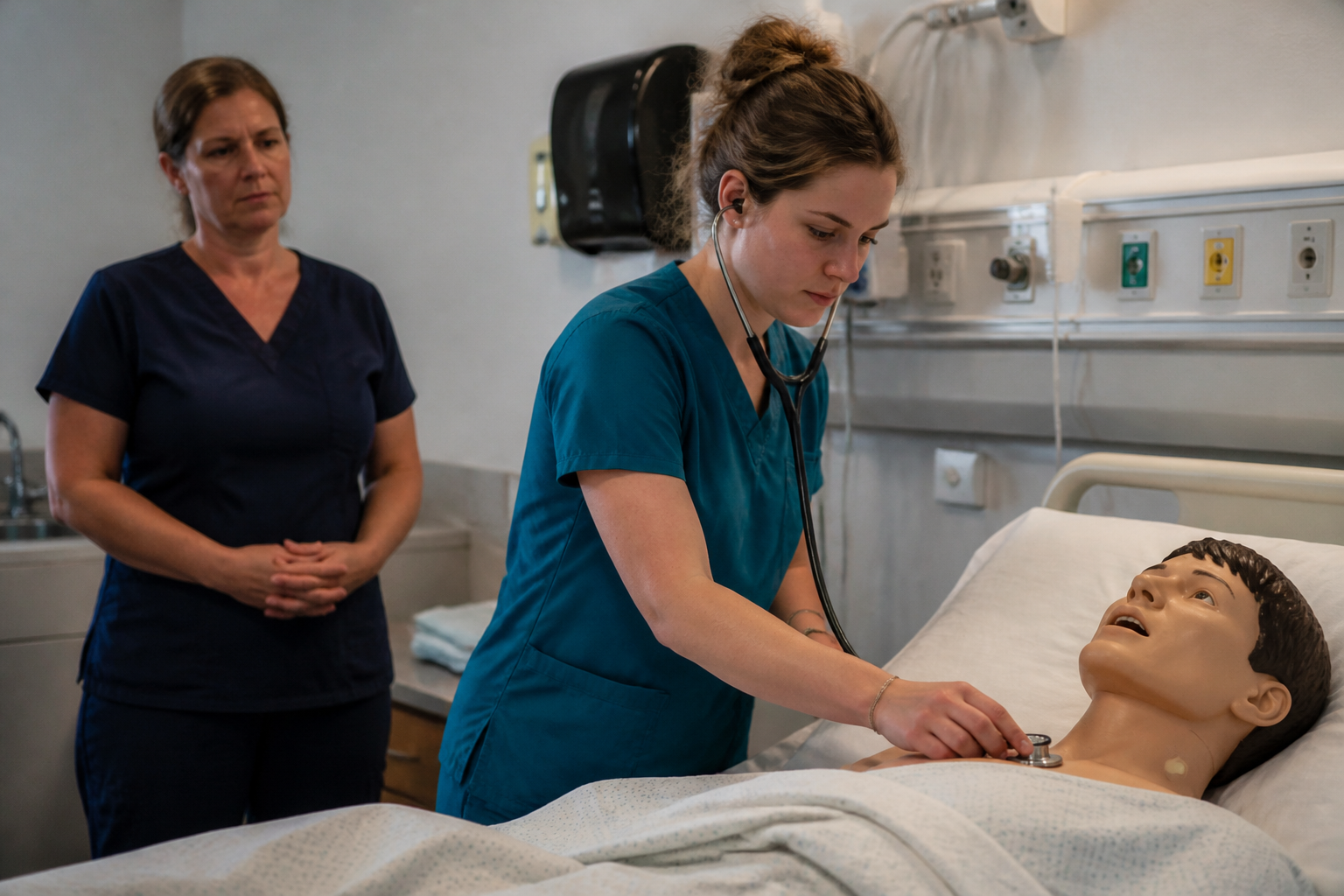
An accelerated BSN is a second-degree nursing program. You start with a bachelor's in a different field, and the school compresses the nursing coursework and clinical hours into as little as 12 months; some Virginia tracks run to two years. Graduates earn a BSN and qualify to take the NCLEX-RN.
Cost is where the programs diverge most. Published in-state tuition ranges from $12,548 at Radford University to $43,920 at Eastern Mennonite University.
Cohorts are small, science prerequisites are strict, and start dates are limited, so a seat is often harder to secure than the money.
Key Points
- George Mason's ABSN runs 12 months and requires a 2.85 GPA.
- Radford, George Mason and UVA post net prices of $14,578 to $21,565.
- Only Virginia Board of Nursing approved programs qualify graduates for the NCLEX-RN.
Best Accelerated BSN Schools in Virginia: Our Ranking
Ten Virginia institutions appear below, ranging from a hospital-run college in Newport News to public flagships in Charlottesville and Fairfax. Each card lists the city, the delivery format, in-state tuition, the average net price after aid for the whole institution, and the share of students who graduate. Read that graduation figure as a campus-wide number, not as a completion rate for the nursing program itself.
University of Virginia
#1Charlottesville, VA · $22,000/yr (est. net price)
Best for: Academic high achievers targeting research hospitals
The University of Virginia is the commonwealth's flagship public research university, set in Charlottesville beside its own academic medical center. Nursing students work inside a school with deep faculty resources, and the wider institution graduates 96% of its students, the strongest outcome in this ranking. In-state tuition is moderate for a flagship and the surrounding hospital system gives students a large clinical environment. It suits strong students who want a research university name and a major medical center in the same place.
- 120 total credit hours
- Two summer sessions built into the sequence
- Close-knit cohort with faculty mentoring
- Interprofessional focus across diverse patient populations
- Clinical rotations at partner sites across the region
- ACEN accredited
Riverside College of Health Sciences
#2Newport News, VA · $21,000/yr (est. net price)
Best for: Hands-on learners who prefer hospital-run colleges
Riverside College of Health Sciences is a small, hospital-based institution in Newport News run by Riverside Health System, so classrooms, simulation labs and clinical units sit inside one organization. Cohorts are tiny compared with a public university, and instruction runs on a daytime schedule with occasional evening or weekend hours. The trade-off is a narrower campus life and a single-system clinical network. It suits readers who learn best at the bedside and want to be hired into the system where they trained.
- 75 core nursing credits after prerequisite work
- Clinical placements at Riverside's medical center and affiliates
- Daytime classes with occasional evening or weekend hours
- Advanced placement option for licensed practical nurses
- Total program tuition quoted at $34,500
- Approved by the Virginia Board of Nursing
- ACEN accredited
George Mason University
#3Fairfax, VA · $15,000 – $20,000/yr (est.)
Best for: Second-degree students wanting D.C.-area clinical sites
George Mason University is a large public research university in Fairfax with one of the biggest nursing footprints in Virginia and clinical placements threaded through the National Capital region. The accelerated track draws on hospitals across Northern Virginia and the District, and scholarships flow through the College of Public Health and the School of Nursing. Roughly 68% of students graduate institution-wide, and the average net price after aid sits below the private options on this list. It suits second-degree students who want metro hospital networks at Virginia public tuition.
- Clinical sites across the National Capital area
- Skill lab and simulation hours included
- Scholarships through the College of Public Health and School of Nursing
- Weekly online Q&A hours with program staff
- CCNE accredited
Liberty University
#4Lynchburg, VA · ~$29,000/yr (est.)
Liberty University in Lynchburg is one of the largest private nonprofit universities in Virginia, with a residential campus, a national online operation and a nursing school approved by the state board. About two in three students graduate, and published tuition sits below the other private universities here even though the average net price after aid lands higher once housing and fees are counted. The culture is explicitly Christian, with faith integrated into coursework and a simulation center certified by the Society for Simulation in Healthcare. It suits students who want a structured campus cohort inside a large, religiously grounded institution.
- 126 total credit hours
- Over 550 hours of supervised clinical practice
- Simulation center accredited by the Society for Simulation in Healthcare
- Transfer up to 75% of prior college credits
- Faith-integrated curriculum with evidence-based practice
- CCNE accredited and Virginia Board of Nursing approved
Eastern Mennonite University
#5Harrisonburg, VA · $25,000/yr (est. net price)
Eastern Mennonite University is a small private university in Harrisonburg with a Mennonite heritage and a long commitment to service and intercultural learning. Nursing classes stay small, faculty mentoring is a stated priority, and clinical placements come from the Shenandoah Valley. About 67% of students graduate, and the published tuition is the highest sticker price in this ranking, though grant aid pulls the average net price down sharply. It suits readers who want a tight cohort, personal attention and a values-driven campus.
- Small summer cohort with one-on-one faculty mentoring
- Clinical rotations across varied care settings
- Intercultural learning built into the curriculum
- CCNE accredited
Shenandoah University
#6Winchester, VA · $30,000/yr (est. net price)
Shenandoah University is a private university based in Winchester with a second health professions site in Loudoun County that puts students closer to the Washington suburbs. The nursing school holds clinical partnerships with Valley Health, Inova and Johns Hopkins, and small classes come with faculty advisors and free peer tutoring. About 67% of students graduate, and the average net price after aid is the highest in this ranking. It suits readers in northern and western Virginia who want hospital variety and a smaller campus.
- Instruction on campuses in Winchester and Loudoun
- Clinical partnerships with Valley Health, Inova and Johns Hopkins
- Rolling admissions review throughout the year
- NCLEX preparation course in the final semester
- Capstone required for graduation
- Small classes with faculty advisors and free peer tutoring
- Employer tuition reimbursement supported
- CCNE accredited
Hampton University
#7Hampton, VA · $25,000 – $30,000/yr (est.)
Hampton University is a historically Black university on the Virginia Peninsula with a long nursing tradition and a growing online division. The accelerated nursing options listed here are delivered fully online in eight-week sessions, and about 57% of students graduate institution-wide. These online tracks are built around licensed registered nurses returning for a BSN, so readers who do not yet hold an RN license should weigh them differently from the campus-based programs above. It suits working nurses who want a Hampton degree without a commute.
- Fully online format with 8-week course sessions
- 120 total credit hours
- Full-time and part-time enrollment options
- Transfer credits accepted
- Nursing program accredited by ACEN and CCNE
- Two-year online track that includes summer semesters
- Paced for students who need a longer sequence
- Financial aid available with a listed FAFSA school code
Radford University
#8Radford, VA · $15,000/yr (est. net price)
Radford University is a public university in the New River Valley with a nursing school that leans on simulation and trauma-center placements. In-state tuition is the lowest in this ranking and the average net price after aid is lower still, which makes it the value pick for Virginia residents. About 49% of students graduate institution-wide, a reminder to weigh nursing program outcomes separately from the campus average. It suits cost-conscious students who want public tuition and Level 1 trauma experience.
- Over 500 direct patient care hours
- Clinical rotations at Level 1 and Level 2 trauma centers
- On-campus Clinical Simulation Center
- CCNE accredited
Marymount University
#9Arlington, VA · ~$29,000/yr (est.)
Marymount University is a private Catholic university in Arlington, minutes from the District line, with clinical ties to Inova, MedStar, Virginia Hospital Center and Children's National. The nursing school runs both a campus track and an online track, and small student-to-faculty ratios are a stated selling point. About 54% of students graduate, and the average net price after aid sits near $29,000. It suits readers who want Northern Virginia hospital access inside a smaller, teaching-focused campus.
- Online theory paired with on-ground simulation labs
- Clinical partnerships with Inova and MedStar
- Full-time and part-time options
- Application fee waived for early applicants
- Commitment to diversity and social justice
- Coursework delivered online with regional clinical placements
- Clinical partners include Inova, MedStar and other area systems
- Scholarships available to enrolled students
- State-of-the-art simulation labs for skills checks
ECPI University
#10Virginia Beach, VA · $23,000/yr (est. net price)
ECPI University is a private, career-focused institution headquartered in Virginia Beach, with campuses across the Southeast and a nursing school built for hands-on training. Admission is less selective than at the public flagships here, and about 42% of students graduate institution-wide. Tuition is modest for a private university, and the simulation-heavy curriculum is taught entirely on campus. It suits readers in Hampton Roads or Richmond who want a practical private option rather than a traditional residential campus.
- On-campus only; nursing courses are not offered online
- High-fidelity simulation training
- 180 total credit hours across 22 courses
- Clinical rotations across diverse care settings
- Leadership, community health and nursing research coursework
- Campus locations in Virginia Beach and Richmond
- Accredited by ACEN and CCNE; institution accredited by SACSCOC
Cost & outcomes by school
Federal data for the highest-earning Accelerated BSN (ABSN) programs, independent of the ranking above. Earnings are this field's bachelor's graduates four years after completing where the Scorecard reports them, else the school's undergraduate median.
| School | Net price / yr | Grad rate | Earnings | Debt | Grads/yr | Format |
|---|---|---|---|---|---|---|
| University of Virginia VA | $21,565 | 96% | $86,863 | $17,500 | 10,898 | Campus |
| George Mason University VA | $17,915 | 68% | $76,343 | $19,500 | 12,566 | Campus |
| Marymount University VA | $29,137 | 54% | $67,516 | $25,000 | 832 | Campus |
| Riverside College of Health Sciences VA | $20,744 | 100% | $66,072 | $14,787 | 44 | Campus |
| Hampton University VA | $25,319 | 57% | $59,159 | $25,442 | 978 | Online |
| Shenandoah University VA | $30,298 | 67% | $58,433 | $25,000 | 1,170 | Campus |
| Eastern Mennonite University VA | $24,588 | 67% | $54,869 | $24,813 | 450 | Campus |
| Radford University VA | $14,578 | 49% | $53,739 | $24,000 | 2,740 | Campus |
| Averett University VA | $22,925 | 48% | $51,516 | $25,000 | 554 | Hybrid |
| Liberty University VA | $29,357 | 65% | $44,813 | $24,500 | 21,932 | Campus |
| ECPI University VA | $22,965 | 43% | $42,837 | $20,000 | 2,986 | Campus |
Sources: U.S. Department of Education. Net price, graduation rate, earnings and debt: College Scorecard (earnings and debt for this field's bachelor's graduates where reported, else school-wide); graduates: IPEDS. A dash means no figure is reported.
Cost, debt & payoff
Median earnings of this field's bachelor's graduates (4 yrs after completing, else the school's undergraduate median) vs. their median federal loan debt · U.S. College Scorecard
Across these programs the median graduate earns about $59,159 and finishes with roughly $24,813 in debt — a ratio that clears a common rule of thumb (keep debt below first-year salary). Net price and debt vary widely school to school, so check the per-school figures in the table above before you shortlist.
Our Method for Scoring Virginia Second-Degree Nursing Programs
The list weighs what a career changer actually pays and earns against how hard each program is to get into. A cheap program you cannot enter, or an open-admission program that leaves you with heavy debt, is not a good deal.
What Goes Into the Score
- Cost: College Scorecard net price and published in-state tuition show what a student pays after aid, not just the sticker price.
- Earnings and debt: Program-level earnings and median debt for nursing graduates are used where they are published, so the focus stays on the nursing credential rather than the whole campus.
- Completions: The number of nursing graduates shows how established a program is.
- Selectivity: Admissions rate signals how competitive entry is. The spread is wide: Riverside College of Health Sciences and the University of Virginia admit a small share of applicants, while Liberty University and Eastern Mennonite University admit nearly everyone who applies.
Limits of the Data
Treat these figures as a starting point. Net price, graduation rate and admissions rate describe the whole institution, not the accelerated nursing cohort alone. A school's undergraduate averages may differ from what a second-degree student sees. Every figure comes from the latest Scorecard snapshot available, and some measures trail current tuition by a year or more. Check each school's own page for current costs before you budget.
What Is Not Scored
NCLEX-RN pass rates and accreditation are not ranking inputs. Both matter a great deal, but they are better checked directly with the Virginia Board of Nursing and the accrediting bodies. The licensure section below shows how to verify each one before you apply.
Cheapest Accelerated BSN Options in Virginia
Sector drives these numbers: the state universities here (Radford, George Mason and the University of Virginia) post average net prices of $14,578 to $21,565 after aid, while private Riverside College of Health Sciences and Averett University come in at $20,744 and $22,925. Each figure is a school-wide average from 2024 IPEDS and College Scorecard data, not a quote for any one ABSN student, so your actual price depends on the grants and scholarships you receive. Check the city and format before you commit, and note that Averett's hybrid ABSN lists Norfolk as its program location even though the university is based in Danville.
| School | City | Sector | Format | Program Length (School-Reported) | Cost | Cost Basis |
|---|---|---|---|---|---|---|
| Radford University | Radford | Public | Campus | 16 months | $14,578 | Average net price after aid |
| George Mason University | Fairfax | Public | Campus | 12 months | $17,915 | Average net price after aid |
| Riverside College of Health Sciences | Newport News | Private nonprofit | Campus | 2.5 years | $20,744 | Average net price after aid |
| University of Virginia | Charlottesville | Public | Campus | 2 years | $21,565 | Average net price after aid |
| Averett University | Danville | Private nonprofit | Hybrid | 16 months | $22,925 | Average net price after aid |
Do You Need a Finished Bachelor's? Degree Rules at Virginia ABSN Programs
George Mason University's Accelerated Second Degree BSN requires a bachelor's degree in a non-nursing field from a regionally accredited U.S. institution, with a minimum 2.85 GPA, earned before the program starts.
Programs That Require a Finished Bachelor's
- George Mason: prior bachelor's required, with no credits-only substitute. Applicants are admitted as degree-seeking Mason undergraduates, and a bachelor's holder without an RN is steered to the accelerated track rather than the traditional one.
- ECPI University: presents its ABSN as built for bachelor's degree holders, delivered year-round across 120 credit hours, eight semesters, or 30 months.
- Liberty University: lists a second bachelor's degree track among the features of its accelerated pre-licensure BSN.
The labels are a clue in themselves. "Accelerated Second Degree," "Accelerated Transfer," and "Accelerated Pre-Licensure" all show up in Virginia program names, and a transfer label usually signals room for applicants whose first degree is unfinished or whose credits come from elsewhere.
Where Transfer and Second-Degree Pathways Widen the Door
Radford University runs both an accelerated pathway and a second-degree BSN option, and transfer students with at least a 3.0 cumulative GPA can enter Pre-Nursing with advising. That is the clearest alternative here for someone still finishing a first degree.
Confirm When Your Degree Must Post
Deadlines are the part admissions pages leave vague. Ask three questions in writing: the date your bachelor's must post to your transcript, whether an in-progress degree is acceptable at application, and whether your transcript needs a course-by-course credential evaluation. George Mason's regionally accredited U.S. institution language makes that last question urgent if your degree came from outside the country or from a school without regional accreditation.
Prerequisite Courses, GPA and TEAS Policies for Virginia ABSN Applicants
Requirements vary by school, so confirm each item on the program's own admissions page before you apply. Use this checklist to see where you stand.
- Prior degree or creditsShenandoah University's accelerated second-degree track is for non-nursing bachelor's holders. Averett University accepts a non-nursing bachelor's or at least 60 non-nursing credits from a regionally accredited school. The University of Virginia's two-year transfer program asks for 52 general education credits, prerequisites included, by the end of the spring before enrollment.
- Anatomy and Physiology I and IIA&P I and II are core prerequisites at UVA, which requires the lab, and at Averett.
- MicrobiologyBoth UVA and Averett list microbiology among their required science courses.
- Chemistry and mathUVA requires chemistry. Averett's general education list includes Principles of Mathematics.
- Developmental psychologyUVA requires Lifespan Development, and Averett requires Developmental Psychology.
- Minimum GPA and gradesAverett sets a 2.8 cumulative GPA across all prior schools. Radford University requires a 3.25 cumulative GPA and allows no more than one prerequisite repeat. UVA requires a C or better in each prerequisite. Many Virginia programs expect a 3.0 or higher and B grades in prerequisites.
- Course recencyMany Virginia ABSN programs want science prerequisites completed within the past 5 to 10 years. Check each school's limit.
- Entrance examAverett requires the TEAS with a proficient score. Radford will require the ATI TEAS for upper-division admission beginning Fall 2029.
Related Articles
ABSN Pace and Cost in Virginia: What 12 to 18 Months of Full-Time Study Really Costs
The sticker price on a Virginia ABSN tells you less about your real cost than the number of months you spend unable to hold a job.
Published Tuition vs. Average Net Price
Two cost figures appear in most school research, and they measure different things. Published tuition is the rate a school charges before aid. Annual in-state tuition at the schools ranked here runs from $12,548 at Radford University to $43,920 at Eastern Mennonite University. Public universities charge nonresidents much more: Radford's out-of-state rate is $25,633, George Mason University's is $38,688 and the University of Virginia's is $61,591. The private schools on this list charge one rate regardless of residency.
Average net price is lower because it subtracts grants and scholarships. It is also a school-wide annual figure for first-time, full-time undergraduates, not a program total for second-degree nursing students. It ranges from $14,578 at Radford to $30,298 at Shenandoah University. Career changers who already hold a degree may qualify for less grant aid, so treat net price as a starting point, not a quote.
Some schools publish a program total instead. Riverside College of Health Sciences publishes $34,500 in total program tuition for its 75-credit, 2.5-year track. UVA adds fees on top of tuition, including a $656 clinical services fee, $100 per credit in clinical and laboratory fees, and $4,220 for student health insurance if you lack coverage.
Pace Shapes the Price
George Mason runs a 12-month program, while ECPI University's year-round track takes 30 months. Eastern Mennonite and Shenandoah take 15 months, while Radford, Averett University and Marymount University take 16. Liberty University runs 19 months and UVA two years. A shorter program means fewer months of rent, but the full-time load of classes, labs and clinical rotations leaves little room for paid work. Budget living costs for the entire program without counting on outside income.
Paying for It
- Federal aid: Pell Grants are generally reserved for students who have not yet earned a bachelor's degree, so federal loans are the main federal option for second-degree students. Confirm your eligibility with each school's aid office.
- School and employer support: George Mason, Marymount and Shenandoah advertise scholarships, and Shenandoah notes support for employer tuition reimbursement.
- Debt at completion: Median debt among nursing bachelor's completers ranges from $13,000 at George Mason to $26,000 at Liberty. These medians describe graduates only and include traditional BSN completers, not just accelerated students.
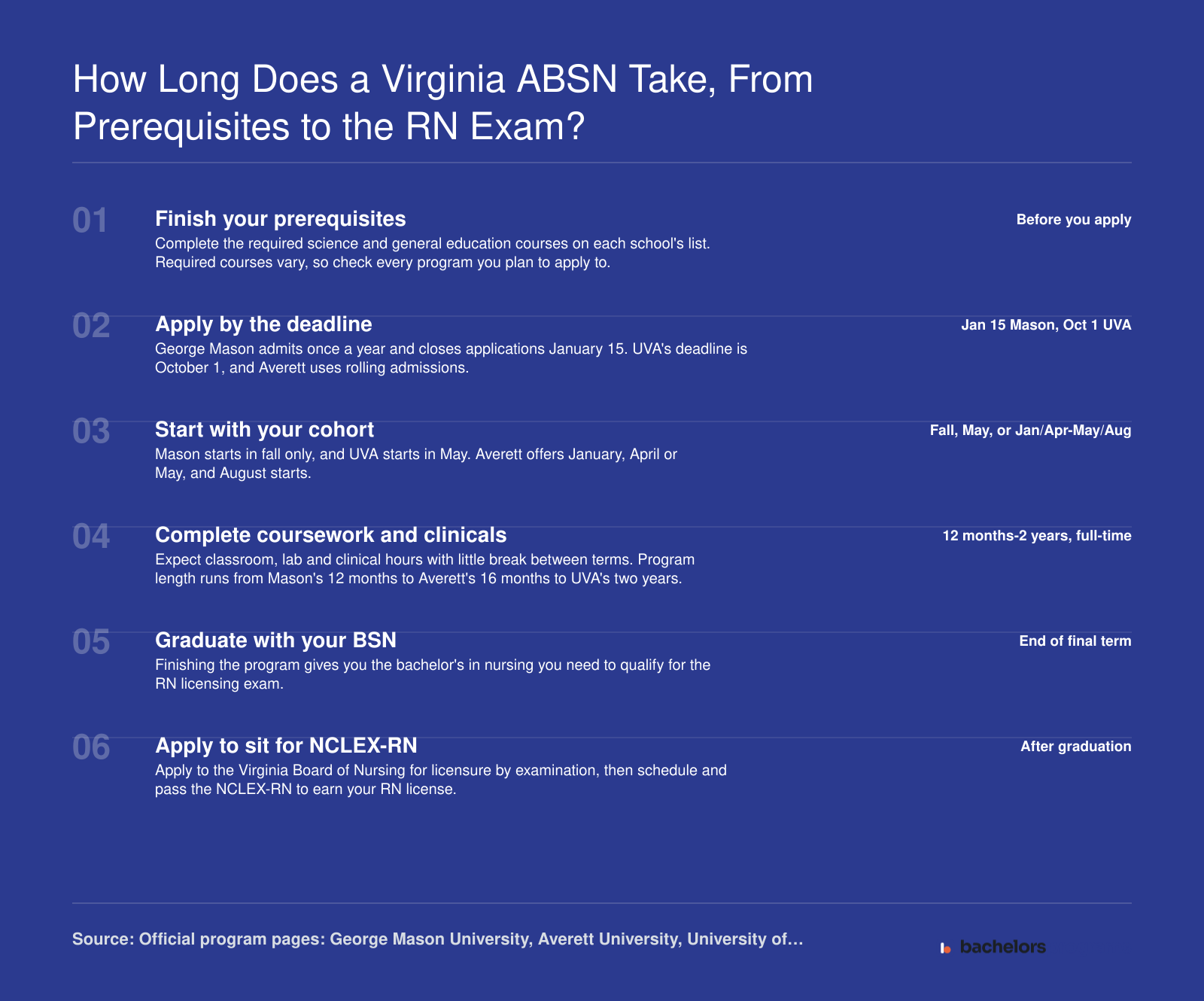
How Long Does a Virginia ABSN Take, From Prerequisites to the RN Exam?
George Mason University runs the shortest track here at 12 months of full-time study. Averett University takes as few as 16 months across four semesters. The University of Virginia's transfer track is the longest at two years, including two summers, and it is built for students who have not finished a bachelor's degree.
Virginia Board of Nursing Approval and NCLEX-RN Licensure for ABSN Graduates
Virginia Board of Nursing approval is the state's permission for a school to run a prelicensure nursing program, and graduating from an approved program is what makes you eligible for the NCLEX-RN. An ABSN from an unapproved program will not lead to a Virginia RN license. The Board also holds programs to a standard: at least an 80% first-time NCLEX-RN pass rate across the past four quarters of graduates each calendar year. A program that falls short can face a correction plan, then conditional approval, and eventually withdrawal of approval.
Accreditation Is a Separate Check
CCNE or ACEN accreditation is voluntary and comes from a separate body, not the Board. It does not decide NCLEX eligibility, but it matters if you later want an MSN or DNP, and some employers look for it. Radford University lists CCNE accreditation for its baccalaureate nursing program. For the other schools here, including Shenandoah University and the University of Virginia, confirm the accrediting body on each nursing page before you apply.
Reading the Published Pass Rates
- Shenandoah University: 97.9% as a three-year weighted average across 319 test takers. The reporting year is not stated.
- University of Virginia: 95% for the Class of 2024. A separate 2025 compilation lists 85.05%. The sources do not explain the gap, so ask the school which cohort each number covers.
- Radford University: The school reports 96% with no year attached. A 2025 compilation lists 100% for 27 accelerated BSN test takers at its Carilion campus, which may not represent the main campus.
For current figures at any school, check the Board's annual report rather than relying on a marketing page.
Why Institution-Level Rates Matter
The Board may report results by institution rather than by ABSN track. That means a school's published rate can blend traditional BSN graduates with accelerated students. It is still a useful signal, but it is not a clean measure of the accelerated cohort. Ask each admissions office whether it can share ABSN-specific results and how many graduates are behind the number.
Steps After Graduation
- Apply to the Board: Submit your licensure by examination application and fee once your program confirms completion.
- Complete the background check: Fingerprinting is part of the Board's review.
- Register with Pearson VUE: Sign up and pay for the NCLEX-RN, then schedule your exam once the Board confirms your eligibility and you receive authorization to test.
Virginia RN Licensure at a Glance
Compare Accelerated BSN (ABSN) programs on the data that matters
Explore more Nursing majors or browse every field of study.
All Nursing programs Browse every field of study