Best BSN Programs in Virginia
Compare 38 accredited Bachelor of Science in Nursing (BSN) programs in Virginia at 33 colleges, with net price after aid, graduation rates, earnings and debt from IPEDS and the U.S. College Scorecard.
Virginia's pre-licensure BSN programs now compete on licensing-exam results as much as reputation. Longwood University posts a 100 percent first-time NCLEX-RN pass rate, yet prices diverge sharply: Shenandoah University lists $36,950 in tuition and fees, versus Longwood's $15,744 in-state. Entry models split too, between direct freshman admission and reapplying after prerequisites.
The schools ranked here offer campus-based, Virginia Board of Nursing approved traditional BSN programs, ordered by first-time NCLEX-RN performance. Licensed RNs belong on the RN-to-BSN route and second-degree students on the accelerated BSN, each with its own page.
A top pass rate helps only if you can win a seat and pay for it.
Key Points
- Shenandoah University's traditional BSN posts the highest median first-year earnings here.
- NCLEX-RN fees total $390: $190 to the Board, $200 to Pearson VUE.
- Virginia licensure requires a Board-approved program with 500 direct client-care hours.
Virginia BSN Schools With the Strongest NCLEX-RN Results: 10 Ranked
These Virginia schools are ordered by how their traditional BSN graduates have performed on the NCLEX-RN, using first-time pass results across the most recent three years reported. Nine of the ten offer a pre-licensure bachelor's program you can enter as a first-time college student; one hospital-based college listed here offers only an online RN-to-BSN completion route, and its card says so. Accelerated and completion tracks are noted in passing where a school runs them, since those serve second-degree students and licensed nurses instead.
Longwood University
#1Farmville, VA · ~$19,000/yr (est.) · NCLEX-RN pass rate 100% (3-yr weighted avg)
Best for: High school seniors entering nursing directly
A public university in Farmville, in south-central Virginia, where freshmen are admitted straight into the nursing major instead of competing for a seat later. The four-year BSN mixes classroom theory with simulation and community clinical work. About 90% of applicants are accepted, the school's overall graduation rate is 61%, and in-state tuition near $15,700 a year nets out to roughly $19,100 after aid.
- CCNE accredited and approved by the Virginia Board of Nursing
- Direct admission for freshmen entering the four-year track
- Service-learning and community engagement threaded through the curriculum
- Emphasis on patient advocacy, care coordination and complex health systems
- Scholarships available for nursing students
Shenandoah University
#2Winchester, VA · $30,000/yr (est. net price) · NCLEX-RN pass rate 97.9% (3-yr weighted avg)
Best for: Simulation-focused learners on a small campus
A private university in Winchester, at the northern end of the Shenandoah Valley, with a traditional four-year BSN that puts students in nursing coursework during the first year. Small classes, high- and low-fidelity simulation labs and clinical rotations at regional hospitals give students early patient contact. About 77% of applicants are admitted, tuition runs roughly $37,000 with an average net price near $30,300 after aid, and the school's overall graduation rate is 67%.
- 121 credit hours over four years on the Winchester campus
- Direct admittance as a first-year student with a nursing faculty advisor
- TEAS entrance exam required; rolling admissions
- High- and low-fidelity simulation labs plus regional hospital clinicals
- NCLEX prep course in the final semester; senior capstone required
- All Apple technology program with small class sizes
James Madison University
#3Harrisonburg, VA · ~$23,000/yr (est.) · NCLEX-RN pass rate 96.5% (3-yr weighted avg)
Best for: In-state students seeking a large public cohort
A public university in Harrisonburg where the traditional pathway produces the largest BSN testing cohort on this list, more than 640 graduates across the three years reported. Licensed nurses have a separate online RN-to-BSN completion route that runs three semesters full time. About 72% of applicants are admitted, in-state tuition is roughly $14,250, and the school's overall graduation rate is 80%.
- Traditional Pathway for pre-licensure BSN students
- Largest NCLEX-RN testing cohort among the Virginia schools listed
- Additional nursing course fees are charged beyond standard tuition
Liberty University
#4Lynchburg, VA · ~$29,000/yr (est.) · NCLEX-RN pass rate 96.9% (3-yr weighted avg)
A private Christian university in Lynchburg, in central Virginia, with a large residential BSN and an unusually open admissions posture: about 99% of applicants are accepted and no entrance exam is required. Clinical hours begin in the sophomore year and total 800, with sites in Richmond and Roanoke as well as locally. Tuition is about $15,300, net price after aid about $22,500, and the school's overall graduation rate is 65%.
- 122 credit hours; nursing courses concentrated in the junior and senior years
- 800 clinical hours starting in the sophomore year
- No entrance exam required and no set admission minimums
- CCNE accredited and approved by the Virginia State Board of Nursing
- 14,000-square-foot simulation center; clinical sites in Richmond and Roanoke
- Global and intercultural engagement concentration available
Old Dominion University
#5Norfolk, VA · $13,000 – $34,000/yr (est.) · NCLEX-RN pass rate 95.8% (3-yr weighted avg)
A public university in Norfolk, in Hampton Roads, with a five-semester pre-licensure BSN that runs fall, spring and summer starts and places students in area hospitals for clinical work. A simulation center and telehealth center anchor the hands-on training, and community partnerships extend clinical experience into public health settings. In-state tuition is about $7,800 a year and the average net price after aid is roughly $14,600; the school's overall graduation rate is 46%.
- Five-semester pre-licensure program; starts fall, spring or summer
- 3.0 GPA minimum plus prerequisite courses
- Small clinical sections with placements in all area hospitals
- On-campus simulation center and telehealth center
- CCNE accredited; military benefits accepted
Virginia Commonwealth University
#6Richmond, VA · ~$23,000/yr (est.) · NCLEX-RN pass rate 94.3% (3-yr weighted avg)
A public research university in Richmond with a three-year, full-time traditional BSN that moves students into clinical settings early, including the Magnet-designated VCU Medical Center. The surrounding network of urban, community and rural sites gives students a wide range of patient populations. About 93% of applicants are admitted, in-state tuition is roughly $13,200, net price after aid about $23,400, and the school's overall graduation rate is 63%.
- Three-year, full-time, in-person traditional BSN
- Clinicals at the Magnet-designated VCU Medical Center and community sites
- Prerequisite courses required; at least two letters of recommendation
- CCNE accredited; $65 application fee
Bon Secours Memorial College of Nursing
#7Richmond, VA · NCLEX-RN pass rate 93.2% (3-yr weighted avg)
A small hospital-based college in Richmond, part of the Bon Secours health system, which secures clinical placements for students at its affiliated facilities rather than leaving them to find their own. The five-semester BSN blends online coursework with on-site classes and starts twice a year. Tuition is about $13,800, and Bon Secours employees who commit to working as RNs after graduation can have tuition fully covered.
- Five-semester program with two start dates per year
- Hybrid format: online coursework plus on-site classes
- 2.5 GPA minimum and 46 prerequisite general education credits
- College secures all clinical placements at affiliated facilities
- Full tuition coverage for Bon Secours employees who commit to RN service
- CCNE accredited
University of Virginia
#8Charlottesville, VA · $22,000/yr (est. net price) · NCLEX-RN pass rate 91.9% (3-yr weighted avg)
A public research university in Charlottesville, in central Virginia, whose School of Nursing runs a four-year BSN for students applying from high school plus transfer and accelerated routes for other applicants. Admission is the most selective here: about 17% of applicants are accepted, roughly 3,000 students compete for about 90 first-year seats, and the school's overall graduation rate is 96%. In-state tuition is roughly $21,800 and the average net price after aid is about $21,600.
- 120 credit hours; apply directly from high school
- Clinical rotations in five specialty areas plus a semester-long practicum
- 10,000-square-foot Clinical Simulation Learning Center
- Exchange program in Brisbane and summer clinical hours in Roatan, Honduras
- About 3,000 applicants compete for roughly 90 first-year spots
- Transfer route: 120 credits over six semesters
- Clinical practice begins in the second year
- Interprofessional learning alongside medical students
- Study abroad option in Australia or New Zealand
- Second-degree route completed in two years, starting each summer
- Cohort structure with two summer sessions built in
- Prerequisite courses required before entry
Centra College
#9Lynchburg, VA · ~$13,000/yr (est.) · NCLEX-RN pass rate 91.1% (3-yr weighted avg)
A hospital-affiliated college in Lynchburg whose baccalaureate nursing offering is a fully online RN-to-BSN completion program for licensed registered nurses, not a pre-licensure track. Students can finish in 12 months of full-time study or spread coursework over two years while working. Tuition is about $8,600, the lowest of the schools listed here, and coursework covers leadership, community health and evidence-based practice. Readers looking for a first BSN should look at the pre-licensure programs above.
- 100% online for licensed registered nurses
- Finish in 12 months full time or two years part time
- Open to Virginia residents
- Coursework in leadership, community health and evidence-based practice
Norfolk State University
#10Norfolk, VA · ~$15,000/yr (est.) · NCLEX-RN pass rate 92.5% (3-yr weighted avg)
A public historically Black university in Norfolk, in Hampton Roads, with a pre-licensure BSN built on two years of prerequisites followed by five semesters of nursing coursework. Four simulation labs and hospital partnerships support 857 clinical hours, and the program reports full job placement within 60 days of graduation. About 88% of applicants are admitted, in-state tuition is roughly $10,200, net price after aid about $15,300, and the school's overall graduation rate is 39%.
- 121 credit hours: two years of prerequisites plus five nursing semesters
- 857 clinical hours across four simulation labs and hospital partners
- HESI entrance exam required
- Doctoral-level faculty teaching small classes
- Program reports 100% job placement within 60 days of graduation
Cost & outcomes by school
Federal data for the highest-earning Bachelor of Science in Nursing (BSN) programs, independent of the ranking above. Earnings are this field's bachelor's graduates four years after completing where the Scorecard reports them, else the school's undergraduate median.
| School | Net price / yr | Grad rate | Earnings | Debt | Grads/yr | Format |
|---|---|---|---|---|---|---|
| Chamberlain University-Virginia VA | $33,199 | 100% | $92,405 | $20,919 | 288 | Campus |
| University of Virginia VA | $21,565 | 96% | $86,863 | $17,500 | 10,898 | Campus |
| Sentara College of Health Sciences VA | — | — | $77,821 | $19,450 | 180 | Campus |
| Bon Secours Memorial College of Nursing VA | — | — | $77,014 | $26,500 | 416 | Hybrid |
| George Mason University VA | $17,915 | 68% | $76,343 | $19,500 | 12,566 | Campus |
| Marymount University VA | $29,137 | 54% | $67,516 | $25,000 | 832 | Hybrid |
| Riverside College of Health Sciences VA | $20,744 | 100% | $66,072 | $14,787 | 44 | Campus |
| University of Mary Washington VA | $20,667 | 66% | $60,613 | $20,500 | 1,786 | Hybrid |
| Centra College VA | — | 100% | $60,122 | $15,250 | 24 | Online |
| Hampton University VA | $25,319 | 57% | $59,159 | $25,442 | 978 | Online |
| Randolph-Macon College VA | $27,866 | 71% | $58,448 | $27,000 | 716 | Campus |
| Shenandoah University VA | $30,298 | 67% | $58,433 | $25,000 | 1,170 | Campus |
Sources: U.S. Department of Education. Net price, graduation rate, earnings and debt: College Scorecard (earnings and debt for this field's bachelor's graduates where reported, else school-wide); graduates: IPEDS. A dash means no figure is reported.
Cost, debt & payoff
Median earnings of this field's bachelor's graduates (4 yrs after completing, else the school's undergraduate median) vs. their median federal loan debt · U.S. College Scorecard
Across these programs the median graduate earns about $55,647 and finishes with roughly $24,250 in debt — a ratio that clears a common rule of thumb (keep debt below first-year salary). Net price and debt vary widely school to school, so check the per-school figures in the table above before you shortlist.
Why NCLEX-RN Performance Drives This Virginia BSN List
A national reputation tells you what other nursing educators think of a school. A first-time NCLEX-RN result tells you whether its graduates walked into the licensing exam ready to pass. For a prospective nurse in Virginia, the second signal matters more, because no one practices as an RN without clearing that exam.
What the Ranking Rewards
The order of the schools above leans on first-time NCLEX-RN performance as reported by the state board, with accreditation and student completion playing supporting roles. Each school's pass rate appears on its ranking card, so you can compare them directly. Cost, net price and early earnings matter too, but they get their own sections and tables rather than shaping the order.
What Falls Outside This List
Only traditional pre-licensure BSN programs are ranked here. Several other routes exist, and each has its own page:
- RN-to-BSN: the route for nurses who already hold an RN license.
- Accelerated BSN: the route for career changers with a prior bachelor's degree.
- ADN and graduate programs: separate credentials that are not ranked here.
How U.S. News Differs
U.S. News & World Report's 2027 undergraduate nursing ranking, released in September 2026, rests entirely on a peer assessment survey1. Deans and senior faculty rated programs they knew on a 1-to-5 scale2. Of 1,236 program leaders surveyed, 351 responded, a 28.4% response rate2.
Three schools on this page placed in that edition. University of Virginia tied at No. 12 nationally and tied at No. 10 among public schools. Virginia Commonwealth University tied at No. 27 after climbing 13 positions3, and James Madison University placed No. 56 after a 42-position jump.4 Treat those placements as useful context on reputation, and lean on NCLEX results when you judge licensure readiness.
Lowest Net Price BSN Schools for Virginia Residents
For the cheapest BSN programs in Virginia for in-state students, this table sorts by average annual net price after grants and scholarships, according to 2024 IPEDS and College Scorecard data from the U.S. Department of Education, with in-state tuition beside it. Net price is an institution-wide average that also counts housing, food and other living costs, so it can run above tuition (Norfolk State University has the lowest tuition here but not the lowest net price), and it is not a quote for any one student. Every school in this table is public, because state funding lets Virginia's public universities charge residents far less than private colleges, and the median debt figure covers all of a school's completers, not nursing graduates alone.
| School | City | Sector | Average Net Price After Aid (institution-wide) | In-State Tuition and Fees | Median Completer Debt (institution-wide, not nursing-specific) | NCLEX-RN Pass Rate |
|---|---|---|---|---|---|---|
| University of Virginia's College at Wise | Wise | Public | $9,210 | $11,780 | $16,750 | 84.8% |
| Radford University | Radford | Public | $14,578 | $12,548 | $24,000 | 90.9% |
| Old Dominion University | Norfolk | Public | $14,638 | $12,750 | $24,000 | 95.8% |
| Norfolk State University | Norfolk | Public | $15,282 | $10,180 | $29,000 | 92.5% |
| George Mason University | Fairfax | Public | $17,915 | $14,220 | $19,500 | 82.7% |
What a BSN Costs in Virginia After Tuition, Aid and State Grants
Sticker price and the price you actually pay can sit far apart, and the gap between public and private schools is often smaller than list rates suggest. Start with the published numbers, then work toward your own net cost.
Published In-State Prices
The University of Virginia lists a 2026-27 Virginia-resident BSN total of $25,637: tuition of $21,671 plus comprehensive and student activity fees.1 Its financial aid pages also note nursing lab fees of $100 per credit and a clinical services fee of $354 for the BSN.2 James Madison University publishes in-state undergraduate tuition and fees of $14,768 for 2026-27, but that is a general undergraduate figure.3 It may not capture nursing-specific lab or clinical charges, so treat it as a starting point. Private schools such as Shenandoah University, Liberty University and Bon Secours Memorial College of Nursing post their own rate schedules, and those sticker prices usually run higher.
Why Net Price Narrows the Gap
Private schools tend to have larger aid budgets, so a high list price can fall substantially once scholarships and grants are applied. A public school with a lower sticker price may offer less discounting. Compare each school's net price for your family income, not its list price.
Virginia Tuition Assistance Grant
The Virginia Tuition Assistance Grant (VTAG) is designed for Virginia residents attending private nonprofit colleges in the state, which may include schools like Shenandoah and Liberty. The award amount is set annually and changes, so confirm the current figure and eligibility rules with the school's financial aid office before counting on it.
Nursing-Specific State Aid
Virginia law creates several nursing aid programs through the Virginia Department of Health. Each carries a service commitment, and current award sizes should be confirmed with the administering office.
- Nursing Scholarship: For Virginia residents enrolled in or accepted to a nursing program, available for up to four academic years.4 Recipients agree in advance to perform nursing service in Virginia.
- Nursing Loan Repayment: For Virginia residents who are licensed RNs, LPNs or CNAs and have graduated from an approved program.4 It requires service in a Virginia long-term care facility.6
- Nurse Educator Scholarship: Recipients must begin full-time nurse-educator teaching within 12 months of finishing and teach two years per annual award, or repay the money.5 It matters mainly if you plan to teach later.
One Practical Step
File the FAFSA as soon as it opens, then check each school's nursing scholarship page for separate applications and early deadlines. Many nursing awards close well before admission decisions are final.
Related Articles
First-Year Earnings for a Virginia BSN
Shenandoah University's traditional BSN posts the highest median first-year earnings among the Virginia schools ranked here.
Getting Into a Virginia BSN: Prerequisites, GPA and Direct Admit vs Upper-Division Entry
Direct admission secures a nursing seat on day one. Upper-division entry makes you earn it a second time, after roughly two years of prerequisites. The model a school uses shapes how much risk you carry as a freshman.
Direct Admit vs Upper-Division Entry
With direct admission, you name nursing on your first-year application and arrive with a reserved place, usually tied to keeping your grades up. Longwood University and Shenandoah University both advertise direct admission for first-year students, and Shenandoah assigns a nursing faculty advisor at entry. The University of Virginia also admits BSN students as first-years.
Upper-division models admit you to the university first, then require a separate, competitive nursing application once prerequisites are complete. Seats are capped, so grades in those courses carry real weight. UVA's 3-Year BSN Transfer works similarly for students coming from other colleges or other UVA majors, requiring at least 30 college credits by the end of the spring before enrollment. For James Madison University, the sources reviewed here do not confirm its 2026 entry model, so check JMU's nursing admissions page before mapping out your first two years.
Second-degree students follow a separate route: accelerated BSN programs such as UVA's 2-Year Accelerated BSN Transfer (52 or more credits) and Liberty University's accelerated pre-licensure BSN (3.25 minimum GPA), each covered on its own page.
Prerequisites, GPA and Entrance Exams
Expect a science-heavy foundation. UVA's transfer route lists Microbiology, Chemistry, Anatomy and Physiology I and II, Growth and Development, and College Composition, generally with a C or better. Statistics is a common requirement at many nursing programs.
UVA publishes no fixed minimum GPA, saying it weighs course rigor and performance instead of a single cutoff. Where schools do post minimums, treat them as a floor, not a target.
Shenandoah requires the TEAS for its traditional four-year track. Other programs may use the TEAS, the HESI, or no entrance exam, so confirm with each school.
SAT/ACT Policy
The admissions pages reviewed for this section do not state a 2026 SAT/ACT policy for UVA, Longwood, Shenandoah or JMU. Rather than guess, check each school's current admissions page; nursing admission can carry different expectations than general admission.
Is It Hard to Get Into a BSN in Virginia?
Institution-wide admission rates give context, not the full picture. Longwood admits about 90% of applicants, Shenandoah about 77% and JMU about 72%. Nursing is often more selective than the university overall, because clinical placements and faculty limit seats. A generous campus-wide rate does not guarantee a nursing spot, especially where an upper-division application stands between you and the major. Plan early: UVA's Early Action and Early Decision deadline is November 1, with Regular Decision on January 5.
From BSN Graduation to a Virginia RN License: The Steps
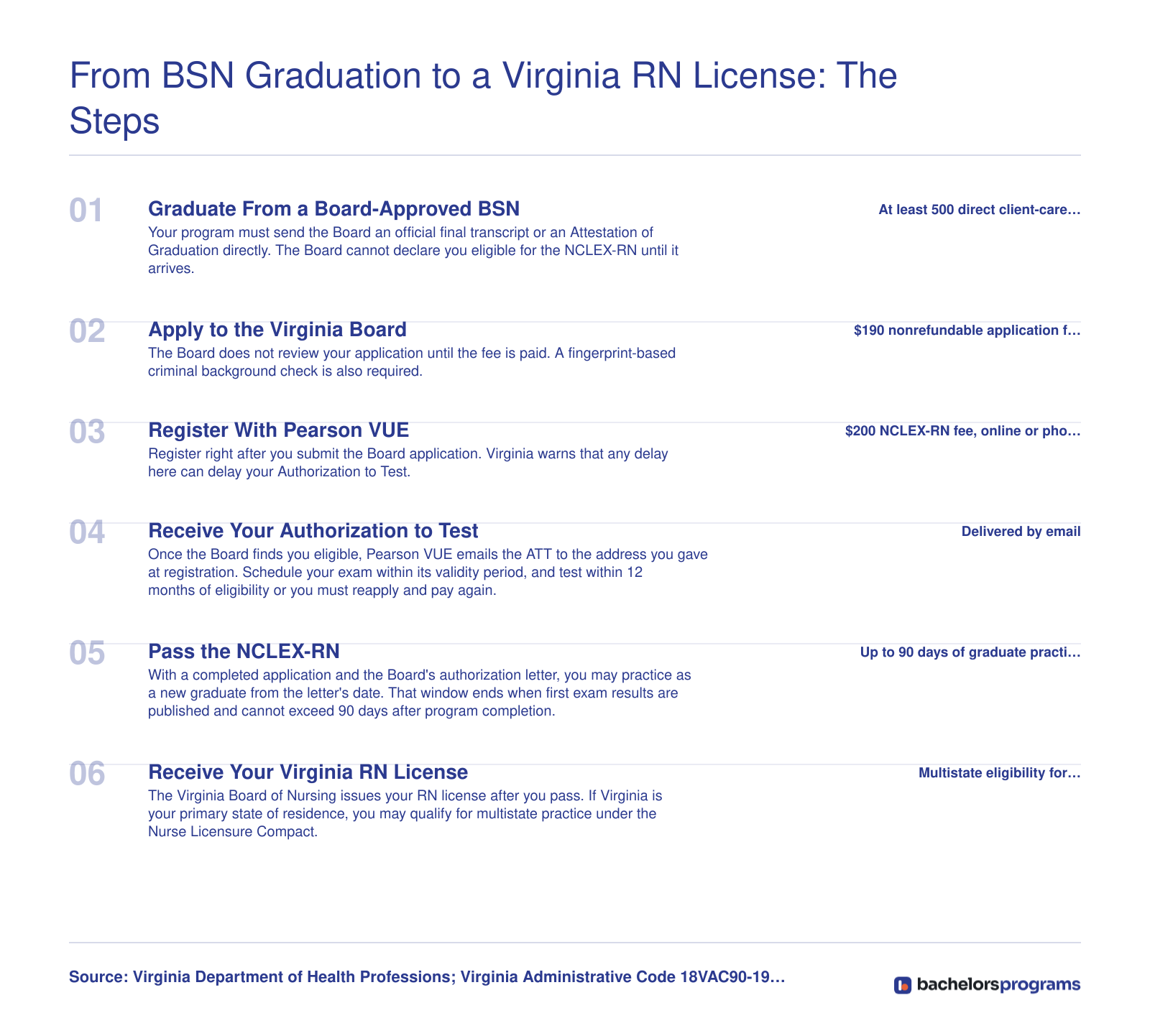
Earning a BSN makes you eligible to sit for the NCLEX-RN, but the Virginia Board of Nursing controls when you can test. Plan on $390 in required fees ($190 to the Board plus $200 to Pearson VUE), before the separate cost of a fingerprint-based background check. File both applications at the same time so your Authorization to Test is not held up.
Board of Nursing Approval, CCNE/ACEN Accreditation and the Nurse Licensure Compact
A nursing program can carry state approval and lack national accreditation, or hold accreditation while sitting on conditional state status, so the two approvals answer different questions. One decides whether you may sit for the NCLEX-RN. The other decides what your degree is worth to a graduate school or a hiring committee.
State Approval Comes First
The Virginia Board of Nursing approves pre-licensure programs under 18VAC90-27, and only graduates of an approved program qualify to take the NCLEX-RN1. Programs move through three stages: initial approval, which can continue with terms and conditions4 while a developing program matures; full approval, which requires a self-evaluation and a Board survey visit and authorizes transfer-student admission; and conditional approval, which the Board imposes with set terms when a program stops meeting standards, including the minimum first-time pass rate measured across four quarters2.
A pass rate under that floor for one year triggers a correction plan. Two consecutive years can bring mandated conditional status, a site visit and a $1,500 fee; three may lead the Board to withdraw approval1. Conditional status is a caution flag, not an automatic disqualifier, but ask what the correction plan requires and how long it has been running.
Accreditation Is a Separate Question
CCNE accredits mainly baccalaureate and graduate programs; ACEN accredits across practical, associate, diploma, baccalaureate and graduate levels. Neither replaces Board approval, and Board approval does not confer accreditation. Programmatic accreditation is what graduate nursing schools and many hospital systems screen for, so check both before you commit.
Virginia and the Nurse Licensure Compact
Virginia participates in the compact, so a multistate license lets you practice in other member states without a second license3. That matters along the DC and Maryland border and for travel assignments. You attest to the Uniform Licensure Requirements at application and at each renewal, and you need a Board-approved program plus NCLEX passage to get there3.
Verify the Record
The Board publishes NCLEX-RN results for approved programs, and the ranking above reflects those figures for the schools here. Read them alongside approval status, not instead of it.
Virginia RN Licensure at a Glance
Compare Bachelor of Science in Nursing (BSN) programs on the data that matters
Explore more Nursing majors or browse every field of study.
All Nursing programs Browse every field of study