Best Accelerated BSN (ABSN) Programs in West Virginia
Compare 7 accredited Accelerated BSN (ABSN) programs in West Virginia, with net price after aid, graduation rates, earnings and debt from IPEDS and the U.S. College Scorecard.
Marshall University packs its B.A./B.S. to B.S.N. into 68 credit hours over 16 months; West Virginia University's accelerated BSN runs 18, starting each spring. That is the shape of a true second-degree track: one cohort, full-time, roughly 10 to 18 months.
Not every program labeled accelerated moves at that pace. Davis & Elkins College compresses a full degree into three years, a different proposition for someone who already holds a bachelor's. Admissions, tuition, aid, campus format, and Board of Nursing licensure all turn on that distinction.
Cohorts start once a year at most of these schools, so prerequisite timing matters as much as your GPA.
Key Points
- Davis & Elkins College delivers about 65 percent of ABSN coursework online.
- Full-time accelerated BSN study typically runs 12 to 18 months.
- RN license applicants file through the West Virginia Board's online Nurse Portal.
The Best Accelerated BSN Schools in West Virginia for 2027
Seven West Virginia institutions currently enroll second-degree students in an accelerated BSN, and the differences among them come down to pace, campus format and clinical partners. West Virginia University and Marshall University anchor the list with the state's largest nursing footprints, while smaller colleges run cohorts built around working adults. Note that the net price and graduation rate on each card describe the whole institution after aid, not an ABSN sticker price or a nursing-cohort completion rate.
West Virginia University
#1Morgantown, WV · ~$16,000/yr (est.)
Best for: Students wanting a large research university
West Virginia's flagship public university runs its ABSN from two campuses, Morgantown and Bridgeport, with simulation labs and a clinical partnership through WVU Medicine. The program is CCNE accredited, takes 18 months of full-time study, and admits one cohort each January. Students who want a large research university, a hospital-system clinical network and a widely recognized nursing school usually start their search here.
- CCNE accredited ABSN built for college graduates changing fields
- 18 months of full-time, cohort-based study
- One start date per year, in January
- Two campus locations: Morgantown and Bridgeport
- Simulation labs plus clinical partnership with WVU Medicine
- Curriculum organized around five core nursing competencies
- Laptop computer program included with the cohort
Marshall University
#2Huntington, WV · $5,000 – $10,000/yr (est.)
Best for: Career changers near Charleston
Marshall University offers its B.A./B.S. to B.S.N. pathway from the South Charleston campus, placing classes inside the Kanawha Valley hospital corridor. The 16-month, 68-credit program mixes in-person instruction, Microsoft Teams broadcasts to South Charleston and a few online or hybrid courses. Admission is competitive, happens once a year for spring, and carries a September 15 priority deadline. It is ACEN accredited.
- ACEN accredited B.A./B.S. to B.S.N. for degree holders
- 16 months, 68 total credit hours
- South Charleston campus with day, afternoon and evening classes
- Some classes televised via Microsoft Teams
- 3.0 overall GPA and 3.0 prerequisite GPA required
- Spring start with a September 15 priority deadline
- Capstone required; all nursing credits earned at Marshall
West Liberty University
#3West Liberty, WV · $15,000/yr (est. net price)
Best for: Hands-on learners preferring small cohorts
West Liberty University is a small public university in the Northern Panhandle running a campus-based ABSN that finishes in 16 months, summer included. Cohorts are intentionally small, and hands-on work happens in simulation and skills labs plus clinical rotations at area hospitals and health agencies. The program is ACEN accredited and admits one class each fall.
- ACEN accredited BA/BS to BSN for second-degree students
- 16 months including summer, 66 total credit hours
- Fall start with one cohort per year
- 3.0 GPA minimum plus prerequisite courses
- Simulation and skills labs with hospital clinical practice
- Capstone project required for graduation
- Personal essay and short resume required to apply
Concord University
#4Athens, WV · $10,000/yr (est. net price)
Concord University, in Athens, opened its CCNE-accredited BA/BS to BSN in 2022 and runs it entirely in person across four consecutive semesters. Classes stay small and use modern simulation and skills spaces, and applicants sit the ATI TEAS before entry. It is the newest ABSN on this list, which means close faculty attention and a compact, cohort-style schedule.
- CCNE accredited BA/BS to BSN for second-degree students
- Finishes in four consecutive semesters
- In-person instruction on the Athens campus
- ATI TEAS pre-entrance exam required
- 3.0 GPA minimum plus prerequisite coursework
- Financial aid available to eligible students
- Program established in 2022
Davis & Elkins College
#5Elkins, WV · ~$18,000/yr (est.)
Davis & Elkins College in Elkins designed its accelerated B.S.N. for working adults, CNAs, career changers, single parents and transfer students, with roughly 65% of coursework delivered asynchronously online. The rest is hands-on at the SIM Center and through a clinical partnership with Vandalia Health Davis Medical Center. The QSEN-based curriculum carries dual NLN-CNEA and ACEN accreditation.
- Dual accreditation: NLN-CNEA and ACEN
- Three-year plan that finishes faster than a traditional four-year BSN
- 94 total credit hours
- About 65% of coursework online and asynchronous
- Clinical partnership with Vandalia Health Davis Medical Center
- Hands-on training in the SIM Center
- Built on QSEN Competencies with a required capstone
- Designed for working adults,CNAs and career changers
Wheeling University
#6Wheeling, WV · $20,000 – $25,000/yr (est.)
Wheeling University is a small private university in the Northern Panhandle offering an 18-month, on-campus ABSN that starts in summer and moves through as a single cohort. Coursework covers pathophysiology, pharmacology, mental health and critical care, with dedicated NCLEX preparation built into the plan. The program is CCNE accredited and charges no application fee.
- CCNE accredited Accelerated BA/BS to BSN
- 18 months of full-time, on-campus study
- Summer start with a cohort-based structure
- TEAS entrance exam required
- 3.0 GPA minimum plus prerequisite sciences and psychology
- Dedicated NCLEX preparation courses included
- $0 application fee
- Core ethics class required within the curriculum
American Public University System
#7Charles Town, WV · $5,000 – $10,000/yr (est.)
American Public University System, based in Charles Town, delivers its accelerated BSN through Rasmussen University, part of APUS. The program is hybrid, pairing online coursework with residential sessions across 180 quarter credits, and it is CCNE accredited with a capstone and required clinical hours. Its residential campuses sit outside West Virginia, so confirm where your clinical placements would take place before applying.
- CCNE accredited Standard Entrance Accelerated BSN (A-BSN)
- 180 total quarter credits with online and residential courses
- Entrance exam required: HESI, TEAS, SAT or ACT
- 2.25 GPA minimum on a conferred bachelor's degree
- Transfer up to 74 general education credits
- Capstone and clinical experiences required for graduation
- BLS/CPR certification, background check and immunizations required
- Residential campuses located outside West Virginia
Cost & outcomes by school
Federal data for the highest-earning Accelerated BSN (ABSN) programs, independent of the ranking above. Earnings are this field's bachelor's graduates four years after completing where the Scorecard reports them, else the school's undergraduate median.
| School | Net price / yr | Grad rate | Earnings | Debt | Grads/yr | Format |
|---|---|---|---|---|---|---|
| Wheeling University WV | $20,503 | 23% | $57,949 | $25,125 | 252 | Campus |
| West Virginia University WV | $15,634 | 65% | $55,939 | $22,500 | 8,098 | Campus |
| Marshall University WV | $7,502 | 51% | $46,354 | $23,250 | 2,980 | Hybrid |
| American Public University System WV | $9,597 | 57% | $44,409 | $21,743 | 17,012 | Hybrid |
| Davis & Elkins College WV | $18,273 | 39% | $43,411 | $27,000 | 306 | Hybrid |
| West Liberty University WV | $15,366 | 60% | $43,296 | $23,250 | 598 | Campus |
| Concord University WV | $9,966 | 39% | $42,703 | $18,900 | 646 | Campus |
Sources: U.S. Department of Education. Net price, graduation rate, earnings and debt: College Scorecard (earnings and debt for this field's bachelor's graduates where reported, else school-wide); graduates: IPEDS. A dash means no figure is reported.
Cost, debt & payoff
Median earnings of this field's bachelor's graduates (4 yrs after completing, else the school's undergraduate median) vs. their median federal loan debt · U.S. College Scorecard
Across these programs the median graduate earns about $44,409 and finishes with roughly $23,250 in debt — a ratio that clears a common rule of thumb (keep debt below first-year salary). Net price and debt vary widely school to school, so check the per-school figures in the table above before you shortlist.
Our Ranking Approach and How We Separated True ABSNs From Look-Alike Pathways
A career changer with a non-nursing bachelor's wants the fastest route to an RN license at a price that still makes sense. Answering that question starts with sorting genuine accelerated second-degree programs from the pathways that merely sound like them.
What We Weighed
The comparisons here lean on affordability (what students actually pay after aid, not sticker tuition), institutional outcomes such as graduation and retention, how selective admission is, and how much flexibility the format allows. One caveat matters: those figures describe the university as a whole, not the nursing school specifically. Treat them as context for the institution behind the degree, then confirm nursing-specific details (cohort size, clinical sites, NCLEX results) with the program itself.
What Makes an ABSN a True Second-Degree Program
A real accelerated BSN does three things. It requires a completed non-nursing bachelor's degree before you start nursing coursework, it runs full-time with little time left for a job, and it finishes in roughly 12 to 18 months of continuous study. Two common look-alikes get labeled the same way elsewhere. The first is a second-degree track that still takes closer to three years, which is a legitimate route but not an accelerated one. The second is an RN-to-BSN completion program, which is built for nurses who already hold a license. West Virginia University runs both, and they serve completely different students: its RN-to-BSN is online and aimed at registered nurses, often finishing in two to three semesters.
Where Each School Lands
WVU's Accelerated BSN is confirmed as an 18-month, continuously enrolled second-degree program taught in Morgantown and Bridgeport, with the prior baccalaureate required before you begin. Wheeling University's Second Degree Nursing track is also an 18-month full-time pathway for career changers, though its published cohort start and graduation dates are described inconsistently, so verify the calendar before committing.1
Marshall University, West Liberty University, Concord University, Davis & Elkins College, and American Public University System each offer a bachelor's-to-BSN route as well. Ask each one directly how many months of full-time study the plan of study actually requires.
Accelerated BSN Admissions Requirements in West Virginia: Your Pre-Application Checklist
Accelerated BSN programs in West Virginia move fast, so admissions committees expect your academic groundwork to be finished before you apply. Use this checklist to compare your record against the published requirements at West Virginia University and Wheeling University, then confirm the details directly with each school's admissions office.
- A completed prior degreeWest Virginia University's accelerated BSN is built for students who hold a bachelor's degree in a non-nursing field. Wheeling University's Accelerated BA/BS to BSN lists a diploma or bachelor's degree as its entry credential.
- Prerequisite science and social science coursesWVU requires chemistry with lab, microbiology, human anatomy with lab, human physiology with lab, psychology and statistics, with a C- or better in each. Human nutrition is strongly recommended. WVU also lets a TEAS science score of 60 or higher stand in for the chemistry lab. Wheeling requires Anatomy and Physiology I and II, chemistry, general psychology, developmental psychology, microbiology/epidemiology and statistics, with a C or better in each prerequisite science course. If your science credits are several years old, ask each school how it evaluates them.
- Minimum GPA of 3.0Both WVU and Wheeling set a 3.0 minimum. WVU applies that 3.0 to overall, institutional and prerequisite GPA. It considers applicants below 3.0 for provisional admission case by case, depending on available seats and prior coursework.
- Entrance exam and English proficiencyWheeling requires a TEAS score of at least 68%. Non-native English speakers need a TOEFL score of 650, and exceptional candidates scoring 550 to 600 may be accepted conditionally. At WVU, the TEAS mainly comes into play as the science-score substitute for the chemistry lab.
ABSN Program Length, Start Dates, and Deadlines by School
Program length is the first hard number to pin down: it determines when you can take the NCLEX-RN and start earning. Most accelerated BSNs in West Virginia finish in roughly 16 to 18 months of full-time study, inside the 12-to-18-month window these programs typically occupy. At least one track runs noticeably longer, and a few programs publish no length at all, so plan to call the department.
Length, Start Terms, and Deadlines by School
- West Virginia University: 18 months, 66 credits, full-time accelerated, spring cohort. Application and Course Equivalency Form due July 1, transcripts July 15, listed for the 2027-2028 cycle.
- Marshall University: 16 months, 68 credits, on campus in South Charleston with some televised and online components. January start; September 15 deadline published for the 2026 cycle.
- West Liberty University: 16 months, on campus, fall start across four consecutive full-time terms. February 1 deadline for the 2026 cycle; total credits not published.
- Wheeling University: 16 months in the revised catalog, 18 in another 2026 source. The sequence runs fall, spring, summer, fall, though an older page listed a May start, so confirm the current intake.
- Concord University: four semesters across two academic years, fall, spring, fall, spring, on campus. Credit total and deadline not published.
- Davis & Elkins College: about three years, six regular terms plus two summers after admission to the nursing major, delivered in person or hybrid. Start term and deadline not published.
- American Public University System: length, start terms, and deadline not published on the program page reviewed.
What One Intake a Year Means for Your Prerequisites
Where a program admits one cohort a year, as most of these appear to do, the deadline sets your pace. A missed prerequisite or a late transcript can cost a full year rather than a few weeks. Finish anatomy and physiology, microbiology, and any statistics requirement at least a term early, and request transcripts well before the cutoff. Where the next deadline is not published, treat the most recent cycle as an estimate and confirm it in writing with the department.
Related Articles
Accelerated BSN Tuition and Total Cost in West Virginia
A per-term sticker price understates the bill: an ABSN keeps you enrolled, and mostly out of work, for well over a year. West Virginia University and Wheeling University publish the most detailed 2026-2027 pricing, and they build that bill very differently.
Published ABSN Pricing
- West Virginia University: ABSN students pay $7,428 per term as residents and $18,024 as nonresidents. That combines university tuition ($4,812 resident, $15,408 nonresident), a $720 university fee and a $1,896 ABSN program fee. Per-credit rates are $619 in-state and $1,502 out-of-state. The program requires 18 months of continuous enrollment, but WVU does not list a single program total, so confirm your number of terms with an advisor before multiplying.
- Wheeling University: The 2026-2027 schedule lists a $25,000 cohort price for tuition and technology fees, billed at $6,250 per term over four terms.1 Adding a separate $1,000 per-semester fee and the $265 graduation fee brings the estimate to $29,265.1 No separate out-of-state rate is listed. One Wheeling catalog instead shows $9,000 per semester and $36,000 total, so ask which figure applies to your cohort.2
For Marshall, Concord, West Liberty, Davis & Elkins and American Public University System, request the current ABSN fee sheet from admissions.
Net Price Is Only a Rough Guide
Average annual net price at these schools spans $7,502 at Marshall to $20,503 at Wheeling. That figure is an institution-wide average for undergraduates after grants and scholarships, not an ABSN price. Second-degree students may qualify for different aid than first-time undergraduates, so treat it as a ballpark rather than a quote.
Costs Beyond Tuition
Wheeling lists ATI testing at $756.25 per semester, plus malpractice insurance, outside its program price.1 At any school, also plan for uniforms, clinical requirements, NCLEX review materials and the NCLEX-RN registration fee.
Budget for Living Costs
A full-time accelerated schedule leaves little room for a paycheck. Build rent, food, transportation to clinical sites and health insurance into your total, and plan your borrowing around the full program timeline, not tuition alone.
Paying for an ABSN: Grants, Scholarships, and Workforce Funding in West Virginia
Can you get financial aid for an accelerated BSN in West Virginia if you already have a bachelor's degree? Yes, but the mix looks different than it did for your first degree.
Federal Aid for Second-Degree Students
Because you already hold a bachelor's, you will generally not qualify for a Federal Pell Grant. Federal Direct Unsubsidized Loans are usually the main federal option, but eligibility depends on how much of your undergraduate borrowing limit you used the first time. Federal loan rules changed in 2026, including an interim exception for students who received a Direct Loan for their program before July 1, 2026.3 Ask each school's aid office for a determination specific to its ABSN, and treat private loans as a last resort for any gap.
West Virginia Scholarships and Workforce Funding
- West Virginia Nursing Scholarship Program: State law authorizes up to $7,500 for students in an RN education program, capped at program cost. Pre-licensure recipients must finish half of their required nursing credits first, then practice or teach in West Virginia for two years or repay with interest. A 2026 listing marks the program inactive, so contact the sponsor about whether a 2026 cycle will open and whether your ABSN qualifies.1
- Nursing Workforce Expansion Program: Launched in 2021, it supported nursing education and workforce efforts through 2025.2 Ask schools whether any 2026 student support remains.
- Rural capacity funding: A September 2026 state award of $291,403 to WVU Medicine's Center for Nursing Education aims to add room for about 100 nursing students a year, with tuition and fee support aimed especially at students from Hancock, Ohio, Marshall, Tyler, and Wetzel counties.2
- Hospital sponsorships: Some employers trade tuition help for a work commitment. Get the amount, covered costs, and repayment terms in writing.
Three Steps to Take Now
- File the FAFSA early: WVU applicants can get FAFSA guidance through its Health Sciences Center Financial Aid Office.
- Ask about ABSN-specific scholarships: Nursing school aid offices often know about awards that never appear on general aid pages.
- Contact employers directly: Ask hospitals near your clinical sites about sponsorships before you commit to a start date.
In-Person vs. Hybrid ABSN Formats Across West Virginia Campuses
Davis & Elkins College delivers about 65 percent of its accelerated BSN coursework online, but the other 35 percent happens in person through clinicals, labs, and simulation. That split shows how "hybrid" works across the state. No ABSN here is fully online. Nursing is a licensed, hands-on profession, so every program requires you to be physically present for skills labs, simulation, and hospital rotations.
Campus-Based Programs
- West Virginia University: Campus-based, with cohorts in Morgantown and Bridgeport. Clinical training runs through WVU Medicine, including Ruby Memorial Hospital and United Hospital Center in Bridgeport.
- Concord University: In person on the Athens campus across four consecutive semesters.
- Wheeling University: An on-campus, cohort-based program in Wheeling.
- West Liberty University: Listed as campus-based in West Liberty, though the program mixes online coursework with in-person labs and clinical practice in hospitals.
Hybrid Programs
- Davis & Elkins College: Offered in person or hybrid in Elkins. The asynchronous online classes pair with hands-on work at the SIM Center and at Vandalia Health Davis Medical Center, which provides clinical-learning facilities from the start of the program.
- Marshall University: Hybrid, built around the South Charleston campus, with day, afternoon, and evening classes and some sessions held over Microsoft Teams.
- American Public University System: Hybrid, with online delivery paired with required in-person clinical experiences.
Check Your Clinical Travel Before Choosing Hybrid
Online lectures can make a program feel location-free, but the clinical component is not. Rotations take place at hospitals and agencies near the program, and a hybrid student living two hours from campus may be driving that distance repeatedly. Named partners are clearest at WVU and Davis & Elkins. For the others, ask the admissions office directly.
Before you commit, ask each program:
- Which hospitals and agencies host rotations for your cohort?
- Can you request a site, or are placements assigned?
- How many days per week are on-site during clinical semesters?
- Are labs and simulation held on one campus or several?
A hybrid format only saves you time if the commute to clinicals fits your life.
What Registered Nurses Earn in West Virginia
An accelerated BSN leads to the registered nurse credential, so state RN pay is the clearest measure of what the degree can return.
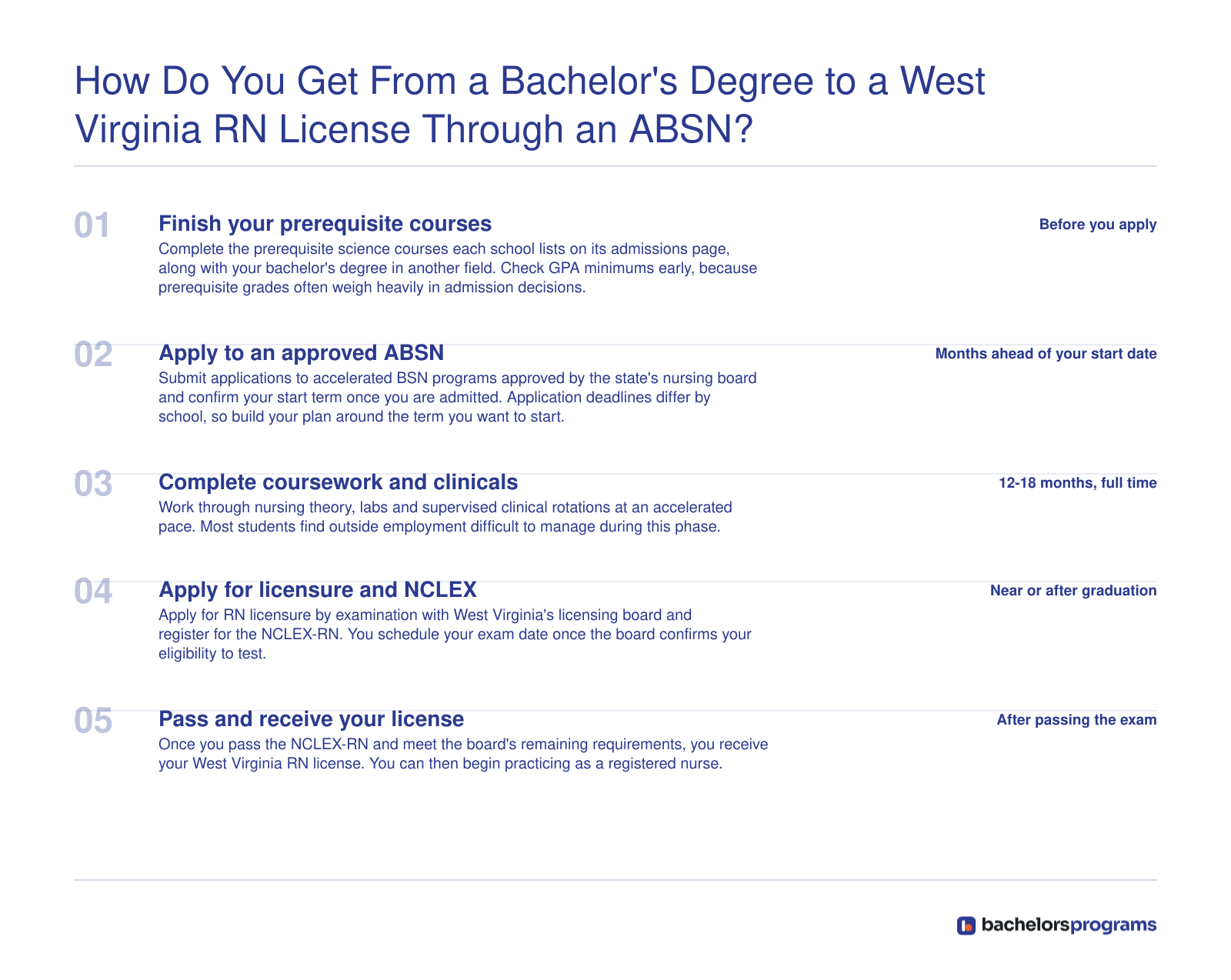
How Do You Get From a Bachelor's Degree to a West Virginia RN License Through an ABSN?
The accelerated BSN route moves in a fixed order, and a delay at any step pushes back your license date. The prerequisite science courses and prior bachelor's covered in the admissions checklist earlier on this page open the door to programs such as those at West Virginia University, Marshall University and Davis & Elkins College, where 12 to 18 months of full-time coursework and clinicals make up the core of the timeline. The final two steps connect to the licensure section below: you apply to West Virginia's RN licensing board, register for the NCLEX-RN, and receive your license after you pass.
West Virginia RN Licensure Requirements at a Glance
Compare Accelerated BSN (ABSN) programs on the data that matters
Explore more Nursing majors or browse every field of study.
All Nursing programs Browse every field of study