Best BSN Programs in West Virginia
Compare 25 accredited Bachelor of Science in Nursing (BSN) programs in West Virginia at 18 colleges, with net price after aid, graduation rates, earnings and debt from IPEDS and the U.S. College Scorecard.
A BSN pays off only when its graduate passes the NCLEX-RN, and West Virginia schools that look alike on paper do not finish alike. Pass rates here run from 99.3 percent at West Virginia University to 87.9 percent at West Virginia Wesleyan College, a gap of more than 11 points.
Only traditional pre-licensure BSN programs are included. Licensed RNs and second-degree students take different routes, and each has its own page.
The strongest exam results sit at public universities, where in-state sticker tuition runs less than half what the private colleges charge.
Key Points
- West Virginia University's freshman BSN benchmark: 3.6 GPA, 25 ACT composite.
- West Virginia University at Parkersburg posts the lowest average net price: $1,807.
- New grads apply as "RN by Examination," paying a $70 board fee.
West Virginia BSN Schools With the Best NCLEX-RN Outcomes: Our Top 10
Every school below reports a first-time NCLEX-RN pass rate above 86 percent, and the ten are ordered by that rate, from 99.3 percent down to 86.1 percent. Completion rates and accreditation standing break any ties. Read each card for the school's overall profile, then weigh campus fit and cost against the exam results.
West Virginia University
#1Morgantown, WV · ~$16,000/yr (est.) · NCLEX-RN pass rate 99.3% (3-yr weighted avg)
Best for: High-achievers wanting a large research campus
West Virginia University is the state's largest public research university, and its Morgantown nursing college posts a 99.3 percent first-time NCLEX-RN pass rate across 449 exam candidates. Seniors complete a rural clinical practice, and two pathways let students finish about nine months early or focus on community health through a Johns Hopkins partnership. The school's overall graduation rate is 65 percent and average net price after aid is roughly $15,634.
- CCNE accredited at a major public research university
- Six-semester curriculum
- Rural clinical practice required in the senior year
- Expedited Summer Pathway finishes about nine months early
- Inside Outside Pathway with Johns Hopkins covers community nursing
- Three campus locations with simulation facilities
- Student laptop program included
Marshall University
#2Huntington, WV · $5,000 – $10,000/yr (est.) · NCLEX-RN pass rate 96.1% (3-yr weighted avg)
Best for: Budget-minded students staying near home
Marshall University in Huntington combines a 96.1 percent first-time NCLEX-RN pass rate with one of the lowest net prices in this group, about $7,502 after aid. The BSN mixes nursing theory with clinical rotations at regional healthcare facilities, and classes run on both the Huntington and South Charleston campuses. The school's overall graduation rate is 51 percent, and two admission pathways serve high school seniors and current college students.
- Entrance exam required (SAT or ACT)
- 2.5 GPA minimum plus prerequisite courses
- Classes on the Huntington and South Charleston campuses
- Clinicals at regional healthcare facilities
- Exposure to critical care, pediatrics, and maternity
- Tracks: critical care nursing, pediatric nursing
West Liberty University
#3West Liberty, WV · $15,000/yr (est. net price) · NCLEX-RN pass rate 95.7% (3-yr weighted avg)
Best for: Hands-on learners preferring small classes
West Liberty University runs a CCNE-accredited BSN on a small residential campus, pairing a 95.7 percent first-time NCLEX-RN pass rate with simulation labs and close faculty support. Applicants need a 3.0 GPA and an entrance exam, and clinical rotations happen in area hospitals. The school's overall graduation rate is 60 percent and average net price after aid is about $15,366; second-degree students can ask about a 16-month accelerated option.
- CCNE accredited
- 3.0 GPA minimum and entrance exam (ACT or SAT)
- Small class sizes with high-tech simulation labs
- Hands-on clinical experience in area hospitals
- Prerequisite courses required before nursing sequence
West Virginia State University
#4Institute, WV · $11,000/yr (est. net price) · NCLEX-RN pass rate 94.6% (3-yr weighted avg)
West Virginia State University, a historically Black public university in Institute, reports a 94.6 percent first-time NCLEX-RN pass rate. The CCNE-accredited BSN sets a liberal arts and sciences base beneath professional nursing courses and points graduates toward pediatrics, obstetrics, oncology, psychiatry, or graduate study. Average net price after aid is about $11,139 and the school's overall graduation rate is 39 percent.
- CCNE accredited
- Prepares nurse generalists for hospitals, clinics, and community settings
- Liberal arts and sciences foundation beneath nursing courses
- Traditional classroom instruction with modern clinical technology
- Pathway toward graduate study and advanced practice
West Virginia University at Parkersburg
#5Parkersburg, WV · $1,800/yr (est. net price) · NCLEX-RN pass rate 93.4% (3-yr weighted avg)
West Virginia University at Parkersburg is a regional public campus whose nursing offering in this data is the online RN-to-BSN completion route for licensed nurses, not a pre-licensure track. It reports a 93.4 percent first-time NCLEX-RN pass rate. Average net price after aid is about $1,807, the lowest in this group, and the school's overall graduation rate is 9 percent as reported.
- 100 percent online degree-completion format for licensed RNs
- ACEN accredited
- 120 total credit hours
- Requires an active, unencumbered RN license
- 2.0 GPA minimum with rolling admissions
- Full-time and part-time options with fall and spring starts
Davis & Elkins College
#6Elkins, WV · ~$18,000/yr (est.) · NCLEX-RN pass rate 92.9% (3-yr weighted avg)
Davis & Elkins College in Elkins runs a traditional four-year BSN built around QSEN competencies, with clinical placements at more than a dozen facilities and a summer nurse externship after the first year. A partnership with Vandalia Health Davis Medical Center supports clinical learning in north-central West Virginia. The reported first-time NCLEX-RN pass rate is 92.9 percent, average net price after aid is about $18,273, and the school's overall graduation rate is 39 percent.
- Four-year traditional BSN
- Clinical placements at more than 12 healthcare facilities
- Summer nurse externship with RN preceptors after year one
- Preceptorship at regional hospitals
- QSEN competencies threaded through the curriculum
- Clinical partnership with Vandalia Health Davis Medical Center
West Virginia Wesleyan College
#7Buckhannon, WV · $18,000/yr (est. net price) · NCLEX-RN pass rate 87.9% (3-yr weighted avg)
West Virginia Wesleyan College in Buckhannon keeps a 13:1 student-to-faculty ratio and small classes, with clinical rotations at WVU Medicine hospitals and a Penn Highlands Healthcare sponsorship worth up to $40,000. A Bethany College partnership adds another route into the BSN, and an Aspiring Nurse Program pairs students with mentors. The reported first-time NCLEX-RN pass rate is 87.9 percent, average net price after aid is about $18,083, and the school's overall graduation rate is 57 percent.
- CCNE accredited
- 13:1 student-to-faculty ratio with small classes
- Clinical rotations at WVU Medicine hospitals
- Penn Highlands Healthcare sponsorship worth up to $40,000
- Bethany College partnership pathway into the BSN
- Aspiring Nurse Program mentorship
University of Charleston
#8Charleston, WV · $20,000 – $25,000/yr (est.) · NCLEX-RN pass rate 87.9% (3-yr weighted avg)
The University of Charleston sends students into clinical rotations at the state's only Level I trauma center and a freestanding women's and children's hospital minutes from campus. The four-year, ACEN-accredited BSN requires the TEAS entrance exam and a 2.0 GPA, and faculty ratios run between 1:8 and 1:10. Its reported first-time NCLEX-RN pass rate is 87.9 percent, average net price after aid is about $22,107, and the school's overall graduation rate is 46 percent.
- Four-year in-seat program; TEAS entrance exam required
- 2.0 GPA minimum plus prerequisite courses
- Clinicals at the state's only Level I trauma center
- Faculty-to-student ratio between 1:8 and 1:10
- More than 50 years of nursing education in Charleston
- March application deadline
Shepherd University
#9Shepherdstown, WV · $9,000 – $19,000/yr (est.) · NCLEX-RN pass rate 86.7% (3-yr weighted avg)
Shepherd University in Shepherdstown structures its CCNE-accredited BSN as 120 credits, with 62 upper-division nursing hours and a capstone immersion ahead of NCLEX-RN preparation. Coursework adds nursing informatics, genetics and genomics, and pharmacotherapeutics, and clinical judgment sits at the center of the curriculum. The reported first-time NCLEX-RN pass rate is 86.7 percent, average net price after aid is about $11,363, and the school's overall graduation rate is 51 percent.
- CCNE accredited
- 120 total credit hours, 62 of them upper-division nursing
- Capstone immersion with NCLEX-RN preparation
- Coursework in nursing informatics, genetics and genomics
- Clinical judgment and patient-centered care at the core
- RN-to-BSN completion track for working nurses
West Virginia Junior College-Bridgeport
#10Bridgeport, WV · NCLEX-RN pass rate 86.1% (3-yr weighted avg)
West Virginia Junior College in Bridgeport delivers a fully online RN-to-BSN that working nurses can finish in about six months, so this card is a route for licensed RNs rather than a pre-licensure BSN. Coursework covers pathophysiology, pharmacology, informatics, population health, and leadership, capped by a capstone and virtual simulation. The reported first-time NCLEX-RN pass rate is 86.1 percent and the school's overall graduation rate is 52 percent.
- Online RN-to-BSN completion program, about six months long
- Requires an active RN license and an ADN
- Capstone plus immersive virtual simulation exercises
- Coursework in pathophysiology, pharmacology, informatics, and population health
- Clinical partnerships with Mon Health Vandalia Health and WVU Medicine hospitals
Cost & outcomes by school
Federal data for the highest-earning Bachelor of Science in Nursing (BSN) programs, independent of the ranking above. Earnings are this field's bachelor's graduates four years after completing where the Scorecard reports them, else the school's undergraduate median.
| School | Net price / yr | Grad rate | Earnings | Debt | Grads/yr | Format |
|---|---|---|---|---|---|---|
| Wheeling University WV | $20,503 | 23% | $57,949 | $25,125 | 252 | Campus |
| West Virginia University WV | $15,634 | 65% | $55,939 | $22,500 | 8,098 | Campus |
| West Virginia University Institute of Technology WV | $9,337 | 33% | $55,939 | $22,500 | 288 | Campus |
| Potomac State College of West Virginia University WV | $9,197 | 31% | $55,939 | $22,500 | 76 | Campus |
| University of Charleston WV | $22,107 | 46% | $55,774 | $19,500 | 1,798 | Campus |
| West Virginia Wesleyan College WV | $18,083 | 57% | $51,593 | $27,000 | 404 | Campus |
| Shepherd University WV | $11,363 | 51% | $49,358 | $21,600 | 962 | Campus |
| Fairmont State University WV | $9,032 | 44% | $46,857 | $21,000 | 1,056 | Campus |
| Marshall University WV | $7,502 | 51% | $46,354 | $23,250 | 2,980 | Campus |
| American Public University System WV | $9,597 | 57% | $44,409 | $21,743 | 17,012 | Online |
| Davis & Elkins College WV | $18,273 | 39% | $43,411 | $27,000 | 306 | Campus |
| West Liberty University WV | $15,366 | 60% | $43,296 | $23,250 | 598 | Campus |
Sources: U.S. Department of Education. Net price, graduation rate, earnings and debt: College Scorecard (earnings and debt for this field's bachelor's graduates where reported, else school-wide); graduates: IPEDS. A dash means no figure is reported.
Cost, debt & payoff
Median earnings of this field's bachelor's graduates (4 yrs after completing, else the school's undergraduate median) vs. their median federal loan debt · U.S. College Scorecard
Across these programs the median graduate earns about $46,354 and finishes with roughly $22,500 in debt — a ratio that clears a common rule of thumb (keep debt below first-year salary). Net price and debt vary widely school to school, so check the per-school figures in the table above before you shortlist.
Why First-Attempt NCLEX-RN Success Shapes This West Virginia BSN List
How much does a nursing school's first-time NCLEX-RN pass rate actually tell you?
Plenty, because a BSN only pays off once its graduate holds an RN license. West Virginia's board publishes results program by program, and a school whose graduates pass on the first attempt is signaling that its curriculum, clinical hours and exam preparation line up with what the licensure test demands.
How the Order Comes Together
Each program's position rests mostly on its first-time NCLEX-RN pass rate over the latest three years the state board reports, roughly three quarters of the total, weighted by how many graduates sat for the exam. A strong rate across hundreds of test-takers is stronger evidence than the same rate across a dozen. Accreditation and a modest completion-and-retention score break ties between programs whose exam results sit close together.
What You See but What Doesn't Score
Cost, net price, graduation rate and federal earnings figures appear on each card so you can compare programs side by side, but they never move a school up or down the order. This ranking covers traditional pre-licensure BSN programs only. RNs and holders of a prior bachelor's degree follow the RN-to-BSN and accelerated routes, which sit outside this list. Treat graduation rates as institution-wide and net prices as averages, not quotes for your situation.
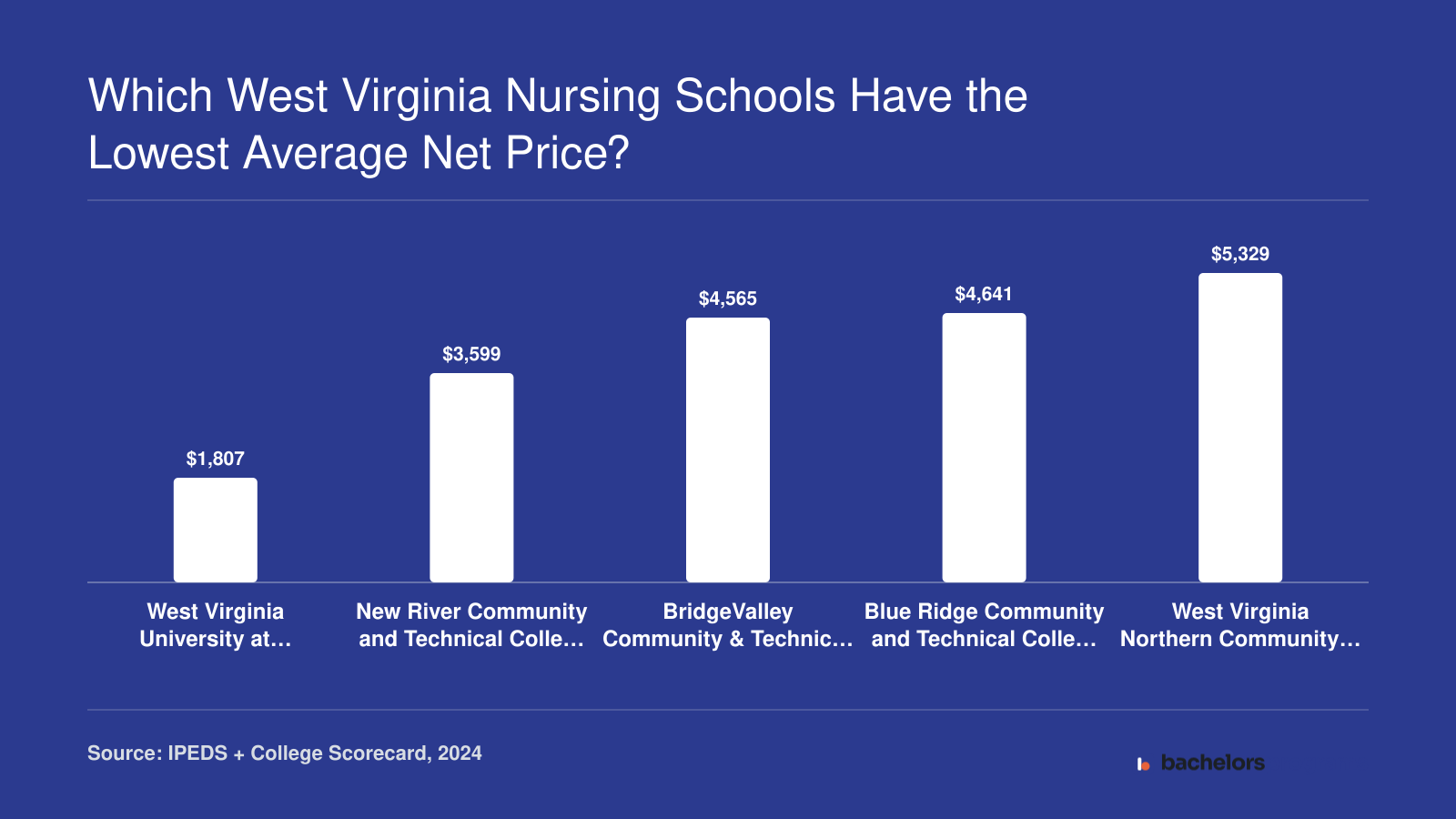
Which West Virginia Nursing Schools Have the Lowest Average Net Price?
All five of the lowest-cost schools here are public, led by West Virginia University at Parkersburg at $1,807 a year, while BridgeValley, Blue Ridge, New River and West Virginia Northern are public community and technical colleges whose nursing route starts with the Associate Degree in Nursing (Parkersburg's listed path is its online RN-BSN). Net price is the average yearly cost after grants and scholarships, measured across the whole institution rather than the nursing program alone, so your own cost will depend on your aid package and enrollment status. West Virginia Northern Community College (96.5% NCLEX-RN pass rate) and West Virginia University at Parkersburg (93.4%) stand out for value, pairing some of the lowest prices on this page with strong first-attempt exam results.
BSN Schools in West Virginia With the Highest Graduate Earnings
The schools below are ordered by median earnings for their nursing bachelor's graduates, drawn from the U.S. Earnings windows differ by row, so check the time frame beside each figure before comparing. The final column is a school-wide figure covering all programs, offered as context rather than as the BSN program's own outcome.
| School | City | Format | BSN Median Earnings (Time After Finishing) | BSN Median Debt | Est. Monthly Payment (10-Year Plan) | School-Wide Context: Median Earnings 10 Years After Entry (All Programs) |
|---|---|---|---|---|---|---|
| Davis & Elkins College | Elkins | Campus | $105,127 (4 years after finishing) | N/A | N/A | $43,411 |
| Fairmont State University | Fairmont | Campus | $85,013 (5 years after finishing) | $24,230 | $257 | $46,857 |
| American Public University System | Charles Town | Online | $82,848 (5 years after finishing) | $16,093 | $171 | $44,409 |
| Shepherd University | Shepherdstown | Campus | $81,437 (5 years after finishing) | $24,875 | $264 | $49,358 |
| West Virginia University | Morgantown | Campus | $80,411 (5 years after finishing) | $23,000 | $244 | $55,939 |
Related Articles
BSN Admissions in West Virginia: Prerequisites, GPA and Direct vs Upper-Division Entry
West Virginia University publishes the most explicit freshman thresholds of any program here: a high school senior with a 3.6 GPA, a 25 ACT composite and a 20 on the ACT math section, or a 1200 SAT with 520 in math, qualifies for direct admission to the nursing major.
Direct Admit: West Virginia University
WVU keeps a second direct route for students with a higher GPA and a strong entrance exam result: 3.8 plus a TEAS score of 80%. Applicants who clear neither set can still enter as Pre-Nursing with a 3.2 GPA, a 23 ACT composite and 20 math (1130 SAT, 520 math), or a 3.6 GPA under the test-optional path. The university's pages do not say whether Pre-Nursing students later compete for upper-division seats or move into nursing coursework automatically, so raise that question with an advisor directly.
Freshman and Sophomore Entry: Marshall University
Marshall admits high school seniors at the freshman level with a 2.5 GPA and a 21 ACT, with automatic acceptance at a 24 ACT and a stronger GPA, space permitting.1 Current and former college students enter at the sophomore level with a 2.5 overall GPA. The prerequisite list runs ENG 101, BSC 227, CHM 205, CMM 213, BSC 228, PSY 201 and MTH 121 or 125, each at C or better and finished by July 15.1 Marshall requires ACT or SAT scores from high school applicants and publishes no test-optional policy.
Where the Entry Point Is Not Stated
Shepherd University publishes detailed numbers (2.85 overall and prerequisite GPA, 2.0 institutional GPA, C or better in every listed science and support course) but its materials do not clearly say whether students enter as freshmen or apply after prerequisites.2 West Liberty University's nursing admission details center on a BA/BS-to-BSN path for bachelor's-degree holders; the traditional pre-licensure track is not laid out in the same place.
Four Years, Sometimes More
A full-time BSN in West Virginia typically runs four years. A competitive upper-division application or a waitlist can push graduation a semester or more, which is the strongest argument for confirming the entry model before you enroll.
BSN Costs in West Virginia: Sticker Tuition vs Net Price After Aid
Sticker Tuition at Public and Private Schools
Published prices vary widely, and not every school posts a traditional-BSN total. West Virginia University lists a 2026-27 resident term total of $7,428 for its traditional BSN, built from $4,812 in tuition, $720 in university fees and a $1,896 nursing program fee (based on at least 12 credits). The cited pages do not say whether that total covers books, clinical costs or the new $250 Mountaineer Athletics Advantage Fee, which starts Fall 2026 for some programs.
West Liberty charges $4,707 per semester in tuition, plus a nursing charge of $74.58 per credit and an $895 nursing fee per semester. It also lists a $100 clinical course fee and a $554 ATI fee. These are program and course charges, so they may not recur every term. The University of Charleston lists $34,490 a year in tuition and fees on its Charleston campus, though that is a general rate and not a nursing-specific one.1
Net Price Narrows the Gap
Average net price after grants tells a different story. West Virginia University averages $15,634 and West Liberty $15,366. Marshall University is lower at $7,502. Among private schools, Davis & Elkins College averages $18,273 and West Virginia Wesleyan College $18,083, despite sticker prices of $31,820 and $34,090. After aid, the private-public gap shrinks to a few thousand dollars a year at some schools. Net price figures usually include living costs, so they can exceed public tuition.
Costs Tuition Leaves Out
Budget for uniforms, equipment, clinical travel (rural placements can mean real mileage), background checks, and NCLEX and licensure fees. Schools publish these unevenly, so check each nursing office.
So How Much Does a BSN Cost?
A realistic range runs from roughly $7,500 to $18,000 a year in average net price for the schools above. That is about $30,000 to $72,000 over four years, before nursing extras. Your own aid package decides where you land.
West Virginia Board of Nursing Approval and NCLEX-RN Licensure
State approval and national accreditation are two separate checks, and a BSN program needs the first one before the second matters for licensure. Board approval decides whether you can sit for the exam. Accreditation from CCNE, ACEN, or CNEA speaks to program quality and matters for graduate school and some employers.
Board Approval Comes First
Graduates of pre-licensure programs must complete a program approved by the West Virginia RN Board to qualify for the NCLEX-RN and a West Virginia RN license. The Board's approved-program list, last updated October 30, 2026, shows approval for West Virginia University, Marshall University, West Liberty University, West Virginia State University, Davis & Elkins College, West Virginia Wesleyan College, Fairmont State University, Shepherd University, the University of Charleston, Concord University and Wheeling University.
To verify any school yourself:
- Check the list: Open the Education section of the Board's website and find the program by name and campus.
- Check the date: Confirm the list's last-updated date, since approval status can change.
- Check the credential: Make sure the listing is for the pre-licensure BSN, not a different track at the same school.
Accreditation Is a Separate Layer
The Board recognizes CCNE, ACEN, and CNEA. Program pages for West Virginia University and West Liberty University describe CCNE accreditation, while Marshall University's page references ACEN. Davis & Elkins College states that CNEA, not CCNE or ACEN, granted its initial accreditation on February 22, 2023.1 Because school pages can lag behind accreditor records, confirm each program in the CCNE and ACEN directories before you apply.
Reading the NCLEX-RN Numbers
First-time NCLEX-RN pass rates in the ranking data are 99.3 percent for West Virginia University, 96.1 percent for Marshall University, and 95.7 percent for West Liberty University. The Board's annual pass-rate reports give the complete program-by-program picture.
Licensed RNs seeking a bachelor's should look at RN-to-BSN programs, and students with a bachelor's in another field should consider accelerated BSN programs. Each has its own page.
Getting Licensed by the West Virginia RN Board
Questions to Ask Yourself
Do you want a guaranteed nursing seat as a freshman, or will you compete for upper-division entry after two years of prerequisites?
Would you accept a slightly lower NCLEX-RN pass rate in exchange for a lower net price closer to home?
Will you qualify for PROMISE or WV Higher Education Grant funds, and would a service-linked nursing scholarship suit you?
Compare Bachelor of Science in Nursing (BSN) programs on the data that matters
Explore more Nursing majors or browse every field of study.
All Nursing programs Browse every field of study